
思科华为,华三命令对比
思科、华为以及H3C交换机常用命令对比
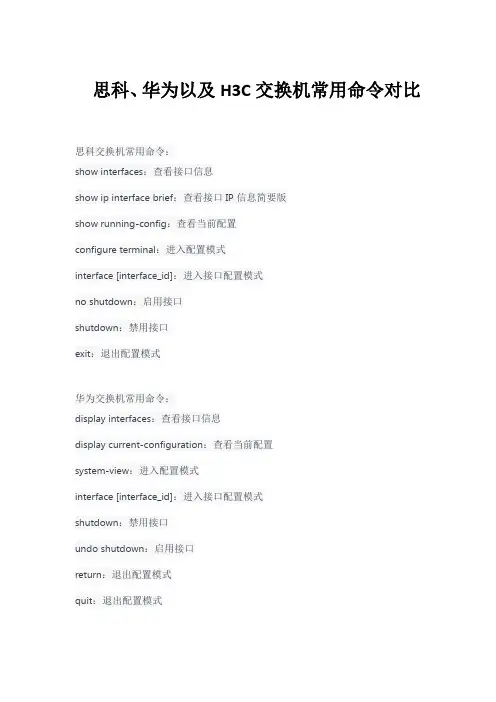
思科、华为以及H3C交换机常用命令对比
思科交换机常用命令:
show interfaces:查看接口信息
show ip interface brief:查看接口IP信息简要版
show running-config:查看当前配置
configure terminal:进入配置模式
interface [interface_id]:进入接口配置模式
no shutdown:启用接口
shutdown:禁用接口
exit:退出配置模式
华为交换机常用命令:
display interfaces:查看接口信息
display current-configuration:查看当前配置
system-view:进入配置模式
interface [interface_id]:进入接口配置模式
shutdown:禁用接口
undo shutdown:启用接口
return:退出配置模式
quit:退出配置模式
H3C交换机常用命令:
display interfaces:查看接口信息
display current-configuration:查看当前配置system-view:进入配置模式
interface [interface_id]:进入接口配置模式shutdown:禁用接口
undo shutdown:启用接口
return:退出配置模式
quit:退出配置模式。
华为路由与思科区别

华为路由与思科路由的配置差别深圳华为公司,作为目前国内最大的电信成套设备及数据通信设备生产商,近年来其路由器产品及技术有了长足的进展。
其生产的高中低端 Quidway 路由器系列产品已有极广的覆盖面,特别是中低端产品凭着极高的性价比,完备的功能特性与良好的兼容性,市场份额逐年剧增,与CISCO等进口产品已成分庭抗礼之势。
华为路由器与同档次的CISCO路由器在功能特性与配置界面上完全一致,有些方面还根据国内用户的需求作了很好的改进。
例如中英文可切换的配置与调试界面,使中文用户再也不用面对着一大堆的英文专业单词而无从下手了。
另外它的软件升级,远程配置,备份中心,PPP回拨,路由器热备份等,对用户来说均是极有用的功能特性。
在配置方面,华为路由器以前的软件版本(VRP1.0-相当于CISCO的IOS)与CISCO有细微的差别,但目前的版本(VRP1.1)已和CISCO兼容,下面首先介绍VRP软件的升级方法,然后给出配置上的说明。
一、 VRP软件升级操作升级前用户应了解自己路由器的硬件配置以及相应的引导软件bootrom的版本,因为这关系到是否可以升级以及升级的方法,否则升级失败会导致路由器不能运行。
在此我们以从VRP1.0升级到VRP1.1为例说明升级的方法。
1.路由器配置电缆一端与PC机的串口一端与路由器的console口连接2.在win95/98下建立使用直连线的超级终端,参数如下:波特率9600,数据位8,停止位1,无效验,无流控,VT100终端类型3.超级终端连机后打开路由器电源,屏幕上会出现引导信息,在出现:Press Ctrl-B to enter Boot Menu.时三秒内按下Ctrl+b,会提示输入密码Please input Bootrom password:默认密码为空,直接回车进入引导菜单Boot Menu,在该菜单下选1,即Download application program升级VRP软件,之后屏幕提示选择下载波特率,我们一般选择38400 bps,随即出现提示信息:Download speed is 38400 bps.Please change the terminal's speed to 38400 bps,and select XMODEM protocol.Press ENTER key when ready.此时进入超级终端“属性”,修改波特率为38400,修改后应断开超级终端的连接,再进入连接状态,以使新属性起效,之后屏幕提示:Downloading…CCC这表示路由器已进入等待接收文件的状态,我们可以选择超级终端的文件“发送”功能,选定相应的VRP软件文件名,通讯协议选Xmodem,之后超级终端自动发送文件到路由器中,整个传送过程大约耗时8分半钟。
Cisco与HC命令对比
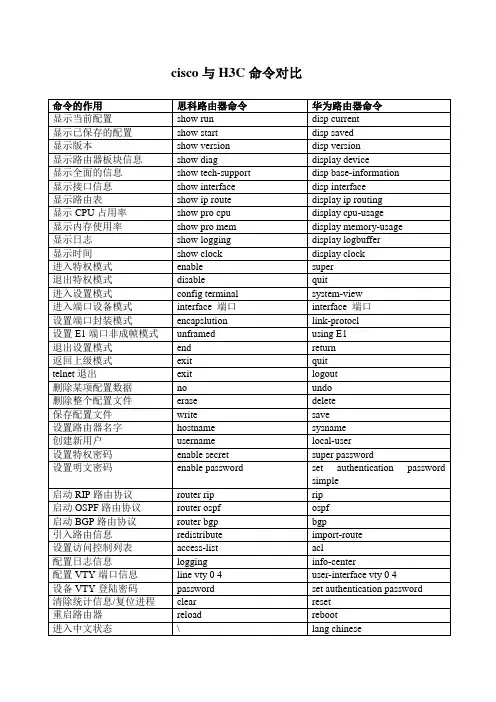
vlan ID / no vlan ID
vlan ID / undo vlan ID
查看端口
show interface
display interface
查看vlan
show vlan id
display vlan id
链路聚合
channel-group 1 mode on
port link-aggregation group 1
开启三层交换的路由功能
ip routing
默认开启
开启接口三层功能
no switchport
不支持
跨交换机的vlan动态注册
vtp domain
GVRP
stp配置根网桥
spanning-tree vlan ID root primary
配置网桥优先级
spanning-tree vlan ID root priority
cisco与H3C命令对比
命令的作用
思科路由器命令
华为路由器命令
显示当前配置
showrun
disp current
显示已保存的配置
show start
disp saved
显示版本
show version
disp version
显示路由器板块信息
show diag
display device
显示全面的信息
show tech-support
disp base-information
显示接口信息
show interface
disp interface
显示路由表
show ip route
display ip routing
华为思科华三基本命令对比
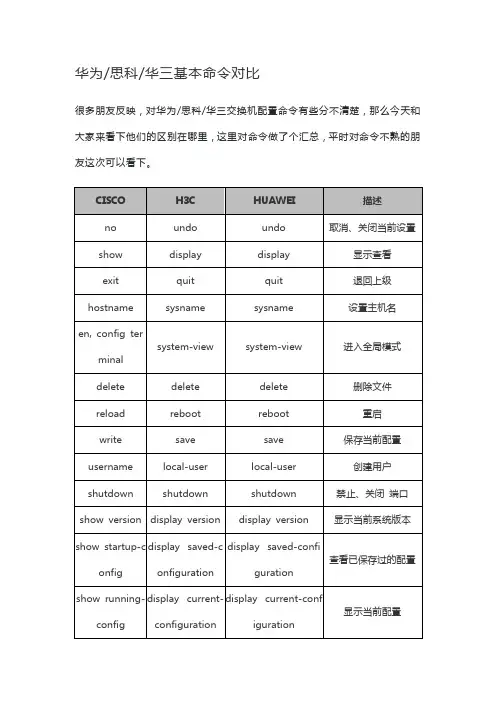
super password
super password
设置特权口令
duplex (half|full|auto)
duplex (half|full|auto)
duplex (half|full|auto)
配置接口状态
speed (10/100/1000)
speed (10/100/1000)
ip route-static 0.0.0.0 0.0.0.0
ip route-static 0.0.0.0 0.0.0.0
配置默认路由
ip route 目标网段+掩码 下一跳
ip route-static 目标网段+掩码 下一跳
ip route-static 目标网段+掩码 下一跳
配置静态路由
show ip route
华为/思科/华三基本命令对比
很多朋友反映,对华为/思科/华三交换机配置命令有些分不清楚,那么今天和大家来看下他们的区别在哪里,这里对命令做了个汇总,平时对命令不熟的朋友这次可以看下。
CISCO
H3C
HUAWEI
描述
no
undo
undo
取消、关闭当前设置
show
display
display
显示查看
exit
line
user-interface
user-interface
进入线路配置(用户接口)模式
start-config
saved-configuration
saved-configuration
启动配置
running-config
current-configuration
思科与华为访问控制列表(ACL)的区别
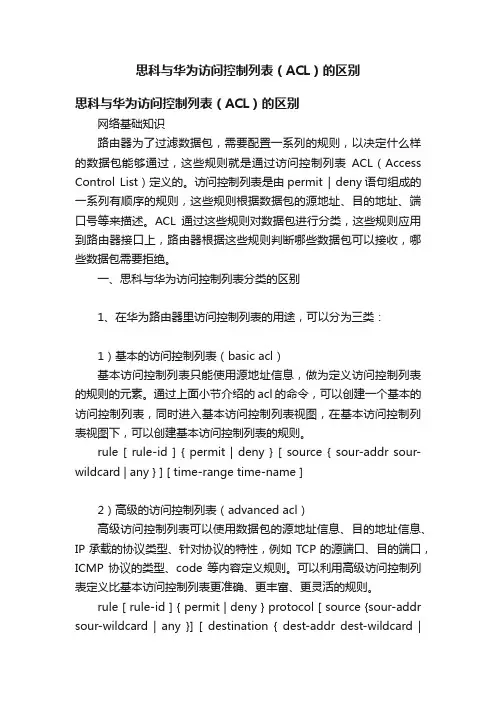
思科与华为访问控制列表(ACL)的区别思科与华为访问控制列表(ACL)的区别网络基础知识路由器为了过滤数据包,需要配置一系列的规则,以决定什么样的数据包能够通过,这些规则就是通过访问控制列表ACL(Access Control List)定义的。
访问控制列表是由permit | deny语句组成的一系列有顺序的规则,这些规则根据数据包的源地址、目的地址、端口号等来描述。
ACL通过这些规则对数据包进行分类,这些规则应用到路由器接口上,路由器根据这些规则判断哪些数据包可以接收,哪些数据包需要拒绝。
一、思科与华为访问控制列表分类的区别1、在华为路由器里访问控制列表的用途,可以分为三类:1)基本的访问控制列表(basic acl)基本访问控制列表只能使用源地址信息,做为定义访问控制列表的规则的元素。
通过上面小节介绍的acl的命令,可以创建一个基本的访问控制列表,同时进入基本访问控制列表视图,在基本访问控制列表视图下,可以创建基本访问控制列表的规则。
rule [ rule-id ] { permit | deny } [ source { sour-addr sour-wildcard | any } ] [ time-range time-name ]2)高级的访问控制列表(advanced acl)高级访问控制列表可以使用数据包的源地址信息、目的地址信息、IP承载的协议类型、针对协议的特性,例如TCP的源端口、目的端口,ICMP协议的类型、code等内容定义规则。
可以利用高级访问控制列表定义比基本访问控制列表更准确、更丰富、更灵活的规则。
rule [ rule-id ] { permit | deny } protocol [ source {sour-addr sour-wildcard | any }] [ destination { dest-addr dest-wildcard |any }] [ source-port operator port1 [ port2 ] ] [ destination-port operator port1 [ port2 ] ] [ icmp-type icmp-type icmp-code ] [ precedence precedence ] [ tos tos ] [ time-range time-name ]3)基于接口的访问控制列表(interface-based acl)基于接口的访问控制列表,是一种特殊的访问控制列表,可以根据接收报文的接口指定规则。
Cisco和华为命令对比

Cisco和华为命令对比建立用户:Router(config)# username aaa password cisco[quidway]local-user aaa启动VTY验证:Router(config)#line vty 0 4[quidway]user-interface vty 0 4选择验证类型:Router(config-line)#login authentication[quidway-ui-vty0-4]authentication-modeVLAN:Switch(config)#vlan 10 name sale[quidway]vlan 10将端口加入vlan:Switch(config-if)#switchport access vlan 10[quidway-ethernet0/10]port access vlan 10将端口设置为trunk,允许所有vlan通过:Switch(config-if)#switchport mode trunkSwitch(config-if)#switchport trunk allowed vlan all[quidway-ethernet0/20]port link-type trunk[quidway-ethernet0/20]port trunk permit vlan all配置动态vlan发现协议:Switch (config)#vtp mode serverSwitch (config)#vtp domain cisco[quidway]gvrp enable配置端口汇聚:Switch(config-range)#interface range fastethernet 0/2[quidway]link-aggregation group 1 mode manual 先建立聚合组,再把端口加里面广域网协议配置:ppp的pap验证:router1(config-if)#encapsulation ppprouter1(config-if)#ppp authentication paprouter1(config-if)#ppp pap sent-username chen password cisco[quidway-serial0/1]link-protocol ppp[quidway-serial0/1] ppp authentication-mode pap[quidway-serial0/1] ppp pap local-user chen password simple cisco帧中继配置:router1(config)#frame-relay switchingrouter1(config-if)#frame-relay map ip 215.10.1.2 105 broadcastrouter1(config-if)#frame-relay lmi-type ansi[quidway]fr switching[quidway-serial0/1]fr map ip 215.10.1.1 dlci 501路由协议配置:静态路由:router1(config)#ip route 192.168.1.1 255.255.255.0 s0[quidway]ip route-static 192.168.1.1 255.255.255.0 s0RIP:router1(config)#router riprouter1(config-router)#version 2router1(config-router)#no auto-summaryrouter1(config-router)#network 192.168.1.0[quidway]rip[quidway-serial0/1]rip version 2 华为路由器是在接口模式下开启V2版本[quidway-rip]undo summary[quidway-rip] network 192.168.1.0OFPF:router1(config)#router ospf 1-65535router1(config-router)#network 192.168.1.0 0.0.0.255 area 0[quidway]ospf[quidway-ospf-1]area 0[quidway-ospf-1-area-0.0.0.0] network 192.168.1.0 0.0.0.255NAT :router1(config)#ip nat inside source static 192.168.1.1 10.1.1.1router1(config-if)#ip nat inside/outside[quidway-serial0/1]nat server protocol tcp global 202.10.1.150 inside 192.168.1.1 将内部ip转成外部ip地址访问控制列表:cisco基本访问列表数字标识:1-99,扩展访问列表是100-199;华为基本访问列表数字标识2000-2999,扩展访问列表是3000-3999基本访问列表:router1(config)#access-list 1 permit 10.1.1.0 0.0.0.255[quidway]acl number 2000[quidway-acl-2000]rule permit source 192.168.1.0 0.0.0.255扩展访问列表:router1(config)#access-list 100 permit tcp 192.168.1.0 0.0.0.255 any eq telnet[quidway]acl number 3000[quidway-acl-adv-3000]rule permit tcp source 192.168.1.0 0.0.0.255 destination any eq telnet应用访问控制列表:router1(config-if)#ip access-group 1 out/in[quidway]firewall enable 开启防火墙[quidway-serial0/1]firewall packet-filter 3000 inbound/outbound。
思科和H3C常用配置详细对比
cisco与华为命令比较功能Cisco命令华为命令进入全局模式#configure terminal <Quidway>system显示当前配置show running-config display current-configuration 显示版本信息show version display version显示vlan信息show vlan display vlan显示接口信息show interface接口display interface接口交换机路由器命名hostname主机名sysname主机名修改特权密码enable password密码(明文)enable secret密码(密文)super password密码进入接口模式interface接口interface接口进入vlan模式interface vlan vlan号interface vlan vlan号给接口配IP ip address <ip> <掩码> ip address <ip> <掩码>配telnet密码line vty 0 4password密码login user-interface vty 0 4authentication-mode passwordset authentication-mode password simple密码user privilege level 3激活端口no shutdown undo shutdown 关闭端口shutdown shutdown退出exit quit创建VLAN vlan vlan号vlan vlan号VLAN中增加端口port e0/1port e0/2 to e0/4当前端口加入到VLAN switchport access vlan vlan号port access vlan vlan号设置端口工switchport mode port link-type作模式trunk|access|dynamic trunk|access|hybrid设trunk允许的VLAN switchport trunk allowed vlanremove|add IDport trunk permit vlan ID|All指定镜像端口monitor session 1 destinationint接口monitor-port接口指定被镜像端口monitor session 1 source int接口 bothport mirror接口设置生成树启动与否spanning-tree vlan vlan号(默认开启)stp enable|disable(默认关闭)端口的聚合 interface range f0/1 – 4channel-group 1 mode on link-aggregation e0/1 to e0/4 ingress|bothundo link-aggregation e0/1|all设置主vlan isolate-user-vlan enable设置主vlan 包括的子vlan isolate-user-vlan<x> secondary <vlan-list>显示路由信息show ip route display ip route 绑定HDLC协议默认就是link-protocol hdlc设静态路由 ip route网络号掩码下一跳IP/接口ip route-static网络号掩码下一跳IP/接口启用RIP路由router rip riprip workrip inputrip output配置路由器的ID int loopback 0ip add IP地址掩码router id A.B.C.D启动OSPF协议router ospf进程号ospf enable配置OSPF区域net网络号反向掩码 area<area_id>int接口ospf enable area <area_id>标准ACL命令格式access-list列表号permit|deny源IP反向掩码acl <acl-number> [match-orderconfig|auto]rule[normal|special]{permit|deny}[source source-addrsource-wildcard|any]扩展ACL配置access-list列表号permit|deny协议源IP反向掩码目的IP反向掩码 eq端口号acl <acl-number> [match-orderconfig|auto]rule{normal|special}{permit|deny}{tcp|udp}source {<ipwild>|any}destination <ipwild>|any} eq服务名PPP设置encapsulation ppp link-protocol pppPap认证主认证方(config)#username用户名password密码(config)#int串口接口(config-if)#pppauthentication pap被认证方(config)#int串口接口(config-if)#ppp papsent-username用户名password密码主认证方local-user用户名password {simple|cipher}密码interface串口接口ppp authentication-mode pap被认证方interface串口接口ppp pap local-user用户名password {simple|cipher}密码Chap认证主认证方(config)#username客户端主机名 password密码主认证方local-user对方主机名password {simple|cipher}密码(config)#int 串口接口 (config-if)#ppp authentication(config-if)#ppp chap hostname服务器主机名 被认证方(config)#username 服务器主机名 password 密码 (config)#int 串口接口(config-if)#ppp chap hostname客户端主机名interface 串口接口ppp authentication-mode chapppp chap user 自己主机名被认证方 interface 串口接口local-user 对方主机名 password {simple|cipher}密码 ppp chap user 自己主机名静态nat (1)为内外部接口配IP 并激活; (2)在接口上启用NAT ; 内部接口:ip nat inside 外部接口:ip nat outside (3)建立静态地址转换(config)#ip nat inside sourcestatic 私有IP 公网IPinterface 接口nat server global <ip> [port] inside <ip> port [protocol]动态NAT (1)为内外部接口配IP 并激活; (2)在接口上启用NAT ; 内部接口:ip nat inside外部接口:ip nat outside(3)定义内网允许访问外网的ACL(config)#access-list 列表号 permit 源IP 反向掩码(1) 建立地址池nat address-group 公网起始IP 公网终止IP pool 1 (2)定义内网允许访问外网的ACLacl 列表号rule permit source 源IP 反向掩码 rule deny sourceany (3)实现地址转换(4)定义合法IP 地址池 (config)#ip nat pool 地址池名 公网起始IP 公网终止IP netmask 掩码(5)实现地址转换(config)#ip nat inside sourcelist 列表号 pool 地址池名int 公网接口nat outbound 列表号address-group pool 1调试命令 思科:Switch#show run 显示所有配置命令Switch#show ip inter brief 显示所有接口状态 Switch#show vlan brief 显示所有VLAN 的信息 Switch#show version 显示版本信息 华为:[Quidway]dis cur 显示所有配置命令[Quidway]display interfaces 显示所有接口状态 [Quidway]display vlan all 显示所有VLAN 的信息[Quidway]display version 显示版本信息 二、接口配置命令思科:Switch(config)#interface f0/8 进入接口视图 Switch(config-if)#no shut 此命令开启接口Switch(config-if)#description to server01 端口描述Switch(config-if)#ip add 192.168.1.100 255.255.255.0 设置接口IP 华为:[Quidway]interface e0/1 进入接口视图 [Quidway]undo shutdown 此命令开启接口[Quidway]description to server02 端口描述[Quidway]ip add 192.168.1.102 255.255.255.0 设置接口IP 三、VLAN 配置命令:思科:建立和删除VLANSwitch# vlan databaseSwitch(vlan)# vlan 20 name test20Switch(vlan)# no vlan 20Switch(vlan)# exit将端口分配给一个VLANSwitch(config)# interface f0/1Switch(config-if)# switchport mode accessSwitch(config-if)# switchport access vlan 20设置VLAN TRUNKSwitch(config)# interface f0/24Switch(config-if)# switchport mode trunkSwitch(config-if)#switchport trunk allow vlan {ID|All}Switch(config-if)# switchport trunk encapsulation dot1q华为:建立和删除VLAN[Quidway]vlan 30[Quidway]undo vlan 30将端口分配给一个VLAN[Quidway]int ethernet0/1[Quidway-Ethernet0/1]port access vlan 30( port default vlan 30)或[Quidway]vlan 30[Quidway-vlan3]port ethernet 0/1 在VLAN中增加端口[Quidway-vlan3]port ethernet 0/1 to ethernet 0/4 在VLAN中增加多个连续端口设置VLAN TRUNK[Quidway]int e0/24[Quidway-Ethernet0/24] port link-type trunk[Quidway-Ethernet0/24]port trunk permit vlan {ID|All}四、端口镜像配置思科:配置镜像源端口Switch(config)#monitor session 1 source interface gigabitEthernet 0/2 –5 rx上面命令最后一个参数:both 监听双向数据,默认为bothrx 接收tx 发送配置镜像目的端口Switch(config)#monitor session 1 destination interface gigabitEthernet 0/6删除镜像端口Switch(config)#no monitor session 1华为:将端口E0/2配置为监控端口[Quidway]monitor-port Ethernet 0/2端口E0/1配置为镜像端口[Quidway]port mirror Ethernet 0/1或者直接配置监控端口和镜像端口[Quidway]port mirror Ethernet 0/1 observing-port Ethernet 0/2删除镜像[Quidway]undo monitor-port五、冗余配置思科HSRP:Switch# interface Vlan20ip address 172.29.197.33 255.255.255.248standby 20 ip 172.29.197.53standby 20 priority 105 优先级standby 20 preempt 抢占standby 20 track GigabitEthernet0/25 decrement 10 跟踪端口如果DOWN 了优先级减10华为VRRP:[Quidway]interface Vlanif30ip address 172.29.197.9 255.255.255.248vrrp vrid 30 virtual-ip 172.29.141.11vrrp vrid 30 priority 150 优先级vrrp vrid 30 preempt-mode 抢占vrrp vrid 30 track interface GigabitEthernet0/0/18 reduced 60 跟踪端口如果DOWN了优先级减60六、设置安全远程访问思科设置vty安全访问:R1(config)# access-list 1 permit 192.168.2.5R1(config)# line vty 0 4R1(config)# access-class 1 in华为设置vty安全访问:[Quidway]acl number 2000rule 1 permit source 172.29.181.150 0rule 2 deny[Quidway]user-interface vty 0 4acl 2000 inbound七、NTP配置思科:Cisco6509#show clock 显示时间Cisco6509#clock set 14:00:00 30 Sep 2011 设置时间Cisco6509(config)#ntp server 202.198.0.102 设置与其他时间服务器同步Cisco6509(config)#clock timezone beijing +8 设置时区华为:[Quidway]dis clock 显示时间[Quidway]clock datetime 23:30:00 2011/11/16 设置时间[Quidway]ntp-service unicast-server 202.198.0.102 设置与其他时间服务器同步[Quidway]clock timezone E8 add 08:00:00 设置时区八、静态路由配置思科:ip route <目的网段> <目的网段掩码><下一跳>Cisco6509# ip route 0.0.0.0 0.0.0.0 10.65.1.2 静态路由Cisco6509#ip route 0.0.0.0 0.0.0.0 192.168.3.1 150 浮动静态路由管理距离为150华为:[Quidway] ip route-static 0.0.0.0 0.0.0.0 10.65.1.2[Quidway]ip route-static 0.0.0.0 0.0.0.0192.168.3.1 preference 150九、可网管配置思科:Switch(config)#snmp-server community sunion ro 配置本交换机的只读字串为sunionSwitch(config)#snmp-server community sunion rw 配置本交换机的读写字串为sunionSwitch(config)#snmp-server enable traps 允许交换机将所有类型SNMP Trap 发送出去Switch(config)#snmp-server host 192.168.190.1 traps sunion 指定交换机SNMP Trap的接收者为192.168.190.1,发送Trap时采用sunion作为字串华为:[Quidway]snmp-agent community read datanms 配置本交换机的只读字串为datanms[Quidway]snmp-agent community write datanms 配置本交换机的读写字串为datanms[Quidway]snmp-agent sys-info location BeiJing China 设置交换机的位置信息[Quidway]snmp-agent sys-info version all 设置交换机支持所有的SNMP协议版本[Quidway]snmp-agent target-host trap address udp-domain192.168.190.121 params securityname datanms 指定交换机SNMP Trap的接收者为192.168.190.121 ,发送Trap时采用datanms作为字串。
华为交换机基本配置命令,附三大品牌命令对比表
华为交换机基本配置命令,附三大品牌命令对比表前言:最近一直有读者咨询有关于交换机配置命令的汇总有没有,我们从事弱电集成工作,会一些简单的交换机配置还是有必要的,想深入学习的话,还是要偏向于网络工程师了。
正文:一、单交换机VLAN划分命令命令解释system 进入系统视图system-view 进入系统视图quit 退到系统视图undo vlan 20 删除vlan 20sysname 交换机命名disp vlan 显示vlanvlan 20 创建vlan(也可进入vlan 20)port e1/0/1 to e1/0/5 把端口1-5放入VLAN 20 中5700系列单个端口放入VLAN[Huawei]int g0/0/1[Huawei]port link-type access (注:接口类型access,hybrid、trunk)[Huawei]port default vlan 10批量端口放入VLAN[Huawei]port-group 1[Huawei-port-group-1]group-member ethernet G0/0/1 to ethernetG0/0/20 [Huawei-port-group-1]port hybrid untagged vlan 3删除group(组)vlan 200内的15端口[Huawei]int g0/0/15[Huawei-GigabitEthernet0/0/15]undo port hybrid untagged vlan 200通过group端口限速设置[Huawei]Port-group 2[Huawei]group-member g0/0/2 to g0/0/23[Huawei]qos lr outbound cir 2000 cbs 20000disp vlan 20 显示vlan里的端口20int e1/0/24 进入端口24undo port e1/0/10 表示删除当前VLAN端口10disp curr 显示当前配置return 返回Save 保存info-center source DS channel 0 log state off trap stateoff 通过关闭日志信息命令改变DS 模块来实现(关闭配置后的确认信息显示)info-center source DS channel 0 log state on trap stateon 通过打开日志信息命令改变DS 模块来实现(打开配置后的确认信息显示)二、配置交换机支持TELNEsystem 进入系统视图sysname 交换机命名int vlan 1 进入VLAN 1ip address 192.168.3.100 255.255.255.0 配置IP地址user-int vty 0 4 进入虚拟终端authentication-mode password (aut password) 设置口令模式set authentication password simple 222 (set aut pass sim 222) 设置口令user privilege level 3(use priv lev 3) 配置用户级别disp current-configuration (disp cur) 查看当前配置disp ip int 查看交换机VLAN IP配置删除配置必须退到用户模式reset saved-configuration(reset saved) 删除配置Reboot 重启交换机三、跨交换机VLAN的通讯在sw1上:vlan 10 建立VLAN 10int e1/0/5 进入端口5port access vlan 10 把端口5加入vlan 10vlan 20 建立VLAN 20int e1/0/15 进入端口15port access vlan 20 把端口15加入VLAN 20int e1/0/24 进入端口24port link-type trunk 把24端口设为TRUNK端口port trunk permit vlan all 同上在SW2上:vlan 10 建立VLAN 10int e1/0/20 进入端口20port access vlan 10 把端口20放入VLAN 10int e1/0/24 进入端口24port link-type trunk 把24端口设为TRUNK端口port trunk permit vlan all (port trunk permit vlan 10 只能为vlan 10使用)24端口为所有VLAN使用disp int e1/0/24 查看端口24是否为TRUNKundo port trunk permit vlan all 删除该句四、路由的配置命令system 进入系统模式sysname 命名int e1/0 进入端口ip address 192.168.3.100 255.255.255.0 设置IPundo shutdown 打开端口disp ip int e1/0 查看IP接口情况disp ip int brief 查看IP接口情况user-int vty 0 4 进入口令模式authentication-mode password(auth pass) 进入口令模式set authentication password simple 222 37 设置口令user privilege level 3 进入3级特权save 保存配置reset saved-configuration 删除配置(用户模式下运行)undo shutdown 配置远程登陆密码int e1/4ip route 192.168.3.0(目标网段)255.255.255.0 192.168.12.1(下一跳:下一路由器的接口)静态路由ip route 0.0.0.0 0.0.0.0 192.168.12.1 默认路由disp ip rout 显示路由列表华3C AR-18E1/0(lan1-lan4)E2/0(wan0)E3/0(WAN1)路由器连接使用直通线。
思科 华为 华为3COM和锐捷之间的命令比较
CISCO 和锐捷基本上是一样的思科和H3C是完全不一样的Cisco 华为解释show display 显示no undo 删除/取消user local-user 新建用户end return 退回到系统视图exit quit 返回上级视图exit logout telnetr的退出router rip rip 启动rip router ospf ospf 启动ospf router bgp bgp 启动bgp hostname sysneme 设置主机名字access-list acl 控制访问列表write save 保存配置erase delete 删除配置0 simple 明文7 cipher 密文host ip host host名字和ip地址对应logging info-center 日志信息encapslution link-pro 封装链路层协议show version disp version 显示版本show run disp 显示当前配置current-configurationshow disp base-information 显示全面的信息tech-supportshow start disp saved-configuration 显示已保存的配置ctrl+z ctrl+z 退回到系统视图ctrl+p ctrl+p 上一条命令ctrl+n ctrl+n 下一条命令- ctrl+adisplay cur- ctrl+rdisplay ip routig-tableundebug all ctrl+d 取消所有debug命令cisco和华为命令2008-04-09 13:27CISCO交换机配置命令大全2006-2-28 14:33:001.在基于IOS的交换机上设置主机名/系统名:switch(config)# hostname hostname在基于CLI的交换机上设置主机名/系统名:switch(enable) set system name name-string2.在基于IOS的交换机上设置登录口令:switch(config)# enable password level 1 password在基于CLI的交换机上设置登录口令:switch(enable) set passwordswitch(enable) set enalbepass3.在基于IOS的交换机上设置远程访问:switch(config)# interface vlan 1switch(config-if)# ip address ip-address netmaskswitch(config-if)# ip default-gateway ip-address在基于CLI的交换机上设置远程访问:switch(enable) set interface sc0 ip-address netmask broadcast-address switch(enable) set interface sc0 vlanswitch(enable) set ip route default gateway4.在基于IOS的交换机上启用和浏览CDP信息:switch(config-if)# cdp enableswitch(config-if)# no cdp enable为了查看Cisco邻接设备的CDP通告信息:switch# show cdp interface [type modle/port]switch# show cdp neighbors [type module/port] [detail]在基于CLI的交换机上启用和浏览CDP信息:switch(enable) set cdp {enable|disable} module/port为了查看Cisco邻接设备的CDP通告信息:switch(enable) show cdp neighbors[module/port][vlan|duplex|capabilities|detail]5.基于IOS的交换机的端口描述:switch(config-if)# description description-string基于CLI的交换机的端口描述:switch(enable)set port name module/number description-string6.在基于IOS的交换机上设置端口速度:switch(config-if)# speed{10|100|auto}在基于CLI的交换机上设置端口速度:switch(enable) set port speed moudle/number {10|100|auto}switch(enable) set port speed moudle/number {4|16|auto}7.在基于IOS的交换机上设置以太网的链路模式:switch(config-if)# duplex {auto|full|half}在基于CLI的交换机上设置以太网的链路模式:switch(enable) set port duplex module/number {full|half}8.在基于IOS的交换机上配置静态VLAN:switch# vlan databaseswitch(vlan)# vlan vlan-num name vlaswitch(vlan)# exitswitch# configure teriminalswitch(config)# interface interface module/numberswitch(config-if)# switchport mode accessswitch(config-if)# switchport access vlan vlan-numswitch(config-if)# end在基于CLI的交换机上配置静态VLAN:switch(enable) set vlan vlan-num [name name]switch(enable) set vlan vlan-num mod-num/port-list9. 在基于IOS的交换机上配置VLAN中继线:switch(config)# interface interface mod/portswitch(config-if)# switchport mode trunkswitch(config-if)# switchport trunk encapsulation {isl|dotlq}switch(config-if)# switchport trunk allowed vlan remove vlan-listswitch(config-if)# switchport trunk allowed vlan add vlan-list在基于CLI的交换机上配置VLAN中继线:switch(enable) set trunk module/port [on|off|desirable|auto|nonegotiate] Vlan-range [isl|dotlq|dotl0|lane|negotiate]10.在基于IOS的交换机上配置VTP管理域:switch# vlan databaseswitch(vlan)# vtp domain domain-name在基于CLI的交换机上配置VTP管理域:switch(enable) set vtp [domain domain-name]11.在基于IOS的交换机上配置VTP 模式:switch# vlan databaseswitch(vlan)# vtp domain domain-nameswitch(vlan)# vtp {sever|cilent|transparent}switch(vlan)# vtp password password在基于CLI的交换机上配置VTP 模式:switch(enable) set vtp [domain domain-name][mode{ sever|cilent|transparent }][password password]12. 在基于IOS的交换机上配置VTP版本:switch# vlan databaseswitch(vlan)# vtp v2-mode在基于CLI的交换机上配置VTP版本:switch(enable) set vtp v2 enable13. 在基于IOS的交换机上启动VTP剪裁:switch# vlan databaseswitch(vlan)# vtp pruning在基于CL I 的交换机上启动VTP剪裁:switch(enable) set vtp pruning enable14.在基于IOS的交换机上配置以太信道:switch(config-if)# port group group-number [distribution {source|destination}] 在基于CLI的交换机上配置以太信道:switch(enable) set port channel moudle/port-range mode{on|off|desirable|auto} 15.在基于IOS的交换机上调整根路径成本:switch(config-if)# spanning-tree [vlan vlan-list] cost cost在基于CLI的交换机上调整根路径成本:switch(enable) set spantree portcost moudle/port costswitch(enable) set spantree portvlancost moudle/port [cost cost][vlan-list] 16.在基于IOS的交换机上调整端口ID:switch(config-if)# spanning-tree[vlan vlan-list]port-priority port-priority在基于CLI的交换机上调整端口ID:switch(enable) set spantree portpri {mldule/port}priorityswitch(enable) set spantree portvlanpri {module/port}priority [vlans]17. 在基于IOS的交换机上修改STP时钟:switch(config)# spanning-tree [vlan vlan-list] hello-time secondsswitch(config)# spanning-tree [vlan vlan-list] forward-time seconds` switch(config)# spanning-tree [vlan vlan-list] max-age seconds在基于CLI的交换机上修改STP时钟:switch(enable) set spantree hello interval[vlan]switch(enable) set spantree fwddelay delay [vlan]switch(enable) set spantree maxage agingtiame[vlan]18. 在基于IOS的交换机端口上启用或禁用Port Fast 特征:switch(config-if)#spanning-tree portfast在基于CLI的交换机端口上启用或禁用Port Fast 特征:switch(enable) set spantree portfast {module/port}{enable|disable}19. 在基于IOS的交换机端口上启用或禁用UplinkFast 特征:switch(config)# spanning-tree uplinkfast [max-update-rate pkts-per-second]在基于CLI的交换机端口上启用或禁用UplinkFast 特征:switch(enable) set spantree uplinkfast {enable|disable}[rate update-rate][all-protocols off|on]20. 为了将交换机配置成一个集群的命令交换机,首先要给管理接口分配一个IP 地址,然后使用下列命令: switch(config)# cluster enable cluster-name21. 为了从一条中继链路上删除VLAN,可使用下列命令:switch(enable) clear trunk module/port vlan-range22. 用show vtp domain 显示管理域的VTP参数.23. 用show vtp statistics显示管理域的VTP参数.24. 在Catalyst交换机上定义TrBRF的命令如下:switch(enable) set vlan vlan-name [name name] type trbrf bridgebridge-num[stp {ieee|ibm}]25. 在Catalyst交换机上定义TrCRF的命令如下:switch (enable) set vlan vlan-num [name name] type trcrf{ring hex-ring-num|decring decimal-ring-num} parent vlan-num26. 在创建好TrBRF VLAN之后,就可以给它分配交换机端口.对于以太网交换,可以采用如下命令给VLAN分配端口:switch(enable) set vlan vlan-num mod-num/port-num27. 命令show spantree显示一个交换机端口的STP状态.28. 配置一个ELAN的LES和BUS,可以使用下列命令:ATM (config)# interface atm number.subint multiointATM(config-subif)# lane serber-bus ethernet elan-name29. 配置LECS:ATM(config)# lane database database-nameATM(lane-config-databade)# name elan1-name server-atm-address les1-nsap-addressATM(lane-config-databade)# name elan2-name server-atm-address les2-nsap-addressATM(lane-config-databade)# name …30. 创建完数据库后,必须在主接口上启动LECS.命令如下:ATM(config)# interface atm numberATM(config-if)# lane config database database-nameATM(config-if)# lane config auto-config-atm-address31. 将每个LEC配置到一个不同的ATM子接口上.命令如下:ATM(config)# interface atm number.subint multipointATM(config)# lane client ethernet vlan-num elan-num32. 用show lane server 显示LES的状态.33. 用show lane bus显示bus的状态.34. 用show lane database显示LECS数据库可内容.35. 用show lane client显示LEC的状态.36. 用show module显示已安装的模块列表.37. 用物理接口建立与VLAN的连接:router# configure terminalrouter(config)# interface media module/portrouter(config-if)# description description-stringrouter(config-if)# ip address ip-addr subnet-maskrouter(config-if)# no shutdown38. 用中继链路来建立与VLAN的连接:router(config)# interface module/port.subinterfacerouter(config-ig)# encapsulation[isl|dotlq] vlan-numberrouter(config-if)# ip address ip-address subnet-mask39. 用LANE 来建立与VLAN的连接:router(config)# interface atm module/portrouter(config-if)# no ip addressrouter(config-if)# atm pvc 1 0 5 qsaalrouter(config-if)# atm pvc 2 0 16 ilnirouter(config-if)# interface atm module/port.subinterface multipoint router(config-if)# ip address ip-address subnet-maskrouter(config-if)# lane client ethernet elan-numrouter(config-if)# interface atm module/port.subinterface multipointrouter(config-if)# ip address ip-address subnet-namerouter(config-if)# lane client ethernet elan-namerouter(config-if)# …40. 为了在路由处理器上进行动态路由配置,可以用下列IOS命令来进行: router(config)# ip routingrouter(config)# router ip-routing-protocolrouter(config-router)# network ip-network-numberrouter(config-router)# network ip-network-number41. 配置默认路由:switch(enable) set ip route default gateway42. 为一个路由处理器分配VLANID,可在接口模式下使用下列命令:router(config)# interface interface numberrouter(config-if)# mls rp vlan-id vlan-id-num43. 在路由处理器启用MLSP:router(config)# mls rp ip44. 为了把一个外置的路由处理器接口和交换机安置在同一个VTP域中: router(config)# interface interface numberrouter(config-if)# mls rp vtp-domain domain-name45. 查看指定的VTP域的信息:router# show mls rp vtp-domain vtp domain name46. 要确定RSM或路由器上的管理接口,可以在接口模式下输入下列命令: router(config-if)#mls rp management-interface47. 要检验MLS-RP的配置情况:router# show mls rp48. 检验特定接口上的MLS配置:router# show mls rp interface interface number49. 为了在MLS-SE上设置流掩码而又不想在任一个路由处理器接口上设置访问列表:set mls flow [destination|destination-source|full]50. 为使MLS和输入访问列表可以兼容,可以在全局模式下使用下列命令:router(config)# mls rp ip input-acl51. 当某个交换机的第3层交换失效时,可在交换机的特权模式下输入下列命令:switch(enable) set mls enable52. 若想改变老化时间的值,可在特权模式下输入以下命令:switch(enable) set mls agingtime agingtime53. 设置快速老化:switch(enable) set mls agingtime fast fastagingtime pkt_threshold54. 确定那些MLS-RP和MLS-SE参与了MLS,可先显示交换机引用列表中的内容再确定:switch(enable) show mls include55. 显示MLS高速缓存记录:switch(enable) show mls entry56. 用命令show in arp显示ARP高速缓存区的内容。
342思科华为HC常用命令对比【zj】
思科、华为、这些网络设备的命令还是挺多的,不过我们一般用的路由交换机设备都是最简单的了,先学基本命令,再学其他功能命令。
路由命令是最基本的命令了。
思科、华为、常用命令对比大全常用命令解释视图模式推荐:普通视图>特权视图在普通模式下输入全局视图() 在特权模式下输入接口视图() 在全局模式下输入接口名称例如或路由协议视图()在全局模式下输入动态路由协议名称、基本配置:> 进入特权模式进入全局配置模式() 设置设备名称就好像给我们的计算机起个名字() 设置特权口令() 不允许路由器缺省使用解析命令() 进入控制口的服务模式() 要设置的密码() 使能可以登陆() 日志同步() 设置进度溢出为() 进入设置服务模式() 设置的密码() 使能可以登陆() 保存退出到特权模式() 对所有在路由器上输入的口令进行暗文加密、接口配置:() 进入接口配置模式端口配置(如果是模块化的路由器前面加上槽位编号,例如代表这个路由器的槽位上的第一个接口).() 添加地址和掩码() 捆绑链路协议或者思科缺省串口封装的链路层协议是所以在配置的时候接口上的配置没有,如果要封装为别的链路层协议例如就是看到接口下的或者.() 建立环回口(逻辑接口)模拟不同的本机网段() 添加地址和掩码给环回口() 在物理接口上配置了地址后用启用这个物理接口反之可以用管理性的关闭接口、路由配置:()静态路由() 下一条或自己的接口() 添加缺省路由()动态路由协议() 启动协议() 宣告自己的网段() 转换为版本() 关闭自动汇总功能,才有作用() 接口名启动本路由器的那个接口为被动接口() 广播转单播报文,指定邻居的接协议() 启动协议() 宣告自己的网段() 调整倍数因子,使用不等价的负载均衡协议() 启动协议() 宣告自己的网段() 调整倍数因子,使用不等价的负载均衡() 关闭自动汇总功能协议() 启动协议启动一个协议进程() 宣告自己的接口或网段在的区域中可以把不同接口宣告在不同区域中() 配置路由的() 配置区域为末梢区域加入这个区域的路由器全部要配置这个条命令() 配置区域为完全末梢区域只在上配置() 配置区域为非纯末梢区域加入这个区域的路由器全部要配置这个条命令() 配置区域为完全非纯末梢区域只在上配置,并发布缺省路由信息进入这个区域内的路由器.、保存当前修改运行的配置:将中的当前配置存储到中,下次路由器启动就是执行保存的配置命令与效果一样、一般的常用命令()()()()()()()命令从接口、协议、等视图模式下退回到全局配置模式,或从全局配置模式退回到特权模式()()()命令从任何视图直接回到特权模式退出当前路由器登陆模式相对与的注销重新启动路由器(热启动)冷启动就是关闭路由器再打开电源开关特权模式下:查看当前的路由表* 清楚当前的路由表查看当前路由器运行的动态路由协议情况查看当前的路由器的接口地址启用情况查看当前运行配置查看启动配置打开报文的调试输出到终端上显示调试信息查看协议的邻居表查看协议的拓朴表查看当前路由器运行协议的接口情况查看当前路由器的协议的邻居表查看当前路由器运行协议的接口情况清楚当前路由器协议的进程显示设置在路由器和访问服务器上所有接口的统计信息. 显示路由器上配置的所有接口的状态显示关于一个串口的信息列出一个接口的信息和状态的小结, 列出接口的状态和全局参数――――――――――――――――――――――――命令全集-思科命令汇总允许路由器在动态访问列表中创建临时访问列表入口把访问控制列表()应用到接口上定义一个标准的在连接的路由器上手动替换临时访问列表入口向子系统发送命令执行信令命令手动引导制作系统设置接口的带宽指定日期信息标语设置突发事件手册模式指定路由器启动时加载的系统映像设置硬件日历更改路径允许接口运行协议复位功能清除接口计数器重新启动接口上的硬件逻辑设置串口硬件连接的时钟速率,如网络接口模块和接口处理器能接受的速率开启关闭连接管理功能修改配置寄存器设置允许进入存在的配置模式,在中心站点上维护并保存配置信息从加载配置信息从终端进行手动配置打开一个终端连接复制配置或映像数据备份系统映像文件到服务器将中的当前配置存储到将中的当前配置存储到网络服务器上从服务器上下载新映像到从服务器上下载配置文件使用调试功能显示接口在拨什么号及诸如此类的信息显示路由选择更新数据显示关于路由选择协议()更新数据包的信息显示关于(业务通告协议)更新数据包信息显示在路由器通道接口上发生的数据链路层(第层)的访问过程显示在实施中发生的业务和交换信息删除文件为一个已命名的设置条件要求线路断开前的空闲进度的长度设置一个串行接口来呼叫一个或多个地点要求花多长进度等待一个载体通过对属于一个特定拨号组的接口进行配置来访问控制定义一个数字数据接受器()拨号表以通过协议或与协议的组合来控制控制拨号显示给定设备上的文件关闭特许模式断开已建立的连接打开特许模式确定一个密码以防止对路由器非授权的访问设置本地口令控制不同特权级别的访问为命令定义额外一层安全性启动帧中继封装要求在网络段上使用的独一无二的格式把设置为由串口或接口使用的封装方法要求在网络段上使用的以太网格式的密码是退出配置模式删除闪存或配置缓存删除中的内容配置命令解释器在检测到用户输入前所等待的进度退出所有配置模式或者关闭一个激活的终端会话和终止一个终止任何配置模式或关闭一个活动的对话和结束格式化设备为使用帧中继封装的串行线路启动本地管理接口()获得交互式帮助系统查看历史记录使用一个主机名来配置路由器,该主机名以提示符或者缺省文件名的方式使用设置接口类型并且输入接口配置模式配置接口类型和进入接口配置模式选择接口并且输入接口配置模式控制对一个接口的访问设定接口的网络逻辑地址设置一个接口地址和子网掩码并开始处理建立一条缺省路由允许路由器缺省使用定义静态主机名到地址映射指定至多个进行名字地址解析的服务器地址建立一条静态路由在为给一个接口分配一个明确的地址情况下,在串口上启动互联网协议()的处理过程设置点计数在串口上启动协议当转发数据包时设置软件使用的等价路径数量在一个特定接口上启动互联网数据包交换()的路由选择并且选择封装的类型(用帧封装)要求使用的路由选择协议启动路由选择在较慢的链路上设置较不频繁的(业务广告协议)更新限制对类数据包广播的传播的接受在路由器上要求已经由业务供应商为信道分配的业务简介号()在路由器上要求已经由业务供应商为信道分配的业务简介号()要求了在接口上的中央办公区的交换机的类型为使用帧中继封装的串行线路(本地管理接口)机制打开连接确定一个特定的线路和开始线路配置设置控制台端口线路为远程控制台访问要求了一个虚拟终端锁住终端控制台在终端会话登录过程中启动了密码检查以某用户身份登录,登录时允许口令验证向下跟踪组播地址路由至终端定义介质类型把新的路由选择信息与正在使用的路由选择信息隔离一段进度向上解析组播地址路由至枝端从组播路由器上获取邻居和版本信息对组播地址多次路由跟踪后显示统计数字由源向目标跟踪解析组播地址路径命名已存在的网络连接开启关闭服务器把一个基于的地址分配给一个与它直接相连的路由器把网络与一个的路由选择的过程联系起来在路由器配置模式下,在网络上启动加强的.指定一个和路由器直接相连的网络地址段对一个直接连接的网络进行要求打开一个关闭的接口开启一个连接为一个已命名的设置条件把响应请求的数据包发送网络上的另一个节点检查主机的可达性和网络的连通性对网络的基本连通性进行诊断发送回声请求,诊断基本的网络连通性开始点到点协议启动握手鉴权协议()或者密码验证协议()或者将两者都启动,并且对在接口上选择的和验证的顺序进行要求当用进行身份验证时,创建一批好像是同一台主机的拨号路由器设置一个密码,该密码被发送到对路由器进行身份验证的主机命令对进入路由器的用户名密码的数量进行了限制对一个接口启动远程支持,并且在对同等层请求数据包验证过程中使用和对一个路由选择协议进行定义,该协议可以是,内部网关路由选择协议(),开放最短路径优先(),还可以是加强的.显示当前设备名关闭并执行冷启动。