
Unit 1 Where did you go on vacation(整单元课件)
Unit 1
Where did you go on vacation?
Section A(1a~1c)
第一课时
1.vacation名词,意为“假期;休假”。
常用搭配有: go on vacation 去度假 take a vacation at/in在……度假 【注意】holiday,vacation都是指工作日以外的休息时间,但不包括 周末或仅一天的休息日;holiday多用于英式英语;vacation多用于美式
13.The twins were in_the_cinema half an hour ago.(对画线部分提问) Where were ________ ________ the twins half an hour ago?
14.The students played football last_Friday_afternoon.(对画线部
英语。
2.camp的用法: (1)n.野营,营地
eg:a summer camp 一个夏令营
(2)v.宿营 eg:go camping 去宿营
3.Where did…?
“Where did…?”是一般过去时的特殊疑问句,did是助动词,在一
般过去时的句子中,在主语之前加did可构成疑问句,在主语之后,动词 之前加didn't可构成否定句,此时谓语动词用原形。
四、根据汉语完成句子。 16.你妹妹去哪儿度假了? Where did go ________ ________your sister________on vacation?
17.他们去了夏令营。
They __________ summer camp. went___________ to 18.张楠待在家里度假。 on vacation Zhang Nan ________ ________ ________. stayed ________home at 19.你去了沙滩吗? Did go beach ________ you ________ to the________? 20.她没有去山里。 didn't go She ______ _______ to the mountains _________.
4.重要短语
stay at home 待在家里 go to the beach 到沙滩去
go to summer camp 参加夏令营
go to the mountains 去大山里 visit museums 参观博物馆
一、单项选择。
C 1.His family ________ the zoo last week. A.visit B B B.am visiting C.visited D.will visit 2.Where ________ you go on vacation? A.does B.did C.are D.were 3.She didn't ________ me about it.
五、从方框内选句子补全对话。 A:Hi,Chen Jun!I didn't see you last month. B:Hi,Zhao Ming!I was on vacation. A:21.________ B B:I went to Australia. D A:Really?Australia is a good place to have fun.22.________ B:My family. A:23.________ E B:Yes,of course.We flew a kite on Bondi Beach. A:Wow,it was great.24.________ A B:We also went to the opera in Sydney Opera House. A:Which do you like,Australian opera or Chinese opera? B:25.________After all(毕竟),it's from our country. C
5.—Did you like your vacation?
—No,I ________. A.did B.didn't C.wasn't D.don't
二、用所给词的适当形式填空。 went 6.He________(go) to the movies last night. to visit 7.At first Nick wanted________(visit) his uncle,but stayed he________(stay) at home at last. 8.________(do) the boy go to school by bike every day? Does 9.—How ________(be) your vacation? was —Wonderful. Did 10.________ they ________(have) a meeting yesterday? have
分提问) play football? ________ ________ the students ________ When did 15.The_Whites lived in Shanghai two years ago.(对画线部分提问) ________ in Shanghai two years ago? Who ________ lived
三、句型转换。
11.I was in the teacher's office just now.(改为一般疑问句,并作否定回 答) Were________ you —________ in the teacher's office just now? —________ No ,I ________. wasn't 12.I read my books last night.(改为一般疑问句) ________ you ________ Did read your books last night?ຫໍສະໝຸດ A.told B.tell
C.telling D.tells
D
4.—________? —I went to New York City. A.Where are you going
B.How was your vacation
C.Did you go to New York City D.Where did you go B
Unit1Wheredidyougoonvacation -完整版教学设计
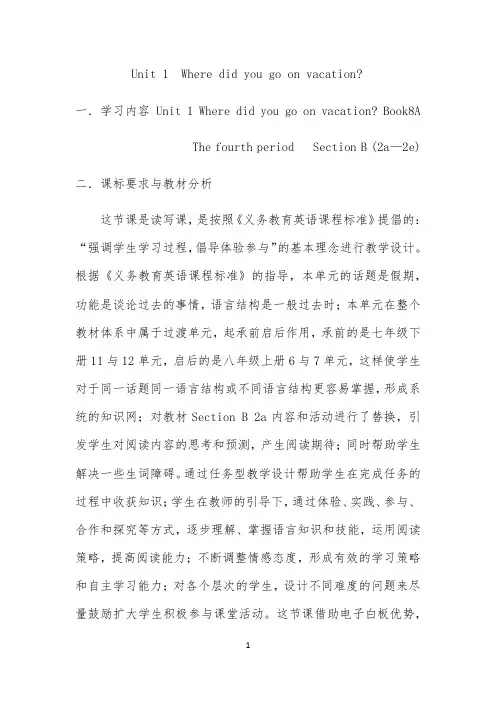
Unit 1 Where did you go on vacation?一.学习内容 Unit 1 Where did you go on vacation? Book8A The fourth period Section B (2a—2e)二.课标要求与教材分析这节课是读写课,是按照《义务教育英语课程标准》提倡的:“强调学生学习过程,倡导体验参与”的基本理念进行教学设计。
根据《义务教育英语课程标准》的指导,本单元的话题是假期,功能是谈论过去的事情,语言结构是一般过去时;本单元在整个教材体系中属于过渡单元,起承前启后作用,承前的是七年级下册11与12单元,启后的是八年级上册6与7单元,这样使学生对于同一话题同一语言结构或不同语言结构更容易掌握,形成系统的知识网;对教材Section B 2a内容和活动进行了替换,引发学生对阅读内容的思考和预测,产生阅读期待;同时帮助学生解决一些生词障碍。
通过任务型教学设计帮助学生在完成任务的过程中收获知识;学生在教师的引导下,通过体验、实践、参与、合作和探究等方式,逐步理解、掌握语言知识和技能,运用阅读策略,提高阅读能力;不断调整情感态度,形成有效的学习策略和自主学习能力;对各个层次的学生,设计不同难度的问题来尽量鼓励扩大学生积极参与课堂活动。
这节课借助电子白板优势,改进英语读写课教学方法,激发了学生的阅读欲望,减少了对语篇的畏惧感,受到学生的普遍欢迎,获得较好的课堂效果。
三.学情分析经过一个学年的中学英语学习生活,学生们已经学过由where, what, how引导的特殊疑问句及一般过去时,具有学习本单元知识的认知前提。
抓住学生对假期感兴趣的因素,就能激发他们的好奇心,使学生想表达假期生活的欲望强烈,有利于学生的学习和兴趣的培养。
但学生在本单元学习过程中存在三个问题:1、对动词过去式的规则变化与不规则变化的掌握与运用2、运用一般过去时完成写作时,学生缺乏对细节知识的处理能力。
Unit 1 Where did you go on vacation课文翻译
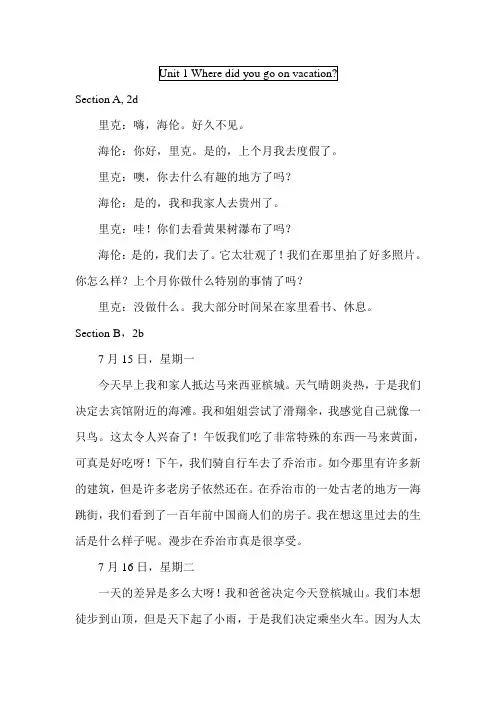
Section A, 2d
里克:嗨,海伦。
好久不见。
海伦:你好,里克。
是的,上个月我去度假了。
里克:噢,你去什么有趣的地方了吗?
海伦:是的,我和我家人去贵州了。
里克:哇!你们去看黄果树瀑布了吗?
海伦:是的,我们去了。
它太壮观了!我们在那里拍了好多照片。
你怎么样?上个月你做什么特别的事情了吗?
里克:没做什么。
我大部分时间呆在家里看书、休息。
Section B,2b
7月15日,星期一
今天早上我和家人抵达马来西亚槟城。
天气晴朗炎热,于是我们决定去宾馆附近的海滩。
我和姐姐尝试了滑翔伞,我感觉自己就像一只鸟。
这太令人兴奋了!午饭我们吃了非常特殊的东西—马来黄面,可真是好吃呀!下午,我们骑自行车去了乔治市。
如今那里有许多新的建筑,但是许多老房子依然还在。
在乔治市的一处古老的地方—海跳街,我们看到了一百年前中国商人们的房子。
我在想这里过去的生活是什么样子呢。
漫步在乔治市真是很享受。
7月16日,星期二
一天的差异是多么大呀!我和爸爸决定今天登槟城山。
我们本想徒步到山顶,但是天下起了小雨,于是我们决定乘坐火车。
因为人太
多,我们等了一个多小时的火车。
当我们到达山顶的时候,雨下得真大。
我们没有带雨伞,结果我们(被淋得)又湿又冷,真是糟透了!并且因为糟糕的天气,底下的东西我们什么都看不到。
爸爸没有带足够的钱,所以我们只吃了一碗米饭和鱼。
因为我太饿了,饭的味道尝起来还真是不错!。
Unit1--Where-did-you-go-on-vacation
The songs sound beautiful.这些歌曲听起来 很优美。
过得高兴,玩得愉快
have a good\great\fun time (=enjoy oneself)
They had a good time yesterday.= They enjoyed themselves yesterday.
find—found找到
2.不定代词和不定副词的用法
some
body
any
one
every thing
no
where(疑问副
词)不定代词和不定副词
(1)左边的some、any、every、no与右 边的body、one、thing构成不定代词, some、any、every、no与右边的疑问副 词where构成不定副词;
2. 回顾一下在3b中所回答的问题的情况,然后 将这些句子按恰当的逻辑顺序排列在一起, 形成条理清晰的一段文字。
3. 可根据旅行经历再加一些恰当想像的句子。 4. 再次,阅读一遍短文,看有没有错误的句
子。
假如你和你的家人在四月八号这天参观了北 京,请你以日记的形式把这天的经历及感受 记录下来。 提示:1. 早上:参观颐和园(爬万寿山;在 昆明湖划船) 2. 中午:吃北京烤鸭 3. 下午: 逛王府井大街 参考词汇:颐和园 the Summer Palace; 万寿山 Longevity Hill;昆明湖Kunming Lake;王府井大街 Wangfujing Street;风 景 scenery
1. 定基调 体裁:应用文(日记);日记的主体部分为 记叙文 时态:谈过去的经历时,用一般过去时。 人称:写个人经历时,用第一人称。
人教版八年级上 单元测试 Unit 1 Where did you go on vacation(含答案)
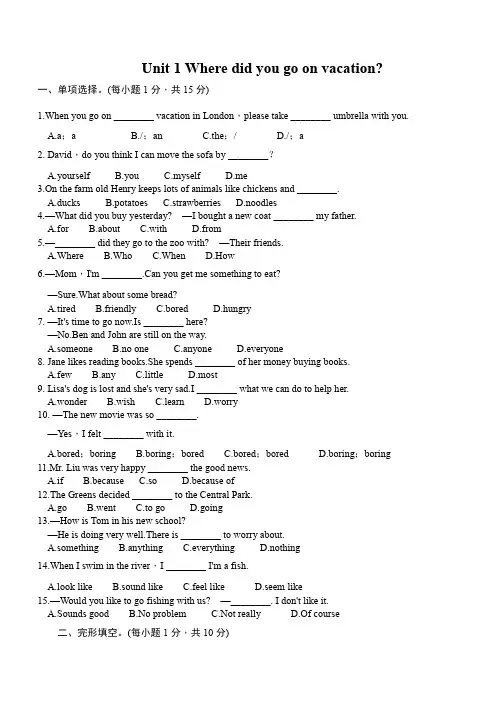
Unit 1 Where did you go on vacation?一、单项选择。
(每小题1分,共15分)1.When you go on ________ vacation in London,please take ________ umbrella with you.A.a;aB./;anC.the;/D./;a2. David,do you think I can move the sofa by ________?A.yourselfB.youC.myselfD.me3.On the farm old Henry keeps lots of animals like chickens and ________.A.ducksB.potatoesC.strawberriesD.noodles4.—What did you buy yesterday? —I bought a new coat ________ my father.A.forB.aboutC.withD.from5.—________ did they go to the zoo with? —Their friends.A.WhereB.WhoC.WhenD.How6.—Mom,I'm ________.Can you get me something to eat?—Sure.What about some bread?A.tiredB.friendlyC.boredD.hungry7. —It's time to go now.Is ________ here?—No.Ben and John are still on the way.A.someoneB.no oneC.anyoneD.everyone8. Jane likes reading books.She spends ________ of her money buying books.A.fewB.anyC.littleD.most9. Lisa's dog is lost and she's very sad.I ________ what we can do to help her.A.wonderB.wishC.learnD.worry10. —The new movie was so ________.—Yes,I felt ________ with it.A.bored;boringB.boring;boredC.bored;boredD.boring;boring11.Mr. Liu was very happy ________ the good news.A.ifB.becauseC.soD.because of12.The Greens decided ________ to the Central Park.A.goB.wentC.to goD.going13.—How is Tom in his new school?—He is doing very well.There is ________ to worry about.A.somethingB.anythingC.everythingD.nothing14.When I swim in the river,I ________ I'm a fish.A.look likeB.sound likeC.feel likeD.seem like15.—Would you like to go fishing with us? —________. I don't like it.A.Sounds goodB.No problemC.Not reallyD.Of course二、完形填空。
Unit 1 Where did you go on vacation 全单元教案
Unit 1 Where did you go on vacation 全单元教案Unit 1 Where did you go on vacationSection A1 (1a―2d)一、教学目标1) 能掌握新单词:anyone, anywhere, wonderful, few, most。
2) 能掌握以下句型:①—Where did you go on vacation —I went to the mountains.②—Where did Tina go on vacation —She went to the beach.③—Did you go with anyone —Yes, I did./No, I didn’t.3) 能掌握语法:复合不定代词someone, anyone, something, anything 等的用法。
4)能掌握一般过去时的特殊疑问句、一般疑问句及其肯定和否定回答。
二、教学重难点1. 教学重点1) 用所学的功能语言交流假期去了什么地方旅行。
2) 掌握本课时出现的新词汇。
2. 教学难点1) 复合不定代词someone, anyone, something, anything等的用法。
2) 一般过去时的特殊疑问句的使用及答语。
三、教学过程1. Lead-in观看有关旅行的动画视频,进入本课时的主题——谈论过去的假期去了什么地方及做了些什么事情。
2. Presentation1)Show some pictures on the big screen. Let students read the expressions.2) Focus attention on the pictures. Ask: What can you see Say: Each picture showswhat a person did in the past. Name each activity and ask students to repeat:stayed at home, went to New York City, visited my uncle, went to summer camp,went to mountains, went to the beach, visited museums.Now, please match each phrase with one of the pictures next to the name of theactivity. Point to the sample answer.Check the answers. Answers: 1. f 2. b 3. g 4. d 5. c 6. a 7. e 3. Listening1) Point to the picture on the screen.Say: Look at the Picture A. Where did Tina go on vacation She went to mountains.Ask: What did the person do in each picture2) Play the recording the first time.3) Play the recording a second time.Say: There are three conversations. The people talk about what they did on vacation. Listen to the recording and write numbers of the names in the right boxes of the picture.4) Check the answers.4. Pair work1) Point out the sample conversation. Ask two students to read the conversation to the class.2) Now work with a partner. Make your own conversation about the people in the picture.3) Students work in pairs. As they talk, move around the classroom and give any help they need.4) Let some pairs act out their conversations.5. ListeningTell students that they will hear a conversation about three people’s talking about their vacations. Listen for the first time and fill in the chart. Then listen again and check Yes or No.1) Let students read the phrases in the chart of 2b.2) Play the recording the first time. Students listen and fill in the chart.3) Play the recording a second time for the students to check “Yes, I did.”or “No, I didn’t. ”4) Check the answers with the students.6. Pair work1) Let two students read the conversation between Grace, Kevin and Julie.2) Let students work in pairs and try to role-play the conversation.3) Ask some pairs to act out their conversations.7. Role-play1) First let students read the conversation and match the people and the places they went to.2) Let students act out the conversations in pairs.3) Some explanations in 2d:Long time no see. anywhere interesting took quite a few photosWhat about... anything special Not really.I just stayed at home most of the time to read and relax.Homework:用英语询问你的一位好朋友,她(他)假期去了哪里?看到了什么?并将此对话写在作业本上。
英语人教版八年级上Unit1Wheredidyougoonvacation单元检测(附答案)
英语人教版八年级上Unit 1Where did you go on vacation?单元检测(总分100分,用时60分钟)Ⅰ.单项选择(每小题1分,共15分)1.It ______sunny today,but it ______ cloudy yesterday.A.is;is B.was;wasC.is;was D.was;is2.I ______ at school now,but I ______ at home an hour ago.A.am;am B.was;wasC.am;were D.am;was3.—______ there any students in the classroom?—No,there aren't.But there ______ some half an hour ago.A.Are;were B.Were;areC.Are;are D.Were;were4.—Where ______ you last night?—I ______ at home.A.are;am B.am;amC.were;was D.were;were5.—______ Nancy at home last weekend?—No,she ______.She was in the library with her friends.A.Is;isn't B.Was;wasn'tC.Did;didn't D.Was;isn't6.—______ did you ______ for dinner?—Sichuan food.A.What;have B.When;hadC.Why;have D.How;have7.This movie is kind of boring.I don't really ______ it.A.see B.look C.enjoy D.want8.I didn't go to the beach ______ vacation.I stayed ______ home.A.for;in B.on;atC.on;in D.in;at9.—Could you give me ______ money?—Sorry.I don't have ______ with me.A.some;any B.little;someC.any;some D.little;any10.I'll buy ______ for my son,but ______ for myself.A.nothing;nothing B.anything;nothingC.something;nothing D.something;something11.Did you do ______ in the park last Sunday?A.something interesting B.interesting somethingC.anyth ing interesting D.interesting anything12.It ______ that he went there last weekend.A.seems B.seemed C.looks D.looked13.The boy is ______ to carry the box.A.enough strong B.enough stronglyC.strong enough D.strongly enough14.I felt like ______ in the sky like a bird.A.fly B.flewC.am flying D.flying15.—How did you feel about the trip?—______.A.By train B.I'm very tiredC.It was great D.The weather was fineⅡ.完形填空(每小题2分,共20分)It was Children's Day yesterday,we __16__ the park.Our teacher was __17__ us.__18__ many people in the park.Some Young Pioneers(少先队员)__19__ near the river.__20__ sang and danced.There were some __21__ on the river.There was a hill __22__.Some boys __23__ in the river.We sat under __24__ apple tree with our teacher.We __25__ on Children's Day yesterday.16.A.went B.went toC.went for D.went in17.A.to B.fromC.with D.of18.A.Those were B.HowC.Had D.There were19.A.are B.wasC.were D.did20.A.They B.ThemC.Their D.Theirs21.A.hills B.boatsC.flowers D.trees22.A.here B.overC.over there D.near23.A.swim B.swimmingC.swimmed D.swam24.A.a B.anC./ D.the25.A.liked B.enjoyedC.had great fun D.didⅢ.阅读理解(每小题2分,共20分)ASome years ago there was an old woman.She had no children because she did not like children at all.But she loved cats.She had mother cats and baby cats.She had black cats and white cats.The children in the neighborhood came to her house to play with the cats.More and more cats came to the old woman's house.There were too many cats.The old woman couldn't (不能)feed them all.Then she had an idea(主意).“The children love my cats,” she thought(想).So she gave each child a cat.Then she was very happy.And the children were very happy,too.And the cats were pleased,too,because they each had a room.26.The old woman didn't like______.A.old cats B.baby catsC.old people D.children27.Why did the children come to the woman's house?A.To look at her house. B.To help the old woman.C.To play with the cats. D.To buy young cats.28.The word “feed” in the passage me ans______.A.give food to B.look afterC.live with D.play games29.The woman gave each child a cat because______.A.the children liked the cats B.she couldn't feed so many catsC.more cats came to her house D.children came to her house very day 30.Finally(最后)t he woman______.A.began to love childrenB.sold(卖掉)all her cats to childrenC.bought enough food for the children's catsD.could get enough(足够的)food for the c ats in her houseBBill and Sue were brother and sister.They studied in the same school.One day,on their way home they saw some nice birds.But they had no money to buy them.Sue had a good idea.On Saturday and Sunday they went to their farm and helped their father pick apples.So their father gave them twenty dollars.Sue and Bill went to Mr.King's shop after school.Every one of them bought a bird.One is yellow.The other is green.The yellow one is smaller than the green one.They liked them very much.31.Bill was Sue's ______.A.father B.motherC.brother D.sister32.______ they went to work for money.A.Every day B.After schoolC.At night D.On Saturday and Sunday33.They helped their father ______ on the farm.A.clean the room B.pick applesC.water the trees D.cook supper34.Bill and Sue bought ______ in Mr.King's shop.A.two dogs B.two applesC.two birds D.apples35.The green bird was ______ than that yellow one.A.bigger B.cheaperC.better D.smallerⅣ.用所给词的正确形式填空(每小题1.5分,共15分)36.My mother and I ______(be)in Beijing last Sunday.37.We ______(see)an interesting movie on TV yesterday.38.Did they go to the beach with ______(someone)?39.I think the movie is too ______(wonder).40.Jack,please help ______(you) to some fruit.41.We all like the ac tivity and nobody gets ______(boring).42.I want to make my ______(decide) for myself.43.They are ______(difference) from each other.44.His brother really enjoyed ______(walk) in the rain.45.Hurry up!Tom ______(wait) for you in the office.A.How were the people there?B.How did you go there?C.What about you?D.What did you do there?E.Because I must study for the coming exams.F.Do you like the people there?G.I stayed at home during the holiday.B:Oh.I went to Xi'an with my parents.A:That's a beautiful city.46.______B:We went to some museums and ate some delicious food.A:47.______B:They were very friendly to us.A:Did you go to Xi'an Zoo?B:Yes,we did.We saw monkeys,tigers,lions and so on.That was interesting!48.______ A:Well,I didn't go anywhere.49.______B:Why not go out?A:50.______B:You are really a bookworm!Ⅵ.书面表达(20分)根据所给中英文提示词,写一篇60词左右的文章,注意时态。
八英上《Unit 1 Where did you go on vacation》大单元教学设计
人教版初中八年级英语上册大单元整体教学设计——《Unit 1 Where did you go on vacation?》一、内容分析与整合(一)教学内容分析本单元以“Holidays and vacations”为核心主题,精心设计了一系列丰富多彩的教学活动,旨在通过探索学生的假期经历和感受,激发他们对英语学习的热情,同时深化他们对英语语法的理解与应用能力。
教学内容不仅贴近学生的生活实际,还巧妙融入了功能用语、词汇拓展以及语法结构的练习,力求使学生在轻松愉快的氛围中掌握并熟练运用新学知识。
本单元着重引导学生“Talk about past events”,即讨论过去发生的事件,这一功能用语的学习对于学生日常交流至关重要,能够帮助他们回顾和分享个人经历,增强口语表达能力和交际能力。
通过模拟对话、小组讨论等形式,学生将在实践中学习如何用英语讲述自己的假期故事,比如去了哪里、做了什么、感受如何等,从而在实践中提升语言运用能力。
在语言结构方面,本单元聚焦于“Indefinite pronouns”(不定代词)和“Simple past tense of regular and irregular verbs”(规则和不规则动词的一般过去时)。
不定代词如someone, anyone, nothing, everything等的引入,丰富了学生的词汇量,使他们能够更准确地表达自己的意思,比如“I met someone interesting during my vacation.”(我在假期中遇到了一个有趣的人。
)通过学习一般过去时,学生能够用正确的时态描述过去的经历,无论是规则动词如“walk-walked”还是不规则动词如“go-went”,都能准确运用,使句子更加生动具体,如“I went to the beach and enjoyed the sunshine.”(我去了海滩,享受了阳光。
)本单元还设计了一系列互动性强的练习和活动,如角色扮演、时间线制作、假期日记撰写等,旨在通过多样化的学习方式,巩固学生对新学知识的掌握。
Unit 1 Where did you go on vacation单元练习(含答案)
Unit 1Where did you go on vacation单元练习(含答案)Unit 1Where did you go on vacation单元练习Ⅰ.补全对话请根据对话内容,从方框内所给的选项中选出能填入空白处的最佳选项。
选项中有两项为多余项。
A:Hello, Mike. How was your vacationB:I really had a good time.A:1B:I’ve been to a forest near my uncle’s farm.A:2B:I went there with my friends.A:3B:For 3 days. I expect to go there again.A:You are lucky. I had to stay at home. But I’m planning to travel to Changbai Mountain.B:Oh, that’s a good place. I went there three years ago.A:Can you give me some advice on my trip to Changbai MountainB:4A:OK, I’ll do as you told me. 5B:They are friendly and you will enjoy yourself there.A.How long did you stay in the forestB.What do you think of the people thereC.Who did you go there withD.Where did you goE.Where have you beenF.You need to take thicker clothes.G.Did you have a good time there1. 2. 3. 4. 5.Ⅰ.完形填空John and his friends would go on vacation. They had a lot of ideas. In the end, they6to go on a road trip. John had a new car, and they would 7 from Los Angeles to Washington. Soon John got 8ready. He prepared CDs with their favorite music. They would sing along to the music 9the way. John also bought so much food that they could eat when they felt 10.The next day, John set off early in the morning. He drove his car and picked up all of his 11. Then their trip started. John showed them a map. It was full of dots. “These are all the stops we will make. We’ll visit all of these places,” he said. “Which12should we listen to first ” he asked. But no one 13. All his friends already got to sleep. And they kept sleeping all the way.6.A.disliked B.decided C.wondered7.A.drive B.fly C.walk8.A.none B.anyone C.everything9.A.at B.on C.in10.A.hot B.cheap C.hungry11.A.friends B.family C.classmates12.A.story B.song C.diary13.A.pointed B.arrived C.answeredⅠ.阅读理解AMost people in Western (西方的) countries have two big vacations every year—one vacation is over Christmas (圣诞节) and New Year, and the other vacation is in the summer. People in different places usually go back home to spend time with their families during Christmas. They exchange gifts and eat big dinners together at home. On the last day of the year, most people have a big party to welcome New Year.During the summer vacations, people usually spend their time doing outside activities. People go camping or climb the mountains. Others play sports or go to the beach. In the United States and Canada, students often spend their summer vacations at summer camps. There they meet and play with new friends.Another popular summer vacation activity is to visit another country.Cities like New York and Paris are very popular. When people visit another country, they often go sightseeing (观光), visit museums and eat at famous restaurants.Of course there are some people who just stay at home and relax on their vacation. What about you What do you like to do on your vacation What did you do on your last vacation14.The underlined word “exchange” means (意思是) “” in Chinese.A.改变B.交换C.推销15.Most people in Western countries often on the last day of the year.A.have a big partyB.go back homeC.watch TV16.American students often spend their summer vacations .A.at homeB.at summer campsC.in another country17.People don’t often when they visit another country.A.go sightseeingB.visit museumsC.go to the movies18.The best title for the passage is “”.A.How to Have a Relaxing VacationB.Have Fun on VacationsC.Western People’s VacationsB请阅读下面短文,根据语篇内容,从方框内所给的选项中选出能填入空白处的最佳选项,使短文意思通顺。
unit1-where-did-you-go-on-vacation测试卷有答案
Test for unit1 where did you go on vacation?初二级 ___ 班学号_________ 姓名________________ 总分____________________.单项选择(每小题 1 分,满分20分)) 1.It is raining hard outside. You 'd better bring _____ umbrella with you ..A. aB. anC. theD. /) 2.—Do you know the ____ between these two words? ---Yes ,I do.A. differentB. differenceC. bicycleD. building) 3. ____ seems very hard to reach the top of the mountains.A. ThatB. ThisC. ID. It) 4. The little boy isn 't ____ to pick the apples on the tree.A. short enoughB. enough shortC. tall enoughD. enough tall) 5. This is a good chance. Does ____ want to have a try?A. someoneB. anyoneC. everyoneD. no one) 6. My parents will be away for a week, I must look after ____ well.A. myselfB. meC. myD. mine( ) 7. -Where did you go last vacation? -- I _____ .A. go to the beachB. went to doctorC. went to the mountainsD. went to school ( ) 8. He decided tomorrow morning.A. leaveB. leftC. leavingD. to leave) 9. He felt ______ when he saw the _______ f ilm.A. boring; boringB. boring; boredC. bored; boringD. bored; bored) 10. he had to retire early __ poor health.A. as a resultB. becauseC. soD. because of) 11.Would you like some Sichuan food _____ d inner.A. asB. forC. onD. in( ) 12. ____ seems difficult _______ who broke the window.A. This; to find outB. It ; to find outC. That ; finding outD. It; finding out( ) 13. She isn'tvery popular. She has ______ friends.A. fewB. a fewC. littleD. myself )14.He doesn'tfeel like ___ anything today..A. to eatB. eatingC. eatD. eats) 15. Lisa, do you have ____ to eat? I 'm so hungry. -well, would you like to try some bread?A. any deliciousB. delicious anyC. anything deliciousD. delicious) 16. From the top of the hill we can see the whole city ______ us.A. underB. belowC. overD. above) 17. He was waiting ______ the bus stop ________ about 2 hours.A. for: forB. for: atC. at ; forD. for; in( )18. ---Whe n _____ your mother _____ y ou that blue dress, Lucy?---Sorry, I really can ' t remember. Maybe two or three weeks ago.A. will ; buyB. did ; buyC. does ; buyD. is ;buy( )19. Everyth ing _____ free. Good luck to you!A. amB. isC. areD. be( )20. CCTV-10 often plays _______ a round the world. It can help us learn more about not onlyn ature but also differe nt cultures and customs.A. new someth ingB. someth ing newC. any thi ng newD. new anything二完形填空(每小题1分,满分10分)The summer vacation is the best time for students. They can go outdoors and have fun. They can go to big cities to 31 , or go to the countryside to enjoy the beauty of 32 .Peter is an American middle school student and he loves 33 very much. He always travels in his coun try.This summer vacation he wants to do 34 . He is interested in Chinese history. 35 he is flying toBeiji ng and Xi'an for the sunvmetion. He is leaving on July 12th and 36 New York on the last day of the mon th. He pla ns 37 a fan tastic vacatio n. During the 38 , he is visit ing places of in terest and going shopping. At night, he is 39 to enjoy the night views. He is sure he will have a 40 time.()21. A. watch TV B. exercis ing C. go sightsee ing D. go fish ing()22. A. buildings B. city C. farm D. n ature()23. A. travelling B. shopp ing C. fish ing D. hiki ng()24. A. something differenee B. differe nt somethi ngC. someth ing differe ntD. differe nee something()25. A. Because B. So C. But D. Although()26. A. getti ng back to B. get back to C. getti ng back D. gets backto ()27. A. havi ng B. to have C. to havi ng D. had()28. A. weeke nd B. week C. night D. day()29. A. take a walk B. tak ing walks C. takes a walk D. take walks()30. A. great B. well C. terrible D. bori ng.阅读理解(每小题2分,满分30分)AWhat do we do whe n we go camp ing? First, we make a pla n. We take food, cloth ing, a knife, and thi ngs for cook ing and eat ing. We take things to keep us away from in sects and the sun.Then we put everything into the car and we drive to the woods. We look for a place for campers (露营者)and we look for a good place for our tent (帐篷).The place should have a lot of moving air. This will keep some in sects away. High land with water on both sides of it is good. Then we put up our tent. We put everyth ing into the tent, and we are ready for fun. We can swim in the lake, walk in the woods, climb a mountain, row a boat, or go fish ing.In the eve ning we come back to the tent, and we build a big fire because it can keep the in sectsaway. We sit around the fire and talk. We may tell in terest ing stories or we may sing son gs.At ni ght we lie dow n on the grass. We can look up at the stars. It is a busy day, so we try to go to sleep early. Everything is dark. Everything is quiet. We hope we won 'hear music from the radio in the next tent. We hope it won 'train. (D. take something for cookingand eating B. it can keep us warm D. it is dark and quiet B. go tosleep earlyD. be busyBwesterners have more vacation days than us. Some people like to stay at home during their vacation. They work in the garden, visit their friends, read books or watch television. Many families take their lunch to a park or somewhere far from the city. They like to eat un der some trees or n ear a nice lake. If they live near the sea, they often go to the seaside. There they can fish, swim or enjoy the sun.The westerners like travelling. They think travelling and outdoor activities are the parts of their lives. They work hard to save money, but their main purpose (目的)is to travel.Most western students often make use of their vacation to camp. There are thousands of camp interesting bases(基地)in western countries. They can swim, go fishing, attend lectures, and take part in many otherrecreational (娱乐性的)activities there. It can help them wrest from the secrets of nature, train(训练)their viability (生存能力),and teach them how to be self-reliant (自立). ()36. Some westerners like to ______ at home during their vacation. A. clea n their roomsB. cook their mealsC. work in the garde n and watch TVD. go fish ing()37. Many families ofte n take their lunch out and have it ______ . A. under some treesB. near the cityC. near the seaD. in the restaurants (餐馆)( )38. ______ is very importa nt for the wester ners. A. Worki ng hardB. Travelli ngC. Savi ng moneyD. Goi ng camp ing()39. What does the underlined phra se “wrest from ” mean here?)31. Before going camping we should firstA. make a pla nC. take things to keep us warm )32. We go to camp _______. A. by busB. by carC. by bike 33. Campers can take part in _____ activities. A. one or two B. only a few C. many34. In the eve ning we build a fire because A. it is cold at ni ghtC. it can keep the in sects away 35. Campers like to ______ at ni ght.A. hear music from the radioB. take some foodD. on footD. two or threeC. have rain TheA.取得B.保守C.认识D.探索( )40. The passage mainly tells us ______ .A. how the wester ners spe nd their vacati onB. the wester ners have more vacati on days tha n usC. differe nt views on vacati on betwee n the westerners and the easter nersD. teach the western stude nts how to be self-relia ntC将个人信息介绍和旅馆匹配。
Unit 1 Where did you go on vacation全单元教案 (5课时)
Unit 1 Where did you go on vacation?Ⅰ.Analysis of teaching materials:This unit is around "Holidays and vacation” to carry out teaching activities.Students should learn to use past tense to talk about holiday activities. The content is close to students’lives,it’s also a topic that students are willing to discuss and share with others .So in teaching process ,we can consolidate the key sentences “Where did you go on vacation? Did you …How …”through different methods such as pair work ,acting , reporting and interviews. Students can consolidate and study further about the past tense on the basis of original.Students can also use the past tense to write a diary about their vacations. Ⅱ.Teaching Aims:1.Knowledge aims:①Ss talk about travel activities correctly using “where” and “how”.②Ss master questions with auxiliary “did”and the answers to the questions.③Ss learn to express their feelings correctly.2.Ability aims::①Ss can ask and answer questions about the things in the past using the past tense.②Ss can use description words to express their feelings.③Ss can record a vacation in a form of a diary and express their feelings about the vacations.3Emotional aims:Ss get to know more about each other through the exchange of what they have seen, heard and felt.Ss learn to express their feelings in a better way.Ⅲ.Teaching important and difficult points1、Ss master and use the vocabulary and expressions.2、Ss master general questions and special questions and the answers to the questions.3、Ss master the past tense of regular and irregular verbs .Ⅳ.Teaching arrangements1.Section A 1a~2c 2. Section A 2d~3c 3. Section B 1a~1e4.Section B 2a~2e 5. Review of Unit 1. 3a~Self check 2Unit 1 Where did you go on vacation?Period 1 Section A 1a~2cI. Teaching Aims:1.Knowledge aims:Key words and phrases: New York City. Central Park anyone. anywhere interesting wonderful. Key sentences: Where did you go on vacation?I went to New York City.Did you buy anything special?Yes. I bought something special for my dad.2.Ability aims: Students learn to discuss their vacations in the past using key sentences.Students improve their listening and speaking skills.3. Emotional aims: Ss exchange their feelings about their vacations and know more about each other. II. Teaching important and difficult pointsSs master key words and sentences, then use them correctly.Ss learn to talk about what they did in the past.Ss improve their listening and speaking skills.Ⅲ. Teaching Aids:mufti-media, tapeUnit 1 Where did you go on vacation?Period 2 Section A 2d~3cI. Teaching Aims:1.Knowledge aims:Key words and phrases: most of the time, quite a few ,something, anything / nothing fun, everyone, of course , myself , yourself, hen, pig, seem to be bored, someone, diary, Huangguoshu Waterfall.Key sentences:Did you do anything fun on your vacation? Yes, I did. I went to ….How was your vacation? How did you like it? It was wonderful.Did you do anything interesting\buy anything special?The only problem was that there was nothing much to do in the evening but read.Still no one seemed to be bored.2.Ability aims: Ss learn to talk about their vacations using key sentences.Ss improve their speaking skills.3. Emotional aims: Ss express their feelings about vacations.II. Teaching important and difficult pointsSs get to know how to talk about their vacations using past tense.Ss understand differences between different pronouns and know how to use pronouns correctlyⅢ. Teaching Aids: mufti-media, tapeⅣ. Teaching ProcedureUnit 1 Where did you go on vacation?Period 3 Section B 1a~1eI. Teaching Aims:1.Knowledge aims:Key words and phrases: Malaysia, Malaysian, Georgetown, Word Quay, Penang Hill,Key sentences: Where did she go on vacation?Did she do anything special?What did she do there?How was the food? How were the people?2. Ability aims: Ss learn to discuss their vacations including the places, the food, the people, the weather and so on. Ss improve their listening and speaking skills.3. Emotional aims: Ss share the vacations and know more about different places.II. Teaching important and difficult pointsSs master and use key words and sentences correctly.Ss improve their listening and speaking skills.Ss learn to talk more about their vacations and exchange their feelings.Ⅲ. Teaching Aids: mufti-media, tapeUnit 1 Where did you go on vacation?Period 4 Section B 2a~2eI. Teaching Aims:1.Knowledge aims:Key words and phrases: activity, decide to do, try, feel like, Paragliding, bicycle ,building, trader, wonder, difference ,top, wait for,umbrella, wet, because of , below, enough, hungry , as, hill,Key sentences: I felt like I was a bird.We saw the houses of the Chinese traders from 100 years ago.I wonder what life was like here in the past.What a difference a day makes!Because of the bad weather. We couldn’t see anything below.2. Ability aims: Ss learn to write a diary about their vacations.Ss improve their reading and writing skills.3. Emotional aims: Ss get to understand different travel experience makes people have different feelings. II. Teaching important and difficult points1. Ss master and use key words, phrases and sentences correctly.2. Ss improve their reading skills and writing skills.3. Ss learn to write a plete diary about their vacation.Ⅲ. Teaching Aids: mufti-media, tapeUnit 1 Where did you go on vacation?Period 5 3a~Self check 2I. Teaching Aims:1.Knowledge aims:key words and phrases: Tian’anmen Square, the Palace Museum ,a Beijing hutong. learn something important , Beijing duckKey sentences: Did you dislike anything?What did you like best?How did you feel about the trip?2. Ability aims: Ss talk about their vacations in the past using key sentences in this Unit.Ss improve their listening, speaking and writing skills.3. Emotional aims: Ss exchange their feelings by talking about vacations and get to know more aboutothers.II. Teaching important and difficult pointsSs revise and master the key sentences and phrases in this unit.Ss improve their speaking, listening and writing skills.Ⅲ. Teaching Aids: mufti-media, tape。