
黑龙江省哈师大附中2013-2014学年高二下学期期中考试英语试题及答案
高二下学期期中考试英语试卷第一卷第一部分听力(共20小题,满分20分)第一节(共5小题;每小题1分,满分5分)听下面5段对话。
每段对话后有一个小题,从题中所给的A、B、C三个选项中选出最佳选项,并标在试卷的相应位置。
听完每段对话后,你都有10秒钟的时间来回答有关小题和阅读下一小题。
每段对话仅读一遍。
1. Where does the conversation probably take place?A. In the woman‘s house.B. In a hotel.C. In a restaurant.2. How much extra money does the man need to pay?A. $7.50.B. $1.50. .C. $0.5.3. What‘s the man doing?A. Weighing a sweaterB. Sending a package.C. Buying a gift.4. What will the boy do first?A. Meet Ben.B. Do shoppingC. Go to the library.5. Why does the man talk with the woman?A. To know what to do to a textbook.B. To tell her about a printing problem.C. To ask her to review a textbook..第二节(共15小题;每小题1分,满分15分)6. How did the man travel around the world?A. By car.B. By motorbike.C. By train.7. Why didn‘t the man choose cycling?A. It was boring.B. It was not adventurous.C. It was unpractical sometimes.听第七段材料,回答8-9小题。
8. Why is the woman worried?A. She has to run ten kilometers.B. She has no previous experience.C. She is afraid of her legs.9. What will the woman do on Saturday?A. Relax her body,B. Practise on the track.C. Make preparations in a gym.听第八段材料,回答10-12题。
10. Why does the man give up the tickets in the lower balcony?A. The tickets have been sold out.B. He prefers the seats in the centre.C. There are no four seats together.11. How will the man get the tickets?A. He will collect them himself.B. The woman will mail them to him.C. He will ask his friends to pick them up.12. When will the man get to the theatre on Thursday night?A. By 6:00.B. By 7:00.C. By 8:00.听第九段材料,回答13-16小题。
13. Where does the man come from?A. India.B. Thailand.C. Britain.14. What does the man often do?A. He visits friends.B. He goes swimming.C. He does gardening.15. Where does the man often go?A. To the cinema.B. To the theatre.C. To the bar.16. How does the man usually spend his holiday?A. By staying at home.B. By visiting relatives.C. By traveling around.听第十段材料,回答17-20小题。
17. What made the woman decide to go to Africa?A. Her curiosity about the real world.B. The equipment of her work.C. Her desire to be a volunteer.18. What was the woman expected to do in Africa?A. Train farmers.B. Teach students.C. Nurse patients.19. What did the woman like doing after she came back from Africa?A. Staying in a flat.B. Living in peace.C. Shopping in the market.20. What is the conversation mainly about?A. A job interviewB. A working experience.C. A volunteer organization.第二部分阅读理解(共两节,满分40分)第一节(共15小题;每小题2分,满分30分)阅读下列短文,从每题所给的四个选项(A、B、C和D)中,选出最佳选项。
AOscar the cat seems to have an unnatural ability for predicting when nursing home patients are going to die, by curling up (蜷伏) next to them during their final hours. His accuracy, observed in 25 cases, has led the staff to call family members once he has chosen someone. It usually means the patient has less than four hours to live. ―Many family members take some comfort from it. They appreciate the companionship that the cat provi des for their dying loved one,‖ said Dosa, a doctor and assistant professor of medicine at Brown University.The 2-year-old cat was adopted as a kitten and grew up in a third-floor dementia (痴呆) unit at the Steere House Nursing and Rehabilitation Center, where the facility treats people with Alzheimer‘s, Parkinson‘s disease and other illnesses. After about six months, the staff noticed Oscar would make his own rounds, just like the doctors and nurses. He‘d smell and observe patients, then sit beside people who would end up dying in a few hours. Dosa said Oscar seems to take his work seriously.―Oscar is better at predicting death than the people who work here,‖ said Dr. Joan Teno of Brown University, who treats patients at the nursing home and is an expert on care for the terminally ill. She was convinced of O scar‘s talent when he made his 13th correct call. While observing one patient, Teno said she noticed the woman wasn‘t eating, was breathing with difficulty and that her legs had a bluish color, signs that often m ean death is near. Oscar wouldn‘t stay inside the room, though, so Teno thought his streak was broken. Instead, it turned out the doctor‘s prediction was roughly 10 hours too early. Sure enough, during the patient‘s final two hours, nurses told Teno that Oscar joined the woman at her bedside.Doctors say most of the people who get a visit from the sweet-faced, gray-and-white cat areso ill that they probably don‘t know he‘s there, so patients aren‘t aware he‘s a predictor of death. Most families are grateful for the advance warning.No one‘s certain if Oscar‘s behavior is scientifically significant or points to a cause. Teno wonders if the cat senses mysterious scents or reads something from the behavior of the nurses who raised him.21. What makes Oscar the cat so special?A. He observes the cases of dying patients.B. He curls up next to the patients.C. He calls family members to the hospital.D. He senses when patients are to die.22. The underlined words ―his streak wa s broken‖ probably mean ______.A. his bones were severely injuredB. his magic power stopped workingC. his devotion to work got changedD. his friendship with patients ended23. The best title for this passage is ―______‖.A. Cats Can Be Used for Looking After PatientsB. Oscar, the Sweet-Faced, Gray-and-White CatC. As Death Comes Calling, So Does Oscar the CatD. Oscar the Cat, the Best Helper of the HospitalBThere are probably no people on Earth who like to gossip as much as the British. If prying into (打探)other‘s lives were an Olympic sport, then Team GB would surely take the gold medal.And when the British can‘t watch the lives of real people, they have another source of entertainment to fall back on—the soap opera. British soap operas are very different to US TV dramas. For one, they are normally longer running. The two most popular, Coronation Street and East-enders, have been running for 48 and 24 years respectively. Both are broadcast several times a week, so remarkably there have been more than 7,000 episodes of Coronation Street.The most obvious difference is that, unlike US dramas, the British soap operas focus on the real world. There is little glamour (魅力), the stars are rarely rich, and they normally have boring jobs. Perhaps the appeal is that the lives of the characters often mirror the lives of the audience—but with some drama added. This means the viewer can relate to the characters and feel the pain and happiness they go through on the show.Because these soap operas last for decades, the cast is ever changing. The shows rarely focus on one or two main characters. Like the real world, people come and go all the time, However, there are exceptions. Coronation Street‘s William Roach, 76, has played the role of Ken Barlow since the very first episode of the show in 1960, and he is still a regular.The choice of which soap opera you follow is often cultural: People from the north of British tend to watch Coronation Street as it is set in Manchester. People from the south generally prefer East-enders, which is set in the east of London. The show is generally considered grittier and is aimed at a younger audience.24. What is the main different between American dramas and British soap operas?A. American dramas are longer.B. British soap operas are longer.C. American dramas deals with dangerous things.D. British soap operas deal with real people.25. Why do British people like to watch such operas?A. They can find their own life from the operas.B. They can enjoy the operas in their free time.C. They can watch the operas for many years.D. They care about the fate of the characters in the operas.26. The underlined world ―episodes‖ in the 2nd paragraph probably means ______.A. playsB. pagesC. issuesD. parts27. One characteristic of British operas is that ______.A. the characters play the same role for a long time.B. the characters in the play often changeC. people don‘t know what will happen nextD. there is only one or two characters in themCBaby girls make their way directly for dolls as soon as they can crawl, while boys will head for the toy cars, a study has shown. The findings, the first to show differences in very young babies, suggest there is a biological basis to their preferences.Psychologists Dr. Brenda Todd from City University London carried out an experiment involving 90 infants aged nine months to 36 months. The babies were allowed to choose from seven toys. Some were typically boys‘ toys: a car, a digger, a ball and a blue teddy. The rest were girls‘ toys: a pink teddy, a d oll and a cooking set. They were placed a meter away from the toys, and could pick whichever toy they liked. Their choice and the amount of time they spent playing with each toy were recorded.Of the youngest children (nine to 14 months), girls spent significantly longer playing with the doll than boys, and boys spent much more time with the car and ball than the girls did. Among the two-and three-year-olds, girls spent 50 percent of the time playing with the doll while only two boys briefly touched it. The boys spent almost 90 percent of their time playing with cars, which the girls barely touched. There was no link between the parents‘ view on which toys were more suitable for boys or girls, and the children‘s choice.Dr. Brenda Todd said: ―Children of thi s age are already exposed to much socialization. Boys may be given ‗toys that go‘ while girls get toys they can care for, which may help shape their preference. But these findings agree with the former idea that children show natural interests in particular kinds of toys. There could be a biological basis for their choices. Males through evolution have been adapted to prefer moving objects, probably through hunting instincts (本能), while girls prefer warmer colors such as pink, the color of a newborn baby.‖28. Baby boys and girls have different toy preferences probably because .A. baby boys are much more activeB. baby girls like bright colors moreC. there is a natural difference between themD. their parents treat them differently29. What can we infer from Paragraph 3?A. Nine-month-old baby boys don‘t play with dolls at all.B. Two-year-old baby girls sometimes play with cars and balls.C. Parents should teach their babies to share each other‘s toys.D. The older the babies are, the more obvious their preference is.30. Both baby boys and baby girls like to play with ______ according to the study.A. a teddyB. a carC. a dollD. a ball31. We may read this article in a section of a newspaper.A. healthB. scienceC. cultureD. entertainmentDAn important scientific report announced ―irrefutable (不能反驳的) proof‖that climate change is happening and it‘s all our fault. How long has it been before people are against the global warming idea? But here‘s a funny thing. Last year there was a very bad hurricane season in the Caribbean when, among other disasters, New Orleans was almost wiped off the map. We were wisely informed by the experts at the time that this was owing to global warming.I remember watching a BBC science programme and hearing a learned professor with a beard tell us, ―The increased frequency and strength of hurricanes is what we shall have to learn to expect given global warming.‖This year there have been far fewer hurricanes and those there have been were relatively mild. Why? Global warming again of course. Professor Bjorn Lomborg, author of The Skeptical Environmentalist, writes, ―In the constant media reports of possible greenhouse- related disasters, almost any event i s now linked to climate change.‖ He adds, ―We should not spend vast amounts of money to cut a tiny slice of the global temperature increase when this leads to a poor use of resources and when we could probably use these funds far more effectively in the developing world.‖ For saying this, Lomborg has had death threats.Other scientists who do not toe the global warming-is-happening-and-it‘s-all-our-fault line have received the same. There are plenty of people who count against global warming. A world of senior climatologists and meteorologists (气象学家) wrote to The Times last year to complain that they couldn‘t get their research findings published—because they disagreed to it. We have had a warm autumn. The experts, fanatics (狂热者) all of them, put it down to global warming. If we have an extra cold winter, they will tell us it‘s a result of global warming. If my big toe feels cold or hurts badly, it will be owing to global warming.32. The purpose of this passage may be to ______.A. support the idea of global warmingB. organize a debate about global warmingC. speak out against the global warming ideaD. encourage people to use money effectively33. What happened to New Orleans last year?A. It was badly destroyed.B. It disappeared in the world.C. It witnessed global warming.D. It experienced several disasters.34. From the passage, we can infer that ______.A. people are taking too many efforts to stop global warmingB. people have realized the side effect of developmentC. a different idea sometimes may cost one his lifeD. the majorities usually stand for the correct opinion35. The main idea of the last paragraph may be ______.A. global warming may lead to toe‘s catching cold in a senseB. The Times refuses to publish articles on global warmingC. a warm autumn is not related to global warming at allD. it is certainly incorrect to owe everything to global warming第二节(共5小题;每小题2分,满分10分)根据短文内容,从短文后的选项中选出能填入空白处的最佳选项。
高中英语真题-学2013-2014学年高二下学期期中考试英语试题

高中英语真题:学2013-2014学年高二下学期期中考试英语试题(考试时间:120分钟,满分:120分)说明:请将第I卷各题答案按要求填涂在答题卡上。
第I卷 (三部分,共90分)第一部分:听力(共两节,满分20分)做题时,先将答案标在试卷上。
录音内容结束后,你将有两分钟的时间将试卷上的答案转涂到答题卡上。
第一节(共5小题;每小题1分,满分5分)请听下面5段对话。
每段对话后有一个小题,从题中所给的A、B、C三个选项中选出最佳选项,并标在试卷的相应位置。
听完每段对话后,你都有10秒钟的时间来回答有关小题和阅读下一小题。
每段对话仅读一遍。
1. What can we learn from the conversation?A. Jack has painted the house himself.B. The woman will paint the house.C. Jack didn’t want to climb a ladder.2. How does the man think of the performance?A. Strange.B. Enjoyable.C. Noisy.3. How much money does the girl get from her parents each mo nth?A. 200 yuan.B. 300 yuan.C. 400 yuan.4. Why is the woman late?A. She got up late.B. She lost her bike.C. She walked to the office.5. What do we know about the man?A. He is hungry.B. He is poor.C. He is ill.第二节 (共15小题;每小题1分,满分15分)请听下面5段对话或独白。
每段对话或独白后有几个小题,从题中所给的A、B、C三个选项中选出最佳选项,并标在试卷的相应位置。
黑龙江省哈师大附中2014届高三第三次高考模拟考试 英语试卷(扫描版含答案)
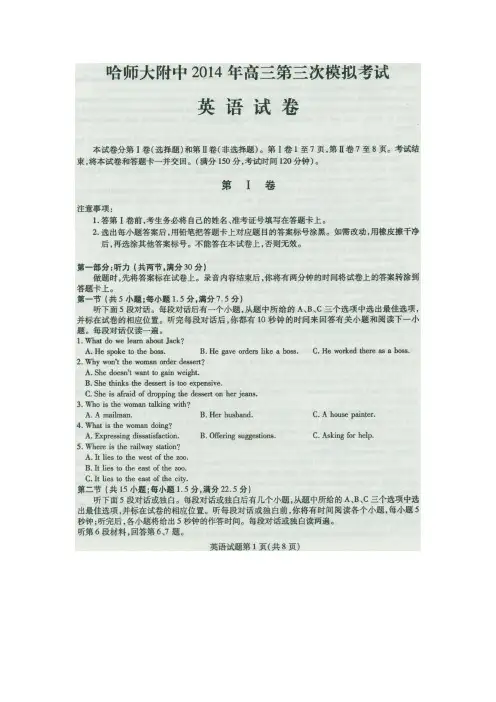
2014年哈师大附中第三次高考模拟考试英语参考答案第I卷(选择题,共100分)听力:1~5 BACBA 6~10 ACBCA 11~15 BCBAC 16~20 BACBA 阅读:21~24 CABD 25~28 CDAB 29~32 BABC 33~35 CCB七选五:36~40 ECAFG完型:41~45 CDACA 46~50 DBABD 51~55 CABAC 56~60 ACDDB第II卷(非选择题,共50分)语法填空:61.speaking 62.him/his voice 63.when 64.the 65.haven’t seen 66.worst 67.could/was able to 68.terrified 69.circumstances 70.without改错:1.car 前加a 2.marking---marked3.it---them 4.much去掉5.photograph---photographs 6.which--where/在which前或settled后加in 7.contain ---containing 8.so ---but9.decide---decided 10.taste---tasty书面表达:Whether Students Should Open Online StoresWith the Internet booming rapidly, creating an online store becomes fashionable. Meanwhile, more and more students are getting into the field to show their capabilities. But opinions on whether they should do it are divided into two aspects. Students who are in favor of it believe that it offers an opportunity to make them get in touch with society ahead of time. What’s more, it will to ughen them better. On the contrary, it’s thought that opening online stores will distract students from their study. Moreover, so naive are students that they would be taken in easily.As for me, opening online stores is a good idea, partly because we should gain and accumulate some experience before getting into society; partly because we need to achieve our maturity earlier. Just find the balance.听力原文:1.W: Do you get along well with Jack at the office?M: He ordered everyone around as if he were the boss there.2.M: I think I’ll order the chocolate ice cream because I didn’t eat lunch earlier today.W: No dessert for me. I can hardly get into my jeans as it is.3.M: Shall I start to paint on the outside of your house now?W: Not yet. I’ve not made up my mind about the color. I’ll have to wait until tomorrow when my husband comes back.4.M: I’d love to go to the Super Bowl next week, but I don’t think there are any more tickets.W: Why don’t you talk to Laura? She is a big football fan. She might be able to give you some advice on how to get a ticket. And I know she is planning to go herself, so maybe you could go with her.5.W: Excuse me, can you tell me how to get to the zoo?M: You can take a No. 111 Bus.W: Where shall I get off the bus?M: At the railway station. The zoo is to the east of it. It’s not very far, you can’t miss it.W: Thank you.6.W: Can I help you, sir?M: Yes, I want to get some pillows. Where can I find them?W: Come this way, please. There are many beautiful ones here.M: How much are these pillows, please?W: $4.00 each or $7.00 for a pair.M: I’ll take a pair of this kind.7.M: I’m wondering if it’s going to be fine this afternoon.W: So what?M: The sports meet! It’s fixed at 2:00, but the fog! You can only see a shor t distance.W: But don’t you see the wind’s beginning to lift it up? I bet it will be fine this afternoon.M: Don’t be so sure.W: You’ve heard the forecast this morning, haven’t you?M: No. That’s why I’m worried.W: Why not try the 24-hour telephone weather forecast service?M: Gee! How come I didn’t think of that? I’ll do it right away.8.W: Tom, when can we expect you and your daughter for dinner? Next Saturday?M: Next Saturday? I’m sorry. I’ve promised to go to a Chinese opera with my daughter. She’s been longing for that day.W: How about Sunday then?M: Yes, Sunday sounds fine. What time?W: Does 6:30 suit you?M: It suits me fine, but we don’t know where you live.W: No problem. I’ll meet you at the school entrance. I just live two blocks away.M: All right. What do you want us to bring?W: Well, I don’t know. That’ll be for you to decide.M: Good. I’ve got a new dish that I want to try out.W: Fine. I’ll see you then.M: Thanks. Goodbye.9.M: Is it true that fast-food restaurants are very popular in the USA?W: Yes, especially in those big cities.M: Why?W: Because the food is good, the service is fast and the prices are low.M: Oh, that’s good. Then which restaurant is most well-known?W: McDonald’s. By 1982, there were 7063 McDonald’s in the world, and about 1283 of them were in other countries, such as Japan, West Germany, England and Australia.M: I see. How about the service and the food?W: Well, the employees there are helpful and polite, and the tables and floors are clean enough, most impor tant, customers can get the same food, at any McDonald’s in any state or country. The food, of course, is quite good. French fries, the hamburgers, the sandwiches—all are specially prepared. Workers would buy their lunches there because they tasted better than their lunches from home.M: Who is the owner of McDonald’s?W: It was first owned by two brothers, Richard and Maurice McDonald. Then, in 1960, Ray Kroc, a 56 years old salesman, bought the name and most of their restaurants for $2.7 million, and now he is the owner.10.Yes, you’re right. I am from South Africa. I am not at all used to this cold weather, but I am glad to say that I have all the clothes for this freezing weather.When I first got to know that I would be attending this international conference here in Finland, I had no idea what kind of clothes I should take along. I didn’t know what to do when I thought of this two week stay here, with a rather formal dinner, a few parties, social gatherings and a dance during the conference.Fortunately, my friend Julia has been to Northern Europe. Yes, she was a great help. She helped to solve my biggest problem. She placed an order for some warm suits and dresses, business-type clothes, of course, of dark colours. She also bought me some skirts and blouses so that I could wear the same clothes in several different ways. A couple of lively coloured dresses will give me a nice change from time to time. She also helped to choose a very warm raincoat and a pair of boots.Oh, how lucky I am to have such a helpful friend. She saved me a lot of trouble.。
黑龙江省哈六中2013-2014学年高二下学期期中考试 英语 Word版含答案

哈尔滨市第六中学校2013-2014学年度下学期期中考试高二英语试题第I卷第一部分听力(共两节,满分30分)第一节1. What does the woman think of the lecture?A. It was interesting but difficult.B. It was easy but boringC. It was long but easy.2. Where do the speakers usually have meals probably?A. At homeB. At the restaurantC. At the student cafeteria3. What are the speakers mainly talking about?A. The man’s bossB. An invitationC. Gifts4. What can the man eat according to the doctor?A. FishB. SweetsC. Meat5. What did the girl forget to buy?A. PaintsB. BooksC. Paintbrushes第二节听第6段材料,回答第6,7题6. What are the speakers mainly talking about?A. Historic placesB. Some friends’ living placesC. Some friends’ jobs.7. What do we know about Ben?A. He is a studentB. He works at a studioC. He lives in a new flat听第7段材料,回答第8至10题8. What is the probable relationship between the speakers?A. Guide and touristB. Boss and secretaryC. Interviewer and interviewee.9. What should the woman do first?A. Pick up the tour groups from their hotel.B. Pick up the tour groups from the airport.C. Answer the questions about the sights.10. What does the woman need to be able to do in case of an emergency?A. Comfort touristB. Drive the tour busC. Answer tourists’ questions听第8段材料,回答第11至13题11. Why does the woman usually take a hat when going on a trip?A. To keep warm.B. To keep her hairstyleC. To protect her against the changing weather.12. What does the man suggest taking?A. A raincoatB. A blanketC. A pair of sunglasses13. Where are the speakers going?A. To the countrysideB. To the beachC. To the mountains听第9段材料,回答第14至16题14. What does the man’s mother ask him to do a few times a week?A. CookB. Wash upC. Clean his room15. What does the woman think is fun?A. The whole family takes a trip at the weekendB. The whole family prepares big dinners at the weekend.C. The whole family watches TV in the living room.16. Who is good at fixing things?A. The manB. The woman’s fatherC. The man’s father听第10段材料,回答第17至20题17. What are sharks famous for?A. Their large bodiesB. Their high intelligenceC. Their attacks on sea creatures.18. How long can the biggest whale shark be?A. Twenty metresB. Ten metresC. Two metres19. What do sharks’ good senses help them do?A. Escape from dangerB. Find their foodC. Kill their enemies20. Where do most sharks live?A. In warm waters of oceansB. In cold areas of oceansC. In warm lakes.第二部分阅读理解(共两节,满分40分)AOffering a powerful new tool against terrorism, researchers have found a way to detect lies in the liar’s blushing(脸红) face. The technique, described in the journal (期刊) Nature, uses a thermal camera (热感照相机) to detect the sudden shift of blood flow in the face. The system performed as a traditional polygraph (测谎仪), the scientists report.Pushed by technological advances and with fresh interest since Sept.11, the discovery is part of the development in the scientific study of detection. Although the lie remains a mysterious phenomenon, researchers in recent years have found a number of new methods that might take the place of the polygraph, from brain scans, to slight changes in eye movement, to sparks of electrical activity that signal a person has seen a victim or a crime scene before. The new finding says, when a person tells a lie, there is a sudden change of blood to the area around the eyes. Although the change is not ordinary visible, the blood warms the skin, causing bands of color to appear through a camera sensitive to heat.One advantage of the camera can provide answers quickly, and doesn’t require a highly trained expert to operate it or explain its results. In theory, this new technology could be used anywhere large numbers of people need to be quickly screened.But some scientists say the technology would need to be improved before it is ready for use, for it is possible that there are other reactions that cause a sudden change in blood flow in the face and there is also the danger that people will learn to fool the machine, the same way they try tofool polygraph examiners by controlling their breathing or taking drugs to relax themselves.21. Compared with a traditional polygraph, the new tool’s progress lies in the fact t hat _______.A. it is moveableB. it is easier to operateC. it gives correct conclusionD. it can only be used in public places.22. Different from the other tried ways, this new technology studies ______ to detect lies.A. brain wavesB. eye movementsC. electrical sparksD. change in facial blood flow23. We can infer that _________ inspires the finding of the new way of detection.A. the need of personal securityB. the data collected in the tried waysC. the threaten from terrorismD. the desire for public use24. It is NOT true that this new technology _________.A. is incomparable as a result of perfect development and necessary restsB. is likely to be used widely to screen large number of peopleC. faces the danger of being fooled by experienced and drug-taking liarsD. needs to be improved before being put into useBOnline Money EarningYes, you can earn money online without any investment or without any time limit. I have many useful easy methods for earning easy money while we all spend our useful time on the Internet by surfing, chatting, downloading and other work. There is no need to stop any other work. We can earn with or without our daily routine. Here I tell you the complete method for online earning.First MethodEarn money with ―Bux. to‖. You can earn money through ―Bux. to‖ by clicking on ads on ―Bux. to‖ site. First you need to poen an account at ―Bux. to‖.―Bux. to‖ is a new international and FREE English based service that allows advertisers to reach thousands of potential customers by displaying their ads on our ―Surf Ads‖ page. An exact calculated percentage of all advertising income is paid to our members. ―Bux. to‖ makes money through advertising.How you make moneyYou view websites in 30 seconds through the ―Surf Ads‖ page. Once the 30 seconds is up, you’ll either get a green tick (对号) sign or a red ―×‖. The green tick sign means you’ve earned $0.01 and the ―×‖ means you have not earned money for the visit. You’ll get red×s when you have more than one website from the ―Surf Ads‖ page open. When this happens, you get no credit.Earnings exampleYou click 10 ads per day=$ 0.1020 referrals (转送) click 10 ads per day=$2.00Your daily earnings=$ 2.10Your weekly earnings=$14.70Your monthly earnings= $63.00How to get paidIf you have at least $10.00 accumulated, you can click on your account balance within your state’s area and it will meet your request. At present, it only makes payments through ―AlertPay ‖. It will soon be using other methods of payment.AlertPay is the payment processing solution that we use to pay members. Your AlertPay address is the e-mail address you use to register with AlertPay. You can get a free AlertPay account at .Method 2 will publish soon…25. The underlined word ―accumulated‖ can be replaced by ―_______‖.A. wastedB. spentC. lostD. gathered26. What can we know from the passage?A. You’ll earn $ 0.10 if you click 1 ad.B. You’ll get many green ticks if you have many websites open.C. You can get your payments through AlertPay.D. Your AlertPay account is not for free.27. What is the author’s purpose of writing this passage?A. To tell an interesting story.B. To introduce a surprising way to earn money.C. To solve a puzzling problem.D. To present exciting research.CFacial expressions carry meaning that is determined by situations and relationships. For example, in American culture (文化) the smile is in general an expression of pleasure. Yet it also has other uses. A woman’s smile at a police officer does not carry the same meaning as the smile she gives to a young child. A smile may show love or politeness. It can also hide true feelings. It often causes confusion (困惑) across cultures. For example, many people in Russia consider smiling at strangers in public to be unusual and even improper. Yet many Americans smile freely at strangers in public places (although this is less common in big cities). Some Russians believe that Americans smile in the wrong places; some Americans believe that Russians don’t smile enough. In Southeast Asian cultures, a smile is frequently used to cover painful feelings. Vietnamese people may tell a sad story but end the story with a smile.Our faces show emotions (情感), but we should not attempt to ―read‖ people from another culture as we would ―read‖ someone from our own culture. The fact that members of one culture do not express their emotions as openly as do members of another does not mean that they do not experience emotions. Rather, there are cultural differences in the amount of facial expressiveness permitted. For example, in public and in formal situations many Japanese do not show their emotions as freely as Americans do. When with friends, Japanese and Americans seem to show their emotions similarly.It is difficult to generalize about Americans and facial expressiveness because of personal and cultural differences in the United States. People from certain cultural backgrounds in the United States seem to be more facially expressive than others. The key is to try not to judge people whose ways of showing emotion are different. If we judge according to our own cultural habits, we may make the mistake of ―reading‖ the other person incorrectly.28. What does the smile usually mean in the U.S.?A. Love.B. Politeness.C. Joy.D. Thankfulness.29. The author mentions the smile of the Vietnamese to prove that smile can ___ .A. show friendliness to strangersB. be used to hide true feelingsC. be used in the wrong placesD. show personal habits30. What should we do before attempting to ―read‖ people?A. Learn about their relations with others.B. Understand their cultural backgrounds.C. Find out about their past experience.D. Figure out what they will do next.31. What would be the best title for the text?A. Cultural DifferencesB. Smiles and RelationshipC. Facial ExpressivenessD. Habits and EmotionsDIt was Saturday. As always, it was a busy one, for ―Six days shall you labor and do all your work‖ was taken seriously back then. Outside, Father and Mr. Patrick next door were busychopping firewood. Inside their own houses, Mother and Mrs. Patrick were engaged in spring cleaning.Somehow the boys had slipped away to the back lot with their kites. Now, even at the risk of having Brother caught to beat carpets , they had sent him to the kitchen for string(线). It seemed there was no limit to the heights to which kites would fly today.My mother looked at the sitting room ,its furniture disordered for a thorough sweeping. Again she cast a look toward the window. ―Come on, girls ! Let’s take string to the boys and watch them fly the kites a minute.On the way we met Mrs. Patrick, laughing guiltily as if she were doing something wrong, together with her girls.There never was such a day for flying kites! We played all our fresh string into the boys’ kites and they went up higher and higher .We could hardly distinguish the orange-colored spots of the kites. Now and then we slowly pulled one kite back, watching it dancing up and down it the wind, and finally bringing it down to earth, just for the joy of sending it up again.Even our fathers dropped their tools and joined us. Our mothers took their turn, laughing like schoolgirls. I think we were all beside ourselves. Parents forgot their duty and their dignity; children forgot their everyday fights and little jealousies. ―Perhaps it’s like this in the kingdom of heaven,‖ I thought confusedly.It was growing dark before we all walked sleepily back to the houses. I suppose we had some sort of supper. I suppose there must have been a surface tidying-up, for the house on Sunday looked clean and orderly enough. The strange thing was, we didn't mention that day afterward. I felt a little embarrassed .Surely none of the others had been as excited as I. I locked the memory up in that deepest part of me where we keep ―the things that cannot be and yet they are.‖The years went on, then one day I was hurrying about my kitchen in a city apartment, trying to get some work out of the way while my three-year-old insistently cried her desire to ―gopark ,se e duck.‖―I can’t go!‖I said. ―I have this and this to do, and when I’m through I’ll be too tired to walk that for.‖My mother , who was visiting us , looked up from the peas she was shelling ,―It’s a wonderful day,‖ she offered,―really warm , yet there’s a fine breeze. Do you remember that day we flew kites?‖I stopped in my dash between stove and sink. The looked door flew open and with it a rush of memories. ―Come on.‖ I told my little girl.―You’re right, it’s too good a day to miss.‖Another decade passed. We were in the aftermath (余波)of a great war. All evening we had been asking our returned soldier, the youngest Patrick Boy, about his experiences as a prisoner of war. He had talked freely , but now for a long time he had been silent . What was he thinkingof – what dark and horrible things?―Say!‖ A smile slipped out from his lips. ―Do you remember --- no, of course you wouldn’t . It probably didn’t make the impression on you as it did on me.‖I hardly dared speak.― Remember what ?‖―I used to think of that day a lot i n POW camp(战俘营), when things weren’t too good. Do you remember the day we flew the kites?‖32.Mrs. Patrick was laughing guiltily because she thought _______ .A. she was too old to fly kitesB. her husband would make fun of herC. she should have been doing her housework thenD. her girls weren’t supposed to play the boys’ game33. By ―we were all beside ourselves‖, the writer means that they all___________.A. felt confusedB. went wild with joyC. looked onD. forgot their fights34. What did the writer think after the kite-flying?A. The boys must have had more fun than the girls.B. They should have finished their work before playing.C. Her parents should spend more time with them.D. All the others must have forgotten that day.35. The youngest Patrick Boy is mentioned to show that _____ .A. the writer was not alone in treasuring her fond memoriesB. his experience in POW camp threw a shadow over his lifeC. childhood friendship means so much to the writerD. people like him really changed a lot after the war第二节七选五(满分10分)__36__ He had more money than he could ever spend, and he was admired and looked up to by his community.__37__ He wasn't happy. All his life he had been pursuing happiness and striving(奋斗)for happiness, but he had never been able to find it.Then one day he heard about a hidden temple in Nepal that had a special room that contained the secret of happiness.__38__ After many years of searching and countless hardships he arrived there. He was tired and penniless, but he knew that none of that mattered now because he had found the temple. He asked a wise, smiling monk(和尚)if he could enter the special room. The monk agreed and showed him the stairs leading to the room.__39__ He stared into the room with sunlight screaming through the window and saw what he had come so far to find. There hanging on the wall was the secret of happiness. The man gazed at his reflection in the mirror and laughed.__40__ Happiness is a choice that we can make. Don't spend the rest of your life searching the world for happiness then. Just look in the mirror and laugh. Just let the happiness flow from your heart, mind, and soul until it fills your life and the lives of all those around you.A.He immediately sold all that he owned and set out to find this hidden temple.B.The man found the secret of happiness at last.C.But he knew that something was missing in his life.D.He climbed them with legs shaking with expectation and slowly opened the door.E.There once was a very wealthy and successful man.F.It is time that we all realized that we were the secret of our own happiness.G.It was difficult to find the temple in Nepal.第三部分英语知识运用(共两节满分45分)第一节完型填空(满分30分)We have been driving in fog all morning, but the fog is lifting now. The little se aside villages are 41 , one by one. ―There is my grandmother’s house,‖ I say, 42 across the bay to a shabby old house.I am in Nova Scotia on a pilgrimage (朝圣) with Lise, my granddaughter, seeking roots for her, retracing (追溯) 43 memory for me. Lise was one of the mobile children, 44 from house to house in childhood. She longs for a sense of 45 , and so we have come to Nova Scotia where my husband and I were born and where our ancestors 46 for 200 years.We soon 47 by the house and I tell her what it was like here, the memories 48 back, swift as the tide (潮水).Suddenly, I long to walk again in the 49 where I was once so glorious a child. It still 50 a member of the family, but has not been lived in for a while. We cannot go into the house, but I can still walk 51 the rooms in memory. Here, my mother 52 in her bedroom window and wrote in her diary. I can still see the enthusiastic family 53 into and out of thehouse. I could never have enough of being 54 them. However, that was long after those childhood days. Lise 55 attentively (聚精会神地) as I talk and then says, ―So this is where I56 ; where I belong.‖She has 57 her roots. To know where I come from is one of the great longings of the human 58 . To be rooted is ―to have an origin‖. We need 59 origin. Looking backward,we discover what is unique in us; learn the 60 of ―I‖. We must all go home again—in realityor memory.41. A. appearing B. moving C. exposing D. expanding42. A. referring B. traveling C. pointing D. coming43. A. shared B. short C. fresh D. treasured44. A. passed B. raised C. moved D. sent45. A. home B. duty C. reality D. relief46. A. built B. lived C. remained D. explored47. A. catch up B. pull up C. step down D. come down48. A. falling B. turning C. rushing D. binging49. A. yard B. village C. room D. house50. A. adapts to B. appeals to C. belongs to D. occurs to51. A. across B. through C. along D. past52. A. lay B. played C. stood D. sat53. A. marching B. looking C. breaking D. pouring54. A. between B. with C. near D. behind55. A. wonders B. listens C. reacts D. agrees56. A. began B. grew C. studied D. stayed57. A. deepened B. recognized C. accepted D. found58. A. heart B. rights C. interest D. behaviors59. A. one B. its C. that D. every60. A. meaning B. expression C. connection D. background第II卷第三部分:英语知识运用(满分45分)语法填空(满分15分)A reporter: Hello, Elias, may I ask you some questions?Elias: Certainly.A reporter: Why did you join the ANC Youth League?Elias: Because it fought 61 equal rights for black and white people in South Africa.A reporter: Can you give me some reasons for it?Elias: Ok. There are three reasons. Firstly, as a black person I could not work without a passport, 62 had my name, address and birthplace in it. If the police found me 63 it or if I was living in the wrong town, I could 64 (put) in prison. Secondly, in the gold mines where I worked, white workers sat in their offices 65 the black South Africans worked underground.Thirdly, the white could live anywhere they 66 (like) in South Africa. They owned almost all the land although they were 67 (few) in number than the black. They had the best schools and the best doctors. We wanted to have the same rights and be 68 (equally) with69 white in our own land. I believe the ANC youth League could help us solve the problems.A reporter: I think you are right. The black should earn 70 equal rights. I support you.Elias: Thank you very much.A reporter: You’re welcome.61. 62. 63. 64. 65.66. 67. 68. 69. 70.第四部分:写作第一节:短文改错(满分10分)I was very exciting when I boarded the flight for Taiwan. The plane flew for about four hoursafter it landed on the island. On arrival, we were greeted by local guide. We stayed in Taiwan for eight day. During our stay, we went boating in Riyuetan Pool, that is a beautiful lake. We visited Mountain Ali, where we went hiking. We also have a good time in Tailu Pavilion and kending Park. That impressed us mostly was that the local people were very friendly. Wherever we went, they were given a warm welcome. Although our trip was very busy, but it was pleasant.第二节:书面表达(满分25分)假如你是李华,在―母亲节‖前,你班举行了一次―学会感恩‖的主题班会。
黑龙江省哈尔滨师范大学附属中学2013—2014学年度高一下学期期中考试试题英语

黑龙江省哈尔滨师范大学附属中学2013—2014学年度高一下学期期中考试试题英语考试时间:2014年5月6日本试卷分为第I卷(选择题)和第II卷(非选择题)两部分。
满分150分,考试用时120分钟。
第I卷第一部分: 单项填空(共20小题;每小题1分,满分20分)从A、B、C、D四个选项中,选出可以填入空白处的最佳选项,并在答题卡上将该项涂黑。
1. Jumping out of ________ airplane at ten thousand feet is quite ________ exciting experience.A. an; /B. /; anC. an; anD. the; an2. With the country’s population reaching 1.6 billion in the mid of this century, most of China’s rivers, including the Yellow River, ________.A. is drying upB. will be drying upC. dry upD. have dried up3. Great ___________ should be made to speed up higher education to meet the needs of industry and agriculture.A. measuresB. goalsC. effortsD. effects4. London is a most beautiful city, ________ the River Thames.A. located inB. lied onC. situated onD. stood in5. —The English exam was not difficult, was it?—________. Even Tom ________ to the top students failed in it.A. Yes; belongsB. No; belongedC. Yes; belongingD. No; belonging6. ________ the Internet is bridging the distance between people, it may also be breaking some homes orwill cause other family problems.A. WhenB. WhileC. IfD. As7. He suddenly saw Sue ________ the room. He pushed his way ______ the crowd of people to get to her.A. across; overB. over; throughC. over; intoD. across; through8. Thinking of the increasingly bad situation, he couldn’t but ______ worried.A. feelB. feelingC. feltD. to feel9. ________ of my school ________ two large lakes in which many kinds of fish live.A. East; lieB. To the east; does lieC. The east; liesD. On the east; lies10. The tower clock was ________ eleven when I was walking towards home.A. hittingB. beatingC. strikingD. knocking11. Nobody would stand out admitting the fact, for some reason, ________ they lost the game.A. thatB. whichC. whatD. why12. The soldiers have to stand for hours without changing ________.A. positionB. stateC. situationD. condition13. —Did you watch the football match last night?—No, there was something wrong with my TV and it couldn’t ________ any programs.A. send upB. get upC. pick upD. take up14. It is exactly the way ________ we speak ________ makes our teacher angry.A. which; thatB. what; whichC. that; whichD. that; that15. Cars do cause us some health problems—in fact far more serious ________ than mobile phones do.A. oneB. onesC. itD. those16. —Were you late for the film?—Very late. Half of it ________ by the time we ________ the cinema.A. was shown; reachedB. had been shown; reachedC. was shown; had reachedD. had been shown; had reached17. ________ is no possibility ________ Rob can win the first prize in the match.A. There; thatB. It; thatC. There; whetherD. It; whether18. —I heard you saw the film Taijiong last night. ________?—It’s totally fascinating.A. Have you got thatB. How do you think of itC. How do you find itD. Oh, really19. ______ in the research of bird languages, Mr. Richard hasn’t got any time to relax these days.A. DevotedB. ConcernedC. ContributedD. Buried20. I don’t like Tom’s way of behaviour, but ________ I admire his great knowledge.A. in other wordsB. on the other handC. for one thingD. as a matter of fact第二部分:阅读理解(共两节,满分40分)第一节(共15小题;每小题2分,满分30分)阅读下列短文,从每题所给的四个选项(A、B、C和D)中,选出最佳选项,并在答题卡上将该项涂黑ASeveral times my daughter had telephoned to say, “Mum, you must come and see the daffodils (水仙花) before they are over.” I wanted to go, but it was a two-hour drive from Lake Arrowhead. “I will go next Tuesday,”I promised, a little unwillingly, on her third call.The next Tuesday dawned cold and rainy. Still, I had promised, and so I drove there. When I finally walked into Carolyn’s house and hugged and greeted my grandchildren, I said, “Forget the daffodils, Carolyn! The road is invisible (看不见的) in the cloud and fog, and there is nothing in the world except you and these children that I want to see!”My daughter smiled calmly and said, “We drive in this weather all the time, Mum. You will never forgive yourself if you miss this experience.”After about twenty minutes, we turned onto a small road and I saw a small church. On the far side of the church, I saw a hand-lettered sign that read“Daffodil Garden”.We got out of the car and each took a child’s hand, and I followed Carolyn down the path. Then, we turned a corner of the path, and I looked up and gasped. Before me lay the most beautiful sight! There were five acres of flowers! “But who has done this?” I asked Carolyn. “It's just one woman,” Carolyn answered. “That's her home,”Carolyn pointed to a well-kept A-frame house that looked small and modest in the midst of all that glory. We walked up to the house. On the patio (庭院), we saw a poster. “Answers to the Questions I Know You Are Asking”was the headline.The first answer was a simple one. “50,000 bulbs (鳞茎),” it read. The second answer was, “One at a time, by one woman.” The third answer was, “Began in 1958.”I thought of this woman whom I had never met, who, more than fifty years before, had begun—one bulb at a time—to bring the beauty and joy to the mountain top.21. The author didn’t go to see the daffodils at first because ________________.A. she was not interested in themB. they were growing on the mountain topC. the weather was not good enoughD. it was not easy for her to drive there22. What do we know about the woman living in the A-frame house?A. She must be out of mind.B. She was a gardener there.C. It took her great determination to grow the daffodils.D. She was poor and made her living by selling daffodils.23. What could the author probably learn from this experience?A. Nothing is too difficult if you put your heart into it.B. We must put the interests of others above our own.C. We can change the world by growing flowers.D. It's never too late to learn.24. What would be the best title for the passage?A. An Unforgettable Experience.B. Beautiful Daffodils.C. One Bulb at a Time.D. I Love Daffodils.BWhy 33% of the households in the USA have cats? And how do you explain why there are 16 million more pet cats than dogs? Yes, cats are bearable. Yes, they can grow up to be good mousers and are very entertaining towatch. And yes, cats are independent and don’t require as much care as dogs. But research shows cats can also be caretakers for us and our families, improve our health and teach us and our children to be kinder, gentler souls.Theodora Wesselman is 94 and has lived for the past two years with her elderly cat, Cleo, at Tiger Place, a retirement community in Columbia, Mo. Their lasting friendship is a classic example of how humans and animals can become family and look out for each other.Wesselman visits other residents, and her children stop by, but Cleo is her best friend, according to her.“She sleeps on her own pillow right beside mine,” Wesselman says. “In the morning, she pecks on my cheek to wake me up. It’s really sweet. I pet her, tell her I love her and take her to the kitchen to prepare her food.”Research shows that being able to care for a pet improves our mood and encourages us to take care of ourselves, says Rebecca Johnson, director of the University of Missouri’s Research Center for Human-Animal Interaction. The research is leading more retirement communities and universities to roll out the welcome mat for pets.25. According to the context, where do you think the sentence “They start and end the day together.”should appear in the passage?A. At the end of para.1.B. At the beginning of para.2.C. At the end of para.3.D. At the beginning of para. 4.26. Which of the following words best describe the author’s attitude towards keeping pet cats?A. Favorable.B. Critical.C. Objective.D. Doubtful.27. Why does the author take 94-year-old Theodora Wesselman as an example in the passage?A. To show that the elderly like Theodora Wesselman in the USA have pet cats.B. To suggest humans and pet cats can be caretakers for each other.C. Because Theodora Wesselman has been living with a pet cat for the past two years.D. Because Theodora Wesselman pets her cat Cleo and tells her she loves her.28. What does “to roll out the welcome mat for pets” in the last paragraph imply?A. To give a special welcome to pets.B. To make the welcome mat for pets.C. To open out the welcome mat for pets to sleep.D. To wrap the welcome mat to make room for pets.CAdult Basic Education (ABE) PreparationTaskThe ABE Department serves a huge population of learners. Our task is to teach basic skills and help learners to get more knowledge to function effectively as a family member, citizen, worker, and lifelong learner in a changing world.DescriptionABE is a non-credit program of self-improvement designed to improve basic skills for students who are of different educational levels. Development of reading, writing, and math skills are paid special attention to, as well as life skills, employability, and technology. Students without a high school diploma also have the opportunity to prepare for the GED (General Equivalency Diploma) exams in the five subject areas: writing, social studies, science, literature, and math.Prerequisites (条件)ABE classes are open to anyone 18 or over who desires to improve basic reading, writing, and math skills at the pre-college level. Students who are 16 or 17 must obtain an official permission from high school before attending class.To be accepted, students must attend an Educational Planning Session. During the Educational Planning Session students will be given an overview of the ABE programs as well as PCC policies, fees, etc.Students will also have their reading, writing, and math abilities assessed (评估)during the Educational Planning Session. The results of their assessments will help the teachers develop individual programs of study for students to guide them toward their personal goals. Students needing special help must get in touch with the Office for Students with Disabilities (503-977-4341) at least two weeks before the session is held.CoursesABE 0741: Beginning LiteracyABE 0742: BeginningABE 0743: Intermediate IABE 0744: Intermediate IIABE 0745: Secondary IABE 0746: Secondary II (Includes preparation for the GED Test)29. The ABE Department serves an aim to ____________________.A. provide learners with basic knowledge and skills to fit in with societyB. help learners successfully get a job in a changing worldC. offer diplomas to those who fail to finish secondary educationD. provide students with opportunities to prepare for the GED exams30. A 17-year-old student is not accepted to ABE classes only because he _________________.A. is below eighteenB. can’t offer a high school diplomaC. can’t provide an official permission from high schoolD. is assessed as poor in learning31. Different courses are offered to different students according to _______________.A. their own choicesB. the assessments during the Education Planning SessionC. their performances in schoolD. how much they pay for the coursesDEach Indian was supposed to keep his birth name until he was old enough to earn one for himself. But his playmates would always give him a name of their own. No matter what his parents called him, his childhood friends would use the name they had chosen. Often it was not pleasing, such as Bow Legs or Bad Boy. But sometimes a name fit so well that the youngster found it difficult to shake it off. If he could not earn a better one from a war later, he could be stuck with a name like Bow Legs for the rest of his life.The Indian earned his real name when he was old enough for his first fight against the enemy. His life name depended on how he acted during this first battle. When he returned from the war, the whole tribe would gather and observe the ceremony in which he would be given his name by the chief. If he had done well, he would get a good name. Otherwise he might be called Crazy Wolf or Man-Afraid-Of-a-Horse. So an Indian’s name told his record or described what kind of man he was.A man was given many chances to improve his name, however. If in a later battle he was brave in fighting against the enemy, he was given a better name. Some of our great fighters had as many as twelve names—all good and each better than the last.An Indian’s names belonged to him for the rest of his life. No one else could use them. Even he himself could not give them away because names were given by the tribe, not the family. So no man could pass on his name unless the chief and the tribe asked him to do so.Sometimes an Indian would be asked to give his name to a son who had performed a noticeable deed. I know of only three or four times when this happened. It is the greatest honor for a person—the honor of assuming(承担) his father’s name.32. An Indian could be given the second name by ________________.A. his fatherB. the enemyC. the chief of the tribeD. his childhood friends33. The greatest honor an Indian could earn was ________________.A. a victory in his first battle against the enemyB. a name given by the chiefC. a ceremony to get his real nameD. the right to use his father’s name34. If an Indian had more than ten names, it meant that __________________.A. many people in the tribe liked himB. he was a great fighterC. he had a lot of friendsD. he had fought in fewer than ten battles35. Which of the following statements is NOT true according to the passage?A. The names given by the playmates of an Indian were usually not pleasant.B. The life name of an Indian was earned in battle.C. An Indian could throw away his birth name when his playmates gave him one.D. The Indians themselves were not allowed to give their names away.第二节(共5小题;每小题2分,满分10分)根据短文内容,从短文后的选项中选出能填入空白处的最佳选项。
黑龙江省哈师大附中2013-2014学年高二上学期期末考试英语试题 Word版含答案

2014年哈师大附中高二学年上学期期末英语测试卷第I卷第一部分听力(共两节,满分15分)第一节(共5小题;每小题1分,满分5分)听下面5段对话。
每段对话后有一个小题,从题中所给的A、B、C三个选项中选出最佳选项,并标在试卷的相应位置。
听完每段对话后,你都有10秒钟的时间来回答有关小题和阅读下一小题。
每段对话仅读一遍。
1. When will the man arrive?A. In the morning.B. In the afternoon.C. In the evening.2. What does the woman advise the man to do first?A. Read the instructions.B. Try pressing the buttons.C. Have the machine checked.3. What does the woman mean?A. She has a dictionary.B. She can pronounce the word.C. They should look up the word in the dictionary.4. What do we know about the man?A. He likes collecting clocks.B. His family makes clocks.C. He has a bad sense of time.5. Why didn’t the girl go on a picnic?A. She had to prepare for her exam.B. She had to look after her grandma.C. The others went without her.第二节(共10小题;每小题1分,满分10分)听下面对话或独白。
每段对话或独白后有几个小题,从题中所给的A、B、C三个选项中选出最佳选项,并标在试卷的相应位置。
黑龙江省哈师大附中-度高二英语下学期期中考试试卷

哈师大附中高二学年下学期期中考试英语试题I.听力部分(共两节,满分20分)第一节(每小题1分,满分5分)听下面5段对话。
每段对话后有一个小题,从题中所给的A、B、C三个选项中选出最佳选项,并标在试卷的相应位置。
听完每段对话后,你都有10秒钟的时间来回答有关小题和阅读下一小题。
每段对话仅读一遍。
1. What is the man?A. A waiter.B. A clerk.C. An airhostess.2. How many hours does the woman work every week?A. 40.B. 47.C. 50.3. What is the probable relationship between the speakers?A. Sister and brother.B. Mother and son.C. Teacher and pupil.4. What would the woman like to drink?A. Coffee.B. Milk.C. Tea.5. What does the woman plan to do tomorrow?A. Sleeping late.B. Doing some washing up.C. Cooking breakfast herself.第二节(共15小题,每小题1分,满分15分)听下面5段对话或独白。
每段对话或独白后有几个小题,从题中所给的A、B、C三个选项中选出最佳选项,并标在试卷的相应位置。
听每段对话或独白前,你将有时间阅读各个小题,每小题5秒钟;听完后,各小题将给出5秒钟的作答时间。
每段对话或独白读两遍。
听下面一段材料,回答第6—7题:6. Who is “Mr. Rice Guy”?A. A famous cook.B. An actor.C. A dancer.7. What can we learn about “Mr. Rice Guy”?A. He is good at cooking.B. He likes watching dinnertime show.C. He is learning to cook from his wife.听下面一段材料,回答第8—10 题:8. Where is the man going?A. To Paris.B. To London.C. To Berlin.9. How did the man go to Europe in World War II?A. By plane.B. By warship.C. By truck.10. How soon will the speakers arrive?A. In 2 hours.B. In 4 hours.C. In 6 hours.听下面一段材料,回答第11—13题:11. Who is the woman?A. A sportswoman.B. A mountaineer.C. A pilot.12. What caused the accident?A. She hurt her arm.B. She lost her way.C. She landed the wrong way.13.What can we learn about the woman?A. She is weak.B. She failed only twice.C. She’ll recover in about two months.听下面一段材料,回答第14—16题:14. Where is the speakers’ apartment?A. On the top floor.B. On a middle floor.C. On the ground floor.15. What can we learn about the house?A. It’s far from the street.B. It’s well furnished.C. It’s pretty small.16. What are the speakers doing next?A. Go to see the house.B. Get a repairman.C. Move house.听下面一段材料,回答第17—20题:17. Why is the meeting held?A. To make the vacation arrangements.B. To announce the end of the semester.C. To announce academic projects.18. What need the audience do now?A. Move their belongings.B. Fill out forms.C. Leave their dorms.19. Which will be closed during the vacation?A. The computer center.B. The library.C. The dining halls.20. Which will be open on regular hours?A. Post office.B. The gymnasium.C. The college store.II.单项选择(共20小题,10分)21. ________ woman as Jane is, she is brave. When she caught ________ sight of a thief, she ran after him.A. A; theB. /; /C.A; aD. /; a22. This kind of desk can be __________ to the height one needs, which makes it very popular.A. adaptedB. adoptedC. addictedD. adjusted23. W e all know that, __________, the situation will get worse.A. not if dealt carefully withB. if not carefully dealt withC. if dealt not carefully withD. not if carefully dealt with24. I thought the pop song was the best I’d ever heard ___________ I heard it.A. for the momentB. the momentC. in a momentD. for a moment25. The problem is _________ we have enough time to do it.A. thatB. ifC. whetherD. what26. I was busy yesterday, otherwise I _________ your birthday party.A. attendedB. had attendedC. would attendD. would have attended27. --- Why was the road crowded?--- The traffic was __________ by a car accident.A. held upB. held backC. held outD. held on to28. --- Did you meet her this morning?--- Yes. It was in the hotel _________ she stayed.A. in whereB. thatC. whereD. in that29. It is agreed that the government should _________ the stadiums built for the Beijing Olympics.A. draw attention toB. take full advantage ofC. look back atD. make an impression on30. _________ more time, he could have done the work much better.A. To be givenB. To giveC. GivenD. Giving31. That was really a beautiful place. The first time I went there, I _________ it.A. fell forB. fell downC. fell overD. fell in32. --- I believe ________ you have done your best and ________ things will improve.--- Thank you.A. that; /B. /; /C. what; thatD. /; that33. Nowadays college graduates have to be highly __________ to find an ideal job.A. competitiveB. sensitiveC. attractiveD. constructive34. --- I don’t think I did anything wrong.--- If so, why were you only blamed _________ others?A. other thanB. as well asC. rather thanD. except for35. We had to rely on our own intelligence to create __________ and balance with the environmentduring development.A. consensusB. agreementC. propertyD. harmony36. Having finished the work, _____.A. it was almost six o’clockB. a postman came and delivered the evening paperC. supper had already been preparedD. we had a rest and then had supper37. I arrived late; I _____ the road to be so icy.A. wouldn’t expectB. haven’t expectedC. hadn’t expectedD. wasn’t expecting38. Only in this way __________ progress in your English.A. you can makeB. can you be able to makeC. you will be able to makeD. can you make39. It worried Tony a bit __________ his homework wasn’t finished.A. whenB. thatC. ifD. for40. --- How about going to the jazz concert tonight?--- I’d rather not. ___________.A. That’s settledB. It’s not my cup of teaC. That’s not the pointD. It’s up to youIII. 完形(满分30分,每题1.5分)A group of class friends, highly established in their careers, got together to visit their old university professor. Conversation soon 41 into complaints about stress in work and life.Offering his guests coffee, the professor went to the 42 and returned with a large pot of coffee and a couple of 43 —porcelain, plastic, glass, crystal, some 44 looking, some expensive, some delicate — telling them to 45 themselves to the coffee.When all the students had a cup of coffee in 46 , the professor said: “If you noticed, all the nice looking expensive cups were taken up, 47 behind the plain and cheap ones. While it is normal for you to 48 only the best for yourselves, that is the 49 of your problems and stress. Be assured that the cup itself 50 no quality to the coffee. In most cases it is just more expensive and in some cases even hides what we drink. 51 all of you really wanted was coffee, not the cup, but you 52 went for the best cups... And then you began 53 each other's cups. Now consider this: Life is the 54 ; the jobs, money and position in society are the cups. They are just tools to hold and contain life, and the type of cup we have does not 55 , nor change the quality of life we 56 . Sometimes, by concentrating only on the cup, we 57 to enjoy the coffee God has 58 us. God brews the coffee, not the cups... Enjoy your coffee! ”The happiest people don't have the best of everything. They just 59 the best of everything.Live simply. Love generously. Care deeply. Speak kindly. Leave the 60 to God.41. A. stopped B. looked C. grew D. turned42. A. living-room B. waiting-room C. bedroom D. kitchen43. A. cups B. pans C. bowls D. bottles44. A. plain B. clean C. ugly D. fine45. A. devote B. help C. dedicate D. enjoy46. A. stomach B. hand C. mind D. mouth47. A. falling B. leaving C. hiding D. keeping48. A. hope B. wish C. need D. want49. A. source B. resource C. energy D. reason50. A. adapts B. puts C. adds D. applies51. A. As B. What C. That D. Which52. A. consciously B. cheerfully C. purposely D. bravely53. A. looking B. glaring C. eyeing D. glancing54. A. tea B. water C. wine D. coffee55. A. sign B. mean C. define D. signal56. A. spend B. live C. hate D. love57. A. fail B. succeed C. tend D. manage58. A. shown B. taken C. sent D. provided59. A. keep B. take C. make D. hold60. A. complex B. remains C. rest D. complaintsIV.阅读理解(满分40分,每题2分)AWe were driving in the right lane when, all of a sudden, a black car jumped out of a parking space right in front of us. My taxi driver slammed on his brakes, skidded, and missed the other car’s back end by just inches! The driver of the other car, the guy who almost caused a big accident, turned his head angrily and started yelling bad words at us.My taxi driver just smiled and waved at the guy. And I mean, he was friendly. So, I said, “Why did you just do that? This guy almost ruined your car and sent us to the hospital!” And this was what my taxi driver told me, which I call “The Law of the Garbage Truck”.Many people are like garbage trucks. They run around full of garbage, full of frustration, full of anger, and full of disappointment. As their garbage piles up, they need a place to dump(倾卸)it. And if you let them, they’ll dump it on you. When someone wants to dump on you, don’t take it personally. You just smile, wave, wish them well, and move on.So this was it: “The Law of the Garbage Truck”. I started thinking, how often do I let Garbage Trucks run right over me? And how often do I take their garbage and spread it to other people: at work, at home, on the streets? It was that day I said, “I’m not going to do it any more.”I began to see garbage trucks. I see the load they’re carrying. I see them coming to drop it off. And like my taxi driver, I don’t make it a personal thing; I just smile, wave, and move on.Good leader know they have to be ready for their next meeting. Good parents know that they have to welcome their children home from school with hugs and kisses. What about you? The markof a successful person is how quickly they can get back their focus on what’s important.61.The driver of the black car got angry because ______.A.he couldn’t control his carB.he was in a bad moodC.he met with a garbage truckD.the taxi driver made a mistake62.Who acted like a garbage truck in the incident described in the first two paragraphs?A. The writerB. The taxi driverC. The black car driverD. None of them63. When the writer said “I’m not going to do it any more”, he meant he’d no longer ______.A. see garbage trucksB. have garbage dumped on himC. dump garbage on othersD. be a garbage truck himself64. What is the main idea of the last paragraph?A. Ignore unpleasantness and stick to your tasksB. Try to be good leaders as well as good parentsC. Always be kind and hard workingD. Do things quickly so as to be ready for the nextBHillary Clinton, 59, with her famous “I’m in, and I’m in to win” 2008 Race, began her e-mail to supporters, saying “I want you to join me not for the campaign but for a conversation about the future of our country. Le t’s talk, let’s chat.”Mrs. Clinton said that she would focus on “practical changes” in foreign, domestic, and national security policy, such as finding “a right end” to the Iraq war, expanding health insurance, pursuing greater energy independence and strengthening Social Security and Medicare, which satisfies many American people.In her statement, Mrs. Clinton also frankly talked about an issue that worries her a lot. Whether she can, in fact, win the presidency, some voters still connect her with the Clinton government.“I have never been afraid to stand up for my beliefs,” Mrs. Clinton said on the Website. “After nearly $70 million spent against my campaigns in New York and two wins, I can say I know how Republicans think, how they operate, and how to beat them.”If successful, she would be the first female nominee(被提名者)of a major American political party, and the first wife of a former president to seek a return to the White House. President Bill Clinton left office in 2000 after two terms marked by economical expansion and a series of official examinations of his personal life and the Clinton’s business dealings. But the successes and shadows of those years will likely affect Mrs. Clinton, who was once an important adviser and caused somedisagreements in his government.Yet Mrs. Clinton has become a major political figure in America.65.By saying “I’m in to win”, Hillary probably means that ______.A.she is online to get people’s support to run for presidencyB.she is going to run for election and work hard to winC.she is online to get more support and she’s sure she will winD.she has decided to run for president and work hard to win66.It can be inferred from the passage that ______.A.Clinton left office only because of his personal lifeB.Hillary was once deeply involved in her husband’s governmentC.all her voters strongly support her and believe in herD.the whole election campaign costs Hillary nearly $70 million67.What many American people are deeply concerned about is ______.A.how to solve the energy problemB.when and how to find a proper solution to the Iraq warC.what practical things Hillary will do for themD.how to strengthen Social Security and Medicare68.The author’s attitude toward Hillary is ______.A. criticalB. positiveC. negativeD. objectiveCGlynis Davis:I first piled on the pounds when I was in the family way and I couldn’t lose them afterwards. Then I joined a slimming club. My target was 140 pounds and I lost 30 pounds in six months. I felt great and people kept saying how good I looked. But Christmas came and I started to slip back into my old eating habits. I told myself I’d lose the weight at slimming classes in the New Year…but it didn’t happen. Instead of losing the pounds, I put them on. I’d lost will power and tried to believe that a few bags of fish and chips didn’t make any difference but the scales don’t lie.Roz Juma:To be honest, I never weigh myself any more. I’ve learnt to be happy with myself. It seemed to me that I would feel sorry about every spoonful of tasty food that passed my lips. My idea is simple. You shouldn’t be too much thinking about food and dieting. Instead, you should get on with life and stop dreaming of a super-thin body. This is obviously the size I’m meant to be and, most of all, I’m happy with it.Lesley Codwin:I was very happy about winning Young Slimmer of the year. I’d look at the mirror unable to believe this slim lady was me. That might have been my problem—perhaps from then on I didn’t pay any attention to myself. Winning a national competition makes everything worse because you feel the eyes of the world are fixed upon you. I feel a complete failure because I’ve put on weight again. Ros Langford:Before moving in with my husband Gavin, I’d always been about 110 pounds, but the pleasant housework went straight to my waist and I put on 15 pounds in a year. Even so often I try to go on a diet…I’m really good on a few days, then end up having the children’s leftovers or eating happily chocolate—my weakness. I’d like to be slim, but right now my duty is the children and home. I might take more exercise when my kids are older.69.What do you think the four women were all talking about?A. Their own weigh-losing matter.B. Their life after marriage.C. Their work as a house wife.D. Different diets they like.70. What does the underlined word “scales” possibly mean?A. The coach in the slimming clubB. A kind of tool to measure weightC. Glynis Davis’s dear husbandD. The salesperson in a food shop71. Which of the following best describes each of the four women’s attitudes towards slimming?1. Glynis Davis a. I put on weight soon after I got married.2. Roz Juma b. Fame doesn’t necessarily mean success.3. Lesley Codwin c. Facts speak much louder than words4. Ros Langford d. I like myself as I am, and to be what you are.A. 1—a; 2—b; 3—c; 4—dB. 1—c; 2—b; 3—d; 4—aC. 1—d; 2—a; 3—b; 4—cD. 1—c; 2—d; 3—b; 4—a72. Where are these short passages most likely to be taken from?A. Talks on the airB. Advertisements on the wallC. Books in a libraryD. Magazines for childrenDEven minor cuts can become infected if they are left untreated. Any break in the skin can let bacteria enter the body. These infections can spread throughout the body. But taking good care of any injury that breaks the skin can help prevent an infection.Medical experts say the first step in treating a wound is to use clean water. Lake or ocean water should not be used. To clean the area around the wound, experts suggest using a clean cloth and soap. They say there is no need to use products like hydrogen peroxide(双氧水)or iodine(碘酒).It is important to remove all dirt and other material from the wound. After the wound is clean,use a small amount of antibiotic ointment(抗生素药膏)or cream. Studies have shown that these products can help in healing. They also help to keep the surface of the wound from becoming dry. Finally, cover the cut with a clean bandage while it heals. Change the bandage daily and keep the wound clean.As the wound heals, inspect for signs of infection including increased pain, redness and fluid around the cut. A high body temperature is also a sign of infection. If a wound seems infected, let the person rest. Physical activity can spread the infection. If there are signs of infection, seek help from a doctor or other skilled medical providers.For larger wounds or in case bleeding does not stop quickly, use direct pressure. Place a clean piece of cloth on the area and hold it firmly in place until the bleeding stops or medical help arrives. Direct pressure should be kept on a wound for about twenty minutes. Do not remove the cloth if the blood drips through it. Instead, put another cloth on top and continue pressure. Use more pressure if the bleeding has not stopped after twenty minutes. Deep cuts usually require immediate attention from trained medical providers.To learn more about first aid, contact a hospital or local organization like a Red Cross or Red Crescent Society. There may be training programs offered in your area.73. According to the experts, how should we clean the area around the wound?e a clean cloth as well as soap.e the clean water from a lake.C.Hydrogen peroxide has to be used.D.It’s very helpful to use iodine.74. All of the following are the signs of infection except ______.A.the body temperature is highB.the area around the cut becomes red and there is fluidC.the wound becomes more painfulD.the bandage over the cut is stained with blood75.From the fifth paragraph, we can know that ______.A.for larger wounds, we should remove all dirt and other material from the wound firsting direct pressure is very important to deal with a larger woundC.if there is a larger wound, we have to seek help from a doctor firstD.direct pressure should be kept on a larger wound for more than twenty minutes76.From the last paragraph, we can infer that the passage is mainly about______.A.some small cuts can become infected if they are left untreatedB.an infection can be prevented if we use clean water to treat a woundC.the first aid for how to treat a cutD.the Red Cross is a local organization mainly to give people first aidENew York Time—A gunman killed eight people at a mall in Omaha this afternoon and then killed himself, setting off panic among holiday shoppers, the police said.“The person who we believe to be the shooter has died from gunshot wounds,”Sgt. Teresa Negron of the Omaha Police Department said at televised news. “We have been able to clear the mall,”she said. “We don’t believe we have any other shooters.”The police said that at least five other people had been injured in the shootings.She did not give the shooter’s identity. “We are still conducting the investigation,”Sergeant Negron said, adding that the city’s mayor, who was out of town, was on his way back to Omaha.She said the police received a 911 call from someone inside the Westroads Mall on the west side of Omaha, and shots could be heard in the background. The first police officers arrived at the mall six minutes after the first call, she said, but by then the shootings were over.It is reported that the gunman left a suicide note that was found at his home by relatives. A law enforcement official who spoke on condition of anonymity(匿名)said the note indicated that the gunman wanted to “go out in style”.The shootings broke the usually banal routine of holiday shopping. The gunman was said by some witnesses to have fired about 20 shots into a crowd. Some customers and workers ran screaming from the mall, while others dived into dressing rooms to hide from the shooter.Shoppers and store workers were trapped inside the mall, which has roughly 135 stores. Others streamed out of mall exits with their hands raised. President Bush was in Omaha this morning to deliver a speech, but he had left the city by the time the shootings took place.77.Where was the shooting first reported?A. On a newspaper.B. In the Internet.C. In TV news.D. In a police poster78. What do the underlined words “go out in style” probably mean?A. to go out of the mall in particular clothesB. to walk in the mall with everybody focused onC. to go to a social event by fashionable meansD. to stop his life in an impressive way79. Which of the following is true according to the passage?A. Nobody knows why the shooter did so and nothing was found at his home.B. The city’s mayor happened not to be in the city when the shooting took place.C. Police arrived at the mall before the shootings were over.D. The sergeant declared the identity of the shooter.80. Which of the following can be the best title of the news?A. Gunman Killed 8 People, then Killed Himself at a Mall in OmahaB. Shoppers in Great Panic before the HolidayC. Bush Happened to Escape a ShotD. Shooter Found Dead in a Mall on the West of OmahaV.单词拼写(10小题,共5分, 用本学期学过的单词的适当形式填写)81.He d_______________ a reward for what he has done these years.82.He fell asleep in class. A__________________, he stayed up late last night.83.I don’t think the chair is f_______________ enough to stand on.84.Due to the financial crisis, our profits continue to d________________.85.It is i_______________ for individuals to possess a gun in China.86. They seem to be talking about something, and I wonder what they are _______________ (低语)about.87. Tough as the task is, if we act wisely and adopt a good strategy, we can surely _______________(完成)it.88. His _______________(方法) to every problem is to draw up a list of pros and cons(赞成和反对).89. People find LiuQian’s magic shows _______________ (耳目一新的) and fascinating.90. A slight unpleasantness ________________(由…引起) from their discussion, but it didn’t last long.VI. 改错(满分10分,每题1分)I’m very glad to have the chance run for president91.________of the student union. I am a student in Grade Two. 92.________ Since I come to the high school, I have always been the 93.________ monitor of my class. I have done a very well job for my 94.________ classmate and my teachers give me a good praise. I’m good at95.________ communicating and organize and always ready to help others. 96.________ Moreover, I have a variety of the hobbies and I’m sure that I am 97.________well qualified with this position. If I become the president, 98.________I would try my best to make the union attractive by organizing 99.________different activities. I’ll do many things for you to meet our 100.________ demands as well. I hope you will give me a chance.VII. 书面表达(满分25分)某公司所登游泳训练广告称其有称职教练,一周包会。
哈师大附中第二学期高二期中考试英语试题
2012-2013学年度哈师大附中第二学期高二期中考试英语试题(满分150分时间120分钟)第一卷第一部分:听力(共二节,满分20分)第一节(共5小题;每小题1分,满分5分)听下面5段对话。
每段对话后有一个小题,从题中所给的A、B、C三个选项中选出最佳选项,并标在试卷的相应位置。
听完每段对话后,你都有10秒钟的时间来回答有关小题和阅读下一小题。
每段对话仅读一遍。
1.What does the man want to drink?A.Coffee. B.Tea. C.Juice.2.When can they leave that afternoon according to the woman?A.Before 5:00. B.After 5:00. C.At 5:00.3.Where are the two speakers most probably talking?A.In a cotton field. B.On a farm. C.On a train.4.How many children does the woman have?A.Four. B.Three. C.Five.5.How did the woman read the book?A.She chose some chapters to read.B.She read it slowly.C.She went over the book chapter by chapter.第二节(共15小题;每小题l分,满分15分)听下面5段对话或独白。
每段对话或独白后有几道小题,从题中所给的A、B、C 三个选项中选出最佳选项。
听每段对话或独白前,你将有5秒钟的时间阅读每个小题;听完后,每小题将给出5秒钟的作答时间。
每段对话或独白听两遍。
听第6段材料,回答第6至7题。
6.What would the woman do during her vacation if she had plenty of money?A.Enjoy the fresh air at the seaside.B.Go to visit the Great Wall.C.Travel around the world.7.Where would the man like to go for his vacation?A.Stonehenge. B.The Great Wall. C.The Statue of Liberty. 听第7段材料,回答第8至10题。
高中英语真题-2013-2014学年高二下学期期中考试英语试题_1
高中英语真题:2013-2014学年高二下学期期中考试英语试题第 I 卷(选择题, 共100分)第一部分听力(共两节, 满分30分)第一节 (共5小题; 每小题1.5分,满分7.5分)1. What does the woman need?A. A three-bedroom flat. B. More furniture. C. A sma ller flat.2. What did the woman think of the movie?A. It was interesting all through.B. It was meaningful.C. It was boring.3. How does the woman usually go shopping?A. On foot.B. By car.C. By bus.4. What is the possible relationship between the speakers?A. Mother and child.B. Workmates.C. Husband a nd wife.5. What does the woman mean?A. It is going to be sunny.B. It is going to be warm.C. It isnot going to be fine.第二节 (共15小题; 每小题1.5分, 满分22.5分)听第6段材料, 回答第6、7题。
6. Why is the man taking the trip?A. For study.B. For business.C. For sightseeing.7. Which country will the man go to?A. France.B. America.C. Britain.听第7段材料, 回答第8、9题。
8. What is the lecture about?A. Cloning.B. Chemistry.C. Biology.9. Which book does the woman want to read?A. A book on developing interests.B. A book on biochemistr y.C. A book on genetic engineering.听第8段材料, 回答第10至12题。
黑龙江省哈三中2013-2014学年高二英语下学期期末考试
哈三中2013—2014学年度下学期高二学年第二模块考试英语试卷本试卷分为第I卷〔选择题〕和第II卷〔非选择题〕两局部。
第I卷1至10页,第II 卷11至12页。
考试完毕,将本试卷和答题卡一并交回。
第I卷须知事项:1. 答第I 卷前,考生务必将自己的姓名、某某号填写在答题卡上。
2. 选出每一小题答案后,用2B铅笔把答题卡上所对应题目的答案标号框涂黑。
如需改动,用橡皮擦干净后,再选涂其他答案标号框。
不能答在本试卷上,否如此无效。
第一局部:听力〔共两节,总分为30分〕做题时,先将答案标在试卷上。
录音内容完毕后,你将有两分钟的时间将试卷上的答案转涂到答题卡上。
第一节〔共5小题;每一小题1.5分,总分为7. 5 分〕听下面 5 段对话。
每段对话后有一个小题,从题中所给的 A、B、C三个选项中选出最优选项,并标在试卷的相应位置。
听完每段对话后,你都有10秒钟的时间来回答有关小题和阅读下一题。
每段对话仅读一遍。
1. Where does the conversation take place?A. In a hospital.B. In a restaurant.C. In a classroom.2. When will the man be able to visit Mr. Black?A. On November 1st.B. On November 2nd.C. On November 3rd.3. What do we know from the man’s answer?A. He doesn’t like either.B. Brown is his favorite color.C. He likes both the two shirts.4. What does the man plan to do this afternoon ?A.Go to a movie.B. Go to his classes.C. Go to buy something.5. What can we learn about Tom from the conversation ?A. He has got a fever.B. He has been practicing running for quite a long time.C. He has no idea where to see a doctor.第二节〔共15小题;每一小题1.5分,总分为22. 5分〕听下面5段对话或独白。
黑龙江省哈尔滨师范大学附属中学高二英语下学期期中试题
哈师大附中2014—2015年度高二下学期期中考试英语试题(考试时间:120分钟;满分150分)第一部分听力部分(共20小题:每小题1分, 满分20分)第一节(共5小题;每小题1分,满分5分)听下面5段对话。
每段对话后有一个小题,从题中所给的A、B、C三个选项中选出最佳选项,并标在试卷的相应位置。
听完每段对话后,你都有10秒钟的时间来回答有关小题和阅读下一小题。
每段对话仅读一遍。
例:How much is the shirt?A. £19.15.B. £9.18.C. £9.15.答案是 C。
1. What does the man want to do?A. Take photos.B. Buy a camera.C. Help the woman.2. What are the speakers talking about?A. A noisy night.B. Their life in town.C. A place of living.3. Where is the man now?A. On his way.B. In a restaurant.C. At home4. What will Celia do?A. Find a player.B. Watch a game.C. Play basketball.5. What day is it when the conversation takes place?A. Saturday.B. Sunday.C. Monday.第二节(共15小题:每小题1分,满分15分)听下面5段对话或独白。
每段对话或独白后有几个小题,从题中所给的A、B、C三个选项中选出最佳选项,并标在试卷的相应位置。
听每段对话或独白前,你将有时间阅读各个小题,每小题5秒钟;听完后,各小题将给出5秒钟的作答时间。
每段对话或独白读两遍。
听第6段材料,回答6、7题。
6. What is Sara going to do?A. Buy John a gift.B. Give John a surprise.C. Invite John to France.7. What does the man think of Sara’s plan?A. Funny.B. Exciting.C. Strange.听第7段材料,回答第8、9题。