
科普版-英语-六下-Lesson5 What will you do tomorrow教学设计
一、教学目标1、认知目标:能够听、说、读、写bread, juice两个四会单词,能够听、说、认读picnic, sausage, chocolate三个三会单词。
2、能力目标:能在周末活动的真实情景中运用What would you like? 和I’d like…进行问答,表达自己的意愿和计划。
3、情感目标:通过做游戏、比赛等活动,培养学生广泛的爱好和积极向上的精神;运用各种教学手段,激发学生学习英语的兴趣及表现欲望;让学生体验成功,树立学习英语的信心。
二、教材及学生分析话题是“What will you do?”,本课的重点单词是juice, bread, picnic, sausage, chocolate, 重点句型是What would you like? 和I’d like…本课的学习目标就是学会使用以上句型对野餐话题进行简单交流。
说起来简单,但学起来不那么容易。
因为本课大多数知识对学生来说是第一次接触,内容又特别多,于教于学都有一定难度。
因而我采用情境教学法、形象教学法等多种教学方法达到化繁为简,降低难度的效果。
本课关于野餐的话题学生还是很有兴趣的。
三、教学方法:情境教学法、形象教学法、直接法、讲授法、小组合作探究。
四、教学准备:多媒体课件、单词卡片、去野餐的食物五、教学过程Step1. Warming-up and Revision1. Greeting.T: In this class, we’ll have a competition in three groups. I hope you can work hard. Now, let’s begin.2. Free talkT: What’s the weather like today?S: It’s sunny.T: It’s a sunny day today. It’s a fine day. What will you do on these days? S: I will….3. Lead in the word "picnic"T: Guess, what are they doing?S: They are having a picnic.Help the students to read the word "picnic".T: Shall we have a picnic? Let’s have a picnic! OK?S:OK!T: We will take some things. There are so many things on the screen. I like some apples. What food and drink do you like?S: I like….T: I will have a picnic too. I will take some things. Look! This is my bag. Guess: What food and drink do I have for my picnic?S: Do you have some…?T: Yes, I'd like….T: We have so many things for our picnic. I think we will be happy.【设计意图】通过自由对话,游戏活动来激发学生的学习兴趣,活跃课堂气氛,复习旧知,引出新知,也为学习新知做好铺垫。
Step2. Presentation & Practice1. Help the students to know the new sentences: We have so many things for our picnic. What would you like? I’d like….T: 教师指着桌子上的东西说: We have so many things for our picnic. What’s the meaning of the phrase" so many things"? (这么多的)T: I'd like some bread for my picnic. What would you like? (你想吃点什么?)引导学生用I’ d like….来回答T: Think it over: I like apples. I’d like apples. 这两句话一样吗?2. Make up sentences with I’d like….3. Learn the new words: sausage, chocolate, bread, juice.①T: Would you like a sausage? S: Yes.T: It’s a sausage.Get students to read it one by one. Show the word card. Stick it on the Bb.T: Look, there are two sausages. Talk about this picture. What would you like?S: I'd like some sausages.Help the students to say this sentence: I'd like some sausages.②T: Would you like some chocolates? S: Yes.Get students to read it one by one.T: Look, there are some chocolates. Talk about the picture:What would you like?S: I'd like some chocolates.Write the sentences" What would y ou like? I'd like…."on the Bb.③T: Would you like some bread? S: Yes.Help the student to read the word. Spell this word.T: We can't say some breads or a bread. Bread is an uncountable noun. We can say" I'd like some bread."T: What would you like?S: I'd like some bread.④T: Would you like some juice? S: Yes.Help the student to read the word. Spell this word.T: We can't say some juices or a juice. Juice is an uncountable noun. We can say" I'd like some juice. "T: There is some strawberry juice, orange juice and cherry juice. What would you like?S: I'd like some orange juice.4. Read the new words.5. Use the new words to make a chant.6. Play a game. Choose a number and then ask and answer.【设计意图】通过创设真实情境,说唱韵句和游戏活动来加深学生对生词的理解和记忆,巩固所学生词和句型,调动学生的学习兴趣。
7. Watch the video.T: I know Lisa’s family will have a picnic this weekend too. Let me introduce them. This is Lisa, Lisa’s father and her mother. What are they talking about? Let’s watch the video.8. Show the questions.①Will they have a picnic?②What do they have for their picnic?③What would Lisa like?9. Listen again and then answer the questions.【设计意图】听力训练。
第一遍听感知语段内容。
第二遍听并回答问题,理解语段大意。
10. Read the dialogue in groups.11. Read the dialogue again. The group reads best can get 1 star.Step 3. ConsolidationHave a free talk.①Teacher talks with one student.T: Tomorrow is Saturday. I guess it will be a fine day. Let’s have a picnic. What would you like?S: I'd like some….T: OK, here you are.S: Thank you.②Students talk in pairs.T: Who can talk with your partner?【设计意图】运用句型,自由对话,通过师生和生生互动,加大学生的口语实践量,提高学生的口语表达能力和交际能力。
Step 4. ApplicationHave a free talk.T: I like fast food. I like hamburgers best. I often go to KFC to eat hamburgers. This is KFC. There is a lot of food in KFC. What would you like?S: I'd like some….Students talk with partners.【设计意图】进一步巩固所学语言,发挥学生的创新精神,给学生一个展示自己的舞台。
科普版-英语-六下-Lesson 5 What will you do tomorrow拔高练习
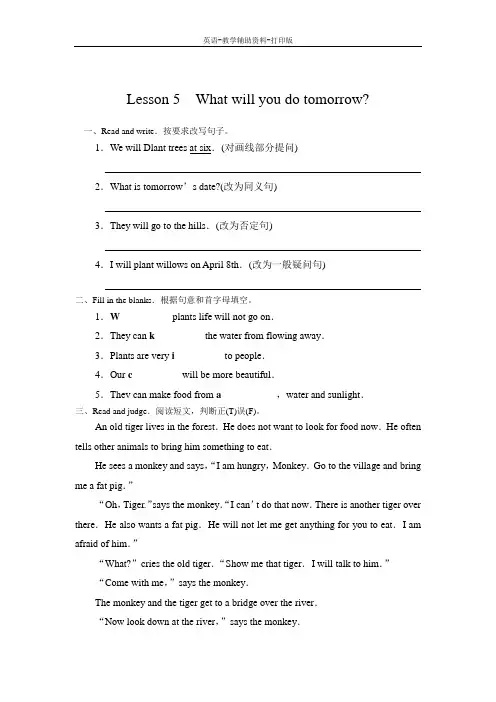
Lesson 5 What will you do tomorrow?一、Read and write.按要求改写句子。
1.We will Dlant trees at six.(对画线部分提问)2.What is tomorrow’s date?(改为同义句)3.They will go to the hills.(改为否定句)4.I will plant willows on April 8th.(改为一般疑问句)二、Fill in the blanks.根据句意和首字母填空。
1.W__________ plants life will not go on.2.They can k__________the water from flowing away.3.Plants are very i__________to people.4.Our c__________will be more beautiful.5.Thev can make food from a__________ ,water and sunlight.三、Read and judge.阅读短文,判断正(T)误(F)。
An old tiger lives in the forest.He does not want to look for food now.He often tells other animals to bring him something to eat.He sees a monkey and says,“I am hungry,Monkey.Go to the village and bring me a fat pig.”“Oh,Tiger.”says the monkey.“I can’t do that now.There is another tiger over there.He also wants a fat pig.He will not let me get anything for you to eat.I am afraid of him.”“What?”cries the old tiger.“Show me that tiger.I will talk to him.”“Come with me,”says the monkey.The monkey and the tiger get to a bridge over the river.“Now look down at the river,”says the monkey.“Do you see the head,the white teeth and the large green eyes of a tiger?”“Yes,I do,”cries the old tiger.“I will eat him up!”With these words,the tiger jumps into the water.( ) 1.The tiger often looks for food himself.( ) 2.There is really another tiger in the forest.( ) 3.The tiger asks the monkey to look for food for him.( ) 4.At last,the monkey jumped into the river.( ) 5.The monkey is very clever and the tiger is very silly.。
科普版小学六年级英语下册导学案lesson 5

Lesson5.What will you do tomorrow?Learning aims:1.掌握本课词汇和短语,并学会询问日期.2.熟练掌握和运用一般将来时态.3.运用本课交际用语进行交际并会作替换练习.What’s the date tomorrow?What will you do?4.理解“Trees and plants”的故事大意,并记住故事中出现的重点词汇及句型,然后回答相关问题.Important and difficult points:1.理解并掌握一般将来时态的运用.2.熟练运用本课交际用语进行交际,What’s the date tomorrow?What will you do?并会作替换练习.Learning procedures:Step1.自主学习A.复习:What will you do when you grow up ?.并做替换练习(两两对话)B.预习:(1)试拼本课单词.(2)听录音跟读课文,试译“Let’s talk and Read ”理解大意.(3)试用Let’s learn 中的交际用语及信息做替换练习.(4)总结预习过程中出现的疑问.Step2.合作学习.A .Let’s talk1.合作交流共同学习掌握以下重点句子及短语。
What’s the date tomorrow?=What is tomorrow’s date? ______________________________ March 12th __________________ On Tree Planting Day __________________Plant trees _______________ on the hills _____________ behind our school _________ Would you like to ________________ join us ___________ what time _______________See you _____________2.听录音跟读课文,共同探讨课文大意,学习如何询问将来日期及将来打算.---What’s the date tomorrow?---It’s March 12th .---Where will you plant them?3.分角色反复操练Let’s talk 中的对话,并会用关键词作替换练习.4.背诵Let’s talk,并会用关键词进行对话练习.B.Let’s learn1.互动展示:利用图片信息,两两操练本课交际用语并会替换练习2.理解并活用一般将来时态.C.听录音学习Let’s chant 并会替换练习D.学习Read .“Trees and plants”.1.听录音,理解故事大意.2.交流互动,翻译并掌握以下词汇及短语。
科普版六年级下册lesson5 第三课时 Let's chant
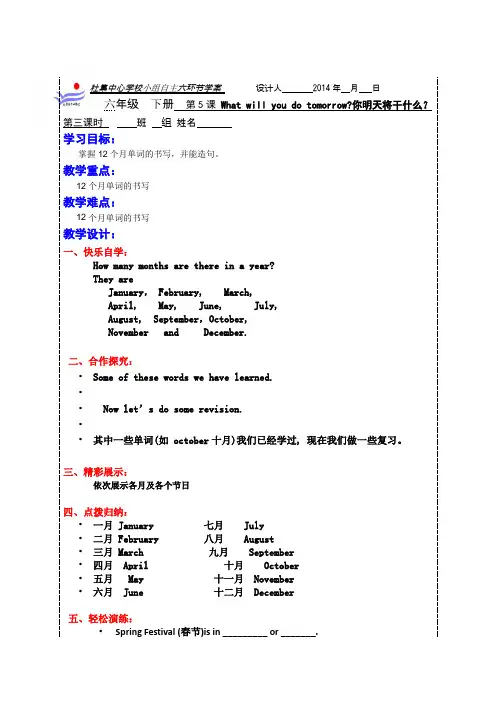
杜集中心学校小组自主六环节学案设计人 2014年月日六年级下册第5课What will you do tomorrow?你明天将干什么?第三课时班组姓名学习目标:掌握12个月单词的书写,并能造句。
教学重点:12个月单词的书写教学难点:12个月单词的书写教学设计:一、快乐自学:How many months are there in a year?They areJanuary, February, March,April, May, June, July,August, September,October,November and December.二、合作探究:•Some of these words we have learned.•• Now let’s do some revision.••其中一些单词(如 october十月)我们已经学过, 现在我们做一些复习。
三、精彩展示:依次展示各月及各个节日四、点拨归纳:•一月 January 七月 July•二月 February 八月 August•三月 March 九月 September•四月 April 十月 October•五月 May 十一月 November•六月 June 十二月 December五、轻松演练:•Spring Festival (春节)is in _________ or _______.•Tree Planting Day (植树节)is in _______.•Mother’s Day is in ______.•National Day (国庆节)is in ________.•Teachers’ Day is in ________.六、创新反思:•通过每个月中不同的节日,让学生体验到英语节日的丰富性。
激发了学生探索知识的欲望。
•。
科普版-英语-六下--Lesson 5 同步讲解 课件
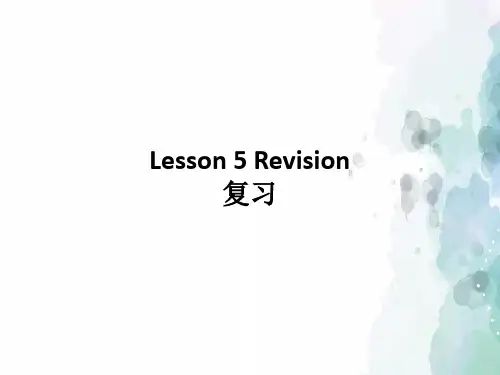
句型结构:What are you going to do+其他? “be going to”表示“计划;打算”,是将来时的 一种表达方式,后面要接动词原形。 例:What are you going to do tomorrow?明天你打算做 什么?
1. The children played games in the park. 孩子们在公园里玩游戏。
2. The cat had a hot dog in his hand. 这只猫手里有一个热狗。
3. Qiqi wasn't at the party. 奇奇没有在聚会上。
4. There was afootball on the ground. 地上有一个足球。
•
③What bad luck!
•
④What is he going to do this afternoon?
• 能力目标 复习Lesson l~Lesson 4的能力目标。
单词解读
Let’s talk 说一说
课文全译
学习要点
• ①本句型用来描述自己的感觉、感受,结构为:I feel+表示感觉感受的形容词。 • “I feel...”句型可以用在就诊时描述自己的感受,还可以用来表达自己的心情。 • 例:I'm going on a trip.I feel happy.我将要去旅行。我感到很开心。 • ②这是一个用来建议某人应该做某事的句型。 • 句型结构:某人+ should+动词(短语)原形+其他. • should意为“应该,应当”,后面要接动词原形,表示“应该……”。其否定形式是在 • should后直接加not,其缩写形式为shouldn't。 • 例:Marv,you should say sorry to Bill.玛丽,你应该向比尔道歉。 • ③该句为Do型祈使句的否定句。用于表达命令、请求、劝告、警告、禁止等的句子叫 • 祈使句。祈使句有以下几种类型,让我们一起来看一看吧! • 肯定式: • (1) Be型:Be+表语(+其他). • 例:Be carefull当心! • (2) Do型:实义动词原形(+其他). • 例:Open your books!翻开你们的书! • (3)Let型:Let+宾语+动词(短语)原形(+其他). • 例:Let me have a look.让我看一看。
科普版-英语-六下-Lesson5What will you do tomorrow练习(含答案)

Lesson5What will you do tomorrow?听力部分一、选出听到的单词。
( )1.A. Marth B.math C.must( )2.A.important B.protect C.country( )3.A.date B.day C.door( )4.A. without B.willow C.flow( )5.A.November B.October C.December 二、听录音,选出合适的答案。
( )1.A. It’s March 12th.B.I’ll plant trees.C.It’s Thursday( )2.A.It’s Tree Planting Day.B.At eight 0’clock.C.See you.( )3.A.I’d like to.B.At three.C.See you.( )4.A.I’ll make a birthday card.B.Uncle Bill.C.It’s Sep.3rd.( )5.A.We’ll go to the park.B. We’ll go by bus.C. We’ll go this afternoon.三、听录音,判断正误,正确的写“T”,错误的写“F”。
1.It’s March 12th today. ( )2.Mike will make a cake tomorrow. ( )3.Trees and plants can’t make the air clean. ( )4.We will go to the plant shop at seven. ( )5.It’s will be sunny tomorrow. ( )书写部分一、单项选择。
( )1.—When is your birthday?—It’s ________ May.A. inB.atC.on( )2.—What ________ you do tomorrow?—I’ll do my homework.A.doB.areC.will( )3.Animal and people can get food ________ plants.A.forB.fromC.about( )4.There are many ________ on the hills.A. peopleB.peopleC.purple( )5.I’ll do ________ best to grow more plants.A.myB.hisC.our二、选出画线部分发音与其他不同的一项。
科普版英语小学六年级下unit5课件
翻译下列句子
• • • • • • 1. 今天几号? 今天5月30号。 What’s the date(today)? It is May 30(th). 2. 今天星期几? 今天星期二。 What day is today? Today/It is Tuesday. 3.明天几号? 六月一号,儿童节。 What’s the date tomorrow?/ What is tomorrow’s date?
• • • • • • • •
sandstorm [‘sænd,stɔ:m] 沙尘暴 do one’s best [best] 尽最大努力 protect [prə‘tekt] 保护 country [‘kʌntri] 国家;乡村 rose [rəuz] 玫瑰, 蔷薇 Chinese rose 月季,蔷薇 willow [‘wiləu] 柳树 pine [pain] 松树
• Very Important Person['pə:sən] • 非常重要的人, 重要人物, 大人物,贵宾 高级会员 • air [ɛə] 不可数名词 空气 • without [wi‘ðaut] 没有 • life [laif] 生命,生活 • keep [ki:p] 保持,喂养 喂养小狗 • Keep a dog. • flow [fləu] (液体等)流 动
英语中日期的读写法
• • • • • • 日期的写法可以用基数词和序数词两种形式。 例如: April 1也可以写成April 1st; July 25 也可以写成July 25th。 但是,日期的读法只能用序数词的形式。例如: October 14(October 14th)读作October (the)fourteenth • August 28(August 28th)读作August(the) twenty-eighth
科普版小学英语Lesson5Whatcanyousee?Let'stalk课件
不,我不能。
8
Let’s Talk
➢ This is my room. Please come in. ➢ Thank you. ➢ What’s in your schoolbag, Eve? ➢ A book. ➢ Can I read it? ➢ Yes, you can.
Let's sing
Can you swim ? Can you fly? Can you sing? I can sing well.
Yes , I can. No , I can't. Yes , I can.
1
Lesson 5 What can you see?
Let's talk
学习目标
你能看到一头猪吗?
Yes,I can.
是的,我能。
What can you see?
你能看到什么?
04
I can see a boy.
我能看到一个男孩。
7
What can you see?
你能看到什么?
I can a fox.
我能看到一只狐狸。
Can you see a monkey?
你能看到一只猴子吗?
1、我会准确认读本课的单词。 2、我会询问某人能否看到某物并回答。
我会根据音标试读下面单词
1 any /'eni/ 一些、任何
2 four /fɔ:/ 四
3 they /ðei/ 他们 4 sheep /ʃi:p/ 羊
4
gsrstrfhroahreoheeoeneaueiemeyydpprn
我会朗读和翻译下列句子
9
Let’s Talk
科普版-英语-六下-Lesson 5 What will you do tomorrow课堂作业
Lesson 5 What will you do tomorrow?一、Read and write.按要求改写句子。
1.We will plant trees at six.(对画线部分提问)2.What is tomorrow’s date?(改为同义句)3.They will go to the hills.(改为否定句)4.I will plant willows on April 8th.(改为一般疑问句)二、Read and choose.读一读,单项选择。
( ) 1.Would you like__________us?A. joinB. to joinC. joining( ) 2.I like ——football.A. playB. playedC. playing( ) 3.— What will you do tomorrow?— I__________the piano.A. willB. will playC. will playing( ) 4.They will__________to me at five.A. go toB. goC. go up( ) 5.There will a match tomorrow.A. beB. isC. are( ) 6.They can stop the wind from__________up sand and earth.A. blowB. to blowC. blowing三、Read and choose.读一读,选词填空。
1.We will plant trees on the hills _________our schoo1.2.They will plant trees_________ eight.3._________will you plant trees?4.There_________many people on the hills.5.Trees and plants can make the air_________.参考答案:一、1、when will you plant trees?2、What's the date tomorrow?3、They will not go to the hills.4、Will you plant willows on April 8th?二、1-6 BCBBAC三、1.behind2.at3.where4.are5.clean。
科普版英语六年级下册Lesson 5 Revision精品课件
(L = Lily, J = Jack) L: What was the date yesterday? J: It was May 1st. L: What did you do yesterday? J: We went to the Great Wall. L: Did you have a good time? J: No, not very good. L: Why? J: Because it rained suddenly and we didn't
B: Yes, I did.
B 4. A: ___________________
B: OK.
A 5. A: ___________________
B: It was May 9th.
F 6. A: ___________________
B: I saw a film.
a.What was the date yesterday? b.I have a fever. Could you give me
3.park
library
5.cold
warm
7.the UK the USA
2.plane
car
4.grandpa father
6.snow
wind
8.swim
bring
Qiqi had a party five days ago. Some of his friends were at the party. Look at the picture of the party.
HOME WORK
1
2
√ Yes.
3
No.
Yes. 4
√ No.
六年级下英语教案-lesson5课题:Whatwillyoudotomorrow-科普版
六年级下英语教案lesson 5 课题:What will you dotomorrow科普版教学内容本课教学内容为科普版六年级下册英语第五课《What will you do tomorrow》。
本节课主要围绕将来的计划与安排进行教学,通过学习本课,学生能够掌握一般将来时的用法,学会用英语描述自己的未来计划,同时增强学生的英语口语表达能力。
教学目标1. 知识与技能:学生能够理解并运用一般将来时,描述未来的计划与安排。
2. 过程与方法:通过听、说、读、写的训练,提高学生的英语口语表达能力,培养学生的合作精神。
3. 情感态度与价值观:培养学生积极向上的生活态度,激发学生对未来的美好憧憬。
教学难点1. 一般将来时的构成及用法。
2. 描述未来计划的句型及词汇。
3. 提高学生的英语口语表达能力。
教具学具准备1. 教具:多媒体课件、黑板、粉笔。
2. 学具:英语课本、练习册、文具用品。
教学过程1. 导入:通过图片、歌曲或游戏等方式,引起学生对本课主题的兴趣,激发学生的学习热情。
2. 新课呈现:讲解一般将来时的构成及用法,展示描述未来计划的句型及词汇。
3. 实践环节:学生分组讨论,用英语描述自己的未来计划,并进行课堂展示。
4. 巩固环节:进行听力、口语、阅读、写作等方面的练习,巩固所学知识。
板书设计1. What will you do tomorrow?2. 重点句型:I will/won't3. 关键词汇:tomorrow、plan、activity、schedule等。
4. 课堂练习:根据提示用英语描述自己的未来计划。
作业设计1. 课后练习:完成练习册上的相关练习。
2. 口语作业:与家人或朋友用英语讨论并描述自己的未来计划。
3. 写作作业:写一篇关于自己未来计划的英语短文。
课后反思1. 教师在授课过程中,要注意关注学生的学习情况,及时调整教学方法和节奏。
2. 针对不同学生的学习程度,进行差异化教学,提高教学效果。