
六年级英语上册Unit1教案新湘少版
六年级英语上册Unit1教案(新湘少版)
教案:
Unit 1 What did you do during the holidays?
Period 1
一、Teaching aims:abllad, say and ww words:
learn words andlay games, learn writing and practice listening.
2.Enablbe familiar wa: What did ...do during the summer holidays?
二、Teaching emphasis:
Enabllad, say and ww words and talk about the past ev三、Teaching difficulties:ablbe familiar wa 四、Teaching tools:
Tau五、Teaching methodal method
六、Teaching steps:Warming uGreetings and gaays: word list-play, learn, write, talk, listen, do, have, go, take, read, speak, teach and holida2.Make a conversation wT: Gladu aga: GladuT: What did you do during the summer holidays?
Ss: I went to Hainan…2 Presentation and drillwure of “learn words and”.
T: This is a pictugming during the summer holidays. What did he do?
Ss: He is learning words andT: Hdoing it now. He learnt words andduring the summer holida2. Leawordame waRead togLittle teaPraT: He learnt words andThey played galearnt writing. He practised listening.
(Action) learn words andlay games, learn writing and practice listening…
3.The Ss act and saLape of Part A and then answquWhat did Anne do during the summer holidays? What did Mingming do during the summer holidays?Listen and repeaPair-wAct it
oulidavalua2.Do ExHomeww words.
Desigblackboard:
Period 2
一、Teaching aims:abllad and say the dialogue;
2.Enablaattern: What did you do during the holidays?ablaster readassages and judge True or Fal 二、Teaching emphasis:
Enabllad and say the dialogue;
三、Teaching difficulties:ablaattern: What did
you do during the holidays?
四、Teaching tools:
Tau五、Teaching methodal method
六、Teaching steps:Warming uGreetings.
2.Act and sa). (Action) learn words andlay games, learn writing and practice listening…
2). Tom: I played ga: Tom played ga (2)
Presentation and drillLape and learn the Word BaWhat did you do during the holidays?
I read many bI visited my grandpaI played games wdPraLape and repeat.
2. Pair-wGroup-wLet’s Read
1.Readassage and then judge True or Fla
2.Read the passage again and underlanswlidavalua2.Do ExHomewDesigblackboard:
Period 3
一、Teaching aims:ablalk aboulida2.Enabland write dowlida二、Teaching emphasis:
Enabldescriblida三、Teaching difficulties:
Enablalk about and write dowlidays ;
四、Teaching tools:
Tape
五、Teaching methodal method
六、Teaching steps:Warming uGreetings.
2. Read Part A tog2 Presentation and drillAsk studalk abouummer holidays and then lPart E: write down your answ2answAsk twalk abouanswLet’s Have Fulass work. Look aures, describe Mingming’s and Ann e’s holida2. Class work. describe your holidalidaDo Ex. Workbook U2.EvaluaHomework. Revise UDesigblackboard:
Unit1 What did you do during the holidays?
一、单元教学内容:(语言知识、语言技能、学习策略、情感态度、文化意识)
1.语言知识:(词汇、句型、功能意念)
(1)掌握词汇:learn words andlay games, learn writing and
Practice listening学生学会表达各种不同的日常活动。
(2)句型:1.What did ...do during the summer holidays ?学生学会使用一般过去时态。
(3)功能意念:Talk about past events 学会讨论过去发生的事情,并对其简单评价。
(4)语法:1.动词的过去式;2.what引导的一般过
去时的特殊疑问句能尝试运用一般过去时态进行语段的描写。
2.语言技能:
(1)听:训练学生在听录音时有目的地获取信息并完成所给听力任务的能力。
(2)说:引导学生了解与“暑假活动”有关的话题,并能正确表达信息。
(3)读:能够用自己在本单元中所学的语言阅读与周末活动有关的对话和文章。
(4)写:能够用一般过去时写句子,叙述上周末所做的事情。
3.学习策略:
能在日常生活中恰当地运用本单元所学知识项目,在真实的语言环境中体会语言、运用语言,感受语言的
真实价值、品味语言的真实意义,从而获得运用语言的
实际能力,创造性地运用所学语言知识,积极主动地用
英语进行交流。
4.情感态度:
通过谈论自己所喜爱的周末活动,以及对自己和同伴的周末活动进行评价,引导学生在业余时间积极参加
有益于身心健康和学习的活动;合理安排自己周末的学习、运动、休息娱乐等活动,过有意义的周末。
化意识:
(1)通过学习课文时同学之间互相交流周末时间的安排,丰富课余生活和活动;
(2)有明确的学习目的,能认识到学习英语的目的在于交流,敢于用英语表达。
语法学习:(1)动词过去式的变化规则:
(2)注意记忆某些动词过去时的不规则变化:am/is→was, are→were, do→did, go→went, have→had→saw
二、单元教学目标
1.学生能够熟练使用一般过去时态,使时态和时间状语保持一致。
2.学生能够熟练询问别人过去所做的事情,或表达自己关于过去时间里某些安排的看法。
3.能够掌握动词原形变成过去式的变化规则。
4.能够运用一般过去时态完成简单的写作练习。
三、单元教学难点提示
1.动词过去式的变化中,辅音字母+y结尾才要求变y→i+ed;否则直接加-ed或者-d。
2.动词过去式的读音。
清辅音后读/t/,例如:jumped;浊辅音和元音后读/d/,例如:begged;/t/、/d/等后面读/id/,例如:invited,scolded。
湘少版六年级英语Unit 1 教案
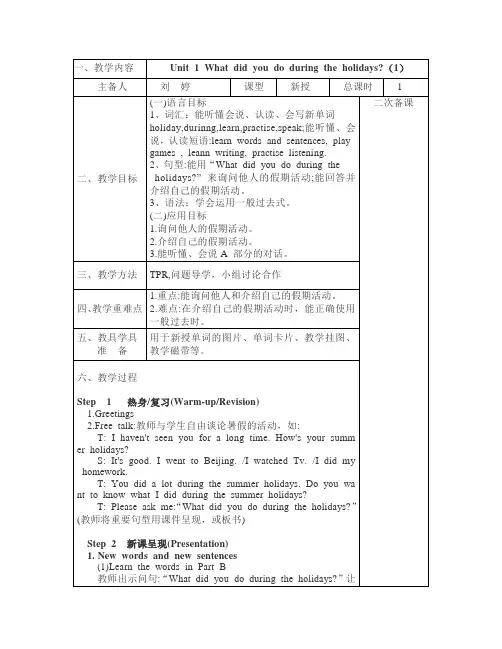
学生跟读三遍,然后用问句向教师提问。
T:(边做看书学习的动作边说)I learnt words and sentences. (将短语“learnt words and sentences”用课件呈现)T: Do you know the meaning of" words and sentences”? (教师用手指着一个单词说) This is the word.(指着问句说) This is the sentence.(边做看书学习的动作边说)Ilearnt words and sentences.Please read after me.Ss read the phrase "learnt words and sentences”after T.Then read by themselves.T:OK,continue asking meS1: What did you do during the holidays?教师用相同的步骤引出B部分的短语,并进行教学。
教师还可以根据学生的具体情况补充一些已学过的单词或短语进行复习。
(2)记忆小达人游戏教师展示假期所做的活动的短语,学生朗读,教师纠错纠音。
如:learn words and sentences, play games, learn writingpractise listening, watch TV, go to the cinema,read many books, do the homework, do some housework play the piano, learn dancing, play basketball给两分钟时间让学生快速记忆以上短语,然后遮住所有的短语,让学生说出短语来。
说出短语最多的学生将是班级记忆小达人。
最后再次朗读一遍所有的短语,加强学生对短语的学习和记忆。
2.The dialogue课文学习:教师可分步骤循序渐进地引导学生熟悉课文(1)Listen and answerWhat did Anne do during the holidays?What did Mingming do during the holidays?(2)Listen and number教师将课文中的句子打乱顺序,在课件中出示或做成句子卡粘贴在黑板上。
湘少版6年级上册英语案【教案】Unit 1 What did you do during the holidays 第2课时(含教学反思)

第二课时1.能听懂、会说新单词和短语learn words and sentences,play games learn writing,practise listening。
2.了解动词变过去式的方法,掌握一些不规则动词过去式。
3.能正确运用一般过去时描述事情。
重点:掌握本单元四会单词。
难点:理解课文。
单词卡片和图片、教学挂图、教学磁带等。
Step 1Warming up1.师生问候。
2.唱英文歌曲。
3.复习已学的单词(during,holiday,learn,practise,speak,sentence,teach)。
Step 2Presentation and drill1.出示教学挂图。
提问:What did × × do during the holiday?指名回答。
然后,板书单词,带读,并利用单词卡片帮助学生理解其含义。
2.让学生看图说话。
3.自由拼读,记忆单词。
Step 3Practise1.指名说说:write、read、learn、play等动词的过去式。
2.仔细观察说说动词变过去式的一般方法,说说有哪些动词的过去式不规则。
3.同桌互相提问:What did you do during the holidays?另一名同学回答。
Step 4Intensive reading1.读课文,然后两人一组朗读课文B部分 Let's learn词汇。
2.听课文A部分录音,跟读。
Step 5Consolidation根据黑板上的单词卡片及图片试复述课文。
练习。
英语学习切不可盲目,要有周密有效的计划。
同时老师要给学生明确各阶段的学习目标,并制定相应的措施来保证目标的实施,要加大督促检查的力度,并在此基础上进行总结。
在教学过程中,应留意思想教育与知识教学互相渗透,寓思想素质教育于知识教育之中。
湘少版6年级上册英语案【教案】Unit 1 What did you do during the holidays 第1课时(含教学反思)

Unit 1What did you do during the holidays?第一课时1.复习一般过去时及动词的过去式,复习并区别现在进行时,能用一般过去时谈论假日活动.掌握重点句子:What did you do during the holidays?I wrote a little storybook./I learnt writing./ I read many books.短语:during the holidays,write a story book,in English,read it to us句型: What did you do during the holidays? I wrote a little storybook./I learnt writing./ I read many books.Word cards, CAI, Drawing InstrumentStep 1Warming upGreetings.Task1: Let's singWhere are you now? What are you doing ?Where were you last month ?用上半年学的一般过去时谈论假日活动Where did you go ?What did you do? What did you see?What did you buy ? What did you eat ?Task2: Let's learn*Game1—— What's missing?(Use CAI to review the learned words: 复习do——did , have——had, go——went , take——took , read——read , speak——spoke ,learn——learnt,teach——taught , etc. )* Game2——Patting flies.(Use this game to consolidate all the words.)Step 2 PresentationTalk about the holidays 用一般过去时谈论假日活动What did you do during the holidays? I wrote a little storybook./I learnt writing./ I read many books.Let's learn the new sentences: talk——talked,practise——practised,listen——listened,learn words and sentences , play games, learn writing, practise listening Teach the new wordsStep 3 Listen and doListen and do. Then practise them*Use the new sentence pattern“ What did you do during the holidays?” to makethe dialogue freely.Step 4 SituationTalk about themselves during the holidays.Using: What did you do during the holidays? I wrote a little storybook./I learnt writing./ I read many books.英语学习切不可盲目,更有周密有效的计划。
新湘少版英语六年级上册:全册教案
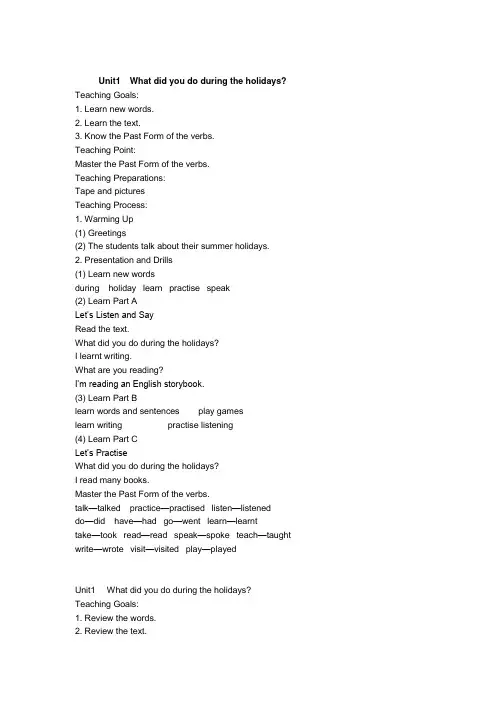
Unit1 What did you do during the holidays? Teaching Goals:1. Learn new words.2. Learn the text.3. Know the Past Form of the verbs.Teaching Point:Master the Past Form of the verbs.Teaching Preparations:Tape and picturesTeaching Process:1. Warming Up(1) Greetings(2) The students talk about their summer holidays.2. Presentation and Drills(1) Learn new wordsduring holiday learn practise speak(2) Learn Part ALet’s Listen and SayRead the text.What did you do during the holidays?I learnt writing.What are you reading?I’m reading an English storybook.(3) Learn Part Blearn words and sentences play gameslearn writing practise listening(4) Learn Part CLet’s PractiseWhat did you do during the holidays?I read many books.Master the Past Form of the verbs.talk—talked practice—practised listen—listened do—did have—had go—went learn—learnt take—took read—read speak—spoke teach—taught write—wrote visit—visited play—playedUnit1 What did you do during the holidays? Teaching Goals:1. Review the words.2. Review the text.3. Review the Past Form.4. Can do the exercises.Teaching Point:Master reading skill.Teaching preparations:Exercises and pictures.Teaching Process:1. Warming Up(1) Greetings(2) Review2. Presentation and Drills(1) Learn Part DLet’s ReadRead the text of Part D.Do the exercises of Part D.Talk about Part D.(2) Learn Part ELet’s WriteWrite down your answers.What did you do during the summer holidays?I went .What did you learn?I learnt .What did you read?I read .What did you listen to?.What did you write?.(3) Learn Part FLet’s Have Fun.Talk about your holidays.Unit2 Katie always gets up early. Teaching Goals:1. Learn new words.2. Learn the text.3. Master the Third Person Singular. Teaching Point:Master the Third Person Singular.Teaching Preparations:Tape and pictures.Teaching Process:1. Warming Up(1) Greetings(2) Review2. Presentation and Drills(1) Learn new words.always weekday often afterwave return sometimes never(2) Learn Part ALet’s listen and SayKatie’s day1>Read the text.Katie always gets up early.Katie returns home at 5:00 p.m.She plays chess with her father after dinner.2>The Third Person Singularget—gets have—has wave—waves go—goes return—returns do—does play—plays3>Short Phrasesget up have breakfast go to schoolreturn home do homework play chess(3) Learn Part Bwave goodbye be late for school do her homework read a newspaper play chess take a walk(4) Learn Part CLet’s PractiseGroup work. Talk about Peter’s activities.Unit2 Katie always gets up early.Teaching Goals:1. Review the words.2. Review the text.3. Review the Third Person Singular.4. Can do the exercises.Teaching Point:Master reading skill.Teaching Preparations:Exercises and picturesTeaching Process:1. Warming Up(1) Greetings(2) Review2. Presentation and Drills(1) Learn Part DLet’s ReadRead the text of Part D.Do the exercises of Part D. Talk about Part D.(2) Learn Part ELet’s WriteFill in the blanks.I always .I often .I sometimes .I never .(3) Learn Part FLet’s Have FunLet’s rhyme.The snail says,” I feel nice,I love my shell.When I see mice,I go into my shell,I always carry my hou se about.”The bird says,” I’m always free! I’m never sad!I like the tree.Resting on my nest is not bad.”Unit3 I like my computer Teaching Goals:1. Learn new words.2. Learn the text.3. Master the Past Form. Teaching Point:Master the Past Form. Teaching Preparations:Tape and pictures Teaching Process:1. Warming Up(1) Greetings(2) Review2. Presentation and Drills(1) Learn new wordssearch find out about worldemail send greeting(2) Learn Part ALet’s listen and Say1>Read the text.I like my computer.It’s very fast.It will help you a lot.You can also find out about countries in the world. Let’s try it now.2>The Past Formbuy—bought is—wascan—could see—saw(3) Learn Part BLet’s Learnemail my friends send greetingssearch for a lot of things find out about countries (4) Learn Part CLet’s PractiseWhat can we do on the computers?We can email each other.We can send greetings to our friends.We can search for a lot of things.Unit3 I like my computerTeaching Goals:1. Review the words.2. Review the text.3. Review the Past Form.4. Can do the exercises.Teaching Point:Master reading skill.Teaching Preparations:Exercises and picturesTeaching Process:1. Warming Up(1) Greetings(2) Review2. Presentation and Drills(1) Learn Part D.Let’s ReadRead the text of Part D.Do the exercises of Part D.Talk about Part D.(2) Learn Part E.Let’s WriteWrite on email to your friend. Tell him/ her what you did lastSunday.Dear ,Last Sunday, I had a wonderful day. I played with my friends9:00 a.m. After the games, I my homework onthe computer. The teacher emailed us about homework. It’s easy to homework this way. In the afternoon, I a short cartoon film on the computer.That’s all for now.Regards,(3) Learn Part FLet’s Have FunLook and make.Let’s Know MoreTeaching Goal:Know something about travelling around China.Teaching Point:Know something about travelling.Teaching Preparations:Some important informations and picturesTeaching Process:1. Warming UpGreetings2. Presentation and Drills(1) Read the text on Page 13.Changsha South Railway StationA bus station in ChengduShanghai Pudong AirportTianjin Port(2) Talk about your travelling during the summer holidays.Assessment ⅠTeaching Goals:1. Review the last class.2. Can do the exercises.Teaching Point:Do the exercises.Teaching Process:1. Warming UpGreetingsReview2. Presentation and Drills(1) Listen and tick(2) Listen and circle(3) Read and fill in the blanks(4) Read and write(5) I can do it(6) I like to do itUnit4 The Mid—Autumn Festival is comingTeaching Goals:1. Learn new words.2. Learn the text.3. Know the Mid—Autumn Festival.Teaching Point:Know the Mid—Autumn Festival.Teaching Preparations:Tape and picturesTeaching Process:1. Warming Up(1) Greetings(2) Review2. Presentation and Drills(1) Learn new wordsthe Mid—AutumnFestival nearby centre mooncake type lotus seed bean taste (2) Learn Part ALet’s listen and SayRead the text.The Mid—Autumn Festival is coming.Mrs Li and her son, Binbin, go shopping at the nearby shopping centre. Which type do you like?I like the ones with lotus seeds.How much is a box of mooncakes?(3) Learn Part BLet’s learnmooncake nuts lotus seed red bean(4) Learn Part CLet’s PractiseI enjoy eating the lotus seed mooncakes.I enjoy looking at the moon.I enjoy reading poems when looking at the moon.I enjoy drinking tea.Unit4 The Mid—Autumn Festival is comingTeaching Goals:1. Review the words.2. Review the text.3. Can do the exercises.Teaching Point:Master reading skill.Teaching Preparations:Exercises and picturesTeaching Process:1. Warming Up(1) Greetings(2) Review2. Presentation and Drills(1) Learn Part DLet’s ReadRead the text of Part D.Do the exercises of Part D.Talk about Part D.(2) Learn Part ELet’s WriteYesterday was the Mid—Autumn Festival. You had a good time in the evening. What did your family do? Write about it.We celebrated the Mid—Autumn Festival at home. Weand . We enjoyedand . My grandfather told .We were very interested in them.(3) Learn Part FLet’s Have FunIn the moze on the book, find out what each person has to celebrate the Mid—Autumn Festival.Unit5 It will be sunny and cool tomorrowTeaching Goals:1. Learn new words.2. Learn the text.3. Master the Future Tense.Teaching Point:Master the Future Tense.Teaching Preparations:Tape and picturesTeaching Process:1. Warming Up(1) Greetings(2) Review2. Presentation and Drills(1) Learn new wordsforecast clear light rain heavy(2) Learn Part ALet’s Listen and SayRead the text.It’s time for the weather forecast.Tomorrow will be clear in Beijing.It will be sunny and cool.There will be a strong wind in Xi’an.It will rain tomorrow in Changsha.But it won’t be heavy.It will be sunny and warm in Sanya.(3) Learn Part BLet’s Learnweather forecast light rain sunny and warmstrong wind heavy rain sunny and cool light snow (4) Learn Part CLet’s PractiseIt will be sunny tomorrow.There will be a light snow next Friday.Unit5 It will be sunny and cool tomorrowTeaching Goals:1. Review the words.2. Review the text.3. Review the Future Tense.Teaching Point:Master reading skill.Teaching Preparations:Exercises and picturesTeaching Process:1. Warming Up(1) Greetings(2) Review2. Presentation and Drills(1) Learn Part DLet’s ReadRead the text of Part D.Do the exercises of Part D.Talk about Part D.(2) Learn Part ELet’s WriteRead and writeTomorrow will be in Changsha.There will be in .It will be .It will .(3) Learn Part FLet’s Have FunLet’s sing the song “Itsy Bitsy Spider”Unit6 I will bring a big bottle of orange juice Teaching Goals:1. Learn new words.2. Learn the text.3. Master the future tense.Teaching Point:Master the future tense.Teaching Preparations:Tape and picturesTeaching Process:1. Warming Up(1) Greetings(2) Review2. Presentation and Drills(1) Learn new wordsbring bottle picnic fruit barpeanut candy wait can(2) Learn Part ALet’s Listen and S ayRead the text.Autumn is coming. The weather is getting cool and nice. What are we going to bring for the picnic?I will bring a big bottle of orange juice.I will bring some peanuts and candies.(3) Learn Part BLet’s Learna bottle of orange juice a box of cakesa few cans of Coke a few bars of chocolatebring meet peanut fruit candy(4) Learn Part CLet’s PractiseI will bring a bottle of orange juice.I will bring a few cans of Coke.I will bring a can of Coke.I will bring three bottles of milk.Unit6 I will bring a big bottle of orange juice.Teaching Goals:1. Review the words.2. Review the text.3. Review the future tense.4. Can do the exercises.Teaching Point:Master reading skill.Teaching Preparations:Exercises and picturesTeaching Process:1. Warming Up(1) Greetings(2) Review2. Presentation and Drills(1) Learn Part DLet’s ReadRead the text of Part D.Do the exercises of Part D.Talk about Part D.(2) Learn Part ELet’s WriteLingling’s family wants to go to the beach for a picnic. Write down what her family will bring to the beach.Lingling’s father will .Lingling’s mother .Dongdong .Lingling .(3) Learn Part FLet’s Have FunLook at the pictures on the book and write down the items.Let’s Know MoreTeaching Goals:Know something about picnic.Teaching Point:Know something about picnic.Teaching Preparations:Important informations and picturesTeaching Process:1. Warming UpGreetings2. Presentation and Drills(1) Read the text on Page 29.(2) Some picnics and partiesTeddy Bears’ Picnic (USA)Easter Egg Hunt (UK)Beach party ( Australia)Assessment ⅡTeaching Goals:Can do the exercises.Teaching Point:Do the exercises.Teaching Preparation:TapeTeaching Process:1. Warming UpGreetings2. Presentation and Drills(1) Listen and circle(2) Listen and number(3) Look and write(4) Read and write(5) I can do it(6) I like to do itUnit 7 What can I do?Teaching Goals:1. Learn new words.2. Learn the text.3. Master the sentence pattern” What can…..do?”Teaching Point:Master the sentence pattern” What can….do?”Teaching Preparations:Tape and picturesTeaching Process:1. Warming Up(1) Greetings(2) Review2. Presentation and Drills(1) Learn new wordsweak slow(2) Learn Part ALet’s Listen and SayRead the text.The children want to help old people.I can make tea or coffee for them.What can I do?I can clean their houses.I can sing to them and make them happy.(3) Learn Part BLet’s Learnan old woman help old people on the road make tea make cakesclean their homes make them happy(4) Learn Part CLet’s PractiseWhat can I do?I can make them happy.I can help them on the road.Unit 7 What can I do?Teaching Goals:1. Review the words.2. Review the text.3. Review the sentence pattern” What can…..do?”4. Can do the exercises.Teaching Point:Master reading skill.Teaching Preparations:Exercises and picturesTeaching Process:1. Warming Up(1) Greetings(2) Review2. Presentation and Drills(1) Learn Part DLet’s ReadRead the text of Part D.Do the exercises of Part D.Talk about Part D.(2) Learn Part ELet’s WriteI can help old people .I am going to tell them .I would like to .I can .I like to .(3) Learn Part FLet’s Have FunLet’s chant.Every day, he sits there alone.No one cares. No one comes near.His heart is cold, like a stone.But he will have some happy tearsWhen you simply say” Hello.”Unit 8 We shouldn’t waste water Teaching Goals:1. Learn new words.2. Learn the text.3. Master the sentence pattern “We shouldn’t ……”Teaching Point:Master the sentence pattern “We shouldn’t ……”Teaching Preparations:Tape and picturesTeaching Process:1. Warming Up(1) Greetings(2) Review2. Presentation and Drills(1) Learn new wordsshould shouldn’t= should not waste blouse enough save drop fresh(2) Learn Part ALet’s Listen and SayRead the text.What are you doing?I’m washing my blouse.We shouldn’t waste water.Why? You need water.Everyone needs water.(3) Learn Part BLet’s Learnkeep the rivers clean keep the air clean and fresh plant more trees use bikes instead of cars shouldn’t kill wild anim alsshouldn’t waste water shouldn’t litter(4) Learn Part CLet’s PractiseWe should plant more trees.We shouldn’t waste water.We shouldn’t kill wild animals.Unit 8 We shouldn’t waste water.Teaching Goals:1. Review the words.2. Review the text.3. Review the sentence pattern “ We shouldn’t….”4. Can do the exercises.Teaching Point:Master reading skill.Teaching Preparations:Exercises and picturesTeaching Process:1. Warming Up(1) Greetings(2) Review2. Presentation and Drills(1) Learn Part DLet’s ReadRead the text of Part D.Do the exercises of Part D.Talk about Part D.(2) Learn Part ELet’s WriteLook at the picture on the book. Write a few sentences about it.There are on the road.We can go to school or .In the morning many people go to work .In the evening many people .(3) Learn Part FLet’s Have FunGet some pictures like those on the book.Talk about the pictures.Work in groups. Design a poster. Use the words “ should “ and “ shouldn’t”.Unit 9 This bird is bigger than the first oneTeaching Goals:1. Learn new words.2. Learn the text.3. Master the Comparative/ Superlative form of adj. and adv.Teaching Point:The Comparative/ Superlative form of adj. and adv.Teaching Preparations:Tape and picturesTeaching Process:1. Warming Up(1) Greetings(2) Review2. Presentation and Drills(1) Learn new wordsthan clay(2) Learn Part ALet’s Listen and SayRead the text.Children’s clay art is on show at Sunshine school.This is the first one. It’s a small bird.This is the second one.This bird is bigger than the first one.Look at the third bird!It’s bigger than the second one.(3) Learn Part BLet’s Learnbig—bigger—biggest small—smaller—smallesttall—taller—tallest short—shorter—shortest long—longer—longest(4) Learn Part CLet’s PractiseTom is taller than Mike.Tom’s hair is shorter than Mike’s.Unit 9 This bird is bigger than the first oneTeaching Goals:1. Review the words.2. Review the text.3. Review the Comparative/ Superlative degree of adj. and adv..4. Can do the exercises.Teaching Point:The Comparative/ Superlative degree of adj. and adv.. Teaching Preparations:Exercises and picturesTeaching Process:1. Warming Up(1) Greetings(2) Review2. Presentation and Drills(1) Learn Part DLet’s ReadRead the text of Part D.Do the exercises of Part D.Talk about Part D.(2) Learn Part ELet’s WriteFill in the blanks.Peter is . David runs .Peter runs . Peter can jump .David can . John .(3) Learn Part FLet’s Have FunLet’s chantThe giraffe says, “ I am taller.”The little rabbit says, “I am faster.”The elephant says, “I am bigger.”The monk ey says, “I am smarter.”The lion says, “I roar louder!And I feel prouderThan you!”Let’s Know MoreTeaching Goals:Master the Comparative degree of adj. and adv.. Teaching Point:The Comparative degree of adj. and adv.. Teaching Preparation:Important informations and pictures.Teaching Process:1. Warming UpGreetings2. Presentation and Drills(1) Read the text on Page 45.(2) Let’s CompareWhich is faster?Which is higher?Which is older?Assessment ⅢTeaching Goals:Can do the exercises.Teaching Point:Do the exercises.Teaching Preparation:TapeTeaching Process:1. Warming UpGreetings2. Presentation and Drills(1) Listen and tick(2) Listen and circle(3) Look, read and match(4) Look, read and write(5) I can do it(6) I like to do itUnit 10 I don’t feel well today Teaching Goals:1. Learn new words.2. Learn the text.3. Can use English to express your feelings.Teaching Point:Express feelings in English.Teaching Preparations:Tape and picturesTeaching Process:1. Warming Up(1) Greetings(2) Review2. Presentation and Drills(1) Learn new wordsfeel well cough headachefever medicine rest just(2) Learn Part ALet’s Listen and SayRead the text.Anne doesn’t feel well today. Her mother takes her to see a doctor. What’s wrong with you?I feel cold and I have a cough.(3) Learn Part BLet’s Learndon’t feel well have a coughhave a headache have a fevertake medicine have a good rest(4) Learn Part CLet’s PractiseWhat’s wrong with you?I have a cough.I have a headache.Unit 10 I don’t feel well todayTeaching Goals:1. Review the words.2. Review the text.3. Can do the exercises.Teaching Point:Master reading skill.Teaching Preparations:Exercises and picturesTeaching Process:1. Warming Up(1) Greetings(2) Review2. Presentation and Drills(1) Learn Part DRead the text of Part D.Do the exercises of Part D.Talk about Part D.(2) Learn Part ELet’s writeAnne is in bed now. She can’t go to school today. Write a letter to tell her teacher that she’s ill.(3) Learn Part FLet’s Have FunDino is in bed. He feels sad and lonely.Work in groups and make cards for Dino.Unit 11 Shall we go to the theatre? Teaching Goals:1. Learn new words.2. Learn the text.3. Master the sentence pattern “Shall we go to…..?”Teaching Point:The sentence pattern “Shall we go to…….?”Teaching Preparations:Tape and picturesTeaching Process:1. Warming Up(1) Greetings(2) Review2. Presentation and Drills(1) Learn new wordstheatre call plan ideaplay concert hall film(2) Learn Part ALet’s Listen and SayToday is Saturday. Dongdong is calling Anne. They’re talking about the plan for the day.Shall we go to the cinema today?What time shall we meet?(3) Learn Part BLet’s Learncinema theatre concert hallsee a film see a play enjoy the music (4) Learn Part CLet’s PractiseShall we go to the theatre?Let’s see a play.Unit 11 Shall we go to the theatre? Teaching Goals:1. Review the words.2. Review the text.3. Review the sentence pattern.4. Can do the exercises.Teaching Point:Master reading skill.Teaching Preparations:Exercises and picturesTeaching Process:1. Warming Up(1) Greetings(2) Review2. Presentation and Drills(1) Learn Part DRead the text of Part D.Do the exercises of Part D.Talk about Part D.(2) Learn Part ELet’s WriteYou and your friends had a good time today. You went to some places and took many photos. You enjoyed yourselves.Write about what you did in the diary.(3) Learn Part FLet’s Have FunLet’s sing the song “Do—Re—Mi”Unit 12 It’s Christmas again!Teaching Goals:1. Learn new words.2. Learn the text.3. Know something about Christmas.Teaching Point:Know something about Christmas.Teaching Preparations:Tape and picturesTeaching Process:1. Warming Up(1) Greetings(2) Review2. Presentation and Drills(1) Learn new wordsChristmas decorate colourful lightPresent dress up Santa Claus receivemerry greet(2) Learn Part ALet’s Listen and SayRead the text.Christmas falls on 25th December.Anne’s family celebrates Christmas.(3) Learn Part BLet’s LearnChristmas tree Christmas card presentSanta Claus celebrate decorate receive greet (4) Learn Part CLet’s PractiseHere’s a present for you.Here’s a Christmas card for you.Unit 12 It’s Christmas again!Teaching Goals:1. Review the words.2. Review the text.3. Can do the exercises.Teaching Point:Master reading skill.Teaching Preparations:Exercises and picturesTeaching Process:1. Warming Up(1) Greetings(2) Review2. Presentation and Drills(1) Learn Part DRead the text of Part D.Do the exercises of Part D.Talk about Part D.(2) Learn Part ELet’s WriteFill in the form.Christmas The Spring FestivalDateDecorationsPresentsActivities(3) Learn Part FLet’s Have FunLet’s sing the song “We Wish You a Merry Christmas.”Let’s Know MoreTeaching Goals:Know something about theatre.Teaching Point:Know something about theatre.Teaching Preparations:Important informations and picturesTeaching Process:1. Warming UpGreetings2. Presentation and Drills(1) Read the text on Page 61.(2) Theatre ShowsBeijing operaShadow puppet show in Xi’anBroadway show in New YorkAssessment ⅣTeaching Goals:Can do the exercises.Teaching Point:Do the exercises.Teaching Preparation:TapeTeaching Process:1. Warming UpGreetings2. Presentation and Drills(1) Listen and circle(2) Listen and write(3) Read and fill in the blanks(4) Look and write(5) I can do it(6) I like to do it(7) Let’s Read More。
新湘少版六年级上册英语教案
新湘少版六年级上册英语教案教案一:Unit 1 My Day目标:1. 学习日常生活中的常见动作和活动的表达方式。
2. 学会使用一般现在时态描述日常活动。
3. 培养学生的听说能力,能够用英语询问和回答关于日常活动的问题。
教学重点:1. 日常活动的表达方式和用语。
2. 用一般现在时态描述日常活动。
3. 关于日常活动的单词。
教学难点:1. 如何使用一般现在时来描述日常活动。
2. 如何用英语进行简单的对话。
教学准备:1. 教师需要提前准备好与本单元相关的图片和单词卡片。
2. 学生需要准备好笔和纸,用于进行练习和作业。
教学过程:Step 1:导入新课1. 用图片或实物呈现一些日常活动,如吃早饭、刷牙、穿衣服等,让学生猜测这些活动的英文表达方式。
2. 引导学生展示并说出相关动作的单词,然后教师出示单词卡片进行搭配练习,激发学生的学习兴趣。
Step 2:学习新课1. 出示图片,让学生用英语描述所看到的日常活动。
2. 引导学生观察图片,根据图片中的人物和动作进行问答练习。
3. 教师板书一般现在时的句型:“I eat breakfast in the morning.”,并进行解释和讲解。
然后让学生自由组合句子描述自己的日常活动。
Step 3:巩固练习1. 学生分组进行对话练习,用英语向同伴介绍自己的日常活动。
2. 教师随堂巩固学生的学习成果,进行适当的纠错和指导。
3. 作业:完成课后练习册上的相关练习。
教案二:Unit 2 My Family目标:1. 学习家庭成员的称呼及其相关的表达方式。
2. 学会用英语描述家庭成员的身份和特征。
3. 培养学生的口语表达能力,能够用英语介绍自己的家庭。
教学重点:1. 家庭成员的称呼及其相关的表达方式。
2. 用英语描述家庭成员的身份和特征。
教学难点:1. 如何正确使用家庭成员的称呼以及相关的表达方式。
2. 如何用英语进行简单的介绍和对话。
教学准备:1. 教师需要准备好与本单元相关的图片和单词卡片。
湘少版六年级上册英语全册教案
湘少版六年级上册英语全册教案第一单元:Family课时一:Unit 1 Family教学目标- 学会介绍自己的家庭成员及其职业- 掌握家庭成员的称谓- 学会使用“everyone”来指代家庭成员- 学会运用句子结构:“My {family member} is a {occupation}.”教学准备- 单元教材- 黑板、白板或幻灯片教学步骤1. 导入新课,引起学生对家庭的兴趣,并激发他们谈论家庭成员的愿望。
2. 通过图片和口头描述,向学生介绍家庭成员的称谓和职业。
例如:爸爸、妈妈、姐姐、弟弟、哥哥、姐姐。
3. 引导学生使用“everyone”来指代家庭成员的概念,并练使用“everyone”来制造问答句。
4. 呈现句子结构:“My {family member} is a {occupation}.”,并引导学生运用该句型进行练。
5. 进行对话创作活动,让学生互相介绍自己家庭成员的职业。
鼓励学生使用目标句型进行对话。
6. 总结本课内容,鼓励学生用英语描述自己的家庭成员及其职业。
课堂练1. 根据图片提示,用正确的家庭成员称谓补全句子。
- My __________ is a doctor.- I have two __________. They are my younger brothers.- Who is the __________ in your family?- Our __________ works at a school.2. 根据提示回答问题。
- Who is an artist in your family?- How many sisters do you have?- What does your father do?- Is your mother a teacher?课后作业1. 完成课本上有关家庭成员的练题。
2. 家庭成员调查:询问家人的职业,并用英语记录下来。
拓展活动1. 家庭相册制作:学生带来家人照片,制作一个家庭相册,并利用相册进行口语表达练。
(湘少版)六年级英语上册 《Unit1第2课时》教案设计2
(湘少版)六年级英语上册《Unit1第2课时》教案设计2一、教学背景本课时是《Hello! My Name Is Sally!》的第二节课,主要讲解身份和位置的表达方式。
二、教学目标语言知识目标1.掌握掌握一些身份和位置的词汇,如:Mr. and Mrs., teacher, doctor, under, on, next to, behind, in front of等;2.能够听懂有关身份和位置的简单对话并准确地表达自己的观点;3.能够用英语进行简单的口头交流。
情感态度目标1.学会用礼貌的方式问候他人;2.培养学生的观察能力和表达能力,提升自信心;3.通过个人表达和团队合作,增强学生的合作意识。
学习策略目标1.通过观察身边环境,学会掌握有关身份和位置的表达方式;2.通过对话练习,提高学生的听说能力;3.通过互动交流,培养学生的合作意识和竞争意识。
三、教学重难点教学重点1.身份和位置的表达方式;2.通过对话练习提高学生的听说能力。
教学难点学生们如何更好地运用所学知识进行对话练习。
1. 导入新课1.教师介绍本节课要学习的身份和位置的表达方式,并与学生进行互动交流,引导他们对身边环境进行观察;2.通过举例子的方式,让学生了解Mr. and Mrs.这一身份;3.身份词汇板书;4.确定问题任务:让学生在家寻找其他身份词汇并告诉同学。
2. 分组学习1.让学生分为小组,每个小组管理1名角色,根据地图上的指引写出穿越公园的路线;2.导师发出问题:从哪里开始,你要走多远,然后向左、向右、往前走,最后到达什么地方?3. 示范交流1.让学生在小组内练习身份和位置的表达方式,然后进行小组讲评,分享互相之间获得的经验;2.导师进行示范,培训学生合理地使用钢笔,如何书写8个身份名称;3.导师发出问题:你觉得是Mr. and Mrs.好还是Doctor好?为什么?4. 模仿活动1.让学生进行模仿活动,以加深记忆;2.导师利用相应的物品,进行温故知新和身份和位置的练习;3.鼓励学生进行模仿,提高记忆效果。
湘少版六年级英语上册第一
湘少版六年级英语上册第一\二单元教案Unit 1 The children are playing in the park.孩子们正在公园里玩Period 1…一、教学目标1、能听懂、会说新单词swing,slide,bench,bark,chain,bite,stones;2、能理解课文;能正确运用现在进行时描述人物正在进行活动。
二、教学重点及难点重点:掌握本单元四会单词。
难点:理解课文。
三、教学准备单词卡片和图片、教学挂图、教学磁带等。
四、教学步骤Step 1 Warming1.师生问候。
2.唱已学的英文歌曲。
Step 2 Presentation and drill1. T: Hello, boys and girls. Nice to see you again! Today is the first day of this new term. I’m very happy. So let’s go to the park together!边说边将一张公园大门的图片贴在黑板上,布置成公园的场景。
2.可出示一张秋千的图片。
T: Look! A swing. Do you like it?板书单词swing,带读。
将图片贴在黑板上“公园”的相应位置。
3.用同样的方法教单词slide和bench。
4.出示一张狗正在叫的图片。
T: What is the dog doing? It is barking.板书单词bark,带读。
T: Don’t throw the stones at the dog. It’ll bite you.板书单词stone和bite,并用动作帮助学生理解其含义。
然后带读。
5.出示一张被铁链锁着的狗的图片。
T:The dog always bites the strangers,so the owers use the chain.板书单词chain,帮助学生理解其含义。
六年级英语上册第一单元教案新湘少版
2014年六年级英语上册第一单元教案(新湘少版)Unit 1 What did you do during the holidays?一.教学目标1.能够听说读写短语:play games,learnwriting,do homework,vbody,learn words and2.能用句子“What did you do during the holidays?”询问别人在过去做了什么,并能做出相应的回答。
让学生通过五彩缤纷的活动感受生活的美好,并学会合理的安排自己的作息时间。
二.教学重点及难点1.掌握四会单词及重点句型。
2.能运用所学的单词、句型询问别人过去做了什么事。
三.教学准备单词卡片,图片,磁带四.教学步骤Warm-uGreetingT:How was your summer holidays?引导学生回答:Ss:Great!/Wonderful!2.Lead-老师做动作,学生结合黑板上的单词卡片复习单词(read learn do visit go play )并学习新词pra2Presenta通过游戏----找朋友,让学生回顾所复习单词的过去式,并适当扩充单词至短语。
ad--read many books learn--learnt writing do--didwlay--played games go--wangsha Underwater Worldvisit--visited my grandpaactice--practiced listening2.通过听力,让学生熟悉句型“What did you do during the holidays?”,并巩固所学短语。
例:Anne,What did you do during the holidays? ----I visited my grandpaPra师生问答。
2.小组对话。
3.听Part A 部分听力,完成“T or F”gming is reading abook. ( )Anne learnt swimming. ( )Anne wrote a storybglish. ( )4.跟读Part A。
(湘少版)六年级英语上册 《Unit1第3课时》教案设计2
(湘少版)六年级英语上册 Unit1第3课时教案设计2一、教学目标1.掌握本课所学的新单词及短语:lesson, English, math, Chinese, science, music, art, P.E.2.能听懂、会读、会说以及书写本课所学的句型:What lesson do you have in the morning/afternoon?3.学会询问他人在上午或下午将要学习什么课程,能够熟练应对。
二、教学重点难点1.本课的重点是让学生学会表达“在上午或下午将要学习什么课程”的问句和答句。
2.本课的难点是如何帮助学生理解将要学习的课程名称。
三、教学过程1.Warming-up•T: Good morning/afternoon, class!•Ss: Good morning/afternoon, teacher!•T: How are you today?•Ss: I’m fine/good, thank you. And you?•T: I’m fine/good, too. Let’s sing a song together. (唱歌)2.Presentation and Practice•T: Please open your books to Unit 1, Lesson 3. Today we will learn about the lesson names in Chinese. (出示新单词)•T: Look at these new words. Do you know what they mean? (引导学生回答)•Ss: English, math, Chinese, science, music, art, P.E.•T: Very good. Can you read them with me? (读单词)•T: Now I will teach you the sentence pattern。