
Unit 6 Do you like bananas?教案
Practice
(5minutes)
Reviቤተ መጻሕፍቲ ባይዱion
"Do you
like···?--Yes, I do. I like···/ No, I don't. I like···"
the teacher
shows some
pictures about the food and fruit,ask students to use
Step Seven
Pair work
(5minutes)
Make up new conversations.
1.利用单词图片重新编对话.
2.引入Does he/she like...?突破难点
Work in pairs
让学生除了知道如何谈论自己和他人喜爱的食物之外,还要让学生明白什么是健康的食物。通过合作交流,渗透了合理的健康饮食理念。
通过两人对话活动到小组的活动,让学生充分地实践运用语言
Step Nine
Summary
(1minutes)
Have the
students sum up the language
points
Sum up the language points.
引导学生对这节课的总结,让学生做自由发言. 培养学生自主学习,自主总结的良好学习习 惯。 简短的评价使学生的课 堂表现得到肯定并且可 以激励学生的学习兴 趣,树立学习英语的信心.
sentences.
Look at the pictures
appear on the screen, and ask their
classmates one by one
利用互动的教学方式,通过师生互动,生生互动,加强师生、生生间的交流与合作。根据前面所学单词与句型,利用图片信息让学生能够更熟练运用所学单词与句型,并能让学生更好掌握第一人称、第二人称和第三人称一般疑问句的运用,为后面的输出互动打下基础。
通过看图及问答,尽可能 做到简洁有趣,为接下 来的听力扫清障碍.做 好铺垫.由浅入深。
Step Three Words game
(4minutes)
What’s
missing?
Show fruits and food pictures ss have learnt.
Work in pairs and try to read out the words that have disappeared.
Step2
New words learning
(5minutes)
New words
l.Show pictures of
food, get the students to read and learn them.
I. Look at the picture learn the new words.
2.Students say the words of food as possible as they can from the pictures.
--Do you like···?
--Yes, I do. I like···/ No, I don't. I like···
教学资源
教材、多媒体、学生在学习、生活及课堂交流中的再生资源。
教学重点
1.To master the vocabulary about food.
2.To talk about one's preferences and dislikes by using the target languages.
1.I like.
Do you like?
Yes, I do.
2.Do you like?
No, I don't like_ 3.Let's have
Oh, no.I don't like
利用图片信息帮助学生做好听前预测:学生需 根据对话填空,写出听到的单词。核对答案时, 教师要求学生说出完整的句子,为后面的输出 活动打下基础。让学生带着预判去听, 从听觉上对材料有初步的理解,同时培养学生 通过听获取细节信息技巧。最后让学跟着录音再读听力文本,更直接掌握材料的信息与并能更好地运用。
利用课件读出消失的单词,加深印象
检测新单词:教师设计游戏,寓教于乐,通过学生的反馈,掌握学生的学习程度
Step Four
Listening(5minutes)
Listening
1b
Listen and
number: Have the students listen to the tape and number
Step Eight
Group work
(7minutes)
Make up new conversations.
利用前面几个单元所学句型拓展对话,教师给模版
Make up new conversations in groups. Use the example the teacher showed. Then act it out before the class.
《Do you like bananas? Section A1a-2c》教学设计
版本
人教版(Go for it)
年级/册/课
七年级上册Unit6
教
材
解
读
教
学
目
标
情感态
度价值
观目标
To understand some common expressions of preferences and dislikes.
To improve the cooperative abilities of students.
能力
目标
1. Cultivate students to have different opinions on the same thing. 2. Cultivate students' ability to classify what they have learned.
Step Ten
Homework
(1minutes)
1. Remember the new words.
2. Write
conversations
Finish the homework.
在训练学生的口语表达 能力的基础上训练写作能力。
板书设计
Unit 6 Do you like bananas?
pear--pears
知识
目标
1.Know the new words of food: banana,pear, orange, tomato, hamburger, strawberry, ice-cream, salad, milk, bread.
2.Learn to discuss their likes and dislikes.
教学难点
To create language communication, drill sentence pattern.
教 学 过 程
教学环节
教学内容
教师活动
学 生 活 动
设计意图
Step 1
Warming
up and
leading
in
(2minutes)
Enjoy the fruit song
1.Greetings.
Listen and number the conversations
A: Do you like salad?
B: No, I don't.
A:Do you like
bananas?
B: Yes, I do.
学生根据所给文本对话进行听力并排序,学生听完后按顺序读出对话,加深学生对Do you like···?句型的掌握与运用。
Step Six
Listening
(5minutes)
Listening
2b
1、Listen and then fill in the blanks.
2.Finally,read the conversation follow the tape
Listen the food they hear and fill in the blanks
tomato __tomatoes
strawberry-- strawberries salad ice-cream milk bread
A: Do you like bananas?
B: Yes, I do .No, I don't.
2.Enjoy the fruit song.Let the students sing together.
1. Greetings.
2. Enjoy the fruit song,let the students
sing together.
Fruit song歌词跟本课要学习的水果有关,能够调动学生的学习情绪,更好地引入新课。为接下来的食物 类词汇的学习作好铺 垫,在充满轻松、愉快的气氛下和学生进行free talk.
Unit 6 Do you like bananas教学设计

《Unit6: Do you like bananas?》教学设计姓名:白俊颖单位:抚宁县骊城学区坟坨初级中学《Unit 6 Do you like bananas?》教学设计抚宁县骊城学区坟坨初级中学白俊颖一、教材分析本单元主要内容是以围绕“Food”教学活动,学习动词like的一般现在时的用法。
在已学习用“Do you have a soccer ball?”来确认物品所属及对各项运动的看法和感受的基础上,进一步以“Food”为话题谈论个人的喜好问题, 引导学生养成良好的饮食习惯,了解健康食品的概念。
所以本单元是继续学习巩固上一单元开始涉及的一般现在时态,拓展生活中饮食方面的词汇,让学生学会善于表达喜欢和不喜欢的情感。
本课是第一课时,涉及到不同种类的食物以及学生通过句型的学习学会相互询问对食品的喜恶,其中图片与词语的匹配,听力以及结对活动的设置使难度层层递进,更有梯度。
二、教学目标(一)语言技能目标1. 能够询问对方或他人的饮食爱好。
2. 学会用两种不同方式回答和表达个人喜恶.( 二) 语言知识目标1.掌握并正确运用常见的食物名称及其他词汇:hamburgers(汉堡包), tomatoes(番茄), French fries(薯条), pears(梨子), oranges(橙子), ice cream(冰淇凌), salad(色拉), bananas(香蕉), strawberries(草莓),have(吃)。
2.了解并掌握可数名词以及不可数名词的用法。
3. 掌握并运用目标句型:--Do you like bananas? --Yes, I do. No,I don’t.--Does he like salad? --Yes,he does.No, he doesn’t.(三) 情感态度目标1.通过对食物喜好的提问,能增强同学之间的相互了解和培养合作精神。
2.学生对周围的事物要用心地观察,做个生活的有心人。
人教新目标英语七上Unit6Doyoulikebananas教案4
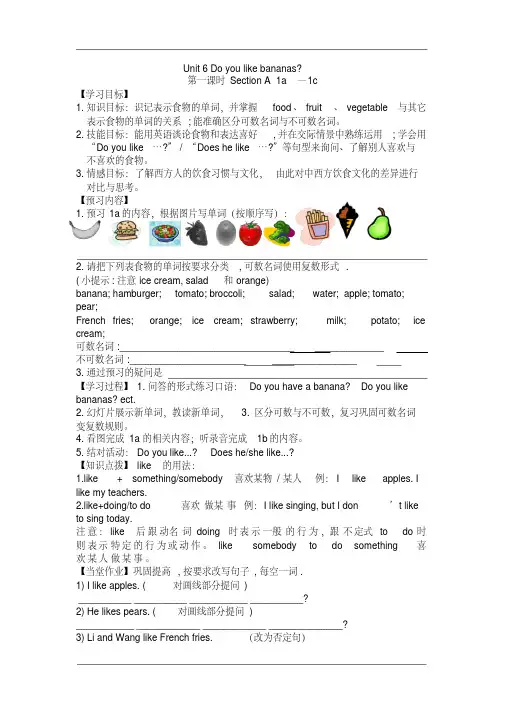
Unit 6 Do you like bananas?第一课时Section A 1a—1c【学习目标】1.知识目标:识记表示食物的单词,并掌握food、 fruit、 vegetable与其它表示食物的单词的关系;能准确区分可数名词与不可数名词。
2.技能目标:能用英语谈论食物和表达喜好,并在交际情景中熟练运用;学会用“Do you like…?” /“Does he like…?”等句型来询问、了解别人喜欢与不喜欢的食物。
3.情感目标:了解西方人的饮食习惯与文化,由此对中西方饮食文化的差异进行对比与思考。
【预习内容】1.预习1a的内容,根据图片写单词(按顺序写):2.请把下列表食物的单词按要求分类,可数名词使用复数形式.(小提示:注意ice cream, salad和orange)banana; hamburger; tomato; broccoli; salad; water; apple; tomato; pear;French fries; orange; ice cream; strawberry; milk; potato; ice cream;可数名词:_________________________________ _____________不可数名词:______________________ ________________3.通过预习的疑问是【学习过程】1.问答的形式练习口语:Do you have a banana? Do you like bananas? ect.2.幻灯片展示新单词,教读新单词,3.区分可数与不可数,复习巩固可数名词变复数规则。
4.看图完成1a的相关内容;听录音完成1b的内容。
5.结对活动:Do you like...? Does he/she like...?【知识点拨】like 的用法:1.like + something/somebody 喜欢某物/某人例:I like apples. I like my teachers.2.like+doing/to do喜欢做某事例:I like singing, but I don’t like to sing today.注意:like后跟动名词doing时表示一般的行为,跟不定式to do时则表示特定的行为或动作。
Unit 6 Do you like bananas 全单元教案
Unit6DoyoulikebananasPeriod1(SectionA1a-1c)Teachingaims1.Learnwordsandbeabletosay,readandwritethem:orange(s),banana(s),strawberry,strawberries,pear(s),appl e(s),tomato(es),carrot(s),vegetable(s),hamburger(s),egg( s),ice-cream(s),salad(s),bread,chicken2.Beabletotalkaboutlikesanddislikesbyusing:I/We/Theylikeoranges.He/Shelikesoranges.I/We/They don’tlike bananas.He/Shedoesn’tlikehamburgers.Doyoulikesalad Yes,Ido./No,Idon’t.Doeshe/sheliketomatoes Yes,he/shedoes./No,he/shedoesn’t.3.Understandthedifferencebetweencountablenounsanduncoun tablenouns.Teachingkeyanddifficultpoints:1.Learnthesewordsandbeabletosay,readandwritethem:2.Beabletotalkaboutlikesanddislikesbyusing:I/We/Theylikeoranges.He/Shelikesoranges.I/We/They don’tlike bananas.He/Shedoesn’tlikeh amburgers.Doyoulikesalad Yes,Ido./No,Idon’t.Doeshe/sheliketomatoes Yes,he/shedoes./No,he/shedoesn’t. Moralobjects(1)Tocallstudents’attentiontoothers’int erestsandenablethemtocaremoreaboutclassmates.(2)ToimproveSts’communicatingskillsandenablethemtokeepinEnglish(showapictureofsomemorewordsbyshowingpictures.GettheSstomakeaneffortt We/Theylike…We/Theydon’tlike…enandnumbertheconversations.(SectionA2a-2d) Teachingaims:1.Words&expressionsBirthday,dinner,week,thinkabout,food,sure,how /what about…Burger,vegetable,fruit,apple,then2.TargetlanguageIlikestrawberries,they’redelicious.Let’shav ethem.--Yes,Ilikethem,too./No,Idon’tlikethem.Ilikesalad,it’sdelicious.Doyoulikeit--Yes,Ido./No,Idon’tbutIlike icecream.Let’shave…Let’sthinkaboutthefood.AbilitygoalsEnablestudentstotalkaboutlikesanddislikes.LearningabilitygoalsHelpstudentslearnhowtotalkaboutlikesanddislik es.2.Listeningandspeakingskills.Moralobject:Learntokeephealthy.Teachingimportant/difficultpointsHowtotalkaboutlikesanddislikeswiththetargetla nguage.Teachingaims:Targetlanguage:DoyoulikesaladYes,Ido./No,Idon’t.DotheylikepearsYes,theydo./No,theydon’t.DoessheliketomatoesYes,shedoes./No,s hedoesn’t.Ilikeoranges,butIdon’tlike bananas.Welikerice.Wedon’tlikehamburgers.Helikesice-creambuthedoesn’tlike vegetables. Learningabilitygoals1.Helpthestudentslearnhowtotalkabouttheirlikesanddislikes.2.Helpthestudentsunderstandcountablenounanduncountablenoun. LearningdifficultandimportantpointsHowtotalkabouttheirfavoritefoods.Teachingaims:1.Words egg,carrot,rice,chicken,so.2.TargetlanguageDoesTomlikecarrotsYes,hedoesIlikecarrots!Abilitygoals1.Enablestudentstotalkaboutlikesanddislikesanddifferencebetweenfruitsandvegetables2.Listeningandspeakingskills.Moralobject:Learntokeephealthy.Teachingimportant/difficultpointsSstodiscussthelistsinpairsandw likes…and…Sallydoesn’tlike…(2a-2c)Teachingaims:1.Words:stareatwellhealthyreallyquestionwantbefat2.TargetlanguageWhatdoyoulikeforbreakfastDoyoulikehamburgersfordinnerAbilitygoals:1.EnablestudentstoreadthemagazinearticleaboutCindy’s favoritefoodsforthreemealsandwritefiv esentencesaboutCindy’seatinghabitsandretellC indy’seatinghabits2.Trainstudents’readingandwritingskills Moralgoals:Enablestudentscanformgoodeatinghabitsandkeeph ealthy.Teachingimportant/difficultpoints:1.Keywordsandsentences:2.Trainstudents’readingandwritingskills3.TalkaboutCindy’seatinghabitsusing“Whatdoyoulikefor….Ithink…WhatfruitdoyoulikeWhataboTeachingaims:1.Wordsapple,icecream,banana,broccoli,like,oranges,c arrot,breakfast,chicken,tomato,lunch,hamburge r,fruit,dinner,Frenchfries,vegetable,pear2.Targetlanguage:Ilike…Idon’tlike…Forbreakfast/lunch/dinn er,Ilike…Abilitygoals1.Enablestudentstolearntowritetheirfavoritefoodformeals2.LearningabilitygoalsHelpstudentslearnhowtowriteapassageabouttheyl ikeanddislikefordinner.Teachingimportant/difficultpoints:。
新目标英语unit6Do-you-like-bananas教案
课题
Unit 6 Section A1a/1b /1c/2a/2b.
课型
New
教学目标
一、知识与技能:
1〕单词:do, don’t, does, doesn’t,strawberries,like,have,bamburgers,orange,tomatoes,icecream,broccoli,salad,
2〕句型:What do you have for breakfast/ lunch/ dinner?
For breakfast, I have…
What does he/ she have for breakfast/ lunch/ dinner?
For breakfast, he/ she has….
Step 7Groupwork: You are going for a picnic with a group of friends.
1. Make a list of food to buy.
2. Read your list of food to the class.
1.Eating healthily is very important.It can make you healthy and happy. Please write about what you like for breakfast, lunch and dinner.
1.Copy the new words and try to learn themby heart.
2.Make up a new dialogue about likes and dislikes then write it down in your exercise book.
Unit 6 Do you like bananas 优秀教学设计

运用 Hiteach
Pairwork:两人一组
计时、抢答功能 练习 Do you like 句型
运用 Hiteach 抢答功能
Chain play:熟 练掌握句型
运用 Hiteach Pairwork:两人一组 随机挑人功能 练习 Does he/she like 句型
运用 Hiteach 实物提示功能
Listen课2b件练习所学单词 .
Groupwork:小组内做调查 写出表达喜恶的短文并展示
运用 Hiteach Exercise:测试学生 即时反馈功能 掌握情况
正确率大于 90%
T 课ቤተ መጻሕፍቲ ባይዱ件结归纳 .
结束
F
讲解相关
知识
2
Step1. Lead-in What’s this in English? It’s a ball. Yeah, I like this ball very much. And I often
Unit6Doyoulikebananas教案
Unit 6 Do you like bananas?Period 1一、教课目的:1.语言知识目标:1)能掌握以下词汇: banana, hamburger, tomato, ice-cream, salad, strawberry, pear,2)能掌握以下句型:① —② —Do you like salad?Does she/he like?— Yes, I do. / No, I don’t.— Yes, she/he does./ No, she/he doesn’t.③ — I like/I don’tlike④ — He/She likes / He/She doesn’tlike3) 能经过介绍食品学会咨询对方喜爱与不喜爱的食品。
2.感情态度价值观目标:经过学习西方食品文化,促进学生认识西方生活方式与文化,培育跨文化社交的意识。
二、教课重难点1.教课要点:1)学习并累积一些食品的词汇。
2)名词复数的使用。
3)动词 like 一般此刻时的各样句式及一般疑问句的一定、否认回答;2.教课难点:1)行为动词 like 的一般此刻时的用法;2)使用do 和does指引的一般疑问句的组成和使用。
三、教课过程I. New wordsAccording the pictures, learn the new words.II. Warming-upAsk some Ss questions:T:What’s that?S1: It’s _______.T:What are those? S1:They are _______.III. Presentation1. Show some pictures of food on the screen and learn the new words.(banana, hamburger, tomato, ice-cream, salad, strawberry, pear, milk, bread, birthday, food, burger, vegetable, fruit)2.Let Ss read and try to remember the new words.3.T: Let ’s look at the picture in 1a. Match the words with the things in thepicture. Then check the answers.IV. Pair work1.Read the conversations in 1b. Have Ss read after the teacher.2.Now let’s act out the conversations 1-3.(Ss work with their partner and act out the conversation 1-3.)3.Look at the picture and make more conversations using the words in 1a.4.Let some pairs act out their conversations.V. Reading1.According the pictures, learn the new words.2.Read the dialogue in 2d. Then answer the questions.Does John like hamburgers?3.Read the dialogue with your partner. Then role play the conversation.4.Practice the conversation with your partner.VII. Pair work1.Read the conversation in speech bubbles in 2b. Ask Ss to read after the teacher.2.Ss practice the conversations in pairs.3.Let some pairs act out the conversations.HomeworkCopy the new words in P99.教课反省period 2I. Language points一,学习新单词 ice-cream, salad, strawberry, pear, milk, bread, birthday, dinner, food,二,语言知识点tomatoes 西红柿tomatoes是 tomato 的复数形式。
人教版七年级英语上册教案(RJ) Unit 6 Do you like bananas
Unit 6Do you like bananas?第一课时Section A(1a-1c)1.重点单词:banana,hamburger,tomato,icecream,salad,strawberry,pear,milk,bread2.重点句式:—Do you like bananas?—Yes,I do.—Do you like salad?—No,I don't.1.用like来谈论喜好2.可数名词的单复数1.用like来谈论喜好2.可数名词的单复数一、预习课本P31新单词并背诵,完成下面的汉译英。
1.香蕉____________ 2.汉堡____________3.西红柿____________ 4.冰激凌__________5.沙拉____________ 6.草莓____________7.梨____________ 8.牛奶____________9.面包____________二、认真预习1a,1b,1c,找出下列句型。
1.—你喜欢香蕉吗?—是的,我喜欢。
________________________________________________________________________ 2.—你喜欢沙拉吗?—不,我不喜欢。
________________________________________________________________________Step 1情景导入Teacher:There are many different kinds of fruits and vegetables in the world,and different people like different food.Everyone has its own taste.What kind of food do you like?What kind of food do you dislike?Today let's talk about the food we like and we dislike in Unit 6.环节说明:由学生感兴趣的话题导入新课,简洁明了,激起学生的学习兴趣。
教学设计unit6-Do-you-like-bananas(新)
人教版新目标七年级英语(上册)unit6教案Unit 6 Do you like bananas?Period one: Section A (1a, 1b, 1c)哈密石油外国语学校王冰楠Context analyze: 内容分析This is the first period of this unit. This period is aim to train the students’ skill of speaking, listening. In this period, students are required to learn the new words and expressions. Role –play a conversation, students will be better able to talk about likes and dislikes.Teaching objectives: 教学目标1. Knowledge goals 目标语言、1). Key words & key phrases 重点单词和词组banana,pear,strawberry,apple,orange,tomato,ice-creamsalad,hamburger, milk ,bread2). Key sentences 重点句子---- Do you like…?-----Yes, I do. No I don ’t.2. Ability goals 能力目标Train the students’ skill of speaking, listening.3. Emotion goals 情感目标*An apple a day keeps a doctor away.*Each kind of fruit has its own taste.*There are no two leaves the same in the world.*People have different likes and dislikes.*Choose what we like and like what we choose.Teaching important points (教学重点)①Train the students’ listening, speaking ability.②Master the new words, phrases, sentence patterns, and make the students be free toexpress their likes and dislikes.Teaching difficult points (教学难点)①How to improve students’ listening, reading ,speaking ability.②How to finish the task of role -play.Teaching methods (教学方法)Pair-work , group-work and discussionTeaching aids 教学用具A computer and a projectorTeaching procedures & ways 教学过程Step 1 Class instruction practiceStep 2 Lead in and warm upStep 3 learn the new words(Show a picture of fridge, ask students to guess “What’s in my fridge? ”Students review and learn the names of the food.Then students try to classify them into two kinds: countable nouns and uncountable nouns. )Step 4 Enlarge the vocabulary and pronunciation practice . ( The students try to pronounce more new words. )(Get ready to the listening ,reading and speaking)Step 5 Listening practice(s tudents listen and number the conversations.)(Then students read after the tape. )Step 6 Pair-work(Students role play the conversation.) (Students talk about their likes and dislikes)Step7 Let’s sing and reviewStep8: Group work(Students work in a group of 6.They choose a topic and talk about their likes and dislikes.)HomeworkMake an interview to your family about the food and fruit. Find out about what they like and don’t like. Then write a letter to your friend.板书设计Unit 6 Do you like bananas?。
初中英语七年级上册Unit 6 Do you like bananas 教案
Unit 6 Section A (1a-1c) 教案1.语言知识目标:1.学习掌握词汇:banana,hamburger,tomato,ice-cream,salad,strawberry,pear,milk,bread2.掌握重点句型Do you like bananas? Yes, I do./No, I don’t.二、能力目标:使学生能够正确运用Do you like.以及回答,谈论对食物的喜好。
三、情感目标:使学生了解同学的喜好,增进友情;了解健康的食物。
教学重难点:1. 教学重点:运用所学词汇进行对话交际练习Do you like...?2. 教学难点:掌握本节课中食物名称以及名词复数的变化。
(Teaching Procedures):Step1:Greetings and talking1.教师向学生表示友好的问候,并复习之前所学到的问候语。
2.采用多种自由交际方式,创设浓厚的英语学习氛围与学生进行Step2: Review展示图片让学生做“Best Eye”来复习球类单词。
Step3: Lead inLet the students enjoy a view “Do you like bananas?” and answer questions to lead in the new lesson.Step4:Presentation1.Learn the new words:Show some pictures to learn new words of fruits and foods.2.Finish 1aLet students match the words with the things in the picture.3.Learn important sentences:展示图片进行师生互动操练重点句型:A: Do you / they like ... ?B: Yes, I/We/They do.No, I/We/They don’t.A: Does he/ she like ... ?B: Yes, he/she does.No, he/ she doesn’t.4.Pair work让学生两人一组操练重点句型:A: Do you / they like ... ?B: Yes, I/We/They do.No, I/We/They don’t.A: Does he/ she like ... ?B: Yes, he/she does.No, he/ she doesn’t.5.Finish 1bListen and number the conversations[1-3].6.Grammar:可数名词单复数变化方法讲解以及不可数名词的用法讲解7.Summary:教师带领学生回顾本节课所上的生词,句型和语法。
《Unit6_Do_you_like_bananas》教学设计新部编版
精选教课教课方案设计| Excellent teaching plan教师学科教课方案[ 20–20学年度第__学期]任教课科: _____________任教年级: _____________任教老师: _____________xx市实验学校精选教课教课方案设计| Excellent teaching plan《Do you like bananas? 》教课方案方案雷州市第二中学吴妲平课题名称《Do you like bananas?》科目英语年级七年级教课时间 1 课时( 45分钟)学习者分初一学生开朗好动可塑性大,他们对英语已经有了必定的基析础,学生在小学已经学习并掌握了一些单词以及表达喜恶的句型,并且已能用形容词等来表达自己的见解。
这个单元是以食品作为话题睁开喜恶的议论正好切合学生的表达欲念,食品这个话题很能惹起学生的兴趣,更能激发学生张口说英语的欲念。
但是学生在英语学习方面没有一个好的语言气氛,他们的知识面相对较窄,胆量广泛较小,不敢使用英语与人沟通,甚至有些孩子对英语学习自己就缺少兴趣。
这堂课我会用食品课件、图片及实物来激发学生的学习热忱,调换学生的参加踊跃性,为学生供给更直观的教课方法,让学生经过演练单词和句型来培育合作精神,学会尊重人与人之间的差别。
教课目的一、感情态度与价值观1.激发学生对食品的学习兴趣,激发学生学习英语的欲念和兴趣,使他们乐于参加各样英语实践活动。
2.经过对食品爱好的发问,能加强同学之间的互相认识和培育合作精神。
二、过程与方法1.以食品的词卡导入新课,以旧带新体现新知识2.运用词汇教课、句型教课及情形教课。
3.经过结对活动来锻炼学生的合作精神及口语能力。
4.做食品报告让学生学会总结与归纳,认识他人的爱勤学会尊敬他人,并且能锻炼学生的听闻读写能力。
三、知识与技术1.简单认识中西方饮食文化的差别,并用适合的方式表达自己的爱好,认识他人的爱好,尊敬人与人之间的差别。