
译林牛津英语M7unit1 welcome&reading
though 可是;虽然;然而
nearly 差不多;几乎 vast 广阔的 adj.
afterwards 后来;然后 adv. system 系统 n.
primitive 原始的 adj.
contribute to… 有助于;贡献 live 直播的 adj.
at the same time 同时
Translation
Part One:
difficult words and expressions
distance 距离 n. it takes…to do… 花费时 间做… decade 十年 n.
broadcast 广播;播放;节目 programme 节目;程序 n.
regular 定期的;有规律的
Q3:
development of dictionary
electronic dictionary Paper dictionary books, calendar, addresses, phone numbers, clock, music, games…
Q4:
development of communication
Q1:
development of TV
black-and-white TV
colour TV
LCD screen
Q2:
development of audio(音响) device
Gramophone phonograph MP4
walkman tape recorder MP3 CD player
How much do you know about these electric devices?
Aቤተ መጻሕፍቲ ባይዱ
B
C
(2’) Who is the inventor of the first color TV? C A. Vladimir Zworykin B. Philo Farnsworth C. John Logie Baird
from satellite TV, However, most people benefit ______ signals to as local TV companies broadcast the _______ the population living nearby.
Part Two:
difficult words and expressions
Reading
The evolution of
video and sound devices
Fast Reading
1. Who developed the system used for most early TV broadcasts? John Logie Baird.
2. Who made the first recording of a human voice? Thomas Edison. 3. What were developed by the late 1960s? Portable cassette players and video recorders.
Unit1 Living with technology
Welcome & Reading
Technology has seen some amazing developments in the last few decades. Can you give me some examples which are changed by technology in your life?
(3’) Who made the first recording of a human voice? A. Vladimir Zworykin C B. Philo Farnsworth C. Thomas Edison
(4’) When and Where the first tape recorders were made? A A. 1928; Germany B. 1925; USA C. 1929; UK
sound recorder 录音机 alternative 供选择的 adj. along with 和…一起 available 可利用的 adj. standard 标准 n.
video recorder 录像机
tape recorder 磁带录音机
keep pace with
保持同步;并驾齐驱
They were used by TV stations first. By the late 1970s, video recorders for home use were introduced.
1925 1929
1938
The first colour TV programme was broadcast. Satellites were used to broadcast TV.
1962 1967
Regular colour TV broadcasts began in the UK. The first CDs were made available.
1982
Year
1993 1995
Event
The VCD was born. The DVD was invented.
Careful Reading 2
1. Colour TV became popular within just a few years after it was invented. F still 2. People without satellite dishes do not F benefit at all from satellite TV broadcasts. 3. Some of the first tape recorders used plastic tape to record on. F steel 4. Records and cassettes do not offer as good a sound quality as CDs T 5. New technology will soon make many of the things talked about in the article out of date. T
Philo Farnsworth He made important ______________ breakthrough in the development of TV. Modern TVs use many of the principles first discovered by him.
The Modern age
1962
Satellites were used to broadcast TV
accessible to people who live Satellites make TV _________ far away from cities.
Satellite TV dishes They can often be seen distributed throughout the countryside and remote areas.
far away from… 远离
breakthrough 突破 n.
difficult words and expressions
throughout 到处;贯穿 remote 偏远的 adj.
benefit from… 从…获益
signal 信号 n.
nearby 附近的
adj.
black-and-white TV
There are many different people contributed to the development of TV.
John Logie Baird Most early TV broadcasts were made using his primitive system. However, his system was very ________ and had many ____________. drawbacks
employ 雇佣;采用 v.
steel 钢铁 n.
plastic 塑料的 adj.
meanwhile 同时 adv.
elecrtical 有关电的 adj.
phonograph
tubes
Tape recorders
Steel tape
Portable cassette player
Video recorders
Careful Reading 1
Year
1877 1887 1925 1929 1938 1962 1967 1982 1993 1995
Event
The first recording of a human voice was made.
Year 1877 1887
Event The first recording of a human voice was made. Emile Berliner invented a record player that used discs to record on. The first public TV broadcasts were made, in the USA. Regular public broadcasting began in London.
letter/telegram beeper
telephone cell phone
development of computer
laptop
desktop
高中-英语-牛津译林版-译林英语模块一Unit1 Welcome (共25张PPT)

Welcome to the unit
to the unit
1. What is your dream school like?
2. Is your shool quite different from your dream shool?
3. Do you know what the western high shool is like?
In the UK small class sizes
In China Large numbers of students
In the UK, there is usually a large classroom with a few students in it, who sit face to face in two lines. The students are encouraged to participate in various classroom activities.
In UK
In China
campus& building
Huge campus; Low buildings
Where to keep books etc.
Lockers
Large campus; Tall buildings
Desks with small drawers
Class Size
No more than Over 50 30 per class
Discussion
Look at the following pictures about high school life in the UK and China. Discuss the following questions with a partner.
牛津译林版英语七年级上册unitthisismewelcometothe
牛津译林版英语七年级上册unitthisi smewel cometo the优 秀课件 (实用 教材)
Summary
Do you know how we introduce ourselves when we are the first to meet our new friends?
I have a dog. Look, the dog is mine. I’m the master of the dog.
主人
My picture
master
look after
A dog’s picture
I need to give it food to eat, and I need to clean its house. I have to look after it every day.
When does Amy meet Simon?
in the morning
People use different greetings at different times.
牛津译林版英语七年级上册unitthisi smewel cometo the优 秀课件 (实用 教材)
牛津译林版英语七年级上册unitthisi smewel cometo the优 秀课件 (实用 教材)
Open your books at Page 6.
Read the conversation after the recording
牛津译林版英语七年级上册unitthisi smewel cometo the优 秀课件 (实用 教材) 牛津译林版英语七年级上册unitthisi smewel cometo the优 秀课件 (实用 教材)
最新2019-牛津译林版7A unit1 welcome (共34张PPT)-PPT课件
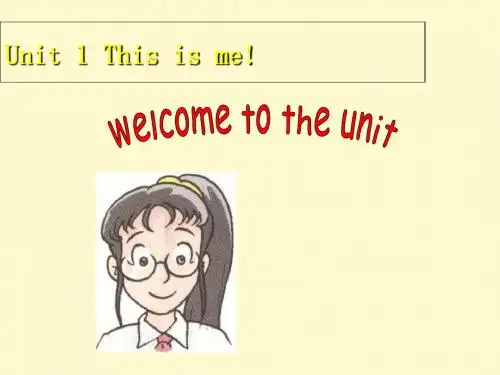
look after She looks after the dog
very well.
Work in pairs
• A: Is there a dog/cat… in your home? • B: Yes ,there is. • A: Who is the master of the ...? • B: ... the master of the ... • A: Can...look after the ...well? • B: Yes, ...can.
Step Three :Free talk(2)
• Who has a pet in our class? • What is it? n. 宠物 • Do you have a ...?
Step Four: Presentation
master
/‘ma:stə/
She is the dog’s master.
Good morning.
2.45 p.m.
Good afternoon.
6.00 p.m.
Good evening.
10.30 p.m.
Good night.
Work in pairs
• A: Hello. • B: … • A: I’m… What’s your name? • B: My name is… Nice to meet you. • A: Nice to meet you too.
Oh, I love this e-dog.
I’m Eddie. What’s your name?
My name is Hobo.
Are you my master? Yes, I am.
牛津译林版-英语-七上-七英语《7a 1单元 welcome》
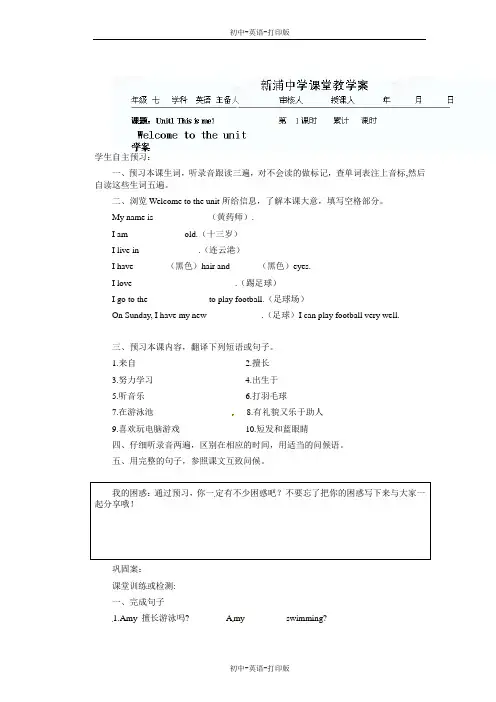
学生自主预习:一、预习本课生词,听录音跟读三遍,对不会读的做标记,查单词表注上音标,然后自读这些生词五遍。
二、浏览Welcome to the unit所给信息,了解本课大意,填写空格部分。
My name is ____________(黄药师).I am ____________ old.(十三岁)I live in _____________.(连云港)I have ______ (黑色)hair and ______(黑色)eyes.I love _______________________.(踢足球)I go to the _____________ to play football.(足球场)On Sunday, I have my new ____________.(足球)I can play football very well.三、预习本课内容,翻译下列短语或句子。
1.来自_____________2.擅长_____________3.努力学习_____________4.出生于_____________5.听音乐_____________6.打羽毛球_____________7.在游泳池_____________ 8.有礼貌又乐于助人_____________9.喜欢玩电脑游戏_____________ 10.短发和蓝眼睛_____________四、仔细听录音两遍,区别在相应的时间,用适当的问候语。
五、用完整的句子,参照课文互致问候。
我的困惑:通过预习,你一定有不少困惑吧?不要忘了把你的困惑写下来与大家一起分享哦!巩固案:课堂训练或检测:一、完成句子1.Amy 擅长游泳吗? _____ A my _______ swimming?2. Simon 来自上海。
Simon _________ Shanghai .lie的表兄擅长数学。
Millie’s cousin __________ Maths.4.鲍勃的表哥在校篮球队Bob’s is the school basketball team.5.他的同桌是从哪里来的?她从云南来.—Where his deskmate ?(—Where his desk ma te come from? )—She /comes from Yunnan.6.格蕾丝的双胞胎兄弟很有趣, 乐于助人.Grace’s twin brother _________ ________ ________.7.Mike 出生在加拿大。
牛津译林版高中英语选修七M7U1Welcometotheunit.docx
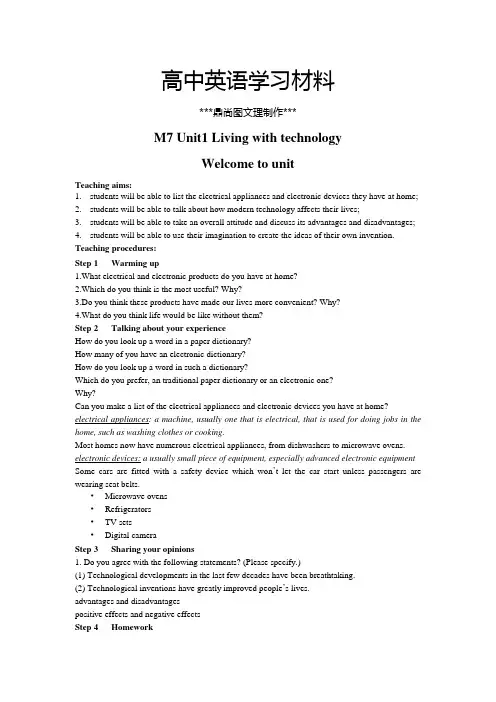
高中英语学习材料***鼎尚图文理制作***M7 Unit1 Living with technologyWelcome to unitTeaching aims:1.students will be able to list the electrical appliances and electronic devices they have at home;2.students will be able to talk about how modern technology affects their lives;3.students will be able to take an overall attitude and discuss its advantages and disadvantages;4.students will be able to use their imagination to create the ideas of their own invention. Teaching procedures:Step 1 Warming up1.What electrical and electronic products do you have at home?2.Which do you think is the most useful? Why?3.Do you think these products have made our lives more convenient? Why?4.What do you think life would be like without them?Step 2 Talking about your experienceHow do you look up a word in a paper dictionary?How many of you have an electronic dictionary?How do you look up a word in such a dictionary?Which do you prefer, an traditional paper dictionary or an electronic one?Why?Can you make a list of the electrical appliances and electronic devices you have at home? electrical appliances:a machine, usually one that is electrical, that is used for doing jobs in the home, such as washing clothes or cooking.Most homes now have numerous electrical appliances, from dishwashers to microwave ovens. electronic devices:a usually small piece of equipment, especially advanced electronic equipment Some cars are fitted with a safety device which won’t let the car start unless passengers are wearing seat belts.•Microwave ovens•Refrigerators•TV sets•Digital cameraStep 3 Sharing your opinions1. Do you agree with the following statements? (Please specify.)(1) Technological developments in the last few decades have been breathtaking.(2) Technological inventions have greatly improved people’s lives.advantages and disadvantagespositive effects and negative effectsStep 4 Homework1. Write a short passage about what you’d like to invent and why.2. Workbook Page106-107 Reading A, B.3. Preview Reading (Page2-4).。
牛津译林版七年级上册(新)unit1 Welcome to the unit(共26张PPT)
I'm your new English teacher. My family name is Lang. I like reading books and running. I have been teaching English for 22 years.
About You
• What’s your Chinese/English name? • How old are you? • What’ your hobby? ---I like…
I want to be your friend!
Our new friends
master
look after
Eddie
Hobo an e-dog
Listen and answer
What does Hobo ask Eddie to do?
Listen and repeat.
Read and complete.
About English
• Do you like English? • Do you think English difficult or easy? Why? Learning English is a big challenge(挑 战) or a piece of cake?(小菜一碟)
Good afternoon.
6.00 p.m.
Good evening.
in the evening
10.30 p.m. in the evening
Good night.
How to greet your friends at the following times? 8:00a.m 10:30a.m
牛津高二英语M7U1 Welcome to the unit课件
Device TV cellphone refrigerator
washing machine
How to improve our life(functions)
air-condition
microwave oven
computer MP3/MP4 U-disk
Timeline
1982 1984 1985 1986 1990 1997 2001 2004 electric fan TV(black-and-white) refrigerator washing machine TV(colour) air-condition mobile phone(with basic functions) mobile phone(with MP3 and camera)
dictionary
development of dictionary
electronic dictionary
letter/telegram
beeper
telephone
development of communication
cellphone
digital camera camera
development of camera
Homework
1.Read two passages on P106-107 2.Preview reading. 3. Unit Revision: Period 1.
Good staying with you!
The end !
cooking utensils (炊具)
desktop
laptop
DVD
digital camera
microphone
牛津译林英语七级上册unitWelcome
Listen to the tape and answer the questions:
1. When does Millie go to school every day?
At 7:20 a.m./7:20 in the morning. 2. Is Millie often late for school?
3.Shall we go walking in the hills? 我们去山上散步好吗?
Shall we\I do sth? Shall 与第一人称连用,表示 提出或征求意见
4.Some dogs just don’t know how to have fun.
疑问词+ to do作宾语
我不知道去哪里。I don’t know ___w_h_e_r_e_to__g_o____. 她不知道做什么。She doesn’t know _w_h_a_t_to__d_o____.
叫醒他/我/我们___wห้องสมุดไป่ตู้a_k_e_h_i_m_/_m_e_/_u_s_u_p__(代__词_置_中__) __
叫醒李华__w_a_k_e_L_i_H__ua__u_p_//_w_a_k_e_u_p__L_i_H_u_a__
2.Is it time for breakfast? 该是吃早饭的时候了吗?
Millie’s day
6:30 a.m.
get up
She gets up at 6:30 a.m. It is time to get up. It is time for her to get up.
• A: What is the time? • B:It is 6:30 a.m. • A:Oh, it is time to get up.
译林牛津模块7 Unit 1 Welcome to the unit(译林牛津版高二英语选修七教案教
译林牛津模块7 Unit 1 Welcome to the unit(译林牛津版高二英语选修七教案教学设计)Unit 1 Living with technologyPart One Teaching Design第一部分教学设计Aims and requirementsRead some exhibition boards about the history of television and audio devices, and an article about the dangers of mobile phonesListen to information about electronic dictionariesTalk about how modern electronic devices affect our lives and ask for information over the telephoneWrite an e-mail to give adviceMake a list of the advantages and disadvantages of some modern electronic devicesProcedures●Welcome to the unitStep 1: BrainstormingNowadays, it seems that man cannot live without such electrical and electronic products as microwave ovens, refrigerators, TV sets, air conditioners, washing machines, electric fans, mobile phones, digital cameras and vacuum cleaners. Do you agree with me?Which do you think is the most useful?What electrical and electronic products do you use in your studies and in your life? (electronic dictionaries, computers, CD players, MP3)Are they helpful or just make you lazier?For referenceElectronic dictionaries give students quick responses in their reading. Students using electronic dictionaries need less time in reading than those who use paper dictionaries. Moreover, electronic dictionaries can provide correct pronunciation to students, which a paper dictionary cannot. The number of people using electronic dictionaries is increasing greatly.As we can see, with the rapid development of electronic technology in the last few decades, electrical and electronic products have made ou r lives more convenient. I’d like to give you some examples.Now, let’s have a discussion: What do you think life wouldbe like without these products?Step 2: Sharing information1. Let’s enjoy some wonderful ads about some electrical and electronic products. What conclusion can you draw?Man has made remarkable progress in this area in the last few decades.Do you think the progress has made our lives more convenient or has made simple things more complicated?For reference●They are invented to meet people’s needs.●They have improved people’s lives to some degree.●They are developing very quickly.●The radiation from some of the electrical and electronic devices, such as mobile phones, may be h armful to people’s health.●When people buy new electrical of electronic devices, they throw away the old ones. This may generate large amount of waste, which is harmful to the environment.2.Group work. Look at the four pictures at page 1. Let’s study them one by one and try to discuss some questions in groupPicture 1What kind of TV do you have at home?What differences can you find between the TV in your home and the TV in this picture? (Early TV had antennae on top. The screen was very small and could show only black-and-white pictures. The size of the TV was small compared with modern TV, and usually it looked like a wooden box. Early TV also did not have a remote control. The control panel was on one side of the screen.)What kind of pictures did early TV have? (Early TV had black-and-white pictures that were fuzzy.)What other functions do you need in a modern TV?Picture 2What did people need when they wanted to record music in the past? (Tapes and a tape recorder.)How did people record music in the past? (People put the tapes into the recorder, then played the tape with music at one side and pushed the play and record buttons at the other side to record the music onto the blank tape.)Look at the picture. What devices do people need to record music now? (A computer, an MP3 player and some recordingHow do People record music using a computer? (People copy the music from a CD to the computer using recording software. The music will then be digitalized in and played by an MP Player. )Picture 3How do you look up a word in a paper dictionary? (The words in a paper dictionary are arranged in alphabetical order from ‘A’ to ‘Z’. We need to look at the f irst letter of the word and use it to search in the dictionary. If two words start with the same letter, we look at the second letter to decide the alphabetical order. If the first and second letters are the same, we look at the third letter and so on.)How many of you have an electronic dictionary? How do you look up a word in such a dictionary? (We key in the word we want to look up and click the button ‘Enter’. Then the word entry will appear on the screen.)Besides the dictionary, what else can be stored in your electronic dictionary? (There can be a calendar, a list of addresses and phone numbers, memos or a clock. More recent electronic dictionaries have large memory space and some can be used as electronic books with hundreds of books stored inside.)Which do you prefer, an electronic book or a traditional paper book? Why?Picture 4How did people keep in touch in the past? (People sent letters in the past, but letters were slow, and they took from a few days to several months to arrive. Then people invented the telegraph, but the telegraph could send only short sentences. Later, people could communicate via telephone, but the disadvantage was that not everyone had a telephone. Now, people use e-mails to communicate. E-mails are quick, but people without computers and access to the Internet cannot send e-mails. Today, most people use mobile phones to keep in touch with others. The size of a mobile phone is small so people can carry one in a pocket and receive and make calls wherever they are and whenever it is.)What recent developments have been made to mobile phones? (Now, mobile phones have more and more functions. They can send text messages. They can also be used as a digital camera to take still or even moving pictures. People can send the pictures they take to other mobile phones or e-mail addresses. Mobile phones can be connected to the Internet and people can look at web pages with mobile phones. More technologically advanced mobile phones can receive TV signals so that people can watch live TV programmes on their mobile phones.)It is reported that many high school students bring mobile phones to their schools. Do you think high school students should use mobile phones at school? Why or why not?Please express your ideas freely and make sure that all ofyou have a chance to speak.Step 3: Discussion:1. How have different electronic devices changed over time?2. How have these inventions improved people’s lives?Sample answers1. Different electrical and electronic devices have changed a lot over time. Take mobile phones as an example. Mobile phones first appeared in 1947, and they looked much bigger than what we are using nowadays. In the past, they could only provide us with basic services like making phone calls. However, customers now want to be entertained. As a result, developments were made. Nowadays, many new types of phones are available that can connect to the Internet or be used as cameras or MP3 players.2. These inventions have greatly improved people’s lives. Mobile phones are a good example of this. Before mobile phones came into use, people couldn’t make phone calls or receive phone calls if there was no telephone nearby. With mobile phones, people are able to make calls at any time and at any place. Today, many of us are very busy and cannot be expected to wait for a long time. Mobile phones provide us with a chance to keep in touch with others wherever we are.For referenceElectrical and electronic goods help people save a lot of time and make our lives more convenient. However, we cannot ignore that every year electronic and electrical waste is increasing considerably, much of which will do great harm to our environment if not properly dealt with. The governments in many countries have realized the importance of solving the problem and they have been trying to find the solutions, but further attention needs to be given to the problem.Step 4: Homework:1. Collect more information about the development of some electronic and electrical devices.2. Prepare the Reading part.文档内容到此结束,欢迎大家下载、修改、丰富并分享给更多有需要的人。
译林七上第一单元 welcome
Practise the dialogue A: Hello. / Hi. / Good morning/ afternoon… B: Hello. / Hi. / Good morning/afternoon… A: I’m…/ My name is…
What’s your name? B: I’m…/ My name is… A: Nice to meet you. B: Nice to meet you, too.
Activity
Work in pairs. Greet your partner and then introduce yourself. Use the conversation below.
Hello!
I’m Millie.
Hi!
What’s your name?
My name is Sandy. Nice to meet you.
Answer Questions:
1. What are the two dogs’ names? Hobo and Eddie.
2. Who is the master? Eddie is the master.
3. Is Hobo a real dog? No, Hobo is an e-dog.
Hi, I’m Simon.
2:45 p.m.
Good afternoon.
Hello, I’m Millie.
I’m _K_i_t_ty__.
6:00 p.m.
Good evening.
Hi, I’m Sandy What’s your name?
My name is _D_a_n_i_e_l .