
2018年福建小学教师招聘-小学英语试题
i'm sorry I broke your teapot
_____I have another one
A. Be careful.
B. Thats OK
C With pleasure
D. Thats right
参考答案B
2. ---do you mind if I ask you some questions?
_____But I am occupied at the moment
A.NO,go ahead
B Yes, please
C. No problem
D. Never mind
参考答案:C
3, We should bear in mind___have set out and make our effort to achieve greate achievement in the new era.
A.what
B.that
C where
D. When
参考答案:B
4.By no means__B_while losing sight of potential problems
A. we should rest and seek comfort
B should we rest and seek comfort
C. rest and seek comfort should we
D. rest and seek comfort we should
参考答案:B
5. Over the past several decades, governments at all levels___ no efforts to improve peoples living conditions
A.spare
B.spared
C had spared
D have spared
参考答案:D
6.____ the blueprint into reality will be a new Long March. The road ahead will be very long
but time waits for no man
A. Translate
B. Translating
C.Having translated
D Being translated
参考答案:B
7. No success can be compared with____ of helping your students achieve their dreams
A that
B.those
C.it
D.one
参考答案:A
8. Scientists in California think they may have discovered a way to____the aging process
A.put aside
B. put off
C put out
参考答案:B
9. We have many manufacturing bases across the country,____ most are unmanned factories
A. for what
B. of that
C for which
D of which
参考答案:D
10. Sitting by the window of the train, you can have a better____.
A.scenery
B sight
C. scene
D. View
参考答案:A
I1, china's railway technology is____to boosting integration, trade and industrialization in Africa.
A.close
B.similar
C. beneficial
D.superior
参考答案:C
12. New measures are introduced to ensure that the business runs____
A.smoothly
B roughly
C frequently
D irregularly
13. The excrciscis____he abilities of the students. it's too difficult
A. for
B beyond
C. wit
D. Unde
参考答案:B
14.____you are swimming, running, or practicing yoga, regular exercise can make for a great nights sleep
A. Since
B. Unless
C. Although
D. Whether
参考答案:D
15. " If winter comes, can spring be far behind"is the last line of the poem_____
written by the British poet Shelley
A Ode to the westw
B Ode to a nightingale
C Ode on Melancholy
D Ode on intimations of immorality
参考答案:A
16. Which is following was written by John Steinbeck, the foremost novelist of the Great Depressingof1930s?
A. The Sound and the Fury
B The Great Gatsby
C. The Grapes of wrath
D. The Scarlet Letter
17. The war between England and france that lasted intermittently from 1337 to 1453 is called____the causes of which were partly territorial and partly economic
A. the Opium War
B. the Hundred years' War
C the french Wars
D. The wars of the roses
参考答案:B
18. The consonant____an be described as voiceless, bilabial and stop
A./K/
B./g/
C./p/
D./b/
参考答案:C
19.暂缺
20.Whictr of the following activities is Not suitable for a-warm-up activity for Children in an English class?
A. Saying a rhyme
B.Giving duty report
C Doing a TPR activity
D. Filling in the blank
参考答案:D
二、阅读理解(暂缺)
三.短文填词(暂缺)
四.填空
36.王老师在课堂上引导学生把感恩节和中秋节进行对比,这有助于学生在比较中外文化的异同中形成___增进国际理解,弘扬爱国主义精神。
(跨文化意识)
37.方老师在学生阅读英文绘本后,让学生观察、归纳文章的大意,在这个过程中教师主要是培训了学生____学习策略。
(认知)
五.翻译
41. Confucian love starts from loving one's family and other people, to loving all living things inthe world. Humans and other living things are of the same kind.
六.书面表达
President Xi said,"A nation will prosper only when its young people thrive. A country with full of hope have a great tomorrow. Please write a composition about "teacher's mission in new era. The composition should consist of 1. What responsibility do the teachers bear? 2. What to do accomplish the objective
七.教学设计和案例分析
(五年级课文,去动物园)
评价“warm-up部分优点
对新授活动指出不足(1处)
Summary分析
设计一个练习活动和一个巩固活动。
福建省教师公开招聘考试小学英语真题及答案
福建省教师公开招聘考试小学英语真题及答案福建省教师公开招聘考试小学英语真题及答案福建省教师公开招聘考试小学英语真题及答案一、单选题1、下列哪个选项不是鸟类? A. 蝙蝠 B. 鸽子 C. 企鹅 D. 蜻蜓答案:D2、下列哪个国家以玫瑰著称? A. 意大利 B. 英国 C. 美国 D. 澳大利亚答案:B3、下列哪个选项不是我国传统节日? A. 春节 B. 端午节 C. 中秋节 D. 圣诞节答案:D4、下列哪个城市是我国的首都? A. 上海 B. 北京 C. 广州 D. 深圳答案:B5、下列哪个国家是著名的产油国? A. 巴西 B. 俄罗斯 C. 印度 D. 沙特阿拉伯答案:D二、多选题1、下列哪些动物属于哺乳动物? A. 猫 B. 狗 C. 鱼 D. 鹿 E. 鸟答案:ABD2、下列哪些调料属于辛辣调料? A. 盐 B. 辣椒 C. 花椒 D. 大料E. 味精答案:BC3、下列哪些物品属于文具? A. 笔 B. 纸 C. 书 D. 笔记本 E. 圆珠笔答案:ADE4、下列哪些城市属于沿海城市? A. 上海 B. 武汉 C. 北京 D. 广州 E. 深圳答案:ADE5、下列哪些国家拥有世界上最多的岛屿? A. 印度尼西亚 B. 菲律宾 C. 澳大利亚 D. 巴西 E. 南非答案:AB三、判断题1、上海是我国的最大城市。
()答案:√2、猴子是最接近人类的动物。
()答案:×3、我国最长的河流是长江。
()答案:√4、蓝色是冷色调。
()答案:√5、太阳是地球的一部分。
()答案:×福建省教师公开招聘考试小学英语真题2024年福建省教师公开招聘考试小学英语真题2024年福建省教师公开招聘考试小学英语真题2024年于近日揭晓。
本次考试涵盖了丰富的知识点,包括语法、词汇、阅读理解、翻译和写作等方面。
下面,我们将对这份试卷进行详细分析。
首先,我们来看一下试卷的整体结构。
整份试卷共分为两个部分,第一部分为客观题,包括单项选择题、完形填空题和阅读理解题,共占100分;第二部分为主观题,包括翻译题和写作题,共占100分。
年福建省小学英语教师公开招聘考试真题(附答案)
年福建省⼩学英语教师公开招聘考试真题(附答案)P10加2016年福建省中⼩学新任教师公开招聘考试真题试卷(三)⼩学英语满分150分,考试时间120分钟。
第⼀部分选择题⼀、选择题(本⼤题分为两个部分:单项选择和阅读理解;满分55分)(⼀)单项选择(共20⼩题,每⼩题2分;满分40分)从A、B、C、D四个选项中,选出⼀个可以填⼊空⽩处的最佳选项。
()1.—Would you be back some time earlier, David?—Sure.____A.How come?B.What’s up?C.Take your time.D. It makes no difference.()2.A report shows that the total value of China’s cultural exports has been more than double____of the United States since 2013.A.thatB.whatC.thoseD.one()3. China’s transport minister warned the online taxi-hailing companies Uber and Didi____their subsidies leadingto“unfair”competition.A.withB.forC.beyondD.over()4. Some people won’t gain weight, ____they have much for meals every day.A. sinceB. whetherC. even thoughD. as if()5. I was unexpectedly____at work, so I failed to contact you on time.A. put upB. held upC. turned downD. pulled down()6. As to gold jewelry, widely____as“safe harbor in uncertain times”, its sales totaled $100 billion over the year.A. consideringB. to considerC. consideredD. to be considered()7. —Darling, I’d like to be out for a sunbath.—All right. If you____, take suntan lotion with you.A. mustB. mayC. canD. should()8. In the near future, occupations that are____related to the Internet will have a bigger chance to double income.A. roughlyB. frequentlyC. closelyD. similarly()9. Made familiar in the monkey master in Kung Fu Panda, the monkey becomes an important____in the world of Chinese martial arts.A. signalB. noticeC. markD. symbol()10. The writers present had a heated discussion with the scholars who study culture and group behavior, as well as those____the psychology of individuals.A. studyB. studyingC. to studyD. studied()11. Unlike some other food-capable 3D printers, the Foodini device____from the start to be a specialized food-printing machine.A. has designedB. has been designedC. would designD. would be designed()12. The athlete who lost vision in his teens took up wrestle, a sport____touch and feel are more important than sight.A. whoseB. whichC. whenD. where()13. The boy walking back and forth at the door, his anxiety was____to everyone on the spot.A. aggressiveB. ambiguousC. apparentD. absurd()14. ____price, the newly-developed fridge has a big advantage over any other.A.In terms ofB.By means ofC.Owing toD.According to()15. Hamlet, Othello, ____and Macbeth are William Shakespeare’s four great tragedies.A.As You Like ItB. King LearC.Twelfth NightD.A Midsummer Night’s Dream()16. In 1719, ____published his famous novel Adventures of Robinson Crusoe.A. Jonathan SwiftB.Samuel RichardsonC.Alexander PopeD.Daniel Defoe()17. In February 1972, The US President____visited China, which led to the establishment of Sino-US diplomatic relations in 1979.A. Dwight D.EisenhowerB.John F.KennedyC.Richard NixonD.Bill Clinton()18. Which of the following is a compound word?A. Bravery.B.Civilization.C.Responsibility.D.Breakthrough.()19. According to the National English Curriculum for Compulsory Education, in regard to language knowledge, functions focus on____.A. what feelings we want to showB. how we construct sentencesC.what rules apply to word formationsD. how sentences fit together()20. Which of the following belongs to a post-reading activity in English teaching?A. Scanning.B.Prediction making.C.Retelling.D.Inductive reasoning.(⼆)阅读理解(共5⼩题,每⼩题3分;满分15分)阅读下⾯的短⽂,从每⼩题所给的四个选项(A、B、C、D)中,选出⼀个最佳选项。
【教师】2018福建省教师招考试题及答案
【关键字】教师教育学内容填空1、教育学的研究对象是(学校教育现象)2、教育现象包括(学校教育、家庭教育、社会教育)3、教育学是一种综合性的学科,既是(理论学科)也是(应用学科)4、完备的教师知识结构是(学科根底知识)(教育学科根底知识)和广泛的文化科学知识。
5、孔子对我国教育的贡献有三个方面(创立私学)(创立儒学)(删订六经)6、孔子流传于事的著作是(论语)7、启发式教学的渊源是(不愤不启)(不排不发),是孔子提出的。
8、孔子之后儒豪代表是(孟子、荀子)9、从(性善论)阐述他的观点是(孟子):从(性恶论)阐述他的观点是(荀子)10、后期称墨家为(功利主义者):称道家为(自然主义者)11、曾子所著,专讲古代大学教育的是(大学)12、曾子的学生子思的著作是(中庸)13、(学记)是根据今人的考证是战国末期(乐正刻)的作品,是世界上最早的教育经典巨著。
14、乐正真考证是(郭沫若)完成的。
15、(大学)是《学记》的教育政治学根底。
16、(中庸)是《学记》的教育哲学学根底。
17、系统总结先秦时代教育理论和实践研究的教育学专著是(学记),被认为……18、西方启发式教育思想的渊源是(苏格拉底的多婆术)。
19、西方教育学传统始于古代希腊的(苏格拉底)(柏拉图)(亚里斯多德)20、古希腊著名教育家柏拉图的著作是(理想国)。
这部著作是后世公共教育思想的源头)。
21、亚里斯多德历史性贡献是他(首次系统阐述了体育、德育、智育、美育和谐发展的教育思想。
22、昆体良的代表著作是(雄判术原理)23、夸美纽斯是17世纪的捷克教育家,所著作是(教育漫画)24、洛克是(绅士教育)的代表著作是(教育漫画)25、卢俊是(自然主义)的代表,著作是(爱弥儿)26、裴斯泰洛齐是(要素教育)的代表。
被成为19世纪中期以后到20世纪世界新教育运动的开创人。
27、赫儿巴特独立化时期的代表作是(普通教育学),是1860年出版的。
28、福禄贝尔被称为(幼儿园之父)29、杜威是(进步主义教育学派)的代表。
2018 年xx区教师招聘考试小学英语真题
2018年xx区教师招聘考试小学英语真题第一部分客观题I.Phonetics,vocabulary and grammar(Questions 1 to 20)Directions:In this part,there are 20 incomplete sentences.For each sentence there are four choices marked A,B,C and D.Choose the ONE answer that best completes the sentence.Then mark the corresponding letter on the Answer Sheet.1.All of the following underlined letters sound(s) except( )A.asksa.springC.muscleD.cycle2.Many people like to see golden lea、cs( )autumn.A.inB.onC.atD.to3.My uncle likes books, ( )he doesn’t have much time to read.A.forB.orC.butD.so4.Linda( )a car hen her phone rang.A.drivesB.is drivingC.will driveD.was driving5.——Do you know( ).---Last yearA.When will Professor lee visit China.B.When Professor lee visit ChinoC.When did Professor lee visit China.D.When Professor lee visited China6.Job made( )silly mistake.( )mistake made the 1eacherge1 mad.A.the:AB.an:theC.a:theD.a:/7.My dad always thinks that my hobbies( )of my stud) .A.gel in the wayB.go out of the wayC. are on the wayD.get into the way8.Look at these stamps.I ( )them for fi、c ) ears. Wo'' Jhe a陀beautifu l.A.boughtB. have boughtC.keptD.have kept9.Some excellent scientists think 山C)' may horn disco、·ercd a way to( )the aging process.人put asideB.put offC.put awayD.put out10.It was because I was caught in the traffic ja叫)I came to school late this morning.A.whicha.whenC.whatD.that11 .( )hard and you’ll make progress in EnglishA.To workB.WorkingC.WorkedD.work12.The hotel room( )I Live( )is 、c巧’ Jorge.A.which./B.that./c.which inD.where in13.Judy( )carefully for her find examination. so she easily passed it.A.preparedB.has preparedC.was preparingD.prepares14.If you what to work with the laptop computer outside buring the charger()thebattery runs out.A.in caseB.as ifC.even thoughD.as long as15Have you been to NanChang before?Yes,I( )there 1ast spring Festival.A.have beenB.goesC.wentD.will go16. Whoever ( )a new idea of how to work out the puzzle will be given a prize.A.keeps up withes up withC.winds up withD.get along with17.Mum,I’ve signed for the box what’s in it?I'm not sure. It( )be a present from your uncleA.needB.mayC.mustD.will18.ls this your key咱Kathy? No.( )is on the desk. Thank )’·ou.A.YoursB.Hersc.HisD.Mine19.I‘m preparing dinner.Arc you allergic to anything?No.But I( )red meat .A.didn’t eatB.wasn’t eatingC. don't eatD.haven't eaten.20. (待更新)III.Reading Comprehension(Questions 31 to 45)Directions:There are 3 passages in this section. Each passage is followed by somequestions and unfinished statements. For each of them there are four choices marked A,B,C and D.You should choose the BEST answer. Then mark the corresponding letteron the Answer Sheet.Farley worked for the Canadian government. One day, he was__to learn more about wolves. Do wolves kill lots of caribou(big animals)? Do they kill people?They gave him lots of food and clothes and guns. Then they put him on a planeand took him to___. The plane put him down and went away. There were no houses orpeople in this place, but there were lots of animals and lots of wolves.People tell terrible stories about wolves. They say wolves like to kill andeat people. Farley remembered these stories, and he was___ . He had his gun withhim____.Then one day, he saw a group of wolves. There was a mother wolf with four baby wolves.A father wolf and another young wolf lived with them.Farley watched these wolves every day. The mother was a very____mother. Shegave milkto her babies. She gave them lessons about life. They learned how to____food. Thefather wolfgot food for the mother. The young wolf____the children. They were a nice, happyfamily-a wolffamily. Farley did not need his____any more. In a short time, he got on well withthe wolf family.Farley watched them for five months. He learned many new things about wolves. Helearned thatmany stories about the wolves were____. Wolves do not eat people, and they do noteat many large animals. And he also learned bad things about men. It was men whokilled many caribou and wolves.Later, Farley wrote a book about wolves. He wanted people to____them and notto kill them.21. A. seen B. told C. heard D. found22. A. a small town B. a big city C.a far place D. a lonely village23. A.afraid B. happy C. angry D. tired24. A. at times B. all the time C. once a week D. every afternoon25. A. bad B. good C. hungry D. thirsty26. A. cook B. make C. get D. pick27. A. shouted at B. looked into C. laughed at D. played with28. A. food B. clothes C. gun D. plane29. A. not good B. not true C. not easy D. not clear30.A. grow B. have C. teach D. understandAFrom my father I have learned a lot. And I’m very thankful to him. I rememberwhen I was a child my father always got up very early, quietly putting on his clothes and going off to work. To arrive in time to open his tiny store at 8:30, he neededto leave our apartment at 6:30. After all, he had to take a bus and then the subway. The last journey was a long walk through a neighborhood much of which was full ofthe smell of rubbish. I learned: it is very important to work. No excuse.When I was 12, I would, on some Saturdays, go to my father’s store to help out.After helping set up the outside clothing display, for the rest of the day, I’d watch to make sure no one stole anything. When I noticed someone looking unusualor strange, I would look the person in the eye, smile and say, “May I help you?”Usually that worked, but sometimes, someone would run off with something. The first time, I ran after the thief but my father shouted, “Martin, stop! There is no need to do that.” It’s true that safety is more important than money.After 10 years of hard work, he saved up enough money to buy his first car, acheap one—he wouldn’t buy one until he could afford to pay for it without borrowing money. I learned: buy only what you can afford. Buying necessary food and clothingwon’t make us go in debt(债务). The unnecessary things won’t give us happiness, which comes from achievement only.31. What shop did the author’s father own?A.A bookshop. B.A coffee shop.C.A clothing shop.D.A food shop.32.Which of the following is NOT true according to the passage?A.The author ran after thieves many times.B.The author thanked his father a lot.C.The author’s father worked very hard.D.The author’s father made some money.33.All the following are talked about in the passage EXCEPT . A.the importance of workingB.the good ways to keep healthyC.that safety comes before moneyD.that it’s bad to spend more than you make34.According to the author, what usually makes people go in debt?A.To rent a house for the family.B.To send their children to school.C.To enjoy something unnecessary.D.To buy enough food for the family.35. What is the passage mainly about?A.How to live a happy life.B.What makes a person successful.C.The help the author got from his father.D.What the author learned from his father.BThere are many differences between British English and American English.I used to teach a course about the differences between the two.We speak English on both sides of the Atlantic Ocean but we have many differences in our common language.We have examples of the same words having very different meanings, differing spellings of the same words as well as completely different wordsfor the same things.Here are some examples.A cookie in the US is called a bi scuit in the UK.A biscuit in the US is asmall cake in the UK.Crisps in the UK, are known as chips, but we British people eat a plate of chips that you call fries in the US.In the UK, a pie can be made from either meat or fruit, while in the US pies are normally made from fruit;pot pies are made from meat.Most things are measured in grams and kilogramsin the US, not pounds and ounces.One very obvious (明显的) difference is the side of the road we each choose to drive on.Petrol in the UK is gas in the US.The place where we fill up ourcars, in the UK, is a garage;while in the US, it's a gas station.The term garage is also used as a place to store your car next to or close by yourhouse.In the UK we call a lorry what is known as a truck in the US.An elevator in the US is called a lift here, and the first floor in the US, is called the ground floor here,so many visitors get off on the wrong floorin British hotels.I could continue with this.There are countless examples of differenceswithin our one shared language.With so many differences, no wonder it's hardto understand each other well.36. The passage is mainly about the differences between British English andAmerican English in________.A. vocabularyB. grammarC. soundD. spelling37. It's implied in the passage that the author may be________.A. a driver from the USB. a cook from the USC. a teacher from the UKD. a gas station worker from the UK38. In the author's opinion, ________.nguage differences don't affect understandingB. the same words in the two different types of English may have differentspellingsC. there will be fewer differences between American and British English in the futureD. it is impossible that some Americans get off on the wrong floor in Britishhotels39.which pair of......A.Chips and friesB.Petrol and gasC.Elevator and liftD.Garage and gas station40. What can we learn from the passage?A. "Elevator" is commonly used in the UK.B. Pies mean the same thing in the UK and the US.C. In the UK, things are measured in pounds and ounces.D. British and American people drive on the same side of the road.CIf you want to become a better reader, what should you know about speed ofreading? Some p eople read very rapidly(很快地), while others read very slowly. But which one is better? The rapid reader may be a good reader when he reads a storybook for fun. But he may not be able to slow down e nough to read directions(说明) carefully. He may read so rapidly that he does not take time to understand fully the ideasand information which are important to remember.The slow reader may be a good reader when he reads directions for making something. But he may spend too much time inreading a simple story which is meant to be enjoyed but is not important enoughto be remembered.So, you see, either a rapid reader or a slow reader is not reallya good one. If you wish to become a better reader, here are four important thingsto remember about speed of reading.Knowing why you are reading will often help you to know whether to read rapidlyor slowly.Some things should be read slowly throughout. Examples are directionsfor making or doing something, science and history books, and Maths problems. You must read such things slowly or remember each important step and understand each important idea.Some things should be read rapidly throughout. Examples are simple stories forenjoyment, letters from friends and bits of news from hometown papers.In some of your reading, you must change your speed from fast to slow and slowto fast, as you go along. You will need to read certain(某些) pages rapidly and then slow down and do more careful reading when you come to important ideas.41. What do you think is better, reading slowly or reading quickly? ( )A. Reading slowlyB. Reading quickly.C.Both of themD. Neither of them42. What should you read slowly when you read? ( )A.Letters messages and e-mailsB. Newspapers and magazines.C Something full of important informationD. Picture books43. What should you read quickly when ) 011 read'? ( )A. TextbooksB. Instructions for making something.C.Story books newspapers and so onD.Science and history books44.Why should we must read instructions slowly? ( )A. Because "c must understand fully 由c idea of 山cm.B. Becase we must remember 由c important information of them.C. Because we thin!..由e instructions arc very funnyD. Both A and B.45. How can 川如come a good render? ( )A. Read as fast as possible and don’t remember them all.B. Change our speed when we read something differentC. Read things throughout quickly.D. Read tit帆gs slowly throughout.第二部分主观题一、书面表达(10分)46.【写作材料】我们周围的环境变得越来越糟糕,污染越来越严重。
2018下半年教师资格考试小学英语面试真题及答案
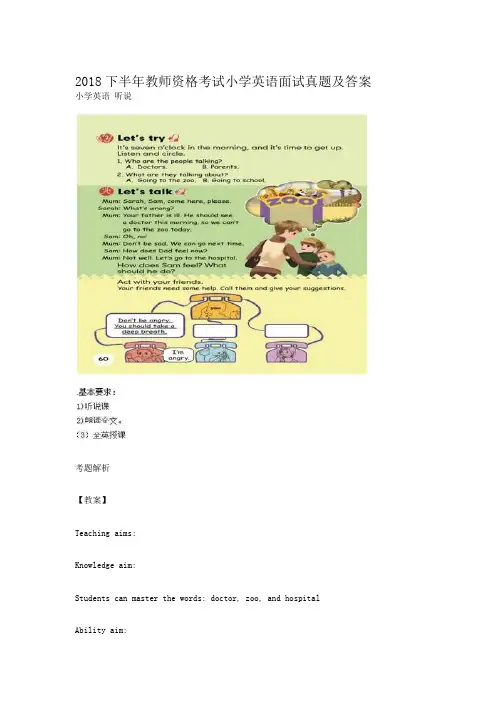
2018下半年教师资格考试小学英语面试真题及答案小学英语听说考题解析【教案】Teaching aims:Knowledge aim:Students can master the words: doctor, zoo, and hospitalAbility aim:Students can improve their skills of listening and speaking.Emotional aim:Students can be more interested in taking part in activities and know how to deal with the emergency..Key and difficult point:Key Point:master the words: doctor, zoo, and hospital and understand the main topic of this dialogue.Difficult Point: know how to deal with the emergency in daily life.Teaching procedure:Step 1: Warming-up1. Greetings.2. Ask students where they went last weekend.3. Ask students “did you meet any emergency when you had the plan”Step 2: Pre- listening1. Draw some pictures to teach about the words: doctor, zoo, and hospital2. Let students guess what the main topic of passage according to the titleStep 3: While-listeningFirst listening: check the prediction of main topic of the dialogue and ask”what are they talking about”Second listening: what’s the matter of Sarah? and what is about his feeling?Third listening: read after the tape.Step4: Post-listeningSet a situation: if you meet this situation, what should you do? and if your friend meet this situation and he calls you for help. What will you say?Step5: Summary and HomeworkSummary: ask a student to conclude the content of the lesson and summarize with the whole class.Homework: ask students to practice the sentence structure learned today with desk mates after class.Blackboard design:略小学英语语音考题解析【教案】Teaching aims:Knowledge aim:Students will master the meaning and pronunciation of the word. Ability aim:Students will know how to pronounce “-er” in words.Emotional aim:Students will be interested in learning English.Key and difficult point:Key Point:Students will master the meaning and pronunciation of the word.Students will know how to pronounce “-er” in words.Difficult Point:Students will be interested in learning English.Teaching procedure:Step 1: Warming-up1. Greetings.2. Sing a song Finger Family.Daddy finger, daddy finger, where are you?Here I am, here I am, how do you do?Mommy finger, mommy finger, where are you?Here I am, here I am, how do you do?Ask them if they know the name of the song. Then may guess it is Finger Family. Thentell them that we are going to learn some pronunciation in “finger”.Step 2: Presentation1. Use some riddles to introduce the words. For example, “I will drink it every day. What is it? Yes, it’s water.” Then draw the according pictures(introduce “sister” by explaining its meaning). And write the words at last.2. Ask the students to read the words after the teacher for twice. Then play high and low voice. If the teacher speak one word loudly, the students should speak it lowly, and vice versa.3. Ask students to find similarities among the words. They may say that they all contain “-er” at the end of the words. Then introduce the rules of the pronunciation.4. Ask students if they know other words containing “-er”. They may say “winter”, “river” or others.Step 3: Practice1. Finish Read, underline, and say in the textbook. Check answers, and ask students to read after the teacher.2. Finish Look, listen and write in the textbook. Then invite students share their answers on the blackboard. Give encouragement.Step4: Production1. Ask students to make up a chant using the words we learned. For example:Water, water, tiger likes water.Sister, sister, sister likes computer.Dinner, dinner, let’s have dinner.Step5: Summary and HomeworkSummary: ask a student to conclude the content of the lesson and summarize with the whole class.Homework: chant for the students’ parents.Blackboard design:略。
福建省教师招聘考试小学英语真题试卷专题
福建省教师招聘考试小学英语真题试卷专题第一篇:福建省教师招聘考试小学英语真题试卷专题学生边做动作边练操:I like to fly a kite.I like to go shopping/go fishing/take a picture/ climb mountains...然后学生在板书“It’s…/ It’s…/I like to...”引导下,练习说出诸如“It’s spring.It’s warm.I like to fly a kite.”的句子。
教师用同样的方法教学summer,fall,winter等单词,然后过渡到对句型“It’s…/ It’s…/I like to...”to...”的操练,最后过渡到拓展短文My Favorite Season的阅读。
学生的阅读进行得很顺利,对教师提出的问题也能轻松作答。
(1)在本教学片段中,教师采用了哪些教学方法?(2)请从不同角度(至少3个)对本案进行评析。
44.教学活动设计(满分20分)根据下列提供的语言项目和活动目的,请你设计单词、句型的教学活动,并说明活动设计的意图。
请将答案完整地写在答题卡上。
设计要求如下:(1)所给单词可选择使用,活动设计要能体现英语教学的趣味性;(2)活动设计要体现单词和句型教学的多样性(至少有3种方法);(3)请注明不同教学活动的设计意图。
【语言项目】单词:these, those, hobby, stamp, chess, collect, listen, Australian, American 句型:What’s your hobby? I like...【活动目的】让学生运用所学词汇和句型What’s your hobby?来询问他人的爱好,并能正确回答和介绍个人爱好I like...。
第二篇:招聘教师考试真题试卷招聘教师考试真题汇编试卷一、单项选择题(本大题共15个小题,每小题2分,共30分)在下列每小题列出的四个备选项中只有一个是最符合题目要求的,请将其代码填在括号内。
2018年福建省教师招聘考试小学英语真题卷
2018年福建省中小学教师招聘考试小学英语真题卷1.i'm sorry I broke your teapot_____I have another oneA.Be careful.B.Thats OKC With pleasureD.Thats right参考答案B2.---do you mind if I ask you some questions?_____But I am occupied at the momentA.NO,go aheadB Yes,pleaseC.No problemD.Never mind参考答案:CNever mind除了回答道歉以外,还在以下几种场合下使用,如:1表示安慰,意为;别着急:不要紧:没关系。
如Never mind,next time i'm sure you can do better没关系,我相信你下次一定会做得好些2.用来谢绝别人的提供,意为,不用噬;别费事啦。
如A:can I help you with it?要我帮你做这事吗?B;never mind.别费心啦3.用来否定某一想法或提议等,意为:算了:没什么。
如13.1Nover mind,please don't go for it,ldon't want it.算了,请不要去取了,我不想要3.2Ar what did you say?你说什么?B:oh,never mind.噢,没说什么。
3,We should bear in mind___have set out and make our effort to achieve g reate achievement in the new era.A.whatB.thatC whereD.When参考答案:B4.By no means__B_while losing sight of potential problemsA.we should rest and seek comfortB should we rest and seek comfortC.rest and seek comfort should weD.rest and seek comfort we should参考答案:B5.Over the past several decades,governments at all levels___no efforts to improve peoples living conditionsA.spareB.sparedC had sparedD have spared参考答案:D6.____the blueprint into reality will be a new Long March.The road ahead will be very longbut time waits for no manA.TranslateB.TranslatingC.Having translatedD Being trans lated参考答案:B7.No success can be compared with____of helping your students achieve t heir dreamsA thatB.thoseC.itD.one参考答案:A8.Scientists in California think they may have discovered a way to____the aging processA.put asideB.put offC put outD.put away参考答案:B9.We have many manufacturing bases across the country,____most are unma nned factoriesA.for whatB.of thatC for whichD of which310.Sitting by the window of the train,you can have a better____.A.sceneryB sightC.sceneD.View参考答案:AI1,china's railway technology is____to boosting integration,trade and i ndustrialization in Africa.A.closeB.similarC.beneficialD.superior参考答案:C12.New measures are introduced to ensure that the business runs____A.smoothlyB roughlyC frequentlyD irregularly参考答案:A13.The excrcisc is____he abilities of the students.it's too difficultA.forB beyondC.witD.Unde14.____you are swimming,running,or practicing yoga,regular exercise ca n make for a great nights sleepA.SinceB.UnlessC.AlthoughD.Whether参考答案:D15."If winter comes,can spring be far behind"is the last line of the p oem_____written by the British poet ShelleyA Ode to the westwB Ode to a nightingaleC Ode on MelancholyD Ode on intimations of immorality参考答案:A16.Which is following was written by John Steinbeck,the foremost noveli st of the Great Depressingof1930s?A.The Sound and the FuryB The Great GatsbyC.The Grapes of wrathD.The Scarlet Letter参考答案:C17.The war between England and france that lasted intermittently from13 37to1453is called____the causes of which were partly territorial and p artly economic5A.the Opium WarB.the Hundred years'WarC the french WarsD.The wars of the roses参考答案:B18.The consonant____an be described as voiceless,bilabial and stopA./K/B./g/C./p/D./b/参考答案:C19.暂缺20.Whictr of the following activities is Not suitable for a-warm-up activ ity for Children in an English class?A.Saying a rhymeB.Giving duty reportC Doing a TPR activityD.Filling in the blank参考答案:D二、阅读理解(暂缺)三.短文填词(暂缺)四.填空36.王老师在课堂上引导学生把感恩节和中秋节进行对比,这有助于学生在比较中外文化的异同中形成___增进国际理解,弘扬爱国主义精神。
2018年教师公开招聘考试《小学英语》试题及答案(二)
2018年教师公开招聘考试《小学英语》试题及答案(二)一、单项选择:从各小题所给的A、B、C、D四个选项中,选出一个最佳答案。
(共20小题;每小题1分,满分20分。
)1.You can’t pass the exam _________ you study hard.A.ifB.becauseC.unlessD.so2.Look out! Don’t get too close to the house roof is under repair.A.whoseB.whichC.of whichD.that3.If it were not for the fact that she _________ sing, l would invite her to the party.A.couldn’tB.shouldn’tC.can’tD.might not4.Always read the _________ on the bottle carefully and take the right amount of medicine.A.explanationsB.instructionsC.descriptionsD.introductions5.Green products are becoming more and more popular because they are environmentally .monB.variousC.friendlyD.changeable6.—What happened to you this morning?—The teacher asked me for my _____ when I was late again.A.meaningB.ideaC.excuseD.answer7.—Would you help me put away these things?—_________.A.Yes, quite rightB.Never mindC.You’re welcomeD.With pleasure8.—Here’s coffee and tea. You many have ________.—Thanks.A.eitherB.eachC.oneD.it9.—Will you please stay here for the party?—Sorry, I ________. I’ll have to go to an important meeting.A.mustn’tB.needn’tC.can’tD.won’t10.—What does the lady look like?—_________.A.She’s fine and wellB.She’s really a nice ladyC.She’s tall and thinD.She like wearing skirts11.—Are you going to buy a camera?—Yes. But there are so many kinds that I can’t decide ________ to buy.A.whatB.whichC.how。
福建省教师公开招聘考试(小学英语)模拟试卷5(题后含答案及解析)
福建省教师公开招聘考试(小学英语)模拟试卷5(题后含答案及解析)题型有:1. 2. 3. 阅读理解 4. 短文填空 5. 6. 7. 书面表达8.V ocabulary and Structure1.—Could you do me a favor and take the box up to the sixth floor? —______.A.With pleasureB.My pleasureC.No wonderD.No comment正确答案:A解析:With pleasure意为“高兴地”“乐意地”;而My pleasure主要用于回答感谢,意为“这是我乐意做的事”“不用客气”,也可说成It’s my pleasure或It’s a pleasure等;Nowonder意为“难怪,怪不得”;No comment意为“不予置评”。
故本题正确答案为A。
2.The young man made a______to his parents that he would try to earn his own living after graduation.A.predictionB.promiseC.planD.contribution正确答案:B解析:prediction表示“预测”;promise表示“许诺”;plan表示“计划”;contribution表示“贡献”。
句意为:这个年轻人向父母许诺,他毕业后会自食其力。
故本题选B。
3.—Is______here? —No, Bob is ill at home.A.anybodyB.somebodyC.everybodyD.nobody正确答案:C解析:根据语法anybody或者everybody都可以,但是根据句意,应该是老师问大家是否都在这儿,everybody可以表示“所有人,大家”,所以答案选C。
4.Don’t be afraid of asking for help______it is needed.A.unlessB.sinceC.althoughD.when正确答案:D解析:when意为“在(当)……时候”。
2018上半年教师资格考题小学英语面试试卷及答案
2018上半年教师资格考题小学英语面试试卷及答案二、考题解析【教案】Teaching Aims:Knowledge aim: Students know how to pronounce oy and oi then to use it.Ability aim: Students can pronounce /ɔɪ/ correctly and use it in other words.Emotional aim: Students will enhance their confidence of pronouncing by realizing the practical use.Teaching Key Points:Students can have correct pronunciation of certain words of the same rule.Teaching Difficult Points:Students could be confident in pronouncing words.Teaching Methods:Communicative teaching method, inductive teaching method.Teaching Aids:PPT, Blackboard flashcards and so onTeaching Procedures:Step 1: Warming up1.Greetings2.Play an English song Billy boy, invite the whole students to clap when singing it. Introduce word boy to students.Step 2: Presentation1. Draw pictures of boy and toy,then show the words after them.2. Play a radio of voice and noise, let students know what the difference is between voice and noise, then show the English words.3. Read the words together, and then let students find the common pronunciation part oy and oi.Step 3: Practice1. Play a game: play on the seesaw(high-low voice) then read lips guess the word.2. Bingo: Divide four students in a group play the bingo game. Give each group a piece of paper with 9 words on it. The first group who can find the three words in a line with oy/oi should be the winner.Step 4: ProductionRead more words: Divide students into different groups then let them have a competition to read words on the flashcards, the fastest group will win the first prize. (Possible words: toy boy voice noise choice coin coy joy ploy), invite the fastest group play it in front of the class.Step 5: Summary & HomeworkSummary : students look at the blackboard and summarize this class.Homework:students introduce the words and pronunciation to their friends or parents.Blackboard design:二、考题解析【教案】Teaching Aims:Knowledge aim: Students will master the changes of third person singular verbs.Ability aim: Students can use sentence to describe what other people do in their daily life.Emotional aim: Students will improve their interest in English and realize they should cherish the time.Teaching Key Points:Students know how to describe daily activities at exact time.Teaching Difficult Points:Students can apply the structure into daily communication.Teaching Methods:Inductive teaching method, TPR teaching method, Communicative teaching method, task-based teaching method.Teaching Aids:Pictures, Blackboard and so on.Teaching Procedures:Step 1: Warming up1.Greetings2.Sing a chant, invite the whole students to do the action when singing together.In the morning GO GO GOBrush your teeth! Brush your teeth! In the morning SHUA SHUA SHUAGo to school! Go to school! In the morning GO GO GOStep 2: Presentation1.Show Students four pictures to review the words get up, brush teeth, have lunch, go to school2.Say sentences to the Students and let them find out what the changes are.e.g. I get up at 6:00 in the morning. Kitty gets up at 6:00 in the morning.e.g. I brush teeth at 6:30 in the morning. Kitty brushes teeth at 6:30 in the morning.......3.Make a conclusion. When we say he/she/other’s name, we change the words ‘get-gets’, ‘brush-brushes’, ‘have-has’, ‘go-goes’.Step 3: PracticeInvite one student coming in front, do the action and let other students say the sentence: He/She goes to school.Step 4: ProductionMake a survey: Let students work in their group of four. They’ll be given 15 minutes to ask some questions with each other and fill in the survey table about what they do at what time. After that, invite some students to share their survey result by saying ‘XX gets up at 6:30’, etc.Step 5: Summary & HomeworkSummary: Invite a student to be a small teacher, to make a summary about what we have learned today.Homework: Let students to think and design ‘A Day of Peppa Pig’. They may draw some pictures. Tomorrow two of them will be invited to share their works and say some sentences to introduce a day of Peppa Pig.Blackboard design:小学英语《boy toy voice noise》一、考题回顾二、考题解析【教案】Teaching Aims:Knowledge aim: Students know how to pronounce oy and oi then to use it.Ability aim: Students can pronounce /ɔɪ/ correctly and use it in other words.Emotional aim: Students will enhance their confidence of pronouncing by realizing the practical use.Teaching Key Points:Students can have correct pronunciation of certain words of the same rule.Teaching Difficult Points:Students could be confident in pronouncing words.Teaching Methods:Communicative teaching method, inductive teaching method.Teaching Aids:PPT, Blackboard flashcards and so onTeaching Procedures:Step 1: Warming up1.Greetings2.Play an English song Billy boy, invite the whole students to clap when singing it. Introduce word boy to students.Step 2: Presentation1. Draw pictures of boy and toy,then show the words after them.2. Play a radio of voice and noise, let students know what the difference is between voice and noise, then show the English words.3. Read the words together, and then let students find the common pronunciation part oy and oi.Step 3: Practice1. Play a game: play on the seesaw(high-low voice) then read lips guess the word.2. Bingo: Divide four students in a group play the bingo game. Give each group a piece of paper with 9 words on it. The first group who can find the three words in a line with oy/oi should be the winner.Step 4: ProductionRead more words: Divide students into different groups then let them have a competition to read words on the flashcards, the fastest group will win the first prize. (Possible words: toy boy voice noise choice coin coy joy ploy), invite the fastest group play it in front of the class.Step 5: Summary & HomeworkSummary : students look at the blackboard and summarize this class.Homework:students introduce the words and pronunciation to their friends or parents.Blackboard design:小学英语《Kitty's morning》一、考题回顾二、考题解析【教案】Teaching Aims:Knowledge aim: Students will master the changes of third person singular verbs.Ability aim: Students can use sentence to describe what other people do in their daily life.Emotional aim: Students will improve their interest in English and realize they should cherish the time.Teaching Key Points:Students know how to describe daily activities at exact time.Teaching Difficult Points:Students can apply the structure into daily communication.Teaching Methods:Inductive teaching method, TPR teaching method, Communicative teaching method, task-based teaching method.Teaching Aids:Pictures, Blackboard and so on.Teaching Procedures:Step 1: Warming up1.Greetings2.Sing a chant, invite the whole students to do the action when singing together.In the morning GO GO GOBrush your teeth! Brush your teeth! In the morning SHUA SHUA SHUAGo to school! Go to school! In the morning GO GO GOStep 2: Presentation1.Show Students four pictures to review the words get up, brush teeth, have lunch, go to school2.Say sentences to the Students and let them find out what the changes are.e.g. I get up at 6:00 in the morning. Kitty gets up at 6:00 in the morning.e.g. I brush teeth at 6:30 in the morning. Kitty brushes teeth at 6:30 in the morning.......3.Make a conclusion. When we say he/she/other’s name, we change the words ‘get-gets’, ‘brush-brushes’, ‘have-has’, ‘go-goes’.Step 3: PracticeInvite one student coming in front, do the action and let other students say the sentence: He/She goes to school.Step 4: ProductionMake a survey: Let students work in their group of four. They’ll be given 15 minutes to ask some questions with each other and fill in the survey table about what they do at what time. After that, invite some students to share their survey result by saying ‘XX gets up at 6:30’, etc.Step 5: Summary & HomeworkSummary: Invite a student to be a small teacher, to make a summary about what we have learned today.Homework: Let students to think and design ‘A Day of Peppa Pig’. They may draw some pictures. Tomorrow two of them will be invited to share their works and say some sentences to introduce a day of Peppa Pig.Blackboard design:小学英语《Sour and Sweet》一、考题回顾二、考题解析【教案】Teaching Aims:Knowledge aim: Students will master the new words.Ability aim: Students can use these new words in a communication in their daily life.Emotional aim: Students will improve their interest in English by realizing the practical use.Teaching Key Points:Students know the new words of some food and their taste.Teaching Difficult Points:Students can apply the words into daily communication.Teaching Methods:Communicative teaching method, task-based teaching method, TPR teaching method. Teaching Aids:Cards, Blackboard and so on.Teaching Procedures:Step 1: Warming up1.Greetings2.Sing a chant Where is my candy, invite the whole students to clap when singing together.Step 2: Presentatione different methods to present new words and sentenceShow students some real candies and lemon to present candy and lemonDo the action of eating ice-cream and let students guess the word;2.Draw some pictures and write corresponding words, draw happy face and sad face to show students the feeling when we eat them, and tell them happy face means it is sweet, sad face means sour.Step 3: Practice1. Games: See-saw, Read Lips, hot potato2. Match the pictures with wordsStep 4: ProductionMake Dialogue: work with their partner and make a dialogue.-What is it?-It’s a lemon.It is sour.Step 5: Summary & HomeworkSummary: Invite a student to be a small T to make a summary of what we have learned today.Homework: Thinks of more food which is sweet or sour. Blackboard design:二、考题解析【教案】Teaching aims:Knowledge aim: Students can understand the pronunciation of “ear”, and get some simple spelling rules.Ability aim: Students can read the words with the pronunciation of “ear” correctly by listening and speaking. Ability of listening and speaking will be improved.Emotional aim: Students can increase their interests in learning English.Key and difficult point:Key points: Students can understand the pronunciation of “ear”, and how how to read the words contain “ear”, such as hear, near and etc.Difficult points: Students can master the pronunciation of “ear” and read the related words correctly.Teaching procedure:Step 1: Warming-upGreeting the students.Sing a song: Head shoulder keens and toes.Step 2: Presentation1. Show the chant and ask the students the question: Can you find the same letter combination in these words?2. Listen to the tape and let students pay attention to the pronunciation of “ear”, and then ask the students question: what does “ear” sounds like in these words?3. Teacher the pronunciation of “ear” ,and let students pay attention to the teacher’s mouth.4. Game: Play the finger show to practice the new words.Step 3: PracticeFind more words with “ear” such as tear, dear, clear... and ask students to try to read by themselves and then invite some of them to share with the class. The teacher should act the role of monitor.Step4: Production1. Ask students to make up their own sentences by using the words learned today, such as “He hears the bad news,and then his tears falls down. ”.2. Reading competition: let students to read the chant as quickly as possible, and then let students choose the best one.Step5: Summary and homework1. Summary: ask students summary what have learned in the class.2. Homework:(1) read these word after class.(2) Find more words with “ear” and make another chant.二、考题解析【教案】Teaching aims:Knowledge aim: Students will master the sentence pattern and new words such as: My birthday is in…, January, February and so on.Ability aim: Students will improve their speaking ability through group workEmotional aim: Students will take part in the class actively and be fond of learning English.Key and difficult point:master the meaning of the sentence pattern and new words.speak freely in class and improve their speaking skill.Teaching procedure:Step 1: Warming-upGreeting the Ss + today is Kelly’s birthday, sing the birthday song;Step 2: PresentationUse calendar to teach the words about month. Teach the sentence pattern “my birthday is in…” by asking, “When is your birthday?”Step 3: PracticeMechanical drilling: Play Bomb game to practice the pronunciation.Meaningful drilling: categorize 12 month into 4 groups according to the season. Picture to present seasons might be used.Step4: ProductionMaking a conversation asking“when is your birthday?”二、考题解析【教案】Teaching aimsKnowledge aim: students will know the pronunciation of the group of letter “ear”. Ability aim: students can read words with “ear” when they learn vocabulary. Emotional aim: students will be more interested in speaking English.Key and difficult points:How to pronounce the group of letter “ear”.Teaching procedure:Step 1: Warming-upAfter greeting students, the teacher plays a game to warm up the class: I say you point. The teacher speaks out a certain part of the body and students point it quickly. For example: point your eye! Point your ear! Point your hand!Step 2: PresentationDraw a ear on the blackboard and ask students what it is. Write down the word. Then ask what ears can be used to, and they will say we use ear to hear something. Write down word “hear”. Then do the action of hearing and put hands near the ear, and write down the word “near”.Ask students to read the three words after the teacher, and find out the similarity among them. After discussion, they will say all these words have “ear”. Then ask students how to pronounce this group of letter. We will know it pronounce as /ir/.Step 3: practiceGive students some other words with the group of letter “ear” and ask students to read them by groups. For example, a sentence “my dear, your tear is clear in my mind for years”. Then students can have a brainstorming and think of more words with “ear”.Play a game Hot potato to practice these words. The teacher plays a piece of music. When the music is playing, students pass the ball from one to another. When the music stops, the one who gets the ball should read words on the blackboard.Step4: ProductionDo a chant with students: put your ear, near my ear, and you will hear, and you will hear, and you will hear, NOTHING!二、考题解析【教案】Teaching Aims:Knowledge aim: Students will master the words “long, small,short, ears, eyes mouth,tail...”Ability aim: Students can get the key information about rabbit and use the words to describe other animals.Emotional aim: Students will improve their interest in English.Teaching Key Points:Students can understand the meaning of the words“long, small short” and use them to describe other animals.Teaching Difficult Points:Cultivate students awareness of loving animals and protecting animals.Teaching Methods:TPR teaching method, Communicative teaching method, task-based teaching method.Teaching Aids:Pictures, Blackboard and so on.Teaching Procedures:Step 1: Warming up1.Greetings2.Let students guess a riddle about rabbits. (Teacher need to make some actions to help students guess the answer- rabbit) and then lead in the topic “A rabbit”.Step 2: Pre-reading1. Show Students different pictures of rabbits to let students discover the common points.2. Invite two students to try to describe rabbits in their own words.3. Teach students these words “ tail, mouth ,ears,eyes”Step 3: While-reading1.Let students read the sentences and circle the words that are used to describe rabbits and invite one student to share.2.Read them again and find out what part of the rabbits do they describe? After that,invite two students to write and draw a picture on the blackboard.Step 4: Post-readingMake a survey: Let students work in group of four. They’ll be given 15 minutes to ask each other about what are they favorite animals and fill in the survey table. After that, invite some students to share their survey result by intimating the animals in front of the blackboard.Step 5: Summary & HomeworkSummary: Invite a student to be a small teacher, to make a summary about what we have learned today.Homework: Draw a picture of your favorite animals and share it to your friends.二、考题解析【教案】Teaching Aims:Knowledge aim: Students will master the words from one to ten.Ability aim: Students can use these words to count things in daily life.Emotional aim: Students will improve their interest in English by realizing the practical use.Teaching Key Points:Students know the words from one to ten.Teaching Difficult Points:Students can apply the words into daily life.Teaching Methods:Communicative teaching method, task-based teaching method.Teaching Aids:Cards, Blackboard and so on.Teaching Procedures:Step 1: Warming up1.Greetings2.Sing a song Ten Little Apples, invite the whole students to clap when singing together.Step 2: Pre-1.Teacher draw one apple on the blackboard and say ‘one’; two apples ‘two’...... At the same time showing the number with fingers.2.Have Ss read the numbers after T.Step 3: While-1. Invite one student come to the front, teacher says a number, have student circle the apples. (e.g. T says 5, S should circle 5 apples)2. Let some students pick the card written numbers from 1-10, and say the number on the card.Step 4: Productionstudents are given 10 minutes to draw some fruits on a paper, after that they’ll be invited to share their painting and say what they have drew. (e.g. 3 apples, 5 bananas)Step 5: Summary & HomeworkSummary: Invite a S to be a small T to make a summary of what we have learned today.Homework: Learn the song Ten Little Apples二、考题解析【教案】Teaching Aims:Knowledge aim: Students will learn three new words and two sentence patterns.Ability aim: Students will be able to talk about their friends in English by using some curtain sentence patterns.Emotional aim: Students will improve their interest in English and realize they should cherish their friendship and love each other.Teaching Key Points:Students know how to describe how to describe his or her friends.Teaching Difficult Points:Students can apply the structure into daily communication.Teaching Methods:TPR teaching method, Communicative teaching method, situational teaching method. Teaching Aids:Pictures, Puppet, Blackboard and so on.Teaching Procedures:Step 1: Warming up1.Greetings2.Sing a song----”Ten Little Indians”, invite the whole students to do the action when singingStep 2: Pre-speaking1. The teacher show the students a puppet while hiding behind the desk, to review the words tall, thin, green and brown and the sentence patterns This is ... and He is ...by asking some simple questions.2. The teacher make a performance with the puppete.g. --What do you have now? --I have a green T-shirt and a pair of brown shorts.--What can you do? --I can skate.3. Introduce Tom (the puppet) to the students.e.g.This is Tom. He is my friend. He is tall and thin.He has a green T-shirt and a pair of brown shorts. He can skate.Step 3: While-speakingActivity 1. Group workWork in groups, and make a conversation by asking and answering questions.Activity 2. Guessing game: Close your eyes and guess.One student show himself/herself and do some actions, another student close his or her eyes and ask questions, the others tell him or her “right or wrong”. Guess who he or she is.e.g. --What’s he like?--He is short and strong. He has a yellow jacket and a pair of brown shoes.--Is he Max?--No, he isn’t--What can he do?--He can swim.--Is he Ted?--Yes, he is.Step 4: Post-speaking1.Share and Evaluation2.Draw a picture: ask the students to draw a picture of his/her best friend and introduce him or her to the whole class and guess who he/she/it is.E.g. He is my friend. He is short and thin.He has a yellow T-shirt and a pair of black shoes. He can play basketball.Step 5: Summary & HomeworkSummary: Invite a student to be a small teacher, to make a summary about what we have learned today.Homework: Make a puppet as they like, bring him/her to the class, and introduce him/her to the other students next class.。