
PEP人教版三年级英语上册《Unit4_B_Let’s_learn名师教案》
教材版本:PEP小学英语三年级上册第四单元
课题Unit 4 We love animals 备课时间
内容Part B Let’s learn Let’s do主备人复备教师
一、课程标准
1. 能根据听到的词语识别或指认图片或实物。
2. 能根据指令做事情,如做动作。
3. 能根据图﹑文说出单词或短语。
二、教材解析
Let’s learn: 本部分通过动物园的场景,呈现要学习的5个动物单词:bird, panda, tiger, elephant, monkey. 并运用句型What’s that? It’s a…进行巩固练习。
Let’s do:本部分是通过Act like an elephant. Act like a bird/tiger/monkey/panda.
五个指令短语,练习动物单词,并按照指令做出相应的动作。
三、目标预设
1. 能听说、认读、辨认5个动物类单词bird, panda, tiger, elephant, monkey。
2. 能用What’s that? It’s a …询问动物信息。
四、重难点预设
1. 进一步学习动物单词:bird, panda, tiger, elephant, monkey。
2. bird中ir的发音不易到位,教师要注意纠正。
3. Let’s do部分是关于动物模仿的多个指令,学生能根据指令正确理解并做出快速的反应。
五、评价设计
1. 通过小组开火车、千里传音的游戏来检测目标一的达成情况。
2. 通过教师说学生做动作、一学生说动作一学生做的活动来检测目标二的达成情况。
六、教学设计
第5 课时
教学环节教学预设
一、热身/复习(Warm-up/Revision)1. 教师利用卡片,或者做动作与学生一起复习已经学过的动物单词,同时渗透句子Act like a/an …
2. 复习What’s tha t? It’s ...
3. 自编Chant
Hello, pig! Do oh do.
Hello, bear! Do oh do.
Hello, cat! Do oh do.
Hello, duck! Do oh do.
Hello, dog! Do oh do.
二、呈现新课(Presentation)1. 承接刚才的复习,教师利用动物图片,引出新的5个动物:bird, panda, tiger, elephant, monkey. 通过猜图片,或者通过动作与声音猜动物的形式呈现新知识。
2. 认读bird, panda, tiger, elephant, monkey.
注意辅导学生的发音,bird中ir的发音不易到位,教师要注意纠正。
3. 把已学过的动物图片、单词贴黑板,用What’s this? It’s a…与学生进行问答练习;
将新学的动物图片、单词贴教室墙上,用What’s that? It’s a/an…与学生进行问答练习。
4. 教师播放Le t’s learn部分的录音,让学生跟读,注意做到“眼到、手到、口到、心到”。
三、趣味操练(Practice)1. 游戏:快速配对
把学生分成两组,教师将两份动物图片与单词卡片分发给两个小组,最先把图片与单词配对的小组为胜者。
并在小组之间用What’s that? It’s a…进行问答练习。
2.“我说你做”“你说我做”
教师说指令,学生来做动作,或者教师做动作,学生说指令的形式,操练Let’s do的短语。
可由慢到快,加强练习。
3. 语篇听力训练
根据课本动物园游行的情景,改编一个完整的听力语篇,让学生边听边在P42上标出动物出现的顺序。
Zoom: Hey Zip! What’s that?
Zip: It’s a monkey.
Zoom: OK. What’s that? It’s black and white.
Zip: It’s a panda. Oh, I see an elephant.
Zoom: Me too. What’s that?
Zip: Oh, it’s a bird.
Zoom: (老虎叫声)Ah, it’s a tiger.
4. 打开U4 B Let’s learn课堂基础练/拔高练,即学即练,检测当堂学习情况。
四、小结(Summary)今天我们学习了:
单词:zoo bird panda tiger elephant monkey 句型:What’s that? It’s a ...
五、作业设计1. 听录音,跟读并模仿发音。
2. 完成练习册。
3. 预习Part C Story time。
六、板书设计:Unit 4 We love animals
Part B Let’s learn Let’s do
zoo bird panda tiger elephant monkey
What’s that? It’s a ...
七、课前预习作业
听Unit4 B Let’s learn录音并跟读单词。
八、课后巩固作业
1. 听读本课时录音,用正确的语音语调朗读,并上传到班级群。
2. 和朋友互相发指令、做动作。
3. 预习Part C Story time。
2024年新版PEP英语三年级上册unit4教案
2024年新版PEP英语三年级上册unit4教案一、教学目标1、学生能够听懂、会说、认读单词:duck, pig, cat, bear, dog。
2、学生能够理解并运用句型:What’s this? It’s a3、培养学生对动物的喜爱之情,增强保护动物的意识。
二、教学重难点1、重点掌握单词:duck, pig, cat, bear, dog 的正确发音和认读。
能够熟练运用句型What’s this? It’s a进行对话。
2、难点单词 bear 的发音。
句型在实际情境中的灵活运用。
三、教学方法1、情景教学法:通过创设生动有趣的动物情境,让学生在情境中学习和运用语言。
2、游戏教学法:设计多样化的游戏活动,如猜动物、模仿动物叫声等,增加学习的趣味性。
3、歌曲教学法:利用欢快的英语歌曲,帮助学生巩固所学单词和句型。
四、教学过程1、热身(Warming up)播放一首欢快的英语歌曲“Old MacDonald Had a Farm”,让学生跟着歌曲一起唱,营造轻松愉快的英语学习氛围。
2、导入(Leadin)展示一张动物园的图片,问学生:“What can you see in the zoo?”引导学生用中文回答,如“猴子、大象”等。
然后说:“Today, we are going to learn some new animals Let’s go!”3、呈现新课(Presentation)依次出示单词卡片“duck”,并做出鸭子的动作和叫声,说:“Look! It’s a duck Quack, quack”让学生跟读单词,强调“duck”的发音。
用同样的方法教学“pig”,模仿猪的叫声“Oink, oink”展示“cat”的图片,说:“Meow, meow It’s a cat”让学生模仿猫叫,练习单词发音。
对于“bear”,先让学生观察图片,然后重点讲解发音,可多带读几遍。
最后教学“dog”,做出小狗摇尾巴的动作,说:“Woof, woof It’s a dog”4、操练(Practice)游戏“猜动物”:教师模仿一种动物的叫声或动作,让学生猜是什么动物,并用英语说出来。
【人教版】三年级上英语《Unit 4 》优质公开课教案
【人教版】三年级上英语《Unit 4 》优质公开课教案一. 教材分析本课是人民教育出版社出版的三年级上册英语《Unit 4》的优质公开课教案。
本课主要围绕日常生活中的食物展开,通过学习本课,学生能够听懂、会说、会读关于食物单词和句子,并能够运用所学知识进行简单的日常交流。
二. 学情分析三年级的学生已经掌握了基本的英语语音、词汇和简单的句子结构,但对一些复杂的句子结构和词汇可能还不太理解。
因此,在教学过程中,需要注重学生对词汇、句子的理解和运用,同时激发学生的学习兴趣,提高他们的学习积极性。
三. 教学目标1.知识目标:学生能够听懂、会说、会读关于食物单词和句子,了解日常生活中的食物。
2.能力目标:学生能够运用所学知识进行简单的日常交流。
3.情感目标:培养学生热爱生活,关注健康的情感态度。
四. 教学重难点1.重点:学生能够听懂、会说、会读关于食物单词和句子。
2.难点:学生能够运用所学知识进行简单的日常交流,并能够正确运用一般现在时进行表达。
五. 教学方法采用情境教学法、互动教学法和任务型教学法,通过创设情境、学生互动、任务实践等方式,激发学生的学习兴趣,提高他们的学习积极性。
六. 教学准备1.教具准备:食物图片、食物卡片、录音机、磁带等。
2.教学环境:教室布置成餐厅情境,墙上贴上食物图片,桌子上摆放一些真实的食物。
七. 教学过程1.导入(5分钟)教师带领学生唱一首关于食物的英文歌曲,激发学生的学习兴趣。
然后向学生展示一些食物图片,引导学生用中文说出这些食物的名字。
2.呈现(10分钟)教师向学生展示食物卡片,并用英语介绍这些食物,让学生听懂并跟读。
同时,教师引导学生用中文翻译这些食物的名字。
3.操练(10分钟)教师学生进行小组活动,让学生互相用英语介绍自己喜欢吃的食物。
然后,教师选取一些学生介绍的食物,进行角色扮演,让学生在情境中运用所学知识。
4.巩固(10分钟)教师设计一个餐厅情境,让学生扮演服务员和顾客,用英语进行点餐和回答问题的练习。
【人教版】三年级上英语《Unit 4 》优质课教学设计

【人教版】三年级上英语《Unit 4 》优质课教学设计一. 教材分析人教版三年级上英语《Unit 4》以日常生活中的食物为主题,包括词汇的学习、简单的句型和日常对话。
本课将教授与食物相关的词汇和句型,让学生能够用英语简单描述自己喜欢的食物。
二. 学情分析三年级的学生已经掌握了基本的英语语音、词汇和句型,具备一定的听、说、读、写能力。
但部分学生对英语的学习兴趣不足,学习积极性有待提高。
三. 教学目标1.学生能够听懂、会说、会读本课的词汇和句型。
2.学生能够用英语简单描述自己喜欢的食物。
3.激发学生学习英语的兴趣,提高学生的学习积极性。
四. 教学重难点1.词汇:食物相关的词汇。
2.句型:描述喜欢的食物的句型。
五. 教学方法采用情境教学法、互动教学法和任务型教学法,让学生在实际情境中感知、理解和运用英语。
六. 教学准备1.食物图片和相关词汇卡片。
2.食物模型的视频或实物。
3.教学课件。
七. 教学过程1.导入(5分钟)–教师展示食物模型的视频或实物,引导学生谈论他们喜欢的食物。
–学生分享自己喜欢的食物,教师记录并在黑板上列出。
2.呈现(10分钟)–教师通过课件呈现本课的词汇和句型。
–教师用中文解释词汇和句型,让学生跟读。
3.操练(10分钟)–教师引导学生进行角色扮演,运用句型描述喜欢的食物。
–学生分组进行练习,教师巡回指导。
4.巩固(10分钟)–教师出示食物图片,学生用英语说出对应的词汇。
–教师出示句子,学生用英语完成句子。
5.拓展(10分钟)–教师引导学生讨论:他们的饮食是否健康?如何保持健康饮食?–学生分享自己的观点,教师给予评价。
6.小结(5分钟)–教师对本节课的内容进行总结,强调重点词汇和句型。
–学生复述本节课所学内容。
7.家庭作业(5分钟)–学生完成练习册的相关题目。
–学生回家后,用英语跟家长描述自己喜欢的食物。
8.板书(课后整理)–教师根据课堂教学内容,整理板书。
以上教学设计供您参考,实际教学过程中可根据学生实际情况进行调整。
人教版英语三年级上册unit4教学设计
Unit 4 We Love AnimalsPart A Let’s learnⅠ. Teaching Objectives1.Learn the words:pig, bear, cat, duck, dog. Enable the students to use these words well.2.Learn the pattern “What’s this? It’s a duck.” Enable the students to use the pattern well.3.Emotion aims: To love animals.Ⅱ. Teaching ImportancesWhat’s this? It’s a duck.Ⅲ. Teaching DifficultyWhat’s this? It’s a duck.Ⅳ. Teaching AidCAI, word cards, video,Ⅴ.Teaching Procedure:Step1.warm-up1) Sing a song: How are you?2) Let’s doStep2. PresentationT: It’s a nice day today. Let’s go to a farm. OK?1) Learn the word “pig”CAI shows a nice farm. There’s a pig on the farm. T: Look! What’s this? It’s a pig. Guide Ss to read one by one. T: In this word, i is prounced /i/. /i/ /i/, pig. Present the sentence: It’s a pig. Guide Ss to describe the pig like this: The pig is pink. The pig is big. Present : Look at the pig. It is big. Guide Ss to read and act.2) Learn the word “dog”.CAI shows a brown dog. T: The pig is pink. Is it pink? No, it’s brown. It’s a dog. Guide Ss to read one by one. In this word, i is prounced /ɔ/./ɔ//ɔ/,dog. Present the sentence: It’s a dog. Guide Ss to describe the dog like this: The dog is brown. The dog is small. T: Where is the dog? It’s on the log. Guide Ss to read the word “log”. /ɔ//ɔ/, dog. And the sentences “ Look at the dog. It’s on the log.”.3) Learn the word “cat”.T: The dog is on the log. What animal is on the log, too? It’s a cat. Guide Ss to read one by one. In this word, a is prounced /æ/. /æ/ /æ/cat. Present the sentence: It’s a cat. CAI shows some pictures about the cats. Guide Ss to describe them like this: The cat is white. The cat is black. The cat is brown. The cat is fat. Present the sentences “Look at the cat. It is fat.” Guide Ss to read and act.4) Learn the word “duck”.Review the words Ss have learned before: pig, dog, cat. Play a guessing game. Some animal pictures are hidden .T: Guess. What animal is it? Ss: …. Present the word “duck”. Guide Ss to read one by one. In this word, u is prounced /ʌ/. / ʌ/ / ʌ/ duck. Present the sentence: It’s a duck. Guide Ss to describe the duck like this: The duck is yellow. The duck is lovely. The duck is small. T: Where is the duck? It’s on the truck. / ʌ/ / ʌ/ truck. Present the sentence: Look at the duck. It’s in the truck. Guide Ss to read and act.5) Learn the word “bear”.T: The duck is small. But the bear is big. Present the word “bear”. Guide Ss to read one by one. In this word, ear is prounced /ɛr/. /ɛr//ɛr/ bear. Present the sentence: It’s a bear. T: Where is the bear? It’s on the pear. /ɛr//ɛr/ pear. Present the sentence: Look at the bear It’s on the pear. Guide Ss to read and act.Step 3.Practice1) Read the new words together and have the chant.2) CAI shows some hand shadows, guide Ss to guess: It’s a duck/dog/cat….3) Task: Animal ShowCAI shows some animals on the farm. There’s an animal show. T: It’s a duck. It’s yellow. It’s in the truck…5Ss a group, try to introduce animals on the farm. Every student acts one kind of animals.4)make a dialogue with your partnerWhat’s this? It’s a …Ⅵ. Homework1.listen to the tape and read follow it.2. Act out the dialogue with your classmates.Ⅶ. Blackboard DesignUnit4 We love animalsdog duck cat bear pigⅧ. Self-examinationUnit 4 Part A Let’s talkⅠ. Teaching Objectives1.Learn the words:pig, bear, cat, duck, dog. Enable the students to use these words well.2.Learn the pattern “What’s this? It’s a duck.” Enable the students to use the pattern well.3.Emotion aims: To love animals.Ⅱ. Teaching ImportancesWhat’s this? It’s a duck.Ⅲ. Teaching DifficultyWhat’s this? It’s a duck.Ⅳ. Teaching AidCAI, word cards, video,Ⅴ.Teaching Procedure:Step 1 Warm-up1. Greetings. (Divide the students into 5 groups named pig, bear, cat, duck, dog)2. Sing a song:Hello. Hello, duck ,do oh do. Hello, dog, do oh do. T: Let’s sing the song: Hello.T: Can you sing the song again?( dog, duck and bear)Ss: Yes. (Sing the song together)T: dog, duck and bear are animals. This class we’ll learn about animals. Some animals are having a party. Let’s have a look. OK?Step 2 PresentationdogT: The first one is dog. Follow me: dog.T: Group dog. Read it. Read one by one.T: Let’s write. (dog)Read again.duckT: No 2. duck. Follow me.T: OK. Let’s write. Follow me again.T: Give you the card, read it one by one.bearT: Look, who comes? yes, bear. Follow me, bear. Ss: bear.T: Group bear, you please.T: Let’s write it.( bear)4. cat 、pigStep3 PracticeBomb gameT: Group dog, dog is the bomb. Let’s read.Ss: dog, duck, bear, cat, pig.What’s missing:T: Close your eyes. OK, open your eyes. What’s missing?Let’s guessT: Look at here. What’s this?S: It’s a dog/ duck/bear/ ca/pig.T: Look at here. I have a big bag. There are many animal toys in it. Please guess:What’s this? It’s a….Let’s chant.T: OK, let’s see: Where is the dog?———I t’s on the log.T: Follow me: look at the dog, it’s on the log.Ss: Look at the dog, it’s on the log.T: Look at this one. Who? Ss: duckT: Yes, Where is the duck? Oh, it’s in the …T: Who can try to read it? S: truck.T: Follow me: look at the duck, it’s in the truck.T: Look, what’s this? Ss: pear.T: Oh, y es, look at the bear, it’s on the pear. Follow me.T: look at the …Ss: catT: Yes, this word, read it. Look at the cat. It is fat. Try to read.T: This one …Ss: pig T: Look at the pig. It is big. Try to read.T: The animals are happy together. Let’s chant, ok? Ss: OK.Step4 SummaryT: Class, some animals come here, but some animals can’t come here. Let’s see them. T: All the animals are our friends. We should love animals. (love animals)T:Now stand up, show me your hands and follow me.Ⅵ. Homework1. listen to the tape and read follow it.2. Act out the dialogue with your classmates.3. Finish the workbook.Ⅶ. Blackboard DesignUnit4 We love animalsWhat’s this? dog duckIt’s a … cat bear pigⅧ.Self-examinationUnit4 Part B Let’s learnⅠ. Teaching Objectives1.Be able to listen, say and read the words: zoo, bird, panda, tiger, elephant, monkey2. Love animals.Ⅱ. Teaching ImportancesListen, say and read the words: zoo, bird, panda, tiger, elephant, monkeyⅢ. Teaching Difficulty1. Pronunciation of new words.2. Using of a/an in the sentences.Ⅳ. Teaching AidVideo, cards,Ⅴ.Teaching Procedure:Step1.warm-up1) Let’s chant (P39)2) CAI Shows the pictures of animals (pig, cat, duck, dog, bear)T: What’s that? S: It’s a … (T guides Ss to say: Oh, it’s big/ funny.)Step2. PresentationT: Look at the bear. It’s in the zoo.1)Learn the word “zoo”(CAI shows the picture of Younger Zoo in Ningbo)Guide Ss learn the new word: /u:/. /u:/. ZooGuide Ss talk in pairs: What’s that? It’s a zoo.Guide Ss to say: Look at the zoo. It’s big. It’s a big zoo.T: It’s a big zoo. Let’s go to the zoo, OK?Chant and do: Zoo, zoo, zoo, go to the zoo.2) Learn the word “panda”.(CAI shows part of a panda)T: Look, It’s white and black. What’s that? Guess!Guide Ss to learn the new word: a / æ / / æ / pandaGuide Ss talk in pairs: What’s that? It’s a panda.Guide Ss to describe th e panda in the CAI: Look at the panda. It’s fat. It’s a fat panda. T (shows a toy panda): Look, I have a panda. I like it. What about you?Guide Ss to say: I like it.3) Learn the word “monkey”.T (shows a part of a toy monkey in hand): Look, It’s funny. What is this?Guess!Guide Ss to read the word: m /m/ /m/ monkey.Guide Ss to describe the toy monkey: Look at the monkey. It’s funny. It’s afunny monkey.1.After teaching the pencil and crayon.(T gives the toy monkey to a student, let her/ him talks with another student by using the sentences. ) S1: Look, I have a monkey. S2: It’s funny. I like it.4) Learn the word “tiger”.(T acts like a tiger) T: Is it a monkey? What’s this?Guide Ss to read the word: /ai/ /ai/ tiger (CAI shows some pictures of tigers.)Look at the tiger. It’s a cool tiger./ It’s a funny tiger. /It’s a big tiger.5) Learn the word “elephant”.(CAI shows a part of a big elephant) T: Look, it’s very big. Is it a pig?Guide Ss to read the word: e /e/ /e/ elephant.Guide Ss to say in pai rs: What’s that? It’s an elephant. (Pay attention to “an”)T: I can act like an elephant. Let’s act like an elephant.Guide Ss to act and say: Act like an elephant.6) Learn the word “bird”.T: Act like a monkey. Act like a tiger. Act like a panda. Act like a bird.(T makes a hand shadow of a bird to help Ss to understand the word bird.)Guide Ss to read the word: b /b/ /b/ birdGuide Ss talk in pairs (边做手影): What’s this? It’s a bird.Guide Ss to talk about the birds in CAI: Look at the bird. It’s black/blu e/white. I like it.Step3. Consolidation1) Let’s doLet Ss listen to the tape and do after it.2)Game: What’s missing?(CAI)T: Look at the zoo. I see many animals. What are they?Guide Ss to say out together and then ask Ss to close eyes.Guide S to find out which animal is missing.3) Game: Find out the changes(Word cards)To read the words on the blackboard together and then ask Ss to close eyes.T changes the places of two word cardsGuide S to find out the cards which are changed and read the words loudly.4) Let’s check (P44)Listen to the tape and do the exercise and then check the answers.Look and matchⅥ. Homework1. Read the words three times.2. Listen to tape five timesⅦ. Blackboard DesignⅧ.Self-examinationUnit 4 Part B Let’s talkⅠ. Teaching Objectives1. Be able to read and say the sentences: What’s that? It’s a tiger.2. Be able to know the orders: “Act like…”3. Love animals.Ⅱ. Teaching ImportancesSentence structures: What’s that? It’s a tiger. I like it.Ⅲ. Teaching Difficulty1. The differences between “this” and “that”.2. Using of a/an in the sentences.Ⅳ. Teaching AidVideo, cards, crayonsⅤ.Teaching Procedure:Step1.warm-up1. Sing a song: Old MacDonald2. Free talk.3. Have a match. Do as I say. If you can do it quickly, you can get a prize. Ready? T: Act like a cat. …Step 2 presentation and practiceShow some pictures about animals.T: What’s this?Ss: It’s a…Put some pictures away from the desk.T: What’s that?Ss: It’s a …Listen and guess what that is in MacDonald’s farm.Pair works. Ask and answer the pictures about MacDonald’s farm.S1: what’s that?S2: It’s a dog. Wolf, wolf, wolf.…Have a match.Look at the pictures on the BB. Now, please listen to me and run to the BB quickly. Hit it quickly as you can.Let’s have a chant.What’s this? It’s a dog, dog, dog!What’s that? It’s a cat, cat, cat!What’s this? It’s a …Step3. consolidationLet’s play.Take out your animal friends or your school things, or your toys, or your pictures…or something else. Can you make a dialogue with your partner?Show time.3. Sum up.Ⅵ. Homework1. Listen and read follow the tape.2. Finish the work book.Ⅶ. Blackboard DesignⅧ.Self-examinationUnit 4 Part B Start to readⅠ. Teaching Objectives1.Listen to the tape and choose the right answer.2.Enable Ss to match words and pictures.prehend the meaning in Story time.4.Check Ss to master the knowledge of this unit.Ⅱ. Teaching ImportancesListening Part B Let’s checkⅢ. Teaching DifficultyComprehend the meaning of the story.Ⅳ. Teaching AidVideo, cards, PPTⅤ.Teaching Procedure:Step 1 Warmming-up1 Greeting2 Sing a song “Old MacDonald”3 Play game “I act you guess”T:What’s that?S:It’s a dog.Step 2 Presentation & Practice.1 T:Some students are very happy .The animals are happy ,too. They are having a Party in a zoo now,Do you want to go to the zoo?S:Yes.( teach the word “zoo”)2 watch a video about : Let’s learn.T:What’s that?Ss:...( tiger).tiger,tiger,ao,ao,ao . say and act.3 teach other words: monkey、panda、elephant、bird。
小学英语_Unit4Weloveanimals教学设计学情分析教材分析课后反思
Unit4 We love animalsPartB Let’s learn&Let’s do一、教材分析本课是人教版PEP小学英语三年级起点三年级上册第四单元中Part B Let’s learn和Let’s do部分的教学设计,主要教学内容继续学习6个动物的单词:zoo, elephant, bird, monkey, tiger, panda ,并能在情景中运用句型What’s that? It’s a…询问并回答动物的名称。
Let’s do 要求学生模仿动物的形体动作,学生要能根据指令做动作。
二、教学目标语句学习目标:100%的学生通过学习活动能听懂并理解What’s that? It’s a ….90%的学生能做到灵活运用。
语词学习目标:100%的学生能积极参与到学习本课时新学词汇zoo, elephant, bird, monkey, tiger, panda 的活动中,其中80%的学生能较好地听、说、认读。
(知识目标:98%的学生能)能力学习目标:100%的学生能听懂基本句型,80%的学生能熟练运用进行简单介绍,培养学生的听说、认知和语言表达能力。
情感培养目标:100%的学生能在活动中进一步培养对英语的喜爱之情,在教学活动中体验学习的快乐,获得成就感并逐步形成团队合作意识。
语用目标:100%的学生能结合复习运用What’s that?It’s a …这一结构询问物体并回答,90%的学生模仿动物的形体动作,学生要能根据指令做动作。
三、教学重难点教学重点:学生能听、说、认读zoo和五个有关动物的词汇。
教学难点:学生能将这5个有关动物的词汇运用到英语交流中,用简单的英语句子询问表达。
四、教学准备1、教师准备zoo, elephant, bird, monkey, tiger, panda的单词卡片和Let’s sing《Old MacDonald had a farm》2、教师准备Let’s learn&Let’s do录音。
三上新版PEPUnit 4 第5课时B Let’s learn优质教案
3.学生能够创作自己的小诗或歌谣,运用所学词汇描述自己喜欢的植物,展现个人创意和表达能力。(知识迁移)
4.设计一个简单的植物小报,用英文标注植物名称,展示学习成果。(知识迁移)
教学目标
教师可以通过小组竞赛形式,检查学生单词发音和记忆情况。
教师可以让学生用汉语表达对话内容,考查学生对会话的理解程度。
从学生遇到的难题出发,以解决问题为目标,设置学生自发寻求答案的方法和过程,可以精准发现并消除疑难问题。
教师在这一过程中要及时发现并纠正学生的发音问题。
通过全班合唱和个别展示,评估学生跟唱情况。
设计意图:本阶段教学旨在通过直观教学法和启发式教学活动,使学生进一步了解植物生长所需物质条件,掌握植物养护基本词汇和句式。
2.学生能在教师提供的图片或实物中,快速指出并说出相应的植物名称;能在简单的对话中使用这些词汇描述周围环境。(应用实践)
8.模仿课文,让学生指出身边的植物或模拟在公园或花园中介绍植物的场景。
How文体结构及语言特点
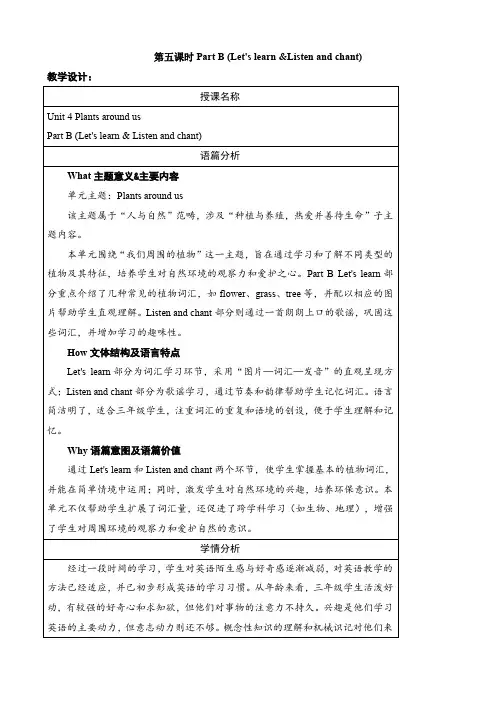
Let's learn部分为词汇学习环节,采用“图片—词汇—发音”的直观呈现方式;Listen and chant部分为歌谣学习,通过节奏和韵律帮助学生记忆词汇。语言简洁明了,适合三年级学生,注重词汇的重复和语境的创设,便于学生理解和记忆。
Why语篇意图及语篇价值
通过Let's learn和Listen and chant两个环节,使学生掌握基本的植物词汇,并能在简单情境中运用;同时,激发学生对自然环境的兴趣,培养环保意识。本单元不仅帮助学生扩展了词汇量,还促进了跨学科学习(如生物、地理),增强了学生对周围环境的观察力和爱护自然的意识。
Unit4 Part B Let’s learn(教学设计)三年级英语上册(人教PEP版2024秋)
Unit 4 Plants around us单元:Unit4 课时:第5课时教学内容分析:本课时以Chen Jie介绍植物的生长条件展开,让我们一起跟随Chen Jie的脚步一起去了解植物生长需要哪些条件吧。
本课主要单词有:sun,water, trees, flowers, grass,air。
本课时的主要句型有:Plants need…本课时结合前几课时的内容,运用重点句型进行巩固和突破。
B部分以绿色校园建设为情景,需要通过图片,词卡,运用主要句型表达自己如何能够帮助植物生长/保护环境。
教学目标:1.语言能力:学生能够听、说、读、写词汇sun,water, trees, flowers, grass,air 等。
学习核心句型:How can we help...? We can...讨论植物的种植条件。
2.学习能力:学生能够运用所学单词和句型讨论植物的种植条件,并且学习有关植物的各种语言表达。
3.思维能力:培养学生运用英语的表达能力,认识和学习植物及其种植条件。
4.文化意识:学生能够通过了解植物的生存条件,从而更好的帮助植物生长。
教学重点:学生能够听、说、读、写词汇sun,water, trees, flowers, grass,air等。
学习核心句型:Plants need...讨论植物的种植条件。
教学难点:学生能够通过了解植物的生存条件,从而更好的帮助植物生长。
教学方法:情境教学法,任务型教学法,归纳总结法,口语训练法,游戏教学法教学过程:Step I: Warm up1.Watch a video2.ReviewT:Look at the pictures and write the words.S:apples/pears/grapes/oranges设计意图:本环节欣赏与植物生长必要条件的科普视频。
既能够激发课堂氛围,又引导学生进入本节课主题。
然后通过一问一答的方式进入本节课的主题。
人教PEP(2024)三年级英语上册Unit 4 B Let’s learn核心素养教学设计
学会tree flower gras sun air water单词。演唱歌谣,抓住韵律和节奏。
教学难点
背会Listen and chant中的内容。演唱歌谣,抓住韵律和节奏。
教学方法
情景教学法、口语练习法、情景交际法、归纳总结法
教学准备
教师准备:PPT
学生准备:课本、笔
教学过程
教学环节
教师活动
2.能够在情景中运用句型:Plants need…help…do
3. chant,能熟练唱出来.
板书设计
Unit 4 Plants around us
tree flower gras sun air water
Plants need…help…do
课后作业
1 听、说、认读本节课的重要词汇,理解植物生长要素。
学生活动
设计意图
导入新课
1.Let’s review
How can they help plants?
plant new trees
water the flower
2.Look and say
看图片想一想。
了解英语的单词是构成句子的基础。
通过图片的内容,引出本节课所学主要内容。
讲授新课
1.Let’s talk
学情分析
本课是学生第一次接触这套教材,在开始进行教材重点句式和词汇的学习之前,应该先让学生熟悉了解英语中可数名词指能够数得清数量的名词,明确可数名词变复数的规律及英语单词的发音规律,对于他们之后长期的英语学习都会有帮助。在此基础上,再带学生进行学习活动,才能起到操练、巩固重点句式的作用。由于英语字母的发音有很多的不同,在学习中还要关注学生的发音,帮助他们克服模仿的困难,大胆地开口,大方地交流。
人教PEP版三年级英语上册《Unit4》精品教案教学设计小学优秀公开课18
Unit 4 We Love Animals 教学设计一、教学目标:1.能在语境中运用What's this?It's a ...来交流物品信息。
2.能够能听说、认读dog, duck, bear, pig, cat等几种动物的名称。
3.能听懂一些简单的指示语,并能按照指令模仿动物做出相应的动作。
二、教学重点:听说、认读dog, duck, bear, pig, cat等动物的名称三、课前准备:动物卡片、动物单词卡、录音机。
四、教学步骤:1.Warm-up (Song 唱一唱)热身活动①复习上一节课的内容:"What's this? It's a ...”教师呈现动物拼图,让孩子们猜。
通过猜的游戏,既复习了上一节课的句型,同时也为歌曲的呈现铺垫,了解 chick, duck, dog, cow, bear, pig, cat 等词汇。
②教师呈现老麦克唐纳的照片,让学生猜他的农场上有什么东西,检测学生对农场的了解,激活已有的生活体验。
③听老麦克唐纳有个农场的歌曲,让孩子们听歌抓词,初步感受农场上有什么动物。
带着问题去听,更有侧重点。
设计意图:通过拼图游戏复习已学句型,同时拓展与铺垫歌曲内容,通过头脑风暴一一看农夫照片想农夫农场的有什么,激活已有生活体验,听轻松愉快的歌曲,带着找出农场上的动物的任务,既复习已学单词,同时引出并教授新单词。
T: Good morning, boys and girls.Ss: Good morning, Miss Deng.T: Before the class, let me see whether you can remember this? Look!What's this?Ss: It's a dog. ( chick, duck, cow, bear, farm 屏幕最后出农场图,老师再引学生看黑板)T: And what's this?S: It's a farm.T: And this?S: It's a farm.T: Yes, it's a farm. Whose farm is this? It's my friend Old Macdonald's. Let's say hello to OM.S: Hello, OM.T: What's can you see on his farm? Then, what else are on his farm?Ss: ... animal, vege, fruits.T: (repeat students' answer, dog, duck, so many animals, maybe ...)Yes, he has many animals. Then what animals are they? Listen to the song. And you will know it. Listen carefully2.Prensetation1)单词教学①教师提问孩子们,刚才的歌曲中有些什么动物,并进行教授新单词duck, pig, dog, cat等。
2024年秋新人教PEP版英语三年级上册课件 Unit 4 PartB Let's learn
Listen and follow.
sunairBiblioteka watertree
grass flowers
Plants need air, water and sun.
Practice
What’s missing?
Listen and chant
Air, water, sun. These help the plants grow. Plant, water, cut, turn. These are things I do to help.
UUnnitit1 4 Plants around us
Let’s learn & Listen and chant
Lead in
Let’s talk.
The school gardens need help.
We can water the flowers.
We can water the grass.
Think and answer
How can we help plants?
Plants need...
We can....
air
water
sun
Plants need air, water and sun.
We can plant, water, cut and turn.
Summary
1
plants
tree flowers grass
2
Plants need...
air water sun
Homework
1 向家人介绍你学过的植物以及植物需要什么。 2 完成《练习册》剩余习题。
同学们,通过这节课的学习, 你有什么收获呢?