
人教版新目标英语七年级上册《Unit 5 Do you have a soccer ball ?》单元练习试题及答案
Unit 5 单元过关卷时间:100分钟满分:120分第Ⅰ卷听力部分(25分)Ⅰ. 听句子, 选择最佳答语。
(每小题1分, 共5分)() 1. A. Yes, I am. B. No, they aren't.C. No. It's Mike's baseball.() 2. A. The desk is in the room. B. A watch.C. It is my desk.() 3. A. Sorry, I don't know. B. Yes, I have.C. No. It is their TV.() 4. A. I like basketball. B. I am fine.C. I have a basketball.() 5. A. It sounds good. B. It's in my bag.C. It is difficult.Ⅱ. 听小对话, 选择与所听内容相符的图片。
(每小题1分, 共5分)() 6. What sport do they like?() 7. What are they going(打算) to do?() 8. What does the man do in the morning?() 9. What does Jack have?() 10. What can the boy do?. Ⅲ. 听下面四段长对话, 选择最佳答案。
(每小题1分, 共10分)听第一段对话, 完成11~12小题。
() 11. What does the man think of(认为) soccer?A. It's difficult.B. It's fun.C. It's easy.() 12. Who has a soccer ball?A. Sally.B. Bob.C. Bob's brother. 听第二段对话, 完成13~14小题。
() 13. The photo on the sofa is________.A. Jack'sB. Anna'sC. Jane's() 14. Jane is Jack's________.A. sisterB. cousinC. classmate听第三段对话, 完成15~17小题。
() 15. Whose computer game is it?A. It's Peter's.B. It's Tom's.C. It's Tony's. () 16. Where is the ping-pong ball?A. On the desk.B. On the chair.C. Under the chair. () 17. How many baseballs are there?A. Three.B. Two.C. One.听第四段对话, 完成18~20小题。
() 18. Where is Mary's ping-pong ball?A. On her desk.B. In her desk.C. Under her bed. () 19. How many ping-pong bats do they have?A. One.B. Two.C. Three.() 20. What are Mary and Dale going to play?A. Soccer.B. Ping-pong.C. Basketball.Ⅳ. 听短文, 填表格, 每空一词。
(每小题1分, 共5分)第Ⅱ卷笔试部分(95分)Ⅴ. 单项选择。
(每小题1分, 共10分)() 26. —What does Mike do after class?—He plays ________ basketball with his friends.A. aB. anC. theD. /() 27. —Does your brother________ping-pong balls?—Yes, he________five.A. have; haveB. has; hasC. have; hasD. has; have () 28. —Let's play computer games.—That sounds ________. Let's play soccer.A. goodB. boringC. interestingD. relaxing () 29. —What________do you like?—I like volleyball. I always play it after school.A. sportB. colorC. nameD. number () 30. —My jacket is on the bed. Can you help me________it?—OK, Dad.A. meetB. getC. knowD. thank () 31. Mike and Grace lost their school ID cards. Can you help ________?A. herB. himC. itD. them() 32. —Do you like baseball?—Yes, I ________. But my brother ________.A. do; don'tB. does; doesn'tC. do; doesn'tD. does; don't() 33. —I can't spell it.—Let my brother________you.A. helpsB. helpC. to helpD. helping () 34. —Do you watch soccer games________TV?—Yes, and I play soccer________my classmates after school.A. on; withB. in; withC. after; forD. at; to() 35. —Let's play ping-pong.—________Let's go.A. I don't like it.B. That's boring.C. That sounds great.D. What about soccer?Ⅵ. 完形填空。
(每小题1分, 共10分)Hello, friends! Look at this picture. You can see two__36__in it. They are my good friends. __37__names are Lucy and Lily.They're__38__. Lucy and Lily are from the USA. Their father is in China, but their mother__39__. So they are in Shenyang__40__their father now. Lucy and Lily like sports, but they don't like the__41__sport. Lucy likes volleyball, and she__42__five volleyballs. Lily likes tennis. It's__43__for her. I like sports too, __44__I don't play them. I only__45__them on TV.() 36. A. books B. desks C. girls D. rooms() 37. A. Her B. Our C. Your D. Their() 38. A. friends B. sisters C. cousins D. classmates () 39. A. is B. isn't C. doesn't D. do() 40. A. with B. for C. of D. at() 41. A. easy B. nice C. great D. same() 42. A. plays B. loves C. has D. knows() 43. A. difficult B. relaxing C. boring D. late() 44. A. for B. with C. and D. but() 45. A. watch B. meet C. say D. thinkⅦ. 阅读理解。
(每小题2分, 共20分)ADo you like sports?Do you only watch sports on TV?Please join(加入) our school sports clubs(俱乐部) . Let's play sports and have fun!() 46. What club can't girls join?A. The Soccer Club.B. The Tennis Club.C. The V olleyball Club.D. The Baseball Club.() 47. The ________Club has a great collection.A. SoccerB. TennisC. BaseballD. V olleyball() 48. Students can call________and join the Baseball Club.A. Mr. SmithB. Mrs. BrownC. Miss GreenD. Mr. Black() 49. Wang Fei and Li Hua want(想) to join the V olleyball Club. They can dial(拨打) ________.A. 400-6562B. 402-6607C. 401-2424D. 422-7474() 50. ________club(s) is/are for boys and girls.A. OneB. TwoC. ThreeD. FourBFrank is my good friend. We are in the same class. Frank is a good student. His English is very good but mine isn't. So he always helps me with it.Frank and I have the same hobby. Frank likes sports. And I like sports, too. After school in the afternoon, we often play sports. We play soccer and volleyball. The soccer ball is Frank's and the volleyball is mine. Frank gets the soccer ball from his father. His father is a great soccer player. We can often watch his father play soccer on TV. Frank wants (想要) to be a soccer player like his father.() 51. Frank is my________.A. brotherB. teacherC. classmateD. cousin() 52. 画线单词hobby的汉语意思是“________”。
人教版人教新目标版七年级上册Unit5DoyouhaveasoccerballSectionB1a

A:Hi,Paul! Let's play computer games!
B: That sounds _in__te_r_e_s_t_in_g_, Jenny,but I don't have a
computer.
A: Well, do you have a volleyball?
B: Yes.
A: Then let's play volleyball.
A: Excuse me , what do you have? B: I have a /an … A: Do you like …? B: Yes , I do . / No , I don't . A: Why ? B: Because it's … A: Let's … B: That sounds …
Life lies in movement.
生命在于运动。
Homework: Make a survey and report.
Name
I like …
I don't like …
Why
Structures : I like … I don't like … My favorite ball is … It's exciting / boring … likes …but he / she doesn't like … and … like … but …
watching TV
playing chess
playing games
playing ping-pong
exciting / difficult/ boring/ interesting/fun/ relaxing/easy…
新目标人教版七年级英语上册Unit5Doyouhaveasoccerball

新目标人教版七年级英语上册Unit5 Do you have a soccerball?第一课时SectionA(1a-2c)教学设计金安苑学校刘团业一、关于教材1.单元分析:本单元的教学主要内容是:学习have 的一般现在时的疑问式的肯定和否定回答,该话题与学生的日常生活紧密联系在一起,容易唤起学生的学习兴趣,这对于提高学生的综合能力很有帮助,特别是说的能力。
本单元仍在继续学习一般现在时,这是一个生活中离不开的时态,也是最基本的一个时态。
新课程标准要求学生重点掌握一般现在时,这在英语中使用频率很高,学好这一时态的用法对以后其他时态的学习和交际有很大的帮助。
但与前几个单元be 动词的一般现在时不同,本单元开始了实义动词一般现在时的一般疑问句及其答语的教学。
2.课时分析:本单元的第一课时,是一堂听说课。
以球类物品为载体学习使用Do you have ...?/Does he/she have ...?让学生掌握实意动词的一般疑问句及其答语。
在教学设计中我以“第一课时的听说教学为第二课时的语法教学打好基础,但该在语法课讲的内容绝不挤占听说时间”为出发点,对本课的句型进行了拓展:I (don’t)have...;He/She (doesn’t have)has...但仅仅是通过大量和反复地操练是使学生运用自如,而不急于提醒has和have的使用场合。
既为后面的学习做好铺垫又留有余地。
二、学生分析学生现有的能力与已掌握的知识:学生在已经学过词汇:What is this ?What is that?句型:Where is… It’s in / on / under/…经过前面的学习学生已经积累了一定的词汇,掌握了一定的目标语,已经具备了一定的听说读写能力。
三、教学目标1.语言知识词汇:A.重点掌握表示有关各种运动球类的名词重点句型:---Do you have a ... ?---Yes,I do./No,I don’t.---Does he/she have a soccer ball ?---Yes,he/she does./No,he/she doesn’t.2.语言技能:能通过图片及实物使用目标句型进行交际。
人教版新目标英语初一上册unit5
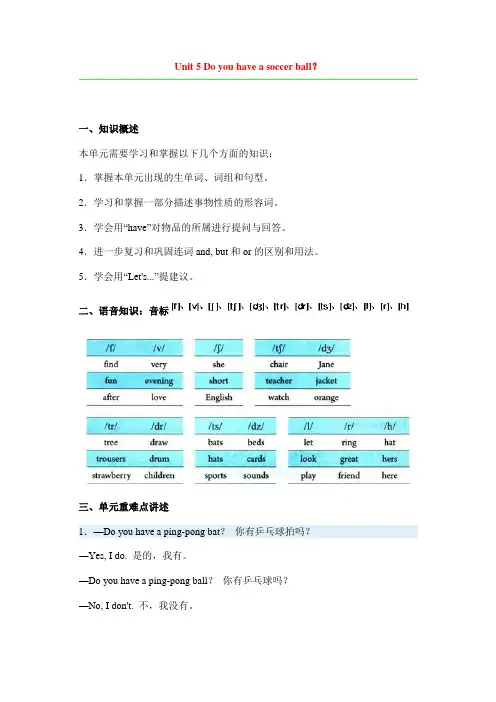
Unit 5 Do you have a soccer ball?一、知识概述本单元需要学习和掌握以下几个方面的知识:1.掌握本单元出现的生单词、词组和句型。
2.学习和掌握一部分描述事物性质的形容词。
3.学会用“have”对物品的所属进行提问与回答。
4.进一步复习和巩固连词and, but和or的区别和用法。
5.学会用“Let's...”提建议。
二、语音知识:音标三、单元重难点讲述1.—Do you have a ping-pong bat?你有乒乓球拍吗?—Yes, I do. 是的,我有。
—Do you have a ping-pong ball?你有乒乓球吗?—No, I don't. 不,我没有。
※动词have的用法:(1)have v.有(用于第一、二人称和第三人称复数)e.g.I have a new book.我有一本新书。
They have many interesting books.他们有许多有趣的书。
(2)have用于第三人称单数时应该用has。
e.g.Jim has a volleyball.吉姆有一个排球。
Rose has a tennis racket.露丝有一个网球拍。
(3)询问别人“有……吗?”要借助于助动词“do”来构成一般疑问句。
“?”句型。
肯定回答用“Yes”,否定回答用“No”。
e.g.-Do you have a bike?你有自行车吗?-Yes, I do. / No, I don't.有。
/ 没有。
-Do they have a basketball?他们有篮球吗?-Yes, they do. / No, they don't.有。
/没有。
对单数第三人称提问时则应用助动词“does”,此时其后的动词“has”就应还原成“have”。
e.g.-Does she have a soccer ball?她有足球吗?-Yes, she does. / No, she doesn't.是的,她有。
最新人教新目标版中学七年级英语上册 Unit 5 Do you have a soccer ball?单元教案1 (新版)

精品教育资料Unit 5 Do you have a soccer ball?一、单元教学内容分析二、教学目标1、能力目标(1)对所属关系进行问答,如:Do you have a soccer ball?(2)提出建议,发出邀请。
如:Let’s play soc cer.(3)谈论自己的感受。
如:That sounds good.2、知识目标(1)have 的一般现在时用法(2)一些体育用品名称(3)表达感受的几个形容词(4)提出建议的句型:Let’s… .3、情感态度目标(1)由于该单元话题贴近学生生活,符合他们热爱运动的心理,可以提高他们学习英语的兴趣,积极参与英语实践活动。
(2)谈论与朋友共度时光,培养同学间团结,友爱的精神。
(3)谈论自己的感受,同时使学生在英语交流中注意并理解他们的情感。
三、教学重点难点1、教学重点Dri ll: Do you/they have…?Does he/she have…?I don’t have…?He/She doesn’t have… .Let’s… .That sounds… .2、教学难点have 在一般现在时中的肯定,否定,一般疑问等形式。
尤其当主语为第三人称单数时。
四、课时安排1、SectionA 1a. 1b. 1c. 2a. 2b. 2c2、SectionA 2d .3a. 3b. 3c3、SectionB 1a. 1b. 1c.1d. 2a. 2b. 2c4、SectionB 3a. 3b. 3c. self check 1、2Period One SectionA 1a-2c一、教学目标1、单词:soccer ball ,tennis racket ,ping-pong ball ,volleyball ,have, basketball ,bat, does, doesn’t2、句型:I have…He/She has…Do you have a… ?Yes, I do./No,I don’t.Does he/she have…?精品教育资料Yes, he/she does./No, he/she doesn’t.二、教学重点:掌握关于运动物品的名词三、教学难点:学会使用句型 I have…He/She has…Do you have a… ?Yes, I do./No,I don’t.Does he/she have…?Yes, he/she does./No, he/she doesn’t.四、教学设计Step1 Lead-in1.What’s this in English ?How do you spell it?What colour is it?2. Talk about the pictures.3. Guessing game.4. Do 1a and 1b.Step2 PresentationSaying:This is my basketball. I have a basketball.Help Ss repeat with other items.I have a backpack. Do you have a backpack?Help the Ss answer :Yes ,I do./No,I don’t.4. Repeat with other things.S tep3 PracticeAsk and answer “Do you have…?”in two parts.Talk about the picture in pairs.Do 2a and 2b.Step4 Presentation1. This is Jim. He has a… This is Lily. She has…2. Ask: Does he/she have…? Help Ss answer: Yes, he/she does./No, he/she doesn’t.Step5 PracticeTalk about the pictures in pairs.Observe the picture .Then ask and answer in pairs.Work in groups of three.Do you have…?Does he/she have…?Step6 HomeworkRecite the new words.Do exercises in exercise books.Period Two SectionA 2d-3c一、教学目标1、单词:don’t, doesn’t, let’s, play, well, sound, good,sport, we, many, club, more, class2、句型:I don’t have…精品教育资料He /She doesn’t have ...They have…They don’t have…Do they have…?Yes, they do./No, they don’t.Let’s play soccer.That sounds good.二、教学重点:掌握否定句have的用法三、教学难点:学会使用句型Let’s … .I don’t have a…He /She doesn’t have ...That sounds good.四、教学设计Step1 Warming-upPair work.What’s this in English ?How do you spell it?2. Guessing game:What do I have in my bag?Do you have a computer?No,I don’t./Yes, I do.Work in groups of three.Step2 PresentationThis is Lucy and Lily’s room. They have… They don’t have…Do they have…?Yes, they do./No, they don’t.Step3 PracticeMemory challenge.Observe my parents’room. Then ask and answer in pairs.Talk about your family in pairs.Step4 PresentationI have… I don’t have…He/She has… He/She doesn’t have…Step5 Practice1. Talk about your room.I have… I don’t have…2. Repeat what the student says.He/She has… H e/She doesn’t have…Step6 PresentationRead the dialogue. Then practice in pairs.Give a model.A: Let’s play basketball.B: I don’t have a basketball.A: Well, Let’s play baseball.精品教育资料B: That sounds good.Practice the dialogue in pairs.Step7 PracticeDo 3a and 3c.Step8 SummaryStep9 Homework1.Recite the new words and the dialogue.2.Do exercises in exercise books.Period Three Section B 1a-2c一、教学目标1、单词:inter esting, boring, fun, difficult, relaxing, watch TV2、句型: Let’s… .That sounds… .二、教学重点:掌握表示感受的有关形容词三、教学难点:正确使用表示感受的形容词四、教学设计Step1 Warming upChoose a student to be Wang Xiaoya. The others act as reporters, ask questions.Make a report.Talk about the twins in pairs.Make a report.Step2 PresentationTeach the new words: interesting, boring, fun, difficult, relaxing.Read the new words.Step3 PracticeDo 1a, 1b and 1c.Talk about the pictures in pairs.(1d)Free talk in pairs.Fill in the blanks.Do 2a.Read the conversation in 2b ,do 2c.Step9 Homework1.Recite the new words and the dialogue.2.Do exercises in exercise books.Period four Section B 3a-3c, self check一、教学目标1、单词:soccer , volleyball, basketball, tennis, ping-pong, bat, racket, interesting, boring, fun, difficult, relaxing2、句型:.Do you have…? Does she/he have…? But句型 , It is interesting/ boring…二、教学重点、难点:掌握But转折句型的用法正确使用表示感受的形容词四、教学设计Step1 PracticeDo 3a and 3b.Free talk in pairs:精品教育资料Talk about the sports equipment in pairs.。
人教版新课标英语七年级上册《Unit 5 Do you have a soccer ball Sec

人教版新课标英语七年级上册《Unit 5 Do you have a soccer ball Section A 》教学设计2一. 教材分析人教版新课标英语七年级上册《Unit 5 Do you have a soccer ball Section A》主要讲述了日常生活中常见的体育运动用品以及询问某人是否拥有某物的交际场景。
本节课的主要语言点是球类名词、动词短语“have”以及一般疑问句“Do you have…”的运用。
本节课内容贴近学生生活,有利于激发学生的学习兴趣,培养他们用英语进行日常交流的能力。
二. 学情分析七年级的学生已经掌握了基本的英语语法和一些日常词汇,具备了一定的听说读写能力。
但是,学生在英语口语表达方面仍有待提高,特别是在运用英语进行日常交流方面。
因此,在教学过程中,教师需要注重培养学生的口语表达能力,让他们在真实情境中运用所学知识。
三. 教学目标1.知识目标:学生能够掌握球类名词、动词短语“have”以及一般疑问句“Do you have…”的运用。
2.能力目标:学生能够在日常生活中用英语询问和描述他人是否拥有某物,并能够用英语进行简单的交流。
3.情感目标:通过本节课的学习,学生能够提高学习英语的兴趣,增强自信心,培养团队协作精神。
四. 教学重难点1.重点:球类名词、动词短语“have”以及一般疑问句“Do you have…”的运用。
2.难点:一般疑问句“Do you have…”的构成和用法。
五. 教学方法1.情境教学法:通过设定生活情境,让学生在实际语境中学习并运用所学知识。
2.任务型教学法:通过完成小组任务,培养学生的团队合作精神和口语表达能力。
3.游戏教学法:通过设计趣味游戏,激发学生的学习兴趣,提高他们的口语表达能力。
六. 教学准备1.教师准备:提前准备好教学课件、球类图片、实物球类等教学资源。
2.学生准备:预习本节课内容,了解球类名词和动词短语“have”的用法。
新目标人教版初中英语七年级上册Unit5Doyouhaveasoccerball4
They don’t have any boats.
1、I have an English book.
Do you have an English book? 一般疑问句 Yes,I do. No,I don’t.
I don’t have an English book. 否定句
2. The brothers go to school at 7:00.
Do the brothers go to school at 7:00? 一般疑问句 Yes,they do. No,they don’t
The brothers don’t go to school at 7:00. 否定句 3.Miss Wang has a big family. Does Miss Wang have a big family? 一般疑问句 Yes,she does. No,she doesn’t
7.What __A___in your backpack?----There are some apples.
8.There is an orange _C____the picture.
9.There __C___many pens in the shop(商店).
10.That is a photo ___C__my sister.
10.He has a watch.(变疑问句及否定句) ____D_o_e_s_h_e__h_a_v_e_a__w_a_t_c_h_?___
____H__e_d_o_e_s_n_’_t _h_a_v_e_a__w_a_t_c_h.
完成下列短语 play play
人教版新课标英语七年级上册《Unit 5 Do you have a soccer ball Sec
人教版新课标英语七年级上册《Unit 5 Do you have a soccer ball Section A 》教学设计1一. 教材分析人教版新课标英语七年级上册《Unit 5 Do you have a soccer ball Section A》主要介绍了一般疑问句的构成和用法。
本节课主要通过一个关于球类运动的场景,让学生掌握一般疑问句的构成,并能运用到实际情景中。
教材内容丰富,插图生动有趣,有利于激发学生的学习兴趣。
二. 学情分析七年级的学生已经掌握了基本的英语语法知识,对于一般疑问句有一定的了解。
但部分学生对一般疑问句的构成和用法仍不够熟练,需要在课堂上进行加强。
此外,学生的词汇量有限,需要通过图片、实物等直观教具帮助学生理解和记忆新单词。
三. 教学目标1.知识目标:让学生掌握一般疑问句的构成和用法,能用英语询问和回答球类运动的相关问题。
2.能力目标:培养学生运用英语进行日常交流的能力,提高学生的口语表达能力。
3.情感目标:激发学生学习英语的兴趣,培养学生的团队协作精神。
四. 教学重难点1.重点:一般疑问句的构成和用法。
2.难点:球类运动的词汇和短语的运用。
五. 教学方法1.任务型教学法:通过设置各种球类运动的情境,让学生在完成任务的过程中自然地学习和掌握一般疑问句。
2.直观教学法:利用图片、实物等直观教具,帮助学生理解和记忆新单词和短语。
3.小组合作学习:鼓励学生分组进行讨论和练习,提高学生的团队合作能力和口语表达能力。
六. 教学准备1.教材:人教版新课标英语七年级上册《Unit 5 Do you have a soccerball Section A》2.教具:球类运动的图片、实物、PPT等3.作业:提前准备相关的家庭作业,巩固所学内容七. 教学过程1.导入(5分钟)利用球类运动的图片或实物,引起学生的兴趣,然后用中文提问:“你们喜欢球类运动吗?为什么?”接着用英语提出一般疑问句:“Do you like ball games?”,引导学生用英语回答。
人教版新目标英语七年级上册Unit_5_Do_you_have_a_soccer_ball_全单元课件_(新版)人教新目标版_2.ppt
Helen’s baseball bat jacket hat We don’t know.
Pairwork
2d Role-play the conversation.
Cindy: Hey, Helen, let’s go! We’re late. Helen: OK. Cindy: Do you have the baseball? Helen: Yes, I do. It’s in my bag. Cindy: And where’s our baseball bat? Helen: Bill has it. Cindy: Oh, yeah. And do you have your jacket? Helen: Oh, no, I don’t. It’s on the chair. Let me get it. Cindy: And your hat, too! Helen: OK, I have my jacket and hat. Let’s go.
1
2
Listening
Listen again. Match the pictures 2b in 2a with the balls.
3
2
1
4
Pairwork 2c Ask and answer about the people in 2a.
Does Jane have a tennis ball?
Does Linda have a schoolbag? Yes, she does. No, she doesn’t.
Linda
Does Anna have a schoolbag?
Anna
1a
Match the words with the things in the picture.
人教(新目标)初中英语七年级上册 Unit 5 Do you have a soccer ball
Let’s play baseball.
Look at the pictures and make sentences.看图造句 e.g. Let’s play soccer
Let’s play volleyball. That sounds boring.
Let’s play soccer. Let’s play basketbal That sounds fun. That sounds relaxing
interesting
有趣的, 令人感兴趣的
Woo! It’s interesting.
fun
有趣的, 令人愉快的
Haha, it’s fun.
轻松的
relaxing
Ah! It’s relaxing.
difficult
困难的
968746232978³+78235768²×77869856343³ =
A: Let’s ... B: I don’t have... A: Well, let’s ... B: That sounds good.
×√
1b Listen and check (∨) the description
words you hear in 1a.
a. interesting ∨__ b. boring ∨__ c. difficult ∨__ d. relaxing __ e. fun ∨__
Let’s play baseball.
Let’s play ping-pong.
That sounds interesting. That sounds difficult.
A: Let’s play basketball. B: But I don’t have a basketball. A: Well, let’s play ping-pong. B: That sounds good.
人教版新目标版七年级英语上册Unit5Doyouhaveasoccerball教案
人教版新目标版七年级英语上册Unit5Doyouhaveasoccerball教案Unit 5 Do you have a soccer ball1.知识与能力目标:1).能预习并说出这单元的主要内容。
2).能运用目标语言询问并描述物品所属关系。
.2.过程与方法目标:通过运用本单元的目标语言,反复练习句型“Do you have a soccer ball? ”“Yes,I do.”“No,I don’t.”从而掌握本单元的重点句型和词组。
3.情感态度与价值观:本单元通过运用过去完成时态,让同学们学会与朋友共度快乐的时光。
Section A第一课时一、课型:新课二、教学重难点:1).Do引导的一般疑问句及其回答。
2)do 和have的意义及用法3)学习有关物品的新单词:tennis、ping-p ong、soccer ball 、volley ball、basketball、baseball、bat。
三、教学准备:多媒体,录音机四.教学过程:1.课前预习回顾上单元所学内容,引出本单元新句型:T:Where’s my book?S: It’s on your desk.T: Where are my pens?S:They’re in your box.T: Yes,thank you! I have a pen,do yo u have a pen?S:Yes,I do./No,I don’t.2.正课教授(1)引入①观察25页图片,引入新单词的学习。
②学习do引导的一般疑问句及其肯定回答和否定回答。
have的用法:①have为实义动词,意为“有”,常用句型sb.have/has+sth.表示某人有某物。
当主语为第三人称单数时,have用其第三人称单数形式。
②have还有“吃、喝”的意思,如:have breakfast。
③含有have的句子变否定句要在have前加don’t;含有has的句子变否定句要在h as前加doesn’t,has变为have。