
Unit4 Finding your way教案2-优质公开课-译林七下精品
Unit 4 Finding your way 教案
(Reading)
一、教学目标
1. To infer meaning from keywords, context and existing knowledge.
2. To understand a series of events and simultaneous actions.
3. To identify specific details by following a route and marking points on a map.
二、教学重点
1. To infer meaning from keywords, context and existing knowledge.
2. To understand a series of events and simultaneous actions.
3. To identify specific details by following a route and marking points on a map.
三、教学难点
1. To infer meaning from keywords, context and existing knowledge.
2. To understand a series of events and simultaneous actions.
3. To identify specific details by following a route and marking points on a map.
四、教学过程
Step 1 Revision
Review the words about directions.
Step 2 Presenting
1. T: Look at me. Now, I’m your tour guide and tell you how to get around the zoo. Listen to me carefully.
2. T: I have some more new words, please look at these pictures and tell me what they are. (the South Gate, panda, lion, bird, monkey, giraffe, elephant)
3. Then ask students make up a new dialogue with these words.
4. T: Ok, you know about these, let’s do part B1 on page 4
5.
Step 3 Reading
1.T: Now please listen to the tape, and try to answer the questions.
How many kinds of animals are there in the story?
Who are they?
2.T: Ok, you can open your book now and check the answers.
Please read the text quickly and choose the right answer..
Panda is ( ), eat ( )
Lion is the ( ) of the animal world.
Bird make beautiful ( ).
Monkey ( ) and make people ( ).
Giraffe has quite ( ), long ( ).
Elephant has ( ) ears like open ( ).
Step 4 Reading
1. Now please work in a group of 4 students. Try to draw out their route to the zoo on the map. (check the answers)
2. T: Let’s look at these True or False questions, and write T if it is true, write F if it is false. The students start their visit from the North Gate. (F)
Pandas do not like to lie down all day along. (F)
Visitors cannot go near the lions. (T)
The birds in the zoo are very quiet. (F)
Monkeys are very clever and funny. (F)
To the north-east of the giraffes there is a hill. (F)
Check the students’ answers and provide help if necessary.
3. Now please read after the tape for one time.
4. Finish the exercises of B4 on page 46.。
牛津译林版英语七下Unit4《Findingyourway》(第2课时)说课稿

牛津译林版英语七下Unit 4《Finding your way》(第2课时)说课稿一. 教材分析《牛津译林版英语七下Unit 4》是一篇关于寻找到达目的地的文章。
本节课的主要内容是通过阅读理解,学习如何描述路线和地点。
教材通过介绍一个城市地图,引导学生学习如何读懂地图,如何用英语描述路线,以及如何根据地图找到目的地。
教材内容丰富,插图生动,旨在提高学生运用英语描述路线和地点的能力。
二. 学情分析学生在进入七年级下学期时,已经具备了一定的英语基础,能够进行简单的英语交流。
但是,对于描述路线和地点的英语表达,部分学生可能还不够熟练。
此外,学生可能对地图的阅读和理解存在一定的困难。
因此,在教学过程中,需要关注学生的个体差异,因材施教,帮助学生更好地掌握描述路线和地点的英语表达。
三. 说教学目标1.知识目标:学生能够掌握描述路线和地点的常用英语表达,如“gostrght on”,“turn left/right”,“take the second turning on the left/right”等。
2.能力目标:学生能够运用所学的英语表达,描述路线和地点,进行简单的英语口语交流。
3.情感目标:培养学生独立思考、合作交流的学习习惯,提高学生对英语学习的兴趣。
四. 说教学重难点1.重点:描述路线和地点的英语表达。
2.难点:如何准确地运用英语描述复杂的路线和地点。
五. 说教学方法与手段1.教学方法:采用任务型教学法,让学生在完成具体任务的过程中,学习描述路线和地点的英语表达。
2.教学手段:利用多媒体课件、城市地图等辅助教学,帮助学生更好地理解和掌握所学内容。
六. 说教学过程1.导入:教师展示一张城市地图,引导学生谈论自己熟悉的地点和路线,激发学生对描述路线和地点的兴趣。
2.新课呈现:教师通过展示一张地图,向学生介绍如何用英语描述路线和地点。
引导学生学习相关的英语表达,如“go strght on”,“turn left/right”等。
牛津译林版七年级下册Unit 4《Finding your way》(reading2)教案
Unit 4 Finding your way reading2教学目标:1、To practice intensive reading and retell the text.2、To understand and master the new points in the text.3、T o understand :Trying to do everything is very important.教学重点:To retell the text.教学过程:Step 2 Presentation1.T 呈现B1部分的简易地图,帮助学生掌握问路语言点的用法:Here is the South Gate. Go straight on, and you’ll fi nd the Panda House. Walk along the road. To the north of the Panda House, you’ll find the lions. Turn left, and to the west of the Lions’ Area, you’ll find the World of Birds. To the north of the World of Birds is the Monkeys’ Forest. Then turn right, and to the east of Monkeys’ Forest. Then turn right, and to the east of Monkeys’ Forest, you’ll see the giraffes. North-east of the giraffes there’s a bridge. Cross the bridge, and you’ll see the elephants.2.对呈现的其中语言点交流体会。
Step 3 Language points1.Go straight on, and you’ll find th e panda House.= If you go straight on, you will find the Panda House.(1)此句型:祈使句 + and + 陈述句可以与if引导的条件状语从句互相转换,但条件状语从句通常用否定句练习:①副词,径直地, 常与come, go, walk等连用练习:直走,直到来到一家商店为止。
最新牛津译林版中学七年级英语下册 Unit 4 Finding your way reading教案2

精品教育资料Finding your way教学目标1.复习阳光镇的基本情况2.复习和拓展有关生活方式和活动的词汇3.学习掌握课文中出现的语言点4.拓展延伸至现实生活的运用重点难点分析1.课文理解和复述2.语言点的理解教学流程安排集体智慧(以知识体系为主)个性设计(二次备课)教学后记S tep 1. Revision (5 min)Retell the text according to the p ictures and the key words. north of the South Gatego straight onP anda Houselike to eat bamboolie down all day longwalk along the roadnorth of the Panda Housethe king of animal world dangerousStep 2. Explanation (20 min)go straight on 径直走 turn left / right 向左 / 右转e.g. Go straight on, you will find the2. lie down 躺下3. all day long 整天e.g. The pandas lie down all day long. . make beautiful sounds 发出美妙的声音e.g. Birds make beautiful sounds when they sing.8. f un n. “乐趣”为不可数名词fun adj. “有趣的”funny adj. “好笑的,滑稽的”e.g. We have lots of fun together.The book is fun.He is a funny person.Step 4. Discussion (10 min)祈使句, and+ 陈述句Step 5. Homework (2 min) 图片展示,学生英语兴趣高。
Unit 4 Finding your way(Reading II)教案(牛津译林版七年级下册)
Reading IITeaching Aims:1. Learn the language points in this article.2. Learn to talk about Ss’ own trips.Step 1. RevisionRetell the text according to the pictures and the key words.Step 2. Explain1.go straight on 径直走turn left / right 向左/ 右转e.g. Go straight on, you will find the Panda House .2. lie down 躺下3. all day long 整天4. walk along the road 沿着这条路走along “沿着,顺着” 是个介词。
5. the king of ……的国王the king of the animal worlde.g. The lions are the king of the animal world .6. remember to do sth. 记住做某事remember doing sth. 记住做过某事e.g. Please remember to bring your homework here tomorrow.e.g. The pandas lie down all day long.I remember cleaning the room.forget to do sth. 忘记做某事forget doing sth. 忘记做过某事e.g. Don’t forget to bring your homework here tomorrow.7.make beautiful sounds 发出美妙的声音e.g. Birds make beautiful sounds when they sing .8. fun n.“乐趣” 为不可数名词fun adj. “有趣的”funny adj. “好笑的,滑稽的”e.g. We have lots of fun together.The book is fun.He is a funny person.9. jump around / into / out of 跳来跳去/跳进/ 跳出e.g. Monkeys jump around and make people laugh .10. make sb. do sth.make 为使役动词,后面用省to 的不定式。
新牛津译林版七年级英语下册《Unit4 Find your way》教案.doc
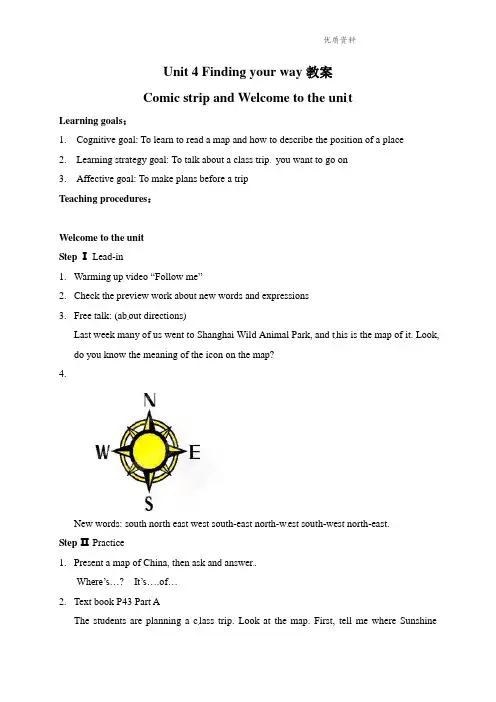
Unit 4 Finding your way教案Comic strip and Welcome to the unitLearning goals:1.Cognitive goal: To learn to read a map and how to describe the position of a place2.Learning strategy goal: To talk about a class trip you want to go on3.Affective goal: To make plans before a tripTeaching procedures:Welcome to the unitStep Ⅰ Lead-in1.Warming up video “Follow me”2.Check the preview work about new words and expressions3.Free talk: (ab out directions)Last week many of us went to Shanghai Wild Animal Park, and t his is the map of it. Look, do you know the meaning of the icon on the map?4.New words: south north east west south-east north-w est south-west north-east.Step Ⅱ Practice1.Present a map of China, then ask and answer.Where’s…? It’s….of…2.Text book P43 Part AThe students are planning a c lass trip. Look at the map. First, tell me where SunshineMiddle School is. Then find the places they plan to visit.Step Ⅲ Presentation1.Simon and Daniel are talking about the trip. Listen to the tape and answer these questions.Where are they going for the trip?How will they get there?2.Please repeat the con versation after the tape.Step Ⅳ PracticeWork in pairs and talk about the trip. You can use Simon and Daniel’s conversation as a model.S1: Where’s Sunshine P ark?S2: It’s north-east of our school.S3: Let’s go there.S2: OK.S1: How can we get there?S2: We can get there by bus/on foot.Comic stripStepⅠPresentationPresent the pictures of Eddie and Hobo. Predict what is going on between them.Step ⅡLi sten and answer1.Listen to the tape and answer the question:Does Hobo know the way?(No, he doesn’t.)2. What does the sign say? (It says ’Dogs this way’.)Step ⅢRead and act1.Listen again, Ss read after the tape recorder.2.Ask some students to act it out, and they can u se their own ideas in the conversation. Step Ⅳ Homework1.Recite t he dialogue and Part B.2.Finish the preview paper of Reading.。
Unit4 Finding your way教案4-优质公开课-译林七下精品
Unit 4 Finding your way 教案(Grammar)一、教学目标能掌握冠词的用法.二、教学重点a, an, the三、教学难点a, an, the四、教学过程A Using a, an and theStep1 Free talkWhat’s this?It’s a book.Whose book is it?It’s…’s.Write the sentences on the blackboard: It’s a book. The book is…’s.Step2 PresentationWe use a or an when we mention a person or thing for the first time. We use the before a noun when the person or thing is mentioned again, or when we are talking about a specific person or thing.Show some pictures and ask students to say something about the pictures:This is a Panda House. We can see some pandas.Look, here is panda. The panda is eating bamboo.Here’s a panda too. What’s the panda doing? (The panda is lying on the grass.)Here is a baby panda. How cute! It’s so small. But the baby panda doesn’t look like its mother. Step3 Practice1. Pair workHave a free talk with your partner, try to use a, an and the.2. Text book Page 47: Fun in the zooAsk students to complete the conversation with “a, an, the”. Then check the answe rs.3. Read and act out the conversation.。
Unit4 Finding your way教案3-优质公开课-译林七下精品
Unit 4 Finding your way 教案(Vocabulary)一、教学目标1. To recognize expressions about directions.2. To give and respond to directions.二、教学重点1. To recognize expressions about directions.2. To give and respond to directions.三、教学难点1. To recognize expressions about directions.2. To give and respond to directions.四、教学过程Step 1 RevisionT: Please look at the map on page 45 B1. Can you retell the story in your own words? (north, south, east, west)Step 2 Presenting1. T: Look at these three signs. (zebra crossing, straight on, crossroads)2. T: Now, can you come to the blackboard and write down the correct words on the right places? ( give them some road signs)S: …T: When you cross the roads, you must know about these signs.Step 3 Doing activities1. Ask one student to come the front and show others the road signs. Divide the other into 2 groups. One group ask: What can you do when you see this sign? The other group answer: I can (must) turn left/turn right/go straight on/be careful/cross the road.2. Ask the students do the exercises on page 47 part A.Step 4 Presenting1. Draw the map on Page 47 part B, read the article to the students and invite some of them to choose which one is right.2. T: Now please open your book and check the answers together.3. Key structures:1) Turn right and you will find it on the left.2) Walk along the road and t urn left. It’s on the left.3) Come to the crossroads and walk straight on. You’ll see it on the right.4) When you come to the corner of the road. Turn right and you’ll find a hotel. Cross the road and the museum is opposite the hotel.4. Supplementary exercises:1) Is there an underground near here?2) A: How can I get to the Zoo?B: Go straight on and turn left at the second crossing.3) A: Where’s the library?B: It’s down Bridge Road on the left.4) A: Could you tell me the way to the museum?B: Go down this road till the corner, turn right and you’ll see it.5) A: Please tell me the way to the Sunnyside Park?B: Walk along the street and take the first turning on the right.。
牛津译林版七年级下册Unit 4《Finding your way》(task)教学设计
牛津译林版七年级下册Unit 4《Finding your way》(task)教学设计一. 教材分析《Finding your way》是牛津译林版七年级下册Unit 4的一篇任务型阅读课文。
课文通过介绍一位游客在伦敦寻找大本钟的过程中,向不同的人询问路线,最终找到目的地。
课文内容涉及到方位词、问路和指路的相关表达,旨在让学生掌握如何用英语询问和描述路线。
教材通过任务型教学法,让学生在实际情境中运用英语,提高学生的语言运用能力。
二. 学情分析七年级的学生已具备一定的英语基础,能够听懂并运用简单的日常用语进行交流。
但学生在实际运用英语描述路线方面可能存在一定的困难,因此教师需针对这一点进行重点指导。
此外,学生对于英语阅读的兴趣会影响他们对课文内容的学习,教师应充分激发学生的学习兴趣,提高他们的阅读积极性。
三. 教学目标1.知识目标:学生能够掌握表示方位的词汇和短语,如up, down, left,right, turn left, turn right等;能够用英语询问和描述路线。
2.能力目标:学生能够在实际情境中运用英语询问和描述路线,提高语言运用能力。
3.情感目标:培养学生乐于助人的品质,学会在遇到困难时,主动向他人寻求帮助。
四. 教学重难点1.重点:表示方位的词汇和短语,以及询问和描述路线的句型。
2.难点:如何将这些词汇和句型运用到实际情境中,进行流畅的交际。
五. 教学方法1.任务型教学法:通过设置各种任务,让学生在实际情境中运用英语,提高语言运用能力。
2.情境教学法:创设生动、真实的情境,激发学生的学习兴趣。
3.交际法:引导学生进行小组合作,进行实况模拟,提高交际能力。
六. 教学准备1.教学课件:制作包含课文内容、图片、动画等的多媒体课件。
2.教学道具:准备一些表示方位的标志,如地图、路标等。
3.练习题:设计一些关于询问和描述路线的练习题。
七. 教学过程1.导入(5分钟)利用课件展示伦敦的风景图片,引导学生谈论自己对伦敦的印象。
Module 1 Unit 4 Finding your way 教案-优质公开课-译林七下精品
Module 1 Home and neighbourhoodUnit 4 Finding your way习题Welcome to the unitTeaching aims and demands:New words: follow, north, north-west, south-westTeaching methods: task-based approachTeaching task:1. To introduce the topic of places and transport.2. To talk about visits and means of transport using model sentences.Teaching aids:tape recorderTeaching procedures:I. Warm-up (presentation)Ask the students on duty to give us a short report about the Sunshine Town.II. ListeningListen to the tape, answer my question, “Did Hobo, in fact, know the way?” Help the Ss to answer.Listen again, Ss read after the tape recorder, then do some True or False exercises. Check the answers with the whole class.Language points:1.follow me2.go up and downe.g. Let’s go down the hill together.3.Don’t be afraid.e.g. (1) Don’t be late for school.(2) Don’t play in the street. It’s too dangerous.be afraid to do. be afraid of sth. I’m afraid that+从句e.g. (1) The little girl is afraid to go out in the evening.(2) Little Tom is afraid of dogs.(3) I’m afraid that I can’t go with you. I have a lot of work to do.III. Main taskIntroduce the topic of place and transport.IV. Discussion (task)Talk about visits and means of transport using the model sentence ---Let’s go to the zoo.---OK. We can go by bus.Language points:1.The zoo is north of Beijing Sunshine Secondary School.north ofsouth, west, north-west, south-weste.g. The library is south of the classroom.The playground is west of the classroom.2. ---How do we get there?---We can go by bus.by air/bus/car/bike/undergroundV.Sum-upGo through the new words and the language points during this lesson.VI. HomeworkReview the contents of this lesson.ReadingTeaching aims and demands:New words:call, robber, drive, quickly, at once, police, uniform, just, push, van, away, fail, use, knife, work, police station, route, along, right, another, stop, traffic, light, jump, later, suddenly, surprised, catch, in the end, crossroadsTeaching methods: task-based approachTeaching task: 1. Prepositions of movement.2. Simple future tense with “shall” “will”Teaching aids: tape recorder, tapes, slide projector, slidesTeaching procedures:Ⅰ. Warm-upAsk the Ss to give a free talk. .Ⅱ.ListeningNow, listen to the text, please answer the question “Did the robbers run away finally?”Listen again, Ss read after the tape, and do some exercises.Ⅲ. ReadingSs read the articles by yourselves. Check the answers with class.Language points:1. nearby=not far awaye.g. I live nearby in the building.2. robber (n.) rob(v.)e.g. The two robbers ran away from the back quickly.3. quickly = fast (adj.) quick (adj.)e.g. She walked quickly away.4. fail失败e.g. Tom failed in his math examination.5. work起作用e.g. Something is wrong with my watch. It doesn’t work.6. route路线take different routee.g. There’s another route you can take to get to the cinema.7. suddenly突然地.e.g. Suddenly I found a big tiger standing in front of me.8. surprised adj. 惊讶地e.g. We are surprised to hear him sing.9. in the end =at laste.g. He passed the exam in the end.10.turn right/left into 7th Streete.g. Don’t tell a lie any more. It’s not good for you.Ⅴ.Discussion (task)Have a discussion about the story.Ⅵ.Sum-upGo through the new words and the language points learnt during this lesson.Ⅶ. HomeworkReview the contents of this lesson.Integrated skills and Study skillsTeaching aims and demands:Key points: Cross the bridge and turn rightTake the second turning on the right.Cross the road at the traffic light.Walk past the police station.Teaching methods: task-based approachTeaching task: 1.To recognize key expressions about directions.2. To use key information given instruction and identify the specific order of themfrom listening.3. To produce formulatic responses to specific instruction.Teaching aids: tape recorder, tapes, slide projector, slidesTeaching procedures:Ⅰ. Warm-upAsk the student on duty to give a short talk.Integrated skillsⅡ.Finding treasure1. Ask the Ss to study the pictures in Part 1 carefully. Put a tick in the correct boxes. Check the answers and explain.2. Listen to the tape. Listen again if necessary. Check the answers with the whole class.Ⅲ. Speak up1. Listen to the tape recording and read after it.2. Ask the Ss to work in pairs to make up a new conversation for giving direction using the conversation in Part B as a model. Ask a few pairs to present their conversations to the whole class.Ⅶ. Study skills (Making a grammar pattern book)Take the Ss through the text of this page. Have a discussion about the Internet. What does WWW stands for? Do you know any common browser name, some search engines? Talk about other key aspects about the Internet.Language points:1. Cross the bridge and turn right2. Take the second turning on the right.3. Walk along a path.Ⅷ. Sum-upGo through the new words and the language points learnt during this lesson.Ⅸ. Homework1. Review the contents of this lesson.2. Do the exercise of the workbook.V ocabulary ﹠GrammarTeaching aims and demands:New words: straight, zebra crossing, entrance, correct, corner, road, hotel, cross, across, round, off, onto, train, tunnel, stair, railway, south, step, side, bridge, join, win, cloudy, paper, campfire Teaching difficulties: 1.prepositions of movement2. simple future tense with “will” and “shall”Teaching methods: task-based approachTeaching task: 1.To learn and know about the directions2. To prepositions of movement to give directions3. To recognize the use of “will” and “shall” and be going to talk about the future Teaching aids: tape recorderTeaching procedures:Ⅰ. Warm-upHelp the Ss retell the story “A lucky escape”.Ⅱ. V ocabulary1. Ask the students what road signs they know, and list the names of the signs: e.g. turn left, traffic light, turn right, straight on, crossroads.2. Ask the students to write the names under the pictures.3. Ask them how to read a map and circle the letters of the correct maps.Language points:turn right/left, cross the road, go straight along the road.Ⅲ.Grammar1. Preposition of movementWe use prepositions of movement to express movements. Prepositions of movement: across, along, down, from, into, off, onto, out of, over, round, through, to, upe.g. The bus goes to the airport.Simon is swimming across the pool.A train is going through a tunnel.Millie is walking along the road.Kitty is climbing up the hill.Hobo is walking round the table.Work out the rule: We use prepositions of movement after the verbs.Finish off the exercise on Page45.2. Simple future tense with “will” and “shall”We use “will” or “shall” wh en we talk about: things that will happen, plans that we are making now.e.g. She will be late for the party.We will take the dog to the park tomorrow.We make negative sentences like this:I/We will not/shall not goHe/She/It/You/They will not goWe ask questions using the simple future tense like:Will (shall) I (We) like go?Will he (she/it/you/they) like go?We answer questions like this:Yes, I (we) will (shall) Yes, he (she/it/you/they) will.No, I (we) will not (shall not) No, he (she/it/you/they) will not.We can use “be going to” when we talk about:Fixed plans for a certain time in near future.e.g. I’m going to take another route.e.g. It’s so cloudy. I think it is going to rain.We ask and answer questions with “be going to” l ike this.Am IAre you/we/they going to see the doctor tomorrow?Is he/she/itI am. I am not.Yes, you/we/they are. No, you/we/they are not.he/she/it is. he/she/it is not.Ⅳ. Discussion (task)Have a discussion and find out the differences between the simple future tense and simple present tense.Main task &CheckoutTeaching aims and demands:New words: farewell, barbecue, picnic, invite, exit, everybody, complete, note, page, yours faithfully, monitor, signature, postcard, footbridgeTeaching methods: task-based approachTeaching task:1. To express direction and information in the contest of writing a letter of invitation.2. To check the use of prepositions of movement, the use of “will” and “be going to” to talk about the future giving of direction.Teaching aids: tape recorder, tapes, slide projector, slidesTeaching procedures:Ⅰ. Warm-upAsk the student on duty to give a free talk.Ⅱ. Main taskAsk the Ss to read the q uestionnaire, then complete it with students’ own information.Ask the Ss to read the letter on their own and complete it with information from the questionnaire results.Ask the Ss some questions to check them.Ⅲ. Writing (task)Ask the students to write an invitation letter for your class’s farewell party at your school. Draw a map and send it with your letter with the help of B2.Ⅳ. Checkout: Sending postcardsAsk the Ss to fill in the blanks with the correct forms of verbs and prepositions. Check the prepositions of movement and simple future tense.Ⅴ. WordsAsk the Ss to look at the picture and write the correct words to describe each picture.Language points:1. be + adj. + to doe.g. He is sad to fail in the exam.2. invite sb. to do sth.e.g. invite us to her homeLily invited us to have dinner at her home yesterday.3. yours faithfully4. send the postcard to my parents.Ⅷ. Sum-upGo through the new words and the language points learn during this lesson. Ⅸ. Homework1. Review the contents of this lesson.。
牛津译林版七年级下册Unit 4《Finding your way》(Reading II)教学设计
牛津译林版七年级下册Unit 4《Finding your way》(Reading II)教学设计一. 教材分析《Finding your way》是牛津译林版七年级下册Unit 4的一篇阅读文章,主要讲述了一位游客在伦敦游玩时,通过询问警察和阅读地图找到了目的地的经历。
文章涉及到方位词、问路和指路的相关表达,适合学生学习如何在实际生活中运用英语进行问路和指路。
二. 学情分析七年级的学生已经掌握了一定的英语基础词汇和语法知识,具备一定的阅读理解能力。
但对于方位词和问路指路的语言功能,可能还不够熟练。
因此,在教学过程中,需要引导学生通过阅读理解文章内容,掌握相关词汇和表达,提高实际运用英语的能力。
三. 教学目标1.知识目标:学生能够掌握文章中涉及到的方位词和问路指路的相关表达。
2.能力目标:学生能够通过阅读理解文章内容,提高阅读能力;能够运用所学知识,进行简单的问路和指路交流。
3.情感目标:培养学生对英语学习的兴趣,增强自信心,提高合作意识。
四. 教学重难点1.重点:学生能够掌握文章中涉及到的方位词和问路指路的相关表达。
2.难点:学生能够运用所学知识,进行实际的问路和指路交流。
五. 教学方法1.任务型教学法:通过设定具体任务,引导学生参与课堂活动,提高学生的实践能力。
2.情境教学法:创设真实情境,让学生在实际情境中学习并运用英语。
3.合作学习法:引导学生进行小组讨论和合作,提高学生的团队协作能力。
六. 教学准备1.教师准备:备好相关教学材料,如PPT、地图、卡片等。
2.学生准备:预习课文,了解文章大意。
七. 教学过程1.导入(5分钟)利用图片或视频展示伦敦的风景,引导学生谈论他们对伦敦的印象,激发学生的学习兴趣。
2.呈现(10分钟)教师通过PPT展示文章标题和图片,引导学生预测文章内容。
然后,教师 read the passage aloud, and ask students to pay attention to the key words and expressions.3.操练(10分钟)教师设计一些简单的问路和指路的情景,让学生进行角色扮演,练习文章中的相关表达。