
2013外研版英语七年级下册M2 U1 (预备)
play the piano
Can you play the piano?? Yes , I can . / No , I can’t
sing
Can he sing ?
Yes , he can . / No ,he can’t
dance
Can she dance ?
Yes , she can . / No , she can’t .
Can you rewrite them ?
1.I can play chess .(改为一般疑问句) Can you play chess ? 2. She can speak Chinese .(改为否定句) She can’t speak Chinese . 3. Can your brother play basketball ?(作肯 定回答) Yes , he can . 4. Can Tom and Amy paint ?(作否定回答) No , they can’t .
Can you say these in English? 1.下象棋 the chess Can you fill inplay blanks ?
2.弹吉他 play the guitar Can 1.____ you swim ? Yes, I can. 2.Can your father English club ? 3.英语俱乐部 play the guitar can’t No, he ______ . Art club 4.艺术俱乐部 you want to join ? 3. What club ___ do
can → She can play the piano. can’t →She can’t play the piano.
ride a bike can can’t
→ They can ride a bike. →They can’t ride a bike.
speak English
I can speak English. (肯定句) Can you speak English ?(一般疑问句) Yes ,I can . / No , I can’t .
Pairwork: Talk about yourself!
(1) (2) (3) (4)
play the guitar
(5) (6) (8) (7)
What can you do? A:Can you play basketball ? B:Yes, I can. / No, I can’t. I can…. Can you…? I can’t…. A: Yes, I can. / No, I can’t.
4. Can Lucy and Alice dance ? 5.加入音乐俱乐部 join the music club they Yes , _____ can . 5. We want ________ (join) the English to join 6.我想加入音乐俱乐部 club I want to join the music club .
I can draw.
I’d like to join the Art Club. I want to join the Art Club.
I can play chess. I’d like to join the Chess Club.
I want to join the Chess Club.
What club are they?
Music Club
2 1
Art Club
English Club 4 What club do you want to join? I want to join the… Can you…? Yes ,I can ./No ,I can’t.
Chess club
你会做什么?
What’s his name?
Can he sing? Can he play basketball ?
His name is Yao Ming, he can sing, and he can play basketball.
Who is she?
Can she sing ?
Can she play soccer ? She is Jolin, she can sing , but she can’t play football.
情态动词 can
表示“能”,“会”,“可以”
今天我们来学习用 can 来表达 自己能做某事。
sing
dance
play the piano
swim
speak English
ride a bike
cook
speak English
can
→ I can speak English.
sing
can → He can sing. can’t → He can’t sing.
Can she swim ? Yes , she can . / No , she can’t .
swim
Can she draw? Yes , she can. / No, she can’t.
draw
speak Chinese
Can they speak English ? Yes , they can . / No , they can’t .
• 一、Can的用法 • (1)它是情态动词帮助说明能力、意愿等的词,can后跟 动词原形,并且它不随主语人称的变化而变化 。 • Eg. I can sing. • He can swim. • (2)肯定句变否定句直接在can后加not,缩写为can’t。 • Eg. 肯定句:I can dance. • 否定句:I can’t dance. • (3)陈述句变一般疑问句直接把can提前。 • Eg. 陈述句:She can swim. • 一般疑问句:Can she swim ? • (4)肯定回答:Yes,主语+can. 否定回答:No,主语+can’t.
play chess
Can they play chess ? Yes , they can . /No, they can’t .
Can you play the piano?
No, I can’t.
Can he play the piano?
Yes, he can.
He can play the piano.
dance
→ can’t →
can
He can dance. He can’t dance.
swim
can
→ can’t →
He can swim. He can’t swim.
draw
can → He can draw. can’t → He can’t draw.
play the piano
Homework:
抄写并记忆单词
What club would you like to join ? I’d like to join the ….
艺术俱乐部 音乐俱乐部 英语俱乐部 象棋俱乐部 the Art Club draw
想加入......
the Music Club sing / dance the English Clubspeak English Chess Club play chess
3
section
A
Unit 1
I Can play the piano .
What1a these can people? Match the words and the people.
a 1. dance _____
e 2. swim _____
f 3. sing ____
b 4. play chess _____
I can speak English. I’d like to join the English Club. I want to join the English Club.
I can play the guitar.
I’d like to join the Music Club. I want to join the music club.
Yes, he can.
He can play baskeball
This is Li Yang.
Can he speak English?
Yes, he can.
Hello!
He can speak English.
Can your parents speak English?
Yes, they can. (__ g
c 6. speak English ____
7. play the guitar
1b
Listen and number the conversations [1-3]
A: Can you swim ? 2 B: No, I can’t . A: I want to join the art club . 3 B: Can you draw ? A: Yes, I can . A: I want to join the music 1 club . B: Oh, can you sing ? A: Yes, I can .
Can you sing?
Yes, I can.
Can they sing? They can sing.
Yes, they can.
Can you play basketball?
Yes, I can. ( No, I can’t.)
Who’s this? It’s Yao Ming.
Can he play basketball?
2013新外研版七年级下英语全册课文电子版
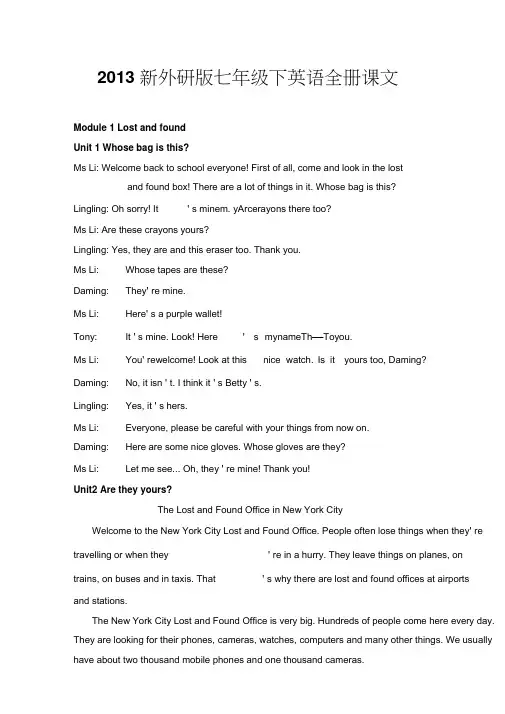
2013 新外研版七年级下英语全册课文Module 1 Lost and foundUnit 1 Whose bag is this?Ms Li: Welcome back to school everyone! First of all, come and look in the lostand found box! There are a lot of things in it. Whose bag is this?Lingling: Oh sorry! It ' s minem. yArcerayons there too?Ms Li: Are these crayons yours?Lingling: Yes, they are and this eraser too. Thank you.Ms Li: Whose tapes are these?Daming: They' re mine.Ms Li: Here' s a purple wallet!Tony: It ' s mine. Look! Here ' s mynameTh—Toyou.Ms Li: You' rewelcome! Look at this nice watch. Is it yours too, Daming?Daming: No, it isn ' t. I think it ' s Betty ' s.Lingling: Yes, it ' s hers.Ms Li: Everyone, please be careful with your things from now on.Daming: Here are some nice gloves. Whose gloves are they?Ms Li: Let me see... Oh, they ' re mine! Thank you!Unit2 Are they yours?The Lost and Found Office in New York CityWelcome to the New York City Lost and Found Office. People often lose things when they' re travelling or when they ' re in a hurry. They leave things on planes, on trains, on buses and in taxis. That ' s why there are lost and found offices at airportsand stations.The New York City Lost and Found Office is very big. Hundreds of people come here every day. They are looking for their phones, cameras, watches, computers and many other things. We usually have about two thousand mobile phones and one thousand cameras.At the moment, there are also some strange things at the New York City Lost and Found Office. There are about a hundred bikes and a large boat. There are also a lot of animals. This week, there are three dogs, two ducks and a pig! Whose are they? Are they yours? We don ' t know! Are you looking for fifteen kilos of sausages? They here too!Module 2 What can you do?Unit 1 I can play the piano.Daming:Look ! The new clubs for this term are on the board. I join th'e d like toMusic Club because I can play the piano. What about you, Betty?Betty:I like cooking, so I can join the Food and Drink Club. Can you cook, Daming ?Daming:No, I can 't. Well, I can cook eggs, but that 's aLliln. gWlinhga?t aboutWhich club can she join?Betty:I think she ' d like to join the Dancing Club because shedacannce really well .Tony , how about you?Tony: I ' d like to join the Chinese Club.I can ' t speak Chinese very well.Daming:Don' tworry about Chinese. We can teach you Chinese! So choose your favourite club.Tony:OK then. .I play table tennis, so I choose the Table Tennis Club. That ' s my favourite! Unit2 I can run really fast.It ' s the start of the new term and we ' re choosing our new monitors.I ' dlike to be the class monitor. I get on well with everyone, classmatesand teachers. I work very hard, and I do well at school .I ' m kind and I ' m always ready t help others. I can even help teachers too. Choose me as your class monitor and I promise to help YOU!I want to be the PE monitor .I enjoy sport, and I can run really fast. I fit ' m r and healthy. Just watch me in the playground between lessons! I play most ball games well. But I ' mreally good at football, and I play basketball in the school team. I usually get the best score in every match. Choose me for the PE monitor and you can get the best score too!I ' d like to be the cleaning monitor. I often help my mother do cleaning at home and I like a cleanand tidy house. I ' m sure everybody would like a clean classroom, just like home. Choose me and we can make our classroom beautiful.Module 3 Making plansUnit 1What are you going to do at the weekend?Betty: What are you going to do at the weekend, Daming?Daming: On Saturday morning, I ' mgoing to check my email and do my homework. Then I ' mgoing tohelp with the housework. What are you going to do, Betty?Betty: I ' m going to see a movie in the afternoon. You can come too.Daming: Sure! Who else is going to be there?Betty: Nobody. Lingling is going to have a piano lesson, so she can 't come with us, but on Sundayafternoon, Lingling and I are going to have a picnic. Would you like to join us?Daming: Yes, I ' d love to. Are we going to meet here?Betty: No, we aren ' t. We are going to meet in the park at one o' clock. Tony:Hi, everyone! Betty:Hi, Tony. What are your plans for the weekend? Tony:Nothing. I ' m going to stay at home alone. Betty: Don 't be silly! You 're going to come withguosin. gIt to be a fa 'n s tasticweekend!Unit 2 We are going to cheer the playersWhat are you going to do?AI ' m looking forward to the football match tomorrow. My friends and I are going to watch our favourite team. We 're gointgo t hoemr efaens, and make some new friends.We ' re all going to wear the team shirt, and we they win the match!MartinBI ' m going to enjoy myself during theMay Day holiday. On the morning of 1st May,regoingI ' m going to get up late and then read a book. In the afternoon I ' m going out wit family and friends. We ' re going to take a walk in the country or go swimming. Andon 2st May we 're going to collect litter in the park near my friend ' s house. Itto be a great holiday ----- busy but good fun!----- Zhang SijiaCUsually I spend the Summer holiday at home, but this year is going to be very different because I ' m going on a summer camp in Sydney, Australia. I ' m going to stay with an Australian family and speak English. We ' re also going sightseeing and goingto have a picnic on the beach.------ LucyModule 4 Life in the future Unit 1 Everyone will study at home.Ms Li: Will schools be different in the future, Daming?Daming: Yes, there will! In twenty years time, maybe there won ' t be any schools! Ms Li: How will students learn then?Daming:Everyone will study at home. Students will use computers and get information on theInternet. They can ask their teachers by Internet, telephone or email.Betty: Well, I ' m not sure. Yes, students will use computers, but school is good fun, and you can make friends there. And teachers can check the students ' level and will help them.Computers won ' t do that.Tony: Yes. Teacherswon' tuse on a blackboard and students won' tuse pens and paper, or erasers any more!Lingling: Great! Will students have a lot of homework to do?Tony: No, they won ' t. They ' ll have a lot of free time!Daming: That ' ll be great!Unit 2 Every family will have a small plane.What will life be like in the future? How will things change? Here are some ideas. Which ones will come true?A In the future, a change of weather won ' t mean a change of clothes. We new kind of clothes. They ' ll be warm when we ' re cold, and coolowt.hen weB There ' ll be no more light rain and cold wind in spring. The weather will be quite warm or even hot all year, with heavy rain and wind. The sea level will rise as well.C We won' t travel by bus or bike any more. Every family will have a small plane. No more expensive cars -it ' ll be cheap to travel everywhere by plane, not only over land, but also over the sea or even into space. Maybe the'rell be traffic jams in the air.D Do you like long holidays? Well, you ' re going to like the future because machines and robots will do all the heavy and difficult jobs, and we and easy work. Working hours will be short so people will have long holidays.Module 5 ShoppingUNIT 1 What can I do for you?(In the shop)Shop Worker: What can I do for you?Lingling: I'd like to buy a T-shirt for my mum.Shop worker: What colour does she like?Lingling; Purple.Shop worker: All right .What size does she take ?Lingling: Small.Shop worker: What about this one ?Lingling: May I try it on?Shop worker: Certainly.Lingling: Look at the price .It's 198 yuan .That's too much.Shop worker: But wait a minute !There's a sale on today .Everything is half pricellwear re ll only do lighLingling: OK! I'll take it .(In the market)Lingling: I've got some food to buy too.Market worker: Can I help you?Lingling: Yes. I'd like some sausages. How much are they?Market worker: Thirty-eight yuan a kilo. How much would you like?Lingling: Half a kilo.Market worker: OK. What else would you like?Lingling: A kilo of beans and two lemons.Market worker: That'll be 30 yuan.Betty: Oh, the strawberries look fresh .How much are they?Market worker: Ten yuan a kilo.Betty: One kilo please. Here's fifty-nine yuan.Unit 2 You can buy everything on the Internet.Online shoppingThere are many new ways of shopping, and online shopping is one of them .You can buy almost everything on the Internet .and it's very easy .First ,you choose something-clothes, tickets, a mobile phone, even a new computer -and pay for it. Then you receive it a few days later by post.Online shopping has several advantages.First, you can shop at any time. The shops are always open. Second, shopping usually takes a lot of time. But to shop on the Internet you only need a computer and a mouse! You can also compare the prices of the same product and spend a lot...or save money.But many people like going out and shopping with friends. They don't like shopping on the Internet because they can't see the product or try the clothes on. Also paying over the Internet isn't always safe.Online shopping is changing our way of life .One day no one will go to the shops any more, because you'll be able to buy anything on the Internet, and you will be able to receive it anywhere in the world at any time!Module 6 Around townUnit 1 Could you tell me how to get to the National Stadium?(Betty and Lingling are standing in front of Tian'anmen Square.) Tourist: Excuse me! Can you tell methe way to Wangfujing Dajie?Betty: Certainly. Go across Dong Chang ' an Jie, go along the street and turn left at the third street on the left. It ' s near here, so you can walk there.Tourist: Great. And I ' dlike to buy a guidebook about Beijing. Is there a bookshop near here? Lingling: Yes, there is a big bookshop over there, just along Xi Chang ' an Jie, on the right,opposite the bank.Tourist: Right, OK! I also want to visit the National Stadium. How can I get there?Lingling: Sorry, I ' m not sure. Why not ask the policeman over there?Tourist: Thank you.Betty and Lingling: You' re welcome.Tourist: Could you tell me how to get to the National Stadium?Policeman: Sure! Go along the street and you ' ll see an underground station. Take the Underground to the Olympic Sports Centre, or you can take a bus or a taxi.Tourist: Thanks a lot.Policeman: You' re welcome. Have a nice day!Unit2 The London Eye is on your rightTour of LondonWelcome to this short tour of London. This square is Trafalgar Square and it is the middle of London. We' restanding opposite the National Gallery, a famous museum with lots of famous paintings. From here, we ' ll walk along the red street to Buckingham Palace. The Queen lives there.Turn left and go to the Houses of Parliament and Big Ben. Opposite you can see the London Eye. It takes you 135 metres above the River Thames. You can see most of London on a clear day.When you are tired, the best way to see London is by boat. You can get the boat near Big Ben. As you go along the river, the London Eye is on your right.Get off the boat at Tower Bridge. Next to the bridge is the Tower of London. It over 900 years old.After visiting the Tower of London, take the boat back along the river to the railway station. When you get off the boat, go past the station and walk along the street. Turn left into King ' s Street and gopast a church. You ' re now back at the And this is where we ' ll finish our tour.Module 7 My past lifeUnit1 I was born in a small villageTony: Hey, Lingling. Where were you born?Lingling: I was born in a small village in Shanxi Province.Tony: What was the name of the village?Lingling: Xucun. Where were you born, Tony?Tony: I was born in Cambridge. It ' s a small city in England.Lingling: What was the name of your first school? Tony: It was Darwin Primary School.Lingling: Who was your first teacher?Tony: My first teacher was Mrs Lane. She was strict but very nice. Who wasyour first teacher?Lingling: Ms Yao. She was very friendly. Who were your first friends? What were they like?Tony: Their names were Becky and Adam. Becky was very good in class butAdam wasn'.t He was quite difficult.Lingling: And what were you like? Were you difficult in class too?Tony: No, I wasn ' t. I was very good!Unit 2 I was born in QuincyMy life in QuincyBy Betty KingI was born in Quincy, a town on the east coast of America, twelve years ago. There were lots of things to do in Quincy, with many stores, two movie theaters,football clubs and basketball teams too. I wasn there.t bored in Quincy. I was very happy Two presidents of the US, John Adams and his son JohnQuincy Adams, were born in Quincy. You can visit their old family houses. Our house was big and comfortable. There was a big living room with a TV, a kitchen, a bathroom and three bedrooms. On my bedroom walls there were pictures of my favourite movie stars.Behind the house, there was a big garden with lots of trees and there was a small lake with fish in it. It was great to play there.There were lots of children in Quincy. Many of them were my friends. This was our last in the US and I was there for the last time in 2010. One day I ' ll go back I ' m looking forward to seeing my friends againModule 8 Story timeUnit 1 Once upon a timeTony: All alone in the dark dark forest, Goldilocks picked some flowers.Daming: Oh, did she often go for a walk in the forest alone?Tony: No, she didn 'At.nd soon she was lost. Goldilocks looked around her.“ Where am I? she asked. Then she noticed a little house, so she hurriedtowards it, and knocked on the door., Nobody answered, so she knockedagain, and again, Finally, she pushed the door. It was open. There wasnobody there.Daming: Oh! Didn ' t anyone live in the house?Tony: Just wait a moment, Daming! Goldilocks entered the house and look intoa small room. On a table there were three bowls with some nice food inthem. One bowl was small, one was big and one was very big. Goldilockswas very hungry. She picked up the very big bowl but she didn ' t like it itwa—s very hot,. Then she picked up the big bowl, but she didn' t like it itwas -old. The little bowl was just right. She finished all the food in it.Unit2 Goldilocks hurried out of the houseGoldilocks and the Three BearsGoldilocks wanted to sit down because she was tired. First she tried the big chair, but wasn' t comfortable. Then she tried the middle chair. It was not comfortable either. Finally, she tried the small chair. It was nice and comfortable, but Goldilocks was very heavy and soon the chair was in pieces.She walked into the bedroom. There were three beds. She didn ' t like the middle bed or the big bed. The small bed was very comfortable. Very soon she was asleep in it.The Three Bears returned. They looked at the bowls and the chairs. Baby Bear cried, ” There ' s nothing in my bowl and my chair is in pieces! ” He wasn ' t very hNext, the Bears looked in their bedroom. They didn ' t notice Goldilocks at first.Then Baby Bear pointed at the little girl in his bed and shouted, “ Look! There ' bad girl! ”Goldilocks opened her eyes. The Three Bears were all around her, so Goldilocks jumped out of bed and hurried out of the house without her basket. She didn ' t go walk in the forest again.Module 9 Life historyUnit1 He left school and began work at the age of 12. Betty: What are you reading?Tony: Tom Sawyer, by the famous American writer, Mark Twain. I ' m writing about him for my English class.Betty: I read Tom Sawyer. Very good! Hey, we can find out about him on theInternet.Tony: Yes! ... OK. Look at this! His real name was Samuel Clemens and he was born in 1835 in Missouri.He left school and began work at the age of 12.Betty: What did he do?Tony: He wrote for a newspaper Later he got work on a boat..Betty: Did he stay in Missouri?Tony: No, he went to New York, and other cities.Betty: When did he begin his stories?Tony: I don' tknow the exact date. But he took the name Mark Twain andbecame very famous in the 1860s. He went to Europe as well. But he didn ' t come toChina.Betty: Yes, I knew that. Enjoy the book.Tony: Yes, it ' s good.Unit 2 He decided to be an actorWilliam Shakespeare was a famous English writer of plays and poems. He wrote 38 plays, 154 short poems and a few long poems in his life. Two of his famous plays are Hamlet and Romeo and Juliet.Shakespearewas born in 1564 in Stratford, England. Like many people four hundred years ago, Shakespeare ' s parents didn ' t learn to read or write. At school heliked plays, so he decided to be an actor when he finished school at 14. He married in 1582 and had three children.Shakespearewent to London and joined a theatre company in about 1592. He became a successful actor and began to write plays. Queen Elizabeth I enjoyed his works very much.In 1599 the company built the Globe Theatre on the River Thames in London.You can visit the theatre today, but it isn ' t the same building. There was a fire in theold theatre. They built it again in 1614 and in the 1990s.William Shakespeare died at the age of 52. He was rich and successful. You can still see his plays in English and in many the languages. He' sfamous around the world..Module10 A holiday journeyUnit1 what did you do? Lingling: Where are you going on holiday, Tony? Tony: To Los Angeles. Betty: Oh, really? You ' ll love it! I went there two years ago and enjoyaelodt.itTony: How long did it take to get there? Did you fly?Betty: Yes, we did, and that took about nine hours. Then our friends met us anddrove us to their home.Lingling: Who was with you?Betty: My parents.Lingling: So what did you do?Betty: Well, first, we went to Disneyland, and guess what? I met Snow White andMickey Mouse! I was so excited!Tony: Wow! How long did you stay there?Betty: We stayed there for two days. And then we went to Hollywood.Lingling: Did you see any movie starts?Betty: No, but we swam in the Pacific Ocean at Santa Monica. It was great!Lingling: Where are you going on holiday this year, Betty?Betty: Paris.Unit2 This morning we took a walk.Hi, Grandma! Here I 'm in Paris. Jenny and I arrived by plane the day before yesterday. Aunt Joan and Uncle Peter met us at the airport. We were tired so we relaxed at home and began our tour of the city yesterday.Yesterday we went to the Louvre Museum. It has many world-famous works of art, such as the Mona Lisa. In the evening we had dinner in a French restaurant. The food was delicious!This morning we took a walk. There are shops, and restaurants everywhere, and I love the street and markets. They sell such good fruit and vegetables.We also did some shopping.I bought a present for you. I hope you ' ll like it!At about three o ' clock, we took the Paris Underground to the Eiffel Tower. It isreally high. There were lots of tourists, so first of all, we had to wait in line for an hour, and then we went to the top. We waited till all the lights were on. It was wonderful!Tomorrow we're going to visit a famous palace and take a boat tour on the RiverSeine. I ' ll write again.Love,BerryModule 11 Body languageUnit 1 They touch noses!Lingling: We' re going to have some Russian teachers at school tomorrow, and I ' welcoming the visitors. How do I do that?Betty: Lingling, you know, in Russia, people usually kiss three times, left, right,left.Lingling: What! No, I didn ' t know that. We Chinese often shake h and ssmile when we meet visitors, and sometimes we nod our heads . But we never kiss. Only parents and children do that. Betty: That ' s because people do different things in different countries.Lingling: So what do people in the US usually do when they meet?Betty: In the US some people shake hands, and some kiss or hug each other. InIndia people put their hands together and nod their heads. And do your know what Maoripeople in New Zealand do when they meet?Lingling: No, What do they do?Betty: They touch noses!Unit2 Here are some ways to welcome them.Body language around the worldby Wang LinglingOur new foreign students are going to arrive very soon, and here are some ways to welcome them.How close do you stand when you talk to a friend? You can stand too close topeople in the Middle East but don'st tand too close to North American! Give them more personal space.How about touching people? Chinese girls often walk arm in arm with theirfriends. South American sometimes hold your arm when they talk to you, so you can ' t move away! But in Britain many people don ' t like other people to touch them at all.Do you look at people when you talk? In some places, it isnt polite to look at peoplewhen they talk, but in other countries it isn ' t polite to look somewhere else. In Britainand the US, people usually look at each other when they talk.And how do you say goodbye? That ' s easy, wave to say goodbye. But be careful!In Greece, it 's not at all polite! In fsacvte, rity rude! 'Module 12 Western musicUnit 1 It' s so beautiful!(The Blue Danube)Daming: Hmm, this is Western music, isn 'itt? Can you hear the violin and the piano? It ' s so beautiful! Is this by Strauss or Mozart?' m not sure …Lingling: IBetty:It ' bsy Strauss. I love his music! Do you know anything about him, Tony?Tony: Was he GermanBetty: No, he was born in Vienna, the capital of Austria. What a beautiful city!This is called The Blue Danube. The Danube is a river in Europe. It goes throughVienna.Lingling: Do you like both. You listen to pop music, Betty?' t you?Betty: Well, I like both. You listen to pop music, Lingling, donLingling: Yes, I do. I also like Beijing opera. Listen to this fantastic voice.Tony: Hmm, the sound is very … different, isn I ' m' taitf?an of rock music.Listen to this!Daming: Hey! Give us a break!Lingling: Rock music? Listen to those drums.' s so noisy! And much too fast!Daming: ItTony: You don ' t like rock music? I donbelieve i't! tUnit 2 Vienna is the centre of European classical music.The city of musicVienna is a beautiful old city on the River Danube in the centre of Europe. It capital city of Austriaand the centre of European classical music. In the eighteenth century a lot of musicians came to study and work in Vienna.In the Strauss family, there were two composers called Johann Strauss: the father and the son. The father, Johann Strauss the elder, wrote and played music for traditional dances, called the waltz. His dance music made him famous all over Europe. The son, Johann Strauss the younger, was also very successful and popular. He wrote over 150 waltzes. In 1867 he wrote The Blue Danube waltz.Mozart was another very important composer. He was born in Austria in 1756. Before he was six, he played not only the piano but also the violin. His family took him around Europe and he gave concerts in many cities. He wrote hundreds of wonderful pieces of music. But he became very poor and died in 1791 when he was only 35. Like Johann Strauss, father and son, he was a great European musician, and many people still think his music is perfect.。
2013年新外研版七年级下册m7u1
现在
礼物
Write a passage about your past life.
It is new and beautiful now. It was small and old many years ago.
What was it like before?
Speaking:
Make up a dialogue about your past life.
Tips (温馨小提示) Be 的过去式 am, is--- was are--- were
I am a teacher now. But I was _______(am/was) a student twenty years ago. were You ______ (are/were)primary students two years ago. was He/She _______ (is/was) 12 years old last year.
7.她非常友好
8.他非常难管
7.She was very friendly
8.He was quite difficult
9.那么你是什么样的呢? 9.And what were you like? Were you 你在课堂上 也很难管么? difficult in class too? 10.不,我不是,我很好 10.No, I wasn’t. I was very good.
2.Tell “T” or “F” (判断对错) ( F ) 4. Mrs Lane was very friendly. ( F )5. Ms Yao was very strict. 3.Fill in the blanks( 完成句子) like What were Becky and Adam _______? Becky was good very ___________ but Adam was very________. difficult
2013新外研版七年级英语下M11-U3

第十四页,共35页。
14
Come to my office. 到我办公室来。 Stop! 停!
Hurry up! 快点!
Please don’t do it.
请不要这么做。
Don’t be late again.
不要再迟到了。
第十五页,共35页。
15
Don’t worry. Be happy.
不要担忧,快乐点儿。
第二十九页,共35页。
29
II. 翻译以下各句。 1. 咱们一起玩吧!
Let’s play together.
2. 请不要迟到。 Don’t be late, please.
3. 答复这个问题。
Answer the question.
4. 不要这么吵。
Don’t make such a noise.
3. You cannot touch anything if the teacher doesn’t ask you to.
Don’t touch anything if the teacher
doesn’t ask you to.
第二十二页,共35页。
22
4. You cannot bring food or drink into the lab. Don’t bring food or drink into the
Do’s • Stand in line. • Shake hands.Байду номын сангаасBritain • Say ‘please’ and ‘thank you’. • Open doors for others. • Look at people when you talk. • Be on time.
2013新外研版七年级英语下M12-U1

① across 表示从一定范围的一边到另 一边,与on 有关,表示动作是在某 一物体的表面进行的。 They walk across the road. 他们穿过公路。 ② through 表示从中间通过,强调动 作是在里面进行的。 We walk through the forest. 我们穿过森林。
Now check √ ) the true sentences. (
√ 1 They’re listening to Western music. √ 2 Tony knows little about Strauss. 3 Strauss was born in the capital of ×
结构一: 前肯 + 后否 Be 动词: 1. You are an actor, __________? aren’t you 2. He is a good boy, ________? isn’t he 3. It was fine yesterday, _________? wasn’t it 行为动词: 1. It often rains here, _________? doesn’t it doesn’t he 2. He likes soccer, _________? 3. You have a headache, _________? don’t you 4. I called you yesterday, _______? didn’t I
lively ( 7 ) noisy ( 9 ) sound ( 3 )
modern ( 5 ) pop ( 8 ) violin ( 4 )
music ( 1 ) rock ( 6 ) Western ( 2 )
2 Work in pairs. Answer the questions about the conversation in Activity 1. 1. Which modern music does Tony like? 2. What does Tony’s mum think about rock music? 3. Why doesn’t Tony like traditional Western music? 4. Which music does Tony’s dad think is too noisy? Listen again and check.
2013年外研版M2_U1-It's_taller_than_many_other_buildings
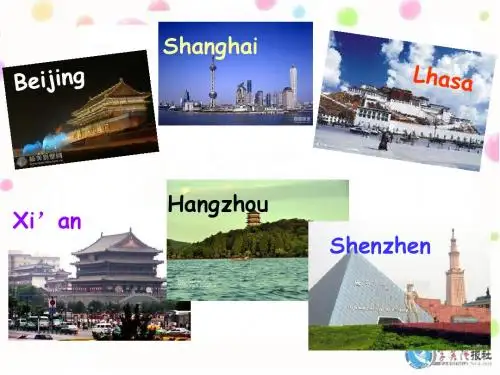
二、用括号内所给单词的适当形式填空。 1. My sister is two years older (old) than I. 2. Who sings better (well), John or Betty? 3. My English teacher is much more serious (serious) than my other teachers. 4. The red coat is as long (long) as the blue one. 5.They don’t get up asearly (early) as us.
Words: hill population wide million pretty than get Phrases: On the coast as busy as… taller than… Patterns: How was your weekend? What’s the population of Shenzhen? It’s taller than many other buildings in Shenzhen.
Listen and notice how the speaker stresses the underlined words. 1. – Shenzhen is larger in population than Beijing. – No, it isn’t. It’s smaller. 2. – Hong Kong is newer than Shenzhen. Now work in pairs. Listen again and – No, it isn’t. It’s older. repeat. 3. – Shenzhen is as old as Hong Kong. – No, it isn’t. It’s newer. 4. – Hong Kong is as busy as Shenzhen. – No, it isn’t. It’s busier.
外研版英语七年级下册-课文译文
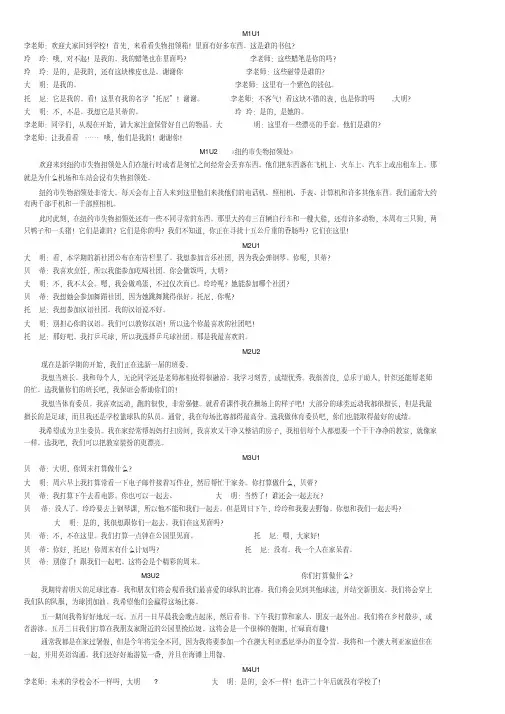
M1U1李老师:欢迎大家回到学校!首先,来看看失物招领箱!里面有好多东西。
这是谁的书包?玲玲:哦,对不起!是我的。
我的蜡笔也在里面吗?李老师:这些蜡笔是你的吗?玲玲:是的,是我的,还有这块橡皮也是。
谢谢你李老师:这些磁带是谁的?大明:是我的。
李老师:这里有一个紫色的钱包。
托尼:它是我的。
看!这里有我的名字“托尼”!谢谢。
李老师:不客气!看这块不错的表,也是你的吗,大明?大明:不,不是。
我想它是贝蒂的。
玲玲:是的,是她的。
李老师:同学们,从现在开始,请大家注意保管好自己的物品。
大明:这里有一些漂亮的手套。
他们是谁的?李老师:让我看看……哦,他们是我的!谢谢你!M1U2 《纽约市失物招领处》欢迎来到纽约市失物招领处人们在旅行时或者是匆忙之间经常会丢弃东西。
他们把东西落在飞机上、火车上、汽车上或出租车上。
那就是为什么机场和车站会设有失物招领处。
纽约市失物招领处非常大。
每天会有上百人来到这里他们来找他们的电话机、照相机、手表、计算机和许多其他东西。
我们通常大约有两千部手机和一千部照相机。
此时此刻,在纽约市失物招领处还有一些不同寻常的东西。
那里大约有三百辆自行车和一艘大船,还有许多动物,本周有三只狗,两只鸭子和一头猪!它们是谁的?它们是你的吗?我们不知道,你正在寻找十五公斤重的香肠吗?它们在这里!M2U1大明:看,本学期的新社团公布在布告栏里了。
我想参加音乐社团,因为我会弹钢琴。
你呢,贝蒂?贝蒂:我喜欢烹饪,所以我能参加吃喝社团。
你会做饭吗,大明?大明:不,我不太会。
嗯,我会做鸡蛋,不过仅次而已。
玲玲呢?她能参加哪个社团?贝蒂:我想她会参加舞蹈社团,因为她跳舞跳得很好。
托尼,你呢?托尼:我想参加汉语社团。
我的汉语说不好。
大明:别担心你的汉语。
我们可以教你汉语!所以选个你最喜欢的社团吧!托尼:那好吧。
我打乒乓球,所以我选择乒乓球社团。
那是我最喜欢的。
M2U2现在是新学期的开始,我们正在选新一届的班委。
我想当班长。
2013外研社七年级下M2-U1 I can play the piano
3. —I’d like to join the Chinese Club. I can’t speak Chinese very well. —Don’t worry about Chinese. —我想加入汉语社团。我汉语说得不好。 —别担心汉语。 想要表达说某种语言, 可以用speak + 语言。 这里 speak意思是“说, 讲(某种语言)”的意思。
Pronunciation and speaking
5 Say the sentences aloud. /kən/ I can play the piano.
/kɑ:nt/ I can’t speak Chinese very well. /kæn/ Can you cook?
6 Listen and repeat.
1. I’d like to join the Music Club because I can play the piano. 我想加入音乐社团是因为我会弹钢琴。 join多指参加某组织、党派或社会团体, 成为其中的一个成员。如: He joined the League in 2011. 他在2011年入团。 I’m thinking of joining a choir. 我正在考虑加入合唱团。
二、从方框中选出合适的词填空。 join dance choose piano cooking You can choose your favourite club. Can you _____? If you can, join the ___ dance piano Dancing Club. I can play the _____. It’s very interesting. If you like cooking _______, you can join the Food and Drink Club. There are English and Chinese Clubs. You can ______ it. choose
M2 U1(第一课时)
/ ðæ t / (单数)
那,那个
看着照片谈论你的家人(复数) 2. --- Are these your parents / grandparents? / ði:z / /′peərənt / 这些是你的父母亲吗? --- Yes, they are. 是的。 / ðeɪ / 他们 No, they aren’t. 不,不是。
通过比较,我们发现:主语是复数 的时候,be 动词不用 is ,要用 are. these------those (复数) / ði:z / 这些 /ðəʊz / 那些
反义词
认识Tony家的几个亲人: Aunt Liz / liz / 利兹 Uncle Paul / pɔ:l / 保罗 cousin Mike / maɪk / 迈克 cousin Helen / ′helən/ 海伦
son 儿子 Mike
mother = mum
sister brother daughter 女儿
a photo of Lingling's family.
parents sister father 父母亲 mother grandmother grandparents 祖父母 Lingling
grandfather
小结: 本课我们学习了什么内容?
1.表示家人的名词。 father , mother, sister, brother… 2.询问照片上的人的指示代词。 this , that, these , those. 3.表示方位的介词。
on the left, on the right, next to, in front of
left /left/ 左边
on the left 在左边
外研版英语七(下)M2 U1导学案
中学七年级下学期英语科导学案编号:5课题:Module 2 Unit 1 I can play the piano.Period 1 (A1—A3) 课型:听说课【学习目标】1. 知识目标:掌握本单元的重点单词、词组和句式的意思及用法。
(重点)2. 能力目标:能听懂关于参加学校社团的对话;能交流各自会干什么与不会干什么。
(难点)3. 情感目标:通过本单元的学习,培养学生认识自我和肯定自我的能力,增强自信心及助人为乐的精神。
【学习流程】一、预习(要求同学们课前完成,组长课前检查)1. 试读本单元的单词,在不会读的单词下做标记,在课文中划出这些新词汇。
2. 做练习册M2 U1预习导航,看第一课要点直击3. 预习检测:完成课本P8 A1中的单词和图片配对。
4. 预习检测:读课本P8 A1和A3的内容并找出以下短语,完成P9 A3后的表格。
划出不懂的句子。
⑴打乒乓球⑵弹钢琴⑶骑自行车⑷说汉语⑸想要,希望⑹仅此而已⑺担心二、交流、展示与点评1. 群学:把不会的新单词与组员交流,朗读展示。
2. 小组讨论预习检测的答案,展示点评。
3. 听录音完成A2的答案并点评。
4. 听录音或观看录像完成课本P2 A3后的练习。
5. 听录音跟读A3课文。
全班齐读。
6. 分角色朗读对话。
展示并点评。
三、合作探究:1. 试翻译以下短语,并讨论有什么不同?弹吉他________________ 踢足球_____________你得出什么结论呢?在乐器前要,在球类前。
2.I’d like=I would like我想要/希望;would like=want意为“想要/希望”;would like sth. 意为“想要某物”;would like to do sth 意为“想要做某事”;would like sb. to do sth. 意为“想要某人做某事”My brother wants _______ the Chess Club. A. join B. to join C. joins3. l ike doing sth. 喜欢做某事(表示习惯性的动作);like to do sth. 喜欢做某事(表示具体的某一次动作)。
2013外研版英语七年级下册M8 U1
从上面的两个例子我们可以看出,walked, lived所表达的都是过去的事情。也就是说:
当我们谈论过去的动作或者状态时, 常常使用一般过去时态,句子中的谓语动词要用 动词的过去式。(V.-ed )
请看: walk --- walked live --- lived
那么,我们可以推论,动词的过去式的结构大 致是在动词后面加 -ed. 这类变化被称为动词的 规则变化。
Did you listen to the news in the morning ? Did you watch TV yesterday evening? Did you watch a movie last night? 行为动词的一般过去时态的一般疑问句, 要用助动词 did 在句首帮提问。
forest
/ ′fɒrist / n. 森林 在森林里 在森林附近
in the forest near the forest
Goldilocks lived near the forest.
Goldilocks walked in the forest with a basket .
go for a walk / ride 去散步 / 骑马
She noticed a little house.
hurry /′ hʌri / v. 匆忙
towards / tə′w3:dz / prep. 向,往;朝……方向
hurry towards the house 匆忙向房子走去
She hurried towards the house.
knock
She was a girl with long golden hair. 她是一个有着金黄色的长发的女孩。