
2013年普通高等学校招生全国统一考试英语(课标全国1卷)
2013年普通高等学校招生全国统一考试(试题类型:B)英语(新课标山西卷)注意事项:1. 本试卷分第I卷(选择题)和第II卷(非选择题)两部分。
第I卷1至13页,第II卷14至16页。
2. 答题前,考生务必将自己的姓名、准考证号填写在本试卷相应的位置。
3. 全部答案在答题卡上完成,答在本试卷上无效。
4. 第I卷听力部分满分30分,不计入总分,考试成绩录取时提供给高校作参考。
5. 考试结束后,将本试卷和答题卡一并交回。
第I卷第一部分听力(共两节,满分30分)做题时,先将答案标在试卷上。
录音内容结束后,你将有两分钟的时间将试卷上的答案转涂到答题卡上。
第一节(共5小题;每小题1.5分,满分7.5分)听下面5段对话。
每段对话后有一个小题,从题中所给的A、B、C三个选项中选出最佳选项,并标在试卷的相应位置。
听完每段对话后,你都有10称钟的时间来回答有关小题如阅读下一小题。
每段对话仅读一遍。
例:How much is the shirt?A. £19.15.B. £9.18.C. £9.15.答案是C。
1. What does the man want to do?A. Take photos.B. Buy a camera.C. Help the woman.2. What are the speakers talking about?A. A noisy night.B. Their life in town.C. A place of living.3. Where is the man now?A. On his way.B. In a restaurant.C. At home4. What will Celia do?A. Find a player.B. Watch a game.C.Play basketball.5. What day is it when the conversation takes place?A. Saturday.B. Sunday.C. Monday.第二节(共15小题:每小题1.5分,满分22.5分)听下面5段对话或独白。
每段对话或独白后有几个小题,从题中所给的A、B、C三个选项中选出最佳选项,并标在试卷的相应位置。
听每段对话或独白前,你将有时间阅读各个小题,每小题5秒钟;听完后,各小题将给出5秒钟的作答时间。
每段对话或独白读两遍。
听第6段材料,回答6、7题。
6. What is Sara going to do?A. Buy John a gift.B. Give John a surprise.C.Invite John to France.7. What does the man think of Sara’s plan?A. Funny.B. Exciting.C. Strange.听第7段材料,回答第8、9题。
8. Why does Diana say sorry to peter?A. She has to give up her travel pan.B. She wants to visit another city.C. She needs to put off her test.9. What does Diana want Peter to do?A. Help her with her study.B. Take a book to her friend.C. Teach a geography lesson. 听第8段材料,回答第10至12题。
10. Why does the man call the woman?A. To tell her about her new job.B. To ask about her job program.C. To plan a meeting with her.11. Who needs a new flat?A. Alex.B. Andrea.C. Miranda.12. Where is the woman now?A. In Baltimore.B. In New York.C. In Avon.听第9段材料,回答第13至16题。
13. What does Jan consider most important when he judges a restaurant?A. Where the restaurant is.B. Whether the prices are low.C. How well the food is prepared.14. When did Jan begin to write for a magazine?A. After he came back to Sweden.B. Before he went to the United States.C. As soon as he got his first job in 1982.15. What may Jan do to find a good restaurant?A. Talk to people in the street.B. Speak to taxi drivers.C. Ask hotel clerks.16. What do we know about Jan?A. He cooks for a restaurant.B. He travels a lot of his work.C. He prefers American food.听第10段材料,回答第17至20题17. What do we know about the Plaza Leon?A. it’s new buil ding.B. it’s a small town.C. it’s public place.18. When do parents and children like going to the Plaza Leon?A. Saturday nights.B. Sunday afternoons.C. Fridays and Saturdays.19. Which street is known for its food shops and markets?A. Via del Mar Street.B. Fernando Street.C. Hernandes Street.20. Why does the speaker like Horatio Street best?A. It has an old stone surface.B. it is named after a writer.C. It has a famous university. 第二部分英语知识运用(共两节,满分55分)第一节单项填空(共15小题;每小题1分,满分15分)从A,B,C,D四个选项中,选出可以填入空白处的最佳选项涂黑。
例:We last night,but we went to the concert instead.A.must have studiedB.might studyC.should have studiedD.would study21. ——Why, this is nothing but common vegetable soup!- , madam. It’s our soup of the day.A.So it isB. Let me seeC. Don’t mention itD. Neither do I22. They might just have a place _____ on the writing course —why don’t you give it a try?A. leftB.leaveC. leavingD. to leave23. Try not to cough more than you can ___ since it may cause problems to your lungs.A. checkB. allowC. stopD. help24. If we ____ now to protect the environment, we’ll live to regret it.A. hadn’t actedB. haven’t actedC. don’t actD. won’t act25. Tony can hardly boil an egg, still ____ cook dinner.A. lessB. littleC. muchD. more26. Police have found ____ appears to be the lost ancient statue.A. whichB. whereC. howD. what27. When I first met Bryan I didn’t like him, but I ____ my mind.A. have changedB. changeC. had changedD. would change28. The driver wanted to park his car near the roadside but was asked by the police ____.A. not to doB. not toC. not doD. do not29. The door _____ open, no matter how hard she pushed.A. shouldn’tB. couldn’tC. wouldn’tD. mightn’t30. At the last moment, Tom decided to _____ a new character to make the story seem more likely.A. put upB. put inC. put onD.put off31. India attained ____ independence in 1947, after _____ long struggle.A. 不填; aB. the; aC. an; 不填D. an; the32. There’s no way of knowing why one man makes an important discovery _____ another man, also intelligent, fails.A. sinceB. ifC. asD. while33. “You can’t judge a book by its cover,” ______.A. as the saying goes oldB. goes as the old sayingC. as the old saying goesD. goes as old the saying34. It was a real race ____ time to get the project done. Luckily, we made it.A. overB. byC. forD. against35. The sunlight is white and blinding, ____ hard-edged shadows on the ground.A. being throwingB. thrownC. to throwD. to be thrown第二节完形填空(共20小题;每小题2分,满分40分)阅读下列短文,从短文后各题所给的四个选项(A、B、C和D)中,选出可以填入空白处的最佳选项,并在答题卡上将该项涂黑。
2013年普通高等学校招生全国统一考试(新课标1卷)数学文科
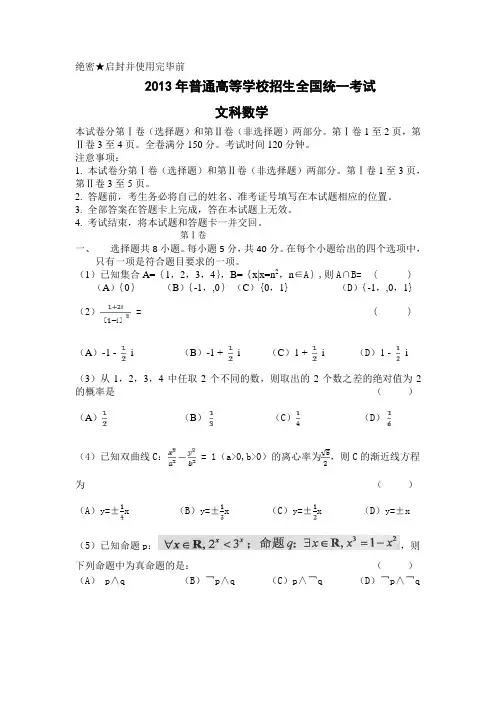
绝密★启封并使用完毕前2013年普通高等学校招生全国统一考试文科数学本试卷分第Ⅰ卷(选择题)和第Ⅱ卷(非选择题)两部分。
第Ⅰ卷1至2页,第Ⅱ卷3至4页。
全卷满分150分。
考试时间120分钟。
注意事项:1. 本试卷分第Ⅰ卷(选择题)和第Ⅱ卷(非选择题)两部分。
第Ⅰ卷1至3页,第Ⅱ卷3至5页。
2. 答题前,考生务必将自己的姓名、准考证号填写在本试题相应的位置。
3. 全部答案在答题卡上完成,答在本试题上无效。
4. 考试结束,将本试题和答题卡一并交回。
第Ⅰ卷一、选择题共8小题。
每小题5分,共40分。
在每个小题给出的四个选项中,只有一项是符合题目要求的一项。
(1)已知集合A={1,2,3,4},B={x|x=n2,n∈A},则A∩B= ( ) (A){0}(B){-1,,0}(C){0,1} (D){-1,,0,1}(2) = ( )(A)-1 - i(B)-1 + i(C)1 + i(D)1 - i(3)从1,2,3,4中任取2个不同的数,则取出的2个数之差的绝对值为2的概率是()(A)(B)(C)(D)(4)已知双曲线C: = 1(a>0,b>0)的离心率为,则C的渐近线方程为()(A)y=±x (B)y=±x (C)y=±x (D)y=±x(5)已知命题p:,则下列命题中为真命题的是:()(A) p∧q (B)¬p∧q (C)p∧¬q (D)¬p∧¬q(6)设首项为1,公比为的等比数列{an }的前n项和为Sn,则()(A)Sn =2an-1 (B)Sn=3an-2 (C)Sn=4-3an(D)Sn=3-2an(7)执行右面的程序框图,如果输入的t∈[-1,3],则输出的s属于(A)[-3,4](B)[-5,2](C)[-4,3](D)[-2,5](8)O为坐标原点,F为抛物线C:y²=4x的焦点,P为C上一点,若丨PF丨=4,则△POF的面积为(A)2 (B)2(C)2(D)4(9)函数f(x)=(1-cosx)sinx在[-π,π]的图像大致为(10)已知锐角△ABC的内角A,B,C的对边分别为a,b,c,23cos²A+cos2A=0,a=7,c=6,则b=(A)10 (B)9 (C)8 (D)5(11)某几何函数的三视图如图所示,则该几何的体积为(A)18+8π(B)8+8π(C)16+16π(D)8+16π(12)已知函数f(x)= 若|f(x)|≥ax,则a的取值范围是(A)(-∞] (B)(-∞] (C)[-2,1] (D)[-2,0]第Ⅱ卷本卷包括必考题和选考题两个部分。
2013年高考英语全国卷1-答案
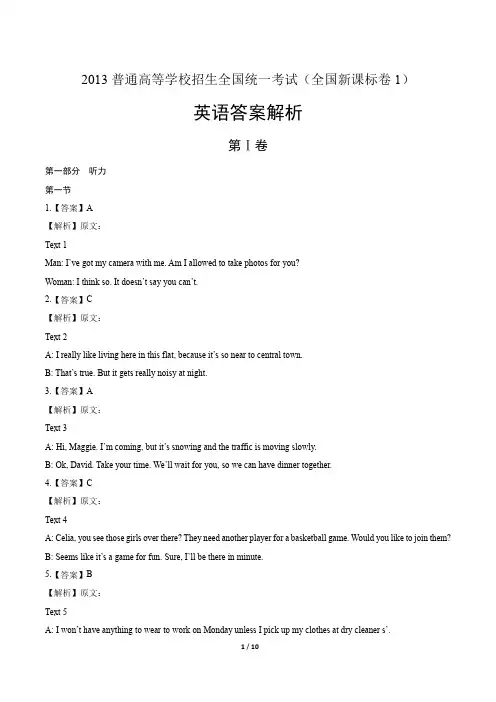
2013普通高等学校招生全国统一考试(全国新课标卷1)英语答案解析第Ⅰ卷第一部分听力第一节1.【答案】A【解析】原文:Text 1Man: I’ve got my camera with me. Am I allowed to take photos for you?Woman: I think so. It doesn’t say you can’t.2.【答案】C【解析】原文:Text 2A: I really like living here in this flat, because it’s so near to central town.B: That’s true. But it gets really noisy at night.3.【答案】A【解析】原文:Text 3A: Hi, Maggie. I’m coming, but it’s snowing and the traffic is moving slowly.B: Ok, David. Take your time. We’ll wait for you, so we can have dinner together.4.【答案】C【解析】原文:Text 4A: Celia, you see those girls over there? They need another player for a basketball game. Would you like to join them? B: Seems like it’s a game for fun. Sure, I’ll be there in minute.5.【答案】B【解析】原文:Text 5A: I won’t have anything to wear to work on Monday unless I pick up my clothes at dry cleaner s’.B: Then you’d better hurry. It closes at noon on Sundays. A: Oh! I should have gone there on Saturday.第二节6.【答案】B7.【答案】B【解析】原文:Text 6A: Alright, Sara, we know that you are planning something big for John’s birthday. Could you tell us just what you have in your mind?B: I want to make his birthday a very special event. John has a sister living in France. And I’ll send her a plane ticket, so that she can be here for his birthday.A: Boy! What an excellent plan! That’s something special. I can’t guess some secret plans and we are waiting for the right time to tell him.B: Well, I didn’t want to s ay anything until I was sure she could come.8.【答案】A9.【答案】B【解析】原文:Text 7A: Hey, Peter, I’m sorry!B: Hi, Diana, what’s wrong?A: We were going to Hong Kong this weekend, but I’m afraid I can’t go.B: How come?A: I have a really big geography test and I have to study for it.B: We can go next week instead.A: No, I don’t want to ruin your weekend. You go ahead and please take the book I bought to my friend Sally. Tell her I have to study all weekend, because I can’t afford to fail the test.B: Ok, then I’ll go with them. But it’s a pity you can’t come.10.【答案】A11.【答案】B12.【答案】A【解析】原文:Text 8A: Hello, this is Andrea.B: Hello, Andrea, this is Alex. I have some very big news for you. Miranda was very satisfied with you and said she was very much looking forward to working with you. Isn’t that wonderful? Congratulations dear! How does it feel to be Miranda’s new assistant? How I imagine that you’ll just be delighted with this news. So let’s see, you can start on Monday, right?A: Umm, well, I don’t think I can start on Monday. I am visiting my father in Baltimore. And because I don’t live in New York, I’ll need a couple of days to find a flat and buy some furniture and move my things from Avon.B: Oh, well then, in that case I suppose Wednesday will be good. Ok, see you then!13.【答案】C14.【答案】A15.【答案】A16.【答案】B【解析】原文:' ’Text 9Woman: Hello, Mr. Jan Erick Freedman. You’re a frequent traveler. And we also know that you eat out twice a day. How can you get so far and eating out.Man: When I my first job back in 1982 and started travelling. I had no other choice but eat out I found that I felt different due to what I was eating, so I tried to find places that served food that made me feel good. The secret was the quality of the food and how well the food was prepared. I made an effort to find out good restaurants as well as nice dishes.Woman: How did you manage to make a list of 218 favorite restaurants?Man: I’ve lived in cities and when I moved back to Sweden from the United States, people asked me where to go and eat and went to the cities I know. I got a lot of ideas. Then I wrote about restaurants for a Swedish club magazine and some suggested I gather information about restaurants together since I had all the facts about the restaurants I`ve been to. I started to do that.Woman: How do you find restaurants?Man: The best way is to ask the people there. I may talk to the people at the street market or take a walk and look for place for myself. I never asked hotel clerks or taxi drivers. I don’t go eithe r restaurants or places with menus too difficult to understand.17.【答案】C18.【答案】B19.【答案】C20.【答案】C【解析】原文:Text 10Man: At the beginning of the tour, we all started the most important place at my town which is the Plaza Leon. The Plaza Leon is more than 100 years old. It’s a gathering place for young people on Friday and Saturday nights, and for parents and children on Sunday afternoon. Four streets lead to the Plaza which have white sidewalks and tree lined. Hemandes Street which was named after writers born in the city contains all of the food stalls fish markets and vegetable stands. Femando Street which was named after a famous educator is where all of the government offices, shops and houses. Via del Mar Street which is the only street which has old stone surfaces. Finally we came to the Hewish’s Street on which there are two universities, one of which is the most famous university in my country. That’s why it’s my favorite street of all.第二部分英语知识运用第一节单项填空21.【答案】A【解析】这只是普通的蔬菜汤!确实如此,女士,这就是我们今天的汤。
2013年普通高等学校招生全国统一考试(山东卷) 含答案
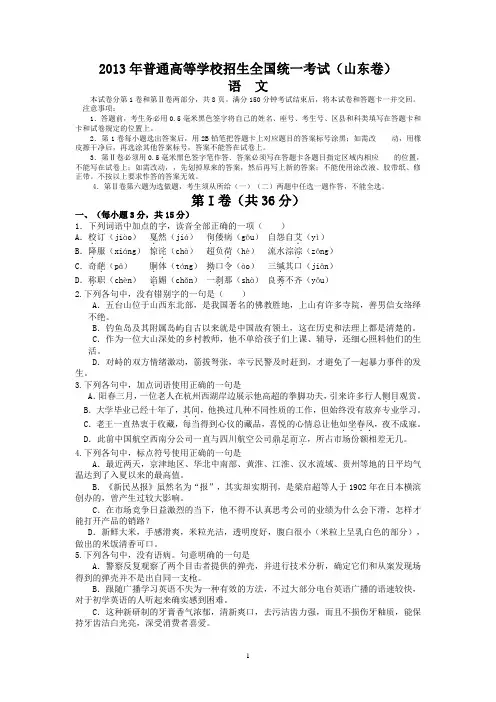
2013年普通高等学校招生全国统一考试(山东卷)语文本试卷分第1卷和第Ⅱ卷两部分,共8页。
满分150分钟考试结束后,将本试卷和答题卡一并交回。
注意事项:1.答题前,考生务必用0.5毫米黑色签字将自己的姓名、座号、考生号、区县和科类填写在答题卡和卡和试卷规定的位置上。
2.第1卷每小题选出答案后,用2B铅笔把答题卡上对应题目的答案标号涂黑;如需改动,用橡皮擦干净后,再选涂其他答案标号,答案不能答在试卷上。
3.第Ⅱ卷必须用0.5毫米黑色签字笔作答.答案必须写在答题卡各题目指定区域内相应的位置,不能写在试卷上;如需改动,,先划掉原来的答案,然后再写上新的答案;不能使用涂改液、胶带纸、修正带。
不按以上要求怍答的答案无效。
4.第Ⅱ卷第六题为选做题,考生须从所给(一)(二)两题中任选一题作答,不能全选。
第I卷(共36分)一、(每小题3分,共15分)1.下列词语中加点的字,读音全部正确的一项()A.校.订(jiào)戛.然(jiá)佝.偻病(gōu)自怨自艾.(yì)B.降.服(xiáng)惊诧.(chà)超负荷.(hâ)流水淙淙.(zōng)C.奇葩.(pā)胴.体(tóng)拗.口令(ào)三缄.其口(jiān)D.称.职(chân)谄.媚(chǎn)一刹.那(shà)良莠.不齐(yǒu)2.下列各句中,没有错别字的一句是()A.五台山位于山西东北部,是我国著名的佛教胜地,上山有许多寺院,善男信女络绎不绝。
B.钓鱼岛及其附属岛屿自古以来就是中国故有领土,这在历史和法理上都是清楚的。
C.作为一位大山深处的乡村教师,他不单给孩子们上课、辅导,还细心照料他们的生活。
D.对峙的双方情绪激动,箭拔弩张,幸亏民警及时赶到,才避免了—起暴力事件的发生。
3.下列各句中,加点词语使用正确的一句是A.阳春三月,一位老人在杭州西湖岸边展示他高超的拳脚功夫,引来许多行人侧目..观赏。
2013新课标高考英语真题及答案

绝密★启用前2013年普通高等学校招生全国统一考试(新课标Ⅱ卷)英语本试卷分第Ⅰ卷(选择题)和第Ⅱ卷(非选择题)两部分。
考试结束,将试题卷和答题卡一并交回。
第Ⅰ卷注意事项:1.答第Ⅰ卷时,考生务必将自己的姓名、准考证号填写在答题卡上。
2. 选出每小题答案后,用2B铅笔把答题卡上对应题目的答案标号涂黑,如需改动,用橡皮擦干净后,再选涂其他答案标号框。
不能答在试卷上,否则无效。
第一部分英语知识运用(共两节,满分45分)第一节单项填空(共15小题:每小题1分,满分15分)从A、B、C、D四个选项中选出可以填入空白处的最佳选项,并在答题卡上将该选项涂黑。
例:It is generally considered unwise to give a child he or she wants.A. howeverB. whateverC. whicheverD. whenever答案是B。
1.--I'm sorry I made a mistake!-- Nobody is perfect.A. Take your timeB. You're rightC.Whatever you sayD. Take it easy2. Would you like to with us to the film tonight?A. come alongB. come offC. come acrossD. come through3. I was glad to meet Jenny again, I didn't want to spend all day with her.A. butB. andC.soD.or4. When I arrived, Bryan took me to see the house_ I would be staying.A. whatB. whenC. whereD. which5.I got to the office earlier that day, the 7:30 train from PaddingtonA.caughtB. to have caughtC. to catchD. having caught6. Since nobody gave him any help, he have done the research on his own.A. canB. mustC. wouldD. need7. We very early so we packed the night before.A. leaveB. had leftC. were leavingD.have left8. The watch was very good, and he 20 percent down for it.A. a good oneB. a better oneC. the best oneD. a best one10. It was only after he had read the papers Mr. Gross realized the task before him was extremely difficult to complete.A.whenB. thatC. whichD. what11 A serious study of physics is impossible some knowledge of mathematics.A. againstB. beforeC. beyondD. without12. Only by increasing the number of doctors by 50 percent properly in this hospital.A. can be the patientsB. can the patients be treatedC. the patients can be treatedD.treated can be the patients13.Four and half hours of discussion took us up to midnight,and break for cheese,chocolate and tea with sugar.A.a;aB. the; theC.不填;theD.a;不填14. It's an either-or situation - we can buy a new car this year or we can go on holiday but we can’t do.A.othersB. eitherC.anotherD. both15. -Are you sure you won't come for a drink with us?- ,if you insistA. Not at allB. It dependsC. All right thenD.I don't care第二节完形填空(共20小题;每小题1.5分,满分30分)阅读下面短文,从短文后面各题锁哥的四个选项(A、B、C 和D)中选出可以填入空白处的最佳选项,并在答题卡上将该项涂黑。
2013年全国高考英语听力试题、原文及答案
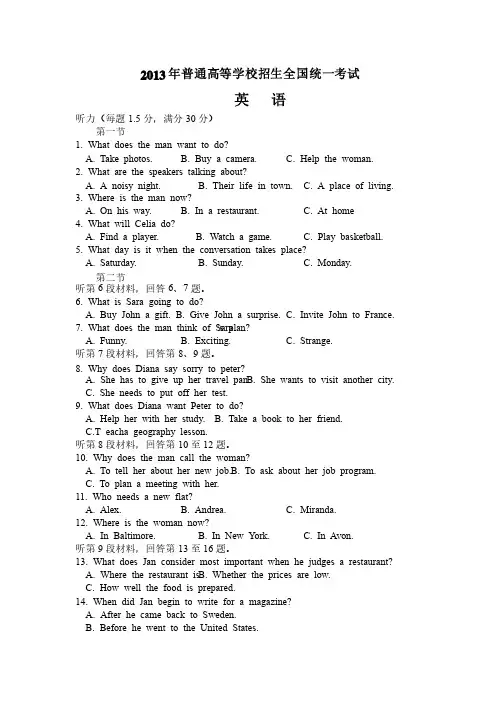
2013年普通高等学校招生全国统一考试英语分)听力(每题1.5分,满分30分)第一节第一节1. What does the man want to do? A. Take photos. B. Buy a camera. C. Help the woman. 2. What are the speakers talking about? B. Their life in town. C. A place of living. C. A place of living. A. A noisy night. B. Their life in town. 3. Where is the man now? A. On his way. B. In a restaurant. C. At home 4. What will Celia do? A. Find a player. B. Watch a game. C. Play basketball. 5. What day is it when the conversation takes place? A. Saturday. B. Sunday. C. Monday. 第二节第二节题。
听第6段材料,回答6、7题。
6. What is Sara going to do? A. Buy John a gift. B. Give John a surprise. C. Invite John to France. ’s plan? 7. What does the man think of SaraA. Funny. B. Exciting. C. Strange. 题。
听第7段材料,回答第8、9题。
8. Why does Diana say sorry to peter? A. She has to give up her travel pan. B. She wants to visit another city. C. She needs to put off her test. 9. What does Diana want Peter to do? A. Help her with her study. B. Take a book to her friend. C.T eacha geography lesson. 听第8段材料,回答第10至12题。
2023年普通高等学校招生全国统一考试英语学科(新课标Ⅰ卷)含答案
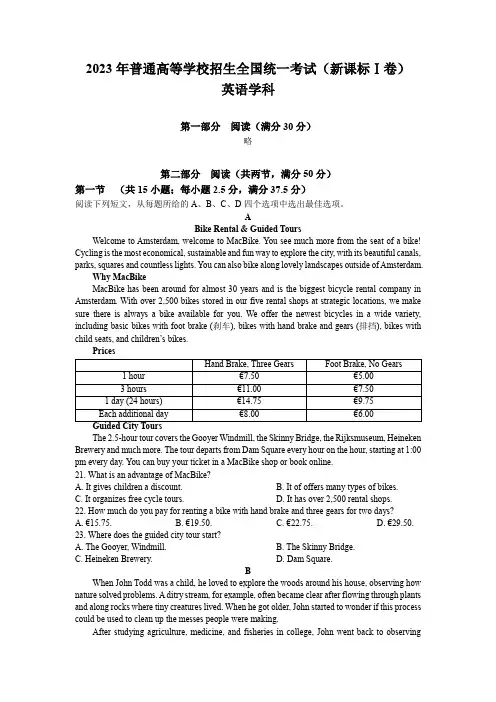
2023年普通高等学校招生全国统一考试(新课标Ⅰ卷)英语学科第一部分阅读(满分30分)略第二部分阅读(共两节,满分50分)第一节(共15小题;每小题2.5分,满分37.5分)阅读下列短文,从每题所给的A、B、C、D四个选项中选出最佳选项。
ABike Rental & Guided ToursWelcome to Amsterdam, welcome to MacBike. You see much more from the seat of a bike! Cycling is the most economical, sustainable and fun way to explore the city, with its beautiful canals, parks, squares and countless lights. You can also bike along lovely landscapes outside of Amsterdam.Why MacBikeMacBike has been around for almost 30 years and is the biggest bicycle rental company in Amsterdam. With over 2,500 bikes stored in our five rental shops at strategic locations, we make sure there is always a bike available for you. We offer the newest bicycles in a wide variety, including basic bikes with foot brake (刹车), bikes with hand brake and gears (排挡), bikes with child seats, and children’s bikes.Hand Brake, Three Gears Foot Brake, No Gears1 hour€7.50€5.003 hours€11.00€7.501 day (24 hours)€14.75€9.75Each additional day€8.00€6.00The 2.5-hour tour covers the Gooyer Windmill, the Skinny Bridge, the Rijksmuseum, Heineken Brewery and much more. The tour departs from Dam Square every hour on the hour, starting at 1:00 pm every day. You can buy your ticket in a MacBike shop or book online.21. What is an advantage of MacBike?A. It gives children a discount.B. It of offers many types of bikes.C. It organizes free cycle tours.D. It has over 2,500 rental shops.22. How much do you pay for renting a bike with hand brake and three gears for two days?A. €15.75.B. €19.50.C. €22.75.D. €29.50.23. Where does the guided city tour start?A. The Gooyer, Windmill.B. The Skinny Bridge.C. Heineken Brewery.D. Dam Square.BWhen John Todd was a child, he loved to explore the woods around his house, observing how nature solved problems. A ditry stream, for example, often became clear after flowing through plants and along rocks where tiny creatures lived. When he got older, John started to wonder if this process could be used to clean up the messes people were making.After studying agriculture, medicine, and fisheries in college, John went back to observingnature and asking questions. Why can certain plants trap harmful bacteria (细菌)? Which kinds of fish can eat cancer-causing chemicals? With the right combination of animals and plants, he figured, maybe he could clean up waste the way nature did. He decided to build what he would later call an eco-machine.The task John set for himself was to remove harmful substances from some sludge (污泥). First, he constructed a series of clear fiberglass tanks connected to each other. Then he went around to local ponds and streams and brought back some plants and animals. He placed them in the tanks and waited. Little by little, these different kinds of life got used to one another and formed their own ecosystem. After a few weeks, John added the sludge.He was amazed at the results. The plants and animals in the eco-machine took the sludge as food and began to eat it! Within weeks, it had all been digested, and all that was left was pure water.Over the years, John has taken on many big jobs. He developed a greenhouse-like facility that treated sewage (污水) from 1,600 homes in South Burlington. He also designed an eco-machine to clean canal water in Fuzhou, a city in southeast China.“Ecological design” is the name John gives to what he does. “Life on Earth is kind of a box of spare parts for the inventor,” he says. “You put organisms in new relationships and observe what’s happening. Then you let these new systems develop their own ways to self-repair.”24. What can we learn about John from the first two paragraphs?A. He was fond of traveling.B. He enjoyed being alone.C. He had an inquiring mind.D. He longed to be a doctor.25. Why did John put the sludge into the tanks?A. To feed the animals.B. To build an ecosystem.C. To protect the plants.D. To test the eco-machine.26. What is the author’s purpose in mentioning Fuzhou?A. To review John’s research plans.B. To show an application of John’s idea.C. To compare John’s different jobs.D. To erase doubts about John’s invention.27. What is the basis for John’s work?A. Nature can repair itself.B. Organisms need water to survive.C. Life on Earth is diverse.D. Most tiny creatures live in groups.CThe goal of this book is to make the case for digital minimalism, including a detailed exploration of what it asks and why it works, and then to teach you how to adopt this philosophy if you decide it’s right for you.To do so, I divided the book into two parts. In part one, I describe the philosophical foundations of digital minimalism, starting with an examination of the forces that are making so many people’s digital lives increasingly intolerable, before moving on to a detailed discussion of the digital minimalism philosophy.Part one concludes by introducing my suggested method for adopting this philosophy: the digital declutter. This process requires you to step away from optional online activities for thirty days. At the end of the thirty days, you will then add back a small number of carefully chosen online activities that you believe will provide massive benefits to the things you value.In the final chapter of part one, I’ll guide you through carrying out your own digital declutter. In doing so, I’ll draw on an experiment I ran in 2018 in which over 1,600 people agreed to perform a digital declutter. You’ll hear these participants’ stories and learn what strategies worked well for them, and what traps they encountered that you should avoid.The second part of this book takes a closer look at some ideas that will help you cultivate (培养) a sustainable digital minimalism lifestyle. In these chapters, I examine issues such as theimportance of solitude (独处) and the necessity of cultivating high-quality leisure to replace the time most now spend on mindless device use. Each chapter concludes with a collection of practices, which are designed to help you act on the big ideas of the chapter. You can view these practices as a toolbox meant to aid your efforts to build a minimalist lifestyle that words for your particular circumstances.28. What is the book aimed at?A. Teaching critical thinking skills.B. Advocating a simple digital lifestyle.C. Solving philosophical problems.D. Promoting the use of a digital device.29. What does the underlined word “declutter” in paragraph 3 mean?A. Clear-up.B. Add-on.C. Check-in.D. Take-over.30. What is presented in the final chapter of part one?A. Theoretical models.B. Statistical methods.C. Practical examples.D. Historical analyses.31. What does the author suggest readers do with the practices offered in part two?A. Use them as needed.B. Recommend them to friends.C. Evaluate their effects.D. Identify the ideas behind them.DOn March 7, 1907, the English statistician Francis Galton published a paper which illustrated what has come to be known as the “wisdom of crowds” effect. The experiment of estimation he conducted showed that in some cases, the average of a large number of independent estimates could be quite accurate.This effect capitalizes on the fact that when people make errors, those errors aren’t always the same. Some people will tend to overestimate, and some to underestimate. When enough of these errors are averaged together, they cancel each other out, resulting in a more accurate estimate. If people are similar and tend to make the same errors, then their errors won’t cancel each other out. In more technical terms, the wisdom of crowds requires that people’s estimates be independent. If for whaterer reasons, people’s errors become correlated or dependent, the accuracy of the estimate will go down.But a new study led by Joaquin Navajas offered an interesting twist (转折) on this classic phenomenon. The key finding of the study was that when crowds were further divided into smaller groups that were allowed to have a discussion, the averages from these groups were more accurate than those from an equal number of independent individuals. For instance, the average obtained from the estimates of four discussion groups of five was significantly more accurate than the average obtained from 20 independent individuals.In a follow-up study with 100 university students, the researchers tried to get a better sense of what the group members actually did in their discussion. Did they tend to go with those most confident about their estimates? Did they follow those least willing to change their minds? This happened some of the time, but it wasn’t the dominant response. Most frequently, the groups reported that they “shared arguments and reasoned together.” Somehow, these arguments and reasoning resulted in a global reduction in error. Although the studies led by Navajas have limitations and many questions remain the potential implications for group discussion and decision-making are enormous.32. What is paragraph 2 of the text mainly about?A. The methods of estimation.B. The underlying logic of the effect.C. The causes of people’s errors.D. The design of Galton’s experiment.33. Navajas’ study found that the average accuracy could increase even if ________.A. the crowds were relatively smallB. there were occasional underestimatesC. individuals did not communicateD. estimates were not fully independent34. What did the follow-up study focus on?A. The size of the groups.B. The dominant members.C. The discussion process.D. The individual estimates.35. What is the author’s attitude toward Navajas’ studies?A. Unclear.B. Dismissive.C. Doubtful.D. Approving.第二节(共5小题;每小题2.5分,满分12.5分)阅读下面短文,从短文后的选项中选出可以填入空白处的最佳选项。
2013年普通高等学校招生全国统一考试英语全国卷1(正文)
2013年普通高等学校招生全国统一考试(课标全国卷Ⅰ)英语第Ⅰ卷第一部分听力(共两节,满分30分)(略)第二部分英语知识运用(共两节,满分45分)第一节单项填空(共15小题;每小题1分,满分15分)从A、B、C、D四个选项中,选出可以填入空白处的最佳选项。
例:We last night,but we went to the concert instead.A.must have studiedB.might studyC.should have studiedD.would study答案是C。
21.—Why,this is nothing but common vegetable soup!—,madam.It s our soup of the day.A.Let me seeB.So it isC.Don t mention itD.Neither do I22.They might just have a place on the writing course—why don t you give it a try?A.leaveB.leftC.leavingD.to leave23.Try not to cough more than you can since it may cause problems to your lungs.A.checkB.allowC.stopD.help24.If we now to protect the environment,we ll live to regret it.A.hadn t actedB.haven t actedC.don t actD.won t act25.Tony can hardly boil an egg,still cook dinner.A.lessB.littleC.muchD.more26.Police have found appears to be the lost ancient statue.A.whichB.whereC.howD.what27.When I first met Bryan I didn t like him,but I my mind.A.have changedB.changeC.had changedD.would change28.The driver wanted to park his car near the roadside but was asked by the police.A.not to doB.not toC.not doD.do not29.The door open,no matter how hard she pushed.A.shouldn tB.couldn tC.wouldn tD.mightn t30.At the last moment,Tom decided to a new character to make the story seem more likely.A.put upB.put inC.put onD.put off31.India attained independence in 1947,after long struggle.A.不填;aB.the;aC.an;不填D.an;the32.There s no way of knowing why one man makes an important discovery another man,also intelligent,fails.A.sinceB.ifC.asD.while33.“You can t judge a book by its cover,”.A.as the saying goes oldB.goes as the old sayingC.as the old saying goesD.goes as old the saying34.It was a real race time to get the project done.Luckily,we made it.A.overB.byC.forD.against35.The sunlight is white and blinding,hard-edged shadows on the ground.A.throwingB.being thrownC.to throwD.to be thrown第二节完形填空(共20小题;每小题1.5分,满分30分)阅读下面短文,从短文后各题所给的四个选项(A、B、C和D)中,选出可以填入空白处的最佳选项。
【Word解析版】2013年普通高等学校招生全国统一考试英语(新课标II卷)1
2013年普通高等学校招生全国统一考试【新课标II卷】1. --I'm sorry I made a mistake!-- ______ . Nobody is perfect.A. Take your timeB. You're rightC. Whatever you sayD. Take it easy1. D。
本题考查情景交际。
乙方是犯了错道歉,从空处后面的“人无完人”来看,另一方是在安慰他/她,所以应该用take it easy,意思是“别紧张”,“放轻松”。
其他三个选项的意思分别是:“不着急,慢慢来”,“你是对的”,“无论你说什么”,均与句意不符,排除。
【句意】—对比起,我搞错了。
—别紧张,人无完人。
2. Would you like to ______ with us to the film tonight?A. come alongB. come offC. come acrossD. come through2. A。
本题考查动词短语。
come along 的意思是“一起,一道”,符合句意,为正确答案;其他三个选项的意思分别是“离开,实现”,“偶然碰到;被理解”,“经历,安然度过”,均与句意不符,排除。
【句意】今晚想跟我们一起去看电影吗?3. I was glad to meet Jenny again, ______ I didn't want to spend all day with her.A. butB. andC.soD. or3. A。
本题考查并列句的连词。
解题关键是弄清前后句子之间的逻辑关系。
前面说见面高兴,后面却说不想整天跟她呆在一起,明显是转折关系,要用连词but。
【句意】我很高兴再次见到詹尼,但是,我不想一整天都跟她一起度过。
4. When I arrived, Bryan took me to see the house ______ I would be staying.A. whatB. whenC. whereD. which4. C。
【Word解析版】2013年普通高等学校招生全国统一考试英语(四川卷)1
2013年普通高等学校招生全国统一考试【四川卷】第Ⅰ卷(选择题共90分)注意事项:1.必须使用2B铅笔在答题卡上将所选答案对应的标号涂黑.2. 第Ⅰ卷共两部分,共计90分。
第一部分英语知识运用(共两节,共40分)第一节单项选择(共10小题;每小题1分,共10分)从A、B、C、D四个选项中,选出可以填入空白处的最佳选项,并在答题卡上将该项涂黑。
1.—I feel so nervous about the National English Speech Competition tomorrow.—________.A. I really envy you.B. Glad to hear thatC. Sounds greatD. Take it easy1. D。
本题考查情景交际。
按照英语表达礼貌习惯,对方说紧张,就应该对他进行安慰,take it easy的意思是“放松,别紧张”,为正确答案;其它三个选项的意思分别是“我真羡慕你”,“听到你这样我很高兴”,“听着不错”,均与句意不符,排除。
【句意】我对明天的全国英语演讲比赛感觉很紧张。
2. The traffic on the main streets has a longer green signal than ________ on the small ones.A. oneB. thisC. thatD. it2. C。
本题考查代词。
空处指代的是前面的the traffic,这是个抽象不可数名词,而且是特指,故应该用that;one不是特指,排除选项A; this不能用于此种情况,排除选项B;it 是指代前面提到的同一个东西,而此处并不是同一个,而是另外街道上的交通情况,排除选项D。
【句意】主大街上的绿色交通信号灯比次要的小街道上的时间长。
3. Hurry up, kids! The school bus ________ for us!A. waitsB. was waitingC. waitedD. is waiting3. D。
【Word解析版】2013年普通高等学校招生全国统一考试英语(陕西卷)1
2013年普通高等学校招生全国统一考试【陕西卷】第一部分英语知识运用(共四节,满分55分)第一节语音知识(共5小题;每小题1分,满分5分)从每小题的A,B,C,D四个选项中,找出其划线部分与所给单词的划线部分读音相同的选项,并在答题卡上将该选项涂黑。
ughA. daughterB. neighbourC. enoughD. though2.citizenA. uncleB. oceanC. rescueD. percentpleteA. sceneB. electC. studentD. respect4.alarmA. rewardB. dollarC. towardsD. farmer5.dailyA. bargainB. saidC. curtainD. explain第二节情景对话(共5小题;每小题1分,满分5分)根据对话情景和内容,从对话后所给的选项中选出能填入每一空白处的最佳选项,并在答题卡上将该选项涂黑。
选项中有两个为多余选项。
Lucy: Hi, Kate. What are you doing tonight?Kate: 6 Any suggestions?Lucy: 7 I’m planning it for days.Kate: A 3D film? What stars?Lucy: Suraj Sharma, a handsome young actor.Kate: Oh! 8Lucy: An Indian boy’s unusual experience with a tiger at sea.Kate: 9 What time is it on?Lucy: Half past six. 10Kate: Sure. When and where shall we meet?Lucy: Let’s meet around six at the gate of Oscar Cinema.Kate: Great. See you then.A. Not decided yet.B. What is it about?C. Wow, sounds cool.D. Could you pick me up?E. Do you want to join me?F. What about going to a concert?G. How about seeing the 3D film Life of Pi e?答案:1-10 CDADD AGBCE第三节:语法和词汇知识(共15小题;每小题1分,满分15分)从每小题的A,B,C,D四个选项中,选出可以填入空白处的最佳选项,并在答题卡上将该选项涂黑。