
2020年春七年级英语下册Module11BodylanguageUnit3Languageinuse课件(新版)外研版
A. Remember
B. To remember
C. Remembering
【理·模块话题】
【记·写作佳句】 【教材句】 1. That’s because people do different things in different countries. 那是因为不同国家的人们做法不 同。
提示: 1. 初次见面要鞠躬问好; 互换信息卡, 仔细看后 再收起来; 2. 排队坐地铁; 乘坐地铁时不要大声交谈; 3. 访问朋友时要带礼物; 要准时赴约。
要求: 1. 电子邮件内容除包括以上提示要点外, 还可适 当发挥; 2. 80词左右。
【审题谋篇】
体裁 时态 人称
要点
记叙文
主要使用一般现在时态
(2)这里有一些方法来帮助你。 _H_e_r_e_a_r_e__so_m__e__w_a_y_s_t_o_h__el_p__y_o_u_. _
2. 具体介绍韩国的礼仪文化 (1)第一次_fo_r__th__e_f_ir_s_t_t_im__e_ (2)乘地铁 _t_a_k_e_a__su_b__w_a_y_ (3)站成一排_s_ta_n_d__i_n_l_in_e_ (4)按时_o_n_t_i_m_e_
②Be 开头: Be+名词/形容词+其他 *Be a good boy! 要做一个好孩子! *Be quick. 快点。 ③否定句: 在句首加Don’t。 *Don’t take photos here. 不要在这儿拍照。 *Don’t be rude. 别无礼。
【语法强化·练】 单项选择 ( B )1. (2019·桂林中考)_____ more books, and you will improve your reading skills. 导学号 A. Reading B. Read C. Reads
【连句成篇】 Dear Li Ming,
I’m glad to hear that you will go to Republic of Korea next week. Here are some ways to help you. Bow to him or her when you meet someone for the first time. After changing information cards with others , read the
because they are nice, but because you are.
A. Treat
B. Treating
C. Treated
D. To treat
( A )6. (2018·湘潭中考) _____to turn off all the
lights when you go out.
【知识详解·记】 1. 定义: 用于表达命令、请求、劝告、警告、禁止等的 句子叫作祈使句。
2. 结构。 ①肯定句: 以动词原形开头。(祈使句因主语是第二人 称, 所以通常都省略。)有时为了表示请求或客气, 可在 句首或句尾加上please。 *Go and bring your biscuits. 去把你的饼干拿来。 *Look at the blackboard, please. 请看黑板。
I hope you will have a good time there. Yours truly, Li Xue
【练·话题写作】 迈克(Mike)、露西(Lucy)和托尼(Tony)是你的三
个新朋友, 他们来自不同的国家, 各有一些习惯性的肢 体语言。请你根据下面的表格提示写一篇英语短文, 介绍他们见面和告别时常用的肢体语言。内容可以适 当发挥, 不少于60词。
Module 11 Body language Unit 3
祈使句 【新知导引·悟】
仔细阅读下列教材原句, 体会句中加下划线内容 的变化及含义。 1. _D_o_n__’t_s_t_a_n_d_(not stand)too close to North Americans!
2. G__i_v_e(give)them more personal space. 3. _R_e_m__e_m_b_e_r_(remember)to give someone from North America lots of personal space. 4. _W_a_v_e_(wave)to say goodbye. 5. _B_e_(be)careful.
cards carefully and then put them into the pocket. It’s a way of being polite and showing respect in Republic of Korea. When you take a subway, stand in line before getting on the subway, and don’t speak loudly in the subway. If you want to visit somebody, remember to take a present and be on time.
(5)与某人握手_sh__a_k_e_h_a_n_d_s__w_i_th__s_b_. (6)挥手告别_w_a_v_e__to__s_a_y_g_o_o_d_b_y_e_ (7)互相; 彼此_ea_c_h__o_t_h_e_r
3. 结局点明作者希望 我期待着收到你的来信。 _I_’m__l_o_o_k_i_n_g_f_o_r_w_a_r_d__to__h_e_a_r_in_g__f_ro_m___y_o_u_. _
_____ahead , and you will see a lot more beautiful sceneries(风景).
A. Plan
B. To plan
C. Planning
D. Plans
( A )5. (2018·河南中考) _____everyone with
politeness even those who are very rude to you, not
3. In India, people put their hands together and nod their heads when they meet. 在印度, 人们见面时通常把手合在一起并且点头。
【鉴·典题考题】 假如你是李雪, 你的朋友李明下周要到韩国去。
请你根据下面的提示给李明写一封电子邮件, 介绍一 下韩国的礼仪文化。
主要使用第二人称
①开门见山, 点明主题 ②具体介绍韩国的礼仪文化 ③结局点明作者希望
【遣词造句】 1. 开门见山, 点明主题 (1)听说你下周去韩国我很高兴。 _I’_m__g_l_a_d_t_o__h_e_a_r_t_h_a_t _y_o_u_w__il_l_g_o__to__R_e_p_u_b_l_i_c _o_f_K__o_re_a_ _n_e_x_t_w__ee_k_.__
computer games this evening?
—_____ your homework first, and then we’ll talk
about it.
A. nishing
B. Finish
C. To finish
D. Finished
( A )4. (2018·黔南州中考)Life is like a journey.
( A )2. (2019·呼和浩特中考)_____ me an email
before you come to Hohhot, and I’ll meet you at the
train station. 导学号
A. Send
B. Sending
C. To send
D. Sent
( B )3. (2018 ·凉山中考)—Mom, can I play
2. In the US some people shake hands, and some kiss or hug each other. 在美国, 有一些人握手, 还有一些人亲吻或者互相拥抱。
【拓展句】 1. People in different countries greet each other in different ways. 在不同的国家, 人们互相问候的方式不同。 2. In Japan, people usually bow to greet each other. 在日本, 人们的问候方式是互相鞠躬。
202X春外研版七下Module11《Body language》(Unit3)ppt课件

Go and wash your hands. 快去洗手。 (命令)
Be quiet, please.
请安静。
(请求)
Be kind to our sister.
要对我们的妹妹友善。 PPT模板:/moban/ PPT背景:/beijing/ PPT下载:/xiazai/ 资料下载:/ziliao/ 试卷下载:/shiti/ PPT论坛: 语文课件:/kejian/yuwen/ 英语课件:/kejian/yingyu/ 科学课件:/kejian/kexue/ 化学课件:/kejian/huaxue/
• Touch people. Britain • Ask a woman’s age.
• Stand too close. • Say anything too personal.
2 Make a list of do’s and don’ts to help visitors to Britain.
•
15、一年之计,莫如树谷;十年之计 ,莫如 树木; 终身之 计,莫 如树人 。2021年4月上 午10时 26分21.4.2710:26Apri l 27, 2021
•
16、提出一个问题往往比解决一个更 重要。 因为解 决问题 也许仅 是一个 数学上 或实验 上的技 能而已 ,而提 出新的 问题, 却需要 有创造 性的想 像力, 而且标 志着科 学的真 正进步 。2021年4月27日星期 二10时 26分1秒10:26:0127 April 2021
•
10、阅读一切好书如同和过去最杰出 的人谈 话。10:26:0110:26:0110:264/27/2021 10:26:01 AM
•
11、一个好的教师,是一个懂得心理 学和教 育学的 人。21.4.2710:26:0110:26Apr -2127- Apr-21
Module11Unit3讲义(学生版)
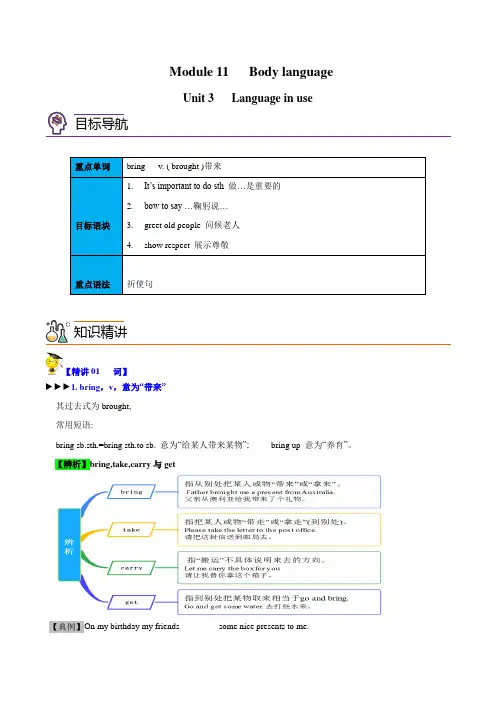
Module 11 Body languageUnit 3 Language in use重点单词bring v. ( brought )带来目标语块 1. It’s important to do sth 做…是重要的 2. bow to say …鞠躬说… 3. greet old people 问候老人4. show respect 展示尊敬重点语法祈使句 【精讲01 词】►►►1. bring ,v ,意为“带来”其过去式为brought,常用短语:bring sb.sth.=bring sth.to sb. 意为“给某人带来某物”; bring up 意为“养育”。
【辨析】bring,take,carry 与get【典例】On my birthday my friends ________ some nice presents to me.知识精讲目标导航A.buy B.bring C.take D.make【精讲02 短语】►►►1.all right意为“好;行;可以”。
【辨析】right,all right和That’s all right.【典例】— Get dressed quickly, Mandy!— ________.A.Here are your clothes B.That sounds good C.All right, mom D.That’s all right【精讲03 语法】祈使句►►►1.【概念引入】祈使句用来表达叮嘱、劝告、希望、禁止、警告、请求、建议或命令等。
祈使句最常用来表达命令。
如:Go and wash your hands. 快去洗手。
(命令)Be quiet, please. 请安静。
(请求)Be kind to our sister. 要对我们的妹妹友善。
(劝告)Watch your steps. 走路小心。
(警告)No littering. 不要乱扔垃圾。
七年级英语下册 Module 11 Body language Unit 3 Language i
天津市宝坻区新安镇七年级英语下册Module 11 Body language Unit 3 Language in use学案(无答案)(新版)外研版编辑整理:尊敬的读者朋友们:这里是精品文档编辑中心,本文档内容是由我和我的同事精心编辑整理后发布的,发布之前我们对文中内容进行仔细校对,但是难免会有疏漏的地方,但是任然希望(天津市宝坻区新安镇七年级英语下册Module 11 Body language Unit 3 Language in use学案(无答案)(新版)外研版)的内容能够给您的工作和学习带来便利。
同时也真诚的希望收到您的建议和反馈,这将是我们进步的源泉,前进的动力。
本文可编辑可修改,如果觉得对您有帮助请收藏以便随时查阅,最后祝您生活愉快业绩进步,以下为天津市宝坻区新安镇七年级英语下册Module 11 Body language Unit 3 Language in use 学案(无答案)(新版)外研版的全部内容。
Module11 Unit3学习目标:能够了解祈使句的各种构成,能在实际中正确操练。
能正确使用祈使句.教学重点:学生能够了解祈使句的各种构成,能在实际中正确操练。
教学难点:学生能正确使用祈使句。
一、自主学习1。
祈使句的定义及句式特征:定义:祈使句是用来表示请求、命令、叮嘱、邀请、劝告或祝愿等的句子. 它的特点是通常省略主语 you,以动词原形开头,末尾可用句号或感叹号。
祈使句没有疑问句的形式,一般只有肯定和否定两种形式。
Go and wash your hands. (表命令) Be quite, please. (Please be quiet。
)(表请求) Be kind to your sister.(表劝告) Watch your steps.(表警告) No parking。
(表禁止) 2。
肯定形式(动词原形开头) 1)以系动词 be 开头的祈使句,这种祈使句的常用结构: be+形容词 / 名词 Be quiet / quick! Be a good student! Be careful when crossing the street。
春学期七年级英语下册Module11BodylanguageUnit3Languageinuse同步课件(外研版)

例 (2017重庆中考A卷)No one can be right all the time. When people
make mistakes, we shouldn't
them.
A.wait for B.send for
C.knock at ugh at 解析 本题考查短语搭配。结合本题语境可知,没有人能一直是正确 的。当人们犯错的时候,我们不应该“嘲笑”他们,故laugh at符合题 意。
9.to drink remember not to do sth.意为“记得不要做某事”,再根据句 意“记得不要喝太多”可知答案为to drink。 10.rules 上面讲到的是一些“规则”,故所缺的词是rules。
Ⅰ.根据句意和汉语提示写出所缺的单词
1.Look at the boy.He is
素养呈现 本模块的话题和身体语言以及日常交往有关。Unit 1的对 话介绍了初次见面时和表达问候时的一些学问;Unit 2的课文介绍了世 界各地一些独特的身体语言。 我们经常会接触到一些和日常交往有关的题目,这些题目通常是说明 文,以阅读理解、任务型阅读和短文填空的题型居多。让我们看看两者 是怎样相结合的吧。典例剖析 从方框中选出合适的词,并用其正确形式填空。 eat, much, left, polite, start, put, drink, somebody, rule, quiet If you're going to a formal western dinner party for the first time, you'd better know about western table manners.It's 1 to follow them. When you sit down at the table, take your napkin and 2 it on your lap.
2020年春初中英语外研版七年级下册Module11Bodylanguage 课件
要点3 each pron. 各个; 每个 Step 1【难点·探】 (1)each作形容词, 修饰单数名词时, 动词用单数还是复 数? (2)each of them后接动词用什么形式?
Step 2【语境·悟】
* In the US some people shake hands, and some kiss or
Step 3【知识·得】 each/every/either的用法辨析
指两个或两个以上的人或事物中的“每个”。 each作形容词, 修饰单数名词, 后接单数动词。 each 作代词, 单独使用, 后接单数动词; 放在复数 名词和代词后作同位语, 接复数动词。each of them后可接(单数/复数)动词
likes
要点4 That’s because people do different things in
different countries. 那是因为不同国家的人做法不同。(P66) Step 1【难点·探】 (1)你能分析这个句子的句式结构吗? (2)because引导的是一个什么从句?
Step 2 【句型·研】 本句是一个主从复合句, because引导的是一个表语从 句。其句子结构如下图所示:
China.
要点1 Russian n. 俄罗斯人; 俄语 Step 1【难点·探】 (1)Russian作“俄罗斯人”讲时, 它的复数是什么? (2)“俄罗斯”的英语是什么?
Step 2【语境·悟】
*We’re going to have some Russian teachers at school tomorrow, and I’m welcoming the visitors. 明天我们 学校会有一些俄罗斯老师来访, 我要去迎接他们。(P66)
201X年春七年级英语下册Module11BodylanguageUnit3Languageinus
答案 A
精选ppt
2
祈使句的用法和结构 本模块的语法重点是“祈使句”。祈使句是英语的基本句型之一,表达 说话人对对方的叮嘱、劝告、请求或命令等。关于祈使句的用法,是这 样的: ★祈使句,无主语,原形动词作开始。 祈使句中一般没有主语,主语you常常省略。句末用感叹号或句号,肯定 结构都以动词原形打头。例如: Go and ask the teacher.去问问老师。 ★Do,Be,Let三种形式,委婉请求用“请”字。 祈使句的肯定句式有三种形式:
strong points and each of
us
weak points.
A.have;have B.has;have
C.has;has D.have;has
解析 句意:我们每个人都有优点,我们每个人也都有缺点。We each中
each是同位语,它并不影响谓语动词的单复数,由此可知,和We搭配的词
知识点十二 比较级的用法 教材原文 Children and young people bow lower when they greet older people.小孩和年轻人在问候年龄大的人时,会鞠躬鞠得更低。 本句中的lower是比较级,表示“更低”。比较级通常以-er结尾。例如: She is shorter than her sister.她比她姐姐个子低。 拓展 对于多音节和部分双音节的词来说,比较级要借助于more来构 成。 Jenny is more beautiful than Lily. 珍妮比莉莉更漂亮。
词性
each可用作代词和副词,而every只能用作限定词,作定语
Each student in this class gave a different answer.这个班的学生所给
七年级英语下册 Module 11 Body language Unit 3 Language in use教案
Book 2 Module 11 Body language一、教学内容:Unit 3 Language in use二、课型:Revision and application三、教学目标:1、正确使用祈使句,让他人准确理解所表达的意思。
2、能通过身势语了解世界不同地方的风俗习惯。
3、通过阅读关于身势语的文章,提高对英语学习兴趣。
4、能运用所学的知识和通过查找资料,运用恰当的语言向他人介绍中国常用的身势语。
四、教学重难点:1、能用正确的祈使句给出书面指示语和建议。
2、能运用所学的知识和通过查找资料,运用恰当的语言向他人介绍中国常用的身势语。
五、教学准备:图片、录音机等。
六、教学过程:教学步骤教师活动学生活动活动目的StepⅠ: Leading in (5min)1. Greeting.2. Enjoy a song .3. Listen to thetape.(about thewords in Module11.)1. Greeting.2. Listen and singthe song.3.Listen andrepeat.先与学生互相交流,通过简单的对话使学生能更快地融入英语的学习。
同时播放歌曲激发学生的兴趣,活跃课堂气氛,集中注意力,让学生做好课前的准备,进入新课。
StepⅡ: Pre-task (4min)Ask students todiscuss what weshould do and whatwe shouldn’t do inChina.Lo ok at thepictures and try tosay the sentences.充分发挥学生的小组合作学习,让学生在小组的共同学习中熟悉课文将出现的有关祈使句的用法。
S tepⅢ: While-task (20min)1. Let thestudents doActivity 1and 2 insmall groups.Finish Activity1and 2, then writedown thesentences.让学生由中国的本土习俗,扩展到外国的习俗,进一步学习祈使句。
外研版英语七年级下册Module 11 Body Language Unit 3 课件
Talk about do’s and don’ts in Britain.
Stand in line.
√
Shake hands.
√
Don’t Touch people.
x
Say “please” and “thank you”.
√
Don’t Ask a woman’s age.
x
Open doors for others.
How do you express…? I’m full. Come here. Don’t do something.
It’s me. Talk about some secrets. Lose face. (丢脸)
stamp the foot
In china, usually it means _______. In the west, it means _________.
A. impatient B. angry C. happy
(不耐烦的)
In china, in means ________. In the Middle East, it is _______.
A. sorry B. rude C. comfort(安慰)
slap on the back
What does bow mean in Japan?
A. Looks
B. To look
C. Look ing
D. Look
( A)4. ________ be late for school again.
A. Don’t
B. Doesn’t
C. Do
D. Does
(B)5. ________ go and play basketball.
七年级英语下册Module11BodylanguageUnit3Languageinuse教学课件(新版)外研版
North Americans.
1 work in pairs. Talk about do’s and don’ts in a foreign country. Do’s
Britain •Stand in line.
Don’t
•Shake hands. •Say “please” and “thank
all right arm in arm different hold on to three times point at hands with wave close kiss shake
1 How do the British say hello to each other when they
first meet?
2 Does body language mean
the same thing in different
countries?
No, it does't.
3 How do the Russians say
hello to each other when they meet?
you”. •Open doors for others. •Look at people when you talk. •Be on time.
•Touch peopl •Ask a woma •Stand too cl •Say anythin
personal.
2 Make a list of do's and don'ts to help visitors to Britain.
can’t be late
Don’t be late for
2022春外研版七下Module11《Body language》(Unit3)ppt课件
第十八页,编辑于星期三:十一点 四十二分。
2. Does body language mean the same thing in different countries? No, it means different things in different countries.
7. 不打架不骂人。
Don’t fight or say rude words.
8. 有事请假。
Ask for leave. 9. 友好待人。
Be friendly to classmates.
第二十五页,编辑于星期三:十一点 四十二分 。
1. To preview Unit 1, Module 12 2. To practise the vocabulary
3. How do the Russians say hello to
each other when they meet?
They kiss three times.
第十九页,编辑于星期三:十一点 四十二分。
4. Is it polite to stand close to North Americans? No, it is not polite to stand close to
第二十六页,编辑于星期三:十一点 四十二分 。
Write ten short imperatives.
You can use do’s and don’ts.
第二十七页,编辑于星期三:十一点 四十二分 。
课文中的这些句子叫作
。
祈使句用来表达叮嘱、劝告、希望、禁 止、警告、请求或命令等。祈使句最常 用来表达命令。
Go and wash your hands.