
(完整版)英语时态(初中英语动词时态归纳总结对照表)(可编辑修改word版)
初中英语动词时态归纳总结对照表初中英语时态专项练习1、一般现在时。
通常用“usually, often, every day, sometimes”。
一般现在时基本用法介绍一、一般现在时的功能1.表示事物或人物的特征、状态。
如:The sky is blue.天空是蓝色的。
2.表示经常性或习惯性的动作。
如:I get up at six every day.我每天六点起床。
3.表示客观现实。
如:The earth goes around the sun.地球绕着太阳转。
二、一般现在时的构成: 肯定句:1).主语+系动词be(is, am, are )+名词(形容词,介词短语)2) .其他主语+动词原形+其它第三人称单数+动词-s+其它如:I am a boy.我是一个男孩。
We study English.我们学习英语。
Mary likes Chinese.玛丽喜欢汉语。
三、一般现在时的变化否定句:1)主语+ be (is,am,are)+ not +其它。
如:He is not a worker.他不是工人。
2)其他主语+do not(don’t)动词原形+其它I don't like bread 第三人称单数+does not(doesn’t) 动词原形+其它He doesn't often play. 一般疑问句:1)Be(Is,Are)+主语+其它?如:- Are you a student? -Yes. I am. / No, I'm not. 2)Do 其他主语+动词原形+其它?Does+第三人称单数+ 动词原形+ 其它+?注意:遇I/we—you, my—your, some—any. Does she go to work by bike? -Yes, she does. / No, she doesn't. Do you often play football?- Yes, I do. / No, I don't. 特殊疑问句:疑问词+一般疑问句。
如:Where is my bike? How does your father go to work? 一般现在时用法专练:一、用括号内动词的适当形式填空。
1. He often (have) dinner at home.2. Daniel and Tommy (be) in Class One.3.We (not watch) TV on Monday. 4. Nick (not go) to the zoo on Sunday. 5._ they (like) the World Cup?二、按照要求改写句子1.Daniel watches TV every evening.(改为否定句)2.I do my homework every day.(改为一般疑问句,作否定回答)3.She likes milk.(改为一般疑问句,作肯定回答)7.I like taking photos in the park.(对划线部分提问)8.John comes from Canada.(对划线部分提问)三、改错( 划出错误的地方,将正确的写在横线上) 1. Is your brother speak English? 2. Does he likes going fishing?3. He likes play games after class.4. Mr. Wu teachs us En glish.5. She don’t do her homework on Sundays. 2、现在进行时。
通常用“now/look/listen”.1.现在进行时表示现在正在进行或发生的动作,也可表示当前一段时间内的活动或现阶段正在进行的动作。
2.现在进行时的结构:.肯定句:主语+be(is,am,are )+动词现在分词- ing eg: I am(not) doing my homework. You/We/They are(not) reading. He/She/It is(not) eating.否定句:主语+be(is,am,are )+not + 动词现在分词-ing 一般疑问句:Is(Are)+主语+动词现在分词-ing?特殊疑问:疑问词+ be + 主语+ 动词ing? 3.动词加ing 的变化规则1)一般情况下,直接加ing,如:cook-cooking2)以不发音的e 结尾,去e 加ing,如:make-making, taste-tasting3)如果末尾是一个元音字母和一个辅音字母,双写末尾的辅音字母,再加ing,如:run- running, stop-stopping,swim—swimming 4. 现在进行时专项练习:一、写出下列动词的现在分词:play run swim make go like wr ite _ski read have sing dance pu t see buy love live 二、用所给的动词的正确形式填空:1.The boy ( draw)a picture now.2. Listen .Some girls( sing)in the classroom . 3. My mother( cook )some nice food now. 4. What _you ( do ) now?5. Look . They ( have) an English lesson . 10. Helen (wash )clothes? Yes ,she is . 三、句型转换:1.They are doing housework .(分别改成一般疑问句和否定句)2.The students are cleaning the classroom . ( 改一般疑问句并作肯定和否定回答)3.I’m playing the football in the playground .(对划线部分进行提问)①②3、一般过去时态一般过去时通常用“a moment ago, just now, yesterday, last…”等。
1.一般过去时表示过去某个时间发生的动作或存在的状态,常和表示过去的时间状语连用。
一般过去时也表示过去经常或反复发生的动作感谢。
2.Be 动词在一般过去时中的变化:⑴am 和is 在一般过去时中变为was。
(was not=wasn’t)⑵are 在一般过去时中变为were。
(were not=weren’t)⑶带有was 或were 的句子,其否定、疑问的变化和is, am, are 一样,即否定句在was 或were 后加not,一般疑问句把was 或were 调到句首。
3.行为动词的一般过去时变化5.特殊疑问句:⑴疑问词+did+主语+动词原形?如:What did Jim do yesterday?⑵疑问词当主语时:疑问词+动词过去式?如:Who went to home yesterday? 过去时练习: 写出下列动词的过去式is\am fly plant are drink play go make does dance worry ask tasteeat draw put throw kick pass do Be 动词的过去时练习:A 一、用be 动词的适当形式填空1. I at school just now. 2. He at the camp last week. 3. We students two years ago. 4. They on the farm a moment ago. 5. Yang Ling eleven years old last year. 二、句型转换1. It was exciting.否定句:一般疑问句:肯、否定回答:2. All the students were very excited.否定句:一般疑问句:肯、否定回答:行为动词的过去时练习:B 一、用行为动词的适当形式填空1. He (live) in Wuxi two years ago.2. The cat (eat) a bird last night.3. We(have) a party last Halloween.4. Nancy (pick) up oranges on the farm last week.5. I (make) a model ship w ith Mike yesterday. 二、句型转换1. Su Hai took some photos at the Sports day.否定句:一般疑问句:肯、否定回答:2. We sang some English songs.否定句:一般疑问句:肯、否定回答:三、中译英1.格林先生去年住在中国。
2. 昨天我们参观了农场。
3. 他刚才在找他的手机。
过去时综合练习A一、用动词的适当形式填空1. It (be) Ben’s birthday last Friday.2. We all (have) a good time last night.3. He football now, but they basketball just now. (play)4. Jim’s mother (plant) trees just now.5. they (sweep) the floor on Sunday? No, they . 二、中译英1.我们上周五看了一部电影。
2.他上个中秋节走亲访友了吗?是的。
3.你们上个儿童节做了什么?我们参观了动物园。
4、一般将来时概念:表示将要发生的动作或存在的状态及打算、计划或准备做某事。
句中一般有以下时间状语:tomorrow, next day(week, month, year…),soon, the day after tomorrow(后天)等。
1.基本结构:①主语+be (is,am,are)going to +动词原形. ②主语+will+ 动词原形.2.否定句:①主语+be (is,am,are)+not +going to +动词原形. ②主语+will +not(won’t)+ 动词原形.例如:I’m going to have a picnic this afternoon.→I’m not going to have a picnic this afternoon. 3.一般疑问句:①Is(Are)+主语+going to +动词原形.+? ②Will+主语+动词原形+?例:We are going to go on an outing this weekend.→Are you going to go on an outing this weekend? Yes,we are. No, we aren’t. Will he go to Beijing next week? Yes,he will. No,he won’t.4.对划线部分提问。
(完整版)英语动词时态归纳总结对照表
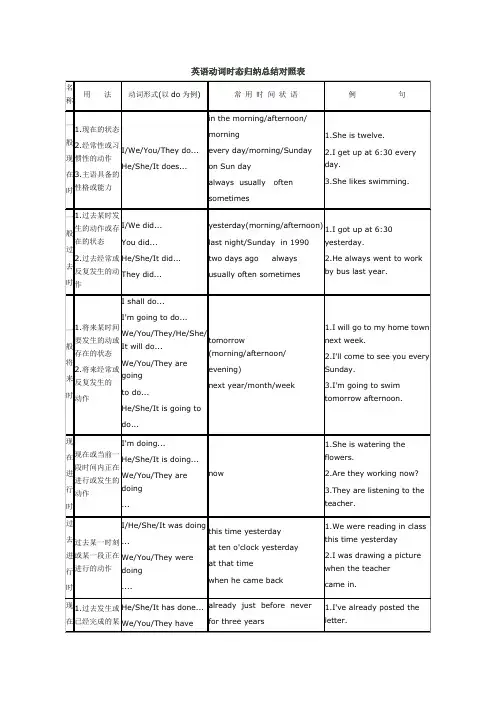
英语动词时态归纳总结对照表英语时态专项练习1、一般现在时。
通常用“usually, often, every day, sometimes”。
一般现在时基本用法介绍一、一般现在时的功能1.表示事物或人物的特征、状态。
如:The sky is blue.天空是蓝色的。
2.表示经常性或习惯性的动作。
如:I get up at six every day.我每天六点起床。
3.表示客观现实。
如:The earth goes around the sun.地球绕着太阳转。
二、一般现在时的构成:肯定句:1).主语+系动词 be(is, am, are )+名词(形容词,介词短语)2) .其他主语+动词原形+其它第三人称单数+动词-s+其它如:I am a boy.我是一个男孩。
We study English.我们学习英语。
Mary likes Chinese.玛丽喜欢汉语。
三、一般现在时的变化否定句:1)主语+ be (is,am,are)+ not +其它。
如:He is not a worker.他不是工人。
2)其他主语+do not(don’t)动词原形+其它I don't like bread第三人称单数+does not(doesn’t)动词原形+其它He doesn't often play.一般疑问句:1)Be(Is,Are) +主语+其它?如:-Are you a student? -Yes. I am. / No, I'm not.2)Do其他主语+动词原形+其它?Does+第三人称单数+动词原形+其它+?注意:遇I/we—you, my—your, some—any.Does she go to work by bike? - Yes, she does. / No, she doesn't.Do you often play football?- Yes, I do. / No, I don't.特殊疑问句:疑问词+一般疑问句。
英语时态全归纳表
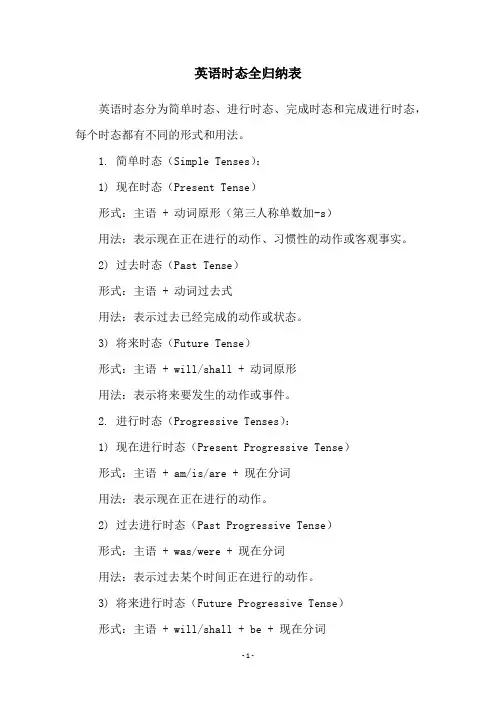
英语时态全归纳表英语时态分为简单时态、进行时态、完成时态和完成进行时态,每个时态都有不同的形式和用法。
1. 简单时态(Simple Tenses):1) 现在时态(Present Tense)形式:主语 + 动词原形(第三人称单数加-s)用法:表示现在正在进行的动作、习惯性的动作或客观事实。
2) 过去时态(Past Tense)形式:主语 + 动词过去式用法:表示过去已经完成的动作或状态。
3) 将来时态(Future Tense)形式:主语 + will/shall + 动词原形用法:表示将来要发生的动作或事件。
2. 进行时态(Progressive Tenses):1) 现在进行时态(Present Progressive Tense)形式:主语 + am/is/are + 现在分词用法:表示现在正在进行的动作。
2) 过去进行时态(Past Progressive Tense)形式:主语 + was/were + 现在分词用法:表示过去某个时间正在进行的动作。
3) 将来进行时态(Future Progressive Tense)形式:主语 + will/shall + be + 现在分词用法:表示将来某个时间正在进行的动作。
3. 完成时态(Perfect Tenses):1) 现在完成时态(Present Perfect Tense)形式:主语 + have/has + 过去分词用法:表示过去已经完成的动作对现在造成的影响。
2) 过去完成时态(Past Perfect Tense)形式:主语 + had + 过去分词用法:表示过去某个时间之前已经完成的动作。
3) 将来完成时态(Future Perfect Tense)形式:主语 + will/shall + have + 过去分词用法:表示将来某个时间之前已经完成的动作。
4. 完成进行时态(Perfect Progressive Tenses):1) 现在完成进行时态(Present Perfect Progressive Tense)形式:主语 + have/has + been + 现在分词用法:表示从过去某个时间一直到现在一直在进行的动作。
(完整版)英语时态(初中英语动词时态归纳总结对照表)(最新整理)

初中英语动词时态归纳总结对照表初中英语时态专项练习1、一般现在时。
通常用“usually, often, every day, sometimes”。
一般现在时基本用法介绍一、一般现在时的功能1.表示事物或人物的特征、状态。
如:The sky is blue.天空是蓝色的。
2.表示经常性或习惯性的动作。
如:I get up at six every day.我每天六点起床。
3.表示客观现实。
如:The earth goes around the sun.地球绕着太阳转。
二、一般现在时的构成: 肯定句:1).主语+系动词 be(is, am, are )+名词(形容词,介词短语)2) .其他主语+动词原形+其它第三人称单数+动词-s+其它如:I am a boy.我是一个男孩。
We study English.我们学习英语。
Mary likes Chinese.玛丽喜欢汉语。
三、一般现在时的变化否定句:1)主语+ be (is,am,are)+ not +其它。
如:He is not a worker.他不是工人。
2)其他主语+do not(don’t)动词原形+其它 I don't like bread 第三人称单数+does not(doesn’t)动词原形+其它He doesn't often play. 一般疑问句:1)Be(Is,Are) +主语+其它?如:-Are you a student? -Yes. I am. / No, I'm not. 2)Do其他主语+动词原形+其它? Does+第三人称单数+动词原形+其它+?注意:遇I/we—you, my—your, some—any. Does she go to work by bike? -Yes, she does. / No, she doesn't. Do you often play football?- Yes, I do. / No, I don't. 特殊疑问句:疑问词+一般疑问句。
(完整版)英语时态总结(完整)
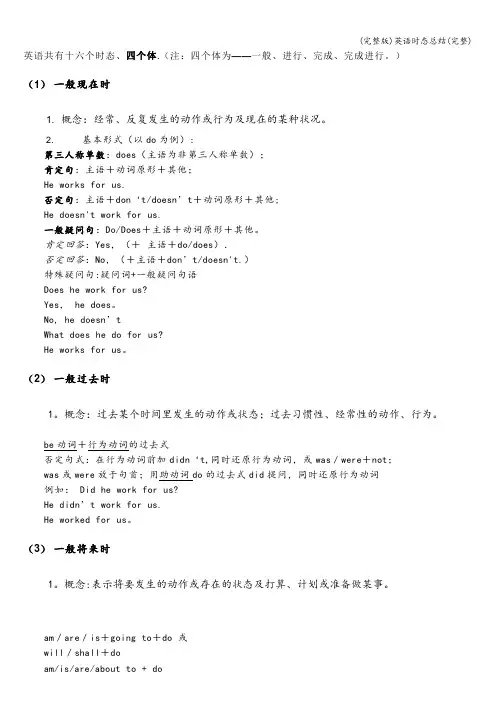
英语共有十六个时态、四个体.(注:四个体为——一般、进行、完成、完成进行。
)(1)一般现在时1. 概念:经常、反复发生的动作或行为及现在的某种状况。
2. 基本形式(以do为例):第三人称单数:does(主语为非第三人称单数);肯定句:主语+动词原形+其他;He works for us.否定句:主语+don‘t/doesn’t+动词原形+其他;He doesn't work for us.一般疑问句:Do/Does+主语+动词原形+其他。
肯定回答:Yes,(+主语+do/does).否定回答:No,(+主语+don’t/doesn't.)特殊疑问句:疑问词+一般疑问句语Does he work for us?Yes, he does。
No, he doesn’tWhat does he do for us?He works for us。
(2)一般过去时1。
概念:过去某个时间里发生的动作或状态;过去习惯性、经常性的动作、行为。
be动词+行为动词的过去式否定句式:在行为动词前加didn‘t,同时还原行为动词,或was/were+not;was或were放于句首;用助动词do的过去式did提问,同时还原行为动词例如: Did he work for us?He didn’t work for us.He worked for us。
(3)一般将来时1。
概念:表示将要发生的动作或存在的状态及打算、计划或准备做某事。
am/are/is+going to+do 或will/shall+doam/is/are/about to + doam/is/are to + do;一般将来时的表达方法be going to +动词原形be +不定式,be to+动词原形,be about to +动词原形be able to +不定式be about to+动词原形will + 动词原形;例如:He is going to work for us。
(完整版)英语十六时态表格完整总结

英语十六时态表格总结(很全面)目录一般现在时、一般过去时 (1)一般将来时、过去将来时 (2)现在进行时、过去进行时 (2)现在完成时、过去完成时 (3)英语时态表—英语时态举例! (4)详细讲解-一般现在时 (6)详细讲解-现在进行时、一般过去时 (7)现在进行时 (7)一般过去时 (7)详细讲解-过去进行时、过去完成时、 (8)过去进行时 (8)过去完成时 (8)详细讲解—过去完成进行时、一般将来时 (9)过去完成进行时 (9)一般将来时 (10)详细讲解—将来进行时 (11)将来进行时 (11)详细讲解-过去将来时、将来完成时 (12)过去将来时 (12)将来完成时 (12)英语共有16种时态!常用的有12个:一般现在时、一般过去时、一般将来时、过去将来时、现在进行时、过去进行时、将来进行时、现在完成时、过去完成时、将来完成时、现在完成进行时和过去完成进行时。
其他时态很少单独使用!下面发部分英语时态表吧!希望能对你们有帮助!一般现在时、一般过去时一般将来时、过去将来时现在进行时、过去进行时现在完成时、过去完成时英语时态表—英语时态举例!现在完成时句子结构:主语+have/has doneI have studied English in several different countries.在一些国家,我已经学习了英语.句子结构:主语+had doneI had studied a little Englishbefore I moved to the U。
S.在我搬去美国之前,我已经学习了一点英语.句子结构:主语+will+have doneI will have studied every tense bythe time I finish this course.在我完成这个课程的时候,我已经能完成英语时态的学习了.句子结构:主语+be going to+havedoneI’m going to have studied everytense by the time I finishthis course。
初中英语动词时态归纳总结对照表
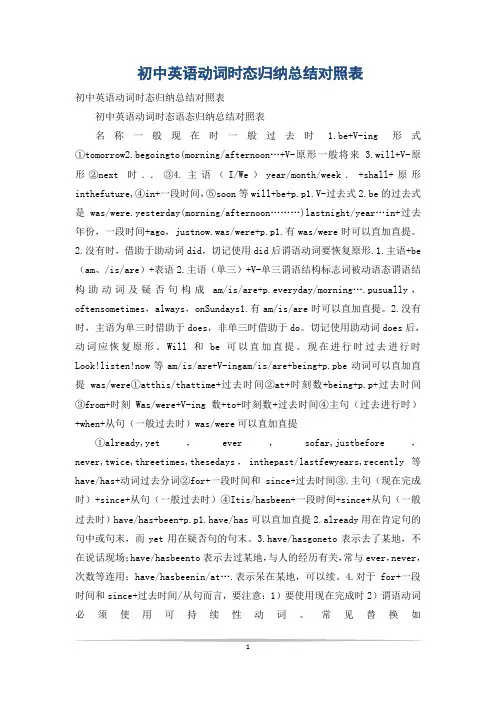
初中英语动词时态归纳总结对照表初中英语动词时态归纳总结对照表初中英语动词时态语态归纳总结对照表名称一般现在时一般过去时 1.be+V-ing形式①tomorrow2.begoingto(morning/afternoon…+V-原形一般将来 3.will+V-原形②next时..③4.主语(I/We)year/month/week.+shall+原形inthefuture,④in+一段时间,⑤soon等will+be+p.p1.V-过去式2.be的过去式是was/were.yeste rday(morning/afternoon………)lastnight/year…in+过去年份,一段时间+ago,justnow.was/were+p.p1.有was/were时可以直加直提。
2.没有时,借助于助动词did,切记使用did后谓语动词要恢复原形.1.主语+be (am、/is/are)+表语2.主语(单三)+V-单三谓语结构标志词被动语态谓语结构助动词及疑否句构成am/is/are+p.everyday/morning….pusually,oftensometimes,always,onSundays1.有am/is/are时可以直加直提。
2.没有时,主语为单三时借助于does,非单三时借助于do。
切记使用助动词does后,动词应恢复原形。
Will和be可以直加直提。
现在进行时过去进行时Look!listen!now等am/is/are+V-ingam/is/are+being+p.pbe动词可以直加直提was/were①atthis/thattime+过去时间②at+时刻数+being+p.p+过去时间③from+时刻Was/were+V-ing数+to+时刻数+过去时间④主句(过去进行时)+when+从句(一般过去时)was/were可以直加直提①already,yet,ever,sofar,justbefore,never,twice,threetimes,thesedays,inthepast/lastfewyears,recently等have/has+动词过去分词②for+一段时间和since+过去时间③.主句(现在完成时)+since+从句(一般过去时)④Itis/hasbeen+一段时间+since+从句(一般过去时)have/has+been+p.p1.have/has可以直加直提2.already用在肯定句的句中或句末,而yet用在疑否句的句末。
(完整word版)初中英语动词时态归纳总结对照表,文档
名用法称一1. 此刻的状态般2. 经常性或习现惯性的动作在3. 主语具备的时性格或能力一 1. 过去某时发生的动作或存般在的状态过2.过去经常或去屡次发生的动时作一 1. 将来某时间要发生的动或般存在的状态将2.将来经常或来屡次发生的时动作初中英语动词时态归纳总结比较表动词形式 ( 以 do为例 )常用时间状语in the morning/afternoon/morningI/We/You/They do...every day/morning/SundayHe/She/It does...on Sunayalways usually oftensometimesI/We did...yesterday(morning/afternoon)You st night/Sunday in 1990He/She/It did...two days ago alwaysThey ually often sometimesI shall do...I'm going to do...We/You/They/He/She/tomorrowIt will do...(morning/afternoon/We/You/They areevening)goingnext year/month/weekto do...He/She/It is going todo...例句1.She is twelve.2.I get up at 6:30 everyday.3.She likes swimming.1.I got up at 6:30yesterday.2.He always went to workby bus last year.1.I will go to my home townnext week.2.I'll come to see youevery Sunday.3.I'm going to swimtomorrow afternoon.现在此刻或当前一段时间内正在进进行或发生的行动作时过去过去某一时辰进或某一段正内前进行的动作时现1. 过去发生或在已经完成的某I'm doing...He/She/It is doing...We/You/Theyare doing...I/He/She/It was doing...We/You/They weredoing....He/She/It has done...We/You/They havenowthis time yesterdayat ten o'clock yesterdayat that timewhen he came backalready just before neverfor three years1.She is watering theflowers.2.Are they working now?3.They are listening to theteacher.1.We were reading in classthis time yesterday2.I was drawing a picturewhen the teachercame in.1.I've already posted theletter.完一动作对此刻成造成的影响或结果时2.表示过去已经开始并连续到此刻的动作或状态过去过去某一时间完前已经发后的成动作或状态时现此刻以前的一在段时间里素来完进行的动作, 成这个运作可能进仍在进行 ,也可能连续进行行下去时done...I/We/You/He/She/Ithad done .I/We/You/They havebeen doing .He/She/It has beendoing .since 1990this morningthese daysby the end o fwhen+一般过去时before+一般过去时since nine o’ clockfor five hours2.We have known eachother for ten years.3.They lived here since1997.4.Have you ever been toBeijing?1.I had learned 2000 wordsby the end of last term.2.When I got out,the bushad already left.1.I have been skating forfive hours.2.She has been skatingsince nine o’ clock..初中英语时态专项练习1、一般此刻时。
初中英语动词时态归纳总结对照表(K12教育文档)
(直打版)初中英语动词时态归纳总结对照表(word版可编辑修改)编辑整理:尊敬的读者朋友们:这里是精品文档编辑中心,本文档内容是由我和我的同事精心编辑整理后发布的,发布之前我们对文中内容进行仔细校对,但是难免会有疏漏的地方,但是任然希望((直打版)初中英语动词时态归纳总结对照表(word版可编辑修改))的内容能够给您的工作和学习带来便利。
同时也真诚的希望收到您的建议和反馈,这将是我们进步的源泉,前进的动力。
本文可编辑可修改,如果觉得对您有帮助请收藏以便随时查阅,最后祝您生活愉快业绩进步,以下为(直打版)初中英语动词时态归纳总结对照表(word版可编辑修改)的全部内容。
初中英语动词时态归纳总结对照表初中英语时态专项练习1、一般现在时。
通常用“usually, often, every day, sometimes”。
一般现在时基本用法介绍一、一般现在时的功能1.表示事物或人物的特征、状态.如:The sky is blue。
天空是蓝色的.2。
表示经常性或习惯性的动作。
如:I get up at six every day.我每天六点起床.3.表示客观现实.如:The earth goes around the sun.地球绕着太阳转。
二、一般现在时的构成:肯定句:1)。
主语+系动词 be(is, am, are )+名词(形容词,介词短语)2) .其他主语+动词原形+其它第三人称单数+动词-s+其它如:I am a boy.我是一个男孩。
We study English。
我们学习英语.Mary likes Chinese.玛丽喜欢汉语。
三、一般现在时的变化否定句:1)主语+ be (is,am,are)+ not +其它. 如:He is not a worker.他不是工人。
2)其他主语+do not(don’t)动词原形+其它I don't like bread第三人称单数+does not(doesn’t)动词原形+其它He doesn't often play.一般疑问句:1)Be(Is,Are) +主语+其它?如:—Are you a student? -Yes。
3. 初中英语动词时态归纳总结对照表
3.初中英语动词时态归纳总结对照表-CAL-FENGHAI.-(YICAI)-Company One1初中英语动词时态归纳总结对照表初中英语时态专项练习1、一般现在时。
通常用“usually, often, every day, sometimes”。
一般现在时基本用法介绍一、一般现在时的功能1.表示事物或人物的特征、状态。
如:The sky is blue.天空是蓝色的。
2.表示经常性或习惯性的动作。
如:I get up at six every day.我每天六点起床。
3.表示客观现实。
如:The earth goes around the sun.地球绕着太阳转。
二、一般现在时的构成:肯定句:1).主语+系动词 be(is, am, are )+名词(形容词,介词短语)2).其他主语+动词原形+其它第三人称单数+动词-s+其它如:I am a boy.我是一个男孩。
We study English.我们学习英语。
Mary likes Chinese.玛丽喜欢汉语。
三、一般现在时的变化否定句: 1)主语+ be (is,am,are)+ not +其它。
如:He is not a worker.他不是工人。
2)其他主语+do not(don’t)动词原形+其它 I don't like bread第三人称单数+does not(doesn’t)动词原形+其它He doesn't often play.一般疑问句:1)Be(Is,Are) +主语+其它?如:-Are you a student -Yes. I am. / No, I'm not.2)Do其他主语+动词原形+其它?Does+第三人称单数+动词原形+其它+?注意:遇I/we—you, my—your, some—any.Does she go to work by bike - Yes, she does. / No, she doesn't.Do you often play football- Yes, I do. / No, I don't.特殊疑问句:疑问词+一般疑问句。
初中英语动词时态归纳总结对照表(1)
初中英语动词时态归纳总结对照表初中英语时态专项练习1、一般现在时。
通常用“usually, often, every day,sometimes”。
一般现在时基本用法介绍一、一般现在时的功能1.表示事物或人物的特征、状态.如:The sky is blue。
天空是蓝色的。
2.表示经常性或习惯性的动作。
如:I get up at six every day。
我每天六点起床。
3.表示客观现实。
如:The earth goes around the sun.地球绕着太阳转。
二、一般现在时的构成:肯定句:1)。
主语+系动词 be(is, am, are )+名词(形容词,介词短语)2) 。
其他主语+动词原形+其它第三人称单数+动词—s+其它如:I am a boy.我是一个男孩。
We study English。
我们学习英语。
Mary likes Chinese。
玛丽喜欢汉语.三、一般现在时的变化否定句:1)主语+ be (is,am,are)+ not +其它。
如:He is not a worker。
他不是工人.2)其他主语+do not(don’t)动词原形+其它I don't like bread第三人称单数+does not(doesn’t)动词原形+其它He doesn’t often play。
一般疑问句:1)Be(Is,Are) +主语+其它?如:-Are you a student?—Yes。
I am。
/ No, I'm not.2)Do其他主语+动词原形+其它?Does+第三人称单数+动词原形+其它+?注意:遇I/we-you, my—your, some—any。
Does she go to work by bike?- Yes, she does。
/ No, she doesn’t。
Do you often play football?- Yes, I do。