
七年级英语下册(新目标) 七英下Unit4 Section B 第一课时
Don’t eat in class.
Section B 1a-1d
学习目标
Key words & phrases:
out, practice, dish, before, go out, do the dishes
Key sentences:
1. I have so many rules.
on school night
watch TV
in the evening
before dinner
make breakfast every morning
do the dishes
after dinner
clean the room
every weekend
see friends
on school days
clean his room
√ √ √ ×
√ √
1c Listen again. Write when Dave has to follow the rules in the chart in 1b. Choose from the phrases in the box.
on school nights on school days every Saturday before dinner in the evening every morning after dinner after school
look at the rules of the Jones
family.
FAMILY RULES
Don’t talk loudly.
FAMILY RULES
Don’t watch TV late at night.
FAMILY RULES
Don’t eat in bed.
FAMILY RULES
1a Read the rules in the chart in 1b. Then match the pictures〔a-h〕with the rules.
Rules a go out Can’t (×) × Have to/ Must (√) When on school nights
h c e b g d f
Rules When Can’ Have to/ t Must (√) (× ) × on school nights ×
a
go out
see friends do his homework practice the guitar do the dishes watch TV help his mom make breakfast
2. I can’t see my friends on school days.
3. I must practice the guitar before dinner
and then I பைடு நூலகம்ave to do the dishes
after dinner.
Do you have family rules? Let’s
Rules
a
go out
When Can’ Have to/ t Must (√) (× ) × on × on school school nights days
see friends do his homework practice the guitar do the dishes watch TV help his mom make breakfast
clean his room
√ √ √
√ √
after class before dinner after dinner in the evening every morning every Saturday
×
1d Talk about the rules in Dave’s house.
He can’t go out on school night. No , he can’t What are Dave’s family rules? Can he see friends on school days? Does he have to do the dishes after dinner?
Clean the bedroom on Saturdays.
FAMILY RULES
Don’t get up late on Sundays.
FAMILY RULES
Don’t sing loudly at night.
FAMILY RULES
Don’t watch TV after school.
FAMILY RULES
Do your homework after school.
FAMILY RULES
Practice the guitar every day.
Do the dishes on Sundays.
Help mom make breakfast.
课文展现
go out
do homework after school practice the guitar
Yes , he does.
My Family Rules I can... but I can't... I have to/ must... watch TV play computer games play the piano clean the room drink milk eat hamburgers eat ice-cream go to bed before 11 o'clock read English help mom make breakfast do homework listen to music talk loudly wear a hat practice the guitar do the dishes …
see friends do his homework practice the guitar do the dishes watch TV help his mom make breakfast clean his room
1b Listen and put an × for things Dave can’t do and a √for things he has to do.
人教版七年级英语下册导学案-Unit 4 Don't eat in class
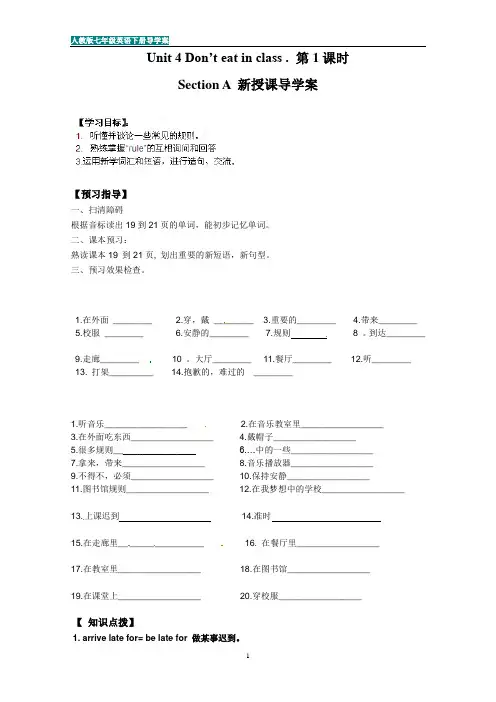
Unit 4 Don’t eat in class .第1课时Section A 新授课导学案【预习指导】一、扫清障碍根据音标读出19到21页的单词,能初步记忆单词。
二、课本预习:熟读课本19 到21页, 划出重要的新短语,新句型。
三、预习效果检查。
1.在外面________2.穿,戴________3.重要的________4.带来________5.校服________6.安静的________7.规则8 。
到达________9.走廊________ 10 。
大厅________ 11.餐厅________ 12.听________ 13. 打架_________ 14.抱歉的,难过的________1.听音乐_________________2.在音乐教室里_________________3.在外面吃东西_________________4.戴帽子_________________5.很多规则_________________6.…中的一些_________________7.拿来,带来_________________ 8.音乐播放器_________________9.不得不,必须_________________ 10.保持安静_________________11.图书馆规则_________________ 12.在我梦想中的学校_________________ 13.上课迟到14.准时15.在走廊里_________________ 16. 在餐厅里_________________17.在教室里_________________ 18.在图书馆_________________19.在课堂上_________________ 20.穿校服_________________【知识点拨】1. arrive late for= be late for 做某事迟到。
Don’t arrive late for the meeting next time 下次开会别迟到2、语法(祈使句)祈使句是用来表示请求、命令、叮嘱、号召或者劝告等的句子,这类句子的主语常是第二人称you,也就是听话者,因而you常省去了。
七年级英语下册Unit4Donteatinclass第1课时SectionA1a2c导学案人教新目标版

Unit 4 Don't eat in class.第一课时Section A(1a~2c)1.Key words and phrases:rule,arrive,hall,dining,listen,fight,sorry,outside,wear,important,bring,uniform,quiet,dining hall,arrive late for school,(be) on time,listen to…, go out,follow/break the rules,in class,be/keep quiet,a lot of,bring…to…,wear a hat,have to,music player2.Key sentences:(1)—Don't run in the hallways.—Sorry,Ms.Clark.(2)—What are(some of)the rules?—Well,we can't arrive late for class.(3)We must be on time.(4)We also have to be quiet in the library.3.Skills:(1)谈论校规,能正确使用否定祈使句陈述规章要求,对别人的劝告、警告做出礼貌回应。
(2)听清楚并能正确使用情态动词can,can't。
(3)能正确使用情态动词have to,must。
(4)能正确使用祈使句谈论规章制度。
4.Emotion:了解校规,规范在校行为。
5.The guidance of learning methods【学法指导】小组合作6.Learning important and difficult points【学习重难点】祈使句Don't…的用法。
(一)自主学习1.预习Page19-20中的生词,根据音标会读,知道汉语意思。
人教七英下Unit 4 Section B 第一课时课件

help his mom make breakfast
√
every morning
clean his room
√
every Saturday
1d Talk about the rules in Dave’s
house.
What are Dave’s
He can’t go out
family rules?
When
Must (√)
a
go out
×
on school nights
h
see friends
c do his homework
e practice the guitar
b do the dishes
g
watch TV
help his mom
d make breakfast f clean his room
do homework listen to music
talk loudly wear a hat
practice the guitar do the dishes
课文展现
go out
do homework
on school night
after school
watch TV
practice the guitar
in the evening
before dinner
make breakfast
do the dishes
every morning
after dinner
1. I have so many rules. 2. I can’t see my friends on school days. 3. I must practice the guitar before dinner and then I have to do the dishes after dinner.
人教版新目标英语七年级下第四单元教案设计
人教版新目标英语七年级下第四单元
教学案例
武安市第六中学苗淑雅
一、教学内容分析
本单元是人教版《新目标》七年级下册第四单元。
这本教材的词汇量很大,内容新颖,尤其是生动活泼的卡通化的画面,很符合七年级学生的年龄特点和心理特点,其中还囊括了很丰富多彩的文化知识,以及合作探究的活动,十分贴近学生的实际生活经验。
因此,本单元对于提升学生的学习兴趣而提高学生的听、说、读、写能力有很大的帮助。
并通过self check检测,积极地、及时地寻找各自的不足,以便学生树立良好的内在动机,不断获得成就感。
二、教学背景分析
本单元的话题Talk about rules.与日常生活密切相关。
作为一名中学生,遵守学校班级、家庭和社会公共场所的规章制度是必须的。
在谈论规则时,一般运用祈使句、情态动词can和have to等。
这是英语新课程标准中规定所必须掌握的内容,是交际英语中必不可少的项目。
三、教学设计说明
本课通过不同种类的规则,谈论学生应该遵循那些规则,主要是应用祈使句、情态动词can和have to等,可以说,本节新课是对这一语法的具体操练。
本课使用多媒体课件教学,用不同类型的规则和地点的图片来吸引学生,激发学生学习的积极性。
新目标七年级英语下册Unit4 I want to be an actor.讲解与练习

班级 姓名 考场 考号 座位号 号-------------------------○密--------------------------------------○封------------------------------------○线----------------------※※※※※※※※※※※答※※※※※※※※※※※※※※※※※※题※※※※※※※※※※※※※※※※※线※※※※※※※※※※Unit 4 I want to be an actor.讲解与练习讲解一.短语:1. want to do sth 想要作某事 Eg: I want to watch TV.我想看电视。
2.want to be … 想成为……,想当… Eg: Do you want to be a teacher?你想当老师吗?3. give sb sth = give sth to sb 给某人某物 / 把某物给某人 Eg: Give me your book.=Give your book to me.4.get … from …从…中取得/获得… Eg: I get a book from my brother.我从我哥哥那里得到了一本书。
5.in the day 在白天 6 .at night 在晚上 TV station 电视台 police station 警察局 7 talk with/ to sb 和----谈话 Eg: I like talking to people.我喜欢和人们谈话。
8 be busy doing sth 忙于做某事 Eg: He is busy listening to the teacher.9 in a hospital 在医院 10 work/ study hard 努力工作 11 Evening Newspaper 晚报 二.重点句式及注意事项: 1.询问别人干什么工作。
人教版新目标七年级英语下册Unit4说课稿
人教版新目标七年级英语下册 Unit 4 说课稿一. 教材分析人教版新目标七年级英语下册Unit 4主要围绕“日常生活”这一主题展开,通过学习本单元,学生能够掌握日常生活中的一些常用表达方式,提高他们的口语交际能力。
本单元的主要内容包括:动词短语的运用、现在进行时态的运用、日常交际用语等。
二. 学情分析七年级的学生已经掌握了基本的英语语法和词汇,但对日常生活中的一些交际用语还不太熟悉。
因此,在教学过程中,教师需要注重引导学生运用所学知识进行实际交流,提高他们的口语表达能力。
三. 说教学目标1.知识目标:学生能够掌握本单元的生词和短语,理解日常交际用语的含义和用法。
2.能力目标:学生能够熟练运用现在进行时态进行日常交际,提高他们的口语表达能力。
3.情感目标:激发学生学习英语的兴趣,培养他们积极参与课堂活动的自信心。
四. 说教学重难点1.重点:学生能够掌握现在进行时态的运用,以及日常交际用语的表达。
2.难点:学生能够灵活运用现在进行时态进行日常交际,并在实际情境中正确使用。
五. 说教学方法与手段1.教学方法:采用任务型教学法,情境教学法,分组合作学习等。
2.教学手段:利用多媒体课件、图片、卡片等辅助教学,激发学生的学习兴趣。
六. 说教学过程1.导入:通过展示图片,引导学生谈论图片中的人物正在做什么,引入现在进行时态的学习。
2.新课呈现:教师通过情境教学,展示日常交际用语,引导学生学习并掌握相关短语和表达。
3.课堂练习:学生分组进行角色扮演,运用所学知识进行实际交流,教师给予指导和反馈。
4.巩固环节:学生进行听力练习,观看相关情景对话,理解并运用日常交际用语。
5.拓展环节:学生进行小组讨论,创造性地运用所学知识,创作自己的日常交际对话。
6.总结:教师对本节课的主要内容进行总结,强调现在进行时态的运用和日常交际用语的重要性。
七. 说板书设计板书设计要简洁明了,突出重点。
主要包括现在进行时态的构成、日常交际用语的表达等。
新目标英语七年级下册unit4课后练习
新目标英语七年级下册u n i t4课后练习-CAL-FENGHAI.-(YICAI)-Company One1Unit 4 Don’t eat in class Section A(20分钟50分)Ⅰ. 根据句意及首字母或汉语提示完成单词(5分)1. Please be q in the reading room.2. D on’t listen to music in the classroom. You can listen to it o.3. Jay Chou will a in Shanghai tomorrow.4. Are there lots of(规则)at your home5. It’s(重要的)to learn English well.Ⅱ. 用所给词的适当形式填空(5分)1. Don’t(run)in the classroom.2. My mother(have)to walk with her dog after supper.3. We can’t(eat)in the classroom.4. We must(work)hard.5. This is our(one)class today.Ⅲ. 单项选择(10分)1. We mustn’t fight our classmates.A. withB. toC. inD. at2. You must be for class.A. on timeB. in timeC. for the first timeD. all the time3. —Tom, you sh ouldn’t your cat to school.—Sorry, Mr. Green. I won’t do that again.A. takeB. bringC. giveD. get4. —When do you arrive school every da y—At eight o’clock.A. inB. onC. atD. of5. It’s very cold. P lease your sweater.A. inB. wearC. put onD. onⅣ. 句型转换(10分)1. We can eat in the dining hall. (改为否定句)We in the dining hall.2. He has to go to school on foot. (改为一般疑问句)he go to school on foot3. Come to school tomorrow. (改为否定句)to school tomorrow.4. We have to wear a uniform at school. (对画线部分提问)we have at school5. Don’t talk in the reading room. (改为同义句)in the reading room.Ⅴ. 完成句子(5分)1. 别在课堂上吃东西。
人教版_初一_英语_下册_第四单元Section_B
工作(到很)晚
忙于干某事
work late
be busy doing sth/be busy
with sth
外出就(晚)餐 go out to dinners
工作到很晚
work late
努力工作
与人交往
work hard
meet people
写故事
为杂志社工作 与其他年轻人 一起工作 对„„感兴趣
Occupation Dream(职业梦想)
请同学们汇总你们的职业梦想,列出班级里 职业梦想 Top Ten.
Name Kim
…
Wants to be reporter
…
Why interesting
…
Guess!What do I do?
1. I work in the hospital every day. My work is very
8. Do you like to work with other young people?
young “年轻的”, 反义词为old。
younger “更年轻的”。
younger brother 弟弟
9. newspaper “报纸”, 可数名词。
Two newspapers 两份报纸。
Evening Newspaper 晚报
a doctor
He likes all kinds of colors.
He has lots of paintings. He can draw nice pictures.
an artist
She works in a street.
She works early in the morning.
2020年春人教新目标英语七年级下册Unit4-Don’t eat in class!全单元导学案
2020年春人教新目标英语七年级下册Unit4 Don’t eat in class!导学案涧池中学主备人:Section A 1a - 2c第1课时【学习目标】1、掌握10个单词:rule arrive be on time hallway hall dining listenlisten to fight sorry outside2、掌握并灵活运用句型:What are the rules ?Don’t do sth. We can(not) do sth We must do/be【学习重难点】1. 祈使句的肯定形式与否定形式2. 句型:What are the rules ? Don’t do sth.We can(not) do sth We must do/be)【预习指导】一、课本预习:(一)熟读1a并根据图中的信息填空(二)预习效果检查。
(1) 写出并读出下列单词和短语:1.校规2.迟到3.听音乐4.和他打架5.在走廊里6.在课堂上7.准时 8.在教室里(2)预习课本p19,找出其中的短语和重要句型1 、不要在走廊里跑 ______________________2、不要上课迟到___________________________3、不要在教室里吃东西 ___________________4、不要在教室里或走廊里听音乐_____________5、不要打架 ______________6、你校的规则是什么? ________________【课内学习】1.检查1a 的预习效果。
(熟练掌握1a中的词组)2.放录音让学生听1b,跟读,朗读听力材料。
3.放录音让学生完成2a,并跟读。
4.听录音完成2b并朗读听力材料。
5.展示成果,小组对话表演,完成2c.知识要点剖析:1.含义:祈使句是用来表示请求、命令、叮嘱、号召或者劝告等的句子,这类句子的主语常是第二人称you,也就是听话者,因而you常省去2.注意:祈使句的开头是动词原形。
新目标英语七年级(下)Unit4知识要点归纳
新目标英语七年级(下)Unit4知识要点归纳作者:来源:《中学生英语·阅读与写作》2017年第04期rule n. 规则;规章arrive v. 到达hallway n. 走廊;过道dining n. 进餐;吃饭listen v. 听;倾听fight v. & n. 打架;战斗sorry adj. 抱歉的;难过的outside adv. 在外面;在户外wear v. 穿;戴important adj. 重要的bring v. 带来;取来uniform n. 制服;校服quiet adj. 安静的practice v. & n. 练习dish n. 碟;盘dirty adj. 脏的kitchen n. 厨房more adj. & pron. 更多的noisy adj. 吵闹的relax v. 放松;休息read v. 读;阅读terrible adj. 非常讨厌的;可怕的 feel v. 感受;觉得strict adj. 严格的;严厉的remember v. 记住;记起follow v. 遵循;跟随luck n. 幸运;运气keep v. 保持;保留hair n. 头发;毛发learn v. 学习;学会arrive late for class 上课迟到be quiet in the library 图书馆安静 at weekend 在周末at school (in the school)在学校 be strict with sb. 对某人要求严格 on time 准时do the dishes 清洗餐具make one’s bed 铺床follow the rules 遵守规则wear a uniform 穿校服1. Don’t leave the dirty dishes in the kitchen!别把脏盘子留在厨房里!leave sth. 表示“留下;剩下”例如:Please leave the book on your desks. 请把书留在你们的课桌上。