
八年级英语下册:Unit3 Could you please clean your room教案
Unit 3 Could you please clean your room?教学目标:1语言目标:谈论做家务的词汇,及如何有礼貌的提出要求。
2 技能目标:能听懂和谈论做家务的话题;能写出重点单词和重点句型。
3 情感目标:培养学生爱劳动,分享家务的能力。
教学重点短语: do the dishes, make the bed, take out the rubbish, fold the clothes, sweep the floor, clean the living room ……句子:1. Could you please take out the rubbish?. Sure. / Sorry, I can’t. I have to finish homework first.2. Could I use your computer?Sorry. I'm going to work on it now.3. Well, could I watch TV?Yes, you can. But first you have to clean your room.教学难点:Make polite requestsAsk for permission课时划分:Period 1 Section A 1a – 2dPeriod 2 Section A 3a-3cPeriod 3 Section A Grammar focus-4cPeriod 4 Section B 1a-2ePeriod 5 Section B 3a-Self checkSection A1 (1a – 2d)Step 1 Warming-upSing the song and dance to the musicStep 2 Presentation1. W atch the photos and talk about them “W hat does he do every day?’ and learnthese phrases: do chores, do the dishes, make the bed, take out the rubbish, fold the clothes, do the laundry, clean the living room.2. Look these phrases and practice the conversation: Could you please take outthe rubbish? Sure. / Sorry, I can’t. I have to finish homework first.3. 1a Do you do these chores at home? Discuss them with your partner.Step 3 Listening1b Listen. Who will do these chores? Check (√) Peter’s mother or Peter.Step 4 Practice1c Make conversations about the chores in 1a.Make conversations.ExamplesA: Could you please...?B: Yes, sure. /All right. /No problem./Certainly.Sorry, I can't. I have to do...Sorry, I can't. I am doing...Step 5 Listening 2a&2bPeter asks his father if he can do four things. What does his father say? Check (√) “yes” or “no”. Listen again. Draw lines to the reasons.Step 6 Practice2c Make conversations using the information in 2a and 2bA: Could I use your computer?B: Sorry. I’m going to work on it now.A: Well, could I watch TV?B: Yes, you can. But first you have to clean your room?2d Role –play the conversationStep 7 Language points and summary1. Tony, could you please help out with a few things?help out 动词短语,表示在某人繁忙或遇到困难时“给予帮助”。
help和out之间还可以加入具体的“人”。
e.g. He helped me out with my task.他帮我完成了任务。
They helped (us) out with the clean-up.他们帮助我们做大扫除。
2. Could I at least finish watching this show?at least 至少e.g. We should brush our teeth at least twice a day.我们每天应该至少刷两次牙。
3. Yes, because Mom will be back from shopping any minute now.be back 回来e.g. I won't be back till 11:00.我11点以前回不来。
any minute now一种常见的口语表达法,相当于“随时;马上;在任何时刻”的意思,表示事情有可能在极短的时间内发生或眼下就要发生。
minute还可以用second, moment, time等词替换。
e.g. Don't worry, he will come here any minute now.别担心, 他会马上来这儿。
The guests are arriving any time now but we’re still not ready.客人即刻就到,但我们还没有准备好。
We’re expecting them any moment now.我们期待他们随时到来。
Step 8 Summary1. New words and expressionsdo the dishes, sweep the floor, take out the trash, make the bed, fold the clothes, clean the room2. ---Could you please…?---Yes, please. / Sorry, I can’t.Step 8 Homework1 List all the main phrases of doing chores that you know. (必做)2 Make a conversation between you and your mother, using the sentence pattern “Could you please …?” (选做)Section A 2 (3a – 3c)Step 1 RevisionA: Could you please make sentences with these phrases in the past tense?B: Sure. I did some chores.take out the trash do choresdo the dishes sweep the floor make dinner make the bed fold the clothesclean the living room help out withat leastfinish doing sth.be back from shoppingsee this mess mother cleane.g. 1. A: Could you please......?B: Yes, sure./ All right./No problem./Certainly.Sorry, I can't. I have to do ...Sorry, I can't. I am doing ...2. A: What kind of chores did you do last weekend?B: I did the washes.Step 2 Reading3a Read the passage and answer the following questions.1. Did Nancy do any housework that day?2. Why was Nancy’s mom angry with Nancy?3. Did they solve the problem? How?3b. Read the story again and read the sentences below. Underline the sentences from the reading that mean the same thing.1. Neither of us did any housework for a week.2. My mom came over as soon as I sat down in front of the TV.3. You’re tired, but I’m tired, too.3c. Decide whether the underlined words in the sentences are verbs or nouns. Then write another sentence using the underlined word in the other form.1.Could you take the dog for a walk? (noun)2. Could I watch one show first?3. I can’t work all day.4. You watch TV all the time.5. “What happened?” she asked in surprise.Step 3 Language points1. You watch TV all the time and ...all the time(在该段时间内)一直;向来,一向;时时刻刻;每时每刻e.g. I do this all the time. 我一直是这么做的。
八年级人教版下册知识点学习与巩固:Unit3Couldyoupleasecleanyourroom
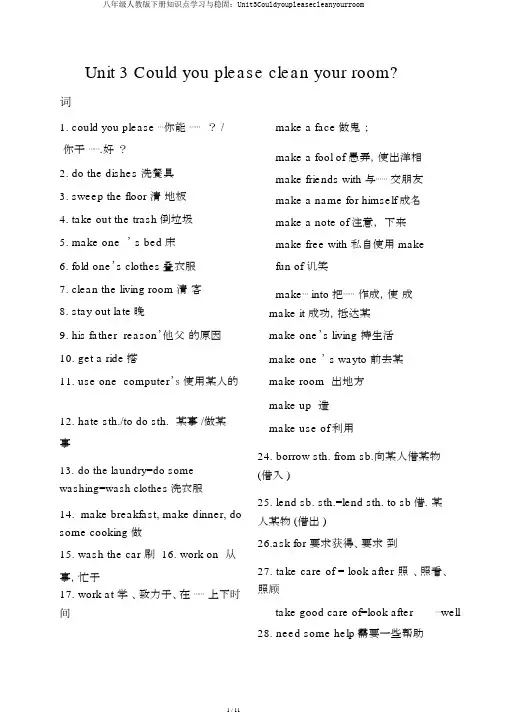
Unit 3 Could you please clean your room?词1. could you please ⋯你能⋯⋯? /你干⋯⋯.好?2.do the dishes 洗餐具3.sweep the floor 清地板4.take out the trash倒垃圾5.make one ’ s bed床6.fold one’s clothes叠衣服7.clean the living room 清客8.stay out late晚9.his father reason’他父的原因10.get a ride搭e one computer’s使用某人的12.hate sth./to do sth. 某事 /做某事13.do the laundry=do some washing=wash clothes洗衣服14.make breakfast, make dinner, do some cooking 做15.wash the car 刷 16. work on 从事,忙于17.work at 学、致力于、在⋯⋯上下时间make a face做鬼;make a fool of 愚弄,使出洋相make friends with 与⋯⋯交朋友make a name for himself成名make a note of注意,下来make free with 私自使用 makefun of 讥笑make⋯ into 把⋯⋯作成,使成make it 成功,抵达某make one’s living持生活make one ’ s wayto 前去某make room 出地方make up 造make use of利用24. borrow sth. from sb.向某人借某物(借入 )25.lend sb. sth.=lend sth. to sb借.某人某物 (借出 )26.ask for 要求获得、要求到27.take care of = look after 照、照看、照顾take good care of=look after⋯well 28. need some help需要一些帮助第1页/共9页18. borrow some money借一些钱29. come over过来19. invite sb. to do sth 邀请某人做某30. get angry生气事31. have a test考试20. go to the store去商铺32. make a clean sweep of 完全打扫21.agree sb. to do sth同.意某人做某事22.agree with sb. =agree with whatone says赞同某人的建议23.(需认识)make a deal作成交易知识重点1. ---Could you please take out the trash ?你能把垃圾倒掉吗?--- sure . 自然能够。
人教版八年级英语下-unit3-could-you-please-clean-your-room教案
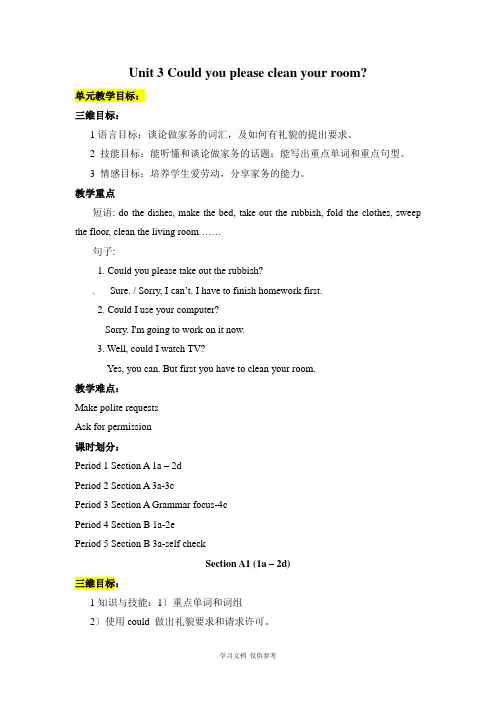
Unit 3 Could you please clean your room?单元教学目标:三维目标:1语言目标:谈论做家务的词汇,及如何有礼貌的提出要求。
2 技能目标:能听懂和谈论做家务的话题;能写出重点单词和重点句型。
3 情感目标:培养学生爱劳动,分享家务的能力。
教学重点短语: do the dishes, make the bed, take out the rubbish, fold the clothes, sweep the floor, clean the living room ……句子:1. Could you please take out the rubbish?. Sure. / Sorry, I can’t. I have to finish homework first.2. Could I use your computer?Sorry. I'm going to work on it now.3. Well, could I watch TV?Yes, you can. But first you have to clean your room.教学难点:Make polite requestsAsk for permission课时划分:Period 1 Section A 1a – 2dPeriod 2 Section A 3a-3cPeriod 3 Section A Grammar focus-4cPeriod 4 Section B 1a-2ePeriod 5 Section B 3a-self checkSection A1 (1a – 2d)三维目标:1知识与技能:1〕重点单词和词组2〕使用could 做出礼貌要求和请求许可。
2.过程与方法:通过合作探究的方法结局本课的重点知识点3.情感态度与价值:学会照顾自己,培养自己的独立意识。
教学重点:谈论做家务的词汇,情态动词could的使用方法。
八年级英语下册-Unit-3-Could-you-please-clean-your-room-Se
3b
Read the sentences below. Underline the sentences from the reading that mean the same thing.
1. Neither of us did any housework for a week. For one week, she did not do any housework and neither did I. 2. My mom came over as soon as I sat down in front of the TV. The minute I sat down in front of the TV, my mom came over. 3. You're tired, but I'm tired, too. Well, I work all day at school, too! I'm just as tired as you are!
not to get it wet.
1—d 2—a 3—c 4—e 5—b
4b Fill in the blanks in the conversation.
A: I hate to __d__o__ chores.
B: Well, I hate some chores too, but I like other chores.
2. Could I watch one show first? (noun) ___C_o_u_l_d_y_o_u__p_l_ea_s_e__sh_o_w__m__e_y_o_u__r_n_e_w__b_o_o_k_?__(v_e_r_b_)___ 3. I can't work all day. (verb) __I_t_’s__d_if_f_ic_u_l_t_t_o_f_in__d_w__o_rk__i_n_t_h_i_s_c_it_y_._(_n_o_u_n_)________ 4. You watch TV all the time. (verb) __H__o_w__m__u_c_h_i_s_t_h_a_t_w_a_t_c_h_?__(n_o_u__n_) _________________ 5. “What happened?” she asked in surprise. (noun) __I_t_w__o_n_'t__su__rp__ri_s_e_m__e_i_f_h_e_l_o_s_e_s_t_h_e_e_x_a_m__. _(v_e_r_b_)_____
人教版八年级下英语Unit 3 Could you please cleanyourroom知识总结
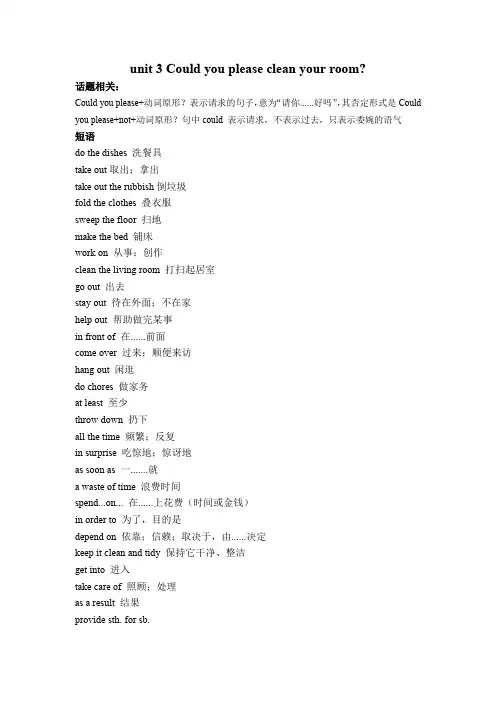
unit 3 Could you please clean your room?话题相关:Could you please+动词原形?表示请求的句子,意为“请你......好吗”,其否定形式是Could you please+not+动词原形?句中could 表示请求,不表示过去,只表示委婉的语气短语do the dishes 洗餐具take out取出;拿出take out the rubbish倒垃圾fold the clothes 叠衣服sweep the floor 扫地make the bed 铺床work on 从事;创作clean the living room 打扫起居室go out 出去stay out 待在外面;不在家help out 帮助做完某事in front of 在......前面come over 过来;顺便来访hang out 闲逛do chores 做家务at least 至少throw down 扔下all the time 频繁;反复in surprise 吃惊地;惊讶地as soon as 一.......就a waste of time 浪费时间spend...on... 在......上花费(时间或金钱)in order to 为了,目的是depend on 依靠;信赖;取决于,由......决定keep it clean and tidy 保持它干净、整洁get into 进入take care of 照顾;处理as a result 结果provide sth. for sb.=provide sb. with sth. 为某人提供某物a developed country 一个发达国家a developing country 一个发展中国家a life of independence 独立的生活an independent country 一个独立自主的国家have no idea “不知道”=don't knowtake care of “照顾;处理”=look after=care for take good care of “好好照顾......”=look after.....well as a result 结果;因此as a result of 由于.......;作为......结果句型和固定结构finish doing sth. 做完某事neither+连系动词be/助动词/情态动词+主语. .....也不hate to do sth. 厌恶做某事let sb. do sth. 让某人做某事spend...doing sth. 花费......做某事provide sth. for sb. 向某人提供某物learn to do sth. 学会做某事learn how to do sth. 学会怎样做某事do one's part in (doing) 尽自己的职责做某事as.....as... 与.......一样not as/so...as... 不如......borrow sth. from sb. “向某人借某物”hate sb./sth. 讨厌某人/某物hate to do sth./doing sth. 厌恶做某事enjoy doing sth 喜欢做某事buy sb.sth.=buy sth. for sb. "给某人买某物invite sb. to +地点名词“邀请某人到某地”invite sb. to do sth. “邀请某人做某事”make sb. do sth. 让/使某人做某事help with sth. =help (to) do sth.帮忙做某事There is no need for sb. to do sth.“对于某人来说,没有必要做某事”解释minute n.分钟;片刻(1)any minute now “随时;马上;在任何时刻”,表示事情有可能在极短的时间内发生或眼下就要发生。
(完整版)英语人教版八年级下册Unit3Couldyouplease--
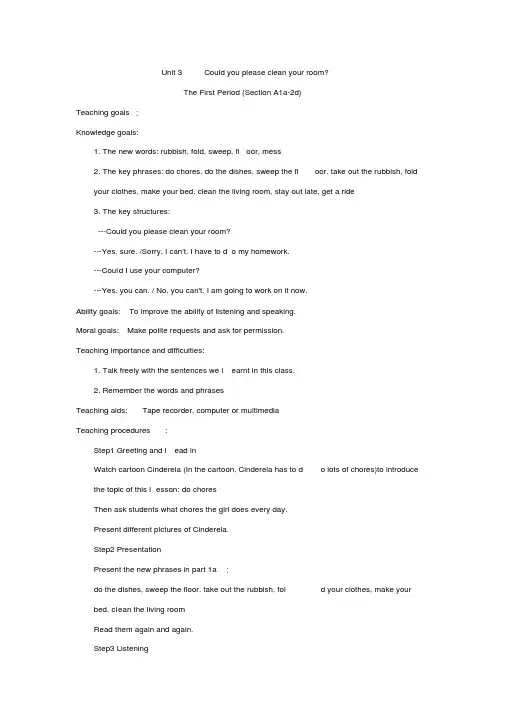
Unit 3 Could you please clean your room?The First Period (Section A1a-2d)Teaching goals:Knowledge goals:1. The new words: rubbish, fold, sweep, fl oor, mess2. The key phrases: do chores, do the dishes, sweep the fl oor, take out the rubbish, foldyour clothes, make your bed, clean the living room, stay out late, get a ride3. The key structures:---Could you please clean your room?---Yes, sure. /Sorry, I can't. I have to d o my homework.---Could I use your computer?---Yes, you can. / No, you can't. I am going to work on it now.Ability goals: To improve the ability of listening and speaking.Moral goals: Make polite requests and ask for permission.Teaching importance and difficulties:1. Talk freely with the sentences we l earnt in this class.2. Remember the words and phrasesTeaching aids: Tape recorder, computer or multimediaTeaching procedures :Step1 Greeting and l ead inWatch cartoon Cinderela (In the cartoon, Cinderela has to d o lots of chores)to introduce the topic of this l esson: do choresThen ask students what chores the girl does every day.Present different pictures of Cinderela.Step2 PresentationPresent the new phrases in part 1a:do the dishes, sweep the floor, take out the rubbish, fol d your clothes, make your bed, cl ean the living roomRead them again and again.Step3 ListeningT: Peter’s room is untidy, peter and his mother are at home, what shoul d they d o?chores or Mom’s chores?1. Now listen to the tape player, then finish part 1b. Peter’sListen it the first time, and check the answers2. Listen it again, then pay attention to the question:T: How does Mum ask peter to help her?----Could you please …?----Yes, sure. / Sorry, I can’t, I have to…Step 4 Pair workLook at the picture in 1a, ask your partner to d o the chores that you see.Example:A: Could you please sweep the fl oor?B: Yes, sure. Can you d o the dishes?ean the living room.A: Well, could you please do them? I ‘m going to clB: No problem.Step 5 Listening1. Look through the tasks in 2a and 2b carefully before listening.2. Play the tape the first time, let the students finish part 2a3. Play the tape the second time and let the stud ents finish the tasks 2b.4. Listen to the tape once more and ask the students to repeat after the tape and checkthe answers by themselves.Question: How to ask for permission?总结请求许可时,常用句型:---Could I…?---Yes, you can. / Sorry, you can’t.Step 6 Group workfather, Peter asks his father if he can do three Student A is Peter, Student B is Peter’smore t hings. Say “yes” or “no”, and give a reason. Such as:A: Could I use your computer?B: Sorry. I’m going to work on it now.A : Well, could I watch TV?B: Yes, you can. But first you have to clean your roomStep 7 Self-studyAsk the students to learn 2d by themselves and finish the tasks of self-study.1. Let students read the conversation loudly, then come up with some questions. Thestudent who raises a question will get 2 points. And the student who answers it will get1 point.2. Read it carefully, then find out the new words and difficult points. Let students showthem in class.3. Role-play the conversation in groups.Step 8 Language points1.Tony, could you please help out with a few things?help out (with something) 是一个动词短语, 表示在某人繁忙或是遇到困难时“给予帮助”。
人教版英语八年级下册Unit3《Couldyoupleasecleanyourroom》说课稿

人教版英语八年级下册Unit 3《Could you please clean your room》说课稿一. 教材分析人教版英语八年级下册Unit 3的主题是“Could you please clean your room?”,主要讨论了日常生活中的一些请求和回应。
通过本节课的学习,学生能够掌握情态动词could的用法,学会如何礼貌地提出请求和回应请求。
教材内容丰富,包括听力、口语、阅读和写作等多个方面,有助于全面提高学生的英语综合能力。
二. 学情分析根据我对学生的了解,他们已经掌握了情态动词can的用法,并具备了一定的听说读写能力。
然而,对于情态动词could的用法,他们还比较陌生。
此外,部分学生在表达请求时,还存在着语气生硬、不礼貌等问题。
因此,在教学过程中,我需要针对这些情况,采取适当的教学策略,帮助学生掌握情态动词could的用法,并培养他们礼貌表达请求的能力。
三. 说教学目标1.知识目标:学生能够掌握情态动词could的用法,了解其表示请求的礼貌性。
2.能力目标:学生能够熟练运用情态动词could提出请求和回应请求,提高日常英语交流能力。
3.情感目标:通过本节课的学习,学生能够学会尊重他人,培养礼貌待人的良好习惯。
四. 说教学重难点1.教学重点:情态动词could的用法,如何用could提出请求和回应请求。
2.教学难点:情态动词could与can的区别,以及在实际情景中灵活运用。
五. 说教学方法与手段1.教学方法:采用任务型教学法,情境教学法,交际法等,激发学生的学习兴趣,提高他们的参与度。
2.教学手段:利用多媒体课件、图片、实物等,创设真实情境,帮助学生更好地理解和学习。
六. 说教学过程1.导入:通过播放一段关于孩子们日常生活的视频,引出本节课的主题“Could you please clean your room?”。
2.新课呈现:介绍情态动词could的用法,并通过例句展示如何用could提出请求和回应请求。
人教新目标英语八年级下册讲义—Unit 3 Could you please clean your…
新目标八年级下册Unit 3 Could you please clean your room?讲义一、词性转换Section A1.sweep →(pt.)swept2.throw →(pt.) threw3.fold→(pt.) folded Section B1. lend →(pt.) lent2. hate →(pt.) hated3. stress →(v.) stress4. waste →(v.) waste5. provide →(pt.) provided6. depend→(pt.)depended7. independence →(adj.) independent8. fairness →(adj.) fair9. unfair →(反义词)fair二、短语归纳1. do the dishes 洗餐具2. take out the rubbish倒垃圾3. fold your clothes叠衣服4. sweep the floor 扫地5. make your/the bed 整理床铺6. go out for dinner 出去吃饭7. throw down 扔下8.in surprise 惊讶地9. hang out 闲逛10. hate to do sth. 讨厌做某事11. do chores 做杂务12.enough stress足够的压力13. in order to为了14. provide sth. for sb.向某人提供某物15. get good grades取得好成绩16.mind doing sth. 介意做某事17. depend on依赖;依靠18. look after 照顾,照看19. keep it clean and tidy保持它干净整洁20. get into 进入21. take care of 照顾22. as a result 结果23. do one’ s part in (doing )sth. 做某人分内的事24. get a ride 搭车25.stay out late在外面待到很晚三、句型集萃1. Could you please help out with a few things? 你能帮忙做些事情吗?2.Mom will be back from shopping at any minute now. And she won’t be happy if she sees this mess.妈妈现在随时都会购物回来,如果她看到这些一团糟,会不高兴的。
新人教版英语八下U 3《Could you please clean your room》
Unit 3 Could you please clean your room知识目标1.重点词汇用法及短语动词用法。
如:rubbish, fold, sweep, floor,take out the rubbish, fold your clothes...2.情态动词could 的用法能力目标礼貌提出要求和请求准许情感目标学会照顾自己,培养自己的独立意识1)倒垃圾_______________2)叠衣服_______________ 3)扫地_______________4)整理床铺_______________5)洗碗____________________重难点Could you please take out the rubbish ?肯定回答________________________________________________________否定回答_________________________________________________________.1.—请你把垃圾倒掉好吗?_好的,当然可以。
—____ ____ _____ take out the trash?—Yes,sure.2.—我可以用一下你的电脑吗?—对不起。
我现在要用它工作。
—_____ ____ use your computer?—Sorry.I’m ___ ____ work on it now.导与学过程根据句意、汉语意思和首字母提示完成句子。
1.The children are picking up the r_________(垃圾)in the river.2.Children often help s__________(打扫)the rooms in the old people’s home.3.There are some dirty clothes on the f_________(地板)in his bedroom.4.Tom’s room is really in a m________(不整洁).5.---Mary, could you help f_________(折叠)the clothes?---Yes, sure.课后反思本课所得: 本课不足:课后作业句型转换1、He has to clean his room himself.(疑问)____ he ____ ___ clean his room himself?2、You'd better take out the trash.(否定)You'd better ____ ____ out the trash.3、It's a very boring thing.(感叹句) _____ ____ ____ ____ it is!4、She cleans her room twice a week.(提问)____ ____ ____ she ____ her room?5、They took some photos there.(否定) They ____ ____ ___ photos there.6、Paul a nd Tom weren't at school yesterday.(提问)___ ___ at school yesterday?7、A. She was late yesterday because she was ill.B. She was late yesterday ________ ________ her illness(病).8、My mum asked me not to play computer.My mum asked me to ______ ____ computer.9、Can you come to my party on Monday at 19:00?(同义)___ ___ ___ ____ come to my party on Monday at 19:00?10、Let's go fishing on Sunday.(同义)____ ____ fishing on Sunday?第2课时Section A 2a--2d学习目标知识目标1.重点词汇用法及短语动词用法。
人教版 八年级英语 下册 Unit3Could_you_please_clean_your_room
invite my friends to a party
go to the store use your CD player
Listen to a conversation between Sandy
a party? Parent: No, you can’t have a party.
You have a test on Monday.
Parent: Could you please…? Child: Yes, sure. / Sorry, I can’t. I
have to ...
clean your room
parents
5. go to the store 6. use your CD player 7. take out the rubbish
parents 8. make your bed
1b Use the phrases in 1a to make
conversations.
Parent: Could you clean your room? Child: Yes, I can. Child: Could I invite my friends to
Li Lei can’t dance , neither can I. neither can Mary. neither can we.
Neither of …是both of … 的否定句 Both of my parents are teathers .(否定句) Neither of my parents is a teacher .
八年级英语下册Unit3CouldyoupleasecleanyourroomPeriod3说课稿
八年级英语下册 Unit 3 Could you please clean your room Period 3说课稿一. 教材分析八年级英语下册Unit 3 Could you please clean your room? Period 3是一节以日常交流为主题的英语课。
本节课的主要内容是学习如何用英语提出建议和请求,以及如何礼貌地回应。
教材通过一个关于孩子们做家务的对话,让学生们掌握情态动词“could”的用法,并学会在实际生活中运用英语进行交流。
二. 学情分析八年级的学生已经掌握了基本的英语语法和词汇,具备一定的听说读写能力。
他们在日常生活中也了一定的英语实践经验,但仍然需要大量的练习来提高口语表达能力和听力理解能力。
此外,学生们的学习兴趣和动机对英语学习效果有很大影响,因此,在教学过程中要注意激发他们的学习兴趣。
三. 说教学目标1.知识目标:让学生掌握情态动词“could”的用法,学会用英语提出建议和请求,并能够礼貌地回应。
2.能力目标:通过课堂活动,提高学生的口语表达能力和听力理解能力。
3.情感目标:培养学生热爱生活、关心他人的品质,以及积极承担家务的责任感。
四. 说教学重难点1.重点:情态动词“could”的用法,以及如何用英语提出建议和请求。
2.难点:在实际生活中运用英语进行交流,特别是在不同情境下正确使用“could”。
五. 说教学方法与手段1.情景教学法:通过设置现实生活中的情境,让学生在实际语境中学习英语。
2.交际教学法:引导学生参与课堂互动,提高他们的口语表达能力和听力理解能力。
3.任务型教学法:通过完成具体任务,让学生在实践中学会使用英语。
4.利用多媒体教学手段:播放音频、视频材料,丰富教学内容,提高学生的学习兴趣。
六. 说教学过程1.导入:以一个关于孩子们做家务的短剧引入课堂,激发学生的学习兴趣。
2.新课呈现:通过展示教材中的对话,让学生了解本节课的主要内容。
3.课堂互动:分角色朗读对话,进行情景模拟,让学生在实际语境中学习英语。