
牛津上海版七年级上册U2教案
5、名词所有格 名词所有格(possessive case)表示人或物的所属关系。主要有三种形式:’s 形式, of +名词形式 和双重所有格形
名词
专有名词(Tom,Shanghai,USA, UN)
举例
普通名词
可数名词
个体名词
person,desk,
集体名词
audience,crew
不可数名词
物质名词
stone,iron
抽象名词
glory,quality
2、名词复数的规则变化
3
名词单数的特征
复数构成方法
举例
规则名词
在名词单数后直接加-s
式 1) ’s 形式 所有格
即:表示有生命的东西的名词的所有格
表示有生命的东西的名词(人或动物)的末尾,加上's,即构成所有格,可放在另一名词之前,作定语用。如:
John's friend 约翰的朋友
Xiao Wang's notebook 小王的笔记本
children's books 儿童读物
my father's room 我父亲的房间
knife---knives life---lives
leaf---leaves
wolf---wolves thief---thieves;
有些,直接加-s
belief---beliefs
roof---roofs safe---safe s gulf---gulfs;
3、名词复数的不规则变化 1)child---children foot---feet tooth---teeth
注意形式 1)单数名词词尾加"'s",复数名词词尾没有 s,也要加"'s",如 the boy's bag 男孩的书包,men's room
男厕所, children’s book 儿童读物。
2) 若名词已有复数词尾-s ,只加"'",如:the workers' struggle 工人的斗争。
5
2) of +名词形式 常用于没有生命的事物:the title of the song 歌的名字
有时加-es
tomato---tomatoes
echo-----echoes
以字母 0 结尾的外来词或者 piano----pianos
新产生的词,直接加-s
solo----solos
zero---zeros
以 f 或者 fe 结尾的名词
多数情况下,变 f 或 fe 为-ves half---halves wife---wives
20.give sb sth to do sth .
给某人某物去做...
give him a basket to sleep in 给他一个篮子睡觉
21.keep-kept-kept
doing sth . 一直让某人做某事
keep sb、sth
adj 保持某人......样子
情态动词 need do sth--否定 needn’t do sth
1
4.cruelty h.残忍 cruel adj.残忍的 be cruel to sb./sth 对...是残忍的 5.thirst n. 口渴 thirsty adj . 口 渴的 hunger n.饿 Hungry adj、饿的 6.lovely friendly 是形容词 7.prefer to=would rather 宁愿做... prefer sth to sth /doing sth to doing sth=like...better than.... 相对于后者来说更喜欢前者 8.Care v.关照 careful adj.细心的 careless adj . 粗心的 take care of 照顾=look after 不定代词放在形容词前 例:something special thing important 9.unkind 反义词 kind be unkind to sb. 对...不友善 10.the +形容词. 表示...人 the blind 育人 the poor 穷人 11.Safely adv 安全地 safe adj.安全的 n.保险柜 Save v.拯救 safety n.安全 12.thief n.小偷 theft n.偷窃案 steal v.偷 steal sth from sb, robber n.抢劫者 robbery n.抢劫案 rob v.抢 rob sb of sth. 13.miss v. 错过 missing adj. 失踪的. 14.hunt r.猎杀 hunter n.猎户 go hunting 去打猎 15.宾语从句 疑问副词十主语+(情)+动词+.... Do you know what's wrong with him?=what's the matter with him?(不改变语序) 16.leave v.留下 leave sth at /in.... 把其物忘在....
2)单复同形 如: deer,sheep,fish,Chinese,Japanese li,jin,yuan,two li,three mu,four jin 但除人民币元、角、分外,美元、英镑、法郎等都有复数形式。如:
a dollar, two dollars; a meter, two meters
等专有的名称,如 Beijing,China 等。普通名词是一类人或东西或是一个抽象概念的名词,如:book,sadness 等。普
通名词又可分为下面四类:
1)个体名词(Individual Nouns):表示某类人或东西中的个体,如:gun。
2)集体名词(Collective Nouns):表示若干个个体组成的集合体,如:family。
5) 表示由两部分构成的东西,永远以复数形式出现如:glasses (眼镜) trousers, clothes 若表达具体数目,要借助数量词 pair(对,双); suit(套); a pair of glasses; two pairs of trousers
6) 另外还有一些名词,其复数形式有时可表示特别意思,且只能在表示不同种类时采用复数,如:goods 货物, waters 水域,fishes(各种)鱼 4、不可数名词量的表示
key-----keys
以 o 为结尾的名词
以元音字母加 0 结尾的名词, radio----radios
直接加-s
bamboo----bamboos
zoo----zoos
以字母加 0 结尾的缩写词, disco----discos
直接加-s
photograph----photographs
以辅音字母加 0 结尾的名词, hero----heroes
名词所有格所修饰的词的省略 名词所有格所修饰的词,如果前面已经提到,往往可以省略,以免重复。如: The dictionary is not mine, but Xiao Wang's.这本词典不是我的,是小王的。 名词所有格后面指地点等的名词,有的习惯上可省去不用。如: I met him at the Johnson's (shop).我在约翰逊商店遇见了他。 I went to my uncle's (house) yesterday.我昨天到我叔叔家去
1)物质名词 a. 当物质名词转化为个体名词时。 比较: Cake is a kind of food. 蛋糕是一种食物。 (不可数) These cakes are sweet. 这些蛋糕很好吃。 (可数) b. 当物质名词表示该物质的种类时,名词可数。 This factory produces steel. (不可数) We need various steels. (可数)
worker-----workers
bag-------bags
computer-----compute音字母,变 y 为 i city------cities
加-es
body-----bodies
country-----countries
y 前面是元音字母,直接加-s boy-----boys
3)集体名词 只在动词使用时区分,如果将名词所表示的集体是为一个整体,则位于动词用单数;
如果将名词表示的集体是为分散的个体,位于动词则用复数。如:
The class is small. 这是小班。
The whole class are working very hard at English. 这个班上的学生学习英语很刻苦。
3) 双重所有格形式 即结合上述两种形式 "of+名词所有格" ,表示部分观念或感情色彩。
如 (1)表示部分观念: a friend of my sister's (= one of my sister's friends)我妹妹的一个朋友; a picture of Mr. Wu's 吴先生(具有的照片中)的一张照片(比较:a picture of Mr. Wu 吴先生本人的照片,即照片 上是吴先生的像)。 (2)表示感情色彩: this lovely child of your aunt's 你婶母的这个可爱的孩子
4
4)以 s 结尾,仍为单数的名词,如: a. maths,politics,physics 等学科名词,为不可数名词,是单数。 b. news 是不可数名词。 c. the United States,the United Nations 应视为单数。 The United Nations was organized in 1945. 联合国是 1945 年组建起来的。 d. 以复数形式出现的书名,剧名,报纸,杂志名,也可视为单数。 "The Arabian Nights" is a very interesting story-book. <<一千零一夜>>是一本非常有趣的故事书。
牛津上海版英语七年级上Unit2 Our animal friends教案
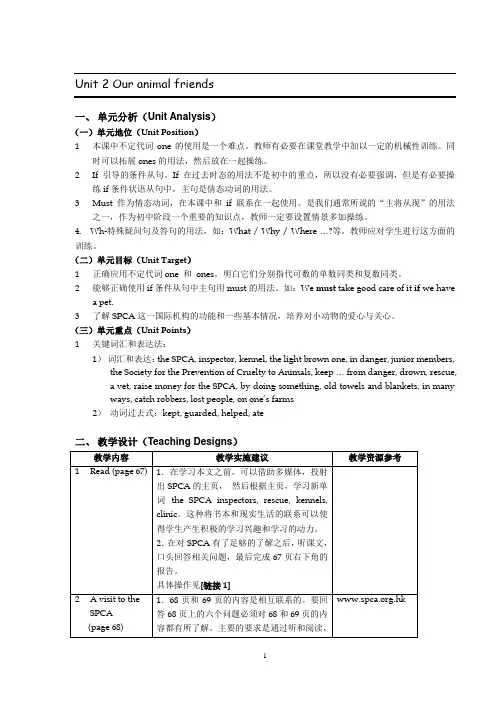
Unit 2 Our animal friends一、单元分析(Unit Analysis)(一)单元地位(Unit Position)1 本课中不定代词one的使用是一个难点。
教师有必要在课堂教学中加以一定的机械性训练。
同时可以拓展ones的用法,然后放在一起操练。
2 If 引导的条件从句。
If 在过去时态的用法不是初中的重点,所以没有必要强调,但是有必要操练if条件状语从句中,主句是情态动词的用法。
3 Must 作为情态动词,在本课中和if 联系在一起使用。
是我们通常所说的“主将从现”的用法之一,作为初中阶段一个重要的知识点,教师一定要设置情景多加操练。
4. Wh-特殊疑问句及答句的用法,如:What / Why / Where …?等。
教师应对学生进行这方面的训练。
(二)单元目标(Unit Target)1 正确应用不定代词one 和ones。
明白它们分别指代可数的单数同类和复数同类。
2 能够正确使用if条件从句中主句用must的用法。
如:We must take good care of it if we havea pet.3 了解SPCA这一国际机构的功能和一些基本情况,培养对小动物的爱心与关心。
(三)单元重点(Unit Points)1 关键词汇和表达法:1)词汇和表达:the SPCA, inspector, kennel, the light brown one, in danger, junior members, the Society for the Prevention of Cruelty to Animals, keep … from danger, drown, rescue,a vet, raise money for the SPCA, by doing something, old towels and blankets, in manyways, catch robbers, lost people, on one’s farms2)动词过去式:kept, guarded, helped, ate二、教学设计(Teaching Designs)●What does SPCA mean?(学生的中文回答是可以的,因为只要有一个概念就可以了)●The SPCA inspectors work for the SPCA and rescue animals.●Dogs live in the kennels and wait for their hosts.●If a dog is ill, it should go to the clinic.学生在教师的讲解和生动的图片引导下,会对以上生词的概念有所掌握。
unit 2同步教案2021-2022学年上海牛津版七年级上册英语
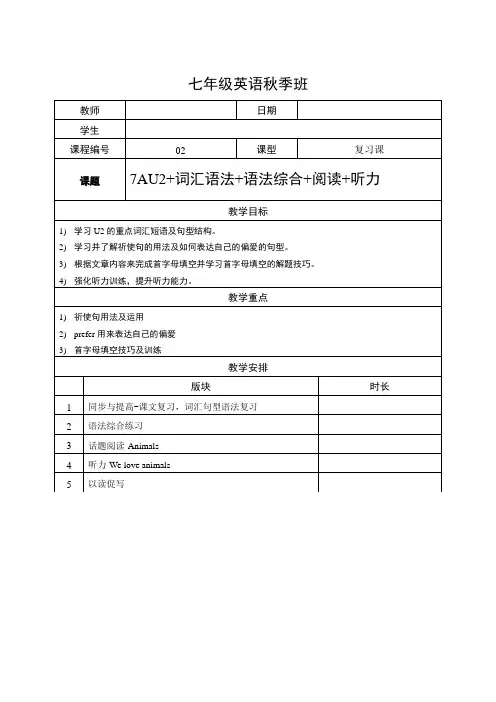
七年级英语秋季班1. 7A U2同步与提高Part 1 课文ReviewAnimals, our friendsThe SPCA is an organization which helps protect animals. Every year, it s_____1_____ a lot of animals in Garden City. Sometimes people are u_____2_____ to their pets. They don’t take c_____3_____ of their pets and leave them in the street. SPCA o_____4_____ save them from danger and take them to the SPCA.The SPCA a_____5_____ helps animals find new homes. If people want to _____6_____ a pet, they can go to the SPCA. H_____7_____, they must promise to look after their new pet.There are clinics for those animals who are s_____8_____ in the SPCA. The vets in the clinics take care of them.Part 2 根据音标写单词7A U2 Vocabulary(牛津)序号英文音标词性中文1 ['ɒfɪsə] n. 官员;高级官员2 [sə'saɪətɪ] n. 社团;协会3 [prɪ'venʃn] n. 预防;防止;防范4 ['krʊəltɪ] n. 残酷5 ['sʌmwʌn] pron. 某人6 ['pʌpɪ] n. 小狗;幼犬7 ['θɜːstɪ] adj. 口渴的8 ['lʌvlɪ] adj. 可爱的;有吸引力的9 [æz] prep. 作为;当作10 [prɪ'fɜː]v. 更喜欢11 [keə] n. 照料;照顾Part 3 词汇语法复习Grammar2. 祈使句一、定义:祈使句是用来表示请求、命令、劝说、号召、警告等的句子。
上海牛津版英语七年级上册七上7AUnit2U2同步讲义教案
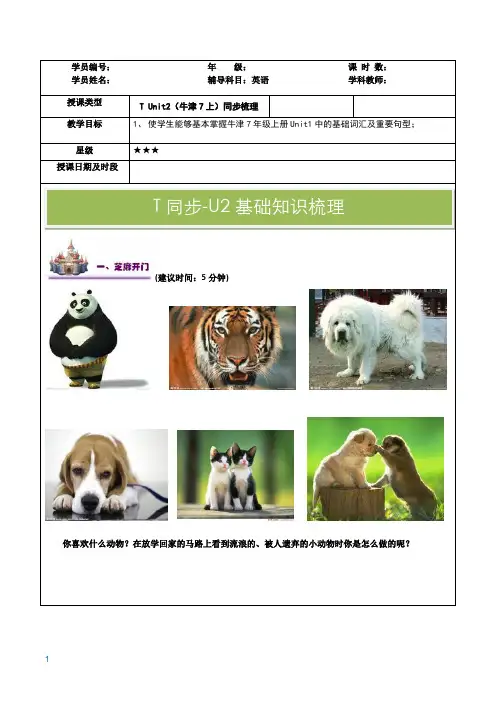
学员编号:年级:课时数:学员姓名:辅导科目:英语学科教师:授课类型T Unit2(牛津7上)同步梳理教学目标1、使学生能够基本掌握牛津7年级上册Unit1中的基础词汇及重要句型;星级★★★授课日期及时段T同步-U2基础知识梳理(建议时间:5分钟)你喜欢什么动物?在放学回家的马路上看到流浪的、被人遗弃的小动物时你是怎么做的呢?一、词汇Words (建议20分钟,老师边讲边要求学员记住单词,此环节结束之后要求学员记住80%)1. officer n. 官员;高级官员【词性转换】office n. 办公室e.g. A police officer came to help when our car broke down on the way.我们的汽车在路上出了毛病,一位警官帮了我们的忙。
2. society n. 社团;协会【词性转换】social adj. 协会的;社会的e.g. the Chemical Society of China 中国化学学会3. prevention n. 预防;防止;防范【词性转换】prevent v. 预防;防止e.g. Prevention is better than cure. 预防胜于治疗。
批注:prevent和protect,很多孩子分辨不清楚,还应该让孩子注意protect的名词形式是protection。
4. cruelty n.残酷【词性转换】cruel adj. 残酷的;悲惨的e.g. cruelty to children 虐待儿童5.someone pron. 某人【近义词】somebody pron. 某人;有人e.g. Someone wants to talk with you. 有人想和你谈话。
6. puppy n. 小狗;幼犬【提示】dog一般用来指“成年狗”或表示狗的总称;puppy特指小狗,复数形式为puppies7. thirsty adj. 口渴的【词性转换】thirst n. 口渴e.g. I often feel thirsty when it’s very hot. 天热时,我常感到口渴。
牛津上海版七年级英语上册教学设计:Unit2Ouranimalfriends
4.布置课后作业,如让学生写一篇关于自己最喜欢的动物的小短文,巩固课堂所学知识,培养学生的写作能力。
五、作业布置
为了巩固本章节所学知识,培养学生的语言实际运用能力,特布置以下作业:
1.请学生根据自己的喜好,选择一种动物,运用本节课所学的词汇和句型,写一篇关于该动物的小短文。要求描述动物的外貌、特点、习性和技能,不少于80词。
d.鼓励学生课后参加与动物相关的实践活动,如参观动物园、做动物保护志愿者等,将所学知识与社会实践相结合。
四、教学内容与过程
(一)导入新课(500字)
1.教师以生动有趣的故事引入新课,例如:“Once upon a time, there was a clever dog named Biscuit. He could do many interesting things, such as fetching a ball, shaking hands, and even dancing. Today, we are going to learn about our animal friends and their amazing skills.”(从前,有一只聪明的狗叫饼干。它会做很多有趣的事情,比如捡球、握手,甚至跳舞。今天,我们将要学习关于我们的动物朋友和它们的神奇技能。)
4.鼓励学生在日常生活中用英语与他人交流,增强学生的跨文化意识,提高学生的国际视野。
二、学情分析
针对牛津上海版七年级英语上册Unit2 Our animal friends这一章节,学情分析如下:七年级学生正处于青春期,他们对新鲜事物充满好奇,尤其对动物有着浓厚的兴趣。在此基础上,学生对本章节的学习将表现出较高的积极性和参与度。然而,学生在英语语言基础、学习方法和情感态度方面仍存在一定差异。
Unit2Section1Reading教学设计2024-2025学年沪教牛津版英语七年级上册
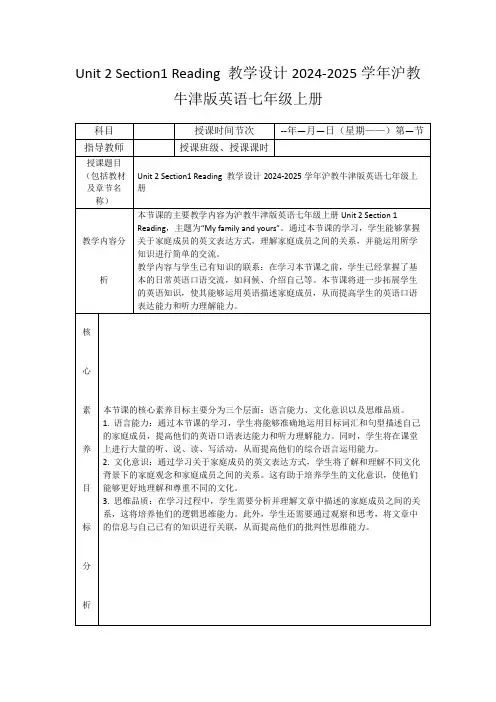
科目
授课时间节次
--年—月—日(星期——)第—节
指导教师
授课班级、授课课时
授课题目
(包括教材及章Leabharlann 名称)Unit 2 Section1 Reading教学设计2024-2025学年沪教牛津版英语七年级上册
-材料2:《Unique Families》
本文讲述了一些特殊家庭的故事,如单亲家庭、领养家庭等。学生可以通过阅读了解这些家庭的特殊性,并学会尊重和理解不同类型的家庭。
-材料3:《The Importance of Family》
本文讨论了家庭对个人成长的重要性,包括家庭成员之间的情感联系和相互支持。学生可以通过阅读认识到家庭在个人生活中的重要作用。
(二)存在主要问题
1.学生自主学习能力不足:在本次教学中,我发现部分学生自主学习能力不足,需要在今后的教学中加强培养。
2.课堂组织管理有待提高:在课堂活动中,我发现课堂组织管理方面存在一些问题,需要进行改进。
3.教学评价方式单一:本次教学中,教学评价方式较为单一,未能全面反映学生的学习效果,需要进行改进。
-讲解知识点:详细讲解家庭成员的英文表达方式,结合实例帮助学生理解。
-组织课堂活动:设计小组讨论,让学生在实践中掌握描述家庭成员的英文表达方式。
-解答疑问:针对学生在学习中产生的疑问,进行及时解答和指导。
学生活动:
-听讲并思考:认真听讲,积极思考老师提出的问题。
-参与课堂活动:积极参与小组讨论,体验家庭成员的英文表达方式的实践应用。
作用与目的:
-巩固学生在课堂上学到的家庭成员的英文表达方式和相关知识。
牛津版上海版七年级上册Unit2Ouranimalfriends说课稿
牛津版上海版七年级上册 Unit 2 Our animal friends 说课稿一. 教材分析牛津版上海版七年级上册Unit 2 Our animal friends 是本单元的主题是动物,通过学习本单元,学生可以掌握关于动物的词汇和表达方式,同时能够运用所学知识描述动物的特点和习性。
教材内容丰富,插图生动,激发学生的学习兴趣。
二. 学情分析七年级的学生已经具备一定的基础英语知识,对于动物这一主题,学生兴趣浓厚。
但部分学生可能对英语表达动物特点和习性存在困难,因此需要在教学中给予指导和帮助。
三. 说教学目标1.知识目标:学生能够掌握关于动物的词汇,如lion, tiger, panda等,以及表达动物特点和习性的句型,如“It has a long tl.” “It can fly.”等。
2.能力目标:学生能够用英语描述动物的特点和习性,提高学生的英语口语表达能力。
3.情感目标:培养学生热爱动物,保护动物的意识。
四. 说教学重难点1.重点:掌握关于动物的词汇和表达动物特点和习性的句型。
2.难点:能够运用所学知识准确描述动物的特点和习性。
五. 说教学方法与手段1.教学方法:采用任务型教学法,通过设定各种任务,让学生在完成任务的过程中运用所学知识。
2.教学手段:利用多媒体课件、图片、卡片等辅助教学,激发学生的学习兴趣,提高学生的参与度。
六. 说教学过程1.导入:通过展示各种动物的图片,引导学生谈论自己喜欢的动物,激发学生的学习兴趣。
2.新课呈现:教师展示各种动物的卡片,引导学生学习动物的名称和特点。
3.小组讨论:学生分组,讨论动物的习性,并运用所学句型进行描述。
4.实践环节:学生分角色扮演,模拟描述动物的特点和习性。
5.总结提升:教师引导学生总结本节课所学内容,强调保护动物的重要性。
七. 说板书设计板书设计如下:Our animal friends•Lion: It has a long tl.•Tiger: It has four legs.•Panda: It is black and white.八. 说教学评价教学评价采用形成性评价和终结性评价相结合的方式。
牛津上海版七年级上Unit2复习教案
七年级上U2复习教案一、同步知识梳理一.单词:officer n. 官员;高级职员 n.. office 办公室adj. official 官方的;正式的society n.. 社团;协会 adj. social 社会的prevention n.. 预防;防止;防范 v. prevent用法:prevent sb. from doing sth.cruelty n.. 残酷 adj. cruel : be cruel to sb. adv. cruelly as prep. 作为;当作如:work……as 以……为工作prefer v. 更喜欢用法:1) prefer to do sth. 喜欢做某事;2) prefer sth. 喜欢……3) prefer A to B 比起B来说,更喜欢 A4) prefer doing A to doing B 比起B来说,更喜欢 A5) prefer to do A rather than do B 宁愿做A, 而不做B。
care n. 照料;照顾 adj. careful / careless n. carefulness / carelessness词组: take care of 照顾safely adv. 安全地; adj. safe n. safetypolice n. 警方该词做警方解释时是集体名词,没有复数形式,但后面的谓语动词要用复数。
thief n. 窃贼;小偷复数形式是:thieves v. thieve 偷missing adj. 失踪的 a missing boy = a lost boy 迷路的男孩v. missadj. missed二.词组:照看好look after …… well为……筹钱raise money for……保证做…… promise to do ……守护我们的家 guard our homes在很多方面 in many ways对……残忍be cruel to ……找到失踪的人 find lost people保护……使免受…… protect …… from浅棕色 light brown阻止,使免于…… keep……from欢迎来到…… welcome to ……把……扔在马路上 leave something in the street.愿意做…… would like to do something给……一碗水喝 give somebody a bowl of water to drink把……作为宠物keep …… as somebody’s pet三.课文中的语法点need 的用法:need 是个重要的词。
牛津上海版英语七年级上册《Unit 2 Our animal friends》教学设计6
牛津上海版英语七年级上册《Unit 2 Our animal friends》教学设计6一. 教材分析《Unit 2 Our animal friends》是牛津上海版英语七年级上册的一单元,本单元主要围绕动物朋友们展开,让学生们通过学习本单元,了解不同动物的特点,以及如何保护动物。
教材内容丰富,包括词汇、对话、阅读理解、写作等各个方面,旨在提高学生的综合语言运用能力。
二. 学情分析七年级的学生已经具备一定的英语基础,对于图片和简单的情景对话有较高的兴趣。
但部分学生可能对某些动物的特点和保护动物的意识较为薄弱,因此,在教学过程中需要注重引导学生理解和关注动物的特点以及保护动物的重要性。
三. 教学目标1.知识目标:–能听懂、会说、会读本单元的生词和短语。
–能理解并运用本单元的重点句型进行交流。
–能阅读并理解与动物相关的短文。
2.能力目标:–能用英语描述动物的特点。
–能用英语表达对于保护动物的看法。
3.情感目标:–培养学生关爱动物的情感。
–培养学生保护环境的意识。
四. 教学重难点•本单元的生词和短语。
•本单元的重点句型。
•与动物相关的阅读理解。
•如何用英语描述动物的特点。
•如何用英语表达对于保护动物的看法。
五. 教学方法1.情境教学法:通过图片、实物、情景对话等方式,创设情境,让学生在实际情境中学习和使用英语。
2.任务型教学法:通过小组讨论、角色扮演等任务型活动,引导学生主动参与学习,提高学生的语言运用能力。
3.情感教学法:引导学生关注动物的特点和保护动物的重要性,培养学生的关爱动物情感和保护环境的意识。
六. 教学准备1.教学课件:制作与动物相关的课件,包括图片、视频等。
2.教学材料:准备与动物相关的阅读材料。
3.教学用具:录音机、磁带、单词卡片等。
七. 教学过程1.导入(5分钟)–利用图片或视频展示本节课的主要动物,引导学生谈论动物的特点,激发学生的学习兴趣。
2.呈现(10分钟)–呈现本节课的生词和短语,让学生听音认词,并用单词卡片进行操练。
最新牛津上海版英语七年级上册《unit 2 at the airport》教案.doc
Module 1 Garden City and its neighboursUnit 2: At the airport (I)Language focus:Using nouns / noun phrases to identify objects.Using prepositions to indicate a period of time.Using the present perfect tense to relate past events to the present. Using adjectives to express quantities.网]Using adverbs to express degree.[I. Warming-up:II. Pre-task preparation:1. Put the map of USA on the board. Ask students: Where is Los Angeles?2. Bring some photos or pictures of interesting places in Los Angeles to class. Circulate around the class to let students have a rough idea what Los Angeles looks like3. Introduce the new vocabulary items in Look and learn.4. Review quantifiers: Use real objects to review a lot of, many, plenty of, several, some, a small amount of, a fe w5. Remind students of the use of the present perfect tense in the passage. Go over the verbs in the present perfect tense with stu dents. Invite the more able students to speak out and spell, if possible, the corresponding verbs in their present tense form.6. Tell students that the use if the prepositional phrase: for (___)_days / weeks / months / years is used to indicate a period of time. Invite some students to answer questions, like this: How long have you studied in this school? How long have you learnt English? to elicit: I have studied in this school for ... / I have learnt English for ...7. Play the recording: Look and learn and Look and read. Students listen and follow in their books.8. Play the recording again. Students listen and repeat.9. Students read the text individually and write down the answers to the questions in Answer true / false. Check the answers with the whole class. Invite the more able students to review the false statements into true ones on the board.III. Consolidation:Grammar Practice Book 7A page 4.Unit 2: At the airport (II)Language focus:Using “going to” to describe events that will occur quite soon.Asking “Wh-” questions to find out time.Using prepositions to indicate time.Asking “How” questions to find out the length of a period of time.Using prepositions to indicate a period of time.I. Warming-up.II. Pre-task preparation:1. Introduce new vocabulary items: departure and arrival. Make sure students can differentiate between the two. Also make sure students can differentiate between a.m. and p.m.2. Look, read and think.3. Play the recording again. Students listen and repeat.4. Invite three students to come to the front and role-play the conversation. Ask a more able student to act as Mr. Li in order to work out the time for leaving home. Encourage other students to supply any different answers.5. Ask students to read page 7 of the Student's Book again. They are required to write and draw the time. Students then help each other check answers in pairs.6. Have students work in pairs to read the dialogue in Ask and answer. Walk around and offer help and guidance to the less able students if necessary.III. While-task procedure:Draw the air tickets on the board and invite some volunteers to write the answers on the air tickets.IV. Post-task activity:Distribute a piece of drawing paper to each s tudent. Tell them to think about where they would like to spend a holiday and to draw their own air tickets with the relevant information. Collect the students' work and bind it into a booklet to be circulated in class.V. Consolidation: Grammar Practice Book 7A page 5.Unit 2: At the airport (III)Language focus:Using imperatives to give instructions and directions.Using nouns to identify objects.I. Warming-up:II. Pre-task preparatio1. Introduce new vocabulary items: trolleys and escalators. Put an enlarged photocopy of pictures of trolleys on the board. Point to the pictures and say: trolleys. Then put an enlarged photocopy of pic tures of escalators on the board. Point to the pictures and say: escalators. Make sure students know the correct pronunciation of the vocabulary items.2. Review / Introduce: exit and entrance. Make sure students can differentiate between the two.3. Have students look at the eight signs and read the eight descriptions in Read and match carefully. Then ask them to match each sign with the suitable description. Finally, the whole class checks answers together. Ask students to point to the signs and read the descriptions aloud.III. While-task procedure:1. Draw the eight signs on the board and invite volunteers to come forward and write the descriptions under the signs.2. Tell students to imagine that they are at the airport. Ask them to think of three more signs that they can see at the airport. Tell them to draw the signs and write theIV. Post-task activity:Ask students to draw the signs that can be seen at restaurants, shopping centres, supermarkets, cinemas, swimming pools and on underground, buses, ferries, planes, etc.Unit 2: At the airport (IV)Language focus:[Using nouns / noun phrases to identify objects.Using the present perfect tense to relate past events to the present. Using adverbs to express time.I. Warming-up:II. Pre-task preparation:1. Review and introduce new vocabulary items in Look and learn. You may explain the meanings of these vocabulary items with real objects or pictures.Read the words aloud. Have students repeat after you2. Look and learn and Say and act.3. Play the recording again. Students listen and repeat.4. Students practise in groups the target language in Say and act by role-playing Mr. Li, Mrs Li and Grandma. Invite a few groups to come out and role-play the conversation in class.5. Have students work in pairs to talk about the checklist in Think and write. Have them complete the checklist by writing down what they have discussed with their partners.III. While-task procedure:1. Students discuss and agree on five items for a checklist before leaving for Los Angeles. Have them complete the checklist by writing down what they have discussed with their partners2. Still in pairs, students read the dialogues on page 9 of the Student's Book again. Students have to write some dialogues and role-play with their partners. They are required to use the target language learned in Say and act.3. Ask for volunteers to act out the conversations.IV. Post-task activity:Workbook pages 3 and 4.V. ConsolidationGrammar Practice Book 7A pages 6 and 8.。
2013年上海牛津版七年级英语Unit2教案
七年级英语上册Unit2教案黄杏坚总课题Unit2 Daily life 总课时 6 第 1 课时课题New words and getting ready 课型New教学目标1. To master new words: daily article never table tennis ride usually so seldom Geography break bell ring band practice together market guitar grade2.phrases: junior high school on foot take part in have a good time go to bed get up2. Getting ready to learn this unit教学重点通过学习新单词加强音标的练习以及为本单元的学习打下基础教学难点引导学生用音节记单词教学过程教师活动学生活动教具Step 1.Introductory1.What do you know about this unit2.What shall we know after this unitStep2 Learn new words①Learn how say and spell②The Ss read the words by themselves. Step3 Getting ready1.Ask some students to answer a few questions which as follow:① What you should do everyday?②How long do you go to the park?Let students discuss and think how to answer.Step 4 Show the cartonStep 5 PracticeLet Ss think and discuss together, then finish P16AStep6 Check the answers Listen and askListen and read .Listen and answerWatchThink and writeCheck and write多媒体、黑板教师活动学生活动教具Step 7 HomeworkPreview the passage in Book A P17 thenfinish Book A P16 B1 and P19 D1Read and learn .Finish thehomework . 多媒体、黑板教学反思总课题Unit 2 Daily life 总课时 6 第2课时课题Reading 课型New教学目标1. Find the new words which the Ss do not know in the passage and check by dictionary.2. Translate the passage.3.Read the passage fluent.教学重点 1.让学生流利朗读课文。