
【最新】牛津上海版七年级英语上册《Unit1 Relationships Grammar》导学案
2020_2021学年新教材高中英语UNIT1RELATIONSHIPSPeriod3Lesson2
3.upset vt.使生气,使心烦意乱 adj.烦恼的,心烦意乱的 (P12)to get upset 【翻译】变得心烦意乱
Their father prefers them to go home early. 他们的父亲更愿意他们早点儿回家。 People who multitask prefer handling different things when getting bored. 那些同时执行多项任务的人在无聊的时候更喜欢处理不同 的事情。
【针对练习】 完成句子 (1)The public never had faith in his ability to ________ ________ ________. 公众从来都不相信他有处理这个工作的能力。
(2)The more powerful the car is,the more difficult it is ________ ________.
我们主张一个国家的事务要由那个国家的人民自己来处理。
handle n.把手;柄 Don’t pull so hard or the handle will come off. 别太使劲拉,不然把手会脱落。 He immediately told the astonished people in Broad Street to remove the handle from the pump so that it could not be used. 他立刻告诉宽街受惊吓的人们把水龙头上的把手去掉,以 便于它不能再用。
2021_2022学年新教材高中英语Unit1RelationshipsSectionⅡLesson
On the surface,I am not reserved at all and take 3.an active
part in social life.But deep down inside,I am distracted by
22. delay /dI̍leI/ vi.& vt.推迟,延期
23. extraordinary /Ik̍strɔːdənəri/ adj.令人惊奇的,异乎寻
常的
24. complain
/kəm̍pleIn/ vi.&vt.抱怨;不满;发牢骚
25. appointment /ə̍pɔIntmənt/ n.约定;约会
2.What does the author mean when he mentions that he can’t remember his oldest friends’ birthdays? C A.He is not considerate. B.He is busy socialising with online followers. C.Phones make people more distant. D.He doesn’t really care about his friends.
二、阅读课文“SO CLOSE,YET SO FAR”,选择正确答案
1.Which of the following expressions can best replace “wired
up” in Paragraph 3? C
A.Shy.
B.Reserved.
英语七年级上牛津上海版Unit1 综合练习(含答案)
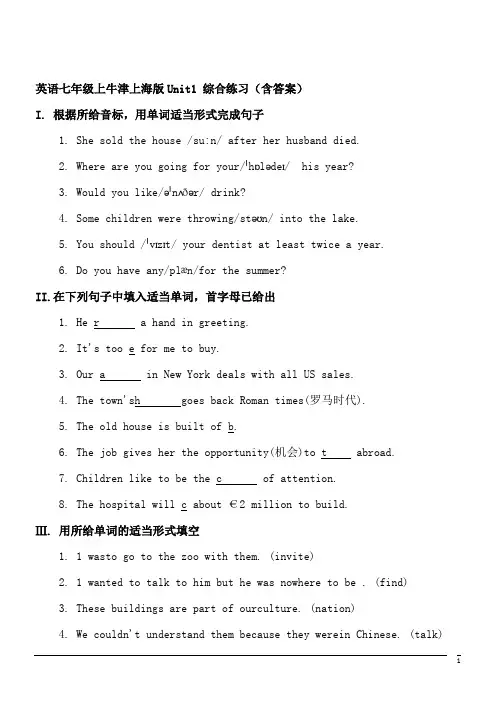
英语七年级上牛津上海版Unit1 综合练习(含答案)I. 根据所给音标,用单词适当形式完成句子1. She sold the house /su:n/ after her husband died.2. Where are you going for your/ˈhɒlədeɪ/ his year?3. Would you like/əˈnʌðər/ drink?4. Some children were throwing/stəʊn/ into the lake.5. You should /ˈvɪzɪt/ your dentist at least twice a year.6. Do you have any/plæn/for the summer?II.在下列句子中填入适当单词,首字母已给出1. He r a hand in greeting.2. It's too e for me to buy.3. Our a in New York deals with all US sales.4. The town'sh goes back Roman times(罗马时代).5. The old house is built of b.6. The job gives her the opportunity(机会)to t abroad.7. Children like to be the c of attention.8. The hospital will c about €2 million to build.Ⅲ. 用所给单词的适当形式填空1. 1 wasto go to the zoo with them. (invite)2. 1 wanted to talk to him but he was nowhere to be . (find)3. These buildings are part of ourculture. (nation)4. We couldn't understand them because they werein Chinese. (talk)5. It him two hours to repair his bike yesterday. (take)6. My brother saw some beautifulswimming on the lake on Sunday. (swan)7. They're going toa big museum on the site of the old powerstation.(building)8. The planeabout 300 passengers. (hold)IV. 根据句意和汉语注释写出单词的正确形式1. His(照片)appeared in the local paper.2. We had to hear about the whole journey from beginning to(结束).3. Cycling is a(便宜的)way to get around.4. These plants will add(吸引力;乐趣)to your garden in winter.5. We spent a week walking in the(高山).6. He is going to deal with the problem(另一)day.Ⅴ. 将下列单词或词组填入空格。
牛津上海版七年级英语上册Unit1重点句型及能力训练
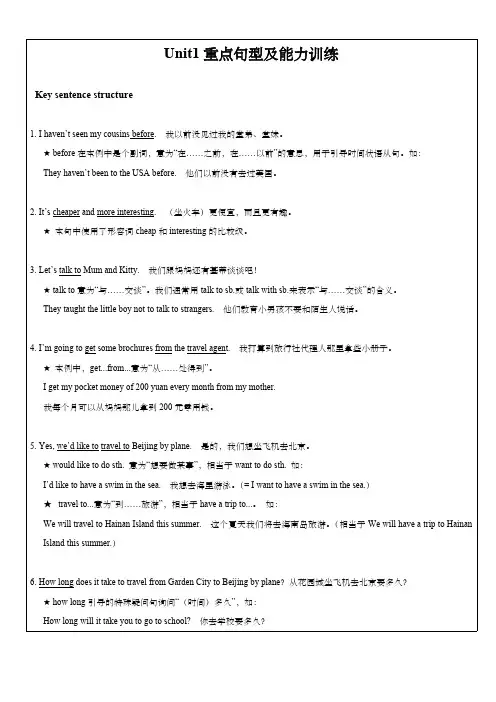
Unit1重点句型及能力训练Key sentence structure1. I haven’t seen my cousins before. 我以前没见过我的堂弟、堂妹。
★ before在本例中是个副词,意为“在……之前,在……以前”的意思,用于引导时间状语从句。
如:They haven’t been to the USA before. 他们以前没有去过美国。
2. It’s cheaper and more interesting. (坐火车)更便宜,而且更有趣。
★本句中使用了形容词cheap和interesting的比较级。
3. Let’s talk to Mum and Kitty. 我们跟妈妈还有基蒂谈谈吧!★ talk to意为“与……交谈”。
我们通常用talk to sb.或talk with sb.来表示“与……交谈”的含义。
They taught the little boy not to talk to strangers. 他们教育小男孩不要和陌生人说话。
4. I’m going to get some brochures from the travel agent. 我打算到旅行社代理人那里拿些小册子。
★本例中,get...from...意为“从……处得到”。
I get my pocket money of 200 yuan every month from my mother.我每个月可以从妈妈那儿拿到200元零用钱。
5. Yes, we’d like to travel to Beijing by plane. 是的,我们想坐飞机去北京。
★ would like to do sth. 意为“想要做某事”,相当于want to do sth. 如:I’d like to have a swim in the sea. 我想去海里游泳。
(= I want to have a swim in the sea.)★travel to...意为“到……旅游”,相当于have a trip to...。
牛津上海版七年级英语上册Unit1重点知识复习
牛津上海版七年级英语上册Unit1重点知识复习一、备课思路本节课主要是学习新的词汇,,使学生掌握重要的词汇及其用法。
二、New lesson一)词汇1. guide n. 指南;手册You’d better buy a travel guide when you are travelling in a foreign country. 当你在外国旅行时,你最好买一本旅游指南。
Design a travel guide. 设计一份旅游指南。
【提示】guide 还可以表示“导游”。
如:The guide showed them around Paris. 导游带领他们参观了巴黎。
【拓展】guide 作动词时,可以表示“为……领路,带领”。
如:Jack guided the old man to the information desk. 杰克把老人领到问讯处。
2. tour n.旅行;旅游Can you give us some tour suggestions? 你能给我们一些旅行建议吗?【联想】tourist n.游客,旅游者3. take part in 参加(活动)如:We’ll take part in the sports meeting this Friday. 本周五我们要参加运动会。
They have decided to take part in a competition. 他们决定参加一个竞赛。
【比较】take part in与join 都有“参加”的意思。
take part in 表示参加某项活动;join表示参加或加入某个团体或组织。
如:He joined the Party ten years ago.他十年前入党。
I’ll join the Youth League next month. 下个月我要入团。
【提示】take part in = join in4. sightseeing n.观光;游览Tourists usually go there for sightseeing and fun.游客们通常会去那儿观光游玩。
牛津上海版七年级上unit1核心词汇 备课资料
牛津上海版七年级上unit1核心词汇备课资料篇1:牛津上海版七年级上unit1核心词汇备课资料(沪教牛津版英语七年级)Unit 1 Relatives in Beijing(七年级上册牛津上海版)核心词汇1. invite [in'vait] v. 邀请【词性转换】invitation [.invi'tein] n. 邀请;请柬I’ve invited the Smiths to visit us next Friday. 我已经邀请史密斯一家下周五来家玩。
2. expensive [iks'pensiv] adj. 昂贵的【近义】dear adj. 贵的【反义】cheap adj. 便宜的I think international calls are very expensive. 我认为国际电话费用很高。
3. talk to sb. 与某人谈话= talk with sb.He stopped to talk to me when seeing me. 看到我的时候,他停下来和我说话4. brochure ['bru] n. 资料手册I’l l send you the brochure right away. 我会马上把资料手册给您寄去。
5. agent ['eidnt] n. 代理人;经纪人【词性转换】agency ['eidnsi] n. 代理处6. soon [su:n] adv. 不久;很快;马上She will be back soon. 他马上就会回来。
7. at the end of (August) 在(八月)底【提示】at the end of本意为“在……末端”,用于表示时间、空间中临近结束的意思。
【反义】at the beginning of 在……的起点There is a post office at the end of the street. 街道的尽头有一家邮局。
牛津上海版七年级英语上册Unit1 Relatives in Beijing Reading 课件
12345
5-5
The Palace Museum
It is in the centre of Beijing. It is a place with many ancient buildings. If tourists want to know the history of China, they can visit the museum.
5-1
Look and talk
Work in pairs. Suppose you are at the travel agent’s. You are S2 and you are asking the agent for some information. S1, the agent, should try to answer your questions.
12345
3-1
Think and write
Mr Li received a (1) ___l_e_t_t_e_r__ from his
(2)
_____b_r_o_t_h_e,rWeiming. Weiming is Ben and Kitty’s (3)
______u_n_c_le_. He lives in (4) _____B_e_i_ji_n_g.
(22)
__________a_t_t_h_e__e_n_d_o_f__A_u_g_u_s_t_. We are going to stay
there for (23) __________t_w_o_w__e_e_k_s__.’
They decided to go there by (24) ____p_la_n_e___ . Taking a
牛津上海版英语七年级上册Module 1 Relationships. Unit 1
Unit 1 Relatives in Beijing.综合能力训练新词对对碰:重点词语达达标I. 根据句意及首字母或汉语提示完成单词。
1. A loud scream broke the s______ of the night.2. A little French can be really u______ when you are in Paris.3.It is not easy to be professional e-sports p______.4.It is very c_______for us to go out in the city centre.5.The students are talking n______ when the teacher came in.要点跟踪练:重点知识演练场I. 单项选择。
1.As we all know, Xinjiang is ________ of China.A.west B.in the west C.on the west D.to the west 2.—Shall we buy some food for this spring outing?—_______.A.I'm sorry B.It's OK.C.That's not true.D.That's a good idea. 3.—Remember to wash your hands before you have lunch.—_______.A.That's all right.B.That's great.C.All right.D.Not at all.4._______ great fun it is to make a snowman on a snowy day!A.What B.What a C.What an D.How5.—My brother has never seen the film Finding Dory.—_______.A.Neither does my sister B.So has my sisterC.Neither has my sister D.So does my sisterII. 完成句子。
Unit1知识要点梳理总结牛津上海版七年级英语上册
Unit 1 知识要点1. Can I help you?•用法:表示“有什么需要帮忙的吗?”,是商店营业员、旅游中心工作人员等常用的服务用语。
•例句:o Can I help you? 有什么需要帮忙的吗?o Can you help me with this? 你能帮我一下吗?o Can you tell me how to get to the station? 你能告诉我怎么去车站吗?2. How long does it take to travel from Garden City to Beijing by plane?•用法:表示“从花园城乘飞机到北京需要多长时间?”。
•例句:o How long does it take to get to the top of the mountain? 从山脚到山顶需要多长时间?o How long does it take to cook this dish? 这道菜要煮多长时间?o How long does it take to learn English? 学英语要多长时间?3. How much does it cost?•用法:表示“要花多少钱?”。
•例句:o How much does this cost? 这件衣服多少钱?o How much does a ticket to the concert cost? 音乐会票多少钱?o How much does a cup of coffee cost? 一杯咖啡多少钱?4. See you soon.•用法:表示“再见”。
•例句:o See you soon. 再见。
o See you later. 待会儿见。
o See you tomorrow. 明天见。
5. Simon and Lucy want to take Ben and Kitty to some interesting places.•用法:句中的take意为“带去,引领”。
牛津上海版七年级英语上册Unit1重点知识复习及练习
2) 形容词比较级+than the other+复数名词。
例如:Asia is bigger than the other continents on the earth.亚洲是地球上最大的洲◆形容词的常用结构:◇a + adj + n a tall boy ◇be + adj. He is tall.◇keep/find/make/think… it adj. to / that …… ◇be + as + adj. + as do + as + adv. + as1)形容词在句子中的句法作用及位置:⑴ 作定语,放在名......词的前面....,.修饰名词。
结构:a/an/ …_______ 名词 ★ 后置的情况:修饰复合不定代词时放在代词之后。
如:Something serious has happened to him .(他发生了严重的事故) 1. Every minute there is _____going on here.A. exciting somethingB. something excitingC. exciting anythingD. anything exciting 2. This river is about 5 feet ________. A. deep B. widely C. depth D. Length★ 少数形容词只能作定语这些形容词包括 little, live , elder, eldest 等,只能作定语,不能作表语。
例如:(正)My elder brother is a doctor. (误)My brother is elder than I. (正)This is a little house.(误)The house is little. (正)Do you want live fish or dead one?(误)The old monkey is still live.⑵作表语时放在连系动词之后,构成系表结构。