
2017七年级英语下册Unit 2集体备课教案
2017七年级英语下册Unit 2集体备课教案2017七年级英语下册Unit 2集体备课教案Unit 2 W?单元备课Language goals:l In this unit students learn to talk about asking for and give dNew languages:l Excua bank near here?lIt’l Way phone?l It’s a/ next to // behind the libral It’s betwand the libral Just go straight and turn ll Turn left on First Avenue.l Take a walk through the paAvenue.l Ta clean / dirty park near my house. Difficul:ListeningaaghborhoodRead the tour guide and an e-mail from a friend you’re going to vWdialogues about asking the way and giving d2. Where quAffirmative staPlace Teaching aids:l A taderluresTeaching periods:Period 1:A1a, 1bPeriod 2:A2a, 2b, 2cPeriod 3:A3a, 3bPeriod 4:B 1a, 1b, 1c, 2a, 2b, 2cPeriod 5:B 3a, 3bPeriod 6: Sel第单元第课时总第课时Period 1教学内容:A1a, 1b教学目标:Teachingaims:Teach vocabulary words.2. Target languages: Ia bank near here?It’教学重点:Enabludask for and give d教学难点:Heludask for and give d教学步骤:Teaching procedures:Warming uwuared before claudents. Ta cat in a boxure 1. Ta cat on a boxure 2. Ta cat under the boxuThen audask and answqu2.Match work (2a)Audadure and the wordumbered lAudatch each word or phralist wuTanswPwaThen audad the dialoguuListening (1b)Audlversations and circle the plaaangles and do the same agaThen students ask and answerwithouldingPraPdlocawure. Ask dudame eaTlocations and ludaHomewPraversaure on pag2. Leaw words and phrad by heart.第单元第课时总第课时Period 2教学内容:A2a, 2b, 2c教学目标:Teaching aims:Learn the vocabulary words and useful ex2. Target languages:The paalibraThe paxlibraThe pabetwand the libraThe paGThe palibraThe pabehind the libra教学重点:Enabludalk aboua pla教学难点:Heludalk aboua pla教学步骤:Teaching procedures:Revision and warming uwork by talking abouuage 7 wudaures with dbuildingand ludents practice asking and answering quabout the plaAuda2. Presentation (2a)Introduaxt to, betwbehind andDraw the following pictublackboard.Paurage or heludanswer: It’s alibraThe same way goes with nexandAudatch eawuThen audad the sixand mauanswListening(2b)Review the buildings andames in Activity 1a andthe six2a.The read the six2blaAudlding and fillblaPlay the taanswPractice (2c)Audaversations ading.Auddo the Pair work asking and answering quabout the plaaGrammar FocusAudadgrammar box aloud. The aanswllowing quxplalanguagudents can’t understand.Homewl Audactice talking aboughborhood in pairs. 第单元第课时总第课时Period 3教学内容:A3a, 3b教学目标:Teachingaims:Teach vocabulary words.2. Target languages:Just go straight and turn lIt’s down BridggIt’s next to a superma教学重点:Enabludalk aboughborhood.教学难点:Heludalk aboughborhood.教学步骤:Teaching procedures:RevLudents look aure in activity 1a. And audanswqudway, Ia library near here? W? Ia bank near here? W?Put uure of activity 2ablackboard and aake conversa2. Presentation (3a)Guidudguaningaffic sigwures and aquabouuThen audld uleft hands andght hands to practice “left” and “right”.Pure and ludents readversaAudadversations. Then ad Paul and NauAudle plaversaut the place that Paul wants to glversations (3b)Audake conversations and answer the qubelow each pictuThe studut the plaure. And write down the answluask a paudaversaakers’ plaGameAudlook aure in Activity 1a and name all the buildings.Audadversaure in Activity 4. And then explauudThen agrouwork.Homewl Audake a similar conversaat in Activity 3a. 第单元第课时总第课时Period 4教学内容:B 1a, 1b, 1c, 2a, 2b, 2c教学目标:Teaching aims:Teach vocabulary words.2. Target languages:Ia big supermarket near your house?Ta bigsupermaNo! Ta small superma教学重点:Enabluddescribghborhood.教学难点:Heluddescribghborhood.教学步骤:Teaching procedures:Revwork by asking the following quay, Look aure in activity 3a. Suu are standing near the buildingde of NewPlease answer my quxcuse me. Ia paghborhood?Ask audent to answer quGivudentschaadialogu2.Match work (1a)Bringbuudents. (Two rulldw. Two boxbig andall. Two bottllean anddirty. Two pictures of abusy andquiet.)Say, Look at the rulers, please. Can you find the dbetw? Yes. Tld. (Show the old ruler.) Andw. (Show the new ruler.) Do you understand old and new? Audalk abouuPach half of each picture and ask about the dbetwalvGo on wuach the languagAudawords wuPair wall aversauThen audwairs and take turns asking eaquabouglases in activity 1a on pagListening (2a, 2b)Audlape and circle the plaa.Say: Now please lape again. Land draw the plaael’s neighborhoodap. Just lPlading.Plading agaThen havudwleted drawinglaPair wAudwairs talking about drawinglaThen aadialogulaAudwairs, draw a mawn neighborhood and practice asking and answering quabout the plalive in. Homewl Audake similar conversaat in Activity 1b.第单元第课时总第课时Period 5教学内容:B 3a, 3b教学目标:Teachingaims:Teach vocabulary words.2. Target languages:Turn left on First Avenue and’s quand small paTake a walk through the paAvenue.Tbeginninggarden tour.Bridge is a good place to have fun.教学重点:Enabludwrite a tour guide and draw the rouw教学难点:How to write a tour guide and draw the rouw教学步骤:Teaching procedures:Revwork by asking abouudent’s neighborhood.AudwaAudwaThen aaversawhole cla2. Reading (3a,3b)Audad the tour guide.Divide the whole claur groups to have a quTell the studwords down and make at least twwith each word after claAfter that audlook aures and fillblaur guidWritingAudwrite a tour guide wudNames of buildings and locaDwordsWords that talk abouWords that talk about dPair work (4b)Learn to draw a pictughborhood. First audanswer the quaccordinguThen auddraw a picture accordingllowing conversaThen ask studdrawingwhole class.HomewAudalk abouand buildingwn neighborhood.2. Audawdworddowlass.第单元第课时总第课时Period 6教学内容:Sel教学目标:Teaching aims:Teach vocabulary words.2. Target languages:I know you are arriving next Sunday.Lll you the wauIu have a good教学重点:Enabludwrite aboughborhood.教学难点:Heludlearn how to write aboughborhood.教学步骤:Teaching procedures:Revwork by asking and answering some quGivudents chaa2.Key word check(1) Audwordw.Then auddxVocab-Builders (2)Expand the students’ vocabulaAfter that audalist wudReadingAudad the letter and draw the rouap.Audange the la telversaLudents pay auay, Look aure of Sally. How old do you? Where do you? What language do youaks? What do youlikes?What do youdislikes?The sagoes wand JulAfter a few minutes, audad their dlaust for Fun!Call aversaaAudadversation and then answer the quHomewl Auddllowing:uur friend is going to visit you. He doesn’t know the way to your house. Writea lllubuur hou2. Review the next unit.教学后记:。
人教版新目标七年级英语下册 Unit 2教学设计

人教版新目标七年级英语下册 Unit 2教学设计一. 教材分析人教版新目标七年级英语下册Unit 2主要围绕日常生活话题,让学生学会描述日常活动、表达喜好和计划。
本单元包括三个部分:听说课、读课和综合语言运用课。
听说课主要训练学生的听说能力,读课通过阅读提高学生的理解能力,综合语言运用课则培养学生的综合语言运用能力。
二. 学情分析七年级的学生已经掌握了基本的英语语音、词汇和语法知识,具备一定的听说读写能力。
但部分学生对英语学习仍存在恐惧心理,缺乏自信心。
因此,在教学过程中,教师需要关注学生的情感态度,激发他们的学习兴趣,提高课堂参与度。
三. 教学目标1.知识目标:学生能够掌握日常生活中常用的词汇和表达方式,如goto school, read books, watch TV等。
2.能力目标:学生能够在真实情境中运用所学知识进行日常交流,提高听、说、读、写的能力。
3.情感目标:学生能够积极参与课堂活动,提高学习英语的自信心和兴趣。
四. 教学重难点1.重点:学生能够熟练运用日常词汇和句型描述日常生活。
2.难点:学生能够正确使用一般现在时表达习惯性动作和喜欢的事物。
五. 教学方法1.任务型教学法:通过完成各种实际任务,让学生在实践中学习、运用英语。
2.情境教学法:创设真实的语境,激发学生的学习兴趣和积极性。
3.情感教学法:关注学生的情感需求,营造轻松、愉快的学习氛围。
六. 教学准备1.教师准备:提前备课,熟悉教材内容和教学目标。
2.学生准备:预习新课内容,复习相关知识点。
3.教学资源:准备多媒体教学课件、图片、实物等。
七. 教学过程1.导入(5分钟)利用图片或实物展示日常生活中的人物和活动,引导学生谈论他们的日常喜好。
例如,展示一张学校操场上的图片,让学生描述图片中学生在做什么。
2.呈现(10分钟)教师通过PPT展示本节课的主要词汇和句型,如go to school, read books, watch TV等,并用例句展示如何运用这些词汇和句型。
2017七年级英语下册Unit 2集体备课教案
2017七年级英语下册Unit 2集体备课教案2017涓冨勾绾цnit 2Unit 2 Where is the post office? Language goals: l In this unit students learn to talk about asking for and give directions on the street. New languages: l Excuse me, is there a bank near here? l Yes, there is. It鈥檚on Center Street. l Where is the pay phone? l It鈥檚across from / next to / in front of / behind the library. l It鈥檚between the post office and the library. l Just go straight and turn left. l Turn left on First Avenue. l Take a walk through the park on Center Avenue. l There is a clean / dirty park near my house. Difficult points: 1. Listening for the information of the names of the neighborhood Read the tour guide and an e-mail from a friend you鈥檙e going to visit. Write the dialogues about asking the way and giving directions. 2. Where questions. Affirmative statements Prepositions of place Teaching aids: l A tape recorder l Some pictures Teaching periods: Period 1: Section A1a, 1b, 1c Period 2: Section A2a, 2b, 2c Period 3: Section A3a, 3b, 4 Period 4: Section B 1a, 1b, 1c, 2a, 2b, 2c Period 5: Section B 3a, 3b, 3c, 4 Period 6: Self Check 绗?鍗曞厓绗?璇炬椂璇炬椂Period 1 ection A1a, 1b, 1c eaching aims: 1. Teach vocabulary words. 2. Target languages: Is there a bank near here? Yes, there is. It鈥檚on Center Street.閲嶇偣锛欵nable the students to ask for and give directions on the street.闅剧偣锛欻elp the students to ask for and give directions on the street.?Teaching procedures: Step 1. Warming up Show three pictures prepared before class to the students. There is a cat in a box in picture 1. There is a cat on a box in picture 2. There is a cat under the box in picture 3. Then ask some students to ask and answer these questions. Step 2.Match work (2a) Ask the students to read the picture and the words in the numbered list. Ask the students to match each word orphrase on the list with one of the pictures. Then check the answers. Present the new sentence patterns. Then ask the students to read the dialogue in the picture. Step 3. Listening (1b) Ask the students to listen to the conversations and circle the places in 1a. Change the roles and do the same again. Then students ask and answer without the help of the recording. Step 4. Practice Point to the different locations shown in the picture. Ask different students to name each one. Then point to more locations and let the students to practice more. Homework 1. Practice the conversation in the picture on page 7. 2. Learn the new words and phrases in this period by heart. 绗?鍗曞厓绗?璇炬椂璇炬椂Period 2 ection A2a, 2b, 2ceaching aims: 1. Learn the vocabulary words and useful expressions. 2. Target languages: The pay phone is across from the library. The pay phone is next to the library. The pay phone is between the post office and the library. The pay phone is on Greet Street. The pay phone is in front of the library. The pay phone is behind the library. nable the students to talk about the position of a place. elp the students to talk about the position of a place. ?Teaching procedures: Step 1. Revision and warming up Check the homework by talking about the pictures on page 7 with the students or prepare some other pictures with different buildings in it and let the students practice asking and answering questions about the places. Ask the students to practice more. Step 2. Presentation (2a) Introduce the items across from, next to, between, in front of, behind and on. Draw the following picture on the blackboard. Park 3 Centre Street Encourage or help the students to answer: It鈥檚across from the library. The same way goes with next to, on and in front of. Ask the students to match each sentence with one of the pictures. Then ask the students to read the six sentences and match the sentences the pictures. Check the answers. Step 3. Listening(2b) Review the buildings and street names in Activity 1a and the six sentences in 2a. The read the six sentences in 2b to the class. Ask the students tolisten to the recording and fill in the blanks. Play the tape. Check the answers. Step 4. Practice (2c) Ask the students to repeat the conversations after the recording. Ask the students to do the Pair work asking and answering questions about the places in 1a. Step 5.Grammar Focus Ask the students to read the sentences in the grammar box aloud. The ask them to answer the following questions. Explain some language points if the students can鈥檛understand. Homework l Ask the students to practice talking about their neighborhood in pairs. 绗?鍗曞厓绗?璇炬椂璇炬椂Period 3 ection A3a, 3b, 4 eaching aims: 1. Teach vocabulary words. 2. Target languages: Just go straight and turn left. It鈥檚down Bridge Street on the right. It鈥檚next to a supermarket.nable the students to talk about the neighborhood. elp the students to talk about the neighborhood. ?Teaching procedures: Step 1. Revision Let the students look at the picture in activity 1a. And ask some students to answer some questions in order to check the homework. Say, Is there a library near here? Where is it? Is there a bank near here? Where is it? Put up the picture of activity 2a on the blackboard and ask them to make conversations. Step 2. Presentation (3a) Guide the students to guess the meanings of the three traffic signs. Show the pictures and ask some questions about the pictures. Then ask the students to hold up their left hands and then their right hands to practice 鈥渓eft鈥?and 鈥渞ight鈥? Point to the picture and let the students read the conversation. Ask the students to read the conversations. Then ask them to find Paul and Nancy in the picture. Ask the students to role play the conversation then point out the place that Paul wants to get to. Step 3. Complete the conversations (3b) Ask the students to make conversations and answer the questions below each picture. The students point out the place in the picture. And write down the answers on the line in the pictures. Or ask a pair of students to say the conversation, the others point to the speakers鈥?place. Step 4. Game Ask the students to look at the picture in Activity 1aand name all the buildings. Ask some students to read the conversation in the picture in Activity 4. And then explain the instruction to the student. Then ask some groups to present their work. Homework l Ask the students to make a similar conversation to that in Activity 3a. 绗?鍗曞厓绗?璇炬椂璇炬椂Period 4ection B 1a, 1b, 1c, 2a, 2b, 2c eaching aims: 1. Teach vocabulary words. 2. Target languages: Is there a big supermarket near your house? Yes, there is. There is a big supermarket. No! There is a small supermarket.閲嶇偣锛欵nable the students to describe the neighborhood.elp the students to describe the neighborhood. ?Teaching procedures: Step 1. Revision Check the homework by asking the following questions. Say, Look at the picture in activity 3a. Suppose you are standing near the building on the side of New Street. Please answer my questions. Excuse me. Is there a pay phone in the neighborhood? Ask another student to answer questions. Give more students chances to practice this dialogue. Step 2.Match work (1a) Bring in some objects or pictures to the students. (Two rulers, one is old, the other is new. Two boxes, one is big and the other is small. Two bottles, one is clean and the other is dirty. Two pictures of a street, one is busy and the other is quiet.) Say, Look at the rulers, please. Can you find the difference between them? Yes. This one is old. (Show the old ruler.) And this one is new. (Show the new ruler.) Do you understand old and new? Ask the students to talk about the picture. Point to each half of each picture and ask about the difference between the halves. Go on with the other pictures to teach the language items. Ask the students to match the words with the pictures. Step 3. Pair work Call attention to the conversation in the picture. Then ask the students to work in pairs and take turns asking each other questions about the things on the list of phrases in activity 1a on page 7. Step 4. Listening (2a, 2b) Ask the students to listen to the tape and circle the places in 1a. Say: Now please listen to the tape again. Listen to it and draw the places in Michael鈥檚neighborhood on the street map. Justlisten. Play the recording. Play the recording again. Then have some students show their completed drawing to the class. Step 5. Pair work Ask the students to work in pairs talking about drawings to the class. Then ask some pairs to present their dialogues to the class. Ask the students to work in pairs, draw a map of their own neighborhood and practice asking and answering questions about the places they live in. Homework l Ask the students to make similar conversations to that in Activity 1b. 绗?鍗曞厓绗?璇炬椂璇炬椂Period 5 ection B 3a, 3b, 3c, 4 eaching aims: 1. Teach vocabulary words. 2. Target languages: Turn left on First Avenue and enjoy the city鈥檚quiet streets and small parks. Take a walk through the park on Center Avenue. This is the beginning of the garden tour. Bridge is a good place to have fun. nable the students to write a tour guide and draw the rout to somewhere.ow to write a tour guide and draw the rout to somewhere.锛?Teaching procedures: Step 1. Revision Check the homework by asking about the student鈥檚neighborhood. Ask the students to work in pairs. Ask the students to work in pairs. Then ask some pairs to present their conversations to the whole class. Step 2. Reading (3a, 3b) Ask the students to read the tour guide. Divide the whole class into four groups to have a quiz. Tell the students to keep these words down and make at least two sentences with each word after class. After that ask the students to look at the pictures and fill in the blanks for this tour guide. Step 3.Writing Ask the students to write a tour guide with the students. Names of buildings and locations. Description words Words that talk about positions. Words that talk about directions. Step 4. Pair work (4b) Learn to draw a picture of neighborhood. First ask the students to answer the questions according to the pictures. Then ask the students to draw a picture according to the following conversation. Then ask students to present their drawings to the whole class. Homework 1. Ask the students to talk about the street and buildings in their own neighborhood. 2. Ask the students to make sentences withthe description words they kept down in the class. 绗?鍗曞厓绗?璇炬椂璇炬椂Period 6 elf Check eaching aims: 1. Teach vocabulary words. 2. Target languages: I know you are arriving next Sunday. Let me tell you the way to my house. I hope you have a good trip.nable the students to write about the neighborhood. elp the students to learn how to write about the neighborhood. ?Teaching procedures: Step 1. Revision Check the homework by asking and answering some questions. Give more students chances to practice. Step 2.Key word check(1) Ask the students to check the words they know. Then ask the students to do the some exercises. Step 3.Vocab-Builders (2) Expand the students鈥?vocabulary. After that ask the students to share their list with other students. Step 4. Reading Ask the students to read the letter and draw the rout on the map. Ask the students to change the letter into a telephone conversation. Let the students pay attention to the pictures. Say, Look at the picture of Sally. How old do you think she is? Where do you think she is from? What language do you think she speaks? What do you think she likes? What do you think she dislikes? The same step goes with Jim and Julie. After a few minutes, ask some students to read their descriptions to the class. Step 5. Just for Fun! Call attention to the conversation in the cartoons. Ask the students to read the conversation and then answer the questions. Homework l Ask the students to do the following: 1. Suppose your friend is going to visit you. He doesn鈥檛know the way to your house. Write a letter to him to tell him the route from the bus stop to your house. 2. Review the next unit. ?。
英语人教版七年级下册Unit2 教学设计
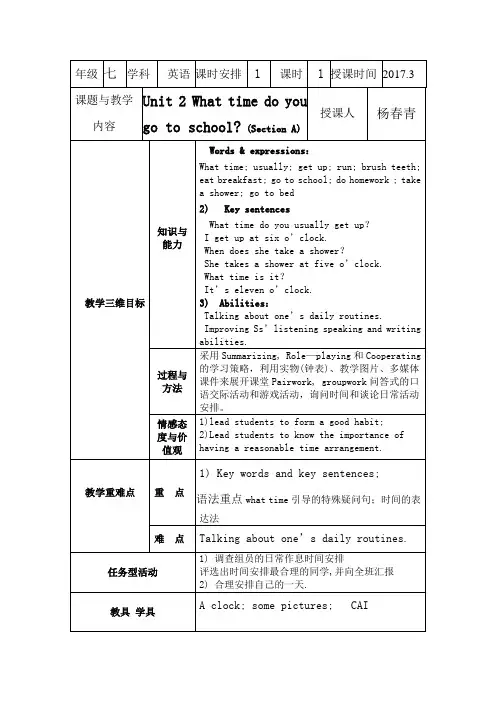
渗透德育,培养习惯 合作交流,取长补短
2. Who has the best timetable ? (Choose and report.)
1. daily activities
1)lead students to form a good habit; 2)Lead students to know the importance of having a reasonable time arrangement.
1) Key words and key sentences;
教学重难点 重 点2)语法重点 what time 引导的特殊疑问句;时间的表
设计意图
1.Q:Do you like singing?(Ss and T listen to the song and learn to sing it.)
学唱歌曲,激发兴趣。 感知语言项目
What time is it?
2.Q: What’s this ? (using a clock)
利用实物,创设情境, 导入新课。 方法
情感态 度与价
值观
What time do you usually get up? I get up at six o’clock. When does she take a shower? She takes a shower at five o’clock. What time is it? It’s eleven o’clock. 3) Abilities: Talking about one’s daily routines. Improving Ss’listening speaking and writing abilities. 采用 Summarizing, Role—playing 和 Cooperating 的学习策略,利用实物(钟表)、教学图片、多媒体 课件来展开课堂 Pairwork, groupwork 问答式的口 语交际活动和游戏活动,询问时间和谈论日常活动 安排。
七年级下册英语unit2教案
七年级下册英语unit2教案英语教案作为反映英语教师知识组织形式、教学行为方式差异的具体表征,是教师职业能力发展的重要体现。
下面是小编为大家精心整理的七年级下册英语unit2教案,仅供参考。
七年级下册英语unit2教案范文Unit 2 What time do you go to school?Section A (1a-2d)一、教学目标:1. 语言知识目标:1) 能掌握以下单词:up, get up, dress, get dressed, brush, tooth (pl. teeth) brush teeth, shower, take a shower, usually, forty, fifty, wow, never, early, job, work, station, radio station, o'clock, funny, exercise 能掌握以下句型:① —What time do you usually get up? —I usually get up at six thirty.② —When do you go to work? —I usually go to work at eleven o'clock. ③ —He has an interesting job. —He works at a radio station.2) 用when和what time引导的特殊疑问句询问时间和时间的表达法;用所学的目标语言对生活和学习活动做计划,学会合理地安排作息时间。
2. 情感态度价值观目标:本部分的话题是“日常作息时间”,学习内容贴近学生的生活,因为学生的作息时间安排是非常有规律的。
通过互相询问或谈论自己或对方的作息时间安排和活动计划,可以培养学生良好的作息习惯和守时习惯。
二、教学重难点1. 教学重点:1) 掌握时间的简单表达方式。
2) 学习询问和谈论时间和制订作息时间表。
七年级下册英语unit2教案
设计
1.抄写重点单词和短语
2.完成导学案课后巩固
3.预习课本2d-Grammar focus
板书
设计
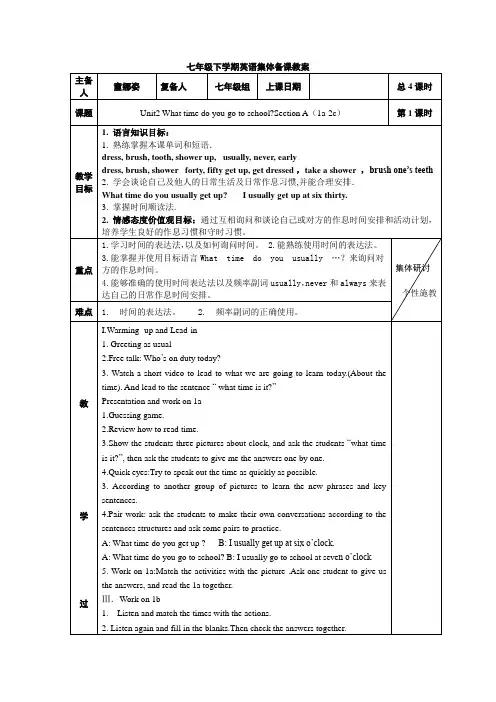
Unit2 What time do you go to school?Section A(1a-2c)
1.重点句型:特殊疑问词+助动词+主语+动词短语?
What time do you get up/get dressed/brush teeth/take ashower/eat breakfast/go to shool?
A: What time do you get up ?B: I usually get up at six o’clock.
A: What time do you go to school?B: I usually go to school at seven o’clock
5.Work on1a:Match the activities with the picture.Ask one student to give us the answers, and read the1atogether.
4.Quick eyes:Try to speak out the time as quickly as possible.
3. According to another group of pictures to learn the new phrases and key sentences.
4.Pair work: ask the students to make their own conversations according to the sentences structures and ask some pairs to practice.
教师备课——英语七年级下UNIT2教案2

教师备课——英语七年级下UNIT2教案2。
1.教材分析我们需要对UNIT2的教材进行一次深入分析。
在这个单元里,主要涉及到动词的使用。
我们要帮助学生握be动词、have和do的用法,从而能够正确使用这些动词构造句子。
此外,该单元还涉及到人称代词,并引导学生熟悉人称代词的用法。
单元课程也引入了一些形容词,帮助学生学会如何用形容词描述物品或事物。
通过深入分析,我们可以清晰地了解到本单元的教学重点内容和核心难点。
2.教学目标基于上述对教材的分析,我们可以明确具体的教学目标。
在此单元中,我们主要要求学生能够:(1)了解be动词、have和do的用法,熟练运用这些动词构造句子;(2)掌握人称代词的用法,运用人称代词替换名词;(3)学会使用形容词描述事物或物品,能够在交流中使用形容词。
3.教学设计基于教材分析和教学目标,我们需要进行详细的教学设计。
我们可以通过提供一些生动的语言材料,向学生展示be动词、have和do 的用法。
在这个过程中,可以帮助学生发现一些常见的语言规律和用法,如肯定句、否定句和疑问句等。
同时,也可以通过练习帮助学生熟悉这些动词的使用方法。
我们可以引导学生熟悉人称代词的使用。
通过对语言材料的分析和练习,学生可以逐渐理解代词在句子中的作用和用法,并掌握有效地使用人称代词进行交际的技能。
我们可以引入形容词,让学生重点了解形容词与名词搭配方法,并且在生活实践中加强彼此搭配的印象。
在此过程中,教师要注意语言的生动性和趣味性,让学生更好地理解用法,同时,鼓励他们在交流中积极运用词汇。
4.教学评估在教学过程中,我们需要对学生的掌握情况进行评估。
在这个过程中,我们可以使用各种形式的评估方法,如听力、口语、阅读和写作等,以帮助学生全面地巩固并使用教材中的词汇和语法。
5.课后回顾最后要注意的是,教师在教学结束后,应该对教学过程进行总结和回顾,以保证学生可以更好地理解和掌握所学的内容。
在回顾过程中,可以和学生讨论一些重点难点,从而加深对其的印象,巩固所学的知识。
译林版英语七年级下册 Unit2集体备课教案
2、These two teams will readAmy’spart, please.And these two will readSimon’spart, please.Then exchange roles.
3、Work in pairs and make up your own conversation about your neighbourhood.
check(line 10)vt.to examine sth to see if it is correct, safe or satisfactory (检查)
college(line 13)n.auniversitywherestudentscan study for a degree after they have left high school (学院)
(3)Whendo they meet?
2、Mini-dictionary
anyone(line 12)ed instead of someone in negative sentences and in questions(任何人)
broken(line 11)adj.has been damaged or injured, no longer whole or working correctly(哦那个坏了的,破碎的)
Step III操练
1、指导学生完成A部分了解彼此邻居的职业情况。教师可以与一位学生进行示范。
帮助学生根据实际情况用已有的知识回答。
Step IV呈现
1、Amyis askingSimonsome questions.What are these questions about?Please listen to the tape and tell me.
七年级下册英语unit2教案
七年级下册英语unit2教案教案标题:七年级下册英语Unit 2教案教学目标:1. 学习并掌握有关学校设施和课程的词汇和表达方式。
2. 能够运用所学知识进行日常对话,描述自己的学校设施和课程。
3. 培养学生的口语表达能力和听力理解能力。
4. 培养学生的合作意识和团队合作能力。
教学重点:1. 学习有关学校设施和课程的词汇和表达方式。
2. 进行听力训练,提高学生的听力理解能力。
3. 进行口语训练,培养学生的口语表达能力。
教学准备:1. PPT或教学课件。
2. 学生课本和练习册。
3. 学生小组活动所需的材料。
教学过程:Step 1: 导入(5分钟)1. 通过展示一些学校设施的图片,引起学生对话题的兴趣。
2. 引导学生回忆并讨论自己学校的设施,鼓励他们用英语进行简单的描述。
Step 2: 学习词汇和表达方式(15分钟)1. 教师通过PPT或教学课件展示学校设施和课程的词汇,并进行发音讲解。
2. 学生跟读词汇,并进行词汇练习,如单词拼写、选择题等。
3. 学生进行词汇对话练习,操练如"How many classrooms are there in your school?"等句型。
Step 3: 听力训练(15分钟)1. 教师播放录音,学生听录音并回答相关问题。
2. 学生进行听力练习,如填空、选择题等。
Step 4: 口语训练(20分钟)1. 学生分组进行小组活动,讨论并描述自己学校的设施和课程。
2. 学生展示他们的讨论成果,分享自己的观点和意见。
3. 教师进行点评和指导,帮助学生改进口语表达。
Step 5: 练习册活动(10分钟)1. 学生完成练习册上与本单元内容相关的练习题。
2. 教师检查学生的练习册,给予必要的指导和反馈。
Step 6: 总结与拓展(5分钟)1. 教师总结本节课的重点内容,并与学生一起回顾所学知识。
2. 鼓励学生运用所学知识进行更多的口语练习,如与同学交流学校设施和课程的情况。
七年级英语下册unit2教案
七年级英语下册unit2教案英语教案代表着教师对课堂的假设与预想。
小编整理了关于七年级英语下册unit2教案,希望对大家有帮助!七年级英语下册unit2教案范文Unit 2 I can run really fast.Ⅰ.Type of lesson: reading and writingⅡ.Teaching aims:1.To understand the reading material about running for class monitors2.To learn to write a speech about running for a class monitorⅢ.Teaching aids: T ape recorder,videos,OHPⅣ. 课时安排:2 课时Ⅴ. Teaching procedureStep 1. Lead-in1.Ask students what they can do very well and say, "He/She is good at..."2.Ask the students to model the question "What are you good at?" Ask them to interview their partners and make notes.Step 2 . Work in pairs. Ask and answer the questions.1. Write the three monitor titles on the board. Ask the class what they are.2. Put students in pairs to ask each other both questions. Tell them to make a list of what they think each monitor does3. Ask three students to come up to the board and write one thing under one of the titles. Then give the chalks or pens to someone else.Step 3 .Read the passage and check ( √ ) the true sentences.1.Tell students that Lingling, Darning and Tony want to be monitors. Ask students to read quickly to find which monitorsthey want to be.2. Ask students to read again. This time they can use their fingers to skim through and underline the things Lingling,Darning and Tony are good at.3. Ask students to check in pairs and elicit answers from the whole class.4. Ask students to read the sentences on page 11, and talk about them in pairs and guess the answers.5. Ask students to read the passage again and decide if the sentences are true or false. If false,then say why.6. Ask students to check with their partners.If their answers are different,tell them to go back to the text,read again and check.7.Ask students to read out the sentences and say if they are true or not. If not ,ask them to say why.Step 4 Underline the correct words.1. Ask students to work in pairs. Tell them to read through the passage and choose the correct words.2. Check answers by reading the passage aloud and pausing to allow the whole classto complete it with the correct words.Step 5 Complete the sentences with the correct form of the expressions from the box.1. Ask students to look at the expressions in the box.2. Ask students complete the sentences on their own and be careful with the language forms.3. Check in pairs. Elicit answers from the whole class in full sentences.Step 6 Work in pairs. Choose the best people in your class to be the monitors in Activity 1.Say: who they are and what job they can do and why they can do it1. Write titles of the three monitors across the board.2. Ask the class for two volunteers for each monitor. Write their names underneath.3. Put volunteers in pairs to talk about what they are good at, can do well and how they can help.4. Ask the rest of the students to make a table as below with three questions about their abilities to ask the volunteers. Put it on the board.Questions Student 1 Student 2 Student 3 Student 4 Student 5 Student 6Good at?Can do?Can help?5.Tell students to talk in groups about their notes,and decide who should be their monitors and say why.Step 7 Homework1. Remember the new words and expressions in Unit2.2 . Write a passage about one of the monitors in Activity 5.Ⅵ Blackboard showingⅦ Self-reflection.英语教学非智力因素探讨1.中学英语教学中非智力因素发展现状1.1中学生普遍缺乏真正的学习动机学习动机和学习兴趣是学生非智力因素中非常重要的一部分,兴趣是最好的教师,只有学生能够真正对英语感兴趣,才能让学生产生对英语的内在需求,才能真正激发他们的非智力因素。
人教版七年级英语下册第二单元集体备课
七年级英语单元集体备课Unit 2 What time do you go to school?一、教材分析本单元主要学习用when和what time引导特殊疑问句询问时间的表示方式,学习表示频率的副词。
通过“谈论日常作息时间”这一话题,该单元设计了三个主要的学习任务型活动。
任务一:谈论自己的作息习惯,学习不同时间点的表达方式;任务二:学习运用when和what time来询问和表达作息时间安排;任务三:收集社会上有关作息时间安排的情况,复习巩固所学的知识。
通过本单元的学习,同学们能学会安排好自己的日常活动,并且能够了解和转述他人的日常生活安排。
Section A以Rick和Jim兄妹的日常生活习惯,以及记者对Scoot的采访为线索开展各项语言训练活动。
在语言能力方面,侧重训练学生听别人谈论日常活动,并简单谈论自己一天的活动。
在语言方面,则侧重词汇、习语的储备和语法训练,并学习询问时间问句What time...?When...?以及时间的简单表达法(顺读法)。
Section B是Section A的深化和拓展,本部分介绍了更复杂的时间表达法(逆读法);在语言技能层面上,Section B进一步训练、发展听说技能的基础上,重点转向读写技能及语言综合素养的培养及提升。
教学重点:1、时间表达法。
2、询问时间的句型:What time do you usually get up?When does Scott go to work?3、频度副词的用法:usually、never、always等。
教学难点:1、时间表达法。
2、频度副词的用法。
二、学情分析七年级学生通过一个学期的学习,掌握所学单元的交际用语和单词,有了一定的语言能力,但对于本课未接触过的语言点,仍有待教师的指导,综合运用英语的能力还有待进一步的提高;本单元的中心话题与学生的生活密切相关,因此我们在教学过程中,应结合学生的实际情况,激发学生兴趣,让学生主动学习,学有所获。