
六年级下册Module2 Unit1 When are you going to eat 外研版三起(含答案及解析)
六年级下册Module2 Unit1 When are you going to eat 外研版三起(含答案及解析)一、单选题(共10题)1.I________ going to play football tomorrow.A.isB.areC.am2.There're some________ in the tree.A.birdB.a birdC.birds3.We're going to ____ a picnic in the park.()A.haveB.hasC.having4.We're going to walk ____ the lake. ()A.roundB.overC.around5.It's going to ____ in Beijing. ()A.hotB.be hotC.to snow6.— What are you going to do today?— _____________. ()A.What's this?B.I'm going to go to the park to play.C.What are you doing?7.My brother is going to________ the 200 metres.A.runningB.runsC.run8.— When are we going to eat?— __________ 12: 00. ()A. AtB.InC.On9.I miss everyone _____ China. ()A.onB.atC.in10.—When are you going to visit your friend?—________ half past eight.A.InB.AtC.On二、填空题(共5题)11.Daming and Simon________(骑自行车)to________(观看棒球赛) last Sunday.12.Look!There are some________ ________in the________.13.Now we can have________(一支棒球队)14.This________(美国宇宙飞船)took a man into space.15.选择合适的应答语。
A. At eleven o'clock.B. I don't think so.C. I'm going to swim with Tim.D. It's five o'clock.E. He is going to take pictures.(1)What time is it?________(2)When are you going to the zoo?________(3)What is Jim going to do?________(4)It's going to rain soon.________(5)What are you going to do?________三、句型转换(共5题)16.They are going to row a boat tomorrow. (就画线部分提问)________ are they going to________ tomorrow?17.They are going to eat at six o'clock. (就画线部分提问)________ ________ they going to eat?18.I'm going to play chess with Bob. (变为一般疑问句)________ you going to________ ________ with Bob?19.It's ten o'clock. (就画线部分提问)________ ________ is it?20.Sam is going to the supermarket with his mum. (变为否定句)Sam________ going to the supermarket with his mum.答案部分第 1 题:【答案】C【考点】动词【解析】【分析】句子意思是: 我明天......打算踢足球。
这是be going to结构的句子,主语是第一人称I, 谓语动词be用am. 故答案为:C.【点评】这是考查动词适当形式的题目。
要掌握主谓一致原则。
第 2 题:【答案】C【考点】名词【解析】【分析】句子意思是: 树上有一些...... 因为有some"一些"修饰, 因此bird应该复数。
A选项和B 选项都是单数, 只有C是复数。
故答案为: C.【点评】这是考查词汇适当形式的题目。
要掌握名词的复数。
第 3 题:【答案】A【考点】动词【解析】【分析】本题含义为:我们将在公园里野餐。
be going to后接动词要使用原形,故选A。
【点评】本题考查动词在将来时中的运用。
第 4 题:【答案】C【考点】介词【解析】【分析】本题含义为:我们将绕着湖走。
我们不可能在湖上面走,只能绕着湖,不能是B,A选项是形容词,圆形的,故选C。
【点评】本题考查介词的运用。
第 5 题:【答案】B【考点】动词【解析】【分析】本题含义为:北京的天气要热了。
be going to后接动词要使用原形,A选项需要一个be 动词才完整,C选项多了to,故选B。
【点评】本题考查动词在将来时中的运用。
第 6 题:【答案】B【考点】疑问句【解析】【分析】本题含义为:你今天要做什么?我打算去公园玩。
问题为特殊疑问句,询问今天将要做什么,需要回答出要做的事情,故选B。
【点评】本题考查特殊疑问句的运用。
第7 题:【答案】C【考点】动词【解析】【分析】句子意思是:我的妈妈打算......200米。
be going to结构后面跟动词原形,A选项是现在分词;B选项是单三形式;只有C选项是动词原形。
故答案为:C.【点评】这是考查动词适当形式的题目。
要掌握be going to结构的用法。
第8 题:【答案】A【考点】介词【解析】【分析】本题含义为:我们什么时候吃饭?12点。
具体到几点钟的“在”要求使用at,故选A。
【点评】本题考查介词的运用。
第9 题:【答案】C【考点】介词【解析】【分析】本题含义为:我想念中国的每一个人。
China是个国家,属于大的地方,“在”需要用in,故选C。
【点评】本题考查动词在将来时中的运用。
第10 题:【答案】B【考点】介词【解析】【分析】句子意思是: —你打算什么时间去看你的朋友?— ......8点半。
表示具体在几点几分用介词at, 这是固定搭配。
In修饰时间具体到月和周,on具体到日。
都不适合。
故答案为:B.【点评】这是考查介词的题目。
要掌握介词和时间的搭配用法。
第11 题:【答案】rode their bicycles;watch baseball game【考点】陈述句【解析】【分析】last Sunday上周星期天。
判断句子用一般过去时。
骑自行车ride a bicycle,ride bicycles。
骑他们的单车ride their bicycles。
ride的过去式rode。
看球赛,看电视等要用watch,to表示不定式结构,即to do sth。
用动词原形。
观看棒球赛watch baseball game。
故填rode their bicycles,watch baseball game。
【点评】固定搭配,时态判断。
第12 题:【答案】dark;clouds;sky【考点】单词拼写【解析】【分析】句子意思是:看!天空......有一些....... 根据图片是天空中有一些乌云,乌云"dark cloud", 用some修饰, cloud用复数clouds, 在天空中用介词in. 故答案为:1. dark;2. clouds;3. sky.【点评】这是考查词汇的题目。
要根据图片意思来补全句子,注意适当形式。
第13 题:【答案】 a baseball team【考点】冠词,名词【解析】【分析】棒球队baseball team,baseball的第一个字母发音是辅音音素所以用 a 。
故填a baseball team。
【点评】名词和a,an考查。
第14 题:【答案】American spaceship【考点】名词,形容词【解析】【分析】宇宙飞船spaceship。
this表示这个,后面接名词单数。
美国的American,是形容词。
故填American spaceship。
【点评】单词识记和用法。
第15 题:【答案】(1)D(2)A(3)E(4)B(5)C【考点】疑问句,情景交际【解析】【分析】所给答语的意思是:A. At eleven o'clock. 在11点。
B. I don't think so. 我不这样认为。
C. I'm going to swim with Tim. 我打算和Tim去游泳。
D. It's five o'clock. 时间是5点。
E. He is going to take pictures. 他打算照相。
(1)问句的意思是:什么时间了?问句问时间,回答用D. It's five o'clock. (时间是5点。
) 故答案为: D. (2)问句的意思是: 你什么时间去动物园?问去动物园的时间,回答用A. At eleven o'clock. (在11点。
) 故答案为: A.(3)问句的意思是: Jim打算做什么? 问Jim做什么, 回答用E. He is going to take pictures. (他打算照相。
) 故答案为: E.(4)句子的意思是: 天气很快要下雨。
这是谈论天气,答语用B. I don't think so. (我不这样认为。
) 故答案为: B.(5)句子的意思是: 你打算要做什么? 问你要做什么,回答用C. I'm going to swim with Tim. ( 我打算和Tim 去游泳。
) 故答案为: C.【点评】这是考查问答的题目。
根据问句和答语的意思进行匹配即可。
第16 题:【答案】What;do【考点】句型转换【解析】【分析】句子意思是:明天他们打算去划船。
划线部分是谓语动词,变疑问句用What......do(做什么)来提问,故答案为:1. What;2. do.【点评】这是考查句型转换的题目。
外研版(三起)(2012)小学英语六年级下册Module2Unit1Whenarewegoingtoeat$%Module2Unit1Wh
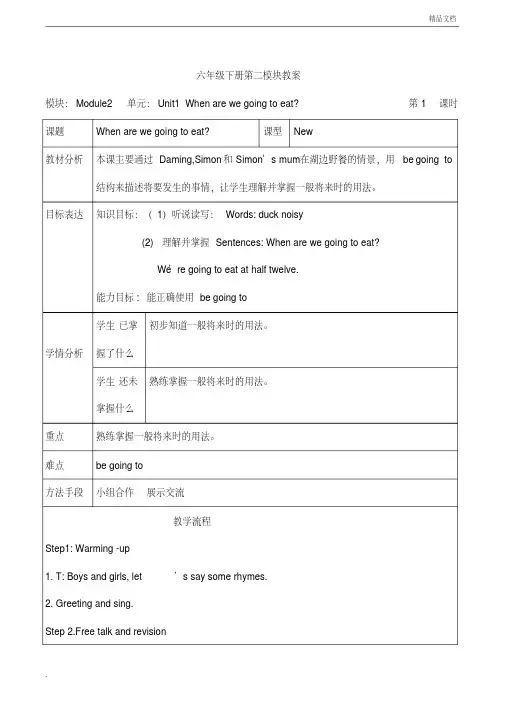
六年级下册第二模块教案模块:Module2 单元:Unit1 When are we going to eat? 第 1 课时课题When are we going to eat? 课型New教材分析本课主要通过Daming,Simon和Simon’s mum 在湖边野餐的情景,用be going to 结构来描述将要发生的事情,让学生理解并掌握一般将来时的用法。
目标表达知识目标:(1)听说读写: Words: duck noisy(2)理解并掌握 Sentences: When are we going to eat?We’re going to eat at half twelve.能力目标: 能正确使用be going to学情分析学生已掌握了什么初步知道一般将来时的用法。
学生还未掌握什么熟练掌握一般将来时的用法。
重点熟练掌握一般将来时的用法。
难点be going to方法手段小组合作展示交流教学流程Step1: Warming -up1. T: Boys and girls, let’s say some rhymes.2. Greeting and sing.Step 2.Free talk and revisionT: What do you like doing in your spare time?S: I like playing football/reading books…T: What are you going to do this Sunday?S: I am going to…T: When are you going to …?S: I am going to …at eight /in the morning.Step 3. LeadingT: Do you want to know, what did Daming, Simon and Simon’s mum do during the weekend? Step 4. Presentation and new teaching1. Look at the screen.2. Write these questions on the board. (让学生看生动的动画,带着问题自学课文,并找出疑难。
六年级下册英语教案-Module 2 Unit1 When are we going to eat
六年级下册英语教案-Module 2 Unit1 When are we going toeat -外研版教学目标1.学生能够听懂、理解并运用日常口语中询问时间和回答时间的表达方式;2.学生能够用英语交际,表达自己的计划和时间安排;3.学生能够听懂并运用日常口语中询问和谈论食物的表达方式;4.学生能够运用语言形式主动参与课堂交流。
教学重点1.掌握短语“have breakfast/lunch/dinner”和日常口语中的词汇;2.掌握问句中的疑问词“when”以及相应句型;3.锻炼听懂并运用简单的时间和食物表达方式;4.通过小组互动,提高学生的口语交际能力。
教学难点1.能够运用英语表达自己的时间安排;2.能够听懂并运用日常口语中询问和谈论食物的表达方式。
教学课时2课时教学内容教学步骤步骤1:导入新课1.引导学生回忆上节课所学内容,并引出本节课的主题:询问时间。
2.向学生展示一张钟表图片,询问学生现在的时间,并呈现一些日常时间,如早餐时间、上学时间、做作业时间等,让学生说出这些时间的英文表达形式。
步骤2:新课讲解1.播放短片《My schedule》,引导学生关注短片中人物的安排和时间。
2.出示“when”的单词卡片,让学生猜测单词意思,并引导学生发散想象:如何用英语表达时间。
3.呈现“when are we going to eat?”的问句,让学生观察其中的疑问词和动词,以达成目的。
4.帮助学生学习时间表达方式,如“What time is it?”、“It’s …”、“I have breakfast/lunch/dinner at…”等。
步骤3:语言运用1.利用磁贴,编制几个关于时间的对话,让学生按照提供的单词卡片,完成对话。
例子:A: When do you usually get up?B: I usually get up at … .A: When do you have breakfast?B: I have breakfast at … .2.分组角色扮演,让学生通过模拟真实情境,练习对话、询问时间、计划活动等。
外研版六英语Module 2《Unit 1 When are we going to eat?》教案
外研版六年级下册英语Module 2《Unit 1 When are we going to eat?》教案一、教材分析:本教材是外研版六年级下册 Module 2《Unit 1 When are we going to eat?》,主要包括两个对话:活动一和活动二。
通过这两个对话,学生将学习如何运用一般将来时态表达将来的活动,并学会用句型"When are we going to...?" 来询问时间并进行回答。
同时,学生还将通过对话了解和体会大自然的美丽,培养对待动物的正确看法。
二、教学目标:1. 语言知识目标:能够听、说、读并理解活动一和活动二的对话。
能够运用 "be going to + 动词原形" 来表达一般将来时态。
能够用句型 "When are we going to...?" 来询问时间并进行回答。
能够正确朗读活动二的对话。
2. 思维能力目标:能够对语篇信息进行分析。
能够体会提问的技巧。
3. 学习能力目标:能够通过教学活动调动学生的积极性,在教师创设的情境中大胆尝试用英语进行交流。
4. 文化意识目标:能够体会大自然的美丽,培养正确对待动物的看法。
三、教学重难点教学重点:能够用一般将来时态的句型来提问并能够回答对活动二对话的理解和认读。
教学难点:对一般将来时态句子的正确运用。
四、学情分析:学生是六年级学生,已经学习了一些基础的英语知识,包括一般现在时态和一些基本的句型。
他们对于时间的表达和询问可能还不够熟练,对于一般将来时态的句子运用也需要进行深入的学习和训练。
在兴趣方面,学生对于大自然和动物可能有一定的好奇和兴趣,可以通过这些主题引发他们的学习兴趣。
五、教学过程:Step 1: Lead-inShow pictures of different activities such as eating, playing, and reading on the board or using a multimedia tool. Ask students to name the activities they see. Encourage them to use complete sentences, such as "I see someone eating."Elicit the question "What are you going to do?" and explain that we can use this question to ask about future plans. Write the question on the board.Teacher: What activities do you see in the pictures? Let's describe them using complete sentences. For example, "I see someone eating."Student 1: I see children playing soccer.Student 2: I see a girl reading a book....Step 2: PresentationPresent the dialogue for Activity 1 on the board or using a multimedia tool. Read the dialogue aloud and ask students to listen and follow along.Play the audio recording of the dialogue and ask students to listen and repeat after the audio.Explain any new vocabulary or expressions in the dialogue, and write them on the board.Divide the class into pairs and ask them to practice the dialogue together, taking turns playing the roles of the characters.Teacher: Now, let's listen to a conversation between Amy and Mike. Pay attention and follow along in your books.[Read the dialogue aloud]Teacher: Great! Now, let's listen to the audio and repeat after it.[Play the audio recording]Teacher: In the dialogue, Amy and Mike are talking about their plans. Can you tell me what they want to do? What did Amy invite Mike to do?Student 1: Amy invited Mike to eat ice cream.Teacher: That's right! Amy invited Mike to eat ice cream. What did Mike say?Student 2: Mike said he was going to play soccer....Step 3: PracticeIntroduce the dialogue for Activity 2. Read the dialogue aloud and ask students to listen and follow along.Play the audio recording of the dialogue and ask students to listen and repeat after it.Ask comprehension questions about the dialogue to ensure students understand the content.Model and practice the question "When are we going to...?" and appropriate answers using the dialogue as examples.Divide the class into pairs or small groups and ask them to role-play the dialogue, taking turns asking and answering questions about the activities.Teacher: Now, let's move on to Activity 2. Listen to aconversation between Lucy and Ben. Pay attention to their plans and the time they mention.[Read the dialogue aloud]Teacher: Let's listen to the audio and repeat after it.[Play the audio recording]Teacher: Good job! Now, let's check your understanding. When is Lucy going to visit her grandparents?Student 1: Lucy is going to visit her grandparents on Saturday.Teacher: Excellent! Now, using the dialogue as an example, let's practice asking and answering questions using "When are we going to...?"Student 2: When are we going to play video games?Teacher: We are going to play video games on Sunday afternoon....Step 4: Grammar ExplanationIntroduce the concept of "be going to + verb" to express future actions.Write examples on the board and explain the structure and usage of the future tense.Provide additional examples and encourage students tocreate their own sentences using the future tense.Teacher: Now, let's focus on the grammar. We use "be going to + verb" to talk about future actions. The form is "am/is/are + going to + base verb." For example, "I am going to eat ice cream."[Write the example on the board]Teacher: Can you give me more examples using "be going to + verb"?Student 1: She is going to read a book.Student 2: We are going to play soccer....Step 5: Guided PracticeGive students a worksheet or handout with sentences in the present tense. Ask them to rewrite the sentences using the future tense.Circulate around the class, providing assistance and feedback as needed.Teacher: Now, let's practice using the future tense. I will give you a worksheet with sentences in the present tense. Your task is to rewrite the sentences using the future tense. For example, "I eat breakfast" should be rewritten as "I am going to eat breakfast."[Give out the worksheets]Teacher: Work individually and let me know if you have any questions.Step 6: Independent PracticeDistribute worksheets or handouts with a set of questions asking about future plans.Instruct students to write their answers using the future tense.Collect the worksheets and provide feedback on their use of the future tense.Teacher: Now, I will give you a worksheet with questions about future plans. Your task is to answer the questions using the future tense. For example, "When are you going to visit your grandparents?"[Hand out the worksheets]Teacher: Take your time to complete the worksheet. When you're done, please pass them to me, and I will provide feedback on your use of the future tense.Step 7: ClosureReview the key points of the lesson, including the use of "be going to + verb" and the question "When are we going to...?"Summarize the main learning objectives and ask students ifthey feel more confident using the future tense.Teacher: Before we finish, let's quickly review what we've learned today. Can someone tell me when we use "be going to + verb"?Student 1: We use "be going to + verb" to talk about future actions or plans.Teacher: Exactly! And how do we form the future tense using "be going to"?Student 2: We use "am/is/are + going to + base verb" to form the future tense.Teacher: Great job, everyone! Today, we practiced asking and answering questions about future plans using "When are we going to...?" I hope you feel more confident using the future tense now. Keep up the good work!六、板书设计:Module 2: Unit 1 When are we going to eat?Key Vocabulary:eatplayreadGrammar:be going to + verbQuestion:When are we going to...?七、教学反思:本节课通过引入不同的活动图片,激发了学生对于未来计划的兴趣。
新外研版六年级英语下册Module 2 Unit 1 When are we going to ea

Let’s relax
She is going to watch TV.
They are going to play football .
She is going to go swimming.
She is going to read a book.
A: What are you going to do? B: I am going to…
A
一般过去时态
描述 过去 发生 的事
BБайду номын сангаас
描述 正在 发生 的事
be + Ving
C
描述 将来 发生 的事
be going to +动词原形
用来表示按划或要发生的动作,有“准备;打算”的意 思。 1.I am going to watch TV。 2.We are going to have a picnic. 3.It is going to rain. 4.Lingling and Daming are going to walk around
A:When are we going to eat?
B:We’re going to eat at half past twelve.
I’m going to get up and have breakfast
Breakfast ? Let’s half past eleven. You are going to have a lunch.
Look!
It’s going to rain soon.
Listen and read the answer.
When are you going to
eat?
外研社小学英语六年级下册 module 2 第1课时 Unit 1 When are we going to eat

播放《微视频Weekend plans知识点总结》和《微视频时间表达法》,总结be going to和时间表达法。
4.第三次播放录音,请学生跟读,然后教师请三名学生在班内展示。
T:Boys and girls, listen to the tape again, and read.
E.g.Whenis / are…going to…?
I’m / He’s / She’s going to…
让学生在交流中大量运用所学句型,加深记忆。
借助游戏,激发学生的学习兴趣,帮助其巩固核心句型。
Step 4
Production
10分钟
Pair work
1. Look and write
教师请学生看图,说出各个时钟显示的时间和图片表现的活动名称。然后请学生朗读例句,仿照示例,独立写出其余三个问题的答句。再请学生两人一组开展问答活动。最后请部分小组朗读对话,全班核对答案。
能力目标
1.能够准确朗读课文,围绕主题展开对话。
2.能运用本课所学句型be going to…谈论计划或打算。
情感目标:
1.培养学生将学到的英语知识运用到生活中的能力,提高学生的交际能力和实践能力。
2.培养学生学习英语的积极性,帮助他们建立英语学习的成就感和自信心,形成的良好的学习策略。
教学重点
用be going to谈论意图和计划。
学习新词汇,为后面的课文学习作铺垫。
初步了解课文内容。
内化语言知识,及时突破重难点。进一巩固本课知识。Step 3
Practice
8分钟
Individual
Whole class
1.Listen andsay
外研版英语六年级下册Module2 Unit1
Practise.
They’re going to play football at eight o’clock .
Practise.
When(What time)are we(you/they) going to eat? We(They) are going to eat at half past twelve.
Simon’s Mum: It looks like you’re going to stay hungry, Simon!
Listen and say.
Simon: When are we going
to eat?
Mum: At half past twelve.
Daming: Look at the ducks!
They’re eating our sandwiches!
Practise.
Look and write. Then ask and answer.
A: When are we going to the park? B: _W_e_’_re__g_oi_n_g_t_o_t_h_e_p_a_r_k_a_t_e_le_v_e_n_.
New words.
duck 鸭子
u
bus 公共汽车
jump 跳
New words.
There are some ducks on the pond.
pond 水池,池塘
New words.
late r later
late (形容词)迟的,晚的 later (副词)后来,以后
New words.
Practise. 根据图片提示完成句子。
1. Xiaoqiang is going to__g_e_t u_p___at half past six. 2. Lucy is going toh_a_v_e_ b_r_e_a_k_f_a_s_t at_e_i_g_h_t_ o'clock. 3.A: When are you _g_o_in_g_t_o _t_h_e _p_ar_k___?
Module2+Unit1+When+aoing+eat_+(课件)外研版(三起)英语六年级下册
分析
When are we going to eat, Mum? when 什么时候 (特殊疑问词)
问:When be going t-o---+ 动词?
什么时候将要去做某事?
答: be going to... at + 时间
基本结构
一般将来时 be going to
那边比较干。快跑,孩子们! ----
over thereFra bibliotek在那边Oh on, look at the ducks! They're eating our sandwiches!
哦不,看这些鸭子!它们在吃我们的三明治。
Naughty ducks! 淘气的鸭子!
It looks like you're going to stay hungry, Simon!
later......
I'm hungry. When are we going to eat, Mum?
我饿了。我们什么时候吃饭,妈妈?
At half past twelve. 十二点半。
----
What time is it now? 现在几点了?
It's only half past eleven. One hour to go! Look, there are some ducks on the pond.
(A) 11:30 (B) 12:3I0am(Cgo) in11g:0to0stu(dDy)fo1r2t:h0e0test tomorrow.--- (B)
3.What does Simon's mum say at the end of the
六年级下册英语教案-Module 2 Unit 1 When are you going to ea
六年级下册英语教案-Module 2 Unit 1 When are you going toeat∣外研社(一起)教学目标1.学习并掌握本课时的词汇和语法。
2.培养学生对时间和日常活动的表述能力。
3.通过编写日程表,帮助学生规划并安排自己的学习和生活。
教学重难点1.教学重点:本课时的时态和句型。
2.教学难点:如何用英语描述自己的日程安排。
教学过程1.课前准备:–确定教学对象和课时内容。
–准备PPT和教材。
–确定教学方式和教学方法。
2.导入新课:–引入本课时的语法,让学生先看一遍,带着问题理解。
–引入本课时的生词,帮助学生记住单词的发音和意思。
–给学生做一些语言输入方面的铺垫,引导学生逐步进入课堂。
3.语法、服务和重点难点讲解:–通过教材的内容讲解本课的语法。
–利用图片、实物等多媒体教学手段帮助学生理解生词。
–将重点难点清晰地讲述,并结合具体例句和图示进行解释。
4.练习:–培养学生运用所学知识和语言进行低水平的语言输出。
–鼓励学生在课前准备后,课下积极练习,提高英语口语表达水平。
–通过模仿、对话、听力练习等形式进行英语表达训练。
5.总结:–总结本节课的重点和难点,复习学过的语法和生词。
–提醒学生下节课的学习安排和任务,将课程内容有机地链接在一起。
6.课后自主学习:–给学生一份小作业,让他们操作实践所学知识。
–鼓励学生课下模仿、练习和复述,提高语言表达能力。
语言输出When are you going to eat? I am going to eat at six thirty.日程表设计时间活动地点6:00起床卧室6:30吃早饭餐厅7:00上学学校12:00午饭学校餐厅17:00放学学校17:30做作业家中18:30吃晚饭餐厅19:00看电视客厅20:00洗澡卫生间21:00睡觉卧室总结本课时主要让学生学习了如何用英语描述日常生活中的活动,并引导学生将活动安排在一张日程表上。
同时,本课还学习了一些基础的语法知识,如一般将来时。
外研版六年级英语下册Module 2 Unit 1 -be going to结构句型
表示打算做某事或计划做某事
tomorrow , next week/month/year , this evening, in 2050…
主语 + be going to + 动词原形
be 动词随主语的变化
⑴I am going to play football.
而改变
He is going to go fishing.
13、He who seize the right moment, is the right man.谁把握机遇,谁就心想事成。2021/7/292021/7/292021/7/292021/7/297/29/2021
• 14、谁要是自己还没有发展培养和教育好,他就不能发展培养和教育别人。2021年7月29日星期四2021/7/292021/7/292021/7/29
__W__h_a_t__i_s_ she _g_o_i_n_g_ _t_o___d_o_____
this term?
4.They're going to go to Beijing by bus.(对划线部分提问)
__H_o__w_ _a_r_e__ they _g_o_in__g __t_o___g_o____ to
the Beijing?
5.The students of Class Three have a field trip on Sunday.(用next Sunday改写)
The students of Class Three __a_r_e_____ __g_o_i_n_g__ ___t_o____ __h_a_v_e____ a field trip next
Are we going to
六年级下册英语教案-Module 2 Unit 1 When are we going to eat
六年级下册英语教案-Module 2 Unit 1 When are we going toeat一、教学目标1.学生能够听懂、掌握询问和表示时间的英语表达方式。
2.学生能够在日常生活中正确地使用时间表达方式。
3.学生能够运用所学知识,口头表达自己的日程安排。
二、教学内容及时间分配时间活动5分钟复习上一课时所学内容15分钟呈现新课内容,介绍核心词汇及表达方式20分钟听力训练及语音模仿20分钟语法与实际应用15分钟练习与反馈三、教学重难点1.重点:掌握核心表达方式及其应用2.难点:时间表达与日程安排的结合运用四、教学准备1.多媒体教学设备2.中英文翻译词汇表3.听力练习音频五、教学过程1. 复习上一课时所学内容先复习上一课时所学的和日期相关的英文表达方式,包括日历、星期几、月份等。
2. 呈现新课内容,介绍核心词汇及表达方式教师呈现新课内容,给学生们介绍核心的时间表达方式。
1. When are we going to eat? 2. We are going to eat at noon. 3. What time is it? 4. It’s half past ten.解释以上英文句子的意思及其背后的指代含义,确保学生们理解语言表达的核心。
3. 听力训练及语音模仿给学生们播放带有时间指示的英语语音,帮助他们熟悉不同时间段的表达方式。
同时,教师可引导学生们通过模仿语音的方式,体验和练习语言发音。
4. 语法与实际应用引导学生们运用所学语言表达方式,组成与日程安排相关的问答句,并通过小组合作进行练习以加深记忆。
例如,你准备什么时候去上学?我准备在早上六点半之前出门。
5. 练习与反馈对学生们进行练习与反馈,帮助他们巩固所学内容。
教师可以在教室内放置时钟或日历,引导学生们用所学语言表达出其指示的时间或日期,以帮助他们更好地记忆。
六、课后作业让学生们回家后,运用所学表达方式,写一份自己的日程安排表,并准备在明天到校后互相之间分享并更正。