
2019年pep人教版六年级英语上册Unit 3 My weekend plan单元测试题(含答案)
Unit 3My weekend plan满分:100分时间:60分钟得分:听力部分一、听录音,判断图片与内容是否相符,相符的画“”,不相符的画“”。
(10分)1. 2. 3.4. 5.二、听录音,选择正确的答案。
(10分)()1. What’s Mike going to do?A. Play sports.B. Read the new books.C. Visit his aunt.()2. Where is Miss Smith going?A. To the supermarket.B. To the shoe store.C. To the hospital.()3. Where is Miss White going?A. To school.B. To the library.C. To the hospital.()4. What is Sarah going to buy?A. A magazine.B. A dictionary.C. A comic book.()5. What’s John going to do?A. Take a trip.B. Play basketball.C. Have an art lesson.三、听录音,判断正(T)误(F)。
(10分)()1. Mike’s family has a holiday plan.()2. Mike is going to play football on Monday.()3. Mike’s father is going to go swimming with his friends.()4. Mike’s family are going to the park on Wednesday.()5. On Friday Mike’s mother is going to clean the house.笔试部分四、选择正确的答案。
(10分)()1. What you this weekend?A. are; going toB. do; doC. are; going to do()2. Thank you for to my birthday party.A. you comingB. comeC. coming()3. your friends going to Beijing summer holiday?A. Is; theB. Are; thatC. Are; this()4. —is your father going to Xiamen?— At 9:00 tomorrow.A. HowB. WhereC. When()5. He is going to the supermarket his mother.A. andB. withC. to()6. — Are Sarah and Amy going to take a trip?— Yes, .A. they areB. she isC. they do()7. The little girl is dogs. Please keep the dog away.A. afraid ofB. good atC. kind of()8. She is going to use books.A. anyB. lot ofC. lots of()9. I’m going to learn to swim.A. howB. whatC. where()10. — Please show me a new comic book.— OK.A. Can I help you?B. Here you are.C. Why not?1. —do you go to school?— By train.2. —are you going?— I’m going at 2 o’clock in the afternoon.3. —is Sarah going to buy the postcard?— She’s going to the post office.4. —word books are you going to buy?— Two.5. —are you going to do?— I’m going to buy some books.六、补全对话。
(10分)Tom: Hi, Tom. Tomorrow is Saturday. 1.Mike: I am going to visit my grandparents. 2.Tom: I am going to see a new film with my parents.Mike: 3.Tom: We’re going to see Where Are We Going, Daddy?Mike: Oh, it is interesting. 4.Tom: We’re going at 2 o’clock.Mike: 5.Tom: No, we’re going on foot.Mike: Have a good time!Tom: The same to you!A. What film are you going to see?B. Are you going by bike?C. When are you going?D. What are you going to do?E. What about you?七、根据汉语提示完成句子。
(10分)1. 为什么不下周去旅行呢?next week?2. 我打算周末看电影。
I’m going to this weekend.3. 她打算买一本连环画册。
She is to a .4. 今天晚上你打算做什么?are you going to do ?5. 很多学生害怕考试。
students of exams.八、仿照例句改写句子。
(10分)例句: Lily cleans her room every day. (tomorrow)Lily is going to clean her room tomorrow.1. Tina buys a new phone. (tomorrow)2. He’s watching TV now. (this evening)3. They are taking a trip now. (next week)4. Does Mary see a film in the morning? (tomorrow evening)5. What does she do? (tomorrow)九、阅读理解。
(10分)My name is Amy. Tomorrow is Saturday. We have no classes. My parents aren’t going to work, but we are going to be very busy tomorrow. My mother is going to buy some food and drinks. My father is going to visit my grandparents. I’m going to the bookstore. I’m going by bus. I’m going to buy a dictionary there. Tomorrow eveningwe are going to visit my uncle and aunt and have a big dinner. After that we are going to the cinema. I think we are going to have a nice weekend.()1. Tomorrow is .A. SaturdayB. FridayC. Sunday()2. Amy’s mother is going to .A. buy some books for AmyB. buy some food and drinksC. visit her friends()3. Amy’s father is going to .A. the officeB. visit her grandparentsC. the bank()4. Amy is going to tomorrow.A. play games with her friendsB. do her homeworkC. buy a dictionary in the bookstore()5. After having a big dinner tomorrow evening, Amy’s family aregoing.A. homeB. to the cinemaC. to the restaurant十、写作。
(10分)根据表格提示,运用be going to结构写一篇英文短文,介绍他们这个星期六的计划。
参考答案听力部分一、听力材料1. play football2. play the guitar3. a word book4. go to the zoo5. read a comic book答案:1. 2. 3. 4. 5.二、听力材料1.— Mike is going to read the new books.— Good idea.2.— Are you going to the supermarket, Miss Smith?— Yes, I am.3. — Where are you going, Miss White?— I don’t feel well. I’m going to the hospital.4. — Hello, Sarah! Are you going to the bookstore this afternoon?— Yes, I’m going to buy a comic book.5. — What are you going to do, John?— I’m going to take a trip.答案:1. B 2. A 3. C 4. C 5. A三、听力材料I’m Mike. Next week is a holiday. My family has a plan for it. On Monday I am going to do my homework. On Tuesday my father is going to go swimming with his friends. On Wednesday I’m going to go to the park with my parents. On Thursday I’m going to read my books. On Friday we are going to visit my grandparents. On Saturday my mother is going to clean the house. On Sunday we are going to the museum. I think we are going to have a nice holiday.答案:1. T 2. F 3. T 4. T 5. F笔试部分四、1. C 2. C 3. C 4. C 5. B 6. A7. A8. C9. A10. B五、1. C 2. D 3. B 4. E 5. A六、1. D 2. E 3. A 4. C 5. B七、1. Why not take a trip2. see a film3. going; buy; comic book4. What; this evening5. Lots of; are afraid八、 1. Tina is going to buy a new phonetomorrow.2. He is going to watch TV this evening.3. They are going to take a trip next week.4. Is Mary going to see a film tomorrow evening?5. What is she going to do tomorrow?九、1. A 2. B 3. B 4. C 5. B十、范文:Tomorrow is Sunday. Henry is going to take photos in a mountain. Jack is going to do some shopping in the afternoon. In the evening, he is going to watch TV. John is going to play football with his friends. Mary is going to clean her room in the morning. In the afternoon, she is going to do her homework.。
2019年人教PEP版英语六年级上册Unit3Myweekendplan优质课教案.docx.
2019年人教PEP版英语六年级上册Unit3Myweekendplan优质课教案.docx.Unit 3 My weekend planPeriod 1 Section A Let’s learn /Make a plan P25教师寄语:First things first .(重要的事情先做)Learning aims(学习目标)1.四会单词及短语:visit film trip supermarket tomorrow tonight evening see a film/ take a trip / next week2.理解句子:What are you going to do today ? I’m going to see a film. Important &difficult points(重难点)1. 能准确的读出和写出新的单词和短语。
2. 能用What are you going…? I’m going to…?进行问答练习。
Learning steps (学习步骤)Step1 : 预习温故(用时5分钟)1、T: GreetingsT: How do you come to school? S: Usually, I come on foot/…..T: Spell them , please! S: o-n, f-o-o-t/…..2、T: How can I get to Pan Zhihua ? S: You can take a bus/taxi. Step 2. 新课内容展示(用时15分钟)Let’s le ar n new phrases1)T: What are you going to do today ?(引出时间短语this morning /this afternoon/ this evening/ next week/tonight/tomorrow出示单词卡片,教读,学生小组、或同桌练习)2)T: What are you going to do this morning ?S: I’m going to visit my grandparents/ take a trip /see a film/go to the supermarket. (板书或出示单词卡片,教读,学生小组、或同桌练习)3) Listen to the tape and repeat.4) Use these new phrases to make sentences. (替换练习)Eg: What are you going to do next week/…?I’m going to see a film/…. Step 3. 合作交流,师生共建(用时10分钟)1. 领读Let’s learn 中的短语及句子,并纠正读音。
人教PEP六年级上册英语教案 《 Unit 3 My weekend plan 》第三课时

人教PEP六年级上册英语教案《 Unit 3 My weekend plan 》第三课时一. 教材分析《Unit 3 My weekend plan》是人教PEP六年级上册英语教材的第三单元,主要讲述了学生们周末的计划。
本节课时主要通过听力、口语、阅读和写作等多个方面,让学生们能够熟练掌握一般将来时的表达方式,以及如何用英语描述自己的周末计划。
二. 学情分析经过之前的学习,学生们已经掌握了一般现在时和一般过去时的表达方式,对于一般将来时的概念和结构也有了一定的了解。
但是,如何灵活运用一般将来时,以及如何用英语描述自己的周末计划,仍然是学生们需要提高的地方。
三. 教学目标1.能够熟练运用一般将来时,用英语描述自己的周末计划。
2.提高听力、口语、阅读和写作能力,增强英语应用能力。
3.培养学生们热爱生活,善于规划的好习惯。
四. 教学重难点1.一般将来时的运用。
2.如何用英语描述自己的周末计划。
五. 教学方法采用任务型教学法,通过听力、口语、阅读和写作等多种方式,让学生们在实践中掌握一般将来时的表达方式,以及如何用英语描述自己的周末计划。
六. 教学准备1.教材、课件等教学资源。
2.录音机、耳机等听力设备。
3.相关话题的图片、视频等资料。
七. 教学过程1.导入(5分钟)通过提问方式,引导学生回顾一般现在时和一般过去时的表达方式,为新课的学习做好铺垫。
2.呈现(10分钟)利用课件或实物,展示一般将来时的结构,如“I will go to the park” 等,同时引导学生观察并理解一般将来时的含义。
3.操练(15分钟)通过听力练习,让学生们听懂并能够模仿一般将来时的表达方式。
然后进行分组练习,让学生们相互描述自己的周末计划,巩固所学知识。
4.巩固(10分钟)通过阅读和写作练习,让学生们运用一般将来时描述自己的周末计划。
教师可提供一些关键词或句子模板,以降低写作难度。
5.拓展(10分钟)引导学生思考并讨论:如何规划自己的周末时间?如何合理安排学习、娱乐和休息?从而培养学生们热爱生活,善于规划的好习惯。
Unit3Myweekendplan(讲义)人教PEP版英语六年级上册
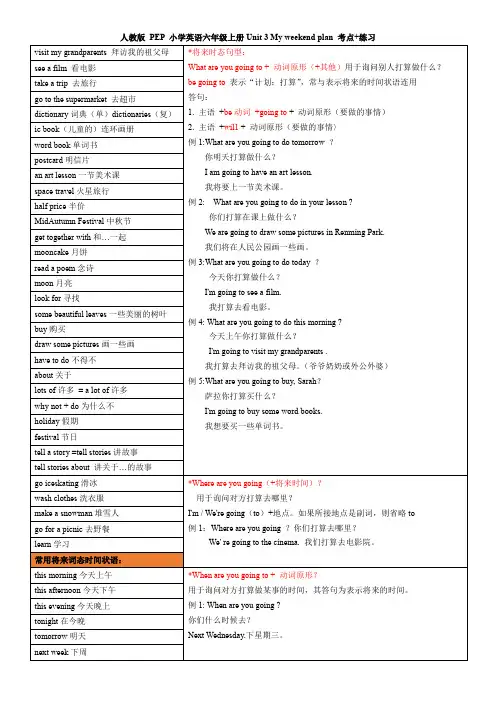
人教版PEP 小学英语六年级上册Unit 3 My weekend plan 考点+练习一、用下划线标出下列单词的重读音节。
(1)visit (2)tonight (3)postcard (4)together (5)dictionary (6)ic二、选出下列每组单词中与其他两项不同类的一项。
(1)()A.word book B.ic book C.next week (2)()A.post office B.maths book C.pet shop (3)()A.tonight B.tomorrow C.visit (4)()A.postcard B.take C.dictionary (5)()A.lesson B.moon C.sun三、英汉互译(1)明信片(2)去旅行(3)词典(4)下周(5)看电影(6)超市(7)this morning (8)get together (9)tomorrow (10)ic book四、单选题1.She a film tomorrow.A.is going to see B.seeing C.sees2.My cousin lives in Hong Kong. Next week, I her. A.visit B.is visiting C.am going to visit 3.Mike is going to visit his grandparents . A.next week B.every day C.now4.Sarah Chinese and does her homework. A.teach B.study C.studies5. I'm going to buy some .A.dictionary B.ic book C.ic books 6.—are you going to do tomorrow?—I am going to play sports in the playground.A.What B.When C.Where7. I'm going to buy a book space travel.A.about B.in C.of8.Lucy is going to Beijing .A.next Saturday B.every day C.last week 9.John is going to a ic book.A.buy B.buying C.buys10.—are you going?—We are going at 8:00.A.Who B.When C.What五、选内容补全对话。
PEP 六年级英语上Unit 3My weekend plan
Unit 3:My weekend plan我的周末计划①重点词汇:四会单词:关于时间:evening 晚上tonight 今晚tomorrow 明天next week 下周名词:film电影trip旅行supermarket 超市dictionary字典wordpostcard明信片短语:see a film 看电影take a trip 去旅行comic book 连环画册word book 单词书其他:visit 拜访trip 旅行comic滑稽的三会单词:lesson 课space太空travel 旅行(长途)half 一半price 价格mooncake月饼poem诗moon月亮Mid-Autumn Festival 中秋节get together 聚会②重点句型:A: --What are you going to do in the nature park? 在公园里你打算干嘛?--I’m going to look for some beautiful leaves。
我想找些好看的叶子。
B: What are you going to do tomorrow?你明天打算干嘛?I’m going to have an art class.我打算去上艺术课。
询问某人打算干嘛的句型:What+be动词+somebody+going to do(+时间或地点状语)be动词的形式由somebody 决定What is....going to do ?What are...going to do ?回答的句型:Somebody+be+going to +v.He/She is going to..I’m going to ...They are going to...(To be continued ..... )。
Unit 3 My weekend plan(说课稿)人教PEP版英语六年级上册
Unit 3 My weekend plan一、教学目标1.学习并掌握有关周末计划的基本日常用语。
2.通过听、说、读、写的训练,让学生能够准确地表达自己的周末计划。
3.通过本单元的学习,培养学生的交际能力。
二、教学重点1.掌握并运用本单元的词汇和日常用语2.掌握并运用实用语法,如一般现在时和情态动词can。
3.通过阅读、听力和口语训练,提高学生的阅读与听说能力。
三、教学难点1.运用一般现在时和情态动词can来表达周末计划。
2.让学生学会提出问题和回答问题的方法。
四、教学方法1.听力训练法,通过听力来训练学生的听力和口语表达能力。
2.阅读训练法,通过阅读来提高学生的阅读能力。
3.口头交流法,通过交流来训练学生的口语表达能力。
五、教学过程第一节环节首先向学生介绍本单元的主题,并通过演示让学生熟悉有关的日常用语。
比如我们可以这样问学生:1.What do you usually do on weekends?2.Do you have any plans for this weekend?教师自己可以先以自己的周末计划为例,并且逐一展示出关键词汇,如go shopping,visit grandparents等。
第二节环节接下来,介绍本单元的语法部分:一般现在时和情态动词can。
我们可以通过问题的形式来引导学生:1.简单的句子练习:What do you do on the weekends? - I play football.What does he do on the weekends? - He watches TV.What does she do on the weekends? - She visits her grandparents.2.一般现在时加can:Can you swim? - Yes, I can.Can he sing? - No, he can’t.Can she dance? - Yes, she can.3.以can为主语的句子:Can we go to the park together? - Sure, that sounds great.Can he come to my house this weekend? - Sorry, he can’t. He has other plans.第三节环节接下来,将语法和实际应用相结合,让学生运用所学的知识来描述自己的周末计划。
六年级PEP英语上册Unit3Myweekendplan知识点总结

六年级PEP英语上册Unit3Myweekendplan知识点总结六年级PEP英语上册Unit2yeeendplan知识点总结Unit3yeeendplan一、知识点归纳词汇四会nextee/eeend下周/周末nespaper报纸thisorning今天上午icboo漫画书Tiethisafternoon今天下午ordboo单词书thisevening今天晚上thiseeend这个周末dictionary 字典tonight今夜toorro明天postcard明信片taeatrip去旅游theepar主题公园activitiesseeafil看电影otherspetshop宠物店gotothesuperaret去看电影superaret超市visitygrandparents参观祖父母shoestore鞋店二、重点句式和句型:本单元中出现的一个重点语法是一般将来时:表示将要发生的动作或状态,常和表示将来的时间连用。
构成:陈述肯定句:主语+begoingto+动词原形+其他例子Iagoingtotheboostorebybusthisafternoon.He/Sheisgoingtotaeatripbytrainthiseeend.e/Theyaregoingtoseeafiltonight.否定句:主语+be+notgoingto+动词原形+其他例子Ianotgoingtotheboostorebybusthisafternoon.He/Sheisnotgoingtotaeatripbytrainthiseeend.e/Theyarenotgoingtoseeafiltonight.一般疑问句:Be+主语+goingto+动词原形+其他?例子:Areyougoingtotheboostorebybusthisafternoon?yes,Ia.No,I’not.Ishe/Shegoingtotaeatripbytrainthiseeend?yes,he/Sheis.No,he/Sheisn’t.Aree/theygoingtoseeafiltonight?yes,e/theyare.No,e/t heyaren’t.特殊疑问句:特殊疑问词+一般疑问句?例子:hatareyougoingtodothisafternoon?hereareyougoingthis afternoon?Hoareyougoingtotheboostorethisafternoon?henareyougoingtotheboostorebybus?三、重点句型:e’regoingtoseeafilaboutspacetrael!我们将要去看关于火星之旅的电影。
人教PEP版六年级上册英语Unit 3 My weekend plan作(作业设计)
Unit3 My weekend plan层次化,作业形式多元化,作业内容与生活实践相结合,并结合合理的评价反馈,让学生完成作业中实现语言目标,提升语言表达能力。
(一)、单元内容:本单元是人教版英语六年级上册的第三单元,单元的话题是“My weekend plan”本单元通过不同的场景,提供了表达活动计划、地点和时间的句型结构。
共三个版块A 部分, B部分和C 部分。
A部分包括重点词组和情景对话,共两个课时。
第一课时呈现了Sarah和陈杰讨论周末计划的场景,引出重点单词、词组和句型What are you going to do...? I’m going to ... 第二课时呈现了Mike 和Sarah打电话互相讨论明天的活动计划的场景,巩固句型What are you going to do...? I’m going to...A 部分重点掌握词组和谈论活动内容的句型What are/is...going to do...? We’re/I’m going to...He/She is going to ...B 部分包括重点词组、情景对话和读和写,共三个课时。
第一课时通过John和Jack 在电影院前讨论下一步计划的场景,很自然的引出了句型Where are you going? I’m going ...第二课时通过Amy和John回家聊的场景,呈现了句型Where are you going? I’m 第三课时呈现了谈论节日、吴一凡的日记和语音三个部分,拓展本单元的知识。
B部分重点是掌握单词和谈论计划的时间与地点的句型Where are/is ...going? We’re/I’m going to... He/She is going to... When are/is going? C 部分包括B部分的听力测试、归纳一般将来时态和C部分的故事,共一课时。
重点是复习巩固本单元所学重点词汇和句型。
人教PEP版六年级上册英语Unit 3 My Weekend Plan(说课稿)
PEP六年级上册Unit 3 My Weekend PlanPart A Let’s try Let’s talk说教材1.教材内容本节教材内容是用be going to do句型交流活动计划,并用特殊疑问词what 引导的问句询问并回答计划中的活动安排,要求学生就能自己或他人的活动安排进行交流。
2.教材的地位本课教材涉及的语言都是反映学生日常活动的,学习内容与日常生活紧密相连,富有真实性,便于学生理解与运用。
这样的安排,体现了教材的编写思路:以话题为纲,以交际功能和语言结构为主线,引导学生运用英语完成有实际意义的语言任务。
在前面几册教材中学生已经学过了有关外出活动、在家活动之类的语言,同时也已学习了一般现在时和现在进行时,在本节课里学生将学习运用一般将来时的be going to do结构表达将要做某事,这是一项新的语法知识。
说目标1.教学目标依据本单元所设计的语言话题、本课时的教学内容以及学生已有的语言水平确定以下教学目标。
【知识目标】能够掌握Let’s talk部分的四会单词和句子,并能听、说、认读其中的三会单词和句子。
【能力目标】能够用be going to do句型与他人交流活动计划,培养有计划地安排活动的良好习惯。
【情感目标】培养学生合理安排自己的学习与生活的能力、乐于小组合作与交流的情感,加强他们自主学习的能力。
2.教学重难点本节的教学重点是能够听、说、读、写四会句子,能就将来的活动运用be going to do句型问答;难点是让学生能运用what开头的疑问句进行真实的交际。
说教法1.教法分析这是一节典型的任务型教学课,任务就是采访别人的活动安排。
教师以培养学生进行合作学习、自主学习的能力为出发点,努力体现语言学习的交际功能。
学生在Let’s learn的学习基础上已经能比较熟练地对What are you going to do...?这个特殊疑问句的问答,但对采访他们的活动安排描述时人称的转换还需强化操练,在学生理解的基础上对具体的人称进行替换练习。
人教PEP版 六年级英语 上册 unit3_My_weekend_plan_partB_read
Have a try! Let us work together!
1. 我打算明天看电视。 I am going to watch TV tomorrow. 2. 他打算明天购物。 He is going to go shopping tomorrow. 3. 她打算下周买本书。 She is going to buy a book next week. 4. 我们打算下周去野炊。 We are going to have a picnic next week. 5. 他们打算明年去旅行。
2. I’m going to buy some food. What are you going to do?
3. They are going to take a trip next year. When are they going to take a trip?
4. He is going to go shopping tomorrow.
They are going to take a trip next year.
National Day
Spring Festival
Christmas Day
Dragon Boat Festival
Lantern Festival
Mid-Autumn Festival
Mid-Autumn Festival
tell us a story about Chang’e
tell stories read a poem
我们除了用“be going to+动词原形”可以表示
一般将来时外,我们还 可以用“will+动词原形 来表示一般将来时。
1.I am going to go shopping tonight. = I will go shopping tonight.
人教版新PEP小学六年级上册英语第三单元Unit3Myweekendplan教案
人教版新PEP小学六年级上册英语第三单元Unit3 My weekend plan教案Unit 3 My weekend plan第一课时A Let’s learn & Make a plan一、教学目标与要求:1.能够听、说、读、写短语:visit my grandparents,see a film,take a trip,go to the supermarket.2. 掌握重点句子What are you going to do?I am going to ...进行简单的提问与回答关于计划的相关动作,并在真实场景中运用所学语言进行真实交流和运用。
3.在对话交流中使学生养成用英语交流的习惯,培养良好的语音,语调和语感。
二、教学重点、难点分析:本课时的教学重点和难点是掌握四会短语和A Let's learn部分中进行简单的提问与回答关于计划的相关动作。
三、教学准备:多媒体课件。
单词图片四、教学步骤和建议:Step1.Preparation1.Greeting2.Let’s talk about our life.引用学过句型,操练交流。
Step2 Presentation(1)展示本部分的图片,向学生提出两个问题,并让学生回答。
Who are they?What are they talking about ?教师组织学生分为3-4人一个小组,尝试着猜想他们在讨论什么,从而引出本节课讨论的有关be going to表示将来时简单计划的话题。
单词呈现2)教师展示本节课的短语图片,引领学生学习这些重要的短语,并引导学生利用多种方法记忆短语visit my grandparents,see a film,take a trip,go to the supermarket。
听音正音3)听录音,指导学生完成探究学习1中的内容,并指导学生记忆关键词。
Pair work4)展示重点句型,并加以操练What are you going to do?I’m going to 组织学生讲所学短语运用到语句中,进行交流练习。