
牛津译林版初中英语七年级下册Unit4知识点总结和单元综合测试(无答案)
牛津译林版初中英语七年级下册Unit 4 Finding your way知识点总结一.重点词组1.follow me 跟着我2. go down 下去3.be afraid 害怕4.have to 必须5.go on a trip去旅行6. north of Sunshine Middle School 在阳光中学的北面7.Go straight on 径直往前走8. lie down all day long整天躺着9. walk along the road 沿着路走10. the kings of the animal world 动物之王11. turn left 向左拐12. make beautiful sounds 发出美妙的声音13. make people laugh 使人们大笑14. eat the leaves from trees 吃树上的树叶15. walk past the house 经过房子16. cross the bridge 过桥17. traffic lights 红绿灯18. the way to my home 去我家的路19. at Exit A 在A出口处20. prepare plenty of food and drinks 准备足够的食物和饮料二、重要句型1, I think we have to go up again.我想我们不得不再上去。
Have to意为“必须,不得不”,否定形式为don’t(doesn’t)have to ,疑问形式为“Do (does)⋯have to⋯?”。
如:We have to finish the work before having supper.I don’t have to practice the piano on Sunday.2. Sunshine Zoo is north of Sunshine Middle School.阳光动物园在阳光中学的北面。
“A+be +方位词+of +B”结构用于描述A地在B地的某个方向。
如:The park is west of my home.公园在我家的西边。
注意:此种结构中方位词前不加the,而在“in/on/to the +方位词+ of”中,却要加the。
如:China is in the east of Asia.中国在亚洲东部。
3. They like to eat bamboo and lie down all day long.它们喜欢吃竹子,整天躺着。
( 1 )lie为不及物动词,意思是“平躺”、“位于”、“说谎”。
例如:After supper he likes lying on his chair.Taiwan lies in the southeast of China.We don’t like a person who often lies.注意:lie的现在分词是lying。
22) all day long的意思是“整天”,亦可以说成all day around。
类似的还有all year long/ around(全年)。
例如:类似的还有all year long/around(全年)。
例如:It’s not too hot or co ld in Kunming all year long.4. Go straight on, and you ’ll find the Panda House.一直往前走,你就将看到熊猫馆。
(l)go on表示“继续(说/做)下去”。
常用结构为:go on doing继续做(未做完的事,中间无间断),go on to do接着做(做完某事,接着干另外一件事)。
如:Go on writing,please.请继续写下去。
We have finished Unit 5. Let’s go on to lea rn Unit 6.我们已经学完了第5单元,让我们继续学习第6单元。
(2) straight用作副词,意为“径直;直接地”。
如:They stood straight.他们站得笔直。
Walk straight on and you ’ll see the traffic lights. 一直走你将看到红绿灯。
5.Walk along the road.沿着这条路走。
(1) along用作介词,意为“沿着;顺着”,相当于down 。
如:The train station is along that road, on the left.(2) along用作副词,意为“向前”,常与表示运动的动词go,come,move等连用,表示向前移动。
如:Come straight along here.直接到这儿来。
6.Remember that they ’re dangerous. 记住它们是危险的。
(1)remember动词,意为“记得、记住”,反义词是forget。
后面可接名词和代词或从句。
如:Do you remember her?你还记得她吗?Did the girl remember your name?那个女孩还记得你的名字吗?(2)remember to do sth意为“记得去做某事”,该事没做:remember doing sth 意为“记得曾做过某事”,该事已做了。
如:Remember to turn off the lights when you leave.I remember telling you about this.7. Cross the bridge, and you ’ll see the elephants. 过桥,你就会看到大象。
1)本句属于“祈使句+ and +简单句”的句型。
它可以转成含有if条件状语从句的复合句。
本句= If you cross the bridge, you ’ll see the elephants. 如:Work hard,and you will pass the exam. = If you work d,you’ll pass the exam.如果你努力学习,你就会考试及格。
2) cross作动词,意为“越过;穿过;渡过”。
如:It’s dangerous to cross the street when the traffic can go.3) cross用作动词,还可意为“使交叉;使相交”。
如:3The street crosses the railroad tracks. 这条街道与铁轨相交。
8.The sign is over the bench.指示牌在长椅的上面。
(1) above用作介词,意为“在,,之上”。
如:The temperature will stay above zero in the daytime.( 2) above用作副词,意为“在上方”。
如:Her bedroom is just above.她的卧室就在上面。
9. Take the second turning on the right.在第二个拐角处右拐。
本句中的“take + the十序数词+ turning on the left/ right”意为“在第,,个拐弯处向左/右拐”,其同义结构为“turn left/right + at + the +序数词+ turning”。
如:Walk/Go along the street, take the second turning on the left.= Walk along the street, turn left at the second turning.沿着这条街往前走,在第二个拐弯处向左拐。
10. My parents will prepare plenty of food and drinks for us.我的父母将为我们准备足够的食品和饮料。
(1) prepare作动词,意为“准备;预备”。
常用短语有:prepare for sth 为,,做好准备;prepare sth(for sb)(为某人)准备某事;prepare todo sth 准备做某事;prepare sth准备(好),,。
如:We must prepare the room for the meeting.我们必须为会议准备好房间。
(2) plenty作名词,意为“丰富,大量,充分”,它是不可数名词,只用于肯定句中。
如:-Would you like some more? –再来点儿吗?--No,thanks. I have had plenty.一谢谢,不要了,足够了。
[拓展]plenty of意为“大量,足够”,前面没有不定冠词,它既可修饰可数名词,也可修饰不可数名词。
如;There’s plenty of time/money .有充足的钱。
There are plenty of books.有充足的书。
11.Follow me,Eddie.跟着我,埃迪。
follow及物动词,意为“跟随”,其后可以接表人或事物的名词或代词作宾语。
The robot follows Mr Green all也e time.这个机器人一直跟着格林先生。
Tom follows his mother all day long.汤姆整天跟着他妈妈。
拓展:follow的形容词是following,意为“下述的,下列的”。
Which of the following sentences is right? 下列哪个句子是正确的12.Is it far away from our school?它离我们学校近吗?be far away from,意为“离,,很远”:其中away可以省略。
4His home is far away from school,他的家离学校很远。
My home is not far away from the zoo.我家离动物园不远。
13. How will we get there?我们将怎样到达那儿?get to意为“到达”,get there意为“到达那儿”,当后面接地点副词时,to 要省略。
How can we get to the hotel?我们怎样到达旅馆?You’d better get there by bus 。
你最好乘公共汽车到那儿。
14.dangerous形容词,意为“危险的”。
It’s dangerous to play football on the road. 在路上踢足球是危险的。
Don’t play with fire,It’s dangerous .不要玩火。
牛津译林版初中英语七年级下册-unit4单元知识总结及单元测试卷
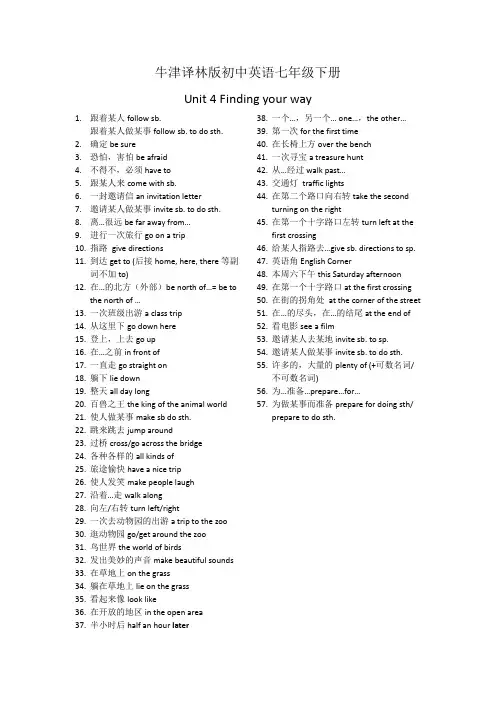
牛津译林版初中英语七年级下册Unit 4 Finding your way1.跟着某人follow sb.跟着某人做某事follow sb. to do sth.2.确定be sure3.恐怕,害怕be afraid4.不得不,必须have to5.跟某人来come with sb.6.一封邀请信an invitation letter7.邀请某人做某事invite sb. to do sth.8.离…很远be far away from…9.进行一次旅行go on a trip10.指路give directions11.到达get to (后接home, here, there等副词不加to)12.在…的北方(外部)be north of…= be tothe north of …13.一次班级出游a class trip14.从这里下go down here15.登上,上去go up16.在…之前in front of17.一直走go straight on18.躺下lie down19.整天all day long20.百兽之王the king of the animal world21.使人做某事make sb do sth.22.跳来跳去jump around23.过桥cross/go across the bridge24.各种各样的all kinds of25.旅途愉快have a nice trip26.使人发笑make people laugh27.沿着…走walk along28.向左/右转turn left/right29.一次去动物园的出游a trip to the zoo30.逛动物园go/get around the zoo31.鸟世界the world of birds32.发出美妙的声音make beautiful sounds33.在草地上on the grass34.躺在草地上lie on the grass35.看起来像look like36.在开放的地区in the open area37.半小时后half an hour later 38.一个…,另一个… one…,the other…39.第一次for the first time40.在长椅上方over the bench41.一次寻宝a treasure hunt42.从…经过walk past…43.交通灯traffic lights44.在第二个路口向右转take the secondturning on the right45.在第一个十字路口左转turn left at thefirst crossing46.给某人指路去…give sb. directions to sp.47.英语角English Corner48.本周六下午this Saturday afternoon49.在第一个十字路口at the first crossing50.在街的拐角处at the corner of the street51.在…的尽头,在…的结尾at the end of52.看电影see a film53.邀请某人去某地invite sb. to sp.54.邀请某人做某事invite sb. to do sth.55.许多的,大量的plenty of (+可数名词/不可数名词)56.为…准备…prepare…for…57.为做某事而准备prepare for doing sth/prepare to do sth.1.跟我来。
牛津译林版初中英语七年级下册Unit4Findingyourway知识点总结及单元综合测试
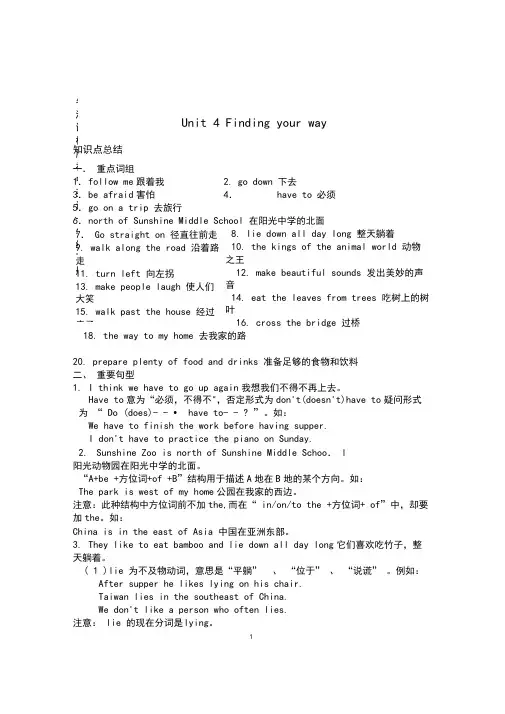
Unit 4 Finding your way 知识点总结 一.重点词组 1. follow me 跟着我 2. go down 下去3. be afraid 害怕 4. have to 必须5. g o on a trip 去旅行6. n orth of Sunshine Middle School 在阳光中学的北面8. lie down all day long 整天躺着 10. the kings of the animal world 动物之王 12. make beautiful sounds 发出美妙的声音14. eat the leaves from trees 吃树上的树叶16. cross the bridge 过桥 18. the way to my home 去我家的路20. prepare plenty of food and drinks 准备足够的食物和饮料二、 重要句型1. I think we have to go up again 我想我们不得不再上去。
Have to 意为“必须,不得不",否定形式为don't(doesn't)have to 疑问形式为 “ Do (does)- - • have to- - ? ”。
如:We have to finish the work before having supper.I don't have to practice the piano on Sunday.2. Sunshine Zoo is north of Sunshine Middle Schoo . l阳光动物园在阳光中学的北面。
“A+be +方位词+of +B”结构用于描述A 地在B 地的某个方向。
如:The park is west of my home 公园在我家的西边。
注意:此种结构中方位词前不加the,而在“ in/on/to the +方位词+ of”中,却要 加the 。
牛津译林版英语七年级下册Unit 4 知识点清单 练习(无答案)
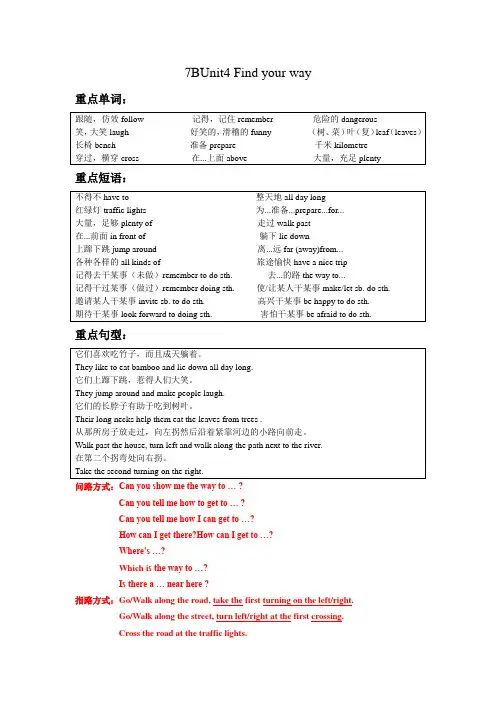
7BUnit4 Find your way重点单词:跟随,仿效follow 记得,记住remember 危险的dangerous笑,大笑laugh 好笑的,滑稽的funny (树、菜)叶(复)leaf(leaves)长椅bench 准备prepare 千米kilometre穿过,横穿cross 在...上面above 大量,充足plenty重点短语:不得不have to 整天地all day long红绿灯traffic lights 为...准备...prepare...for...大量,足够plenty of 走过walk past在...前面in front of 躺下lie down上蹿下跳jump around 离...远far (away)from...各种各样的all kinds of 旅途愉快have a nice trip记得去干某事(未做)remember to do sth. 去...的路the way to...记得干过某事(做过)remember doing sth. 使/让某人干某事make/let sb. do sth.邀请某人干某事invite sb. to do sth. 高兴干某事be happy to do sth.期待干某事look forward to doing sth. 害怕干某事be afraid to do sth.重点句型:它们喜欢吃竹子,而且成天躺着。
They like to eat bamboo and lie down all day long.它们上蹿下跳,惹得人们大笑。
They jump around and make people laugh.它们的长脖子有助于吃到树叶。
Their long necks help them eat the leaves from trees .从那所房子放走过,向左拐然后沿着紧靠河边的小路向前走。
Walk past the house, turn left and walk along the path next to the river.在第二个拐弯处向右拐。
牛津译林版七年级英语下册Unit4知识点复习及练习汇总
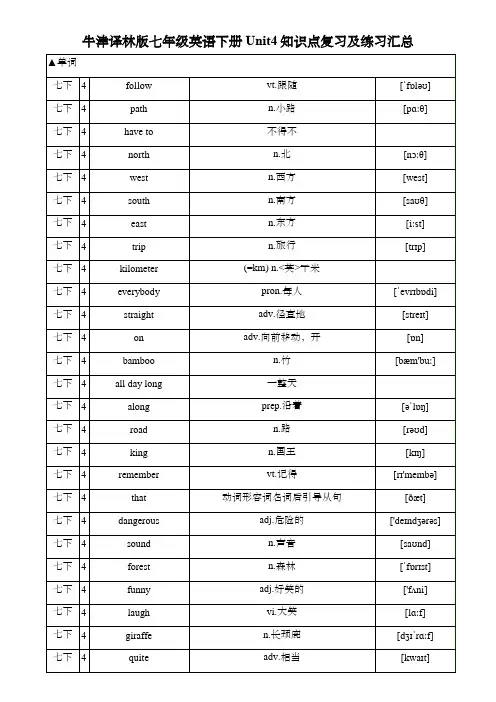
牛津译林版七年级英语下册Unit4知识点复习及练习汇总七年级英语下册 Unit 4 Finding your way一、重点词组、句型1. Are you sure, Hobo?be sure of sth. 对……确信(有把握) be sure to do sth. 一定要去做某事 be sure +that从句 I am sure of my answers. 我对我的答案有把握。
They are sure to win the game. 他们一定会赢得比赛。
I am sure that they will win the game.have(had/has) to意为“不得不",强调客观,愿意也要做,不愿意也要做(否定式 don’t have to)must强调主观,自己认为必须要去做, 但mustn’t 意为“禁止,不准”,语气强烈。
Dad, must I finish my homework before going shopping?爸爸,我必须要在购物之前完成作业吗?肯定回答:Yes, you must./ I’m afraid you have to.否定回答:No, you don’t have to./ No, you needn’t.My bike is broken,so I walk to school.3.Sunshine Zoo is north of Sunshine Middle School.表示“A在B的东/南/西/北面”用句型:”A is east/south/west/north of B”其同义句是:A is to/on the east/south/west/north of Beg. Nanjing is west of Shanghai=Nanjing is to the west of Shanghai.表示方位的介词in, on与to 的区别(1)in表示 A在B的范围之内, Taiwan is the south of China.(2) to表示两者不接壤,不从属 Hangzhou is the south of Taizhou.(3)on表示两地接壤 China is on the south of Russia.4. Remember that they are dangerous. Never go near them.记住他们很危险,不要靠近他们remember sth. 记得/记住某物 Can you remember your ID card numbers?remember to do sth. 记得去做某事(未做) Please remember to turn off the lights when you leave.remember doing sth. 记得做过某事(已经做了)I remember turning off the lights, but it’s on now.remember +that从句反义词:forget(过去式forgot)用法相同eg. Please remember (turn) off the light when you leave the classroom.I remember (meet) the man somewhere.5.Go straight on,and you’ll find the Panda House.“祈使句+and/or +一般将来时"表示在假设的某种条件下将会产生的结果,and通常后接好的结果,or 意为“否则”,通常后接不好的结果。
江苏专版牛津译林七年级下册 Unit 4 知识点复习总结
江苏专版译林七下U4知识点总结1.Follow me, Eddie. 跟我来,埃迪解析:follow,动词,意为“跟随”,后面直接跟表示人或事物的名词作宾语,follow sb.意为“跟随某人”,相当于come after sb.。
如:➢ Spring follows winter. 冬去春来。
拓展:follow作动词,还可表示“效仿;理解,明白”,表示“理解,明白”时,相当于understand。
如:➢ As students, we should follow the school rules.作为学生,我们应该遵守校规。
➢ He speaks too fast. I can't follow him.他说得太快了。
我听不懂他(的话)。
提醒:follow的形容词形式为following,意为“接着的,下列的”。
如:➢ Which of the following sentences is right?下列哪个句子是正确的?2.Let's go down here. 我们从这里下去吧。
解析:go down为动词短语,意为“下去;向下走”,反义短语为go up. godown常用来表示位置或价格的下降。
down,副词,意为“向下”。
如:➢ Is this lift going down?这部电梯是向下的吗?拓展:go down还可表示“顺着,沿着”,此时down为介词,意为“沿....而下”。
如:➢ Go down this street, and then turn right.沿着这条街道走,然后右拐。
3.Eddie, I think we have to go up again.埃迪,我想我们不得不再爬上去。
解析:have to后接动词原形,表示外界的强制作用,强调被迫性,含有不情愿的色彩,常译为“不得不,必须”如:➢ We have to finish the work before supper.我们不得不在晚饭前完成这项工作。
牛津译林版英语七年级下册第四单元知识点归纳
七年级下册Unit4 Finding your way1.follow me/ follow the teacher跟我来/ 跟着老师2.There’s a path between hills山间有一条小路3.Let’s go down here咱们从这儿下去4.Don’t be afraid. 别害怕。
be afraid of... 害怕,恐怕,担心...be afraid to...不敢做...练习题用of 或to填空1)She was afraid of waking her husband.她生怕吵醒她丈夫。
2)I used to be afraid of the dark.我以前害怕黑暗。
3)The little boy is afraid to return home because he is afraid being beaten by his father.这个小男孩因为害怕会被他老爸打,所以不敢回家5.Let’s go on a trip.咱们去旅行吧6. ...be north/west/south/east of ...之北//西//南//东练习题1)阳光花园在动物园的东/西边Sunshine Garden is east/west of the zoo.2)湖滨公园在阳光花园的南/北边Lake Park is south/north of Sunny Garden.7.Is it far from our school?它离我们学校远吗?拓展:far away在远处far away from离…很远away from离开far from远远不(far是表示较笼统、模糊概念的“远”,而away是表示具体的“远”。
)练习题1)不要离开正道太远了。
Don't stray too far from the correct path. 2)他看到遥远的地平线上有个岛屿。
牛津译林版七年级英语下册Unit-4单元知识点归纳总结
牛津译林版七年级英语下册Unit 4 Finding your wayA Welcome to the unit1 Follow me, Eddie.Follow: 动词,跟随follow sb to do sthe.g.: Please follow me to sing an English song.Following: 形容词,接着的e.g: Answer the following questions.The following month is coming soon.2 Are you sure?Be sure to do sth 确定做某事3 Don’t be afraid.Afraid: 形容词,害怕的Be afraid to do sth: I am afraid to go out alone at night.Be afraid of sth\doing sth: I am afraid of dog.I am afraid of falling into the river.Be afraid +(that) 从句: I am afraid (that) he won’t come tomorrow.4 I think we have to go up again.Have to :不得不(主观不愿意,但不得不这么做)Must: 必须(主观上来讲就是愿意的)e.g: I want to play computer games, but my mother told me that I have to finish my homework.5 go on a trip类似的词组:go on a picnicgo on a visitgo on a tripgo on a vocationWe will go on a picnic on the hill.They want to go on a trip this summer.6 方位名词East west south northNorth-west 东北south-west 东南north-east 西北north-east西南(中文与英文相反)形容词:east\west\south\north + ern=东方的\西方的\南方的\北方的7 How will we get there.Get there\here\home\back(没有介词to)Get to the school\park\museum. (有介词to)B Reading1 Hi, everyone.指物:everything, anything, something.指人:anybody, somebody, nobodyThere is nothing in the fridge.I need someone to fix my computer.Anyone needs help.2 Go straight on, and you’ll find the Panda House.Straight: 形容词,直的,笔直的,直接的Give a straight answer.a straight linestraight:副词,径直地,一直地go straight \ stand straightGo straight along the road.3 like doing sth\to do sthDoing:一贯喜欢的To do : 当下喜欢的4 lots of \ a lot of\+名词复数Lots of visitors come here to see them .5 Remember that they’re dangerous.Remember to do (还没做) I will remember to tell her about it.Remember doing(已经做过)Don’t you remember telling me the story yesterday. Forget to do (还没做)Forget doing (已经做过)Stop to do (停止现在做的的去做另一件)Stop doing (停止现在做的事情)Dangerous 危险的,形容词I think tigers are very dangerous.Danger 危险名词in danger \ out of danger6 never do sth 不要做………7 turn left\right 掉头,转向He turned the car to the left.Please turn to the page12.Turn on the light and sit down please.The park turn into the school.8 help sb do sthTheir long necks help them eat the leaves from trees.(leaf----leaves)9 Cross the bridge , and you’ll see the elephants.Cross:动词,横穿,穿过cross the bridgeCrossing 名词,交叉口,十字路口Turn left at the first crossing.Cross 与across 的区别:cross相当于go across, across为介词,一般用在动词后面Cross a street= go across a streetCross the road=go across the road10 all kinds of+名词复数各种各样C grammar and integrated skills1 over, above, 与on 的区别Over 表示垂直于下放,不与表面接触,与under 相对There is a lamp hanging over the desk.There is a bridge over the river.Above 表示在一个表面的斜上方,与below相对The p lane is flying above the clouds.On 表示在物体的上面,表面相互接触The glass is on the table.2 walk past the house, turn left and walk along the path next to the river.Past 的用法Past 介词,The man walked past the police station.It’s half past nine.Past 形容词,过去的,以前的In the past nine years Cathy has collected many stamps.The time for discussion is past.Past 作名词,过去,昔日,往事In the past he was a milkman and now he is a boss.No one knows his past.Past 与pass 的区别Pass 做动词,past 不用做动词I passed the exam at last.3 which way should I go at the traffic lights?有关于问路的句型Where is ………….?Is there a ……….here?Can you tell me the way to…….?Can you tell me how can I get to…….?4 My parents will prepare plenty of food and drinks for us.Prepare sth for sb= prepare sb sthMother often prepares some cakes for us.Can you prepare something to eat for us.Preparation 名词make preparation forThey are making preparation for the party.Plenty of=lots of =a lot of 接可数名词复数或者不可数We have plenty of time to finish the job.There are plenty of eggs in the fridge.5 be interested inHe is interested in sports.Interesting 有趣的形容词It is an interesting story.D 语法解析1 冠词的用法A 不定冠词a , an1 表示泛指某一类物或者人中的任何一个,文章中首次提及的物或者人。
牛津译林版七年级英语下册Unit 4重点短语、句型 、语法 、单元作文汇总
5. between 意 为 “在 ……( 两 者 ) 之 间 ”, 常 用 结 构 between ... and ... 表 示 “在 ……与 ……之 间 ” 【例句】 There is a post office between the shop and the pay phone. 在那个商店和公用电话亭之间有一家邮局。
Yours, Zhou Qi
3. 用 在 谈 话 双 方 都 知 道 的 人 或 物 前 。 【例句】 Where is the little boy? 那个小男孩去哪了?
方位介词
方位介词是用来表示事物之间方位关系的介词,我们常用方位介词来 说明人或物所处的位置。例如:
1. in front of 意 为 “在 ……前 面 ”, 其 反 义 词 为 behind, 意 为 “在 ……后 面” 【例句】 There is a school in front of the hospital.
【例句】 1. He doesn't remember my telephone number. 他没记住我的电话号码。
2. I remember closing the windows before leaving home.
我记得我离家之前关窗了。
3. Remember to buy some fruit for your mother. 记得给你妈妈买一些水果。
二、定冠词
定 冠 词 the 用 在 名 词 前 , 有 以 下 几 种 用 法 :
【新】牛津译林版七年级英语下册Unit4复习知识点
【新】牛津译林版七年级英语下册Unit4复习知识点Unit4 复习知识点一、重点词组(短语)go up/down ; has/have to ;far away from; like to eat bamboo;lie down all day long ; come here to see them ;make beautiful sounds ; jump around ;make people laugh; lie on the grass;look like; in the open area;across the bridge; on the left/right;chat on the bench; walk past the house;an English Corner; at the traffic lights;at the corner of the street; prepare……for二、重要句子(句型)I think we have to go up again.Go straight on, and you will find……Walk along the road, to the north of the Panda House, you will find……Turn left, you will see…….Cross the bridge, and you will find……Take the second turnin g on the right/leftWould you like to come…?I would like to invite you to the party.I am looking forward to seeing you at the party.Get out at Exit A.三、重要语法1冠词(a/an/the)的用法。
Unit4知识整理单元测验牛津译林版英语七年级下册
7BU4知识整理&单元测验follow [ˈfɒləʊ] vt.跟随path [pɑːθ] n.小路have to 不得不north [nɔːθ] 北west [west] 西方south [saʊθ] 南方east [iːst] 东方trip [trɪp] 旅行kilometer (=km) <英>千米everybody [ˈevrɪbɒdi] 每人straight [streɪt] 径直地on [ɒn] 向前移动,开bamboo [bæm'buː] 竹all day long 一整天along [əˈlɒŋ] 沿着road [rəʊd] 路king [kɪŋ] 国王remember [rɪ'membə] 记得that [ðæt] 动词形容词名词后引导从句dangerous ['deɪndʒərəs] 危险的sound [saʊnd] 声音forest [ˈfɒrɪst] 森林funny ['fʌni] 好笑的laugh [lɑːf] 大笑giraffe [dʒɪˈrɑːf] 长颈鹿quite [kwaɪt] 相当neck [nek] 脖子leaf [liːf] 树叶northeast 东北方bridge [brɪdʒ] 桥cross [krɔːs] 穿过cage [keɪdʒ] 笼子across [ə'krɔːs] 在...对面inside [ˌɪn'saɪd] 在里面outside ['aʊt'saɪd] 在外面above [ə'bʌv] 在上面below [bɪ'ləʊ] 在下面sign [saɪn] 指示牌over ['əʊvə] 在上面beach [biːtʃ] 长椅past [pɑːst] 在另一边treasure [ˈtreʒə] 宝藏turning ['tɜːnɪŋ] 转弯处traffic ['træfɪk] 交通traffic lights 红绿灯should [ʃʊd] 应该crossing ['krɔːsɪŋ] 交叉路口corner ['kɔːnə] 拐角prepare [prɪˈpeə] 准备prepare ... for ... 为……准备……plenty [pliːzd] 大量plenty of 大量exit ['eksɪt] 出口bank [bæŋk] 银行02Unit4 知识梳理【重点短语】1. find the/your/my way (to sp.) 找到去某地的路2. follow sb./ go after sb. to sw. 跟某人去某地3.have to do sth. 不得不做某事4.like to eat bamboo 喜欢吃竹子5.go for a class trip/go on a class trip 进行一次班级旅行6.a trip to the zoo 去动物园的一次旅行7.be far (away) from ... 离.....远8.be three kilometers away from... 离......三公里的距离9.get here/there/home (arrive here/there/home) 到达这儿/那儿/家10.lie down all day long 整天躺着11.be quite tall=be very tall 相当高12.jump around 四处跳跃13.cross the bridge=go across the bridge 过桥14.be like open fans 像打开的扇子15.lie on the grass 躺在草地上16.look like its mother 看起来像它的妈妈17. in an open area 在一开阔地18.on the left/on the right 在左边/右边19.find treasure 找到财宝20.at the traffic lights 在红绿灯处21.at the corner of the street=at the street corner 在街道拐角处22.in the corner of the room 在房间角落里23.prepare sth. for sb. 为某人准备…24.plenty of /lots of food and drinks 大量的食物和饮料25.get out at Exit A 在A出口处出来start at 2 p.m. on Sunday ,21 April在4月21日,星期天下午两点开始【词形变化】1. north(n.)北方northern(adj.) 北方的south (n.) 南方southern(adj.) 南方的west (n.) 西方western(adj.) 西方的east (n.) 东方eastern(adj.) 东方的2. northeast东北northwest 西北southeast 东南southwest西南3. lie (v)lyinglay /ei/ 过去式4. dangerous (adj) danger(n)5. funny (adj) fun(n.)6. leaf leaves (复数)7. visit (v)visitor(n)【语言知识点】1. It’s north /east / northwest of the school=It’s to the north /east/northwest of the school.在学校的北/东/西北部。