
人教版英语七年级下Unit6整单元
Do you know what they are doing?
What is he doing?
他正在做什么?
He is reading a
newspaper. 他正在看报纸。
What is he doing?
ask --- asking
write --- writing
Correct the sentences:
1. I doing my homework. I am doing my homework.
2. She is watch TV. She is watching TV.
3. He is writeing. He is writing.
Grammar Focus
What are you doing? I’m watching TV.
What’s she doing? She’s washing her clothes.
What are they doing? They’re listening to a CD.
Are you doing your Yes, I am./No, I’m not.
homework?
I am cleaning my room.
Is he reading a newspaper?
Yes, he is./No, he isn’t. He’s playing basketball.
Are they using the Yes, they are./No, they
computer?
Number the sentences in order to make 3b a telephone conversation. Then practice it with a partner.
_W_5_hDaot ayroeuywoaundtotiongo? tomorrow then? _I8_’_mOrKea. dSienegyaoubotomk.orrow evening! _D_2_oIy’mourweaadnitntgoagobotokt.he movies now? _N7__oL, tehti’s bgooakt sisevrenalloy’cilnotcekre. sting. _D4__oNyo,uthwiasnbtotookgios troemalloyrrinotwertehsetnin?g. _S_1u_rWe,hwaht atretiymoeu?doing? _L_3e_tD’sogyooautwseavnetntoo’gcolotcokt.he movies now? _O_6_ree, wyohuattsten again. Fill in the blanks.
Jack: Hello, Steve.
Steve: Hi, Jack.
Jack: What__a_r_e_ you_d_o_i_n_g_, Steve? Steve: I’m w__a_t_c_h_i_n_g__T_V_. What about you? Jack: I’m_l_is_t_e_n_i_n_g__to__a__C_D__, but it’s kind
What is it doing?
It is singing.
改为否定句:It isn't singing.
sing
Is 改为一般疑问句: it singing?
Summary 总结
现在进行时态谓语结构:be + V-ing 肯定式结构: 主语+be+V-ing+其他. 否定式结构: 主语+be+not+V-ing+其他. 一般疑问句结构:
他正在做什么?
eat soup
喝汤
He is washing the
dishes. 他正在洗餐具。
1a Match:
1. watching TV__i__ 2. cleaning __d__ 3. reading a newspaper _g_
4. talking on the phone _a_ 5. listening to a CD __h__ 6. using the computer _e__ 7. making soup __b__ 8. washing the dishes__c__ 9. exercising __f__
(1)表示这现些在句(子说有话什瞬么间共)同动的作特正点在呢进?行或发生。 (2)W表h示at现is阶h段e 动do作in正g?是持W续ha地t a进re行y。ou doing?
WHeeairsechleaavniningg.an EnI agmliswhactclhaisnsg. TV.
我们正在上英语课。
What's John doing? Bob: He's washing the dishes. Jenny: Well, what are Dave and Mary doing? Bob: They're listening to a CD.
P112
4.
谓语动词结构:(现在分词)
助动词be (am/is/are) + 动词 –ing形式
_B_o_b_m__a_k_e_s_d__in_n_e_r__ev_e_r_y__S_a_tu__rd__a_y.___
3. Mary’s parents/ drink tea/after dinner
M__a_r_y_’_s_p_a_r_e_n_t_s_d_r_i_n_k_t_e_a_a_f_t_e_r_d_i_n_n_e_r._
他正在做什么?
He is using the computer原. 形他u正s在e, 用“电使脑。
用”
Do you know what they are doing?
What is he doing?
他正在做什么?
He is making soup.
他正在煲汤。 make soup
做汤,煲汤
What is he doing?
of _b_o_r_i_n_g_.
Steve: Yeah, my TV show is also not very
i_n_t_e_r_e_s_t_in_g_. Do you want to_g_o_t_o_ the movies?
Jack: That sounds good.
2d Role-play the conversation.
4. They are runing. They are running.
What is he doing? He is playing soccer. 改为否定句:He isn't playing soccer. Is 改为一般疑问句: he playing soccer?
What are they doing? They are dancing. 改为否定句:They aren't dancing. 改为一般疑问句:Are they dancing ?
性的动作。 区别下面的两组句子: I do my homework everyday. I am doing my homework now. He cleans his room every afternoon. He is cleaning his room now. 区别这两种时态主要是看时间状语。
两种时态区别主要体现在动词的形式上。
3a
Write sentences following the examples.
1. Jenny/ clean the house/ now
_J_en_n_y__is__cl_e_a_n_in_g_t_h_e_h_o_u_s_e_n_o_w__. _____
2. Bob/ make dinner/every Saturday
aren’t. They’re exercising.
She’s exercising (now).
She exercises (on Mondays/ every
night / in the mornings/ etc.)
现在进行时与一般现在时 •现在进行时是表示一个动作正在发生或进行。 •一般现在时表示现在的状态或经常的,习惯
Listen.What are these people doing?
1b
Write numbers from 1a. Jenny _1__ John _8__ Dave and Mary _5__
Bob: Hello, Jenny! Jenny: Hi, Bob. Bob: Jenny, what are you doing? Jenny: I'm watching TV. Bob: Do you want to play tennis? Jenny: No, this TV show is interesting.
Add –ing to the following verbs :
go --- going
get ---getting
begin --- beginning walk --- walking
give --- giving
play ---playing
take --- taking
look --- looking
4. Bill/ talk on the phone/now
B__il_l_i_s _ta_l_k_i_n_g_o_n__t_h_e_p_h_o_n_e__n_o_w__. ____
5. Becky and Bob/ watch TV/on weekends
_B_e_c_k_y_a_n_d__B_o_b__w_a_t_c_h_T__V__o_n_w__e_e_k_e_n_d_s_._
Unit6SectionB2a-2c课件人教版七年级英语下册
Retell the story according to the words.
(复述)
from
Zhu Hui
Shenzhen
A host family(an American family) New York
Today is Dragon Boat Festival .
Unit 6 I’ m watching TV
Section B 2a-2c
Lead-in
What’s he doing?
He’s reading a newspaper.
What’s he doing? He’s making soup.
What are they doing? They’re watching TV.
朱辉十分思念他的家人,并且渴望吃上他妈妈做的美 味粽子。
3).Zhu Hui likes New York and his host family a lot ,but there's still "no place like home"
朱辉十分喜欢纽约和他的寄宿家庭,但是千好万好还 是不如自己的家好。(金窝银窝不如自己的狗窝)
American
Dragon Boat Festival
miss
living room
delicious东京纽约 Nhomakorabea悉尼
A: What time is it in Beijing? B: It’s eight o’clock in the morning.
It’s 8 a.m.
Different places have different time. 不同的
人教版七年级英语下册Unit 6 课文+单词+朗读+知识梳理+词汇讲解+句型解析

1. newspaper(1)newspaper意为“报纸”,是可数名词。
“在报纸上”用英语表示为“in the/a newspaper”,不能用介词on。
我们日常所说的晨报/晚报是morning / evening newspapers。
例如:She likes collecting old newspapers. 她喜欢收集旧报纸。
(2)newspaper是由news和paper构成的合成词,合成词是一种重要的构词法,对我们记忆单词很有帮助。
例如:bed + room→ bedroom 卧室class + room →classroom 教室head + phone →headphone 耳机police + man→ policeman 警察basket + ball→basketball 篮球2. use(1)use 动词,意为“使用,运用”;其形容词形式为useful,意为“有用的,有益的”。
例如:Can I use your phone?我能用一下你的电话吗?Thanks for giving me such a useful book.谢谢你给我这么一本有用的书。
拓展:use&withuse动词在句子中作谓语,表示用途。
I use the pen to write. 我用钢笔写字。
with介词在句中作状语,表示方式。
I write with a pen. 我用钢笔写字。
(2)use 也可以作名词,意为“使用,用途,用法”。
不过此时的读音为/ ju:s /。
例如:I’m sure you’ll think of a use for it.我相信你会给这东西找到用途的。
3. moviemovie 是名词,意为“电影”。
“go to the movies” 意为“去看电影”,同意短语有“go to the cinema, go to see a film”。
例如:I often go to the movies with my classmates on weekends.周末我经常和我的同学去看电影。
(完整版)人教版七年级英语下册unit6(详细内容)(最新整理)
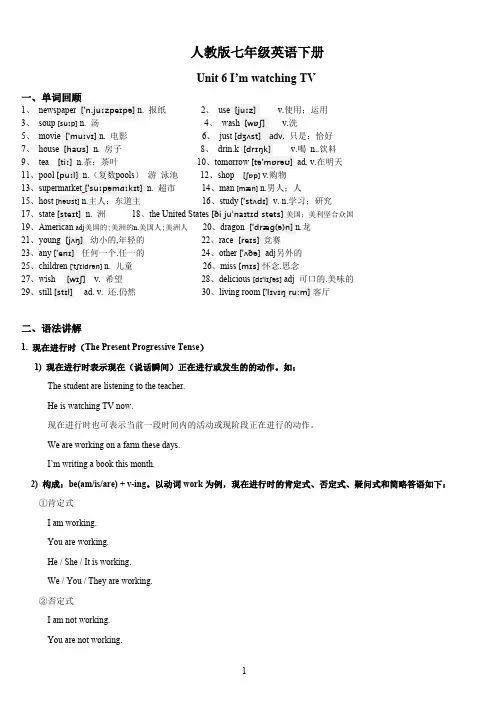
人教版七年级英语下册Unit 6 I’m watching TV1、报纸2、use [juːz]v.使用;运用3、4、wash [wɒʃ]v.洗5、6、just [dʒʌst]adv.只是;恰好7、8、drin.k [drɪŋk]v.喝n..饮料9、tea 10、tomorrow [tə'mɒrəʊ] ad. v.在明天11、游泳池12、shop [ʃɒp] v.购物13、超市14、man [mæn] n.男人;人15、16、study ['stʌdɪ] v. n.学习;研究17、the United States [ði juˈnaɪtɪd stets]美国;美利坚合众国19、adj美国的;美洲的n.美国人;美洲人20、dragon ['dræg(ə)n]n.龙21、young [jʌŋ]幼小的,年轻的22、race [reɪs]竞赛23、any ['enɪ]任何一个.任一的24、other ['ʌðə] adj另外的25、children ['tʃɪldrən] n. 儿童26、miss [mɪs]怀念.思念27、wish [wɪʃ]v. 希望28、delicious [dɪ'lɪʃəs] adj 可口的.美味的29、still [stɪl]ad. v. 还.仍然30、living room ['lɪvɪŋ ru:m]客厅二、语法讲解1. 现在进行时(The Present Progressive Tense)1) 现在进行时表示现在(说话瞬间)正在进行或发生的的动作。
如:The student are listening to the teacher.He is watching TV now.现在进行时也可表示当前一段时间内的活动或现阶段正在进行的动作。
We are working on a farm these days.I’m writing a book this month.2) 构成:be(am/is/are) + v-ing。
精选】人教版七年级下册英语Unit6第六单元优秀教案
精选】人教版七年级下册英语Unit6第六单元优秀教案Unit 6: I'm Watching TVLesson 1: n A (1a-1c)XXX:1.Key Vocabulary: newspaper。
use。
soup。
wash2.Key Phrases: read a newspaper。
using the computer。
making soup3.Key Sentence Structures:What's he doing?He's using the computer.What are they doing?XXX.Focus of Learning:Present Continuous XXXChallenges:1.n of Present Participle (-ing)2.XXX using Present Continuous XXXIndependent Study:1.Preview the new words on page 31 and memorize them。
Translate the following words from Chinese to English: 报纸 (newspaper)使用 (use)汤 (soup)洗 (wash)2.Preview ns 1a。
1b。
and 1c。
Identify the following phrases and sentence structures:read a newspaperusing the computermaking souptalking on the computerWhat's he doing。
He's using the computer.What are they doing。
They are XXX.Classroom Guidance:Step 1: nXXX some students to perform ns in front of the class。
人教版英语七年级下册单元Unit6知识点+测试卷+思维导图

⼈教版英语七年级下册单元Unit6知识点+测试卷+思维导图Unit 6 I’m watching TV.1.重点词汇:newspaper, movie, tea, house, pool, supermarket, living room, race, wash, drink, study, miss, wish, young, delicious2.短语归纳:1.watch TV 看电视2. read a newspaper 看报纸3. talk on the phone 通过电话交谈4. listen to music 听⾳乐5. use the computer 使⽤电脑6. make soup做汤7. wash the dishes 洗餐具8. kind of 有点⼉3. 必背典句:1. —Why are you doing? 你在做什么?—I’m watching TV. 我在看电视。
2. —What’s she doing? 她在做什么?—She’s washing her clothes. 她在洗她的⾐服。
3. —What are they doing? 他们在做什么?—They’re listening to a CD. 他们在听⼀张CD 唱⽚。
4. —Are you doing your homework? 你在做你的家庭作业吗?—Yes, I am. / No, I’m not. I’m cleaning my room.是的,我在做。
/ 不,我没有。
我在打扫我的房间。
5. Zhu Hui misses his family and wishes to have his mom’s delicious zongzi.朱辉思念他的家⼈并希望吃上他妈妈的可⼝粽⼦。
4.语法知识:现在进⾏时1.定义:表⽰现在或现阶段正在进⾏的动作。
常与now, these days等时间状语连⽤,句⾸有Look ! / Listen !等提⽰语。
人教版初一下英语七年级第六单元教案
人教版初一下英语七年级第六单元教案人教版出一下英语七年级第6单元教案【教师寄语:Where there is life ,there is hope. 有生命必有希望!】Unit 6 I am watching TV【基础知识】一、语法讲解--现在进行时(一)、定义现在进行时表示现在(说话的瞬间)正在进行或发生的动作。
(二)、用法:A表示现在( 指说话时) 正在发生的事情。
例:We are waiting for you.B. 表示现阶段正在进行的动作,说话时未必正在进行。
例:Mr. Green is writing another novel.C.已经确定或安排好的但不确定会不会发生的将来活动。
I'm leaving for a travel in Nepal next week.(我下周要去尼泊尔旅行) We're flying to Paris tomorrow(我们明天乘飞机去巴黎)(三)、构成现在进行时的构成是:主语+be+v.ing〔现在分词〕形式第一人称单数I+am+V-ing. 第一人称复数We+are+V-ing. 第二人称单(复)数You+are+V-ing. 第三人称单数He(She,It)+is+V-ing. 第三人称复数They+are+V-ing.(四)、句型变化(1)肯定式:be+v-ing She is singing in the next room. (2)否定式:be+not+v-ing The students aren’t cleaning the room. (3)一般问句:be动词提前。
肯定答语Yes,主语+be; 否定答语No,主语+be not。
Are you playing the computer game? Yes, I am. No, I am not. (4)特殊问句:对谓语动词进行提问的:What+be +主语+doing+其他?What is the old man doing under the tree? 对其他成份进行提问的,疑问词+一般疑问句?人教版出一下英语七年级第6单元教案Where is the boy swimming? Who is she waiting for?【及时训练】1、按要求改写句子The boy is playing basketball.否定句:____________________________ 一般疑问句:_________________________肯定回答:__________________________否定回答:__________________________ 对“The boy”提问:__________________________2、把对话补充完整。
人教版七年级英语下册-Unit 6:知识点总结+单元测试(word版,含答案)
Unit6 I’m watching TV.【重点单词】newspaper n .报纸read a newspaper 看报纸use v.使用;运用soup n.汤make soup 做汤wash v.洗movie n.电影go to movies 看电影just adv. 只是;恰好eat out 出去吃饭house n.房子drink v..喝n.饮料tea n.茶;茶叶drink tea 喝茶tomorrow adv. 在明天 n. 明天;未来pool n. 游泳池;水池shop v. 购物 n. 商店supermarket n. 超市man n.男人;人race n.竞赛host n.主人;东道主study v./n. 学习;研究state n. 洲the United States 美国;美利坚合众国American adj. 美国的;美洲的n. 美国人;美洲人dragon n.龙Dragon Boat Festival 端午节any adj. 任何的,任一的 pron. 任何;任一other adj. 另外的;其他的 pron. 另外的人(或物)young adj. 幼小的,年轻的children n. 儿童miss v.怀念. 思念wish v. 希望delicious adj. 可口的,美味的still adv. 还.仍然living room 客厅【重点短语】1.watch TV看电视2. read a newspaper 看报纸3. talk on the phone 通过电话交谈4. listen to a CD 听CD5. a useful book 一本有用的书6. make soup 做汤7. wash the dishes 洗碟子8. go to the movies 去看电影9. at home 在家10. eat out 在外面吃11. drink tea 喝茶12.Dragon Boat Festival 端午节13. make zongzi 包粽子14. watch the boat races 看龙舟比赛15. the night before the festival 节日前的晚上16. any other night 任何其他的晚上17. his host family 他的寄宿家庭18. read a story to sb 读故事给某人19. miss sb. 思念某人miss doing sth 错过做某事20. wish to do sth希望做某事wish sb to do sth希望某人做某事hope to do sth希望做某事21. no place like home 没有地方像家一样22. in the United States 在美国23. study for a test 为一个考试而学习【重点句型】1.一What are they doing?他们在干什么?—They’re listening to a CD.他们在听光碟。
人教版英语七年级下Unit 6单元整体教案设计
Unit 6 I’m watching TV.Section A 1 (1a-2d)一、教学目标:1. 语言知识目标:1) 能掌握以下单词: newspaper, use, soup, wash, movie, just能掌握以下句型:①—What are you doing? —I'm watching TV.②—What's he doing? —He's using the computer.③—What are they doing? —They're listening to a CD.④—This is Jenny. —It's Laura here.2) 能掌握语法:现在进行时态的用法。
3) 能运用所学的知识,描述人们正在干的事情。
2. 情感态度价值观目标:通过对本单元的学习活动,能培养培养学生学习英语的强烈兴趣,善于发现生活中正在发生的事情,积极思考,乐于助人,乐于参加各种活动的积极情感,培养学生团结合作的精神。
二、教学重难点1. 教学重点:1) 词汇、词组搭配和现在进行时的用法。
能用现在进行时的各种形式进行准确的描述和表达正在发生的动作。
2) 能掌握现在进行时态及一些表示具体动作的词组搭配,如: doing homework, using the computer, watching TV, eating dinner…等2. 教学难点:现在进行时中现在分词的结构及读音,能在交际中准确地运用现在进行时来描述或表达正在进行的动作。
三、教学过程Ⅰ. Warming-up and Lead in1. Greet the Ss and check the homework.2. Watch a video program.Ⅱ. Presentation1. Show some pictures on the big screen. Present the new words and expressions.2. Ss watch and learn the new words and expressions.3. Give Ss some time and try to remember the new words and expressions.4. (Show some pictures on the screen and ask some students to perform the actions.)e.g. T: What are you doing?S: I am doing homework. (Help him/her to answer)T: What is he /she doing?Ss: He /she is doing homework.Teach: watching TV, cleaning, reading a book, eating dinner, talking on the phone...as the same way.5. Work on 1a. Ss read the activities and look at the pictures. Then match the activities with pictures.6. Check the answers with the Ss.Ⅲ. Game (guess)1. T: Now let's play a game. What's she/he doing? You must watch the big screen carefully.(Show some pictures on the big screen quickly) Let Ss guess what's he/she is doing?2. Ss watch and guess the actions.3. Ask and answer about the pictures.—What's he/she doing?—He's/She's …Ⅳ. Listening1. T: What are Jenny, John, Dave and Mary doing? Now let’s listen to the tape, find out the right activities from 1a.2. Play the recording for the Ss twice.3. Ss listen to the recording and write the numbers from 1a.Ⅴ. Pair work1. Ask the Ss to read the conversations in 1c with a partner. Then look at the pictures in 1a. And conversations about other person in the picture.2. Ss make conversations by themselves and practice the conversations. Ⅵ. Listening1. Work on 2a;T: Jack and Steve are talking on the phone. What are they doing now? Listen to the conversations and match the answers with the questions. (Play the recording for the first time, students only listen carefully. Then, listen to the recording again, and match the answers with the questions. )Check the answers.2. Work on 2b.Let Ss read the conversation in 2b first. Then play the recording for the Ss twice.The first time Ss only listen and write down the words in the blanks. Then play the recording again for the Ss to check the answers. (If necessary, press the Pause button to help.)Ⅶ. Pair work1. Now, role-play the conversation with your partners.2. Let some pairs to act out the conversation in front of the class. Ⅷ. Role-play1. Ask Ss to read the conversation in 2d and answer the questions below.① Are Jenny and Laura talking on the phone?(Yes, they are.)② What's Laura doing now?(She's washing her clothes.)③ What's Jenny doing?(She's watching TV.)④ When do they meet at Jenny's home?(At half past six.)2. Ss read the conversation and answer the questions above.3. Check the answers with the Ss.4. Let Ss work in pairs and role-play the conversation.Homework:1. Review the words and expressions in this period.2. Understand the knowledge about the present progressive tense.3. Make five sentences on what are you doing now.板书设计:Section A 2 (Grammar Focus-3c)一、教学目标:1. 语言知识目标:1) 继续练习运用现在进行时态来谈论人们正在做的事情。
人教版七年级英语下册-Unit 6:知识点复习总结+单元测试(word版,含答案)
Unit6 I’m watching TV.【重点单词】newspaper n .报纸read a newspaper 看报纸use v.使用;运用soup n.汤make soup 做汤wash v.洗movie n.电影go to movies 看电影just adv. 只是;恰好eat out 出去吃饭house n.房子drink v..喝n.饮料tea n.茶;茶叶drink tea 喝茶tomorrow adv. 在明天 n. 明天;未来pool n. 游泳池;水池shop v. 购物 n. 商店supermarket n. 超市man n.男人;人race n.竞赛host n.主人;东道主study v./n. 学习;研究state n. 洲the United States 美国;美利坚合众国American adj. 美国的;美洲的n. 美国人;美洲人dragon n.龙Dragon Boat Festival 端午节any adj. 任何的,任一的 pron. 任何;任一other adj. 另外的;其他的 pron. 另外的人(或物)young adj. 幼小的,年轻的children n. 儿童miss v.怀念. 思念wish v. 希望delicious adj. 可口的,美味的still adv. 还.仍然living room 客厅【重点短语】1.watch TV看电视2. read a newspaper 看报纸3. talk on the phone 通过电话交谈4. listen to a CD 听CD5. a useful book 一本有用的书6. make soup 做汤7. wash the dishes 洗碟子8. go to the movies 去看电影9. at home 在家10. eat out 在外面吃11. drink tea 喝茶12.Dragon Boat Festival 端午节13. make zongzi 包粽子14. watch the boat races 看龙舟比赛15. the night before the festival 节日前的晚上16. any other night 任何其他的晚上17. his host family 他的寄宿家庭18. read a story to sb 读故事给某人19. miss sb. 思念某人miss doing sth 错过做某事20. wish to do sth希望做某事wish sb to do sth希望某人做某事hope to do sth希望做某事21. no place like home 没有地方像家一样22. in the United States 在美国23. study for a test 为一个考试而学习【重点句型】1.一What are they doing?他们在干什么?—They’re listening to a CD.他们在听光碟。
人教版七年级英语下册(新)《unit6I'mwatchingTV》单元课件(SectionB)
Today’sstoryisaboutZhuHui,astudentfromShenzhen.He’snowstu dyingintheUnitedStates.He’slivingwithanAmericanfamilyinNew York.TodayistheDragonBoatFestival.It’s9:00a.m.AndZhuHui’sf amilyareathome.Hismomandauntaremakingzongzi.Hisdadandun cleareWatchingtheboatracesonTV.
Explanation
1.【any】any既可以用作代词,也可以用作形容词。 (1)作代词,意为“任何一个(些)”。如: Youcantakeanyofthese.你可以随便拿这些中的任何一
个。 (2)作形容词,意为“一些;什么;任何的”,用于疑
问句或否定句,表示“一些”;用于肯定句表示“任何 的”。如: Isthereanyjuiceinthebottle?瓶子里还有果汁吗? Anystudentcananswerthisquestion.任何学生都可以回 答这个问题。
It’seighto’clockint hemorning.
Whattimeisitin Tokyo?
It’snineo’clockint
Whattimeisitin NewYork?
It’seighto’clockint heafternoon.
Whattimeisitin Sydney?
Conversation3 A:Lisa? B:No,thisishersister, Julie. A:Oh,isLisathere? B:No,sheisn’t.She’satthe library. A:Oh.Isshereading? B:Yes,sheis.