
冀教版五年级下册Lesson 21 Look at the Photos
Which photo do you like? Who was he/she? Where was he/she? Where were they? What did they do? Were they happy? (loud, quite, big, quick, slow, new, old…)
Writing Time 选择其一
1.My dairy
Wednesday ,May 14th,2014 cloudy
(日记)
Where were you? What did you do? Were you happy? What do is eight years old this year. year
He was seven years old last year year.
We are in Canada this week week. We were in China last week. week
this year this week last week 2008 often last year yesterday now today
am are
were
was were
is are
Free talk :The photos I like
你和你的朋友一起参观摄影展,交流你们喜欢的照片,当然也可 以拿着自己的照片或摄影作品参加展览哦! Which photo do you like? Who was he/she? Where was he/she?
Photos from Danny Photos about school life
Where were they?
What did they do?
Photos outside school
Were they happy?(loud, quite, big, quick, slow, new, old…)
A
2. Read quickly and look for the answers. Where were they?
3. Read and find the words you don’t understand.
I am happy today today!
I was sad yesterday yesterday.
We _____ were quiet in the library yesterday. My mother’s hair____ was gray last year. Everyone ____ was running quickly in the rain last Saturday.
was
was am is are
were
It ____ was sunny yesterday. I was ___ tired yesterday.
was were
There were ____ five pencils in my pencil case yesterday. They were ____ loud on the train last week.
Which photo do you like?
Who was he/she?
Where was he/she?
Where were they?
What did they do?
Were they happy?(loud, quite, big, quick, slow, new, old…)
Which photo do you like?
Who was he/she?
Where was he/she?
Where were they?
What did they do?
Were they happy?(loud, quite, big, quick, slow, new, old…)
Do you like these photos?
A photo is a wonderful moment. Forever memory, forever love. 美好的瞬间,永远的 回忆,永远的爱!
Lesson 21 Look at the Photos
the Great Wall
This is …
This was …
They were Ms. Xu’s students last year.
You are Ms. Xu’s students now.
1. Listen and order.
冀教版五年级英语下册基本功训练19~21课练习题
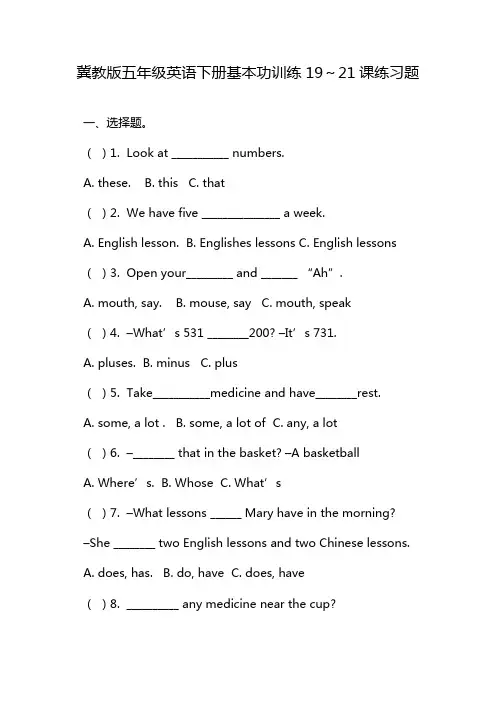
冀教版五年级英语下册基本功训练19~21课练习题一、选择题。
()1. Look at ___________ numbers.A. these.B. thisC. that()2. We have five _______________ a week.A. English lesson.B. Englishes lessonsC. English lessons ()3. Open your_________ and _______ “Ah”.A. mouth, say.B. mouse, sayC. mouth, speak()4. –What’s 531 ________200? –It’s 731.A. pluses.B. minusC. plus()5. Take___________medicine and have________rest.A. some, a lot .B. some, a lot ofC. any, a lot()6. –________ that in the basket? –A basketballA. Where’s.B. WhoseC. What’s()7. –What lessons ______ Mary have in the morning?–She ________ two English lessons and two Chinese lessons.A. does, has.B. do, haveC. does, have()8. __________ any medicine near the cup?A. There are.B. Are thereC. Is there二、情景交际。
()1. 当你想询问别人想喝什么,你会问:A. What would you like to eat?B. What would you like to drink?()2. 去商店买东西时,服务员会对你说:A. Can I help you?B. Can you help me?()3. 当你想表达“没问题”时,你会说:A.Wonderful!B. No problem.()4. 你想知道别人是否会做饭时,你会问:A. Can you do any cook?B. Can you cook?()5. 你想称赞别人的房间很漂亮时,你会说:A. My room is really nice.B.Your room is really nice.。
五年级下册英语21课
五年级下册英语21课21. My DayUnit 6: Healthy eatingIn the 21st lesson of the fifth grade English textbook, students will learn about healthy eating habits and how to talk about food and meals in English. This lesson aims to enhance students' vocabulary, reading, and speaking skills while also promoting the importance of a balanced diet.The lesson begins with a warm-up activity where the teacher introduces the topic by asking students about their favorite foods and meals. Students can take turns sharing their answers, allowing for class participation and engagement.Next, the teacher presents new vocabulary words related to healthy eating such as fruits, vegetables, grains, proteins, and dairy products. Handouts or flashcards with pictures and words can be used to facilitate understanding and memory retention.To introduce the concept of a balanced diet, the teacher can show visuals or use real food items to categorize different food groups. Students can be askedto identify which food groups each item belongs to and explain why they are important for our health.Once the vocabulary and concepts are introduced, the teacher can proceed to the reading activity. The textbook provides a passage titled "My Day" where a fictional character named Lily describes her daily routine, including her eating habits. The passage should be read aloud by the teacher, with proper intonation and emphasis on key vocabulary words.After the reading, the teacher can ask comprehension questions to check students' understanding of the passage. For example, "What does Lily have for breakfast?" or "What does she eat for lunch?" This encourages students to recall information from the text and practice their reading comprehension skills. Following the reading and comprehension questions, students can be divided into pairs or small groups to discuss their own daily routines and eating habits. They can take turns asking and answering questions using the target vocabulary words. For example, "What do you eat for dinner?" or "Do you like to eat fruits and vegetables?"To further reinforce the lesson, a group activity can be conducted where students have to create a healthy meal plan for a day. They can use magazines or online resources to find pictures of different foods and categorize them into food groups. Each group can then present their meal plan to the class and explain why their choices are healthy.Finally, to conclude the lesson, students can create posters or collages showcasing the importance of healthy eating. They can use pictures, drawings, and key vocabulary words to illustrate the concept of a balanced diet. The posters can be displayed in the classroom as a reminder for students to make healthy food choices.In summary, the 21st lesson of the fifth grade English textbook focuses on healthy eating habits. Through various activities such as vocabulary introduction, reading comprehension, speaking practice, and group activities, students learn about the importance of a balanced diet and how to talk about food and meals in English. By actively engaging students in the learning process, this lesson aims to promote healthier eatinghabits and improve English language skills simultaneously.。
冀教版英语5下课件Lesson 21 Exercise!拓展知识跑步运动的好处

A good pace for beginners is one in which they can converse without breathlessness. 对于初学者而言,比较适宜的速度为跑步时仍能讲话,同时没 有喘不过气的感觉 A walk-run program is a good introduction or a re-entry strategy. 跑步与走 路相间结合的方式很适合初学及 重新开始跑步的阶段 Even for long-distance running, the walk-run program is an excellent strategy for injury prevention. 对长距离而言,跑步与走路相间结合也是一种
Although there is no optimal training load, people who run 30 miles(48K)
a week have 15% less injuries than those who run 40 miles(64K) a week. 尽管不可能有人人适用的理想运动量,但每周跑30英里(48公里), 要比每周
跑40英里(64公里)的人少15%的受伤机会
For the average runner, around 20 miles(30K) a week is a reasonable distance. 对于大众跑步者来说,每周跑20英里(30公里)比较适宜
Prevention is the best medicine 有效预防,远离危害 (续)
Common problems facing runners 跑步者常见问题6
Stress fracture 应力性骨折 Occurs due to repetitive loading 由于反复承受压力而产生 Microtrauma of the bone accumulates over time 骨头微创伤随时间累加 Bone remodeling unable to keep up with stress 骨头的再生跟不上所承受
新冀教版五年级英语下册《Unit 4 Did You Have a Nice Trip. Lesson 21 Look at the Photos.》教案_18
Lesson 21 Look at the photos!教材分析:本单元以“Did you have a nice trip ?”为话题,讲述了Li Ming、Danny、Jenny 回到家中,向他们的亲戚朋友讲述了这次的旅行经历。
在讲述时主要用到一般过去时描述过去发生的事情。
而本节课是第四单元的第三课,Danny 和Jenny给朋友Steven展示旅行时的照片并讲述他们这次的旅行经历,讲述时同样运用了过去时来描述过去旅行时发生的事情。
同时本课第二部分通过一般现在时和一般过去时的对比学习,使学生能更深刻的理解一般现在时和一般过去时。
学情分析:五年级学生已经有一定的词汇基础,接触了一些简单的词汇和句型,课堂上能够在老师的指导下顺利学习和参加一些教学活动,这个年龄段的学生对动画比较感兴趣,并且愿意和同伴交流,乐于分享。
所以本节课运用生动的课堂视频调动学生的学习积极性。
同时,让学生和同伴分享自己以前的照片,提高课堂参与度。
教学基本策略及设计思路:本课题是根据本学段学生学习语言的认知规律和《课标》提出的学习目标来设计的,以学生熟悉的生活情境和经验为基础,通过听、说、读、chant等活动让学生在情境中学,在学中学习语言、运用语言。
教学目标:一、语言技能目标:1、能根据录音模仿说英语;2、听懂课堂上的常用指令,并根据课堂上的简单提问和要求做出适当的反应;3、能在具体的情境中交流,巩固所学的词汇、句型;4、能根据照片写出简短的描述。
二、语言知识目标:1、学生能听懂、会说、认读并书写以下词汇:photo、was、were、happy;2、学生能继续加深对现在时和过去时概念的理解。
三、情感态度目标:1、体会英语学习的乐趣,乐于学英语,用英语交流,在各种活动中培养学生学习的兴趣;2、通过小组合作,培养学生的合作精神和竞争意识。
四、学习策略:培养学生的合作意识,遇到问题主动向同学或老师请教,在课堂交流中注意倾听,积极思考,提高学习效率,增强学习效果。
五年级下册英语教案-21 Look at the Photos |冀教版(三起)
Lesson 21 Look at the Photos一、教学目标1.知识目标:(1)能听懂、会说、会读、书写词汇:was, were,photo,happy。
(A,B,C)(2)初步感知含有be 动词的句子在过去时态表达中的用法,尝试在情境中灵活运用。
(A,B,C)2.学习策略目标:通过独立阅读发现新知,在不同时态的语句对比中发现规律,形成自主学习能力。
(A,B,C)3.情感与态度目标:(1)通过丰富的图片资源激发学习兴趣。
(A,B)(2在观察描述照片的描述中体会摄影作品带给人们视觉和心灵的冲击,引导学生心中有爱,崇尚亲情。
(A,B)(3)采取小组活动和评价的形式,培养学生竞争合作意识。
(A,B)二、重要单词: was,were,photo,happy。
三、重点句型:I am happy today. I was sad yesterday.He is 8 years old this year. He was 7 years old last year.We are in Canada this week. We were in China last week.四、教学重点:感知be动词的过去式形式,巩固和扩充学生动词过去式的词汇,学习使用过去时态。
五、教学难点:正确使用一般过去时,并有意识地运用过去时态描述照片。
六、课前准备:ppt、自己的照片七、教学过程:Step I Class Opening教师与学生互致问候。
师:Hello, boys and girls.What did you do yesterday ?生:I watched TV . I walked to the park.I did my homework .…(由B组学生先回答,再由C组学生回答,A 组学生做补充或评价。
)师:What do you do on Sundays ?生:I watch TV on Sundays. I walk to the park on Sundays.I do my homework on Sundays.…(由B组学生先回答,再由C 组学生回答,A组学生做补充或评价。
Unit4 Lesson21 Look at the Photos(教学设计)冀教版(三起)英语五年
Unit4 Lesson21 Look at the Photos(教学设计)一、教学背景本教学设计适用于冀教版(三起)英语五年级下册 Unit4 Lesson21 Look at the Photos。
二、教学目标1.了解表示人物、食物、动物和地点的英文单词。
2.掌握描述图片的句子,如“Look at the…”和“There is/are…”。
3.能够用英文描述自己或他人的照片。
4.培养孩子们观察、描述事物的能力。
三、课前准备1.教师准备课件、图片和学生练习册。
2.确保学生已经学习了表示人物、食物、动物和地点的英文单词。
四、教学过程步骤一:引入新单词1.教师出示人物、食物、动物和地点的图片,让学生尝试用英文说出图片中的物品。
2.介绍新单词及其拼写。
步骤二:观看图片1.教师出示照片,让学生欣赏照片并尝试描述。
2.教师设计问题引导学生,如“Look at the photo. What can you see?”和“What is in the photo?”。
3.引导学生使用“There is/are…”描述照片中的物品,如“There is a cat in the photo.”或“There are three children in the photo.”步骤三:活动练习1.教师将学生分成小组,给每个小组发放几张照片。
2.学生自己或合作伙伴使用英文描述自己的照片。
3.学生轮流上台,将自己的照片展示给全班,其他学生则用英文描述。
步骤四:练习册教师分发练习册,让学生独立完成练习册上的相关练习。
五、课后作业1.复习本节课所学单词和句型。
2.查找并记忆新单词。
3.设计类似步骤三的活动,邀请家长或朋友来展示自己的照片,并用英文进行描述。
六、小结本课教学通过引入新单词、观看图片、活动练习和练习册的方式,让学生通过视觉、听觉、口语和笔头等方式全方位掌握本节课的内容。
通过本课的学习,孩子们不仅扩展了词汇量,还进一步培养了观察能力和描述能力,从而驱动感性认知和形成美好的语言习惯。
冀教版英语五年级下册第三四单元
五年级(下)Unit 340.单词:much(与how联用以询问数量)多少;很;非常write 写mum 妈妈(非正式用语)did 爸爸(非正式用语)dear 亲爱的fine 健康的;晴朗的left 左边的;左边right 右边的;右边turn 转向;转弯wrong 错误的email 电子邮件(an email)postcard 明信片letter 信idea 想法;主意computer 电脑use 使用;利用kind 友好的;体贴的us 我们(we的宾格形式)stamp .邮票。
41.短语:write an email/write emails写电子邮件write a postcard/ write postcards 写明信片write a letter/write letters写信send…to…把…..寄/送给…buy some postcards 买一些明信片a picture of 一张…的图画42. These are postcards .这些是明信片。
A postcard has a picture on it . 明信片上有一张图片。
43. This is a letter .这是一封信。
We write a letter on paper . 我们在纸上写信。
44. This is an email .这是一封电子邮件。
We write an email on a computer .我们在电脑上写电子邮件。
45. This postcards has a picture of the Palace Museum!这张明信片上有一张故宫的图片。
46. I want to send this postcard to my mum and dad .我想给我的爸爸妈妈寄这张明信片。
47. May I see that postcard ?我能看一下这张明信片吗?Sure . 当然。
九年义务教育2020年编五年级英语下册Unit4DidYouHaveaNiceTripLesson21LookatthePhotos作业冀教版三起
Lesson 21 Look at the Photos!一、读一读,判断单词是(T)否(F)同类。
二、单项选择。
( ) 1. ______ you _____ your nose yesterday?A. Did; hurtsB. Do; hurtC. Did; hurt ( ) 2. I often _____ books on weekends.A. readB. readsC. reading ( ) 3. I bought a T-shirt _____ you.A. toB. onC. for( ) 4. It is ____ small for you.A. tooB. toC. just三、按要求完成下列各题。
1. there, by, we, bus, went (.) (连词成句)____________________________2. I had fun in Beijing. (改为否定句)____________________________3. I am happy today. (用yesterday改写句子)______________________________答案:一、1. T 2. F 3. F 4. T 5. T二、1. C 2. A 3. C 4. A三、1. We went there by bus.2. I didn't have fun in Beijing.3. I was happy yesterday.赠送试卷五年级Module2T,不同F。
( )1.She danced in a lot of _____.A.cityB.citysC.cities( )2.Did she learn any ____?A.foreign languagesB.foreign languageC.foreign English ( )3.She is a ____ .A.danceB.dancerC.teach( )4.He ____ English last year.A.is learningB.learnC.learnt( )5.Ten years _____ , I was a child.A.agoB.beforeter( )6.Ms Smart learnt ___ .A.danceB.to danceC.dancing( )7.-- _______are they? --They’re my grandparents.A.WhoB.WhatC.Whose( )8. --What she yesterday? --She made a cake.A.do, didB.did, didC.did, do( )9.He ______English now.A.learningB.is learningC.learnt( ) 10.Five years ago, he _____ to school. Now he to school by bus.A.Walked, wentB.walks, goesC.walked, goes三、选答语。
教案 Lesson 21 Look at my hair
图片来源:
/qq/sucai/20110316/6667.html
/show/2/52/5358235k951cb575.html
ppt: sheep; goat; noodles; instant noodles
第三届全国“教学中的互联网搜索”
优秀教学案例评选教案设计
Unit 3 Body and Feelings
单位:河北省石家庄市维明路小学
姓名:刘伟
地址:河北省石家庄市维明路小学
教案背景:
1.面向学生:小学三年级学生
2.学科:英语
3.课时:2
4.学习者分析:三年级学生有了一定的单词积累量,能够用简单的句子进行日常的交流。学生们对英语保持着浓厚的兴趣,但是他们注意力时间不长,活泼好动,学习知识还是依赖于具体形象的事物,因此在教学设计中要考虑到教授内容的趣味性、生动性,教学活动的多样性,寓教于乐。
教学方法:
教授法、问答法、情景教学法、演示法
1.教师通过语言系统连贯的向学生讲授头发的颜色及长短曲直。
2.通过教师的提问,引导学生用“My hair is …?向别人描述自己的头发特征。
3.通过设置情景:假设学生是名发型设计师,让学生自己设计所喜欢发型并利用美发游戏进行操作。
4.美发游戏需要教师进行演示,然后再让学生自己操作。
游戏设计意图:学生自备毽子,激发学生学习积极性,生动形象。通过学生问答,操练本课句型: “What color is your hair? My hair is…”
Step 3.T: I will show you some styles of hair. Look, this is a girl.
含有be动词的一般过去时课件
含有be动词的一般过去时
南宫市北胡中心学校北胡小学 石玉娇
01 一般过去时(含有be动词)的含义
表示人或物在过去某个时间的情况或存在的状态。
在句中,常和表示过去的时间状语连用,如: yesterday ,last week, last year ,in 2008,three days ago 等。
02
Be动词的一般过去式
be动词的过去式形式为was/were,具体来说:
原形 am is are 过去式 was was were
①He is eight years old this year. He was seven years old last year.
②I am happy today. I was sad yesterday.
①
I _w_a_s__ a baby in 2010.
I _a_m__ a boy now.
②
They _w_e_r_e_ eggs last
week.
They _a_r_e_ baby chickens now.
③ The elephant _w_a_s_ small five years ago.
②I was sad yesterday. Were you sad yesterday?
③We were in China last week. Were you in China last week?
Note:注意主语与be动词的对应变化。
04 Exercise : 1.Read and write “am”,“is”,“are”,“was” or “were”.