
英语阅读整体教学设计
高中英语全学科阅读教学设计

高中英语全学科阅读教学设计第一部分:教学目标与背景介绍高中英语全学科阅读教学旨在培养学生的综合阅读能力,提高他们的文化素养和批判性思维能力。
本教学设计针对高中一年级学生,通过选取不同学科的文本,引导学生进行跨学科的阅读和思考,以提升他们的学科综合素养。
第二部分:教学内容与步骤1. 教学内容(1)选择丰富多样的学科文本,如历史、地理、数学、科学等,确保学生接触到不同学科的知识和信息。
(2)设计相关练习活动,包括问题解答、信息概括、文本分析等,以帮助学生全面理解和掌握文本的内容和要点。
2. 教学步骤(1)引入:通过介绍一个具有跨学科背景的话题,激发学生的兴趣和思考。
比如,通过介绍宇航员在太空中的实验,引发学生对科学、物理、生态等学科的思考。
(2)学生阅读文本:提供相关学科文本,让学生阅读并理解其中的知识内容。
(3)问题解答:提供一些问题,要求学生根据文本内容回答。
问题涵盖各个学科的知识点,鼓励学生进行跨学科思考。
(4)信息概括:要求学生准确概括文本中的信息和观点,培养他们的归纳总结能力。
(5)文本分析:引导学生分析文本结构和语言特点,培养他们的文本解读和理解能力。
(6)学科综合思考:鼓励学生对不同学科的知识进行综合思考,引导他们形成有深度和广度的学科视野。
第三部分:教学评估与反馈1. 教学评估(1)开展课堂小测:通过课堂小测,检测学生对不同学科的文本和相关知识的理解程度。
(2)布置作业:设计相关作业,要求学生根据文本内容进行扩展思考,或者写一篇综合分析的文章。
2. 教学反馈(1)批改作业:认真批改学生的作业,给予及时的反馈和建议。
(2)答疑解惑:根据学生在作业中的问题,进行答疑解惑,帮助他们更好地理解和应用所学知识。
第四部分:教学资源与延伸1. 教学资源(1)学科教材:选择适合的学科教材,作为教学资源,满足学生对不同学科文本的需求。
(2)互联网资源:利用互联网资源,搜索相关学科资料和文档,为学生提供更丰富的学科背景知识。
整本书阅读教学设计英语

整本书阅读教学设计英语Introduction:In recent years, there has been increasing emphasis on developing effective strategies for teaching reading skills in English. This article aims to present a comprehensive teaching design for guiding students through the process of reading an entire book in English. By following this design, students will enhance their reading comprehension, vocabulary, and language skills, ultimately fostering a love for reading in a foreign language.Section 1: Pre-reading Activities1.1 Setting the ContextBefore diving into the book, it is essential to engage students and activate their prior knowledge related to the topic. This can be done by introducing relevant vocabulary, discussing related themes, or sharing personal experiences.1.2 Predicting and Setting GoalsTo establish reading objectives, students should be encouraged to make predictions based on the book cover, title, and chapter headings. Setting individual or group reading goals fosters motivation and a sense of purpose throughout the reading process.Section 2: During-reading Activities2.1 Skimming and ScanningTo develop efficient reading skills, students need to learn how to skim for main ideas and scan for specific information. Incorporate guided practice with selected chapters, allowing learners to practice these skills in a controlled manner.2.2 Vocabulary BuildingEncountering unfamiliar words is a common challenge in reading. Design vocabulary activities such as word mapping, context clues exercises, or word association games to equip students with effective strategies for expanding their vocabulary.2.3 Comprehension ChecksPeriodically assess students' understanding of the content by incorporating comprehension checks during the reading process. This can be done through short quizzes, class discussions, or written reflections.2.4 Critical Thinking and DiscussionEncourage students to think critically about the text by posing open-ended questions that require deeper analysis and interpretation. Facilitate discussions to promote active engagement and language practice, allowing students to express their thoughts and opinions.Section 3: Post-reading Activities3.1 Summarizing and RetellingGuide students through the process of summarizing the book, emphasizing important events, characters, and themes. Provide opportunitiesfor them to retell the story orally or in writing, reinforcing their comprehension and language skills.3.2 Extension ActivitiesTo further enhance learning outcomes, plan extension activities related to the book. This can include creative projects, such as writing a sequel or designing a book cover, or research assignments exploring related topics.3.3 Reflective ActivitiesEncourage students to reflect on their reading experience by writing personal reflections, participating in class discussions, or creating visual representations of their favorite parts or memorable scenes from the book. Reflective activities promote metacognitive awareness and provide valuable feedback for both students and teachers.Conclusion:By implementing this comprehensive teaching design for reading an entire book in English, educators can guide students to develop effective reading strategies, expand their vocabulary, and foster a deeper appreciation for reading in a foreign language. Remember, adjusting the design to meet the students' proficiency level and interests is crucial for optimal learning outcomes. Let us embark on this journey of reading together and open doors to a world of language and imagination. Happy reading!。
英语阅读课教学设计
英语阅读课教学设计英语阅读课教学设计第一篇英语阅读课教学设计第五篇教学目标:1.会使用可数名词和不行数名词开购物单。
为后两课学习购物做预备。
2. 学会商量吃什么饭,买什么东西。
3.复习一些礼貌用语和习惯表达,如:How about…? What about…? Can you come with me? What do you have for dinner this evening? Let me and have a look.等。
教学用具:录音机,实物投影仪,图片或实物等。
如有条件可做一商店的模型。
是的可更加生动真实。
教学步骤:Step 1 Revision[课件展示]值日生Duty Report。
教师让学生看图片编对话,两人一组操练对话。
同时教师总结售货员用语和顾客用语。
A: May I help you ?B: Thank you. I want …of …, please.A: Certainly. Here you are. Is that all?B: No. And some… please.A: How many do you want?B: About…, please.Step 2 Read and act[课件展示]教师可以点击图片播放影片让学生观看。
教师点击图标播放录音并让学生跟读。
让学生听录音一遍后问:Where are they?在听录音一遍后问学生: What does Tom want to buy? What else? How many? How much are they?听第三遍,模仿跟读,直至练熟。
Step 4 practice[课件展示]教师点击图片播放影片让学生观看,使学生模仿情景影片中的对话,学生可依据课件中提供的食品名称和重量,两人一组自行编对话。
有条件的班级可以让学生进行对话演练。
Step 5 Listen and answer[课件展示]教师点击图标播放录音,同时让学生观看课件中的问题,要求学生边听边记。
英语阅读教学设计优秀教案

英语阅读教学设计优秀教案一、教学背景学生:高中生,学习英语已有一定基础,但存在阅读能力较弱的问题。
目标:提高学生英语阅读理解能力,培养学生兴趣主动阅读。
二、教学目标1. 了解阅读教学的重要性及影响因素。
2. 掌握有效的英语阅读教学方法。
3. 提高学生的英语阅读理解能力。
4. 培养学生主动阅读的兴趣和习惯。
三、教学过程引入:教师可以以一个引人入胜的故事或有趣的事例引起学生对英语阅读的兴趣。
内容一:阅读目标设定及预习1. 导入前期知识,激活学生已有知识框架,利用图表、图片等方式进行预习。
2. 设定阅读目标,明确任务,帮助学生明确阅读的目的。
内容二:阅读技巧指导1. 扫读:快速阅读全文,获取整体理解,对文章内容有个初步认识。
2. 精读:重点关注文章细节,加深理解,理清文章脉络。
3. 理解障碍处理:指导学生如何处理遇到的理解障碍,如生词、句子结构等。
内容三:阅读策略培养1. 预测:让学生在阅读前先预测文章的大意,并让他们在阅读过程中对预测进行修正。
2. 问题提导:通过提问指导学生主动思考问题,培养学生解决问题的能力。
3. 反思总结:结合阅读内容,引导学生总结所学到的阅读策略和技巧。
内容四:拓展学习1. 练习与巩固:布置与阅读内容相关的相关练习,巩固学生的阅读理解能力。
2. 阅读拓展:引导学生进行更广泛的英语阅读,如阅读报刊、杂志、小说等,培养学生主动阅读的习惯。
四、教学评价通过作业、测试等方式对学生的阅读能力进行评价,及时发现问题并给予指导和帮助。
五、教学资源准备1. 适合学生阅读水平的英语阅读材料。
2. 教学投影仪、电脑等多媒体设备,方便教师呈现相关课件和资源。
六、教学反思根据学生的反馈和实际情况,及时对教学方法和内容进行调整,不断优化教学效果。
总结:通过以上教学设计,可以帮助学生提高英语阅读理解能力,培养他们的主动阅读兴趣和习惯。
教师在实施教学时要根据学生的实际情况和水平,灵活调整教学方法和策略,积极引导学生进行主动思考和自主学习,从而取得良好的教学效果。
英语整体阅读教学设计

英语整体阅读教学设计English Integrated Reading Teaching DesignIntroduction:In recent years, there has been a growing emphasis on developing students' English reading skills. Reading is not only a crucial aspect of language learning but also an important means of acquiring knowledge. This article presents a comprehensive teaching design for English integrated reading, aiming to enhance students' reading comprehension and critical thinking abilities.1. Pre-reading Activities:Before starting any reading activity, it is essential to engage students and activate their prior knowledge. Pre-reading activities can include:a) Brainstorming: Encourage students to brainstorm relevant vocabulary and concepts related to the reading passage. This will help them anticipate the content and make predictions.b) KWL Chart: Ask students to create a KWL (Know-Want to know-Learned) chart. In the "Know" section, students list what they already know about the topic. In the "Want to know" section, they generate questions and areas of interest. After reading, students complete the "Learned" section.2. Reading Strategies:Teaching students effective reading strategies is crucial for their overall reading development. Here are some strategies that can be incorporated into the teaching design:a) Skimming and Scanning: Teach students how to skim the text to get a general idea of the content and scan for specific information. This helps in developing their reading speed and accuracy.b) Predicting and Inferring: Guide students in predicting and inferring the meaning of unfamiliar words or phrases based on the context. This encourages critical thinking and enhances reading comprehension.c) Using Graphic Organizers: Introduce graphic organizers such as Venn diagrams, concept maps, or storyboards to help students visually organize their thoughts and make connections between ideas in the text.3. Vocabulary Development:Expanding students' vocabulary is vital for their overall language proficiency. Here are some strategies to incorporate vocabulary development into reading lessons:a) Contextual Clues: Teach students how to use contextual clues such as surrounding words, phrases, or sentences to guess the meaning of unfamiliar words. This fosters independent learning and improves word recognition skills.b) Word Lists and Flashcards: Ask students to create word lists or flashcards with new vocabulary they encounter during the reading. Encourage them to review and practice using these words in various contexts.c) Word Games and Activities: Incorporate vocabulary games and activities, such as crossword puzzles, word searches, or vocabulary quizzes, to make learning enjoyable and interactive.4. Post-reading Activities:After completing the reading, it is important to consolidate students' understanding and encourage reflection. Some post-reading activities can include:a) Reading Comprehension Questions: Provide a set of comprehension questions related to the text. Encourage students to answer in complete sentences, promoting language production and critical thinking.b) Discussion Groups: Divide students into small groups and assign discussion topics related to the reading passage. This fosters collaboration, communication, and the exchange of ideas.c) Summarizing and Retelling: Ask students to summarize the main idea or retell the story in their own words. This helps consolidate their understanding and improves their writing and speaking skills.Conclusion:Incorporating these teaching strategies into an integrated reading design provides students with a holistic approach to English reading instruction. By engaging them in pre-reading activities, teaching effective reading strategies, developing vocabulary, and providing post-reading activities, students can enhance their reading comprehension skills, critical thinking abilities, and overall language proficiency.。
基于单元整体教学的初中英语阅读教学设计
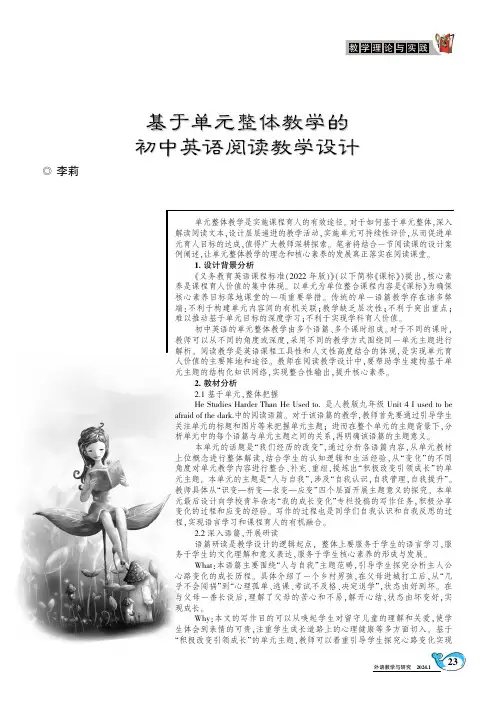
教学理论与实践◎李莉人价值的主要阵地和途径。
教师在阅读教学设计中,要帮助学生建构基于单元主题的结构化知识网络,实现整合性输出,提升核心素养。
2.教材分析2.1基于单元,整体把握He Studies Harder Than He Used to.是人教版九年级Unit4I used to beafraid of the dark.中的阅读语篇。
对于该语篇的教学,教师首先要通过引导学生关注单元的标题和图片等来把握单元主题;进而在整个单元的主题背景下,分析单元中的每个语篇与单元主题之间的关系,再明确该语篇的主题意义。
本单元的话题是“我们经历的改变”,通过分析各语篇内容,从单元教材上位概念进行整体解读,结合学生的认知逻辑和生活经验,从“变化”的不同角度对单元教学内容进行整合、补充、重组,提炼出“积极改变引领成长”的单元主题。
本单元的主题是“人与自我”,涉及“自我认识,自我管理,自我提升”。
教师具体从“识变—析变—求变—应变”四个层面开展主题意义的探究。
本单元最后设计向学校青年杂志“我的成长变化”专栏投稿的写作任务,积极分享变化的过程和应变的经验。
写作的过程也是同学们自我认识和自我反思的过程,实现语言学习和课程育人的有机融合。
2.2深入语篇,开展研读语篇研读是教学设计的逻辑起点,整体上要服务于学生的语言学习,服务于学生的文化理解和意义表达,服务于学生核心素养的形成与发展。
What:本语篇主要围绕“人与自我”主题范畴,引导学生探究分析主人公心路变化的成长历程。
具体介绍了一个乡村男孩,在父母进城打工后,从“几乎不会闯祸”到“心理孤单、逃课、考试不及格、决定退学”,状态由好到坏。
在与父母一番长谈后,理解了父母的苦心和不易,解开心结,状态由坏变好,实现成长。
Why:本文的写作目的可以从唤起学生对留守儿童的理解和关爱,使学生体会到亲情的可贵,注重学生成长道路上的心理健康等多方面切入。
基于“积极改变引领成长”的单元主题,教师可以着重引导学生探究心路变化实现23成长的主题意义,该主题意义的确立可以促进单元教学的整体性,提升单元教学效率。
英语阅读整体教学设计
英语阅读整体教学设计一、引言英语阅读是学习英语不可或缺的一部分,对学生的语言综合能力和文化素养的提升尤为重要。
本文旨在设计一个整体的英语阅读教学方案,以帮助学生提高阅读理解能力,增强语言表达能力。
二、目标设定1. 帮助学生掌握基本的阅读技巧,包括速读、 skimming 和 scanning。
2. 培养学生的阅读兴趣和阅读习惯。
3. 提高学生的词汇量和阅读理解能力。
4. 培养学生的文化意识和跨文化交际能力。
三、课程内容与教学方法1. 选择适当的教材:根据学生的年级和英语水平,选择符合学生需求的英语阅读材料,如短篇故事、新闻报道、科普文章等。
2. 教学方法的多样化:结合多种教学方法,如讲授、讨论、小组活动、角色扮演等,激发学生的学习兴趣,提高课堂参与度。
3. 阅读技巧的训练:针对不同的阅读材料,设计相应的阅读任务,帮助学生掌握速读、skimming和scanning等技巧,提高阅读效率。
4. 词汇与语法的学习:结合阅读内容,引导学生学习相关的词汇和语法知识,帮助学生理解文本并提升语言表达能力。
5. 文化背景的介绍:通过阅读材料的选取,向学生介绍英语国家的文化背景,培养学生的跨文化交际能力。
6. 阅读讨论与写作:设计有针对性的问题,引导学生进行阅读讨论,培养其批判性思维和分析能力。
同时,组织学生根据所读内容进行写作练习,提高学生的写作能力。
四、评估方式1. 阅读理解测试:通过设计不同难度的阅读理解题目,评估学生对所学知识的掌握情况。
2. 口头表达评估:结合课堂讨论和演讲等活动,评估学生的口头表达能力和思维逻辑。
3. 书面作业评估:通过学生的书面作业,评估其写作表达能力和语言准确性。
五、教学实施与反思1. 分层教学:根据学生的英语水平和阅读能力,进行分层教学,以满足不同层次学生的需求。
2. 学生参与:鼓励学生积极参与课堂讨论和活动,提高学习效果。
3. 反思与改进:及时总结每堂课的教学效果,反思教学方法和内容的合理性,不断优化教学设计。
全英文英语阅读课教案
全英文英语阅读课教案【篇一:全英文英语教案模板】lesson plannsefc module2 unit reading in teacher:period:period1 type:readingduration: 45minutesteaching ideologythe current theory view reading as a interactive process which involves not only the printed page but also the reader’s old knowledge of the language in general, the world and the text types. in the reading process, these factors interact with each other and compensate for each other. based on the understanding of reading as an interactive process, teaching reading in the classroom is divided into three stages in which the top-down and bottom-up techniques integrated to develop the students language efficiency in general and reading strategies. the three stages are pre-reading, while-reading and post-reading.teaching material and learning conditionthe analysis of teaching materialthe teaching material is the reading part from nsefc module2 unit. the topic of this unit is . this passage mainly introduces the passage consists of paragraphs. the first paragraph is a general introduction of the . para.2 to para.4 introduces . the last paragraph tells about . the topic is not new to the ss. but there is some new words and phases in the passage.the analysis of learning conditionthe students are from grade1 in senior high school. as high school students, they have achieved certain english level and they have the ability to get the basic idea of the reading. since they are in grade1, they are easily activated and want to air their own opinions on the topic. they are familiar with the topic of and know some. but they may not know before. moreover, their vocabulary is limited so they may have difficulties in understanding some sentences.learning objectives1. language skillsat the beginning of the class, ss can predict the content ofthe passage based on the title. ? ss can scan the passage andfind out the specific information such as the person relatedwithss can summarize the passage with the help of the clues ofthe passage.2. language knowledgess can master the key words and phrases of the passage as follows, . ? ss can learn , especially3. affectsss will realize that and they will concern themselves with the issue of4. cultural awarenessss will broaden their minds by knowing something about 5. learning strategiesss will cultivate their ability individual learning and cooperative learning by doing someactivities independently and some in groups.ss will communicate with each other in english while doingthe group work.language difficultiesfocuses and anticipatedlanguage focusesthis is a reading period so the focus is to cultivate thestudents’ reading skills. the many activities are designed tohelp ss to train their reading skills, such as predicting, skimming, scanning and summarizing.it is also important for the ss to master the new words and phrases.anticipated difficultiesas the ss have a limited vocabulary, so they may have some difficulties in understanding the passage. so the teacher willhelp them learn the new words and phrases.ss may did not heard before, so the teacher will tell themsome background knowledge about it.teaching methodthree-stage model: based on the understanding of reading asan interactive process, teaching reading in the classroom is divided into three stages in which the top-down and bottom-up techniques integrated to develop the students languageefficiency in general and reading strategies. the three stagesare pre-reading, while-reading and post-reading.teaching aidsmultimedia devices and ppt documents: in order to help ss tofully understand the whole passage, i adopt multimediadevices and ppt documents to bring the real-life situation intothe classroom.teaching proceduresstep1. lead-in (6min)activity1. greetings and free-talking (2min)t leads into the topic by asking ss some they know. ss tell the name of the they know freely.t: hello boys and girls. (ss say hello to the teacher.)t: when we say , what appears in your minds? (ss tell thethings appear in their minds freely.) t: what are the ? (ss tell some names of .)activity2. picture-talking (4min)t shows some pictures about the in china and abroad. after seeing the pictures, ss are expected to tell the similarities of them.t: just now, you talk about some in china. now, let’s see some pictures of some . (t shows the pictures and ss see them carefully.)t: what do the have in common?for example, they are very precious. what are your opinions?(t gives them some hints and ss tell the characteristics of ) [aims]in this step, t first leads in the topic by talking with the ssfreely about the whichis familiar to them and then ss see some pictures and tell the characteristics. these two activities aim to arouse the ss’interests in the topic and activate their old knowledge of . thenss will be mentally prepared for the reading comprehension. what’s more,when they are talking about the charateristics of, they will realize that theare rare and precious and they will concern themselves with the issue of .step2. pre-reading (3min)activity1. knowing something about (1min)t gives a brief introduction of the. ss will know the t: today, weare going to learn . it is . do you know what is? (t shows some pictures ofand ss get to know the .)activity2. predicting (2min)t asks ss to read the title of the passage and then ask themsome questions. ss will predict the content of the passage withthe help of the title.t: please look at the title “”, what does “” mean?(if the ss can not give the answer, then t explain it.)t: in search means that people are looking for it. why arepeople looking for it? can you guess? what will the passagetalk about?(ss predict the content, but t will not give the answer here.)[aims]in this step, the ss first know some information of the ; the background information will make it easier for the ss tounderstand the passage. then t asks ss to make predictionsabout the passage. it aims to help ss develop the reading skillsof predicting.step3. while-reading (22min)activity1. skimming (4min)ss skim the whole passage and find out and check their predictions. t: why are people still ? here is a multiple choicefor you.activity2. scanning (3min)t presents several true or false statements and asks the ss toscan the passage and judge the right from the wrong.(keys: F,F,T,T,F)activity3 close-reading (15min)t designs various kinds of activities and ss do the activities tofully understand the passage. para.1t: please read para.1 carefully and then take some note aboutthe .para.2-4please read para.2-4 carefully and then find out the removal ofthe room.please read para.2-4 carefully and then find out the personrelated with the amber room and the things them down with it. para.5please read para.5 carefully and then find out the therebuilding of the amber room.【篇二:初中英语阅读课教学设计】谈初中英语阅读课教学案例吉林省桦甸市金沙中学:王欣平一、背景现行初中英语教材具有很多的优点,但由于学生认知水平的发展具有规律性,教师只有充分认识和掌握这种规律,并结合教学实际,合理设计教学程序,充分发挥学生的主体作用,教学相长,才能达到教学效果的最优化。
单元整体教学设计典型案例
单元整体教学设计典型案例典型案例:英语阅读教学设计1. 教学目标:- 帮助学生提高英语阅读能力,包括词汇理解、句子理解和篇章理解等方面。
- 培养学生的阅读习惯和方法,提高学生的阅读速度和理解能力。
- 培养学生的阅读兴趣,拓宽学生的知识面。
2. 教学内容:- 选择与学生年龄和英语水平相适应的英文原版故事书或新闻文章作为教材,例如《哈利·波特》系列、《小王子》等。
- 分为不同难度的阅读理解题,包括词汇选择、填空、判断等题型。
3. 教学过程:- 导入阶段:通过英文图片、小故事、问题等引导学生进入阅读主题,激发学生的阅读兴趣和欲望。
- 预习阶段:教师带领学生预览文章的标题、图片和段落等,引导学生猜测文章内容,激发学生的思考和好奇心。
- 阅读阶段:学生独立进行阅读,并根据问题回答文章的相关内容。
教师可以提供必要的词汇解释和语法知识点的讲解。
- 理解阶段:教师引导学生讨论答案,解释文章中的生词和句子,并对学生的答案进行评价和改正。
同时,教师也可以启发学生思考文章的隐含意义和深层含义。
- 运用阶段:通过角色扮演、问答等形式,让学生将阅读的知识运用到实际情境中,并鼓励学生用英文讲述自己的观点和看法。
4. 巩固与拓展:- 布置阅读任务,要求学生在课后继续阅读相关内容,并完成相应的练习题或写作作业。
- 提供更多相关的英语阅读材料,让学生享受阅读的乐趣,并激发学生对英语学习的兴趣。
5. 评价与反思:- 考察学生的阅读理解能力,包括词汇的理解、句子的理解和篇章的理解等方面。
- 根据学生的表现和进步情况,及时调整教学方法和内容,对学生进行个别指导和辅导。
通过以上的典型案例,可以看出教师在教学设计中注重培养学生的阅读能力和兴趣,通过合适的教材和教学方法,提高学生的阅读水平和自主学习能力。
这个案例可以作为其他科目教学设计的参考,能够帮助教师更好地设计整体教学方案。
高中英语整本书阅读教学设计
高中英语整本书阅读教学设计一、引言在高中英语教学中,整本书阅读是一项重要的教学活动。
通过整本书的阅读,学生能够提高自己的阅读理解能力、语言表达能力以及对不同文化的理解。
本文将针对高中英语整本书阅读的教学设计进行探讨。
二、目标设定1. 提高阅读理解能力:学生通过整本书的阅读,能够熟练运用各种阅读技巧,提高自己的阅读理解能力。
2. 培养语言表达能力:学生通过整本书的阅读,能够学习并灵活运用一些常用的英语表达方式,提高自己的语言表达能力。
3. 增进对不同文化的理解:学生通过整本书的阅读,能够了解并理解不同文化的差异,培养自己的跨文化交际能力。
三、教学方法1. 指导阅读:教师通过提问、解释等方式,引导学生进行整本书的阅读。
教师可以适时给出一些阅读策略和技巧,帮助学生更好地理解文章内容。
2. 分组讨论:将学生分成小组,让他们就书中的不同章节进行讨论。
鼓励学生积极参与,分享自己的阅读理解和观点,并引导他们互相尊重、倾听他人的意见。
3. 作品展示:鼓励学生将自己对整本书的理解、感悟以及涉及到的文化差异等内容进行整理,并进行个人或小组作品展示。
可以选择演讲、PPT、小组讨论等形式,培养学生的表达能力。
四、教学步骤1. 预习阶段:在开始整本书的阅读之前,教师可以通过提供相关背景知识、激发学生的兴趣等方式,引导学生进行预习。
可以要求学生了解作者、背景、主题等信息,在阅读之前有一个大致的了解。
2. 整本书阅读:学生根据教师的指导,进行整本书的阅读。
在阅读过程中,教师可以组织一些课堂活动,如阅读小组讨论、边读边记、分析作者意图等,帮助学生更好地理解文章的内容。
3. 总结讨论:整本书阅读结束后,教师可以组织全班或小组间的总结讨论。
让学生分享自己的阅读体会,讨论整本书的主题、情节、角色等方面的内容,并引导他们扩展讨论到文化差异、社会背景、人物心理等更深层次的问题。
4. 作品展示:鼓励学生将自己的阅读心得整理成作品,并进行展示。