
unit2 Our new home Period 3五年级英语下牛津上海版
Step 3: Share your ideas within the group. Step 4: Share your ideas in the class.
Step 5: Regroup. Step 6: Design the poster (the aspects your group want to mention).
How do birds find their way? No one really knows.
They may follow the Sun, or maybe they use other ways such as finding landmarks. Some scientists say that the birds follow the Earth’s magnetic field ( 地球磁场) when they fly back.
Read and judge
( F ) In winter, wild geese fly south. ( T ) Wild geese can find food in the south in winter. ( T ) Wild geese fly back to the north in spring. ( F ) Wild geese change homes once a year.
Let’s learn more!
Let’s learn more!
Let’s learn more!
takes a walk
trip
shell
postman
shelter safe
Let’s learn more!
a
b, d
c
Let’s learn more!
Homework
1. Read the passage “Why do wild geese change homes?” on Student’s Book page 10.
How do birds change their homes?
Those birds usually fly over land, not water.
Big groups of birds may fly together over land. Sometimes you will see them flying in a Vformation(V字形) in the sky.
Listen and answer
Where do they fly to?
In spring, they fly north. In autumn, they fly south.
Listen and answer
Why do they change homes?
In winter, they cannot find enough food in the north. In spring, it is warm in the north.
2. Retell the passage. 3. Search the information and find the relative
answers to the questions. Finish the poster. 4. Finish Workbook pages 12 and 13.
where
how
Look and listen
Read and judge
( ) In winter, wild geese fly south. ( ) Wild geese can find food in the south in winter. ( ) Wild geese fly back to the north in spring. ( ) Wild geese change homes once a year.
Names of the rooms
What are the rooms like?
Activities in the rooms
Байду номын сангаас
Think and say
Do you want to change your home? Why or why not?
Brainstorming
why
Wild geese change homes.
Step 1: Form your group.
Step 2: Read the material.
Some of the birds may fly a long way to look for food or places. However, some birds live near the equator (赤道). They do not usually change their homes because there is enough food. And it is warm all year round.
Why do wild geese move around so much? In winter, they cannot find enough food in the north, so they fly south in autumn. Then in spring, it is warm in the north, so they fly back.
Birds in the north are not lucky enough. It is very cold in winter.
Some birds like golden eagles stay in their homes in the north. However, some birds travel south to warmer areas.
More reading
More information about “Home and away”
Step 1: Form your group. Step 2: Read the material. Step 3: Share your ideas within the group. Step 4: Share your ideas in the class. Step 5: Regroup. Step 4: Design the poster (the aspects your group want to mention).
Look and say
Think and say
Are wild geese the only animal that changes homes? Do other animals change homes?
Think and say
Think and say
What is in the picture? - Birds. What are they doing? - They are changing homes.
Oxford English
Module 1 Changes and differences
2 Our new home
Period 3
Think and guess
Think and guess
Make a dialogue
How many rooms are there?
Which is your favourite room? Why?
Why can’t wild geese find enough food in the north in winter?
Look and read
Wild geese have busy lives. They fly from one place to another. They change homes twice every year. In spring, they fly north. In autumn, they fly south.
五年级下册英语课件-Unit 2 Our new home(课时3)|沪教牛津版(三起)

>>Presentation
Read and answer (1) Where are wild geese in winter? They are in the south. (2) Why don’t they stay in the north? Because they cannot
find enough food there. (3) Will they fly back to the north?
>>Summary
阅读:
Why do wild geese change homes?
语音:
字母组合ir, ur, au, oor在单词中的 发音。
>>Homework
1.观看课文动画, 按照正确的语音、语调朗读课文对话。
2.朗读“Look and read”部分课文。 3.预习“Listen
and say”。
close
the north. In spring, it is warm in
the north.
>>tation
Read and answer (1) How many times do wild geese change homes every year? They change homes twice every year. (2) Where do they fly in spring? They fly north in spring. (3) Where do they fly in autumn? They fly south in autumn.
Yes. They will fly back to
the north in spring.
小学英语牛津译林苏教版四年级上册(新版)Unit5 Our new home Period 3课件
This is my home. We have a big bathroom in our home. We have a TV and a sofa in the living room. We have a fridge and a clockin the kitchen. We like our home.
江苏《牛津英语》四年级
Unit 5 Our new home Period 3
Vick
Bad bears! You take away my things.
熊大Bramble
熊二Briar
What rooms do they have?
I think they have …
Where’s my …? It’s in the …, I think. Where are my …? They’re …, I think.
Can you show us your home?
This is my home. We have a We have in the We have in the We like our home.
in our home. … .… .…
What would the bird like?
刘宝杰 liuyi303@
我能谈论我的家
3 sentences 5 sentences
I can say where my things are.
我能说出我的 东西在哪儿
2 sentences
3 sentences 5 sentences
Homework
1. Continueut the cartoon with your friends. 3. Write about your home. (at least 3 sentences 至少3句话)
五年级下册英语课件Unit2Our new home Period3 牛津上海版
Why can’t wild geese find enough food in the north in winter?
Look and read
Wild geese have busy lives. They fly from one place to another. They change homes twice every year. In spring, they fly north. In autumn, they fly south.
Listen and answer
Where do they fly to?
In spring, they fly north. In autumn, they fly south.
Listen and answer
Why do they change homes?
In winter, they cannot find enough food in the north. In spring, it is warm in the north.
Look and say
Think and say
Are wild geese the only animal that changes homes? Do other animals change homes?
Think and say
Think and say
What is in the picture? - Birds. What are they doing? - They are changing homes.
Step 1: Form your group.
Step 2: Read the material.
Some of the birds may fly a long way to look for food or places. However, some birds live near the equator (赤道). They do not usually change their homes because there is enough food. And it is warm all year round.
Unit 2 Our new home (导学案)- 2021-2022学年英语五年级下册 无答案
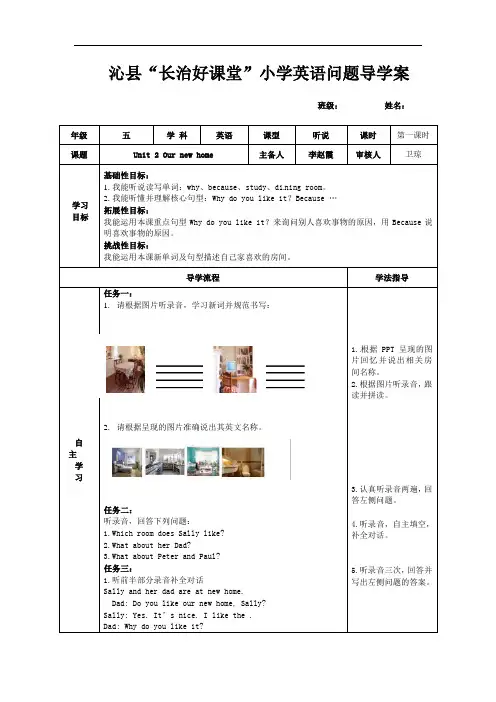
沁县“长治好课堂”小学英语问题导学案班级:姓名:年级五学科英语课型听说课时第一课时课题Unit 2 Our new home 主备人李赵霞审核人卫琼学习目标基础性目标:1.我能听说读写单词:why、because、study、di ning room。
2.我能听懂并理解核心句型:Why do you like it?Because …拓展性目标:我能运用本课重点句型Why do you like it?来询问别人喜欢事物的原因,用Because说明喜欢事物的原因。
挑战性目标:我能运用本课新单词及句型描述自己家喜欢的房间。
导学流程学法指导自主学习任务一:1.请根据图片听录音,学习新词并规范书写:2.请根据呈现的图片准确说出其英文名称。
任务二:听录音,回答下列问题:1.Which room does Sally like?2.What about her Dad?3.What about Peter and Paul?任务三:1.听前半部分录音补全对话Sally and her dad are at new home.Dad: Do you like our new home, Sally?Sally: Yes. It’s nice. I like the .Dad: Why do you like it?1.根据PPT呈现的图片回忆并说出相关房间名称。
2.根据图片听录音,跟读并拼读。
3.认真听录音两遍,回答左侧问题。
4.听录音,自主填空,补全对话。
5.听录音三次,回答并写出左侧问题的答案。
Sally: Because it’s so big! What about you, Dad? Dad: I like the.2.听后半部分录音,回答下列问题。
Does Sally’s Dad like the study? Why?_________________________________________Is there a garden in their new home?_____________________________________合作探究活动一:小组核对并讨论活动二:分角色朗读课文活动三:结对练习重点句型:Why do you like it? Because___________ .活动四:组内讨论,对话练习课本第12页“Ask and answer”。
小学英语牛津译林苏教版四年级上册(新版)Unit5 Our new home Period 3教案
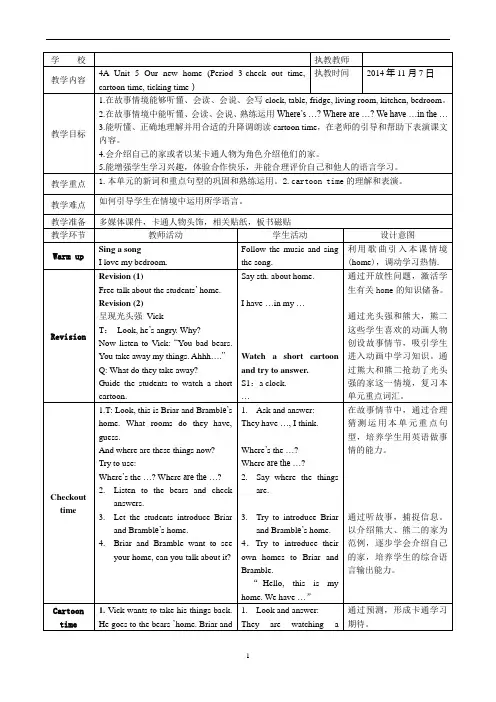
校 4A Unit 5 Our new home (Period 3-check out time, cartoon time, ticking time)
教学内容
执教教师 执教会读、会说、会写 clock, table, fridge, living room, kitchen, bedroom。 2.在故事情境中能听懂、 会读、 会说、 熟练运用 Where’s …? Where are …? We have …in the … 教学目标 3.能听懂、正确地理解并用合适的升降调朗读 cartoon time,在老师的引导和帮助下表演课文 内容。 4.会介绍自己的家或者以某卡通人物为角色介绍他们的家。 5.能增强学生学习兴趣,体验合作快乐,并能合理评价自己和他人的语言学习。 教学重点 教学难点 教学准备 教学环节 Warm up Sing a song I love my bedroom. Revision (1) Free talk about the students’ home. Revision (2) 呈现光头强 Vick Revision T: Look, he’s angry. Why? Now listen to Vick: “You bad bears. You take away my things. Ahhh….” Q: What do they take away? Guide the students to watch a short cartoon. 1.T: Look, this is Briar and Bramble’s home. What rooms do they have, guess. And where are these things now? Try to use: Where’s the …? Where are the …? Checkout time 2. Listen to the bears and check answers. 3. Let the students introduce Briar and Bramble’s home. 4. Briar and Bramble want to see your home, can you talk about it? 3. Try to introduce Briar and Bramble’s home. 4 . Try to introduce their own homes to Briar and Bramble. “ Hello, this is my home. We have …” Cartoon time 1. Vick wants to take his things back. He goes to the bears ’home. Briar and 1. Look and answer: They are watching a 通过预测,形成卡通学习 期待。 通过听故事,捕捉信息。 以介绍熊大、熊二的家为 范例,逐步学会介绍自己 的家,培养学生的综合语 言输出能力。 Where’s the …? Where are the …? 2. Say where the things are. Watch a short cartoon and try to answer. S1:a clock. … 1. Ask and answer: They have …, I think. I have …in my … 通过光头强和熊大,熊二 这些学生喜欢的动画人物 创设故事情节,吸引学生 进入动画中学习知识。通 过熊大和熊二抢劫了光头 强的家这一情境,复习本 单元重点词汇。 在故事情节中,通过合理 猜测运用本单元重点句 型,培养学生用英语做事 情的能力。 1.本单元的新词和重点句型的巩固和熟练运用。2.cartoon time 的理解和表演。 如何引导学生在情境中运用所学语言。 多媒体课件,卡通人物头饰,相关贴纸,板书磁贴 教师活动 学生活动 Follow the music and sing the song. Say sth. about home. 设计意图 利用歌曲引入本课情境 (home),调动学习热情. 通过开放性问题,激活学 生有关 home 的知识储备。
牛津上海版五上《Unit3Movinghome》word教案

5A M2 U3 Moving homeTheme : Moving homeTopic : Look and say& Look and learnstPeriod : 1 PeriodTeach ing Aims :Lan guage Aims:•Lear n the new words: n orth, south, west, east, study, a lot of •Lear n the new phrases: face(s) ____•Learn the new patterns: Why …? Because …Ability Aims:•Usi ng adverbs to in dicate direct ions.•Using wh-questi ons to ask for reas ons.•Using modeled senten ces to give reas ons.Emotio n Aims:•Love our home.Main poin ts: Using adverbs to in dicate direct ions.Difficult poin ts: Using modeled senten ces to give reas ons.Teach ing aids: PPT, cassette player and cassette 5ATheme : Moving homeTopic : Peter 'new homePeriod : 2nd PeriodTeach ing Aims :Lan guage Aims:•Lear n the new words: share, through, take•Lear n the new patter ns: It takes ___ by bus.Ability Aims:•Using wh-questi ons to ask for reas ons.•Using modeled senten ces to give reas ons.Emotio n Aims:•Love our home.Mai n poi nts:•Using wh-questi ons to ask for reas ons.•Using modeled senten ces to give reas ons.Difficult poi nts: Ss can talk about their homes and give reas ons to the room they like.Teach ing aids: PPT, cassette player and cassette 5AThe second paragraphThethir dparagraphSay and act 1.Ss read the sec ondparagraph.2.Elicit: through3.Show the differe neebetwee n cross andthrough.4.Practise:We must ___________ theroad very carefully.We walked _____________the forest.You can' t _________ theroad when the light is redI try to get into the room________ the wi ndowbecause I can ' t open thedoor.1.Ss read the thirdparagraph.2.E licit: take, take 20minu tes by bus3.Practise:My home is far away fromschool. It takes_____ .(乘公交车需要1小时)The cinema is near myhome. It only takes______ .(步行需要5分钟)1.Ss watch the flashabout the dialogue.2.Ask and an swer.How many bedrooms are therein Peter ' s n home?Does Peter like his room?Why?Who shares the学习第二段语段,了解cross 与through的区别,通过练习巩固知识点。
五年级下册英语课件Unit 2Our new home 牛津上海版(三起)
Presentation
Listen and answer
1. Which room does Sally like? She likes the living room.
2. Which room does Sally’s dad like?
He likes the study. 3. What dห้องสมุดไป่ตู้ Peter and Paul like?
Presentation
Listen and answer
3. Why do Peter and Paul like the garden? Because they can play in the garden all day.
Practice
Role-play
Match and say
Make a dialogue
7.阅读理解,选择正确的答案。 Do you think you can communicate (交流) without
words?A smile on your face shows you are happy or friendly. Tears in your eyes tell others that you are sad. When you raise your hand in class, the teacher knows you want to say something or ask questions. You shake your head, and people know you are saying "No". You nod and people know you are saying "Yes".
上海沪教牛津版英语五年级下册Unit 2 Our new home 课件
……………………………………………………………………………………………………………………………………………………………………
近义词: sitting room 短 语: in the living room 在客厅里
拆拼记忆 living room
living [ˈlɪvɪŋ] room
living
because 意为”因为”,用来说明原因,一起来看看它的用法吧。 because用来回答why引导的疑问句。
—Why do you make so many noodles? 你为什么做这么多面条? —Because I'm very hungry. 因为我非常饿。
—Why do you go to the park by bike? 你为什么骑自行车去公园? —Because it's not far. 因为它不远。
萨莉和她的爸爸在他们的新家。
Dad: Do you like our new hone, Sally?
Why do you like it? 你为什么喜欢它? Because it's so big. 因为它很大。
爸爸:你喜欢我们的新家吗,萨莉?
Sally:Yes. It's nice. I like the living room.
……………………………………………………………………………………… ………………………………………………………………………………………
……………………………………………………………………………………………………………………………………………………………………
……………………………………………………………………………………上…海……沪……教……牛……津……版……英…语……五……年……级……教……学……课…件……… 1
牛津深圳版小学英语五年级下册课时同步练习试题及答案(全册)
Unit 1 Tidy up 第一课时习题一、写出下列单词。
1.整理2.让3.一些4.袜子5.乱二、按要求写单词。
1 .这么乱(中文)____________ 2.what’s (完全形式)__________ 3. are(否定形式)_____________ 4. cap(复数)___________5. I(宾格) ______________三、根据句子大意补充完整。
1. It is your .(袜子)2. (什么)a mess?.3. (让)me do it.4. Can you (把)them on your bed?5. Look at the umbrella and the (帽子).四、将下列句子翻译成英语。
1.这些是谁的袜子?2.不用谢。
3.是皮特的。
4.不,不是他们的。
5.是你的吗?五、按要求写句子。
1.There is their caps. (改为一般疑问句)2. They are on the bed. (划线部分提问)3. It is a cap. (划线部分提问)4. Are there your clothes? (作肯定回答)5. I can tidy them up. (变为否定句)Unit 1 Tidy up第一课时答案一、【解析】该题考查单词的熟悉程度【答案】1.tidy 2.let 3.a few 4.socks 5.mess 二、【解析】1. What a mess.固定搭配。
2. 考查动词what’s 完全形式,故答案为what is。
3. 考查否定,故答案为aren’t。
4. 考查复数,故答案为caps。
5. 考查主宾转换,mine。
【答案】1.What a mess。
2. what is 3. aren’t 4. caps 5.mine 三、【解析】考察学生的句意理解能力。
【答案】1. socks 2. What 3. Let 4.put 5. cap四、五、【解析】本题考查学生句子的运用。
五年级下册英语教案二:Module1Unit2Ournewhome,学习家具的英语词汇
Module 1 Unit 2: Our New Home - Learning Furniture VocabularyAs we start learning English, one of the essential things we need to do is to enhance our vocabulary. We need to learn many words that we use daily in our daily life. One of the exciting places where we can learn a lot of vocabulary is our own home. We have different things in our house that we use daily, and it's essential to learn the English words for them. Today, we're going to be learning about furniture, the things we sit on, sleep on, eat on, and store things in.1.Bed: A bed is the piece of furniture on which wesleep. A bed usually consists of a mattress, a bed frame,a headboard, a footboard, slats, and support rails. Somecommon types of beds are a single bed, a double bed, atwin bed, a bunk bed, and a canopy bed.2.Sofa: A sofa is a piece of furniture that we sit orlounge on. It's usually more extensive than a chair, andit can seat more than one person. There are many types of sofas, such as a sectional sofa, a loveseat, a reclinersofa, and a Chesterfield sofa.3.Chair: A chair is a piece of furniture with a seat and a backrest that's designed for one person to sit on. Some common types of chairs are a dining chair, an armchair, a rocking chair, and an office chair.4.Table: A table is a piece of furniture with a flat top and one or more legs that's used for eating, working, or placing things on. Some common types of tables are a dining table, a coffee table, an end table, and a nightstand.5.Cabinet: A cabinet is a piece of furniture with doors or drawers that's used for storing things in. Some common types of cabinets are a kitchen cabinet, a bathroom cabinet, and a file cabinet.6.Bookshelf: A bookshelf is a piece of furniture with shelves that are used for storing books on. It can bewall-mounted or freestanding. There are many types of bookshelves, such as a corner bookshelf, a ladder bookshelf, and a cube bookshelf.7.Wardrobe: A wardrobe is a piece of furniture with doors and hanging space that's used for storing clothes in. It's also called a closet. Some common types of wardrobesare a walk-in wardrobe, a sliding door wardrobe, and abuilt-in wardrobe.8.Desk: A desk is a piece of furniture with a flattop and drawers that's used for working on. Some common types of desks are a computer desk, a writing desk, and a standing desk.Learning English vocabulary is an essential part of language learning, and learning about house furniture is an effective way to start. By learning these words, we can now communicate better with native English speakers and understand them better. We can also describe our surroundings and express our ideas more effectively. Let's keep practicing and exploring more words related to the things we use daily.。