
九年级英语外研版下module7unit1教案
外研初三下册MODULE 7Content:Module 7 Eating together一、题材内容本模块以食物和饮食习惯为话题。
在21世纪的今天,越来越多的人走出国门,同时越来越多的外国朋友来到中国旅游、学习和工作。
因此了解西方的用餐礼仪不仅是外语教学的任务之一,也是时代提出的要求。
本模块通过准备聚会食物的对话和介绍西餐用餐习惯的课文,帮助学生了解西方的饮食文化和用餐习俗,同时可以加深同学们对中国饮食文化的认识与理解。
第一单元从谈论请帖开始,引入本课的话题。
下面的对话以即将举办的毕业生晚会为话题谈论不同国家的传统食物。
对话中突出了本模块的语法---- 被动语态,学生们可以在学习对话的过程中复习被动语态的用法和结构。
第二单元的课文讲的是西方的用餐习俗,内容涉及用餐时间、餐具、食物数量和如何结束等方面。
第三单元的任务是复习、巩固被动语态用法、复习检测重要词汇并完成模块任务。
教学目标1)语言知识:语音能根据意群正确朗读语句。
词汇finger, basket, bread, fork, knife, lemonade, pancake, serve, spoon, hold, hot, roll, Roman, saying, cheers, plate, explanation, cross, generally, over, blind, sense, taste, owner, bee, officer, course语法复习被动语态。
功能谈论食物和饮食习惯。
话题以食物和饮食习惯为话题。
2)语言技能:听能听懂有关饮食习惯方面的对话;运用记笔记的方法掌握细节信息。
说能够谈论聚会计划。
读能读懂有关介绍食物和饮食习惯的文章;根据相关信息预测下文;能评价文章和根据文中信息推断文章的深层含义。
写能够模仿课文写一篇关于中国食物和饮食习惯的短文。
演示与表达展示和介绍中国的饮食文化。
3)学习策略学习一定程度形成自主学习,有效交际、信息处理、英语思维能力。
自学策略在文段中加深理解被动语态的意义、结构和用法。
合作学习策略交流健康饮食的窍门和经验。
4)文化意识:中外对比了解西方的饮食习惯,加深对中国饮食文化和习俗的认识。
5)情感态度:了解不同国家的饮食文化,保持中国饮食文化中良好的习惯,学习西方饮食习俗中好的方面。
6)任务:介绍自己的餐饮经历。
教学重点和难点重点:1.掌握介绍食物和饮食习惯的基本词汇,能够叙述自己的餐饮经历,读懂含有被动语态的句子。
难点:正确介绍自己的餐饮经历。
教学方法基于课程改革的理念及“第二语言习得论”,培养实现人的可持续发展和人的主体精神的自我完善和发展所必需的能力和素质,运用任务型教学途径,围绕核心任务,设定小任务,开展和谐愉悦的课堂活动,强调兴趣第一的原则,初步设计“P—T—P”自主学习立体模式:pre-task…task-cycle…post-task。
二、教材处理核心任务:能够运用所学句型结构介绍食物和饮食习惯。
三个环节如下:pre-task:学生联系生活实际,激活背景知识,。
task –cycle:通过整个模块的听说读写的训练,强化对食物和饮食习惯的表达能力,为完成任务做好铺垫post-task:达成任务,展示成果,反馈学习情况三、教材安排根据学生学习英语的特点和规律,我们把本模块划分为4课时:Period 1: Listening and V ocabulary & Pronunciation and SpeakingPeriod 2 V ocabulary and ReadingPeriod 3. Language in usePeriod 4. Writing& Around the world &Module Task注:教学时应根据学生的学习水平、生活实际水平、接受程度及课堂出现的临时状况进行运用、调整及筛选。
『教学设计』Title: Module 7 Eating togetherPeriod 1: Listening and V ocabulary and Pronunciation and SpeakingTeaching Content : Listening and V ocabulary and Pronunciation and SpeakingTeaching Aims and Demands:1. Language KnowledgeKey vocabulary and phrases: finger, basket, bread, fork, knife, lemonade, pancake, serve, spoon, hold, hot, rollKey structure: And everyone has been told to prepare a traditional dish from our own countries.It’s made with chicken or pork and vegetables. (难点)2. Listening skill: To understand the conversation involving the use of passive voice. (重点)3. Speaking skill: To ask and give information about one’s diet or diet habit.Learning strategies:Bottom –up approach and listening to the tape and do some exercises.Teaching Aids: Multi-Media (Tape recorder, video, OHP, handout)Teaching Procedures:Part I: RevisionTask: Recall what we have learned in Module 6.Directions:Step one: Label the pictures with the phrases.(1). Read through the phrases in the box and have the Ss. Repeat them after you.(2).Ask them to label them in the pictures on the screen.(3).Make some sentences with the phrases. Ask students to speak out as many as they can.Step two: Talk about food and diet habit.Part II: Lead in:Task 1 : Introduce to them the new words .Directions:Step one: Read through the new words and phrases and have the Ss. repeat them after you chorally and individually.Step two: Ask the students to talk about the pictures on the screen.Step three: Collect some descriptions in a whole- class setting.Step four: Pair the Ss to discuss what else they know about food.Step five: Collect any other information they can provide from them and list them on the board.Task 2: Introduce to them about food and diet habit.Directions:Step one. The teacher can show them the video abut food and diet habit.Step two: Free talk about food and diet habit.Part III: ListeningTask1:. Step three: Look at the party invitation and answer the questions in Activity 1 on page 56. Directions:Step one: Ask the students to do this individually, then check with a partner.Step two: Call back the answers from the whole class, having one student ask a question and another answer.Answers1. A party for students who are completing their secondary school education that year.2. Something which belongs to the place where you live or where you’re from.3. Food which you can eat with your hands--- you don’t need knives and forks or chopsticks.4. Listen to music and dance.Task2.: activity 2on page 57. Listen and answer the questions.Directions:Step one: Read through the words in the box with the whole class, and have them repeat them chorally and individually if you feel it is necessary.Step two: Ask the students to read the questions to themselves.Step three: play the recording once while they just listen and focus.Step four: play it again for them to answer; they can then check with a partner.Step five: play it once more for them to complete, check and correct.Step six: call back the answers from the whole class, having one student ask a question and another answer.Answers1. In a basket.2. Food and drink for the family and for the party.3. Pancakes or pizza.4. Grapes, bread and wine.5. Lemonade and pizza (ham, tomatoes, cheese to make the pizza).Task3: Listen and read:Directions: Play the recording while the students follow the conversation in their books.Task4: activity 4 on page57.Directions:Step one: Ask the students to do this individually, then check with a partner.Step two: Call back the answers from the whole class. You may want to complete a table on the board as they give the answers.AnswersDish Made withBetty hamburgers (meat) cheese, bread rollLingling S uanla tang Chicken or pork and vegetablesTony pizza Cheese, tomato, hamDaming jiaozi (we don’t know, but probably meat or eggs, vegetables, flour)Task5: activity 5 on page 57.Directions:Step one: Ask the students to do this individually, then check with a partner.Step two: Call back the answers in a whole- class setting.Answers1. I think he feels pleased and proud.2. At home.3. Because their school asks the students, not their relatives, to prepare the food.4. Because you can eat it everywhere in England.5. Because it is an Italian dish which wasn’t introduced into Britain then.Part IV: Language points1. What food and drink is for the family?句中的food and drink看成一个整体,所以谓语动词用单数。
外研版九年级英语《Module 7 Great books Unit 1》教学设计
外研版九年级英语《Module 7 Great books Unit 1》教学设计一. 教材分析外研版九年级英语《Module 7 Great books Unit 1》以文学名著为主题,介绍了三部世界著名文学作品《骆驼祥子》、《简·爱》和《远大前程》。
本单元通过阅读名著梗概,学习与名著相关的文化背景、人物关系、故事情节等,提高学生的阅读理解能力。
教材内容丰富,既有文学知识的介绍,又有阅读策略的学习,旨在激发学生对文学的热爱,培养学生的文学素养。
二. 学情分析九年级的学生已经具备一定的英语基础,对于阅读理解也有自己的方法。
但学生在阅读长篇文学作品时,可能会遇到生词、难句等障碍,影响阅读理解。
此外,学生对于文学名著的了解相对有限,需要老师在教学中进行引导和拓展。
三. 教学目标1.知识目标:学生能够掌握与名著相关的词汇和表达,理解名著梗概,了解名著的文化背景。
2.能力目标:学生能够运用阅读策略进行名著阅读,提高阅读理解能力。
3.情感目标:学生能够热爱文学,主动探索文学作品。
四. 教学重难点1.重点:学生能够阅读并理解名著梗概,掌握与名著相关的词汇和表达。
2.难点:学生能够运用阅读策略进行名著阅读,提高阅读理解能力。
五. 教学方法1.阅读指导法:教师引导学生进行阅读,帮助学生解决阅读中的困难。
2.任务驱动法:教师设计各种任务,引导学生积极参与课堂活动。
3.小组合作法:学生分组讨论,共同完成任务。
4.情境教学法:教师创设情境,激发学生的学习兴趣。
六. 教学准备1.教师准备:教师熟悉教材内容,了解学生的学习情况。
2.学生准备:学生预习教材,了解将要学习的内容。
七. 教学过程1.导入(5分钟)教师通过提问方式引导学生谈论自己对文学作品的了解,激发学生的学习兴趣。
2.呈现(10分钟)教师介绍本节课要学习的三部名著《骆驼祥子》、《简·爱》和《远大前程》,展示名著封面、作者图片等,帮助学生对名著有一个直观的认识。
外研版九年级英语Module7Unit1
学而时习之,不亦乐乎?
学而不思那么罔;
思而不学那么殆。
Lun Yu
敏而好学,不耻下问。 — Confucius
Do you know who wrote Romeo and Juliet? William Shakespeare
Do you know his four great tragedies?
e) People are still influenced by
his ideas. v. 影响;作用于
True or False
1. Both Betty and Mr Jackson think that Confucius and Shakespeare are great writers.
discuss influence
review (n. 评论)
sense (n. 道理;意义;合理)
thinker (n. 思想家) wise
Mr Jackson and Betty are (1) _d_is_c_u_s_s_in_g_ great writers. Betty explains that in her Internet group, each person reads a favourite
Listen again and fill in the blanks.
Presenter: Hello, today our guests will each introduce an important person from their countries, and we’ll discuss why they are famous. Chinese person: Confucius was a great _te_a_c_h_e_r_a_n_d__t_h_in__k_e_r in ancient China. He lived over 2,000 years ago and he is
新外研版九年级下册英语 Module 7 Unit 1 教案(教学设计)
Step 7
Summarize
1. Guide the students to summarize the words and expressions in the lesson.
(1)achieve a lot获得很多
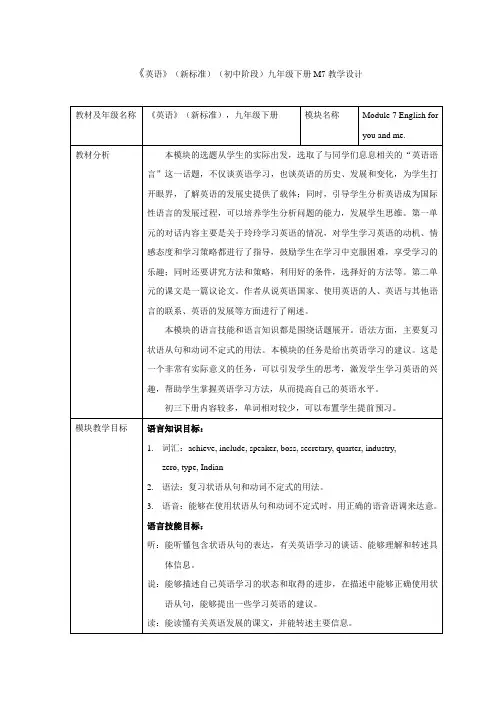
Module 7English for you and me
Unit 1Have you ever been to an English corner?
知识目标
单词
AchievebrighthandwritinglevelcerБайду номын сангаасainhowever
no matterwhereverfairly
句型
1. Describe problems and give advice about learning a foreign language
2. Understand the Adverbial clauses and infinitives
The use of the Adverbial clauses and infinitives
在本节课的教学活动设计中,能够创设丰富的语境,充分调动学生的学习兴趣,引导学生学会“预习——展示——练习——反馈”的学习过程,并确保学生学会描述学习某种外国语言时遇到的问题或提出建议。
③I hope I cancontinueto make progress next year.
④I can speak English with youwheneverwe meet.
技能目标
能够运用所学的句型描述学习某种外国语言时遇到的问题或提出建议
新外研版九年级上册英语 Module 7 Unit 1 教案(教学设计)

Module 7 Great BooksUnit 1 We’re still influenced by Confucius's ideas.单词discuss, thinker, wise, review, influence,4.能够谈论自己喜爱的书籍和作家。
5.掌握一般现在时被动语态的概念和用法。
能够听懂谈论人物或文学作品的对话。
并能在一般现在时的被动语态的用法。
能够通过对话学习,对孔子、莎士比亚、马克吐温这三位伟大的人物有基本的认识,在交流中鼓励不同层次的学生敢于发表自己的观点。
Step 1情景导入T:There are many famous writers and thinkers in the world. How many do you know?S1:Lu Xun is a great writer.T:You\'re right. Who else?S1:Shakespeare is a great writer.T:Do you know Confucius?S2:Yes, I do. He was a teacher, a thinker. He was also a writer.T:Today, we will learn more about them.Step 2完成教材 Activities 1,2的任务1.Work in pairs. Look at the pictures.Say who the people are and why they are famous. Now listen and check your answers. (Activity 1)(1)教师先提供一些词汇,供学生讨论使用。
例如:great, influence, play, poem, respect, story, thinker, thought, wise, writer 等。
外研版(新标准)英语九年级下册教案(全册)
外研版(新标准)英语九年级下册教案Module 1 Travel一、学习目标:A. 单词和短语:flight, because of, direct, pilot, succeed, as long as, school-leaver, exactly, take care, sir, officer, stupid, take off, jacketB. 交际用语:1. Not bad!2. It was great fun!3. How about you?4. We’d better get back to work.5. We’ll have a great time!6.— What did you do during the winter holiday?—I went to see my grandparents in Xi’an.7. The train was full of people and I had to stand for three hours!8. But the pilot succeeded in landing on time.9. There’s nothing to worry about as long as you work hard.10. Please have your tickets ready.11. Oh, it’s a long story12. He went to stay with his family in the UK.13. Why is travel so difficult in winter?14. We flew direct to Hong Kong.15. We took a tour by coach to the Summer Palace.16. Then we took a boat to Lantau Island and went to Disneyland.17. This is Seat 12A, but you should be in Car 9. This is Car 8.二、教学目标1. Function: Talking about travel.2. Structure: Revision: nouns; articles; numbers.3. Skills: 1) Listening for specific information; taking notes..2) Talking about familiar topics (holidays)3) Predicting; reading for specific information .4) Writing a short play about a trip.4. Around the world: The first pilot to fly alone across the Atlantic Ocean.5. Task: Writing and acting out a short play.三、重点及难点:Grammar: Revision: nouns; articles; numbers.四、教学设计:Unit 1 We toured the city by bus and by taxi.Ⅰ Teaching modelListening and speakingⅡ Teaching methodCommunicative approachⅢ Teaching aims1. To understand the conversations conversation with regard to “travel”.2. To talk about one’s holiday and new term..Ⅳ Teaching Objectives1. Key vocabulary: flight, because of, direct, pilot, succeed, as long as, school-leaver,exactly2. Key structures: Sentence structureⅤ Teaching aidsTape recorder, OHP, videoⅥ Teaching StepsStep 1 Warming up1. Show some pictures to talk.1) — How do you go to school / work?— I go to school by ______.2) — How do you most like to travel by?— I most like to travel by _________.3. Show some pictures to introduce the new words.4. Learn the new words.5. Read the words after the teacher.Step 2 Complete the sentences.1. Ask the students to read through the sentences in Activity 1.1) I most like to travel by _____________.2) I least like to travel by _____________.3) I travel most often by ______________.4) I travel least often by ______________.2. Complete the sentences so they are true for you.3. Ask the students to check their answer with a partner.4. Call back the answers from the whole class and check the answers.Step 3 Listening practice.1. Ask the students to read through the sentences in Activity2.1) The flight takes about __________ hours.2) Time difference: __________ hours.3) Flight number: __________4) From _________ to _________5) Leave at (new time): _________6) Arrive at (new time): _________Keys: 10, 8, CA938, London, Beijing, 11:30, 5:30 p.m.2. Play the tape and ask the students to listen to the tape carefully.3. Listen and complete the notes.4. Ask the students to check their answer with a partner.5. Call back the answers from the whole class and check the answers.Step 4 Listen and read.1. Ask the students to listen and read the conversation silently.When you listen to the recording, try to note down the key information. Your notes will then help you retell the main information.2. Now complete the table.Holiday activitiesLingling went to see her grandparents in Henan Province by trainTonyDamingBetty4. Ask the students to check their answer with a partner.5. Call back the answers from the whole class and check the answers.Keys:went to stay with his family in the UK by plane.flew to Hong Kong and visited Lantau Island Disneyland.toured Beij ing by bus and by taxi and took a tour by coach to the Summer Palace. Step 5 Answer the questions.1. Ask the students to read through the questions in Activity 4.1) When do you think the conversation takes place?2) According to Lingling, why is travel so difficult in winter?3) What are Daming and Betty looking forward to at the end of the term?2. Answer the questions.3. Ask the students to check their answer with a partner.4. Call back the answers from the whole class and check the answers.Keys:1. The conversation takes place in winter.2. Travel is difficult because of the Spring Festival.3. They are looking forward to the school-leavers’ party.Step 6 Choose the correct answer.1. Ask the students to read through the words in the box in Activity 5.direct exactly pilot succeed2. Choose the correct answer.1. When you fly direct, you ______.a) arrive without stopping at another place2. When you say “Exactly”, it means ______.a) you do not agreeb) you completely agree3. The pilot of plane ______.a) flies itb) gives you food and drink during the flight4. If you succeed in doing something, you ______.a) manage to do itb) nearly do it3. Ask the students to check their answer with a partner.4. Call back the answers from the whole class and check the answers.Keys: 1. a 2. b 3. a 4. aStep 7 Everyday EnglishNot bad!It was great fun!How about you?We’d better get back to work.We’ll have a great time!Step 8 Pronunciation and speaking: Listen and mark the pauses.1. Play the recording once without stopping.2. Play the recording again and ask the whole class to repeat.Lingling: How about you, Betty?Betty: We had quit a good time in Beijing. We toured the city by bus and by taxi. Last weekend, we took a tour by coach to the Summer Place and went for a long walk around the lake.Lingling: That soun ds great! But now, we’d better get back to work . We’re going to have a big exam at the end of the term.3. Ask the students to listen and mark the pauses.4. Now listen again and repeat.Step 9 Work in groups.Talk about your winter holiday.1. Ask and answer about what you did during the winter holiday.— What did you do during the winter holiday?— I went to see my grandparents in Xi’an.2. Talk about what happened during the trip.The train was full of people and I had to stand for three hours!Step 10 Language points1. But the pilot succeeded in landing on time. 不过飞行员成功地按时着陆了。
外研版英语(新标准)九年级下册《Module 7 English for you and me》教学设计
Invite individualSs to read the paragraphs.
本活动主要训练学生在朗读中找准重读单词、准确把握意群并正确断句。
Step7:
Practice:Free talk.
Get the Ss to work in pairs to talk about their progress in English learning.
学习策略:
自学策略:能够反思自己的学习,采用适当的策略进行复习。
合作学习策略:能够与人交流与合作,共同完成任务。
文化意识:
通过学习,理解英语的重要性,激发学习英语的动机;同时又看到汉语日益增强的影响力,培养学生对汉语的热爱,加强民族自豪感。
教学重点及难点
重点:
1.掌握与课文内容相关的词汇句型。
2.复习状语从句和动词不定式。
Play the tape,Ss listen and answer the questions.
Ask Ss to compare their answers with their partners.
Play the tape again forthem to check answers.
Check answers as a class.
Check the answers.
2.Get the Ss listen and read to decide who might agree with the following sentences in Activity 3.
Check the answers.
3.Play the tape for the Ss to listen and follow.
Module7Unit1外研版英语九年级上册教案详解
二、核心素养目标
1.提高学生的语言素养:通过学习新词汇和语法,使学生能够熟练运用英语描述旅行经历,增强口语表达和书面表达能力;
2.培养学生的文化意识:通过了解不同城市的旅游景点和风土人情,拓展学生的国际视野,增进对多元文化的理解和尊重;
1.加强对基础薄弱学生的关注,给予个别指导和鼓励,提高他们的学习信心。
2.使用简洁明了的语言讲解语法知识,注重实际应用,让学生更容易理解。
3.在实践活动和小组讨论中,加强对学生的引导,确保讨论围绕主题进行。
4.培养学生的独立思考能力,让他们在学习中更加自信。
5Байду номын сангаас及时关注学生的疑问,确保他们能够跟上教学进度。
3.发展学生的思维品质:通过分析课文中的描述性语言和写作技巧,提高学生的思维逻辑性和创新性,培养批判性思维;
4.增强学生的学习能力:引导学生自主探究、合作交流,培养其解决问题的能力和团队协作精神,提高学习效率;
5.塑造学生的人格素养:借助旅行主题,教育学生关爱自然、尊重历史,培养积极向上的生活态度和价值观。
举例:解析课文中的句子,如“During the trip, we saw many interesting sights.”,让学生学会如何描述旅行中的见闻。
(4)写作:根据课文模板,编写一篇关于自己旅行经历的英文短文。教师应指导学生运用所学词汇和语法,提高写作能力。
举例:给出写作框架,如“Introduction-Body-Conclusion”,并指导学生如何将自己的旅行经历填充到框架中。
(2)语法:一般过去时的运用是本节课的重点语法。教师应通过实例讲解,让学生掌握一般过去时的结构,并在实际情境中运用。
2022年外研版九年级上《Module 7 Unit 1 》公开课教案
Module 7 Great booksUnit 1 We’re still influenced by Confucius’s ideas.教学目标【知识目标】1、能够正确使用以下单词和词组: crocodile, shark, hand, have a look at, alongside,2、能够初步了解that引导的限定性定语从句.【能力目标】3、能够听懂有关介绍澳大利亚的对话;能够询问他人的旅游经历.4、能够用本单元学到的词汇、短语、句型介绍参观过的某个地点.【情感态度目标】了解不同国家的风景, 自然与文化, 同时能够介绍中国的文化景点, 增强民族意识;培养学生对自然和生活的热爱之情.教学重难点【教学重点】1、能够掌握本单元重点单词和固定表达2、能够用本单元学到的词汇、短语、句型介绍参观过的某个地点.【教学难点】一般现在时的被动语态的用法教学过程Step 1 Lead-in标题导入:“Recently I’ve read a great book called Romeo and Juliet. I’m deeply moved by it. Have you ever read some great books? 〞随即将“Great books〞呈现在黑板上, 鼓励学生说出他们读过的名著. 这里用学生们熟悉的话题导入新课, 能够激发学生学习的兴趣, 活泼课堂气氛, 更重要的是通过老师的表述, 如运用重读、稍慢的语速等方式强调被动语态的句子, 让学生们在真实的语境中感知被动语态. Step 2 Listening听activity1, 展示三幅图片, 问“Who are they? Do you know something about them? Try to use the words in the table to help you.〞,学生们两人一组描述图片, 之后, 听磁带看学生们的匹配是否与所听到的一致.1. Ask the students to Look at the pictures.2. Say who they are and why they are famous.3. Play the recording and ask the students to listen carefully.4. Now listen and check your answers.5. Ask the students to check their answer with a partner.6. Call back the answers from the whole class and check the answers.Step 3 Listening carefully1. Ask the students to read through answer the sentences.1) Confucius is well-known in _______________.2) Shakespeare wrote ______________________.3) Mark Twain’s stories are set __________________ of the US.2. Play the recording and ask the students to listen carefully.3. Listen and complete the sentences.4. Ask the students to check their answer with a partner.5. Call back the answers from the whole class and check the answers.6. Now listen and check.Step 4 Listen and read〔一〕学生自主学习, 理解activity 3的意思, 找出不懂的地方.〔二〕小组内合作解决不懂的地方, 再有疑难, 小组间共同解决, 教师适时点拨.1. Show some pictures, and ask the students to talk about them.2. Ask the students to read the conversation silently.3. Play the recording and ask the students to listen and read the conversation.4. Read the conversation.5. Act it out.6. Match the people with the descriptions.〔1〕Ask the students to read the conversation again.〔2〕Read the information in Activity 3.1) Confucius 2) Shakespeare 3)Mark Twaina) He was a very wise man.b) He is not as well-known as the other two people, but his works are still popular.c) His plays are read by millions of people.d) He was more a teacher and thinker than a writer.e) People are still influenced by his ideas.3. Now match the people with the descriptions.4. Ask the students to check their answer with a partner.5. Call back the answer from the whole class and check the answer.Keys: 1.a), d), e) 2. c) 3. b)Step 5 Finish the activity 4.1. Ask the students to the words in the box in Activity 4.accept discuss influence review sense thinker wise2. Ask the students to read through the passage in Activity 4.3. Complete the passage with the correct form of the words in the box.4. Check with a partner.5. Call back the answers from the whole class.Keys: 1. discussing 2. review 3. accepted 4. thinker 5. wise6. influenced7. senseStep 6 Everyday English让学生们说说这些句子在文中的意思.What’s up? Well, maybe…I suppose… Why don’t you…?Step 7 Pronunciation1〕跟读录音朗读文章, 模仿语音语调2〕读熟文章3〕画出重读的句子1. Play the recording once without stopping.2. Play the recording again and ask the whole class to repeat.1) We’re still influenced by Confucius’s ideas.2) Shakespeare’s plays also make a lot of sense to us today.3) He was important, but I suppose he isn’t as well-known as Confucius or Shakespeare.3. Ask the students to listen and underline the words the speaker stresses.4. Now listen again and repeat.Step 8 Group work and speaking1. Work in groups. Do you agree with the following opinions? Give your reasons.1) Teahouse is one of the greatest plays in China.2) Everyone should learn some Tang poems.3) We should only read books by great writers.I accept… I agree / don’t agree with…I suppose… I think…2. Now report the ideas of your group to the whole class.Most of us think…We think we learn…3. Work in groups.Step 9 Language points1. What’s up?What’s up? 是一种非正式的用法, 意思是“怎么了/出什么事了?〞例如:What’s up? You look very worried? 怎么了?你看上去很焦虑.2. But I think I’d describe Confucius more as a teacher and thinker than a writer.这里的Confucius指孔子, 为“孔夫子〞的英语译名, 是长期以来约定俗成的译法. more…than…在本句中表示“与其说是…不如说是…〞. 例如:Success is more hard work than good luck. 成功来自努力, 而非好运.3. … and Shakespeare’s plays also make a lot of sense to us today. …make sense的意思是“合情理;明智;有意义〞. 例如:No wonder how I tried to read it, the sentence still did not make any sense to me. 不管我们怎么努力地读, 我还是不懂这个句子的意思.Why did she do such a thing? It does not seem to make sense. 她为什么做这样的事?似乎没有道理.4. I want to join an Internet group to discuss great books by great writers.discuss v.讨论;谈论discuss的过去分词是discussed, 现在分词是discussing,discuss sth. (with sb.)和某人谈论某事e.g. We will discuss the plans with them at the meeting.我们将和他们在会议上讨论这个方案.5. We’re still influenced by Confucius’s ideas.influence v.影响;作用于influence用作动词时, 后面直接跟宾语, 常可用于influence sb. to do sth.结构.e.g. What influenced you to take the job? 什么影响你接受这份工作?6. By the way, what do you think of Mark Twain, …by the way用于转入新的话题, 意为“顺便说;附带说〞.e.g. By the way, has everybody arrived? 顺便问一句, 大家都到了吗?7. He was important, but I suppose he isn’t as well-known as Confucius or Shakespeare.suppose v.猜想;推测;相信;认为后面可以带动词不定式的复合结构或从句, 也常用于be supposed to结构.e.g. I suppose him to be on duty. 我想他在值班.We are not supposed to smoke here. 我们不应该在这儿吸烟.well-known adj.众所周知的;著名的be well-known as意为“作为……而著名〞, 相当于be famous as .e.g. Norman Bethune was well-known as a great doctor.白求恩作为一个伟大的医生而著名.拓展:be well-known for意为“因为……而著名〞, 相当于be famous for. 除v-ing形式外, for后还可跟名词.e.g. Yuan Longping is well-known for hybrid rice. 袁隆平因杂交水稻而著名.8. 小组自我补充9. 学生自主完成这些重点与难点.自主完成后, 小组合作, 交流学习成果, 共同释疑.让学生朗读以上重点知识.Step 10 中考链接A. 单项选择:1. Experts ________ to make suggestions to help him develop.A. will inviteB. are invitedC. have invited2. Han Han’s books are popular. They ________ by many teenagers.A. are readingB. are readC. were read3. —At present, one of the best ways to study is working in groups.—More chances _______ to students to learn from each other.A. offerB. are offeredC. have offered4.—Don’t you see the sign “No Parking!〞on the right?—Sorry, I didn’t. But now I know parking______ here.A. wasn’t allowedB. isn’t allowedC. won’t allowD. doesn’t allow Keys: 1. B 2.B 3. B 4. BB. 完成句子:1. 我试图让每首歌都表达出它自己的意义.I try to make each song ____________for itself.2. 顺便问一下, 你认为这个队的水平如何?_____________, what do you think about this Team?3. 今天很多人仍然看孔子的作品.Confucius’ works ______________ by many people today.4. 学校鼓励学生大声地讲英语.All the students ______________ speak English loudly.5. 我们受到孔子思想的影响.We _____________ by Confucius’s thoughts.Keys: 1. make sense 2. By the way 3. are still read 4. are encouraged to5. are influenced课堂作业Remember the words of Unit 1 and prepare the text of Unit 2.教学反思Unit 3 Language in use教学目标【知识目标】让学生能够使用在本模块所学的单词和短语.【能力目标】总结和理解if条件状语从句.【情感态度目标】在日常生活中能听懂他人的问题和给出建议, 做一个老实的人.教学重难点【教学重点】【教学难点】教学过程Step 1 Revision and lead-inLet Ss look at the pictures and answer the questions to review what they have learnt. Step 2 Language practice and grammarTo master the tense of the adverbial clause of condition.用所给单词的适当形式补全对话1. If I ______(start) the dinner, I ________ (finish) it before I go to bed.2. If you _____(do) these other things instead of your homework, you _______(not have) time to study.3. He thinks something _______(go) wrong if I play games on it.Grammar: If从句(2)一、引导条件状语从句最常用的连词是if, 常见的if条件状语从句表示在某条件下, 某事很可能发生.e.g. If you ask him, he will help you.如果你请他帮助, 他会帮你的.If he does not work hard, he will fail his exams.如果他不努力, 考试就要不及格了.二、If从句的时态1. if从句用一般现在时, 主句用一般将来时.e.g. If he runs, he’ll get there in time.如果他跑着去, 他就会及时赶到那儿.2. if从句用一般现在时, 主句用情态动词+动词原形.e.g. She may come with us if she arrives in time.如果她来得及时, 就可以和我们一道去.三、if 引导的条件状语从句位置灵活, 可直接放在主句后面, 也可以放在句首. 放在句首时, 从句后面要用逗号和主句隔开.e.g. I’ll go to see you if I have time. 如果有时间, 我就去看你.If it rains tomorrow, we’ll stay at home. 如果明天下雨, 我们就待在家里.四、同义句转换用“祈使句+and / or +一般将来时的句子〞转换.e.g. If you work hard, you’ll pass the exam easily.→ Work hard, and you’ll pass the exam easily. 努力学习, 你将很容易通过考试. If you don’t hurry up, you’ll miss the train. → Hurry up, or you’ll miss the train.快点儿, 否那么你就赶不上火车了.Exercises1.If you ____ to the party, you’ll have a great time.A. will goB. wentC. goD. going2. I ______ her the answer if she _______me.A. can tell, will askB. will tell, will askC. would tell, askD. will tell, asks3. -What are you going to do tomorrow?-We’ll go to the library tomorrow if it ______.A. isn’t rainB. rainC. won’t rainD. doesn’t rain4. I’ll give the book to him if he _____ here next Sunday.A. will comeB. comesC. is comingD. cameStep 3 Join the sentences with if●The teacher show Ss how to join the sentences with if.Listen in class, or you will not understand what to do.If you do not listen in class, you will not understand what to do.1. Eat your breakfast, or you will get hungry at school.If you do not eat your breakfast, you will get hungry at school.2. Hurry up! You will be late.If you do not hurry up, you will be late.3. Read the book carefully. Then you will not make mistakes.If you read the book carefully, you will not make mistakes.4. Don’t watch too much TV, or your eyes will hurt.If you watch too much TV, your eyes will hurt.5. Work harder! You will get higher marks.If you work harder, you will get higher marks.●Let Ss write new sentences with if.Step 4 Make a survey1.Think of three problems you have in your schoolwork.2.Make notes about them in the Problem boxes.Now work in pairs. Talk about your problems and give advice to each other. Complete the table.-I can’t speak English well.-If you practise more outside the classroom, you will make progress.Step 5 Complete the sentences so that they are true for you1. Read the sentences carefully.2. Use the correct words to fill in the blanks1 I will be really happy if________________.2 I will do well in English if______________________________.3 My parents will be angry if____________________.4 If it rains next Saturday, I_____________________.Step 6 Complete the conversation with the correct form of the words and expressions in the box1.Read the conversation carefully.2.Now complete the conversation with the words or expressions in the box.Step 7 Complete the passages with the correct form of the expressions in the box1. Read the passages carefully.2. Now complete the passages with the words or expressions in the box.Step 8 Read the problems and give your adviceStep 9 ListeningListen to the conversation and answer the questions.1. What is the girl’s problem?2. Is it a common problem among teenagers?3. What does the doctor advise the girl to do?4. What does the doctor advise the girl not to do?Step 10 Around the worldLearn about the advice columns.Read the passage and fill the blanks.1. Advice columns have been used since ___________________.2. In the past, advice columns could mainly be found in _______________________.3. Nowadays, _______________________are much more popular.Step 11 Writing1. Work in pairs. Write a letter about a problem.2. Decide on advice for the problems in groups.3. Make a problem page.Step 12 PracticeDo some exercises from the entrance exam to senior high schools.1. -Would you like to go shopping with me, Carmen?-I’d love to, ____ you don’t want to go alone.A. untilB. beforeC. if2. You will be late for school ____ you don’t get up early.A. butB. ifC. andD. or3. -Please give Alice the story book ____ you see her.-All right.A. unlessB. orC. butD. if4. If the weather ____ fine, we ___ have a sports meeting this weekend.A. will be; willB. is; willC. was; would5. He will go to the mountains with his parents if it _____ next Sunday.A. won’t rainB. doesn’t rainC. isn’t rainD. will rain6. If she _____ tomorrow, I’ll call you.A. comeB. comesC. will comeD. came课堂作业假设你是Lucy, 你的笔友Mary给你写了一封信, 告诉你她现在的问题, 请你给她写一封回信, 并给她提出你的一些建议.Dear Lucy,I am a good girl but I am not good at studying. I like watching TV so much that I can’t stop myself from watching it. My parents have tried their best to stop me watching TV too much. They argued〔争吵〕with me about it. I was so angry with them that I left home. The problem makes me very sad and I don't know what to do. Can you help me?Yours,Mary教学反思。
外研版英语九年级下册Module7 Unit1 精品教案
Module7 Unit1 精品教案Unit1 Have you ever been to an English corner?【教学目标】Knowledge objectiveWords: achieve, including, speakerAbility objective能听懂和阅读关于英语学习情况的对话,能通过相关词汇或图片描述自己和他人的英语学习活动;能编写关于英语学习的对话。
Moral objective学会倾听他人的英语学习经历,了解他人的学习过程中的快乐和苦恼;养成关心、帮助他人的良好品质。
【教学重点】1. including的运用。
2.日常英语的使用。
【教学方法】PWP method, task-based method and interactive approach【教学手段】multimedia and some pictures【教学过程】Teaching Procedures:Step 1 Warming upSs look at the pictures and answer the questions.Step 2 Look and answerLook at the photos and answer the questions.Which is more difficult…1 speaking to your classmates or speaking to people from the UK or the US?2 doing English exercises or reading English stories?3 understanding written English or spoken English?Step 3 ListeningListen to Part 2 and choose the correct answer.1. How has Tony’s dad made progress in learning Chinese?a) He has been to classes.b) He has practised it every day.c) He did not do anything special.2. According to Ton y’s da d, what do you need to do to be good at a foreign language?a) You need to be very bright.b) You need to work hard.c) You need to go to classes.3. What does Tony’s dad think about Chinese?a) It is easier than English.b) It is more difficult than English.c) It is as easy as English.Step 4 Reading1. Read the passage and decide who might agree with the following sentences and write B for Betty and L for Linging.1) English may not be difficult to learn as long as you keep on trying. ______2) Chinese may be more popular in the future. _____4) English is my favourite subject at school. _____2. Read the passage again and complete the sentences in your own words.1) Some people think English is difficult to learn because ______________________.2) You’ll find a lot of fun in learning English if ______________________________.3) You can go to an English corner if ______________________________________.4) It is good to meet other speakers of English, although _______________________.5) Lingling does not have to go to an English corner because ___________________. Step 5 Language pointsSs should master the main points from the passage in Part 2. If possible, let the students say at first.1. I think I’ve achieved a lot.achieve是动词,表示“成功,实现〞。
第二课时外研版英语九年级上册Module7Unit1说课稿
一、教材分析
(一)内容概述
本节课是外研版英语九年级上册Module 7 Unit 1的教学内容。在这个模块中,学生将围绕“节约能源,保护环境”这一主题展开学习。本节课在整个课程体系中的位置是继八年级学习了环境保护的基本概念和措施之后,进一步深入学习能源的使用和节约,为后续学习低碳生活、可持续发展等内容打下基础。
(三)学习动机
为了激发学生的学习兴趣和动机,我将采取以下策略或活动:
1.创设情境:通过展示世界各地环保活动的图片和视频,让学生感受到环保的重要性,激发他们的学习兴趣。
2.互动讨论:组织学生进行小组讨论,分享各自了解的环保知识和措施,促进学生之间的互动,提高课堂氛围。
3.任务驱动:设计具有挑战性的学习任务,如编写环保短剧、制作环保宣传海报等,让学生在实践中运用所学知识,提高学习成就感。
3.小组讨论:组织学生进行小组讨论,分享各自的想法和观点,为接下来的学习做好铺垫。
(二)新知讲授
在新知讲授阶段,我将逐步呈现知识点,引导学生深入理解:
1.呈现词汇:通过图片、实物等展示与能源和环保相关的词汇,让学生在直观的情境中学习新词。
2.语法讲解:结合实例,讲解一般现在时和一般将来时在描述能源使用和节约措施时的运用,帮助学生掌握语法知识。
本节课的主要知识点包括:1.学习关于能源和环保的词汇,如renewable, non-renewable, solar energy等;2.掌握一般现在时和一般将来时在描述能源使用和节约措施时的运用;3.了解世界各国在节约能源、保护环境方面的做法和经验;4.提高学生的听说读写综合运用能力,特别是口语表达和写作能力。
(三)互动方式
为促进学生的参与和合作,我计划设计以下师生互动和生生互动环节: