
2011年12月英语四级听力原文及答案
2011年12月英语四级听力原文及答案—短对话Conversation OneM: When I say I live in Sweden, people always want to know about the seasons.W: The seasons?M: Yeah, you know how cold it is in winter? What is it like when the days are so short?W: So what is it like?M: Well, it is cold ,very cold in winter. Sometimes it is cold as 26 degrees below centigrade. And of course when you go out, you’ll wrap up warm. But inside in the houses it’s always very warm, much warmer than at home. Swedish people always complain that when they visit England, the houses are cold even in the good winter.W: And what about the darkness?M: Well, yeah, around Christmas time there’s only one hour of daylight, so you really looks forward to the spring. It is sometimes a bit depressing. But you see the summers are amazing, from May to July in the North of Sweden the sun never sets. It’s still light in the midnight. You can walk in the mountains and read a newspaper.W: Oh, yeah, the land of the midnight sun.M: Yeah, that’s right, but it’s wonderful. You won’t stay up all night. And the Swedes makes most of it often they started work earlier in summer and then leave at about 2 or 3 in the afternoon, so that they can really enjoy the long summer evenings. They’d like to work hard, but play ha rd, too.I think Londoners work longer hours, but I’m not sure this is a good thing.Q19: What do we learn about the man from the conversation?Q20: What do Swedish people complain about when they visit England in winter?Q21: How does the man describe the short hour of daylight around Christmas in Sweden?Q21:What does the man say about the Swedish people?Conversation TwoW: What kind of training does one need to go into this type of job?M: That’s a very good question. I don’t think there is any, spec ifically.W: For example, in your case, what is your educational background?M: Well, I did a degree in French at Nottingham. After that, I did careers work in secondary schools like the careers guidance people. Here is in the university. Then I went into local government because I found I was more interested in the administrative side. Then progressed on to universities. So there wasn’t any plan and there was no specific training. There are plenty of training courses in management techniques and committee work which you can attend now.W: But in the first place, you did a French degree.M: In my time, there wasn’t a degree you could do for administration. I think most of the administrators I’ve come across have degrees and all sorts of things.W: Well, I know in my case, I did an English literature degree and I didn’t really expec t to end up doing what I am doing now.M: Quite.W: But you are local to Nottingham, actually? Is there any reason why you went to Nottingham University?M: No ,no, I come from the north of England, from west Yorkshire. Nottingham was one of the universities I put on my list. And I like the look of it. The campus is just beautiful.W: Yes, indeed. Let’s see. Were you from the industrial part of Yorkshire?M: Yes, from the woolen district.Q23. What was the man’s major at university?Q24: What was the man’s job in secondary schools?Q25: What attracted the man to Nottingham University?Part III Listening ComprehensionSection ADirections: In this section, you will hear 8 short conversations and2 long conversations. At the end of each conversation, one or more questions will be asked about what was said. Both the conversation and the questions will be spoken only once. After each question there will be a pause. During the pause, you must read the four choices marked A), B), C) and D), and decide which is the best answer. Then mark the corresponding letter on Answer Sheet 2 with a single line through the centre.11.W: This crazy bus schedule has got me completely confused. I can’t figure out when my bus to Cleveland leaves?M: Why don’t you just go to the ticket window and ask?Q: What does the man suggest the woman do?12.W: I really enjoyed the TV special about drafts last night. Did you get home in time to see it?W: Oh, yes, but I wish I could have stayed a week long enough to see the whole thing.Q: What does the man mean?13.W: Airport, please. I’m running a little late. So just take the fastest way even if it’s not the most direct.M: Sure, but there is a lot of traffic everywhere today because of the football game.Q: What do we learn about the woman from the conversation?14.W: May I make a recommendation, sir? Our seafood with this special sauce is very good.M: Thank you, but I don’t eat shellfish. I’m allergic to it.Q: Where does this conversation most probably take place?15. W: now one more question if you don’t mind, what position in the company appeals to you most?M: Well, I’d like the position of sales manager if that position is still vacant.Q: What do we learn about the man?16. M: I don’t think I want to live in the dormitory ne xt year. I need more privacy.W: I know what you mean. But check out the cost if renting an apartment first. I won’t be surprised if you change your mind.Q: What does the woman imply?17. M: You’re on the right track. I just think you need to narrow the topic down.W: Yeah, you’re right. I always start by choosing two boarder topics when I’m doing a research paper.Q: What do we learn from the conversation?18. W: This picnic should beat the last one we went to, doesn’t it?M: Oh, yeah, we had to spend the whole time inside. Good thing, the weather was cooperative this time.What do we learn about the speakers from the conversation?答案:11. B) Go and ask the staff.12. A) He fell asleep in the middle of the TV program.13. B) She is worried about missing her flight.14. A) In a restaurant。
2011年12月听力原文,翻译答案

Section A11.W: This crazy bus schedule has got me completely confused. I can‘t figure out when my bus to Cleveland leaves?M: Why don’t you just go to the ticket window and ask?Q: What does the man suggest the woman do?12.W: I really enjoyed the TV special about drafts last night. Did you get home in time to see it?W: Oh, yes, but I wish I could have stayed awake long enough to see the whole thing.Q: What does the man mean?13.W: Airport, please. I’m running a little late. So just take the fastest way even if it’s not the most direct. M: Sure, but there is a lot of traffic everywhere today because of thefootball game.Q: What do we learn about the woman from the conversation?14.W: May I make a recommendation, sir? Our seafood with this special sauce is very good.M: Thank you, but I don’t eat shellfish. I’m allergic to it.Q: Where does this conversation most probably take place?15. W: now one more question if you don’t mind, what position in the company appeals to you most?M: Well, I’d like the position of sales manager if that position is still vacant. Q: What do we learn about the man?16. M: I don’t think I want to live in the dormitory next year. I need more privacy.W: I know what you mean. But check out the cost if renting an apartment first.I won’t be surprised if you change your mind.Q: What does the woman imply?17. M: You’re on the right track. I just think you need to narrow the topic down. W: Yeah, you’re right. I always start by choosing two boarder topics when I’m doing a research paper.Q: What do we learn from the conversation?18. W: This picnic should beat the last one we went to, doesn’t it?M: Oh, yeah, we had to spend the whole time inside. Good thing, the weather was cooperative this time.What do we learn about the speakers from the conversation?Long ConversationConversation OneM: When I say I live in Sweden, people always want to know about the seasons. W: The seasons?M: Yeah, you know how cold it is in winter? What is it like when the days are so short?W: So what is it like?Q19: What do we learn about the man from the conversation?M: Well, it is cold ,very cold in winter. Sometimes it is cold as 26 degrees below centigrade. And of course when you go out, you’ll wrap up warm.But inside in the houses it’s always very warm, much warmer than at home. Swedish people always complain that when they visit England, the houses are cold even in the good winter.Q20: What do Swedish people complain about when they visit England in winter?W: And what about the darkness?Q21: How does the man describe the short hour of daylight around Christmas in Sweden?M: Well, yeah, around Christmas time there’s only one hour of daylight, so you really looks forward to the spring. It is sometimes a bit depressing. But you see the summers are amazing, from May to July in the North of Sweden the sun never sets. It’s still light in the midnight. You can walk in the mountains and read a newspaper.W: Oh, yeah, the land of the midnight sun. M: Yeah, that’s right, but it’s wonderful. You won’t stay up all night. And the Swedes makes most of it often they started work earlier in summer and then leave at about 2 or 3 in the afternoon, so that they can really enjoy the long summer evenings. They’d liketo work hard, but play hard, too. I think Londoners work longer hours, but I’m not sure this is a good thing.Q22: What does the man say about the Swedish people?Conversation TwoW: What kind of training does one need to go into this type of job?M: That’s a very good question. I don’t think there is any, specifically. W: For example, in your case, what was your educational background?Q23. What was the man’s major at university?Q24: What was the man’s job in secondary schools?M: Well, I did a degree in French at Nottingham. After that, I did careers work in secondary schools like the careers guidance people. Here is in the university. Then I went into localgovernment because I found I was more interested in the administrative side. Then progressed on to universities. So there wasn’t any plan and there was no specific training. There are plenty of training courses in management techniques and committee work which you can attend now.W: But in the first place, you did a French degree.M: In my time, there wasn’t a degree you could do for administration. I think most of the administrators I’ve come across have degrees and all sorts of things.W: Well, I know in my case, I did an English literature degree and I didn’t really expect to end up doing what I am doing now.M: Quite.W: But you are local to Nottingham,actually? Is there any reason why you went to Nottingham University?Q25: What attracted the man to Nottingham University?M: No, no, I come from the north of England, from west Yorkshire. Nottingham was one of the universities I put on my list. And I like the look of it. The campus is just beautiful.W: Yes, indeed. Let’s see. Were you from the industrial part of Yorkshire?M: Yes, from the Woolen District.Section BPassage One26, What did Obcamp’s speech focus on? While Gail Obcamp, an American artist was giving a speech on the art of Japanese brush painting to an audience that included visitors from Japan, she was confused to see that many of herJapanese listeners have their eyes closed. Were they tuned off because an American had the nerve to instruct Japanese in their own art form or they deliberately tried to signal their rejection of her? Obcamp later found out that her listeners were not being disrespectful. Japanese listeners sometimes closed their eyes to enhance concentration. Her listeners were showing their respect for her by chewing on her words.27, Why do Japanese listeners sometimes close their eyes while listening to a speech?Some day you may be either a speaker or a listener in a situation involving people from other countries or members of minority group in North America. 28, What does the speaker try to explain?Learning how different cultures signal respect can help you avoid misunderstandings. Here are some examples. In the deaf culture of North America, many listeners show applause not by clapping their hands but by waving them in the air. In some cultures, both overseas and in some minority groups in North America, listeners are considered disrespectful if they look directly at the speaker. Respect is shown by looking in the general direction but avoiding direct eye contact. In some countries, whistling by listeners is a sign of approval while in other courtiers it is a form of insult.Passage Two29. What is Chris’s main responsibility at Taxlong Company?Chris is in charge of purchasing and maintaining equipment in his Divisionat Taxlong Company. He is soon going to have an evaluation interview with his supervisor and the personnel director to discuss the work he has done in the past year. Salary, promotion and plans for the coming year will also be discussed at the meeting. Chris has made several changes for his Division in the past year. First, he bought new equipment for one of the departments. He has been particularly happy about the new equipment because many of the employees have told him how much it has helped them. Along with improving the equipment, Chris began a program to train employees to use equipment better and do simple maintenance themselves. The training saved time for the employees and money for the company.30. What problem did Chris encounter in his Division?Unfortunately, one serious problem developed during the year. Two employees the Chris hired were stealing, and he had to fire them.31. What does Chris hope for in the near future?Chris knows that a new job for a purchasing and maintenance manager for the whole company will be open in a few months, and he would like to be promoted to the job. Chris knows, however, that someone else wants that new job, too.32. What do we learn about Kim from the passage?Kim is in charge of purchasing and maintenance in another Division of the company. She has also made several changes over the year. Chris knows that his boss likes Kim’s work, and he expects that his work will be compared with hers.Passage Three33. Why are proverbs so important? Proverbs, sometimes called sayings, are examples of folk wisdom. They are little lessons which older people of a culture pass down to the younger people to teach them about life. Many proverbs remind people of the values that are important in the culture. Values teach people how to act, what is right, and what is wrong. Because the values of each culture are different, understanding the values of another culture helps explain how people think and act. Understanding your own culture values is important too. If you can accept that people from other cultures act according to their values, not yours, getting along with them will be much easier. Many proverbs are very old.34. According to the speaker what happens to some proverbs with the passage of time?So some of the values they teach may not be as important in the culture as they once were. For example, Americans today do not pay much attention to the proverb “Haste makes waste”, because patience is not important to them.But if you know about past values, it helps you to understand the present and many of the older values are still strong today. Benjamin Franklin, a famous American diplomat, writer and scientist, died in 1790, but his proverb “Time is money”is taken more seriously by Americans of today than ever before.35 What do we learn from the study of proverbs from around the world?A study of proverbs from around the world shows that some values are shared by many cultures. In many cases though, the same idea is expressed differently.Compound Dictationown. Even if I am on vacation in the mountains, I am eating food someone else has grown, living in a house someone else has built, wearing clothes someone else has sewn from cloth woven by others, using electricity someone else is distributing to my house. Evidence of interdependence is everywhere; we are on this journey together.As I was growing up, I remember being carefully taught that independence not interdependence was everything.“Make your own way”,” Stand on your own two feet” or my mother’s favorite remark when I was face-to-face with consequences of some action: Now that you’ve made your bed, lie on it.Total independence is a dominant thing in our culture. I imagine that what my parents were trying to teach me was to take responsibilities for my actions and my choices. But the teaching was shaped by our cultural imagines. And instead, I grew up believing that I was supposed to be totally independent and consequently became very reluctant to ask for help. I would do almost anything not to be a burden, and not require any help from anybody.翻译答案:1.raise money for people who survived the earthquakeraise money for the survivors in the earthquake2.couldn’t have received my e-mail3. who always encourages me not tolose heart / give up /dismay4. take the popularity of the fiction / novel into consideration /account5. define one’s happiness only by how much money he has /money measure one’s happiness only by money / how much money one has .。
2011年12月CET4真题及答案听力部分

C. One should choose a broad topic for a research paper.
D. It tool a lot of time to get the man on the right track.
18. A. They went camping this time last year.
C. He is an Englishman living in Sweden.
D. He visits London nearly every winter.
20. A. The bad weather B. The gloomy winter C. The cold houses D. The long night
ce on the window B. Get a new bus schedule
C. Go and ask the staff D. Board the bus to Cleveland
12. A. He was looking forward to seeing the giraffes.
16. A. The man should consider his privacy first.
B. The man will choose a low-rent apartment.
C. The man is not certain if he can find a uieter place
21. A. Delightful B. Painful C. Depressing D. Refreshing
22. A. They often stay up late reading B. They work hard and play hard
2011年12月四级真题答案

2011年12月四级真题答案2011年12月英语四级真题答案汇总听力:Section A11.答案:B) Go and ask the staff.12.答案:A) He fell asleep in the middle of the TV program.13.答案:B) She is worried about missing her flight.14.答案:A) In a restaurant15.A) He is being interviewed for a job.16.B) The man is unlikely to move out of the dormitory.17.D) The woman is going to make her topic more focused.18.B) They didn’t quite enjoy their last picnic.Passage One(听力短文第一大题)26. A. The art of Japanese brush painting27. A. To enhance concentration28. C. How listeners in different cultures show respectPassage Two(听力短文第二大题)29. A. Buying and maintaining equipment.30. A. Two of his employees committed theft.31. D. Advancement to a higher promotion32. D. She is competing with Chris for that new job.33. A)They help us see the important values of a culture.34.B) The values they reflect may change.阅读:Section A47 growth48 stable49 challenges50 certainly51 role52 combined53 significant54 included55 comprise56 solutions Section B Passage One57, C encourage boys to express their emotions freely58, A perform relatively better59, C It fails to give boys the attention they need60, A teaching can be tailored to suit the characteristics of boys61, C They have sharper visionPassage Two62. C . It makes all the hard work worthwhile.63. D. Disputes over money may ruin a relationship.64. A. conflicts between couples tend to rise65. D. men and women view money in different ways.66. C. discuss money matters to maintaina healthy relationship.完型填空67.reveals68.stuff69.while70.shortages71.surveyed72.private73.concerned74.recruit75.As76.for77.intensify78.technical79.priority80.subjects81.if82.rate83.particular84.highlighted85.workforce86.where翻译87. Charity groups organized various activities to raise money for the survivors of the earthquake. (为地震幸存者筹款)88. Linda couldn’t have received mye-mail (不可能收到我的电子邮件), otherwise, she could have replied.89. It’s my mother who/that keeps encouraging me not to lose heart (一直鼓励我不要灰心) when I have difficulties in my study.90. The publishing house has to consider the popularity of this novel. (考虑这本小说的受欢迎程度)。
2011年12月英语四级真题解析+听力原文

Listening Comprehension短对话答案Section A11.W:This crazy bus schedule has got me completely confused.I can’t figure out when my bus to Cleveland leaves?M:Why don’t you just go to the ticket window and ask?Q:What does the man suggest the woman do?【答案】B)Go and ask the staff.【解析】这是一道事实细节题。
从对话中可知,女士搞不清楚列车时刻表,男士建议她去售票窗口咨询。
ticket window售票窗口。
12.W:I really enjoyed the TV special about drafts last night.Did you get home in time to see it?W:Oh,yes,but I wish I could have stayed awake long enough to see the whole thing.Q:What does the man mean?【答案】A)He fell asleep in the middle of the TV program.【解析】这是道推理判断题,考查男士的言下之意以及虚拟语气。
could have done意为本可以做某事,但未做。
从对话中可知,男士确实回家看了电视节目,但是他说道:I wish I could have stayed awake long enough to see the whole thing.我真希望自己当时能再晚点睡着,这样我就可以看完整场节目了。
说明他没有看完整场节目就睡着了。
13.W:Airport,please.I’m running a little late.So just take the fastest way even if it’s not the most direct.M:Sure,but there is a lot of traffic everywhere today because of the football game.Q:What do we learn about the woman from the conversation?【答案】B)She is worried about missing her flight.【解析】这是道场景题,略有难度。
2011年12月四级真题+答案详解+听力原文-推荐下载
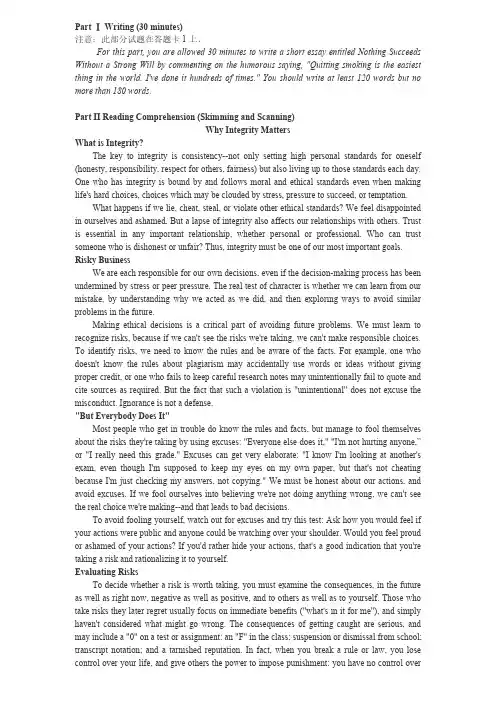
Part Ⅰ Writing (30 minutes)注意:此部分试题在答题卡1上. For this part, you are allowed 30 minutes to write a short essay entitled Nothing Succeeds Without a Strong Will by commenting on the humorous saying, "Quitting smoking is the easiest thing in the world. I've done it hundreds of times." You should write at least 120 words but no more than 180 words.Part II Reading Comprehension (Skimming and Scanning)Why Integrity MattersWhat is Integrity? The key to integrity is consistency--not only setting high personal standards for oneself (honesty, responsibility, respect for others, fairness) but also living up to those standards each day. One who has integrity is bound by and follows moral and ethical standards even when making life's hard choices, choices which may be clouded by stress, pressure to succeed, or temptation. What happens if we lie, cheat, steal, or violate other ethical standards? We feel disappointed in ourselves and ashamed. But a lapse of integrity also affects our relationships with others. Trust is essential in any important relationship, whether personal or professional. Who can trust someone who is dishonest or unfair? Thus, integrity must be one of our most important goals. Risky Business We are each responsible for our own decisions, even if the decision-making process has been undermined by stress or peer pressure. The real test of character is whether we can learn from our mistake, by understanding why we acted as we did, and then exploring ways to avoid similar problems in the future. Making ethical decisions is a critical part of avoiding future problems. We must learn to recognize risks, because if we can't see the risks we're taking, we can't make responsible choices. To identify risks, we need to know the rules and be aware of the facts. For example, one who doesn't know the rules about plagiarism may accidentally use words or ideas without giving proper credit, or one who fails to keep careful research notes may unintentionally fail to quote and cite sources as required. But the fact that such a violation is "unintentional" does not excuse the misconduct. Ignorance is not a defense."But Everybody Does It" Most people who get in trouble do know the rules and facts, but manage to fool themselves about the risks they're taking by using excuses: "Everyone else does it," "I'm not hurting anyone,” or "I really need this grade." Excuses can get very elaborate: "I know I'm looking at another's exam, even though I'm supposed to keep my eyes on my own paper, but that's not cheating because I'm just checking my answers, not copying." We must be honest about our actions, and avoid excuses. If we fool ourselves into believing we're not doing anything wrong, we can't see the real choice we're making--and that leads to bad decisions. To avoid fooling yourself, watch out for excuses and try this test: Ask how you would feel if your actions were public and anyone could be watching over your shoulder. Would you feel proud or ashamed of your actions? If you'd rather hide your actions, that's a good indication that you're taking a risk and rationalizing it to yourself.Evaluating Risks To decide whether a risk is worth taking, you must examine the consequences, in the future as well as right now, negative as well as positive, and to others as well as to yourself. Those who take risks they later regret usually focus on immediate benefits ("what's in it for me"), and simply haven't considered what might go wrong. The consequences of getting caught are serious, and may include a "0" on a test or assignment; an "F" in the class; suspension or dismissal from school; transcript notation; and a tarnished reputation. In fact, when you break a rule or law, you lose control over your life, and give others the power to impose punishment: you have no control overwhat that punishment might be. This is an extremely precarious and vulnerable position. There may be some matters of life and death, or highest principle, which might justify such a risk, but there aren't many things that fall in this category.Getting Away With It--Or Not Those who don't get caught pay an even higher price. A cheater doesn't learn from the test, depriving him/herself of an education. Cheating undermines confidence and independence: the cheater is a fraud, and knows that without dishonesty, he/she would have failed. Cheating destroys self-esteem and integrity, leaving the cheater ashamed, guilty, and afraid of getting caught. Worst of all, a cheater who doesn't get caught the first time usually cheats again, not only because he/she is farther behind, but also because it seems "easier." This slippery slope of eroding ethics and bigger risks leads only to disaster. Eventually, the cheater gets caught, and the later he/she gets caught, the worse the consequences. Students have been dismissed from school because they didn't get this simple message: Honesty is the ONLY policy that works.Cheating Hurts Others, Too Cheaters often feel invisible, as if their actions "don't count" and don't really hurt anyone. But individual choices have a profound cumulative effect. Cheating can spread like a disease, and a cheater can encourage others just by being seen from across the room. Recent statistics suggest 30% or more of college students cheat. If a class is graded on a curve, cheating hurts others' grades. Even if there is no curve, cheating "poisons" the classroom, and others may feel pressured to join in. ("If I don't cheat, I can't compete with those who do.") Cheating also has a destructive impact on teachers. The real reward of good teaching is seeing students learn, but a cheater says, "I'm not interested in what you're trying to teach; all I care about is stealing a grade, regardless of the effect on others." The end result is a blatant and destructive attack on the quality of your education. Finally, cheating can hurt the reputation of the University, and harm those who worked hard for their degree.Why Integrity Matters If cheating becomes the norm, then we are in big trouble. We must rely on the honesty and good faith of others every day. If not, we couldn't put money in the bank, buy food, clothing, or medicine from others, drive across a bridge, get on a plane, go to the dentist--the list is endless. There are many examples of the vast harm that is caused when individuals forget or ignore the effect their dishonesty can have. The savings and loan scandal, the stock market and junk bond swindles, and, of course, Watergate, have undermined the faith of many Americans in the integrity of political and economic leaders and society as a whole. Such incidents take a tremendous toll on our nation's economy and our individual well-being. For example, but for the savings and loan debacle, there might be funds available to reduce the national debt and pay for education. In sum, we all have a common stake in our school, our community, and our society. Our actions do matter. It is essential that we act with integrity in order to build the kind of world in which we want to live.1. A person of integrity not only sets high moral and ethical standards but also _______。
201112四级听力原文

11. W: This crazy bus schedule has got mecompletely confused. I can’t figure out when my bus to Cleveland leaves?M: Why don’t you just go to the ticket window and ask?Q: What does the man suggest the woman do?12.W: I really enjoyed the TV Special about giraffes lastnight. Did you get home in time to see it?M: Oh, yes. But I wish I could have stayed awake long enoughto see the whole thing。
Q: What does the man mean?13.W: Airport, please. I’m running a little late, so justtake the fastest way even if it’s not the most direct。
M: Sure, but there’s a lot of traffic everywhere todaybecause of the football game。
Q: What do we learn about the woman from the conversation?14.W: May I make a recommendation, sir? Our sea food with thisspecial sauce is very good。
M: Thank you. But I don’t eat shellfish, I’m allergic to it。
2011年12月英语四级真题解析+听力原文
Listening Comprehension短对话答案Section A11.W: This crazy bus schedule has got me completely confused. I can’t figure out when my bus to Cleveland leaves?M: Why don’t you just go to the ticket window and ask?Q: What does the man suggest the woman do?【答案】B) Go and ask the staff.【解析】这是一道事实细节题。
从对话中可知,女士搞不清楚列车时刻表,男士建议她去售票窗口咨询。
ticket window售票窗口。
12.W: I really enjoyed the TV special about drafts last night. Did you get home in time to see it?W: Oh, yes, but I wish I could have stayed awake long enough to see the whole thing.Q: What does the man mean?【答案】A) He fell asleep in the middle of the TV program.【解析】这是道推理判断题,考查男士的言下之意以及虚拟语气。
could have done意为本可以做某事,但未做。
从对话中可知,男士确实回家看了电视节目,但是他说道:I wish I could have stayed awake long enough to see the whole thing. 我真希望自己当时能再晚点睡着,这样我就可以看完整场节目了。
说明他没有看完整场节目就睡着了。
13.W: Airport, please. I’m running a little late. So just take the fastest way even if it’s not the most direct.M: Sure, but there is a lot of traffic everywhere today because of the football game.Q: What do we learn about the woman from the conversation?【答案】B) She is worried about missing her flight.【解析】这是道场景题,略有难度。
2011年12月大学英语四级真题及答案解析
2011年12月英语四级真题及答案1作文真题范文及点评Nothing Scucceeds Without a Strong Will by commenting on the humorous saying, "Quitting smoking is the eaiest thing in the world. I'va done it hundreds of times." You should write at least 120 words but no more than 180 words.Part I WritingNothing Succeeds Without a Strong WillNothing runs smoothly in our life. To achieve things successfully, a strong will is essential. Life is like a Marathon. Many people can’t get to the terminal. This is not because they are lack of vit ality but because theirwill of success is not strong enough.To take quitting smoking as an example, some regard it as a piece of cake. They make up their minds to quit it in the morning, but in the evening they feel that the smell of cigarettes is tempting. Their throats are sore, their mouths are thirsty, and their hands are shaking. After the painful mental struggle, they tell themselves that “One cigarette is enough. Just take one, and the next day I will quit it.” By doing this, they surrender to th eir weak will. In the end, they have quitted smoking “a hundred times”, but in no time they succeed.Just like quitting smoking, nothing succeeds without a strong will. To be successful in one’s life, a strongwill means that you know where you go and you will persist on the road you choose. Undoubtedly success belongs to those who overcome their weak will and who hang in there until the last minute文章点评:本文属于话题类作文,只看题目“Nothing Succeeds without a strong will”考生会觉得比较抽象,难以下手。
2011年12月cet4真题及答案
Nothing succeeds without a strong willThere is a prevalent joke around young people saying that …quitting smoking is the easiest thing in the world, and I’ve done it for hundreds of times.‟ This seemingly funny statement ironically reflects the fact that the determination of most youngsters is often started with enthusiasm, but the passion becomes increasingly weaker each day, and then diminishes as if there has been no such thing at all.It is obvious that their failure in …quitting smoking‟ and decli ne of determination are all ascribed to their lack of will. Initially, every success involves several stages of setbacks and risks, and we need to summon up our will to conquer them. Moreover, there are enormous temptation in our path of pursuit of success. For instance, when we plan to quit smoking, our roommates may smoke freely in front of us; when we are eager to keep fit, our close friends may invite us to have late night snacks. Under these occasions, only strong will can assist us to resist the temptation, and persist in chasing our goals until we triumphantly realize them.In short, no dream will successfully come true if we do not have strong will. An old famous proverb says that …where there is a will, there is a way‟. Let us bear this motto in mind no matter how many thunders and thorns are on our roads ahead, and then we will be successful with such precious and powerful spirit.1. A) sticks to them in their daily life2. C) It is the basis of mutual trust3. A) To ensure we make responsible choices.4. B). it is claimed to be unintentional.5. A). Avoid making excuses.6. C). value immediate benefits most.7. A) pay more dearly8. steal a grade.9. honesty and good faith.10、the Watergate scandal11-15 BDCAB 16-20 DABCC21-25 CBCCD 26-30 CBABD31-35 BDABA36. company37. single38. completely39. vacation40. sewn41. electricity42. evidence43. journey44. I remember being carefully taught that independence, not interdependence,was everything45. what my parents were trying to teach me was to take responsibility for my actions and my choices.46. I would do almost anything not to be a burden, and not require any help from anybody.47、H 根据this确定此空必然填一单数名词,15词中D/E/H备选,E/H 相似,其中必有一个答案,前文所说人口、能源消耗等,均只能用“增长”来指代,而不能说是进步;故选择H.growth,根据相似原则,E和H可以一起划去。
2011年12月大学英语四级考试听力真题及答案
2011年12月英语四级听力Part III Listening ComprehensionSection A11. A. Read the notice on the window B. Get a new bus scheduleC. Go and ask the staffD. Board the bus to Cleveland12. A. He was looking forward to seeing the giraffes.B. He enjoyed watching the animal performance.C. He got home too late to see the TV specialD. He fell asleep in the middle of the TV program.13. A. She wants to take the most direct way.B. She may be late for the football game.C. She is worried about missing her flight.D. She is currently caught in a traffic jam.14. A. At a restaurant B. In a fish shop C. At a clinic D. On a fishing boat15. A. He is an experienced sales manager.B. He is being interviewed for a job.C. He is a close friend of the woman.D. He is good at answering tricky questions.16. A. The man should consider his privacy first.B. The man will choose a low-rent apartment.C. The man is not certain if he can find a quieter placeD. The man is unlikely to move out of the dormitory.17. A. The woman is going to make her topic more focused.B. The man and woman are working on a joint project.C. One should choose a broad topic for a research paper.D. It tool a lot of time to get the man on the right track.18. A. They went camping this time last year.B. They didn’t quite enjoy their last picnic.C. They learned to cooperate under harsh conditions.D. They weren’t experienced in organizing picnics.Questions 19 to 22 are based on the conversation you have just heard.19. A. H e likes Sweden better than England.B. He prefers hot weather to cold weather.C. He is an Englishman living in Sweden.D. He visits London nearly every winter.20. A. The bad weather B. The gloomy winter C. The cold houses D. The long night21. A. Delightful B. Painful C. Depressing D. Refreshing22. A. They often stay up late reading B. They work hard and play hardC. They like to go camping in summerD. They try to earn more and spend more Questions 23 to 25 are based on the conversation you have just heard.23. A. English Literature B. Management C. French D. Public Administration24. A. English teaching B. Staff trainingC. Careers guidanceD. Psychological counseling25. A. Its generous scholarships B. Its worldwide fameC. Its well-designed coursesD. Its pleasant environmentSection BPassage One26. A. Characteristics of Japanese artists B. Some features of Japanese cultureC. The art of Japanese brush paintingD. The uniqueness of Japanese art27. A. To calm themselves down B. To enhance concentrationC. To show their impatienceD. To signal lack of interest28. A. How listeners in different cultures show respectB. How speakers can win approval from the audienceC. How speakers can misunderstand the audienceD. How different Western and Eastern art forms arePassage Two29. A. Directing personnel evaluation B. Buying and maintaining equipmentC. Drawing up plans for in-service trainingD. Interviewing and recruiting employees30. A. Some of his equipment was damaged in a fireB. The training program he ran was a failureC. Two of his workers were injured at workD. Two of his employees committed theft31. A. A better relationship with his boss B. Advancement to a higher positionC. A better-paying job in another companyD. Improvement in the company’s management32. A. She has more self-confidence than ChrisB. She works with Chris in the same divisionC. She has more management experience than ChrisD. She is competing with Chris for the new jobPassage Three33. A. They help us see the important values of a cultureB. They guide us in handling human relationshipsC. They help us express ourselves more effectivelyD. They are an infinite source of human knowledge34. A. Their wording may become different B. The values they reflect may changeC. Their origins can no longer be tracedD. They may be misinterpreted occasionally35. A. Certain values are shared by a large number of culturesB. Some proverbs are assuming more and more importanceC. Old proverbs are constantly replaced by new onesD. Certain values have always been central to a cultureSection CDictationOur lives are woven together. As much as I enjoy my own 36________. I no longer imagine I can get through a 37________ day, much less all my life, 38________ on my own. Even if I am on 39________ in the mountains, I am eating food someone else has grown, living in a house some else has built, wearing clothes someone else has 40________ from cloth woven by others, using 41________ someone else is distributing to my house. 42________ of interdependence is everywhere. We are on this 43________ together.As I was growing up, 44______________________________________________________. “Make your own way”, “stand on your own two feet”, or my mother’s favorite remark when I was face-to-face with consequences of some action: “Now that you’ve made your bed, lie on it!” Total independence is a dominant theme in our culture, I imagine that 45________________________ ________________________________. But the teaching was shaped by our cultural images, and instead I grew up believing that I was supposed to be totally “independent”and consequently became very reluctant to ask for help.46________________________________________________________________________.2011年12月四级听力答案及原文PartⅢListening ComprehensionSection AShort Conversations11. A) Read the notice on the window.B) Go and ask the staff.C) Get a new bus schedule.D) Board the bus to Cleveland.原文:W: This crazy bus schedule has got me completely confused. I can’t figure out when my bus to Cleveland leaves?M: Why don’t you just go to the ticket window and ask?Q: What does the man suggest the woman do?12. A) He was looking forward to seeing the giraffes.B) He enjoyed watching the animal performance.C) He got home too late to see the TV special.D) He fell asleep in the middle of the TV program.原文:W: I really enjoyed the TV special about drafts last night. Did you get home in time to see it?W: Oh, yes, but I wish I could have stayed awake long enough to see the whole thing.Q: What does the man mean?13. A) She wants to take the most direct way.B) She may be late for the football game.C) She is worried about missing her flight.D) She is currently caught in a traffic jam.原文:W: Airport, please. I’m running a little late. So just take the fastest way even if it’s not the most direct.M: Sure, but there is a lot of traffic everywhere today because of the football game.Q: What do we learn about the woman from the conversation?14. A) At a restaurant.B) In a fish shop.C) At a clinic.D) On a fishing boat.原文:W: May I make a recommendation, sir? Our seafood with this special sauce is very good.M: Thank you, but I don’t eat shellfish. I’m allergic to it.Q: Where does this conversation most probably take place?15. A) He is an experienced sales manager.B) He is being interviewed for a job.C) He is a close friend of the woman.D) He is good at answering tricky questions.原文:W: now one more question if you don’t mind, what position in the company appeals to you most?M: Well, I’d like the position of sales manager if that position is still vacant. Q: What do we learn about the man?16. A) The man should consider his privacy first.B) The man will choose a low-rent apartment.C) The man is not certain if he can find a quieter place.D) The man is unlikely to move out of the dormitory.原文:M: I don’t think I want to live in the dormitory next year. I need more privacy. W: I know what you mean. But check out the cost if renting an apartment first.I won’t be surprised if you change your mind.Q: What does the woman imply?17. A) The woman is going to make her topic more focused.B) The man and woman are working on a joint project.C) One should choose a broad topic for a research paper.D) It took a lot of time to get the man on the right track..原文:M: You’re on the right track. I just think you need to narrow the topic dow n.W: Yeah, you’re right. I always start by choosing two boarder topics when I’m doing a research paper.Q: What do we learn from the conversation?18. A) They went camping this time last year.B) They didn’t quite enjoy their last picnic.C) They learned to cooperate under harsh conditions.D) They weren’t experienced in organizing picnics.原文:W: This picnic should beat the last one we went to, doesn’t it?M: Oh, yeah, we had to spend the whole time inside. Good thing, the weather was cooperative this time.Q: What do we learn about the speakers from the conversation?Long Conversation One19. A)He likes Sweden better than England.B)He prefers hot weather to cold weather.C)He is an English living in Sweden.D)He visits London nearly every winter.20. A)The bad weather.B)The cold houses.C)The gloomy winter.D)The long night.21. A)Delightful.B)Painful.C)Depressing.D)Refreshing.22. A)They often stay up late reading.B) They work hard and play hard.C) They like to go camping in summer.D) They try to earn more and spend more.原文:M: When I say I live in Sweden, people always want to know about the seasons.W: The seasons?M: Yeah, you know how cold it is in winter? What is it like when the days are so short?W: So what is it like?M: Well, it is cold ,very cold in winter. Sometimes it is cold as 26 degrees below centigrade. And of course when you go out, you’ll wrap up warm. But inside in the houses it’s always very warm, much warmer than at home. Swedish people always complain that when they visit England, the houses are cold even in the good winter.W: And what about the darkness?M: Well, yeah, around Christmas time there’s only one hour of daylight, so you really looks forward to the spring. It is sometimes a bit depressing. But you see the summers are amazing, from May to July in the North of Sweden the sun never sets. It’s still light in the midnight. You can walk in the mountains and read a newspaper.W: Oh, yeah, the land of the midnight sun.M: Yeah, that’s right, but it’s wonderful. You won’t stay up all night. And the Swedes makes most of it often they started work earlier in summer and then leave at about 2 or 3 in the afternoon, so that they can really enjoy thelong summer evenings. They’d like to work hard, but play hard, too. I think Lo ndoners work longer hours, but I’m not sure this is a good thing.Questions 19 to 22 are based on the conversation you have just heard.19. What do we learn about the man from the conversation?20. What do Swedish people complain about when they visit England in winter?21. How does the man describe the short hour of daylight around Christmas inSweden?22. What does the man say about the Swedish people?Long Conversation Two23. A)Management.B)French.C)English literature.D)Public Administration.24. A)English teaching.B)Staff training.C)Careers guidance.D)Psychological counseling.25. A)Its pleasant environment.B)Its worldwide fame.C)Its generous scholarship.D)Its well-designed courses.原文:W: What kind of training does one need to go into this type of job?M: That’s a very good question. I don’t think there is any, specifically.W: For example, in your case, what was your educational background?M: Well, I did a degree in French at Nottingham. After that, I did careers work in secondary schools like the careers guidance people. Here is in theuniversity. Then I went into local government because I found I was more interested in the administrative side. Then progressed on to universities. So there wasn’t any plan and there was no specific training. There are plenty of training courses in management techniques and committee work which you can attend now.W: But in the first place, you did a French degree.M: In my time, there wasn’t a degree you could do for administration. I think most of the admini strators I’ve come across have degrees and all sorts of things.W: Well, I know in my case, I did an English literature degree and I didn’t really expect to end up doing what I am doing now.M: Quite.W: But you are local to Nottingham, actually? Is there any reason why you went to Nottingham University?M: No, no, I come from the north of England, from west Yorkshire. Nottingham was one of the universities I put on my list. And I like the look of it. The campus is just beautiful.W: Yes, indeed. Let’s see. Were you from the industrial part of Yorkshire? M: Yes, from the Woolen District.Questions 23 to 25 are based on the conversation you have just heard.23. What was the man’s major at university?24: What was the man’s job in secondary schools?25. What attracted the man to Nottingham University?Section BPassage One26. A) Characteristics of Japanese artists.B) Some features of Japanese culture.C) The art of Japanese brush painting.D) The uniqueness of Japanese art.27. A) To calm themselves down.B) To enhance concentration.C) To show their impatience.D) To signal their lack of interest.28. A) How listeners in different cultures show respect.B) How speakers can win approval from the audience.C) How speakers can misunderstand the audience.D) How different Western and Eastern art forms are.原文:While Gail Obcamp, an American artist was giving a speech on the art of Japanese brush painting to an audience that included visitors from Japan, she was confused to see that many of her Japanese listeners have their eyes closed. Were they tuned off because an American had the nerve to instruct Japanese in their own art form or they deliberately tried to signal their rejection of her? Obcamp later found out that her listeners were not being disrespectful. Japanese listeners sometimes closed their eyes to enhance concentration. Her listeners were showing their respect for her by chewing on her words. Some day you may be either a speaker or a listener in a situation involving people from other countries or members of minority group in North America. Learning how different cultures signal respect can help you avoid misunderstandings. Here are some examples. In the deaf culture of North America, many listeners show applause not by clapping their hands but by waving them in the air. In some cultures, both overseas and in some minority groups in North America, listeners are considered disrespectful if they look directly at the speaker. Respect is shown by looking in the general direction but avoiding direct eye contact. In some countries, whistling by listeners is a sign of approval while in other courtiers it is a form of insult.Questions 26 to 28 are based on the passage you have just heard.26. What did Obcamp’s speech focus on?27. Why do Japanese listeners sometimes close their eyes while listening to a speech?28. What does the speaker try to explain?Passage Two29. A) Directing personnel evaluation.B) Buying and maintain equipment.C) Drawing up plans for in-service training.D) Interviewing and recruiting employees.30. A) Some of his equipment was damaged in a fire.B) The training program he ran was failure.C) Two of his workers were injured at work.D) Two of his employees committed theft.31. A) A better relationship with his boss.B) Advancement to a higher positionC) A better-paying job in another companyD) Improvement in the company’s management32. A) She has more self-confidence than Chris.B) She works with Chris in the same division.C) She has more management experience than Chris.D) She is competing with Chris for the new job.原文:Chris is in charge of purchasing and maintaining equipment in his Division at Taxlong Company. He is soon going to have an evaluation interview with his supervisor and the personnel director to discuss the work he has done in the past year. Salary, promotion and plans for the coming year will also be discussed at the meeting. Chris has made several changes for his Division in the past year. First, he bought new equipment for one of the departments. He has been particularly happy about the new equipment because many of the employees have told him how much it has helped them. Along with improving the equipment, Chris began a program to train employees to use equipment better and do simple maintenance themselves. The training saved time for the employees and money for the company. Unfortunately, one serious problem developed during the year. Two employees the Chris hired were stealing, and he had to fire them. Chris knows that a new job for a purchasing and maintenance manager for the whole company will be open in a few months, and he would like to be promoted to the job. Chris knows, however, that someone else wants that new job, too. Kim is in charge of purchasing and maintenance in another Division of the company. She has also made several changes over the year. Chris knows that his boss likes Kim’s work, and he expects that his work will be compared with hers.Questions 29 to 32 are based on the passage you have just heard.29. What is Chris’s main responsi bility at Taxlong Company?30. What problem did Chris encounter in his Division?31. What does Chris hope for in the near future?32. What do we learn about Kim from the passage?Passage Three33. A) They help us see the important values of a culture.B) They guide us in handling human relationships.C) They help us express ourselves more effectively.D) They are an infinite source of human knowledge.34. A) Their wordings may become different.B) The values they reflect may change.C) Their origins can no longer be traced.D) They may be misinterpreted.35. A) Certain values are shared by a large number of cultures.B) Some proverbs are assuming more and more importance.C) Old proverbs are constantly replaced by new ones.D) Certain values have always been central to a culture.原文:Proverbs, sometimes called sayings, are examples of folk wisdom. They are little lessons which older people of a culture pass down to the younger people to teach them about life. Many proverbs remind people of the values that are important in the culture. Values teach people how to act, what is right, and what is wrong. Because the values of each culture are different, understanding the values of another culture helps explain how people think and act. Understanding your own culture values is important too. If you can accept that people from other cultures act according to their values, not yours, getting along with them will be much easier. Many proverbs are very old. So some of the values they teach may not be as important in the culture as they once were. For example, Americans today do not pay much attention to the proverb “Haste makes waste”, because patience is not important to them. But if you know about past values, it helps you to understand the present and many of the older values are still strong today. Benjamin Franklin, a famous American diplomat, writer and scientist, died in 1790, but his proverb “Time is money” is taken more seriously by Americans of today than ever before. A study of proverbs from around the world shows that some values are shared by many cultures. In many cases though, the same idea is expressed differently.Questions 33 to 35 are based on the passage you have just heard.33. Why are proverbs so important?34. According to the speaker what happens to some proverbs with the passageof time?35. What do we learn from the study of proverbs from around the world? Section CCompound DictationOur lives are woven together. As much as I enjoy my own (36) company,I no longer imagine I can get through a (37) single day much less all my life(38) completely on my own. Even if I am on (39) vacation in the mountains,I am eating food someone else has grown, living in a house someone else has(40) built, wearing clothes someone else has sewn from cloth woven by others, using (41) electricity someone else is distributing to my house. (42) Evidence of interdependence is everywhere; we are on this (43) journey together.(44) As I was growing up, I remember being carefully taught that independence not interdependence was everything. “Make your own way”,“Stand on your own two feet” or my mother’s favorite remark when I was face-to-face with consequences of some action:“Now that you’ve made your bed, lie on it!” Total independence is a dominant thing in our culture. I imagine that (45) what my parents were trying to teach me was to take responsibilities for my actions and my choices. But the teaching was shaped by our cultural imagines. And instead, I grew up believing that I was supposed to be totally independent and consequently became very reluctant to ask for help.(46) I would do almost anything not to be a burden, and not require any help from anybody.。