
外研版英语七年级下册Module4 Unit2教案设计
二、教学重点
1.认读表示land air bike car cheap long heavy easy等单词。
2.能根据图片、文章的提示,准确使用句型What will life be like...? The weather will be quite warm... We won’t travel...进行问答。
(五)
布置作业
Talk about life in the future
PPT第8页
【设计意图】课后作业可以帮助学生巩固吸收本堂课所学的知识,再次加深学生的记忆,强化一般将来时的应用。
(六)
板书设计
Module4 Unit1Every family will have a small plane.
What will life be like...? The weather will be quite warm... We won’t travel...
2.鼓励学生通过Complete the passage with the correctform...Match the words with their opposites.培养学生的阅读能力与理解能力。
PPT第6-7页
【设计意图】适机的归纳,帮助学生整理,建立新旧知识的学习框架,通过各种方式加强学生的阅读理解能力,为学生创设一个相对自主的平台,鼓励学生把所学知识进行综合运用。
(二)
新知呈现
1.通过学生的描述及问答复习Unit 1所学句型
2.Answer the quesitons
PPT第3-4页
3.通过小组讨论等形式使学生对老师所提问题进行充分的了解和练习
PPT第3-4页
【设计意图】以问答形式鼓励学生去发现,并帮助他们感知、整理单词和句型现在进行时表将来和一般将来时的不同表达,达到形象记忆的目的。
(三)
课文学习
1.介绍课文背景并提出听录音的任务:What life will be like in the future?
2.播放M4 U2活动2录音。第一遍听,要求学生Match the pictures with the paragraphs.;第二遍听,Match the paragraphs with the headings.
三、教学难点
一般将来时的应用。
四、教学资源
互动教学系统,点读笔,PPT
五、教学过程
说明:教学活动具体描述包括教学任务的描述,教师的关键语言,板书呈现,教学资源的使用等。
教学环节
教学活动具体描述
教学资源
(一)
热身导入
1.师生互相问候
Look and say
利用PPT展示图片,教师鼓励学生观察图片,快速说出图中内容:What will schools be like in the future?
M4U2A2录音
互动教学系统
画图
3.用Check(√) the true sentences.使学生对passage加深印象。
PPT第5页
【设计意图】先看图,再带着问题听课文学习录音,有益于学生展开积极的联想,快速理解课文内容。有层次的游戏设计帮助学生理解课文,强化重难点知识的操练。
(四)
拓展运用
1.归纳整理句型:What will life be like...? The weather will be quite warm... We won’t travel...
3.巩固一些单词和句型的一般将来时变化形式。
【能力目标】1.能初步运用句型What will life be like...? The weather will be quite warm... We won’t travel...进行问答。
2.能运用一般将来时对天气进行简单的描述。
3.通过图片对比,能区别一般将来时的变化。
外研版七年级下册Module 4 Unit2 Every family will have a small plane.教案
一、教学目标
【知识目标】1.To get information from the reading material about life in the future.
2.掌握land air bike car cheap long heavy easy等单词的用法。
教师用What will ....? Will we ...?的句型提问,学生根据猜想回答问题;
用已学句型I will…等句型表达内容。
PPT第2页
【设计意图】课前利用观察图片快速说出内容的游戏吸引学生的注意力,用The school will be ...的句型复习旧知的同时给学生抛出新的问题:怎样表达一般将来时的句型.
外研版英语七年级下Module4Unit2 教学设计

教学设计外语教学与研究出版社《新标准》英语初中一年级下册ModuleFourLifeinthefutureUnitTwoEveryfamilywillhaveasmallplane.开发区第二中学胡怡诺一、教材分析本模块以未来的生活为话题,分设三个课时进行学习。
本节课是这个模块中的第二课时,是一节读写课型的新授课。
作为模块的第二课,它补充扩展了第一课的内容,为三单元不仅提供了话题和语境,同时也为学生们后来的学习扫清语言和文化的障碍。
在第二单元中,学生的读写活动都是围绕未来的生活而展开。
学生们通过学习课文,了解其中人物对未来生活的设想并且感知和运用对未来进行预测的大凡将来时用法。
本单元中的内容与学生们的实际生活息息相关,激发了学生的学习兴趣,语言实践活动也比较好开展。
本单元的重点是对未来的事实或对将来进行预测的大凡将来时的使用。
难点是运用想象力,在特定语境下正确使用大凡将来时描述未来的生活,使语法知识的学习融入生活实践,培养用语言做事的能力。
二、教学目标1.语言知识目标(1)学会词汇:airlandmachinerobotspacetrafficjamtruecheapeverywhererise(2)复习词汇:rainseawindbikecarlongheavylighteasyhourshort2.技能目标(1)能使用关键句型“will+do”对未来的生活进行描述。
(2)能通过例外目的的阅读,迅速提取有用信息。
(3)能读懂,理解和复述整篇文章。
(4)能完成由读到写的信息转换,表达自己对未来生活的展望。
3.学习策略目标(1)借助鱼骨图,感知、领悟阅读技巧和方法;(2)通过小组合作的方式,学会合作学习;4.情感与态度目标在教学过程中,学生们通过实践、参与有意义的各种形式的活动,体验与他人合作,共同完成学习任务的欢乐。
在本课中,发挥学生的想象力,通过对美好未来的憧憬,培养乐天向上的精神。
5.教学重点和难点发挥想象力,学会确凿使用大凡将来时的基本句型“will+do”描述未来的生活。
2023年外研版七年级英语下册Module 4 Unit 2教案

Module 4 Life in the futureUnit 2 Everyone will have a small car.教案学习目标:1.通过自主探究学习本课出现的单词及短语;2. 能过听说读写等技能的锻炼能熟练运用一般将来时态will描述未来的生活,例如天气,日常生活等;3.激发学生学习英语的兴趣,能对未来世界的神奇变化产生好奇并有美好憧憬。
学习重点:一般将来时态―will+动词原形的意义和用法学习难点:一般将来时态―will+动词原形; not only…but a lso…的用法.课前预习一、使用说明与学法指导:1.课前朗读新单词,注意其音标和汉意,将不会读的圈出来。
2.本堂课为阅读课,教会学生泛读和细读的阅读技巧。
3.将预习中不能解决的问题标出来,并写在我的疑问处。
二、教材助读:1、熟读单词:air, land, machine,robot, space, wind, car, cheap, everywhere, long, heavy, l ight2、熟读短语:come true, no more, all year, as well, not only...but also3、熟读句型:(1.)What will life be like in the future?(2.)Here are some ideas.(3.)They’ll be warm when we’re cold,and cool when we’re hot.三、预习自测:写出下列单词及词组陆地_____________ 机器 _____________ 机器人 _____________太空,空间 ________ 交通___________ 交通堵塞 _____________风 _____________ 真的,真实的 ______ 实现,成真 _____________ 便宜的 _____________ 到处,处处_____________ 不仅….而且….________繁重的,沉的_________ 轻的,轻松的__________ 工作的_________短的,短暂的_________ 升起,上升___________Keys:land machine robot space traffic traffic jam wind true come true cheap everywhere not only...but also heavy light job short raise四、我的疑惑:____________________________________________________课内探究一、情景导入:free talk. Look at the pictures on PPT and talk about them.二、学始于疑:ask students to talk about the life i n the future三、质疑探究1.Feedback on the preview讨论解决预习中存在的问题(师生互问探讨)。
英语:Module4 Unit2(2)教案(外研社七年级下2013春季版)

目
过程与方法
标
情感、态度、价值观 学生探索未来的科学思想 及高尚的情操。
教学重点
1.The students can use “will” to express their own wishes. 2.以谈论将来生活为中心,介绍并询问有关将来生活的信息。 3. To learn to join sentences with “so” 4. 能运用一般将来时中出现形容词的句式。 学会 will 引导的一般将来时的陈述句、否定句、一般疑问句式及回答。
第 -1- 页 共 2 页
Greeting the class.
二次备课应改进的 地方:
如:It was wrong for you not to help her.你当时不帮助她是错误的。(it 代替不定式短语) 3. not only„but also„用于连接两个表示并列关系的成分,着重强调后者,其意为“不 仅„„而且„” ; She not only plays well, but also writes music. 若连接两个成分作主语,其谓语通常与靠近的主语保持一致。如: Not only you but also he has to leave. 不只是你,他也得离开。 若连接两个句子,not only 后面的句子要用倒装,如: Not only did he speak more correctly, but he spoke more easily. 他不仅说得更正确,而且 讲得更不费劲了 。 Step 5. Activity 4 1.Read through the words and have the students repeat them chorally and individually. (Activity 4) 2. Make sure they understand the meaning of all of them. Step 6. Practice Look at the sentences. Working hours will be short. People will have long holidays. Working hours will be short so people will have long holidays. Now complete the sentences with so. 1. Every family will have a plane so„ 2. The weather will get hot so„ 3. Machines and robots will do the heavy and difficult jobs so„ Step 7.Exercise 1. It’s going to be rainy soon. (改为同义句) ---It’s going to _____ soon.
外研版七年级英语下册Module4Unit2Everyfamilywillhaveasmallplane教案
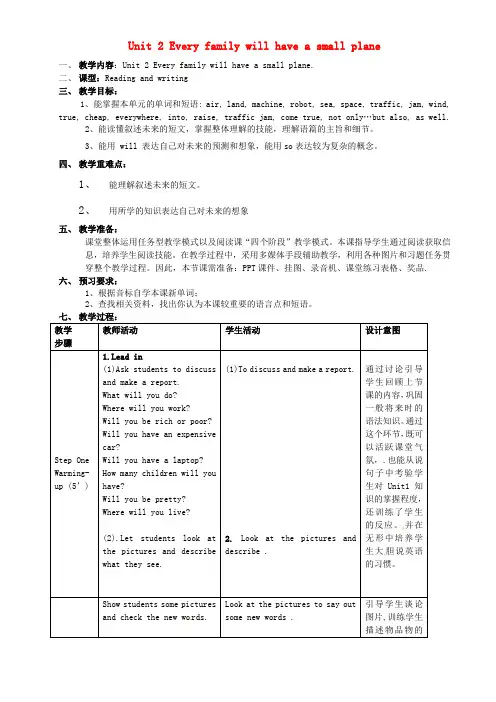
Unit 2 Every family will have a small plane一、教学内容:Unit 2 Every family will have a small plane.二、课型:Reading and writing三、教学目标:1、能掌握本单元的单词和短语: air, land, machine, robot, sea, space, traffic, jam, wind, true, cheap, everywhere, into, raise, traffic jam, come true, not only…but also, as well.2、能读懂叙述未来的短文,掌握整体理解的技能,理解语篇的主旨和细节。
3、能用 will 表达自己对未来的预测和想象,能用so表达较为复杂的概念。
四、教学重难点:1、能理解叙述未来的短文。
2、用所学的知识表达自己对未来的想象五、教学准备:课堂整体运用任务型教学模式以及阅读课“四个阶段”教学模式。
本课指导学生通过阅读获取信息,培养学生阅读技能。
在教学过程中,采用多媒体手段辅助教学,利用各种图片和习题任务贯穿整个教学过程。
因此,本节课需准备:PPT课件、挂图、录音机、课堂练习表格、奖品.六、预习要求:1、根据音标自学本课新单词;2、查找相关资料,找出你认为本课较重要的语言点和短语。
rds.scan)Paragraph 3 and 4:they foun d in this paragraph. found in this paragraph.willlanguage达标训练题一、单项选择1.It will be hot all year _______ the winter will be very short.A. becauseB. soC. asD. but2. The rain is very______ . Let’s stay at home.A. heavilyB. smallC. heavyD. big3. You must be kidding. The price can’t not be so _________.A .short B. small C. cheap D. low4. We will go to Beijing________ plane.A. onB. byC. by aD. with5. We will get there at eight, but they __________.A. aren’tB. didn’tC. won’tD. don’t二、根据中文提示,完成下列句子。
2023年外研版七年级英语下册Module 4 Unit 2教学案
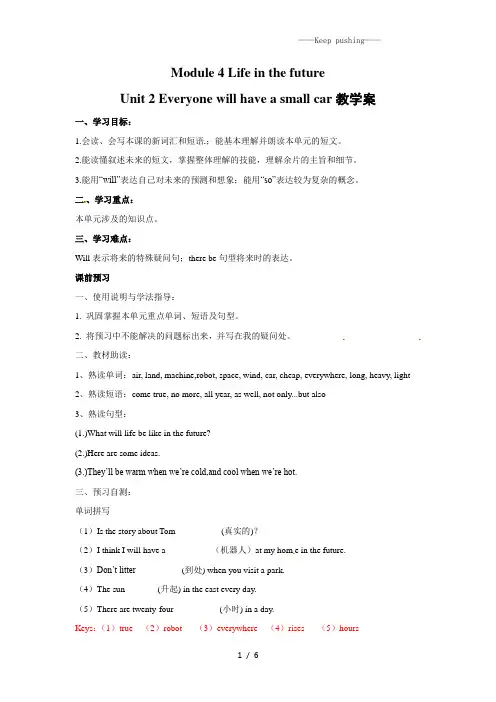
Module 4 Life in the futureUnit 2 Everyone will have a small car教学案一、学习目标:1.会读、会写本课的新词汇和短语;能基本理解并朗读本单元的短文。
2.能读懂叙述未来的短文,掌握整体理解的技能,理解余片的主旨和细节。
3.能用“will”表达自己对未来的预测和想象;能用“so”表达较为复杂的概念。
二、学习重点:本单元涉及的知识点。
三、学习难点:Will表示将来的特殊疑问句;there be句型将来时的表达。
课前预习一、使用说明与学法指导:1. 巩固掌握本单元重点单词、短语及句型。
2. 将预习中不能解决的问题标出来,并写在我的疑问处。
二、教材助读:1、熟读单词:air, land, machine,robot, space, wind, car, cheap, everywhere, long, heavy, light2、熟读短语:come true, no more, all year, as well, not only...but also3、熟读句型:(1.)What will life be like in the future?(2.)Here are some ideas.(3.)They’ll be warm when we’re cold,and cool when we’re hot.三、预习自测:单词拼写(1)Is the story about Tom __________(真实的)?(2)I think I will have a __________(机器人)at my hom e in the future.(3)Don’t litter __________(到处) when you visit a park.(4)The sun _______(升起) in the east every day.(5)There are twenty-four __________(小时) in a day.Keys:(1)true (2)robot (3)everywhere (4)rises (5)hours四、我的疑惑:______________________________________________________课内探究知识点导学1)What will life be like in the future? 未来的生活会怎么样?2)Which ones will come true? 其中那些会变成现实呢?例如:He hopes his dreams come true. 他希望他的梦想成真。
外研版七下module4unit2教学设计
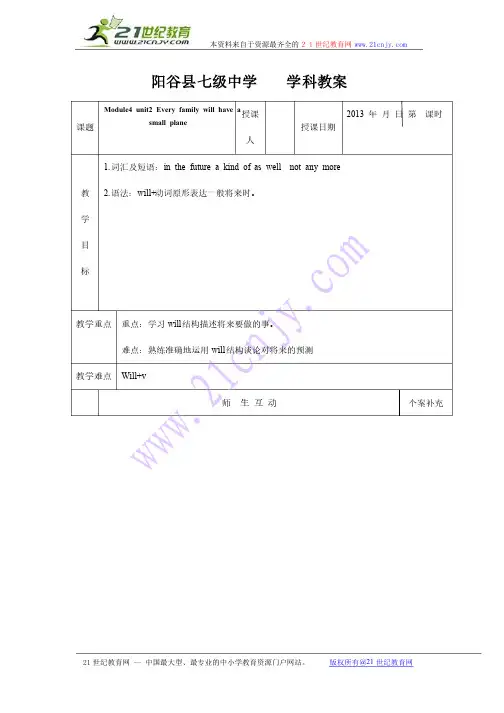
阳谷县七级中学学科教案课题Module4 unit2 Every family will have a small plane授课人授课日期2013年月日第课时教学目标1.词汇及短语:in the future a kind of as well not any more 2.语法:will+动词原形表达一般将来时。
教学重点重点:学习will结构描述将来要做的事。
难点:熟练准确地运用will结构谈论对将来的预测教学难点Will+v 师生互动个案补充教学过程Step 1.W ork-ShowWork-ShowShow their homework. A poster about their classroom, home or school。
Share their success with all the students Step 2 .PresentationStep2.New words(1) Presentation of some of the new words with sentences (2) (2) Read Read Read through through through the the the new new new words words words and and and have have have the the the students students students follow follow follow and and and then then then repeat repeat chorally and individually. (3) Pair work: What can you see in the pictures? Step 3. R eadingReading(1)Read quickly and match the pictures and headings. (2)Read carefully and find the adjectives and its opposite meanings. (3)Read one by one paragraph to finish the relative exercises. Step 4.Group workTalk about the questions: Will we have an easy or a difficulty life in the future? why? Step nguage points1. What will life be like in the future?将来学校是什么样子?将来学校是什么样子?Be like……像什么,怎么样,可以询问物体或人的外貌像什么,怎么样,可以询问物体或人的外貌What is your school like? It’s big and beautiful. What is your father like? He’s tall. 2.There will be no more light rain and cold wind in spring. 一般将来时态用在出there be句型中就是“There will be…”。
外研版英语七年级下册M4U2教案
新知呈现
1.通过学生的描述及问答复习Unit 1所学句型
2.Answer the quesitons
PPT第3-4页
3.通过小组讨论等形式使学生对老师所提问题进行充分的了解和练习
PPT第3-4页
【设计意图】以问答形式鼓励学生去发现,并帮助他们感知、整理单词和句型现在进行时表将来和一般将来时的不同表达,达到形象记忆的目的。
2.鼓励学生通过Complete the passage with the correctform...Match the words with their opposites. 培养学生的阅读能力与理解能力。
PPT第6-7页
【设计意图】适机的归纳,帮助学生整理,建立新旧知识的学习框架,通过各种方式加强学生的阅读理解能力,为学生创设一个相对自主的平台,鼓励学生把所学知识进行综合运用。
M4U2A2录音
互动教学系统
画图
3.用Check(√) the true sentences.使学生对passage加深印象。
PPT第5页
【设计意图】先看图,再带着问题听课文学习录音,有益于学生展开积极的联想,快速理解课文内容。有层次的游戏设计帮助学生理解课文,强化重难点知识的操练。
(四)
拓展运用
1.归纳整理句型:What will life be like...? The weather will be quite warm... We won’t travel...
三、教学难点
一般将来时的应用。
四、教学资源
互动教学系统,点读笔,PPT
五、教学过程
说明:教学活动具体描述包括教学任务的描述,教师的关键语言,板书呈现,教学资源的使用等。
教学环节
外研版英语七年级下Module4 Unit2教案
Unit 2 Every one will have a small carTeaching aims:1. To learn to use the new words and expressions.2. To learn to use the will structure.3. To get necessary information from the reading material.Teaching points:Key vocabulary—plane, car, robot, holiday, weather, sea, sun, cheap, expensive,heavy, difficultKey structure—will doTeaching procedures:Step 1. RevisionTalk about what we are going to do this Sunday. Get the students to put sentences into anew one using will do.Step 2. Warming-upGet a student to read his passage about his plan for this Sunday, ask and answer questionsabout it.Step 3. PresentationGet the students to look at the pictures in Activity 1, talk about them and say,What can we see on the picture?Step 4. ListeningListen to the tape while looking at the book. Then match each picture to one paragraph.Read the passage again; match the picture and paragraphs with the heading in Activity 3.Step 5. Let’s talkGet the students to talk about each heading, try to find other things to match to it.Such as:Weather: quite warm even hot heavy rain wind sea level riseClothes: warm cold cool hotJobs: machines robots heavy difficult jobs light and easy work long holidays Travel: plane cheap space traffic jamsStep 6. PracticeComplete the passage with the correct form of the words from the box in 5.air cheap everywhere into rise trueWill travel in the future be expensive? No, it’ll be (1) _______. We’ll travel (2)_______ by plane. We’ll be able to (3)_______ over the traffic jams on the land, and we’ll be able to go (4)_______ space. But maybe there’ll be traffic jams in the (5)_______ too. What do you think? Do you think this idea about life in the future will come (6)_______?Answers:Check the answers.cheap everywhere rise into air trueStep 7. PracticeThe teacher says easy; get the students to say hard or difficult. Say big; get the students tosay small.Get the students to match the words in Box 1 with words which mean the opposite in Box2. (Activity 6)Check the answers.Answers:easy --------- difficultexpensive ---------cheaphot ---------coldlarge ---------smalllight ---------heavylong ---------shortwarm ---------coolStep 8. PracticeSay, I buy a cheap coat, but it’s small. Put it as an example.Guide the students to say a sentence like this:I buy an expensive coat, but it’s large.Get the students to make up new sentences, practice in groups. Then share the answers inclass.Step9. Oral workSay, let’s think what we will have in the future.Talk about it in groups, share the answers in class.Choose one or two students to give a report in class.Help the students to give out the right answers.Step 10. Do exercisesFinish off the exercises in Activity 8.Answers:1 Every family will have a plane so it will be cheap to travel everywhere.2 The weather will get hot so the sea level will rise as well.3 Machines and robots will do the heavy and difficult jobs so we’ll only do light andeasy work.Step 11. Homework1. Finish off the Workbook exercise.2. Copy the new words in this unit.。
七年级英语Module4 Unit2教案 外研社 教案
MODULE 4My familyPart 1: Teaching design第一部分教学设计Function Describing familiesStructureHave /has got (affirmative, negative, interrogative)Listening/Speaking Identifying family membersDescribingyour familyReading/Writing Describing familiesDescribing families; using punctuation: full stops, capital letters, question marksCulture FamiliesTask Writing about your familyUnit 2 I’ve got a small family.■Warming upHi, everyone! Today I want to introduce my family to you. I’ve got a small family, not a big family. There are three people in my family, my father, my mother and I. I have got no sisters or brothers. I am the only child of my parents. My family is a happy small family. We love each other very much.Have you got a small family or a big family? Do you like to introduce your family to us? Now let’s go to page 22 to learn some interesting things about family.■Reading and vocabulary1 Match words in Box A with the words in Box B.First let’s match words in Box A with the words in Box B. Can you find the correct answer?a unt→ uncle grandma→grandpagral ndmother→ grandfathermother→ father mum→ dad sister→ brother2 Work in groups. Talk about your family.This time I’d like you to work in groups and talk about your family. Have you got a big family? How many people are there in your family? Who are they? Use the words big and small in your conversation.big/ small---Have you got a small family or a big family?---I’ve got a bigfamily. There are ten people in my family.I’ve got four grandparents, my mum and dad, two uncles, an aunt and a brother.---Have you got a small family or a big family?---I’vegot a small family. There are three people in my family. They are my father, my mother andI.3 Work in pairs.Read the email and answer the questions.On page 23, we can see an email from Lingling to Diana. What can you learn from this email? After you read theLet’s read the email. While reading try to cut (断句)/ the sentences into parts, blacken(涂黑)the predicates,Read the email once again. This time pay attention to its meaning. Try to understand the passage yourself.■Writing4 Look at this passage. Underline the capital letters,full stops and question marks.In our writing, it is important to know the use of capital letters, full stops, question marks and other punctuations.5 Put capital letters, full stops, and question marks into this passage.Do you know when to use the capital letters? Do you know the difference between full stops and question marks? Please put these things into the passage below.。
外研版英语七年级下册探究式教学(教学设计)Module 4 Unit 2
Module 4 Unit 2 Every family will havea small plane.教学模式介绍探究式教学模式是指在教学过程中,要求学生在教师指导下,通过以“自主、探究、合作〞为特征的学习方式对当前教学内容中的主要知识点进展自主学习、深入探究并进展小组合作交流,从而较好地到达课程标准中关于认知目标与情感目标要求的一种教学模式。
其中认知目标涉及与学科相关知识、概念、原理与能力的掌握;情感目标那么涉及思想感情与道德品质的培养。
探究式课堂教学模式的教学环节:创设情境——启发思考——自主〔或小组〕探究——协作交流——总结提高设计思路说明【创设情境】教师首先用英语问好,营造良好的英语气氛,然后通过讨论引导学生回忆上节课的内容,稳固一般将来时的语法知识。
通过这个环节,既可以活泼课堂气氛,也能从说句子中考验学生对Unit1知识的掌握程度,还训练了学生的反响,并在无形中培养学生大胆说英语的习惯。
【启发思考】引导学生谈论图片,训练学生描述物品物的能力,在描述的同时学习新单词和句型,为学生扫清阅读障碍。
【自主或小组探究】自主探究环节让学生带着任务〔问题〕去阅读课文,去找答案,有助于学生更加准确地获取信息,提高阅读效果和技能。
学生通过分层次阅读文章,获取具体信息,把知识点和课文理解在分段学习得以突破。
合作探究环节的小组活动能通过学生间的自主、合作学习,让学生充分地实践运用语言,并激发学生创造性思维的开展。
【协作交流】本环节通过写作,让学生稳固所学,并增强写作能力。
适量的口头练习,让学生稳固本课时的语言重点。
课堂测验检测学生对于本课知识点的掌握程度,教师应注重培养学生形成自我检测意识,对于所欠缺的知识的进展查缺补漏。
【总结提高】引导学生对这节课的总结,让学生做自由发言,培养学生自主学习,自主总结的良好学习习惯。
简短的评价使学生的课堂表现得到肯定并且可以鼓励学生的学习兴趣,树立学习英语的信心。
教材分析本节课是这个模块中的第二单元,是一节阅读课型的新授课。