
外研版高中英语必修五Module6
外研新标准高二必修 5 module 6教案

Module 6 Animals in DangerPeriod OneTeaching aims and demands:1. Knowledge and Skills(1) Ss will learn some information about the present situation of the wild animals and the effort made to protect the wild animals.(2) Ss will learn to recognize the important reasons to protect the animals in danger and helpthem to realize that saving the wild animals is saving human beings.(3) Help Ss to consolidate their reading skills like skimming and scanning for details.2. Process and methodology(1) municative approach(2) Task-based strategy(3) Cognitive strategy3. Emotion, attitude and value(1) Help Ss to sense the importance of saving the animals in danger and the necessity of protecting the earth.(2) Help Ss learn how to realize the dream, how to call on more people to realize theimportance of saving the animals in danger.Difficult points:1. Enable the Ss to talk about the current situation of wild animals.2. Guide the Ss to summarize the main idea of each paragraph as well as the main idea of the text.3. Help Ss learn what effort has been made to change the serious situation and what else should be done.Teaching methods:1. Task-based activities and fast reading skills for main ideas and details.2. Discussions to improve Ss' reading prehension of the passage.3. Individual,pair or group work to make every student work in class.Teaching aids:puter, tape recorder, and blackboard and papers.Teaching procedures:Step 1. Greetings. Greet the whole class as usual.Step 2. Warming up.Begin with several pictures of dinosaurs, which will help the Ss to realize the topic of this module. And talk about several pictures with 2 questions:1.What do the giant panda and Siberian tiger have in mon?2.What can we do to help them in their struggle for survival?Step 3. PresentationWith the help of several pictures and a flash, let the students predict the text.Step 4. Reading.1. Fast reading: help the Ss get some general information of the passage.A. Who is Jiesang Suonandajie?B. Why do the poachers kill the antelopes?2. Careful reading: Summarize the general idea of the whole passage.Para. 1 Jiesang Suonandajie died when protecting antelopes.Para. 2 The reason for the trade.Para. 3 The process of the trade.Para. 4 The result of the battle.Para. 5 The present situation and the future of the battle.3. Listen to the tape to catch specific information of the passage and ask the Ss to fill in the blanks.The general idea of the text:The reading gives a brief description of the current situation of antelopes. Realize the importance and urgency of protecting the wild animals. The struggle of protecting antelopes will last a long time and will call on more and more people to take part in it.Step 5. Reading for details and prehension.plete the tableNumbers& dates What they refer to?199450,000$5,00019752%3,0005,000meters19971382. Finish exercise2 on Page 52.Step 6. Discussions:let the Ss realize the purpose of learning this passage, the importance of saving antelopes and the necessity of taking immediate measures. (a flash 藏羚羊的心愿will help the Ss fully understand the topic.)1. What do you learn from the text?2. Why do we have to prevent the animals from dying out?3. In your opinion, what should we Chinese people do to save the endangered Tibetan antelope?Step 7. Collecting answers and making a summaryStep 8. HomeworkRead the text and underline the difficult sentences.Finish exercise 4 on Page53.Period TwoStep 1. Language points in introduction:1. Thanks to scientists’ hard work, the number of the pandas living in the wild has increased to about 1,590.thanks to 多亏,由于because of,as a result of,e.g. Thanks to the firefighters,people were saved in the fire.2. Every year thousands of wild animals and plants bee extinct.extinct adj. (生物等)已灭绝,已绝种的This kind of elephant has been extinct for a long time.3. …More than 12,000 animal species are now in danger.in danger 在危险中,濒危e.g. This kind of tiger is in danger.He is in great danger of failing the entrance examination.Step 2. Language points in reading:4. On a freezing cold day in January 1994,…freezing adj. 极冷的, 冷淡的frozen adj. 被冰冻的, 结冰的,冷漠的freezing point, a freezing machine,frozen food, in frozen silence5. Although surprised, the poachers had an advantage—they were more of them.although surprised—although they were surprised at the shout6. He had given his life to save the Tibetan antelope.give one’ life to…为……献身, 把一生献给……7. The animals are skinned on the spot and the wool taken to India…on the spot当场,在现场, 立刻e.g. Anyone breaking the rules will be asked to leave on the spot.When the fighting started, policemen and reporters were soon on the spot.8. But in the 1990s the shawls came into fashion among rich people.e into fashion 成为时尚9. The small group of officials who work in the reserve are helped by volunteers who e from all over the country, and who are ready for the difficult conditions of life at 5,000 metres.此句包含了三个由who 引导的定语从句(让学生体会定语从句在高考中的考察) 10. Meanwhile, in those countries where the shawls are sold, police are getting tough with the dealers.get/ be tough with sb. 对某人强硬起来, 对某人毫不妥协e.g. The government will get tough with the people who avoid paying taxes.11. be / feel concerned about/ for / over sth. 关心, 担心某事,对某事关注12. important phrases:keep an eye on 照看go for someone 向某人进攻on the brink of … 在……边缘stand for 代表have an effect on 对……有影响Step 3. Homework1. Review what we have learnt.2. Remember the new words and expressions.3. Finish exercises on P53.Period ThreeStep1. Grammar –1. Presentation.Look at the underlined clauses and find the function of the clauses.Step2. Grammar –2. Practice. (15m)Do exercises 2,3,4 and 5 in the textbook.Step3. Grammar –3. Conclusion (15m)Ask Ss to make a conclusion of the use of attributive clauses. Two kinds of the attributive clause:1. 限制性定语从句restrictive attributive clause(无逗)2. 非限制性定语从句non- restrictive attributive clause(有逗)He doesn’t like to wear clothes which/that made him very strange.He doesn’t like to wear clothes ,which made him very strange.Xi hua who I met across in the street a few days ago has gone abroad.Xi hua ,who I met across in the street a few days ago has gone abroad.Attributive clause:定语从句被修饰的词:先行词引导定语从句的词:关系词关系词分为关系代词和关系副词两类,指代被修饰的词(先行词),并且在从句中充当成分.They have three houses. + The three houses are built of stone.===They have three houses which/that are built of stone.He is not a true man. + He doesn’t reach the Great Wall ====He who doesn’t reach the Great Wall is not a true man.Step 4. Function – 1. PresentationGive some facts and show your concern.✧Today there are only about 1,000 Siberian tigers left.✧It is reported that there are only 200-300 Northern bald ibises left.✧It is said that 12,000 animal species are now in danger.What do you feel when you read this?Step 5. Function – 2. PracticePoint out the expressions of concern.It is really upsetting.I’m very worried about…I’m concerned about…We really should do more for…Make more sentences to show your concern to the animals in danger.Step 6. Homework - Task of the lesson1.Have a revision of the grammar—the attributive clauses .2.Finish the exercises of workbook on page97Period FourTeaching aims:1. Target languagea. 重点词汇和短语bird, insect, mammal, reptile, reserveb. 重点句子It’s a pity I didn’t have my camera! P562. Ability aimsGet the Ss to tell apart birds, insects, mammals and reptiles.3. Learning abilityGet the Ss to learn how to get the main information by writing down “key words”. Important & difficult points:Get the Ss to learn how to get the main information by writing down “key words”. Teaching methods:Practising, sorting and listening.Teaching aids:A puter, a projector and a tape-recorder.Teaching procedures:Step 1. Greeting and revisionT: There are more than ten English teachers attending to our class. Let’s wele them. O K, class begins. Good morning!Ss: Good morning!Go through the teaching procedures, then make a revision by practicing the language focuses.T: Last lesson, we have practiced how to get main information by “key words” on reading.Here are four short passages at the bottom of page 55. Please read them as quickly as you can, then match the description with the photos.Half a minute later, check the answers and summary the means of getting main information by key words.Step 2. VocabularyGuide the Ss to do Activities 1 and 3. Get them to guess the animals on the screen and sort them.T: But who can tell us the differences between birds, insects, mammals and reptiles? Show the exercises of Activity 1 on the screen and ask individual to do the answers.S1: A bird has warm blood and lays eggs.S2: An insect is a small animal with six legs. Some have wings.S3: A reptiles has cold blood and lays eggs.S4: A mammal is an animal which drinks its mother’s milk when it is young.T: You are pletely right! Now, please turn to Page 56 and do Activity 3 according to the instruction. I will show you some photos of animals. You should tell me their names and fill in the table.Show some photos of animals on the screen and check whether the Ss tell their names rightly. Then, show one student’s answers on the screen to check with the whole class.Bird Insect Mammal Reptileeagle butterfly wolf snakeibis dragonfly antelope crocodileswallow grasshopper pandabee tigerwild piglionelephantStep 3. ListeningT: Now, please look at the picture on the screen. What is the continent?Ss: Africa.T: Yes. Pay attention to the south. There is a nature reserve. What’s its name?Ss: Tembe Elephant Reserve.T: Well, just now, we have talked about some animals. If you were a volunteer there, which animals would you talk about? Why?Ss: Elephant. Because the name of the reserve tells us. And the elephant is the most famous and useful animal in South Africa.T: You are quite right. Now go through the questions on the screen. Try you best to get the useful information for listening, at the same time, you should focus on what information you have to get while listening. I’ll give you two minutes.1.What was William Norris?2.Where was he work in?3.How long was he there?4.How many elephants are there in the reserve?5.Which animals did he work with?6.How often did he see them?7.Does William think people can help animals in danger?Two minutes later, Get the Ss to listen to the tape carefully and try to write down t he “key words” for answering the questions.T: Are you ready?Ss: Yes.T: Now, listen to the tape carefully and try to write down the “key words” for answering the questions.Ss: OK.T: Have you got the answers?Ss: Yes.T: Good! Who wants to tell us your answers?S1: He was a volunteer.S2: On the Theme Nature Reserve in South Africa.S3: Only three months.S4: About 250.S5: Lions.S6: Almost every night.S7: Yes, he does.T: Well done! Now listen again and plete the page fro m William’s diary in Activity 6.Then check the answers and summery the skills of listening.Step 4. HomeworkDo pair works to describe an animal in Activity 3 after class. One describes an animal and the other tries to guess what it is. Then make a change.Period FiveStep 1. Read the form and find out what animals they are.Step 2. Read the form and ask and answer.Talk about these animals and find more information.Ss may do like this:A: What kind of animal is the Siberian tiger?B: It is the largest member of cat family.A: Where can Siberian tigers be found?B: It can be found in Siberia of Russia and parts of Northeast China.… …Step 3. Cultural Corner – Prediction Look at the title and the pictures and predict the answers.1. What does WWF stand for?2. What kind of work does WWF do?Step 4. Read the passage and answer the questions.1. What’s the aim of the WWF when it was founded?2. Does the organization always have the same focus of attention?3. When did the WWF set up an office in Beijing?Step 5. Read again and decide the following statements are True or False.1. The WWF was founded in Switzerland in the year 1961.2. Peter Scott was both a painter and a naturalist.3. At present the organization has branches in 130 countries.4. The WWF only pays attention to protecting wild animals in danger.5. It was Dr George Shaller who set up an office of WWF in Beijing.6. Saving the panda is one of the projects that the WWF is carrying out in China. (Answers: 1—6 FTFFFT)Step 6. Ask Ss to do the role-play and give an interview.Four Ss a group to have an interview, talking about how to save the endangered animals.A: an official working for the branch of the WWF in ChinaB: a volunteer working for the WWFC: a reporter from CRID: a reporter from CCTVStep 7. Language points in cultural cornerStep 8. HomeworkWrite a passage of a certain kind of endangered animal, its description, habitat, numbers left and the way to save it must be included.。
高中英语外研版必修五module 6讲义资料()
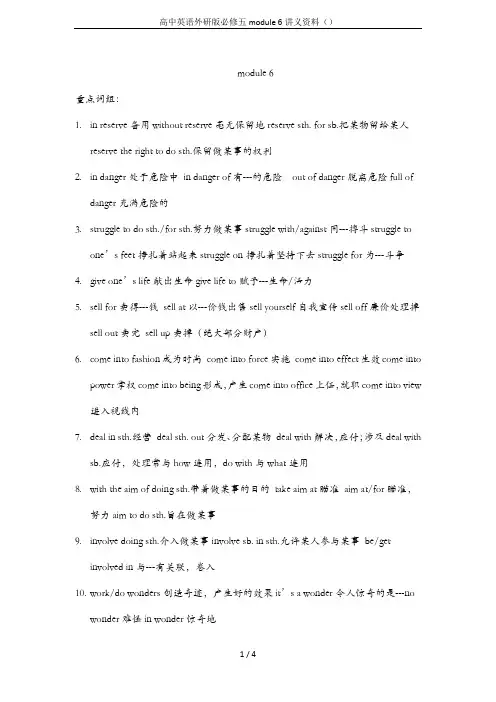
module 6重点词组:1.in reserve备用without reserve毫无保留地reserve sth. for sb.把某物留给某人reserve the right to do sth.保留做某事的权利2.in danger处于危险中in danger of有---的危险out of danger脱离危险full ofdanger充满危险的3.struggle to do sth./for sth.努力做某事struggle with/against同---搏斗struggle toone’s feet挣扎着站起来struggle on挣扎着坚持下去struggle for为---斗争4.give one’s life献出生命give life to赋予---生命/活力5.sell for卖得---钱sell at以---价钱出售sell yourself自我宣传sell off廉价处理掉sell out卖完sell up卖掉(绝大部分财产)e into fashion成为时尚come into force实施come into effect生效come intopower掌权come into being形成,产生come into office上任,就职come into view 进入视线内7.deal in sth.经营deal sth. out分发、分配某物deal with解决,应付;涉及deal withsb.应付,处理常与how连用,do with与what连用8.with the aim of doing sth.带着做某事的目的take aim at瞄准aim at/for瞄准,努力aim to do sth.旨在做某事9.involve doing sth.介入做某事involve sb. in sth.允许某人参与某事be/getinvolved in与---有关联,卷入10.work/do wonders创造奇迹,产生好的效果it’s a wonder令人惊奇的是---nowonder难怪in wonder惊奇地11.be home to/be the home of是----的家园be/feel at home随便,无拘束,感到自如make oneself at home请随便,别拘礼12.be concerned about为---担忧be concerned with/in牵涉到,参与,与---有关as faras I’m concerned在我看来be concerned with与---有关13.keep an eye on密切注视,照顾keep an eye out for注意have an eye for对---有眼光keep one’s eyes open警觉,留心14.feed on以---为食feed---to---把---喂给feed----into---把---投入/放入feed up养肥,养壮feed---with---用---喂15.stand for代表,象征,容忍stand against反对stand around闲站着无所事事standby袖手旁观,支持stand down辞职,退出竞选stand out显眼,突出stand up 站立,耐用16.the focus is on sth.焦点是在某事上the focus of attention关注的焦点bring/throw sth. into focus使特别注意某物in/out of focus清晰/不清晰focus on集中注意力于focus---on---把---集中于---上拓展:concentrate on, be buried in ,be absorbed in ,be occupied with17.set up建立,设定,安排set about开始(做某事)set down放下,写下set aside留出,存储set off出发,引起set out出发set out to do sth.开始做某事18.protect sb./sth. from sth.使---免于---protect sb./sth. against sth.防止---遭受---under the protection of---在---的保护下---拓展:动词+sb./sth.+from---save sb./sth. from---使某人/某物免于---rescuesb./sth. from拯救某人/某物以免---shelter sb./sth.from---保护某人/某物以免---ban/prohibit/forbid sb./sth. from---禁止某人/某物做某事prevent/stop/keep/discourage sb./sth.from---阻止某人/某物做某事19.on the spot当场,在现场,立即,马上carry out/launch/make a raid on突然袭击,突然抢劫get tough with采取强硬措施go for对---也适用,去找,喜欢20.base in以---为基地base—on/upon以---为基础重点单词:1.energy精力,能量strength体力,实力,优势force武力,为做某事而使用的力power能力,权力,侧重作为行动依据的能力、本领或职权2.base活动的基地或物体的基础basis工作或理论所依据的基础,原则3.struggle奋斗,挣扎,尤指在困境中的抗争fight打仗,打架,一般的战斗campaign 为特定目的所做的一连串战斗,数次battle组成battle指一次会战或战斗war大规模的战争,战争的通称4.profit局限于物质或金钱利益,利润用复数advantage物质利益及竞争中所占的优势或有利条件benefit物质精神方面的好处5.skin剥去----的皮,擦破----的皮head带领eye注视nose打探,搜寻finger触摸hand传递leg逃跑foot负担费用arm装备back支持shoulder承担mouth说出6.meanwhile在此期间,是副词,单独作状语同时=at the same time during在---期间,是介词,后接名词或代词while在----期间,是连词,引导时间状从7.upset由于某事的发生而感到心烦意乱nervous在事情发展的过程中有一中紧张害怕的感觉anxious由于害怕某件事会发生而感到焦急8.condition环境,情况monitor监测,监视wonder奇迹,奇观,想知道,endanger 危机extinct灭绝的involve涉及,包括energetic精力充沛的bald秃的initial首要的,重要的enable使能够enlarge扩大9.How would you like your steak? rare半熟medium中等熟well –done全熟重点语法:1.be worth doing=be worthy of being done/to be done=it is worthwhile doing/to do sth.做某事是很值得的be worth it很值得be worth doing主动形式表被动意义eg. The room is worth cleaning.2.seem to do/to be doing/to have done好像要做/正在做/已经做(主语是具体的人或物)seem as if---好像---There seems to be---好像有---It seems that---好像---eg. The teacher seemed to appreciate what I did for my classmates.。
外研版高中英语必修5 Module6 Grammar精品课件

[自我总结]
1.定语从句以从句形式在句中作
,修饰名词、
代词、句子中的部分或全部。被修饰的部分称为 。定
二、“介词十关系代词”的用法 1.“介词十关系代词”结构中介词的确定方法。 (1)根据从句中的谓语动词或主要的形容词确定介词。 The witness to whom the policemen referred was killed last night.警察所提到的那个目击证人昨晚被杀了。 (2)根据定语从句修饰的先行词确定介词。 I don't know the reason for which he was late for school.我不知道他为何上学迟到。 (3)根据句子所要表达的意思确定介词。 This is the pilot by whom my son was saved. 这就是那位救了我儿子的飞行员。
2.“介词十关系代词”结构中的关系代词通常用 which或whom,不用that。
I'll never forget the day on which I joined the army. 我永远也忘不了我参军的那一天。 This is the pencil with which I draw pictures. 这是我画画用的那支铅笔。
Module 6 Grammar
观察下列从Reading中选取的句子,用适当的关系代 词或关系副词填空,体会定语从句的结构和用法
①On a freezing cold day in January 1994, Jiesang Suonandajie found what he was looking for—a group of poachers who were killing the endangered Tibetan antelope.
外研版高中英语必修五Book5Module6课件

1.Preview the reading passage. 2.Master the new vocabulary in the module.
nature Animals haarbeitaotusr; friends, so should we p…ro…tect them?
Individual work
Read the passage on Page 51 and answer the question: What is the present living situation of the Siberian tiger?
3 protection ,especially of natural things ( conservation )
4 in danger
( endangered )
5 a fighter which lasts a long time
( strugand where animals are protected
高中英语课件
(madeofdingshangtuwen)
Module 6 Animals in danger Introduction
The adnainmgaelrous The endangered animal
antelopes
elephant
Report of the extinct animals
conservation endangered extinct habitat reserve species struggle survival wild wildlife
1 a type of animal or plant ( species )
2 the place where an animal lives naturally ( habitat )
高中英语外研版_必修五_module_6阅读课件

(2) v.特别注意,集中注意力于 Focus on集中注意力于….. Focus….on….把….集中到….上 She tried to focus her mind on her work. 她试图集中思想干活。 We need to focus public attention on this issue.我们需要把公众的注意力集中到这个 问题上。 He focused on his study.他集中注意力学习。
bald ibis 秃鹮
Crocodil
Penguin
antelopes
The Tibetan antelopes
The antelopes live on the Qinghai- Tibetan Plateau. They look like deer. They are good at running, so they were chosen as one of the mascots for the 2008 Olympic Games, whose name is Yingying. Their wool is soft , light and warm and can be made into shawls. Their life span is at most 8 years.
Keep an eye on密切关注,照看 We’ve asked the neighbors to keep an eye on the house foe us while we are away.我们已请邻 居在我们离开时帮我们照看一下房子。 Please keep an eye on your luggage while you are on a train.坐火车时请密切关注你的行李。 Feed on(动物)以…..为食 Butterflies feed on the flowers of garden plants. 蝴蝶以园林中草木的花为食。 Owls feed on mice and other small animals. 猫头鹰以老鼠和其他小动物为食。
外研版必修五MODULE6知识点

9.But today the government seems to win the battle.但今天政府似乎将会赢得这场战争。
精讲拓展:
①seem+adj. n.
②It seems(ed) that...
③It seems(ed) as if/though...
①spot原意为“小点,斑点”,引申为地点,场地,因而带有从宏观看来只是一小点的意思,如:a spot for a picnic 野餐地;an interesting spot风景点。
②site专指现场,还可指建筑物的地址,地基,如:the site of an accident事故现场;the construction site建筑工地。 ③position可表示方位,位置,此时与location同义;还可表示被放置的状态,姿势;职位,如in an upright position 以坐直的姿势;in the manager's position在经理的职位上。
⑤stand back退后;靠后站
⑥stand by在场;靠近;袖手旁观;支持
⑦stand by one's promise遵守诺言 ⑧stand down退出竞选;退出证人席
⑨stand in当替身;代替
⑩stand out明显;突出;坚持;抵抗;支撑
B11stand out a crisis挨过危机
④location用作可数名词,为方位、地点,有很强的方向感;用作不可数名词,为找出……的位置,如:a proper location for a new train station适合建筑新车站的地点。
⑤place的用法最广,表示地方、场所,可泛指也可指具体的事物。 活学巧练:
外研版高中英语必修五课件Module 6 Reading
Read the passage again and say what the numbers and dates refer to
1. 50,000
2. $ 5,000
3. 1975
4. 138
5. 2%
6. 3,000
7. 5,000 metres
8. 1997
The number of antelopes left by the 1990s
result, Jiesang was shot and killed. He had
g_i_v_e_n_h__is__li_f_e_ to save the Tibetan antelope.
Consolidation (paragraph 3)
1. The poachers shoot whole herds of antelopes at a
迎迎是一只机敏灵活、驰骋如飞的藏羚羊,他 来自中国辽阔的西部大地,将健康的美好祝福 传向世界。迎迎是青藏高原特有的保护动物藏 羚羊,是绿色奥运的展现。
迎迎的头部纹饰融入了青藏高原和新疆等西部 地区的装饰风格。他身手敏捷,是田径好手, 代表奥林匹克五环中黄色的一环。
Discussion:
The year when the antelope population started to grow again.
Word practice
Find the words in the passage 1. high ground ____ 2. a piece of cloth people wear on the shoulders. ______ 3. money you make by selling something. ______ 4. a group of animals which live or move together.________ 5. to cut the skin off an animal. ________ 6. an order not to do something. _______ 7. a surprise visit_______
外研版高中英语必修五课件Module 6 Introduction
5. a fight which
people
lasts a long struggle 10. wild animals wildlife
time
Discussion
Look at the reasons why some animals are becoming extinct. Which is the most important? Discuss your ideas with other students.
高二外研版必修五
Module 6 Animals in Danger
Introduction
Learning goals
1. Review and learn some vocabularies of wild animals. 2. Learn to analyze the reason of rare animals’ becoming extinct.
2. What can we do to help them in their struggle for survival?
Match the words with the meanings
conservation endangered extinct habitat reserve species struggle survival wildlife
Animals swimming in water: buffalo, seal, dolphin, otter, alligator, hippopotamus…
Group work
How much do you know about the Siberian tiger and the giant panda?
外研版高中英语必修5 Module6 Introduction精品课件
Individual work
Read the passage on Page 51 and answer the question: What is the present living situation of the Siberian tiger?
reserve
7 dead (for a species, not a single animal)
extinct
8 continuing to live
survival
9 living in a natural state, away from people
10 wild animals
wild wildlife
(白鳍豚-长江女神)
We have not seen it since 2002.
(中华白臀叶猴)
The last one The last Asian Lion
was shot by a French man.
died in 1908.
Golden monkey
giraffe
alligator
1.Preview the reading passage. 2.Master the new vocabulary in the module.
Module 6 Animals in danger
Introduction
The dangerous animal The endangered animal
antelopes
elephant
Report of the n
外研版高二英语必修五module6
4. What’s happened to the trade in “shahtoosh”?
A. It has grown quickly. B. It has become legal. C. It has become harder to sell “shahtoosh”.
5. What will happen to the Tibetan antelope? A. Its number will continue to increase. B. It may survive. C2.02I0t/11w/30ill soon become extinct.
Many poachers were caught and 300 vehicles _co_n_fi_sc_a_te_d. Police are getting _to_u_g_h___ with the dealers. As a result, the antelope population has slowly begun to grow again. The writer tells us the facts about thee_nd_a_n_ge_r_edantelope to make us realize the importance of protecting animals.
4. seem
2020/11/30
seem to be doing
When I came in, the baby
seem to do
seemed to be sleeping.
15
seem to have done
2020/11/30
16
谢谢
2. Why are Tibetan antelopes in danger? A. They have lost their natural habitat. B. They are killed for their wool. C. They cannot survive at high altitude.