
【高一英语新教材必修二】Unit 1 Listening and Speaking P2-3
√
I know the general meaning of the word.
The speaker gives an example of the word.
After-listening
Youth Project
Who
What
(create an app)
Why
take photos of ... write texts ...
Unit 1 Cultural Heritage
Listening&Speaking P2-3
The Forbidden City
Mogo Caves of Dunhuang
Potala Palace
The Great Pyramid
Taj Mahal
The Great Wall is not only China's heritage, it is also the world's heritage.
News report
Title Body
news lead: where, who, what
details: why, how, what
Would you like take part in a project like this? Why or why not?
Could you think of more ways to protect the cultural heritage?
Help the reporter to complete the news report based on what you hear and the interview notes.
International Youth Camp Members Create Mount Tai App
Tai'an, 18 June 2019. A group of high school students who are taking part in an international youth camp at Mount Tai are creaaptipng a(n) ___ about China's most famous mountain. The purpose of the camp is to p_r_o_m__o_t_e Mount Tai by introducing it to young people in a fun and easy way. The students are making an app about Mount Tai and taking photos of the t_e_m__p_le_s_ and stones. The volunteers also visit middle schools in the area in order to talk to local teenagers. Liu Bin, a member of the camp, says that he is p__ro_u_d_ to help Mount Tai as people have done for more than 3,000years.
Use context to guess words To guess the meaning of new words, look at the other words and use what you know about the topic.
Inference Meaning is not given, so use text clues to guess it.
Listen again and use the context to guess the meaning of the words below. Tick the reason why you were able to guess the words.
Reason
Preserve Promote Cypress
√ Yuanmingyuan? Just cross the street.
2 Bruce referred to the guidebook./
√ Bruce preferred to the guidebook.
3 The dragon followed its tail./
√ The dragon followed its trail. 4 √ It is a different context./
While-listening
Listen to the conversation and choose the main idea.
A Students from different countries are working creatively to protect a temple in China.
Definition Meaning is explained in the sentence. Example Example of the word is used in the
sentence or nearby sentences. Antonym Word with the opposite meaning is
EXAMPLE The palace was destroyed years ago. By studying old photos of the former palace, they have made the new one look exactly like the old one. Clues: destroyed years ago; studying old photos; made the new palace like the old one Guess: The former palace means “the palace that _w_a_s_b_u_i_lt_b_e_f_o_re__b_u_t_w_a_s__d_e_st_r_o_ye_d__”.
It is a different contest. 5 The trays were dark green./
√ The trains were dark green.
3 Listen and repeat.
Tongue twisters
➢ All I want is a proper cup of coffee made in a proper copper coffee pot. You can believe it or not, but I just want a cup of coffee in a proper coffee pot. Tin coffee pots or iron coffee pots are of no use to me. If I can't have a proper cup of coffee in a proper copper coffee pot, I'll have a cup of tea!
The word is an example of a group/type I know.
√
The word is explained by the speaker.
√
The word means the opposite of a word I know.
The word means the same as a word I know.
used in the sentence or nearby sentences. Synonym Word with a similar meaning is used in the sentence or nearby sentences.
Practise using context clues to guess the meaning of new words. Look and fill in the blank.
Pre-listening
Read and talk: Mount Tai
“五岳独尊”是泰山众多古迹石刻中最具代表性的杰作,五岳为群山 之尊,是中国五大名山的总称,一般指东岳泰山(位于山东)、西 岳华山(位于陕西)、南岳衡山(位于湖南)、北岳恒山(位于山 西)、中岳嵩山(位于河南)。
Take part in a youth project
×
Pronunciation
1 Listen and tick the word that you hear.
1 √ present/ pleasant 2 crew/ √ grew 3 √ scream/ cream 4 exist/ √ exists 5 twelve/ √ twelfth 6 confident/ √ confused
It has been p_r_o_te_c_t_e_d for more than 3,000 years
22 temples, around 1,800 s_t_o_n_e_s with writing on them
Dai Temple on _M_o_u_n_t_T_a_i_ over 6,000 _s_te_p_s_
➢ A pleasant peasant keeps a pleasant pheasant and both the peasant and the pheasant are having a pleasant time together.
From the title “Take part in a youth project”, what do you think the projeca youth project
The two girls are looking for information about Mount Tai in books and on the Internet. The two boys are taking pictures of the rock carving at Mount Tai and taking notes. In the classroom, the students are discussing Mount Tai. The girl is working on her computer.
2021_2022学年新教材高中英语Unit1TeenageLifeListeningandSpea
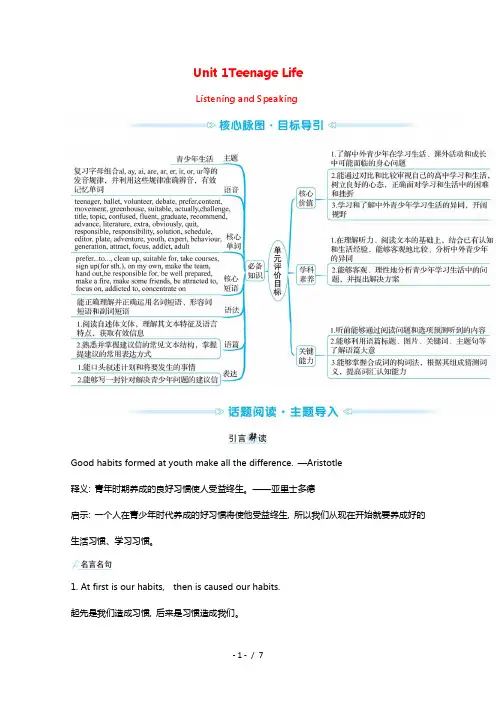
Unit 1Teenage LifeListening and SpeakingGood habits formed at youth make all the difference. —Aristotle释义: 青年时期养成的良好习惯使人受益终生。
——亚里士多德启示: 一个人在青少年时代养成的好习惯将使他受益终生, 所以我们从现在开始就要养成好的生活习惯、学习习惯。
1. At first is our habits, then is caused our habits.起先是我们造成习惯, 后来是习惯造成我们。
2. Habit is a human thought and behavior of the leader.习惯是一个人思想与行为的领导者。
3. Habit forms character, character determines destiny.习惯形成性格, 性格决定命运。
We don’t always get our hopes and dreams, and we don’t always get our own way. But don’t give up hope, because you can make a difference one situation and one person at a time.Look for the beauty around you: in nature, in others, in yourself, and believe in the love of friends, family, and humankind.You can find love in a smile or a helping hand. It is all around, if you just look for it.Give love, for in giving it you will find the power in life along with the joy, happiness, patience, and understanding. Believe in the goodness of others and remember that anger and depression can be countered by love and hope.Even when you feel as if there isn’t a lot you can do to change unhappiness or problems, you can always do a little, and a little at a time finally makes a big difference.[词海拾贝]1. humankind n. 人类2. patience n. 耐心3. depression n. 抑郁; 沮丧4. counter vt. 反驳; 抵制[我学我思]1. give up放弃2. along with连同……一起; 除了……3. make a big difference有很大影响; 产生很大不同4. What will you do when you are facing difficulties in high school?I will be brave to face challenges and ask my friends or my parents to help me.Choose a school clubⅠ. 主题词汇听写①Science②Basketball③Photography④BalletClub Club Club Club⑤Chess⑥Nature⑦Volunteer⑧DebateClub Club Club ClubⅡ. 教材听力填空Conversation 1(Listen and fill in the blanks)Teacher: Shh! Listen carefully!Teacher: Did you hear that? No? How about this?Teacher: If you couldn’t hear the first one, it means you’re ①not a dog! [Laugh]. Dogs can hear very high frequency ②sounds, but people can’t. And if you could hear the second one, you’re ③younger than 25.Student: Wow! Why is that?Teacher: Our ears change when we ④get older. Children and young people can hear the second one, but most people older than 25 can’t.Conversation 2(Listen and choose the best sentences)Teacher: ⑤__________ Team A, please begin.Team A: We say no, they shouldn’t. ⑥__________ They should think about schoolwork and spend more time studying.Team B: We don’t agree with Team A. ⑦__________ Teenagers can date if they want. It is quite natural for a teenager at that age to feel he or she likes somebody. ⑧__________Teacher: Team A?A. Our answer is “Yes”.B. We think it’s possible for teenagers to date and study at the same time.C. One reason is that teenagers are too young.D. Today’s topic is “Should teenagers date? ”答案: ⑤~⑧DCABⅢ. 话题听力体验听下面一段对话, 回答以下小题。
2019新人教高中英语必修二Unit1 Listening and speaking
Listen to the second part and answer the questions. 1. How many elephants are killed on average every day ?
54
2. What did Prince William say about China ? B
on
Listening tip: Use visuals to predict content-Before you listen, look pictures, charts, videos, and other visuals to help you predict what you will hear.
of wildlife in simple English.
Lead in
Look and discuss about the opening page.
Questions: 1.What do you think of when you see this photo? 2.Do you think that elephants are an endangered species? 3.What other endangered animals can you think of when
A: That’s terrible. What measures are being taken to help them? B: The authorities are under pressure to build elephant parks and tell
people not to buy elephant products.
Example:
人教版高一年级英语上册Unit 1 Listening and speaking教学设计

Watch a short video and talk about science and scientists.
Ask students to find and speak out as many scientists and their achievements as they can.
Brainstorming
Find and speak out as manቤተ መጻሕፍቲ ባይዱ scientists and their achievements as they can.
Play the record for students to listen and correct answers with the whole class.
三、学习者特征分析(学生对预备知识的掌握了解情况,学生在新课的学习方法的掌握情况,如何设计预习)
English is a language, and the last purpose of a language study is to use the language to communicate with others. Listening and speaking teaching is an important part in English teaching,which is also the best way of testing if the students have mastered the language and if they can use the language to communicate. The students can listen to the use expressions they have learnt in this lesson, and they can describe science and famous scientists which they are familiar,which will show that our teaching aims have reached. If they can listen and use English to communicate with others in their future life, and if they can use the useful expressions they have learnt in class, which will show that they have obtained the ability.
【高中英语必修一U1】1.1 Listening and speaking 教学设计(2)-人教版
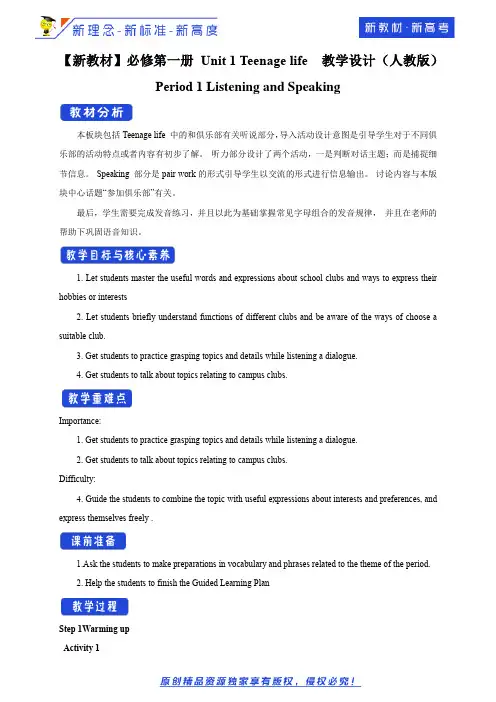
【新教材】必修第一册Unit 1 Teenage life 教学设计(人教版)Period 1 L istening and Speaking本板块包括Teenage life 中的和俱乐部有关听说部分,导入活动设计意图是引导学生对于不同俱乐部的活动特点或者内容有初步了解。
听力部分设计了两个活动,一是判断对话主题;而是捕捉细节信息。
Speaking 部分是pair work的形式引导学生以交流的形式进行信息输出。
讨论内容与本版块中心话题“参加俱乐部”有关。
最后,学生需要完成发音练习,并且以此为基础掌握常见字母组合的发音规律,并且在老师的帮助下巩固语音知识。
1. Let students master the useful words and expressions about school clubs and ways to express their hobbies or interests2. Let students briefly understand functions of different clubs and be aware of the ways of choose a suitable club.3. Get students to practice grasping topics and details while listening a dialogue.4. Get students to talk about topics relating to campus clubs.Importance:1. Get students to practice grasping topics and details while listening a dialogue.2. Get students to talk about topics relating to campus clubs.Difficulty:4.Guide the students to combine the topic with useful expressions about interests and preferences, and express themselves freely .1.Ask the students to make preparations in vocabulary and phrases related to the theme of the period.2.Help the students to finish the Guided Learning PlanStep 1Warming upActivity 1Ask Ss to match the photos with the names of the clubs. And hold a brief discussion about what the students are doing in the clubs.Step 2 Listening (1)Activity 2Guide the students to listen to the first two conversations and choose the correct answers.Remind the students to pay attention to the Predict Content:“Before you listen, you can read the questions and choices. It will help you to predict what you will hear.”1.What are they learning about in Conversation 1 ?(A)A. HearingB. SoundsC. Dogs.2.The students are discussing_____ in Conversation 2.(C)A. school workB. relationshipsC. dating.3.Circle the two clubs where these two conversations happened. (A)(D)A. Science ClubB. Ballet ClubC. Nature ClubD. Debate ClubActivity 3Guide the students to listen to conversation3. Then finish the following exercise.1. Tick the activities that happen in each club.Ballet Club Nature Club Cartoon Club Volunteer Clublearn new movements listen to lectures watch cartoons help old people watch dance programs grow plants writes stories clean up parks make Ballet clothes work in a greenhouse draw cartoons give directions.2. Adams says that he likes ___________but is not so interested in _________ .(B)A. stories, cartoonsB. animals, plantsC. making friends, cleaning up.3. Which club do you think is suitable for Adam? Why?I think Adam should join the Volunteer Club because he likes to do something outdoors.Step 3 SpeakingActivity 4Organize the students to working pairs and help each other choose a school club.Make some preparations before pair work.Brainstorm USEFUL WORDS and EXPRESSIONS FOR THE PAIR WOWRK. Are you going to join …?. I’d like to…, but I am not sure….. Which club do you like to join?. Have you decided which club to join?. My dream is to be……. …is not for me.. I like …,but I am not so interested in….…Provide an example for the students to modify.EXAMPLEA: Hi, Sam! I've decided to join the Music Club.B: Good decision!A: How about you? Are you going to join a club?B: Yes I'm wondering which one I should choose:the Act Club or the Ballet Club?A: I guess the question is… Do you like dancing better than acting?B: Actually, I like acting better, but my friends go to the Ballet Club and I want to be with them.A: Hmm…If you ask me,I think you should choose what you like.Step 5 PronunciationActivity 51.Listen and repeat.Guide the students to listen and pay attention to the combinations of lettersEncourage the students to add more words to each groupProvide help whenever necessary.al talk, wall, ball,fall,call, all…ay pay, stay, delay, day, may, play, display, away…ai paint, daily, gain, pain, hailstone, wait…are care, declare, dare, prepare, spare, scare…ar bar, hard, car, star, large, enlarge…er her, prefer, teacher, farmer, paper …ir bird, circus, circle, ,third, thirsty, fir, birthday, shirt, dirty……or horse, absorb, bore, door, story…or word, work…ur burn, hurt, fur, turn, nurse, turtle, purple…ee keen, tree, fee, seem, feet, teeth…ea clean, eager, teach, leave, speak…ea head, ready, bread, weather, sweater, heavy…ear clear, appear, fear, hear, dear, near, ear, …ear earn, heard, search, learn, earn, e arth…oa boat, coach, coat, goat, load, …ow show, grow, low, blow, slow, follow, eyebrow……ow now, shower, town, down, how, tower…ou out, loud, about, loud, doubt, mouth, house, mouse…ore more, bored, forecast, forehead, core…2. Guide the students to listen to the proverbs and repeat. Notice the pronunciation of the letters in bold.1. The ear ly bird catches the w or m.2. Al w ay s prep are f or a r ai ny d ay.3. Actions sp ea k l ou der than w or ds.4. Al l w or k and no pl ay makes Jack a dull boy.5. Distance tests a h or se’s strength. Time rev ea ls a p er son's character.1、通过本节内容学习,学生能否了新旧知识结合,将俱乐部话题与表达兴趣爱好的句式和表示选择和决定类词汇相结合,自由的谈论相关话题。
新人教版高一英语必修二unit1教案
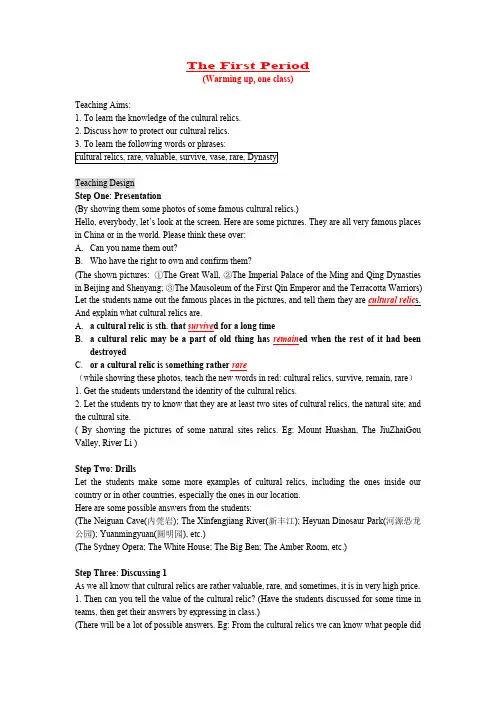
The First Period(Warming up, one class)Teaching Aims:1. To learn the knowledge of the cultural relics.2. Discuss how to protect our cultural relics.3. To learn the following words or phrases:cultural relics, rare, valuable, survive, vase, rare, DynastyTeaching DesignStep One: Presentation(By showing them some photos of some famous cultural relics.)Hello, everybody, let’s look at the screen. Here are some pictures. They are all very famous places in China or in the world. Please think these over:A.Can you name them out?B.Who have the right to own and confirm them?(The shown pictures:①The Great Wall, ②The Imperial Palace of the Ming and Qing Dynasties in Beijing and Shenyang; ③The Mausoleum of the First Qin Emperor and the Terracotta Warriors) Let the students name out the famous places in the pictures, and tell them they are cultural relic s. And explain what cultural relics are.A. a cultural relic is sth. that survive d for a long timeB. a cultural relic may be a part of old thing has remain ed when the rest of it had beendestroyedC.or a cultural relic is something rather rare(while showing these photos, teach the new words in red: cultural relics, survive, remain, rare)1. Get the students understand the identity of the cultural relics.2. Let the students try to know that they are at least two sites of cultural relics, the natural site; and the cultural site.( By showing the pictures of some natural sites relics. Eg: Mount Huashan, The JiuZhaiGou Valley, River Li )Step Two: DrillsLet the students make some more examples of cultural relics, including the ones inside our country or in other countries, especially the ones in our location.Here are some possible answers from the students:(The Neiguan Cave(内莞岩); The Xinfengjiang River(新丰江); Heyuan Dinosaur Park(河源恐龙公园); Yuanmingyuan(圆明园), etc.)(The Sydney Opera; The White House; The Big Ben; The Amber Room, etc.)Step Three: Discussing 1As we all know that cultural relics are rather valuable, rare, and sometimes, it is in very high price.1. Then can you tell the value of the cultural relic? (Have the students discussed for some time in teams, then get their answers by expressing in class.)(There will be a lot of possible answers. Eg: From the cultural relics we can know what people didin the past, and we can know the cultures at that time, and maybe we can know the technology of making them…)2. How to protect the cultural relics? (The same as Question 1)(There will be a lot of possible answers. Eg: Having the idea of protecting our cultural relics; don’t damage them; use them in a right way…..)Step Four: Discussing 21. If you find a cultural relic, what will you do with it?2. Do you think to whom the cultural relics belong?(All cultural relics belong to all people and whole society.)Have the students to discuss the first question for about two or three minutes, then show the answer for their team. Then the same way for Question 2.(While discussing, teach the new phrase in red)The Second Period(Reading part, 2-3 classes)Teaching Aims:1. Reading and understanding, catching the history and information of the Amber Room.2. Functional item, how to tell the story about the Amber Room3. Grammar point: The Attributive Clause4. Learning the following useful words and phrases:in search of, fancy, style, jewel, in return, reception, light, mirror, wonder, at war, remove, furniture, secretly, wooden, doubt, remain, mystery, apart, take apartTeaching DesignStep One: PresentationLast period, we talk about the cultural relics at home and abroad, such as The Great Wall, The Imperial Palace of the Ming and Qing Dynasties in Beijing and Shenyang; The Mausoleum of the First Qin Emperor and the Terracotta Warriors The Sydney Opera; The White House; The Big Ben; The Amber Room (which we have learnt last period)Then, we will go the Amber Room, showing them the pictures of it.Do you know the history of the Amber Room, and do you know where the Amber Room is now? (The Amber Room is a room built by lots of ambers. It was a gift given to Peter the Great, the King of Russia, by the King of Prussia, Frederick William I. It was given the name because almost seven thousand tons of natural ambers were used to make it. But during World WarⅡ in 1941, the Nazi German army secretly stole the Amber Room and sent boxes of the Amber Room on a train to a German City. After that, what really happened to the Amber Room remains a mystery.) Step Two: Reading 1 (Listening, reading and understanding)1. Now please listen to the tape of the text IN SEARCH OF THE AMBER ROOM. And then read aloud. Pay attention to the pronunciation of each word and the pauses within each sentence.2. After reading the text, please complete the exercises of Comprehending.①Keys to Ex1 CEBDAF②The suggested answers to the Ex2Para 1 How was the Amber Room made?Para 2 Why did the King of Prussia give the Amber Room to the Czar of Russia as a gift? Para 3 How did the Amber Room become one of the wonders of the world?Para 4 How did the Amber Room get lost?Para 5 How was a new Amber Room built?3. Detailed ReadingRead the text again and answer the following questions:①.What was given to the Russian people as a great gift by Frederick WilliamⅠ,the Kingof Prussia?(The Amber Room was given to the Russian people as a great gift by Frederick WilliamⅠ,the King of Prussia )②.Why it is called the Amber Room and how many tons of amber were used to make theAmber Room?(Because it was made of seven thousand tons of amber, which has a beautiful yellow brown color)③.What did Catherin eⅡ do with the Amber Room?(She had the Amber Room moved to the palace outside St Petersburg and transformed it.)④. What happen to the Amber Room during World Wa rⅡ?(It was stolen by the Nazi and it was taken apart and missing in World WarⅡ)Step Three: Intensive ReadingSkimming and identifying the general idea of each paragraphNow please read the text again and try to catch the main idea of each paragraph. After about five minutes reading, have some students speak for their teams.1st paragraph: the introduction of the Amber Room(The Amber Room had a strange history and something about its design, color, shape and material.)2nd paragraph: the gift to the Czar(the history of the Amber Room and its use in Russia—the Czar’s winter palace and a small reception hall for important visitors.)3rd paragraph: the relocation of the Amber Room in CatherineⅡ time(CatherineⅡhad the Amber Room moved to the palace outside St Petersburg told the artists to add more details to it.)4th paragraph: the missing of the Amber Room(the German Nazi stole the Amber Room secretly during the World Wa rⅡ,and what really happen to the Amber Room remain a mystery)5th paragraph: the rebuilding of the Amber Room(Russia and Germany have built a new Amber Room for the 300th birthday f St Petersburg.)Step Four: DiscussingClosing down by having a discussionA.Can you imagine the fate of the Amber Room? What is it?B.Do you think if it is worthwhile to reproduce the Amber Room? Why?Have the students discussed one question by one question for some time, and then show theirviews for their teams. There may lots of possible answers.Keys for reference:A: I have no idea about the fate of the Amber Room. Because anything can happen to it. Maybe it was destroyed at war in the fighting fire. You see, ambers can be melted easily. Maybe it was kept secretly by somebody who had died without telling about it to anyone else. So maybe it is lying somewhere quietly.B: I think it is worthwhile to reproduce the Amber Room. Because it represents the culture and a period of history in St Petersburg. It is a trace and feature surviving from a past age and serving to remind people of a lost time.Step Five: New words teachingRead the reading part paragraph by paragraph again and pick up the key words and phrases by themselves, let the students try to explain the meaning and usage.amazing, select, honey, heat, design, fancy, style, decorate, jewel, artist, belong, in return, troop, light(lit), mirror, wonder, at war, remove, furniture, wooden(wood), doubt, formerEspecially pay attention to the words and phrases underlined.Step Six: Grammar points in this textLet the students try to find out the Attributive clause in warming up and the reading part.1. A cultural relic is something that has survived for a long time.2. It is your job to look into any reports of cultural relics that have been found in China.3. You are sent to a small town where you find a relic that was stolen from a palace.4. The man who has it insists that it belongs to his family.5.This gift was the Amber Room, which was given this name because almost seven thousand tons of amber were used to make it.6. Later, CatherineⅡhad the Amber Room moved to the palace outside St Petersburg where she spent her summers.7. In 1770, the room was completed the way she wanted it.8. This was a time when the two countries were at war.Have the student’s judge whether they are the same as those we had learnt before. Especially the 5th one. This will be the homework after class.The Third Period(Learning about Language, 1-2 classes)Teaching Aims:1.To learn some useful words and expressions2.To learn some useful structures3.To learn the Restrictive and Non—Restrictive Attributive ClauseTeaching Important PointLearn how to use the Attributive Clause with that/which/who/where/whenTeaching Difficult Point:⑴. How to tell the Attributive Clause with that/which/who/where/when from other clauses.⑵. Learn the differences between the Restrictive and Non—Restrictive Attributive ClauseTeaching DesignStep One: Retelling (Can be chosen)Retell the story of the Amber Room in their own words.Step Two: Exercising 1 (Exercise 1 &2 on Page 3)(1) Complete Exercise One in Learning about Language on Page3. Asking and answering activity to check the students’ answers of the exercises; individual, pair of group work or finish each task.Here are the keys to Ex1:1.select2.rare3.reception4.amaze5.less than6.wooden7.in search of8.suivive9.remove10.artist11.former12.at war(2) Read the passage and complete it with the words giving.Keys to Ex2:dynasties, style, amazing, jewels, designed, decorated, fancy, rare, doubt, worthStep Three: Exercising 2 (Exercise 3 on Page 3)Look, think and compareRead over the materials in Ex2 carefully and try to find out the different meanings and usages of the phrase belong to,and try to match the meaning with the given sentences.Keys:1.to be the property of; The coat belongs to me.2.to be a part of, be connected with; That top belongs to this desk.3.to be a member of; He belongs to a large family.Step Four: Grammar point (the Attributive clause)1. Discovering useful structures (on Page 4)Let the students try to find out the Attributive clause in warming up and the reading part.1. A cultural relic is something that has survived for a long time.2. It is your job to look into any reports of cultural relics that have been found in China.3. You are sent to a small town where you find a relic that was stolen from a palace.4. The man who has it insists that it belongs to his family.5.This gift was the Amber Room, which was given this name because almost seven thousand tons of amber were used to make it.6. Later, CatherineⅡhad the Amber Room moved to the palace outside St Petersburg where she spent her summers.7. In 1770, the room was completed the way she wanted it.8. This was a time when the two countries were at war.Explain some of them, look at the fifth sentence carefully. Get the students to tell the differences from the others.There is a comma before the relative pronoun which.And this is a Non-Restrictive Attributive clause.The relative clause carries extra information that is not necessary to identify the person or thing being discussed.While the other sentences have the Restrictive Attributive Clauses.●非限制性定语从句的用法:1.非限制性定语从句与先行项的关系不紧密,只是作为附加说明,不起限制作用。
2021新人教高一英语必修二 课本听力与视频材料原文
高一英语必修二课本听力与视频材料文本Unit 1 Cultural HeritageListening and SpeakingReporter: Hello. What are you guys doing?Stephanie:We’re creating an app about Mount Tai. We’re part of an international youth project.Reporter: That's interesting. How many students are taking part in the project?Stephanie: There are 23 senior high school students from seven countries.Reporter: Why is the project here at Mount Tai?Liu Bin: Well, as you know, Mount Tai is one of the most famous mountains in China. The mountain and the temples have been protected for over 3,000 years, so it's a great example of how people preserve theircultural heritage. We feel so proud to have chance to do something.Reporter: Tell me about the app you're making.Liu Bin: We want to promote Mount Tai; that is, we want to tell teenagers in other countries about the mountain and Chinese culture. The app teaches teenagers about Mount Tai and even has a few games about cultural relics.Reporter: Oh, that’s a clever idea.Stephanie: Yes. For example, this game is about the six cypresses that were planted on Mount Tai during the Han Dynasty. You learn about the trees and also the life in China over 2,000 years ago.Reporter: That sounds great! So what else will you put in the app?Liu Bin: Well, there are 22 temples and some 1, 800 stones with writing on them. We’ll take photos of them all, and then visit the Dai Temple on Mount Tai, since it has so many important paintings and relics. Another group is reading about Mount Tai and writing texts for the app. We’ll also visit local schools and talk to Chinese students.Reporter: Do you think that some people will use the app instead of visiting Mount Tai?Liu Bin: No, not a chance! The app is great, but the best way to see Mount Tai is to climb all 6,000 steps! Reporter: What?! How many steps?Liu Bin Stephanie: More than 6,000!Listening and Talking[Street sounds from Red Square.][]Tour guide: OK, here we are: the Kremlin and Red Square.Tourist 1:Excuse me, but what is the Kremlin exactly?Tour guide: The Kremlin is a special government area. Inside, there are five palaces and four cathedrals. It's where the president lives, too.Tourist 1: Wow... a little bit like the Palace Museum in Beijing.Tour guide: Yes. I guess you could say that. The Kremlin was actually built around the same time, between the 14th and 17th centuries.Tourist 1: What's that building over there, with the colourful round towers? I’ve seen so many photos of it. It looks so pretty, like a flame!Tour guide: That’s Saint Basil, s Cathedral. People all over the world think of Russia when they see it. It's like the Eiffel Tower in France or the Great Wall in China, a symbol of the country.Tourist 2: Forgive me for ask ing, but can you tell me more about Red Square?Tour guide: Well, it's considered the centre of Moscow, and there have been many important parades and events held here. It also used to be a marketplace a long time ago.Tourist 2: Oh, really? How amazing!Tour guide: I see that you're looking at the photos of an ice hockey game. Did you know that children can skate on Red Square in the winter?Tourist 2: No way! That's so coolTour guide: Yes. Red Square is also a place for music concerts. People have a lot of fun here.Video TimeThe Great WallNarrator: The Great Wall winds through vast mountains, sometimes visible, sometimes hidden. Once a great project that underwent 23 centuries of construction, many sections of it have now fall en into ruin oreven disappeared without a trace, depending on when they were built.Each section of the Great Wall records its transformation through the years and has incomparablehistorical value. This section of the wall is not far from the famous Badaling Great Wall. Mr MeiJingtian has walked this six-kilometre mountain path for 30 years.Weeds not only affect the wall's image, but will also speed up its collapse, as their roots grow intothe cracks in the bricks. These past 30 years, Mr Mei Jingtian has been pulling weeds throughout thissection of the Great Wall.After six long years of hard work by surveyors and archaeologists, in 2012, the State Administrationof Cultural Heritage in China announced the final data that the total length of the Great Wall ofChina is 21, 196.18 kilometres. This is equivalent to the distance between the North and South Poleson the earths surface. This is clearly an astonishing figure, for it is four times longer than what hasbeen described in the textbooks of China as the "Wanli Changcheng (10,000-mile Long Wall) of theQin Dynasty.Since 2006, Mr Mei, together with surveyors and archaeological experts, has been measuring thissection of the Great Wall. This, obviously, is a tough but fun task. For the last 30 years, this ordinaryelderly man has been taking care of the Great Wall in his own simple manner.Visitor: Hi! How often do you come here?Volunteers: HeyVolunteers 1: We are volunteers and we usually come here once a month.Volunteers 2: Yes, but when we are not busy with school, we come here once every two weeks.Visitor: Thank you so much for what you're doing. For all the international people like me this is a beautiful wall for all these years.Volunteers 3: Oh, you're doing a great iob!Volunteers 4: GreatVolunteers 5: Wonderful!Volunteers 1: It is a different feeling each time we are here. We hope more people will protect our cultural heritageVolunteers 2: We need to protect the Great Wall, so we can present it to the future generations and let our cultural imprint live on.Narrator: With the participation of more volunteers, the area around the Great Wall has gradually become more natural and peaceful.Each time we approach the Great Wall, without touching it, we can feel the memories and strongemotions from the ancient times.Unit 2 Wildlife ProtectionListening and SpeakingLISTENING PART 1A: Have you seen that poster with the clock? It's so good, but a little scary, too.B: I know. So many wild animals are dying out. This poster says that between 150 and 200 species die out every day.A: That' s terrible. We really need to do something. Why are so many species dying?B:Well, some animals are being hunted and killed. And then there’s pollution and habitat loss, I guess. A nimals need a place to live in, just like us, and they need clean air and water, too.A: It seems like people need to be more awareB: Absolutely. More people need to know.A: Yes, they should make more of these posters-maybe it will help protect the wildlifeLISTENING PART 2Someone has to speak up for endangered animals. Some famous people, such as Chinese superstar Yao Ming and Britain’s Prince William, work hard to help. In October 2015, Prince William gave a moving speech on CCTV: "In the 33 years sinc e I was born, we’ve lost around 70 percent of Africa’s elephant population. Of those that are left, 20,000 are killed every year. That is 54 elephants killed every single day. " That means there are elephants which are being killed right now!In his speec h, Prince William also praised China’s efforts to protect wildlife: "I am absolutely convinced that China can become a global leader in the protection of wildlife. You don’t have to be Prince William or Yao Ming to speak up and do something about endangered animals. You can be the voice of wildlife protection in your area. Remember: Change begins with you.Listening and TalkingNarrator: It's 5: 00 a m. on a Saturday morning and some teenagers have gathered in the Qinling Mountains.They got up early so as to search for wild birds.A: OK, is everybody ready? Do you have all the equipment?B: I've brought a bird field guide so that we can look up the birds we see. It's a really good field guide. It's got descriptions of all the main types of birds, and even a CD with lots of birdsong.C: Great! My dad gave me these binoculars in order that we can see the birds better. They’re really powerful.A:Cool, so let’s go.[Soft footsteps as they walk away.]A: Shh... Do you hear that[Birdsong. ]B: I think tha t’s a… Give me the binoculars!C:What can you see?B: Yes, there it is! Wow, it's a…[fade out. ]Narrator: Birdwatching is an interesting hobby that you can do anywhere. The Qinling Mountains are one of the best birdwatching sites in China, but you can also find many species in your local park. Birdwatchingclubs clean up habitats, build bird feeders, and put paper cut-outs on windows in order to protect birds.*Video TimeThe Elephant Whisperers[Text graphic on-screen.]A special program in Kenya rescues orphaned elephants. Workers in the program raise the elephants until they can return to the wild.[Mishak Naimbi, Elephant Keeper.]“Elephants are... are like humans. If you love them, they will love you too. They live on Zahim because they don't have their mothers. Their mothers have been killed by people. Others have been (pause)died because of no food, not food for them-others because of diseases”The elephants wake up at 5: 30 a m. every day. The keepers then lead them to the forest. They feed hem and play with them.Elephants... they love each other, yah. They are like... Like, our elephants here, they are not from the same area. They are from the whole country. But when they come here, they make friends.They learn to survive together.“We take the elephants to the bush”Keepers stay with the elephants in their native environment, also known as “the bush.”“We stay with them because we have to feed them every 3 hours, day and night. Because the elephants——when they come they don’t have their mothers, and we have to do the work that their mothers do. We have to sleep with them… because when we leave them alone, they cry.”How have you cared for animals?Unit 3 The InternetListening and SpeakingSam: Hi, guys! I'd like to ask you some questions about your online habits. First, how much time do you spend online every day? Anna?Anna: It depends. I'd say two or three hoursSam: How about you. Paul?Paul: Oh, maybe about two hours. Sometimes more. What about you, Joe?Joe: Well, I think I spend at least an hour every day.Sam: What do you usually do online, Joe?Joe: I have a blog. It's like an online diary where you write about something you’ re interested in. For example,I like basketball, so I write a lot on my blog about my favourite team. It's fun.Anna: I like to stream videos and music. That is. I watch videos and listen to music online. It's cheap and easy.Sometimes I look up information, too. With the Internet, I can also chat with my friends anytime, anywhere.Paul: I usually use a search engine to do my homework. A search engine is a tool that helps you find what you're looking for. With it, I can find all the information, videos, and pictures that I need for my homework. It's so helpful.Sam: Great. It seems like you all use the Internet every day. So what do you think life would be like without the Internet?Joe: No Internet?! Are you kidding? Life would be over!.Listening and TalkingLaura: Hey Xiao Bo, what's up?Xiao Bo: Hi, Laura. Not much. I’m trying to get in shape, so I’m looking for an exercise app.Laura: Oh yeah? Found anything?Xiao Bo: Well, there’s an app that counts every step you take during the day. It might help me walk more, but I don’t think it’d be enough. Here’s another one. It keeps track of how much you exercise and what you eat. It also helps you make a fitness plan. I imagine this app would help me get fit faster.Laura: I wish there were an app for getting rich.Xiao Bo: Ha-ha, well, there are apps for saving money.Laura: Really?Xiao Bo: Yes, sure. Look at this one. It helps you find discounts and the best price for whatever you’ re looking.Laura: I suppose that’d be good but I need an app that adds some oink to my piggy bank.Xiao Bo: Oink to your piggy bank? What does that mean?Laura:Ha-ha, sorry! I mean I want to add some money to my savings.Xiao Bo: Oh, I see, a piggy app. Ha-ha! How about this one? Every time you pay for something with your phone, it puts a little money into a bank account, just a few yuan-you wouldn't miss it. I guess you could save a little with this app.Laura: Cool. Great idea! I' m good at spending. Now all I need is an app that l make my grades better.Xiao Bo: Well, perhaps this app...*Video TimeSocial Media and Teen HealthLike most teenagers, much of the socializing these students at Blackburn College do is online."And then you realise, oh no, it's 2 o'clock in the morning and I've got an exam...”But the British Psychological Society has raised concerns that late nights spent maintaining social media profiles could be detrimental to their health.“Most people use social media nowadays so it's very easy to become too invested in having to keep updating and liking pictures, and responding to people online.”“Many people post pictures of themselves which can quite easily not peak people’s confidence.”“Seeing posts of people and like, their lives, and comparing your life to other people’s lives, and maybe it's not as exciting or not as successful and it might put yourself down.”Researchers think that it's not just the lack of sleep caused by late nights online that are causing these issues but that it's the emotional investments in maintaining a 24/7 social media profile that could also be a major factor.That comes from research carried out at the University of Glasgow.[Dr Heather Cleland Woods, Lead Researcher. Glasgow University.]“We saw that overall, social media use was related to someone’s anxiety, and their depression. They want to be online 24/7. And as that need increased, then we also saw that that had an impact on their sleep quali ty.”Here at Blackburn, they embrace the technology but try to encourage students to use it responsibly.[Tracy Stuart, Blackburn College.]“What we try to do here is to develop some self-regulation skills in young people so they understand when to turn off, when to turn on, when to make sure that they’ve got all the commitments. all the parts of their lives so that the whole world doesn’t become a virtual world.”The advice of course would be to moderate your social media use. Easy to say, but for many young people, not so easy to do. If they can, they may find themselves looking and feeling much more healthy in their selfiesUnit 4 History and TraditionsListening and SpeakingWilliam: Excuse me, do you speak English? I’m looking for the Confucius Temple, but I’m not good at maps—they're my Achilles' heel!Xiao Kong: Oh, hello, yes. Come with me-I’m going to the temple right now. By the way, what does "Achilles’ heel" mean?William: Oh, it means that something is my weakness—I'm really bad with maps! So do you know much about Confucius? He’s one of my favourite philosophers. He was such a wise man.Xiao Kong: Oh, yes. I was born here. In fact, I believe I am a descendant of Confucius himself.William: No way, you're pulling my leg, right? So how do you know you're related to Confucius? Didn’t he live over 2,500 years ago?Xiao Kong: Yes, but his family tree is well recorded. He has over three million descendants. Sorry again, what does "pulling my leg " mean?William: Oh, sorry, it means to joke with someone. Anyway, so you’re actually going to the temple to pay respects to your relative?Xiao Kong: Well, yes. But I'm also meeting my study group there. We are doing a research project on Confucius ideas on education. You know, Confucius was a great educator, and he had many great ideas abouteducation. For example, he talked about the relationship between learning and reflecting. He believedthat learning without reflecting leads to confusion..Oh, look, the temple is just over there .William: Oh, great! What's that big building over there?Xiao Kong: Oh, that's the famous Dacheng Hall. You know, it's so well-respected in Qufu that no other building in the city can be taller than it.William: Wow, now that’s respect. That’s a little bit lik e my hometown-Stratford-upon-Avon.Xiao Kong: Wait, you mean where Shakespeare was from? What a coincidence—Confucius and Shakespeare, two of the greatest minds in history! I really want to visit the UK—I'M really interested in Britishhistory and cultureWilliam: Oh, that’s great! So later we can go for a cup of tea and have a chat about it. And it would be great if you could take me somewhere to get my watch fixed.Xiao Kong: OK, no problem! So come and meet my study group—we can tell you all about the temple. And how long are you staying in Qufu? I can show you the Cemetery of Confucius and the Kong FamilyMansion as well.William: Really? That's so kind! I need all the help I can get—I'm like a fish out of water.Listening and TalkingXiao Yan: Hi, Paul. I'm sorry to hear you're leaving tomorrow. So what did you make of Pingyao?Paul: Well,to be honest, when I first arrived, I was a little disappointed. I had expected something different.But then I walked into the old city. I was so amazed! It was like walking into history. So many beautiful buildings from the Ming and Qing dynastiesXiao Yan: Yes, Pingyao has a long history—over 2.000 years. It used to be a very important banking centre in ChinaPaul: Yes, so I visited the Rishengchang Bank and learnt all about the Jin Businessmen. I've got to say though, it wasn't as big as I had expected. But it was still interesting to learn about what banks were like almost200 years ago.Xiao Yan: Oh, well, what about the Ming-qing Street—that's pretty big. Some of the snacks there are amazing Paul: Oh, that place, yes. But I had no idea there would be so many tourists! So I decided to leave and ride out to Shuanglin Temple.Xiao Yan: Oh, cool, that’s one of my favourite places! It's so peaceful out there.Paul: Yeah, that place is really quiet. And some of those sculptures—wow! I couldn’t believe how big and lifelike they were.Xiao Yan: Yes, they're amazing. So today you walked along the city wall, right?Paul: Unfortunately, no. I just didn't have the time.Xiao Yan:Wow, I can’t believe you didn’t see the wall! You have to stay longer, Paul. There’s so much more of Pingyao’s history to see.Paul: Oh, don’t worry, I'll be back in Turtle City one day—I just can't get enough of those beef noodles.* Video TimeAn Introduction to Historic LondonLondon is one of the world's ten great cities and it's a perfect blending混和物 of the past and the present. A city with so many places to visit that you can never find the time to view them all. Samuel Johnson was right when he said that when someone is tired of London, he is tired of life.Here’s the Westminster Bridge on the River Thames. It's a great city to walk in as there are no hills to negotiate on foot and the best starting point is near the Parliament Buildings in Westminster Bridge with its views of the Parliament Buildings and Big Ben.With a population of almost 9 million people, London is Europe’s biggest city, spreading over an area of more than 900 square miles from its core on the River Thames.The Tower Bridge has long symbolised the city of London to people around the world. It's the gateway to the capital for ships coming upriver to dock in the port and it is the first bridge over the Thames coming upriver from the east. Ships are not required to wait—The road traffic on the bridge must give way to the traffic on the river.The Tower of London marks the eastern extent of the old city. It's usually thought of as a place of imprisonment and death but has variously been used though as an armoury, royal residence and a repository of the crown jewels. And not far from the Tower of London is the spectacular Kings Cross Station where thousands of people grab subways and trains every day.And this is Westminster Abbey, founded in the 8th century. Since William the Conqueror onwards, all royal funerals, most coronations, have happened inside Westminster Abbey. Many of the nations most famous citizens are honoured here, too.St James Park. Contrary to many expectations, London is a very green city with sizeable parks right in the centre. St James Park here is the oldest of the royal parks and it's also the smallest and most ornamentalHere are the gates of Buckingham Palace, and nearby on Whitehall, the site of a concentration of government buildings. The two guardsmen posted front, on Horse Guards Parade are famously quite unruffled by the crowds of touristsThe hubs of political and royal London—parliament and Buckingham Palace—are surprisingly not that close together.And here again is Buckingham Palace. It served as the monarchs permanent residence since the ascension of Queen Victoria. The buildings exterior, remodelled in 1913, is, as some critics say, as bland as it's possible to be. Buckingham Palace, however, has been open to the public since 1993 for two months of the year. Crowds assemble here around 11: 00 a m. each day to watch the always popular Changing of the Guard.The most important role of the monarchy is to represent the four component parts of the United Kingdom. Those four parts are of course England, Scotland, Wales, and Northern Ireland.This is the National Gallery, on the north side of Trafalgar Square. It contains one of the world’s great art collections. Here you’ ll find a vast range of paintings from Raphael to Botticelli, from Titian to Velazquez, from Goya to Rembrandt, and David to Cezanne and Monet, all here at the National Gallery.Trafalgar Square. The huge traffic island of Trafalgar Square is dominated by Nelsons Column, a vast pillar topped with a statue of Admiral Horatio Nelson. This grand square has been a traditional place for public meetings ever since 1848. Many political marches end here with rallies and with speakers usually address the crowds from the base of the column. Four huge lions, designed by Victorian painter Landseer, guard the column's base. Two adjacent fountains provide a magnet for overheated sightseers during the summer.And here is Big Ben and the Houses of Parliament. Also called the Palace of Westminster, these grand buildings stand on the side of the palace that was the seat of the English kings for five centuries. Though they look older, these current buildings were constructed in the mid-1800s after a fire devastated the original palace. It's a mix of Gothic and Elizabethan styles, a mass of pinnacles and tracery. The clock tower known around the world, Big Ben, is 320-feet high. Big Ben is of course the name applied to this tower but it is in fact the name of its main bell.The writer W. U. Weatherby wrote "One goes to London at last as Americans go to New York, To experience the shock of vitality, from so many millions living together and to see the country in melting pot.Unit 5 MusicListening and SpeakingReporter: What kind of music do you like?Student 1: I like country music. I really love Billy James.Reporter: Why?Student 1: His music touches my heart.Reporter: So you like music that's full of feeling?Student 1: Yes, that' s what country music is all about.Reporter: Do you like hip-hop?Student 2: I love it!Reporter: What makes it so special to you?Student 2: When I listen to hip-hop, I just have to move!Reporter: Oh, so it makes you want to dance'Student 2: That's right! I just can't stopReporter: And what kind of music do you like?Student 3: I play the piano, so I like classical musicReporter: What do you like about it?Student 3: When I play, I get carried away. I feel like I' m sitting beside a quiet stream and enjoying nature. Reporter: So, to you, it's peaceful and beautiful?Student 3: YesListening and TalkingHi, everyone! Can I have your attention, please? Next month, we will hold our music festival on the school sports field. Our musical guests include the famous singer Patty Williams, the Beijing Chinese Traditional Music Band, and our very own Grace Davis, who will sing some English folk songs. We need other performers, too. Anyone with musical talent can try out. We are also putting together a choir to sing with Patty Williams. This is a wonderful chance for you to sing with a music star! Those who don t have musical talent but who still want to help out can sell tickets or run one of our food stands. Volunteers of all kinds are welcome! Just get in touch with your teacher. The money we raise from this festival will be given to charity. Everyone, let's join together to make this year's music festival the best ever!*Video TimeWorld MusicNarrator: Hundreds of people from around the world are arriving in the English countryside. They are coming for a music festival called WOMAD. WOMAD means, “world of music, arts and dance. ” The artistscome to WOMAD to perform traditional music and dance from their cultures in a celebration of worldmusic. One fan of world music is singer and songwriter Peter Gabriel. He co-founded WOMAD in1982.Peter Gabriel: I had a very personal, practical attraction to what is now "world music". And I would hear all these fantastic things from all over the world... and there were these really stunning voices doing muchbetter than I ever could have. So that was really inspiring for me. What I love to see when I go toWOMAD now is so many people being open-minded... and listening to music from all over the world. Narrator: Spaccanapoli, an eight-piece band, is coming from Naples, Italy, to perform at WOMAD. The head of the group, Marcello Collasurdo, sings and plays the tambourine.Marcello Collasurdo: Spaccanapoli! CiaoNarrator: He is getting the group ready for its first performance at WOMAD.Marcello Collasurdo: [words translated] My name is Marcello Collasurdo, and I am from Naples. My father taught me to love the tambourine when I was just a young boy.Narrator:The bands music is a combination of folk rock and the music from two traditional Italian dances…the tarantella and tamurriata.Marcello Collasurdo: [words translated] Tamurriata music is like rap It's a mountain rap, a country rap—i t’s part of our culture.Narrator: Marcello gets the inspiration for his music from the streets of Naples, where he lives. People here often sing in the street. It can happen at any time and in any place. For Marcello, everyone on the street is aneighbour, and every street is a stage in his neighbourhood in Naples .[Singing of Marcello Collasurdo and fellow musicians.]Marcello Collasurdo: OK, grazie.。
人教版高一英语-必修第二册-Unit-1-Listening-and-Talking-ppt课件
Red Square is an important place
_____________________________________________
_____________________________________________
World Cultural Heritage Site Fact Sheet THE KREMLIN AND RED SQUARE, MOSCOW
● Built between the __________ and __________ centuries ● The palace where __________ lives ● The Saint Basil’s Cathedral looks like__________. ● The _________ part of Moscow ● Place for parades, concerts, and even __________
Activity 3: Choose a cultural site and role-play a conversation.
the Aswan Dam ♦ to control the floods and bring electricity in the area to
help economic development. ♦ the temples and other cultural sites were taken down
What do you know about the Kremlin and Red Square?
Activity 2: Listen to the conversation and gather information.
【课件】Unit+1Listening+and+Talking+课件人教版(2019)必修第二册
cultural heritage in the world
Warming up
Do you knowthis world cultural heritage site ?
complete the fact sheet.
World Cultural Heritage Site Fact SheetTHE KREMLIN AND RED SQUARE, MOSCOWBuilt between the ______ and ______ centuriesThe palace where ___________________ livesThe Saint Basil’s Cathedral looks like __________.The ______ part of MoscowPlace for parades, concerts and even ______________
1. the Kremlin/a special government area/built between the 14th and 17th centuries/ the president lives The Kremlin is _______________________________________________________ _______________________________________. 2. the Saint Basil’s Cathedral/looks like a flame/a symbol of the country The Saint Basil’s Cathedral _____________________________________________. 3. Red Square/the centre of Moscow/used to be a marketplace/a place for music concerts, parades and even ice hockey games Red Square is ________________________________________________________ _______________________________________________________.
高中英语Unit2TravellingAroundPeriod1ListeningandSpeaki
(4)Mary had the house ________ ________ ________ ________ $10,000 a month.
玛丽以每月一万美元的租金租用房子。 (5)I have a friend who wants to ________ ________ his apartment. 我有个朋友正想出租他的公寓。 【答案】(1)for rent (2)rent; from (3)rent out; to (4)at a rent of (5)rent out
Not a few citizens in big cities make their living by renting out houses.
在大城市很多市民靠出租房屋谋生。 The old couple rent rooms to students nearby. 那对老夫妇将房子出租给了附近的学生。
[针对练习] 单句语法填空 (1)We have had lots of __________(apply) for these positions. (2)His __________(apply) for membership of the organization was rejected. (3)She could not entirely apply __________(she) to the arrangements for her wedding.
【答案】(1)applicants (2)application (3)herself (4)apply to be (5)to apply for (6)could not apply herself/himself to
2.rent vt.租用;出租 vi.租用;租金为 n.租金 (P24)rent a car 租一辆小汽车
新人教必修二 unit1 Listening and talking教案
Ask students to read the example dialogue in Activity on Page7 and summarize expressions of starting a conversation.
Hand out the information cards prepared in advanced (the Great Wall, the Forbidden City,etc.) to inspire students to work in pairs to role-play a conversation between a tourists and a tour guide to talk about their favorite cultural heritage.
Guide students to pay attention to expressions like“I beg your pardon”,“Forgive me for asking”, which can be used to start a conversation and make sentences with them.
Invite some pairs to make their presentations and others listen andevaluate.
新人教高一英语教案
教 学 过 程
备注
Background Design
Unit 1
Section 4 Listening and Talking
Talk about history and culture
教学难点
Express their own ideas about cultural heritage by using certain structures.