
外研版 英语九年级上册 m2 知识点整理
M2
U1
✧copy cn 本;册v 复制,抄写
✧That’s right.=Right. 对的
That’s all right.①没关系 It doesn’t matter .=Never mind.
not …any more. = no more.②不用谢 You’re welcome .= Don’t mention it.
=That’s OK.=Not at all.
All right.=OK. 好的
✧不再… not …any more. = no more. (句末) 数量、程度上
not …any longer. = no longere.(句末)时间上
✧think about 考虑
注:think over 仔细考虑 think out 想出
think of ①想起②认为③考虑
What do you think of…?= How do you like…?你认为…怎么样?
✧go on doing/to do stn 继续做某事
✧work ① v 工作;(机器)运转;(药)起作用注:吃药 take medicine
② ucn 工作(cn job) cn (文学、美术、音乐)作品
✧be known/famous for/as 因为/作为…而闻名
✧be popular with sb 受某人欢迎
✧as far as 就…来说;至于;和…一样远
注:as +adj/adv 原级+as 和…一样
not as/so +adj/adv原级+as 和…不一样
✧make 使役动词同:have、let 后直接加do
make +宾语+adj/do 使某人…/做某事
let sb do 让某人做某事
have sth do 使某人做某事
注:have have sth to do 有某事做(主动)
Have sth done 使某事被做(被动)
✧get sth right 弄清楚某事
✧sound 听起来感官v/系v 听起来…
sound like +n 听起来像
✧感叹句:How +adj +主语(+谓语)
What +(adj)n +主语(+谓语)
U 2
✧run 跑步run after sb 追赶某人
run away 潜逃
run out 用光;耗尽
run down 快速看(清单)
✧die v死延续性v :be dead 现在进行时:dying
注:n 死亡death adj 死去的dead (后可与时间段连用)
die、tie、lie 现在进行时变-ie为-ying
✧alive adj 活着的①作表语②做后置定语
✧和…有关be/have to do with
和某人/某事无关have nothing to do withsb/sth=be not to do with sb/sth
✧grow up ①长大②逐渐形成
✧surprised adj 令人惊奇的
be surprised to do sth 做某事出人意料
be surprised at sb/sth 对某人/某物感到惊讶
to one’s surprise (句首)出人意料的是surprise n ﹠v
in surprise (句末)出人意料地
by surpise 出其不意地
✧pleased adj 令人高兴的
be pleased to do 高兴去做某事
be pleased with sb/sth 为某人/某事感到满意
注:pleasant adj 令人高兴的(物本身,主动讨人喜欢)作定语
pleasure n 愉快的事(It’s)my pleasure. 我的荣幸(回答感谢,同不用谢)
With pleasure. 很荣幸;好的,乐意效劳。
(回答请求帮助)。
新外研版九年级上册M2知识点整理共45页文档

1、合法而稳定的权力在使用得当时很 少遇到 抵抗。 ——塞 ·约翰 逊 2、权力会使人渐渐失去温厚善良的美 德。— —伯克
3、最大限度地行使权力总是令人反感 ;权力 不易确 定之处 始终存 在着危 险。— —塞·约翰逊 4、权力会奴化一切。——塔西佗
5、虽然权力是一头固执的熊,可是金 子可以 拉着它 的鼻子 走。— —何源泉吸 收都不可耻。——阿卜·日·法拉兹
42、只有在人群中间,才能认识自 己。——德国
43、重复别人所说的话,只需要教育; 而要挑战别人所说的话,则需要头脑。—— 玛丽·佩蒂博恩·普尔
44、卓越的人一大优点是:在不利与艰 难的遭遇里百折不饶。——贝多芬
45、自己的饭量自己知道。——苏联
外研版 英语九年级上册 m2 知识点整理
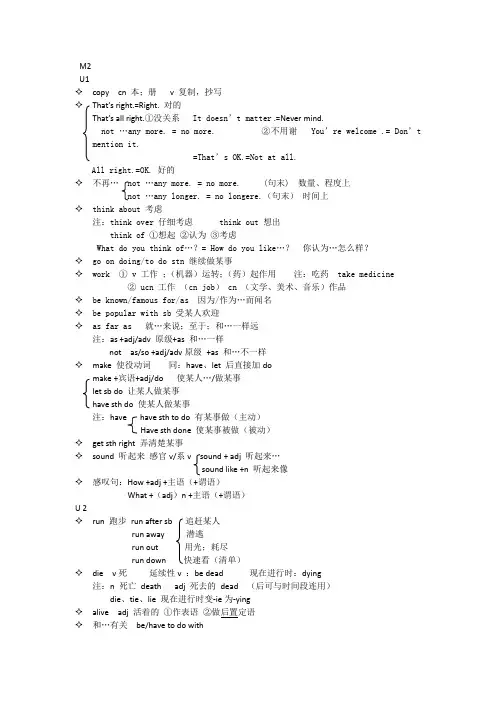
M2U1✧copy cn 本;册v 复制,抄写✧That’s right.=Right. 对的That’s all right.①没关系 It doesn’t matter .=Never mind.not …any more. = no more.②不用谢 You’re welcome .= Don’t mention it.=That’s OK.=Not at all.All right.=OK. 好的✧不再… not …any more. = no more. (句末) 数量、程度上not …any longer. = no longere.(句末)时间上✧think about 考虑注:think over 仔细考虑 think out 想出think of ①想起②认为③考虑What do you think of…?= How do you like…?你认为…怎么样?✧go on doing/to do stn 继续做某事✧work ① v 工作;(机器)运转;(药)起作用注:吃药 take medicine② ucn 工作(cn job) cn (文学、美术、音乐)作品✧be known/famous for/as 因为/作为…而闻名✧be popular with sb 受某人欢迎✧as far as 就…来说;至于;和…一样远注:as +adj/adv 原级+as 和…一样not as/so +adj/adv原级+as 和…不一样✧make 使役动词同:have、let 后直接加domake +宾语+adj/do 使某人…/做某事let sb do 让某人做某事have sth do 使某人做某事注:have have sth to do 有某事做(主动)Have sth done 使某事被做(被动)✧get sth right 弄清楚某事✧sound 听起来感官v/系v 听起来…sound like +n 听起来像✧感叹句:How +adj +主语(+谓语)What +(adj)n +主语(+谓语)U 2✧run 跑步run after sb 追赶某人run away 潜逃run out 用光;耗尽run down 快速看(清单)✧die v死延续性v :be dead 现在进行时:dying注:n 死亡death adj 死去的dead (后可与时间段连用)die、tie、lie 现在进行时变-ie为-ying✧alive adj 活着的①作表语②做后置定语✧和…有关be/have to do with和某人/某事无关have nothing to do withsb/sth=be not to do with sb/sth✧grow up ①长大②逐渐形成✧surprised adj 令人惊奇的be surprised to do sth 做某事出人意料be surprised at sb/sth 对某人/某物感到惊讶to one’s surprise (句首)出人意料的是surprise n ﹠vin surprise (句末)出人意料地by surpise 出其不意地✧pleased adj 令人高兴的be pleased to do 高兴去做某事be pleased with sb/sth 为某人/某事感到满意注:pleasant adj 令人高兴的(物本身,主动讨人喜欢)作定语pleasure n 愉快的事(It’s)my pleasure. 我的荣幸(回答感谢,同不用谢)With pleasure. 很荣幸;好的,乐意效劳。
外研版九年级m2知识点讲解
外研版九年级m2知识点讲解第一节:语法知识点我们首先来讲一讲外研版九年级M2中的一些重要语法知识点。
在这个单元中,我们将涉及到宾语从句、名词性从句和定语从句这几个重要的语法点。
1. 宾语从句宾语从句是一个句子作为宾语出现在主句中,它通常由连接词that, if, whether, who, whom, whose, which, when, where, why等引导。
例如:He said that he would come to the party.(他说他会来参加派对。
)在这个例句中,that引导的从句“He would come to the party”作为动词said的宾语。
2. 名词性从句名词性从句是一个句子作为名词的一部分,可以在句子中充当主语、宾语、表语或者同位语。
例如:What the teacher said is very important.(老师说的话很重要。
)在这个例句中,名词性从句“What the teacher said”作为整个句子的主语。
3. 定语从句定语从句是一个句子用来修饰一个名词或代词的从句。
它通常由关系词that, who, whom, whose, which等引导。
例如:I know the girl who is playing the piano.(我认识正在弹钢琴的那个女孩。
)在这个例句中,定语从句“who is playing the piano”修饰名词girl。
第二节:阅读技巧与训练除了语法知识点外,阅读技巧也是外研版九年级M2中的重要内容。
在这个单元中,我们将学习如何提高阅读理解的能力,并且训练一些相关的技巧。
1. 主旨归纳主旨归纳是指通过阅读理解文章,提取出文章的核心思想。
在做阅读理解题时,我们可以通过关注文章的首尾段落和标题,以及对文章的整体把握,来归纳出文章的主旨。
2. 推理判断推理判断是指通过文章中的信息和语境来进行推理,并做出正确的判断。
九年级英语上册外研版知识点M2

九年级英语上册外研版知识点M2 M2单元主要介绍了英语中动词的时态,包括一般现在时、一般过去时、一般将来时和现在进行时。
掌握这些时态对于我们准确表达出过去、现在和未来的意思非常重要。
下面我们将分开来详细介绍这几个时态。
一、一般现在时一般现在时用来表示经常性或习惯性的动作或状态,它的构成非常简单,即主语+动词原形。
例如:I eat breakfast at 7 o'clock every morning.另外,一般现在时还可以表示客观真理、科学原理、宗教信仰等普遍存在的情况。
例如:The sun rises in the east.二、一般过去时一般过去时用来表示过去某个时间发生的动作或存在的状态,它的构成是主语+动词过去式。
例如:I watched a movie last night.需要注意的是,有一些不规则动词的过去式形式与原形不同,需要记住这些不规则动词的过去式形式。
例如:go-went, eat-ate等。
三、一般将来时一般将来时用来表示将来发生的动作或存在的状态,它的构成是主语+将来时助动词will+动词原形。
例如:I will visit my grandparents tomorrow.但是需要注意的是,有些含有一定情态动词含义的词会和will 构成一个新的词组,作为一般将来时的助动词。
例如:can-will be able to, shall-will等。
另外,我们还可以通过其他方式表达将来的时间,例如使用be going to, be to等。
例如:I am going to play basketball this afternoon.四、现在进行时现在进行时用来表示现在正在进行的动作,它的构成是主语+be动词(am, is, are)+动词-ing形式。
例如:He is studying in the library now.需要注意的是,有些动词在进行时态中有特殊形式的变化。
九年级英语上册Module2知识点总结(外研版)
九年级英语上册Module2知识点总结(外研版)单词与短语•festival:节日•celebrate:庆祝•it is celebrated in order to…:它被庆祝是为了…•dress up as…:扮成…•fancy dress:化装舞会服装•mask:面具•pumpkin:南瓜•ghost:鬼魂•witch:女巫•vampire:吸血鬼•monster:怪物•trick or treat:不给糖就捣蛋•lantern:灯笼•bonfire:篝火•fireworks:烟花句型与语法定义与用途1.be celebrated:被庆祝2.It is celebrated in order to…:它被庆祝是为了…3.I dress up as…:我扮成…4.There is/are…:有…5.How do people celebrate…?:人们如何庆祝…?6.What do you wear on…?:你在…时穿什么?7.We usually…:我们通常…8.have a bonfire:篝火晚会9.set off fireworks:放烟花例句与示例1.Christmas is celebrated on December 25th.(圣诞节在12月25日庆祝。
)2.It is celebrated in order to commemorate the birth of Jesus Christ.(它被庆祝是为了纪念耶稣基督的诞生。
)3.On Halloween, I dress up as a ghost.(在万圣节,我扮成鬼。
)4.There are many lanterns during the Lantern Festival.(元宵节期间有很多灯笼。
)5.How do people celebrate the Mid-Autumn Festival?(人们如何庆祝中秋节?)6.What do you wear on New Year’s Eve?(你在除夕夜穿什么?)7.We usually have a bonfire and watch fireworks on Guy Fawkes Night.(在盖伊·福克斯之夜,我们通常有篝火晚会和观看烟花。
九上外研英语m2重点单词短语

九上外研英语m2重点单词短语Unit 1: Happy New Year!1. celebrate (v.) - to mark a special occasion or event with enjoyable activitiesExample: We always celebrate New Year's Eve with fireworks and a big feast. 2. resolution (n.) - a firm decision to do or not to do somethingExample: My New Year's resolution is to exercise more and eat healthier.3. festival (n.) - a special time or event when people celebrate something Example: The Lunar New Year is a festival celebrated by many Asian countries.4. parade (n.) - a public procession, often celebrating a special event Example: The streets were filled with people watching the colorful parade.5. tradition (n.) - a belief or behavior that has been passed down within a group or society for generationsExample: It is a tradition in our family to have a big Thanksgiving dinner together.6. gather (v.) - to come together as a group or in one placeExample: Let's gather everyone in the living room for a family meeting.7. firework (n.) - a device that produces a bright display of colored lights and loud noises, used especially for celebrationsExample: The fireworks lit up the sky on New Year's Eve.8. lantern (n.) - a small, usually round or oval, container with a handle anda hook for holding a candle or lightExample: During the Mid-Autumn Festival, children carry lanterns while walking in the park.9. reunion (n.) - an occasion when people who have not seen each other for a long time meet againExample: Our high school reunion was a great opportunity to catch up with old friends.10. decorate (v.) - to make something look more attractive by adding ornaments or embellishmentsExample: We decorated the Christmas tree with colorful lights and ornaments.Unit 2: Do you remember...?1. memory (n.) - the faculty by which the mind stores and remembers information or experiencesExample: My earliest memory is of playing in the park with my grandparents. 2. event (n.) - something that happens, especially something important or notableExample: The Olympic Games are a major sporting event held every four years.3. childhood (n.) - the period of time when someone is a childExample: I have many fond memories of my childhood spent with my siblings.4. experience (n.) - something that happens to someone, or something that someone does or feelsExample: Traveling to a foreign country was an amazing experience for me.5. grow up (v.) - to become an adult or matureExample: I want to be a teacher when I grow up.6. enjoy (v.) - to find pleasure or satisfaction in somethingExample: I really enjoy reading books in my free time.7. happiness (n.) - the state of feeling or showing pleasure or contentment Example: The birth of their baby brought great happiness to the couple.8. sad (adj.) - feeling or showing sorrow; unhappyExample: I feel sad when I see people fighting or arguing.9. laugh (v.) - to make the sounds and movements of your face that show you think something is funnyExample: The comedian's jokes made everyone laugh during the show.10. remember (v.) - to have or keep an idea, image, or thought of something or someone in your mindExample: I will always remember the time we spent together at the beach.Unit 3: What were you doing...?1. past (adj.) - gone by in time and no longer existing or happening Example: The past year has been a challenging one for all of us.2. present (adj.) - happening or existing now; not past or futureExample: I am currently studying at university, so my present focus is on my education.3. future (n.) - the time or a period of time following the presentExample: I hope to travel around the world in the future.4. yesterday (adv.) - on the day before todayExample: We went to the park yesterday and had a picnic.5. earlier (adj.) - happening or done before this time or that you were born or came into existence before someone or something elseExample: I woke up earlier than usual today to go for a run.6. during (prep.) - throughout the course or duration of a particular event or timeExample: I read a book during my lunch break.7. while (conj.) - during the same time; at the same timeExample: While I was studying, my sister was playing the piano.8. suddenly (adv.) - quickly and unexpectedlyExample: It started raining suddenly, so we had to run for cover.9. continue (v.) - to keep happening, existing, or doing something withoutstoppingExample: The rain continued throughout the night, causing flooding in some areas.10. just (adv.) - a very short time agoExample: I just finished cooking dinner, so it should be ready to eat.Unit 4: How was your school trip?1. excited (adj.) - feeling or showing happiness and enthusiasmExample: I'm really excited about going on vacation next week!2. choose (v.) - to decide which thing or person to have or do from several possibilitiesExample: I can't decide which dress to choose for the party tonight.3. order (v.) - to request the delivery or preparation of food, goods, or servicesExample: Let's order a pizza for dinner tonight.4. normal (adj.) - conforming to a standard, usual, or typical pattern or behaviorExample: It's not normal to stay up all night and sleep during the day.5. visit (v.) - to go to a place in order to see and talk to someone Example: I'm planning to visit my grandparents this weekend.6. amazing (adj.) - causing great surprise or wonder; astonishingExample: The view from the top of the mountain was absolutely amazing.7. performance (n.) - an act of presenting a play, concert, or other form of entertainmentExample: We went to see a ballet performance at the theater.8. delicious (adj.) - very pleasant to taste or smell; highly enjoyable Example: This cake is so delicious! Can I have another slice?9. strange (adj.) - unusual or surprising; difficult to understand or explain Example: There was a strange noise coming from the attic last night.10. accident (n.) - an unfortunate incident that happens unexpectedly and unintentionallyExample: I had a car accident on my way to work this morning.Unit 5: Do you want to watch a game show?1. game show (n.) - a television program featuring games or competitions between individuals or teamsExample: My favorite game show is "Who Wants to Be a Millionaire?"2. channel (n.) - a television station and its programsExample: There are many channels to choose from on our cable TV.3. soap opera (n.) - a television or radio drama series dealing typically with daily events in the lives of the same group of charactersExample: My mom loves watching soap operas in the evening.4. documentary (n.) - a factual film or television program about a particular subjectExample: We watched a documentary about wildlife conservation last night.5. sitcom (n.) - a situation comedy; a light-hearted television or radio genre Example: Friends is a popular sitcom that aired for ten seasons.6. news (n.) - reported information about recent eventsExample: I watch the news every evening to stay informed about current events.7. weather forecast (n.) - a prediction of what the weather will be like in the near futureExample: The weather forecast says it will rain tomorrow, so don't forget your umbrella.8. reality show (n.) - a type of television program in which ordinary people are continuously filmed, designed to entertain rather than informExample: The reality show "Survivor" puts contestants in challengingsituations to see who can outlast the others.9. episode (n.) - one of a number of separate installments into which a series is dividedExample: I missed the latest episode of my favorite TV show, so I will catch up online.10. commercial (n.) - a short advertisement on television, radio, or online promoting a product or serviceExample: The commercial break during the movie gave us a chance to grab some snacks.Unit 6: How long have you been collecting?1. collect (v.) - to bring together a group of similar things as a hobby orfor study or displayExample: I collect stamps from different countries.2. stamp (n.) - a small piece of paper with a design on it that is stuck onto an envelope to mark that something has been paid for, signed, or sent Example: He put a stamp on the envelope and dropped it in the mailbox.3. coin (n.) - a flat, typically round piece of metal issued by a government as moneyExample: My grandfather gave me a rare coin from his collection.4. postcard (n.) - a card for sending a message by mail without an envelope, typically having a photograph or other illustration on one sideExample: When I travel, I usually send postcards to my friends and family.5. toy (n.) - an object for a child to play with, typically a model or miniature representation of somethingExample: He has a collection of vintage toys from the 1980s.6. record (n.) - a thin plastic disc carrying recorded sound in grooves, or a digital representation of this, used as a medium for reproductionExample: Vinyl records are making a comeback among music enthusiasts.7. autograph (n.) - a signature, especially that of a famous personExample: I got the actress's autograph when I met her at the movie premiere.8. poster (n.) - a large printed picture used for decorationExample: I have a poster of my favorite band hanging on my bedroom wall.9. magazine (n.) - a periodical publication containing articles and illustrations, typically covering a particular subject or area of interest Example: I subscribed to a fashion magazine to keep up with the latest trends.10. album (n.) - a collection of recordings issued as a single item on CD, record, or another mediumExample: I have a photo album with all my favorite pictures from my travels.。
九年级英语上册Module2知识点总结(外研版)
九年级英语上册Module2知识点总结(外研版)九班级英语上册module2学问点总结module 2 unit 1学问点1. 怎么了?发生了什么?what’s up? =what happened to sb?=what’s wrong with sb? =what’s the matter with sb?2. look for 查找,强调找的动作;find找到,发觉,强调找的结果find out查找,指经过观看、探究、查询而弄清晰状况或发觉某物discover 发觉,发觉,发觉早已存在(还未被发觉)的东西invent 创造,指创造制造以前没有的东西。
i was looking for my book at that time and at last, i found it. we must find out the truth. columbus discovered america.edison is an inventor, he invented a number of inventions.3. get sth right 正确理解某事4. as far as 就…来说 as far as i know/remember 据我所知/记得5. not …any more = no more 不再…we don’t have a magazine any more. =we have magazine no more. 6. think of 想到,想起,认为 think about 仔细考虑(方案等是否可行)what do you think of the book? = what’s your opini on of the book?i will think about your suggestion. 写日记keep a diary7. 连续做另一件事go on/continue to do 连续做原来的事go on/continue doing8. daily 每日一次的 weekly 每周一次的 monthly 每月一次的 yearly 每年一次的9. 数百万的millions of ;hundred, thousand, million, billion 前面有详细数字用单数,与of连用用复数 100 million ;4321 billion ;thousands of works10.例如: for example 后举一个例子 such as 后至少两个例子11. 以/因…而闻名 be known/ famous for; 作为…而闻名 be known/ famous ashangzhou is known for west lake. lao she is known as a great writer.12. in fact= actually 事实上,实际上13. make 做,制作;使成为 what makes a great writer?什么成就一名宏大的作家?14. agree with sb 同意某人或某人的话;与…全都 agree to do 同意做某事拒绝做某事refuse to do 方案做某事plan to do 想要做某事would like to do15.run away 逃跑 put away 把…收好/放好 throw away 扔掉,铺张give away 分发,泄露go away 走开 send away 解雇 far away from 远离…;离… 远 take away 拿走16. 看起来像 look like 听起来像 look like 好像,似乎 as if 即使even though17. work 工作(不行数);作品(可数且常用复数名著 great wooks)18. 迷路get lost ;be lost his son got lost yesterday.19. 后缀--ed 形容词,通常用来形容人interested;excited, pleased, surprised, worried;后缀—ing形容词,通常用来形容事物interesting, exciting, pleasing, surprising, worryingbe interested in sth;be excited at/about/by; be pleased with/ to do; be surprised at/ to do共3页,当前第1页123。
新外研版九年级上册M2知识点整理PPT课件
Unit 1 My family always go somewhere interesting as soon as the holidays
begins
Module 2 Unit 1 知识点
1.什么时候用when,什么时候用while? (1).主句:短暂动作 + when/while +从句:持续动作
7. plenty of = lots of 大量的 (用于修饰可数名 词复数或不可数名词)
There are plenty of places to visit in Beijing. 北京有很多可以参观的地方。
8. We have celebrated the festival since the
He fell asleep when /while he was reading.
I met him when /while I was taking a walk in the park. (2).主句:持续动作 + while +从句:持续动作 (同时进
行),且主句动作延续到从句所指的整个时间
就一直是朋友。
9. The following year they celebrated together by eating a dinner of the new food.
第二年他们聚在一起品尝新收获的食物,一起
欢庆(丰收)。 by eating a dinner of the new food 在句中作状语,
My mother asked me to lay the table for dinner. 拓展:(1) lay还可表示“下蛋;产卵”
(lay—laid—laid) (2) lay 还是lie(撒谎)的过去式
初三英语上册(外研版)Module 2 Public holidays 知识点总结
初三英语上册(外研版)Module 2 Public holidays知识点总结一、重点词汇1st October, 1949·原文再现The People’s Republic of China was founded on 1st October 1949.中华人民共和国是在1949年10月1日成立的。
·基本用法这是英式英语日期的表达法。
在英语中常用基数词表示“年份”,“日”常用序数词读出,前面用定冠词the。
“年、月、日”的表达顺序美式英语和英式英语有区别,美式英语中,通常为“月、日、年”,英式英语中,通常为“日、月、年”。
表达“……世纪……年代”时,在表示年份的阿拉伯数字后加-s或-’s。
have…off·原文再现It’s a public holiday, but we only have one day off.它是一个公共假日,但是我们只休息一天。
·基本用法have…off 表示“休息,不上班”,休息的时间长短通常放在have和off之间。
如:We usually have three days off on National Day.在国庆节我们通常休息三天。
have fun·原文再现Kids have great fun.孩子们玩得都很高兴。
·基本用法have fun 意为“过得愉快;玩得高兴”。
它相当于enjoy oneself和have a good time。
如:We had a lot of fun in the park yesterday.昨天我们在公园里玩得很开心。
—We’re going to take a vacation in Hainan this year.今年我们将在海南度假。
—Have fun!祝你们玩得愉快!·知识拓展--相关句型/结构have fun in doing sth. 做某事很愉快。
外研版英语九年级上册Module2单元知识点归纳总结(详细版)
外研版英语九年级上册Module2单元知识点归纳总结(详细版)Module2 Public holidaysUnit1 My family always go somewhere interesting as soon as the holiday begins.1.The People’s Republic of China (简写为PRC) was founded (一般过去式的被动语态) on 1st October, 1949.find–found--found找到found—founded--founded建立, 创立类似的:lie- lay- lain 躺(现在分词l y ing)lie- lied- lied 撒谎lay- laid- laid 下蛋;铺设,摆设(三单lays 现在分词laying)1)I lay on the floor with my legs in the air.我躺在地上,双腿抬起。
2)Don’t believe him. He’s lying.3)My hen lays an egg a day.4)They laid him on the floor. 他们把他放在地上。
lay the table 摆放餐具2.People have celebrated the National Day since then. (since then从那以后, 是现在完成时的标志)eg: He went to Beijing in 1999. He has lived there since then.celebrate vt.eg:We held a party to celebrate our success.我们举行宴会庆祝我们的成功。
celebrate… with…用…来庆祝have a celebrat ion n.3. have…off 休息多少时间eg:I’m going to have some time off.I was off duty yesterday. 昨天我不值班。