
牛津深圳版八年级英语下册Unit 2 Body Language Grammar (共20张PPT)
• Simon tried smiling at people.
object
We often use gerunds after these verbs. consider finish enjoy(like,love) keep admit mind imagine suggest practise
动名词做句子主语时,谓语动词使用单数形式。
In pairs, ask and answer questions about the pictures. Follow the example.
S1: What can shaking your closed hand show? S2: Shaking your closed hand can show that you’re angry.
In pairs, ask and answer questions about the pictures. Follow the example.
S1: What does the boy enjoy?
S1: What is the girl practising?
S2: He enjoys reading books.
add -ing
drop the –ie and add -ying
-ing
Gerunds as subjects
• Smiling shows that you are happy. • Ballet training usually starts at an early age. • Dancing is her favourite hobby. subject
We often use gerunds after prepositions.
Debbie is good at communicating with people. I am looking forward to going to Beijing.
We often use gerunds after these phrases.
be fond of be good at be interested in be tired of be used to give up keep on look forward to think of
Complete the sentences using the verbs in the box in the -ing form.
S2: She is practising climbing mountains.
S1: What is the girl good at?
S1: What is the girl interested in?
S2: She is good at skiing.
S2: She is interested in playing chess.
S1: What can resting your head on your hand show? S2: Resting your head on your hand can show that you’re bored.
S1: What can sighing show? S2: Sighing can show that you’re sad.
4. ________ is fun.
We form gerunds from verbs. begin communicate dance hold sigh lie beginning communicating dancing holding sighing lying
double the final consonant and add -ing drop the –e and add -ing
S1: What can closing your eyes show? S2: Closing your eyes can show that you’re thinking.
动名词的用法总结
▲ 动名词作主语时,谓语用单数:
如:Communicating ___ not just speaking.
Oxford English
Unit Module 1 Social communication
2
Body language
Period 3
Gerunds
• Communicating is more than just speaking. • He tried smiling at people.
动名词可作主语、宾语以及 表语等句子成分
Look at the pictures and complete the sentences with gerunds.1. 来自 like_______.
2. ______ damages your health.
3. ______ builds your imagination.
breathe do hear organize smoke take use walk
1 2 3 4 5 6 7
She is tired of ________ the dirty air in the city centre. She keeps on ________ to school instead of _________ a bus. He finally gave up ________. She is used to ________ a handkerchief instead of a tissue. She was interested in ________ the puzzle. She looks forward to ________ from her new e-friend. She is good at __________ party activities.
交流不仅仅是说话。
▲ 两个或两个以上不同的动名词作主语,谓语用 复
数。
如:Playing computer games and playing basketball ___ my hobbies. 打游戏和打篮球是我的兴趣爱好。
Gerunds as objects
• Debbie enjoys smiling and always looks friendly.
牛津深圳版八年级英语下册《Unit 2 Body language》教

教案1课题Unit2 Body language 课型NEW WORDS备课时间1 period教材分析教学目标1.Students can master how to pronounce the new wordsand master the meanings of the words .2.Students can use the new words to make newsentences.3.Train the students ability of cooperation教学重点The pronunciation and the usages of the new words : communication ,accept, meaning , message, bored, part-time, well-dressed, expression,matter, towards, hold, remind, cross, sure教学难点gesture, expression, appearance, impression, towards, shake,教学关键Let all the students can read the words and know the meaning ofthe new words教法与学法指导Use some pictures and games and PPT教学环节主要教学步骤或内容学生主体活动教师活动设计意图时间分配第一环节复习回顾平移的基本性质,引入课题Step one: Warming up.Freely talk: What do you knowabout body language?Talk about the bodylanguage.1.Show somepictures of thegestures whichare used in thebody languages1.To arousethe interest andlead them toget into thewords of the newwords5第二环节观察操作、探索归纳平移的作法Step two: New words.Read the new words.2. Read after the tapeand pay attention tothe pronunciation ofthe new words:communication , accept,meaning , message,bored, part-time,well-dressed, expression,matter, towards, hold,remind, cross, sure2.Play theMP3 of the newwords for themand lead them toread in a properway.2.Let thestudents readsthe wordscorrectly.20Step three: Game time.Guess what it isStep four: Key words learning.Step five: have a competition 3.Play the game:Choose a number in anumber table andanswer the relatedquestions like : Tellthe Chinese meaning ofthe words , or Spellout the words ,or makea sentence with thewords4. Work in groups tolearn the usage of thekey word:5. let five studentsas a group and come tothe blackboard towrite down the wordswhich are speak out bythe other one student3 Prepare anumber game, andshow it on pptand givedifferentgroups marksaccording to thequestions theyanswer.4.Show the PPTof the meaningof the key wordsand let ss makemore sentenceswith the newwords5. check the wordsand give themmarks for thegroups3.To make themget familiarwith thepronunciationand the spellingof the newwords.4. Train thestudents’ability tocooperate. Letthe students indifferentleaves can takepart in theactivity.5.Provie thechances tostudents to showthemselves andpractice thespeakingability.第三环节课堂练习Step six: exercise6. Finish theexercise given onthe sheet, likeusing the correctforms of the words tofill in the blanks:_____________(communicate) is veryimportant in our dailylife.6. Correct themistakes in thestudents’exercise.6. To check theStudents ’learning situation .10第四环节课时小结step SevenHow many words do youmaster?Write them down in yoursheet7. Remember the wordsyou learn and spellthem out7. Give them apiece of paperto write thewords.7. To developthe students’ability of self–checking.5第五环节课后作业1.Dictatione the new words tomake sentences onyour own or checkthem in adictionaryRead after the tapeand then use thephonetic symbols toremember the words3. make sentences1.Dictation2.correct themistakesStrengthen theremembering ofthe words andsee if they canuse the wordscorrectly课堂教学流程Read the new words--- Games and remember the new words ---- learn the usages of the new words -----Exercise----check how they master the new words.效果评价与反思。
牛津深圳版八年级英语下册《Unit 2 Body language》教案:Grammar
教案5课题Unit2 Body language 课型Grammar备课时间1 period教材分析教学目标 1. Master the usage of gerunds as objects and subjects 教学重点enjoy doing , imagine doing , practice doing , finishdoing , mind doing , like doing , be good at doing , beinterested in doing教学难点be good at doing , be interested in doing sth教学关键Make it clear about the gerunds as subjects教法与学法指导Cooperating, Self-study教学环节主要教学步骤或内容学生主体活动教师活动设计意图时间分配第一环节复习回顾平移的基本性质,引入课题StepⅠ:Free talk 1. What is yourhobby in your freetime?1. List outthe sentenceswith gerundslike : Myhobby isplaying basketball.1. To arousethestudents’interest inlearningaboutgerunds.5第二环节观察StepⅡ: learn aboutgerunds as subjects2. Make a simpledialogue accordingto the pictures byusing gerunds assubjects2. Write downthe sentenceslike :Shaking yourclosed handscan show that2.Master theusage ofgerunds assubjects .15操作、探索归纳平移的作法StepⅢ: learn about thegerunds as objects 3.Remember someverbs which usegerunds as theirobjects like :enjoy , finish ,practice, start ,hate, imagine ,mindThen make a simpledialogue accordingto the picturesyou areangry.3. sum up therules and letstudents makemoresentences byusing gerundsas objects3.know moreabout theusage of thegerunds asobjects第三环节课堂练习Step Step V: morepractice5.finish theexercise given byteacher andpractice the usageof gerunds5. hand outthe sheetsand letstudentsfinish theexercise init5.Toconsolidatewhat theyhave learnedin this class10第四环节课时小结StepⅥ:Sum up 6. Go over therules of thegerunds assubjects andobjects6. Show a pptto guide thestudents togive sum upof the class6.To makestudents havea good habitof takingnotes andhave ageneralunderstandingof this class5第五环节课后作业Finish the exercise in the English paper.。
牛津深圳版英语八下 Unit2 Body language

Unit2 Body languageReading1 练习一、单词填空。
1.He is clever. He learned a foreign ________ (语言)by himself.2. ________ (女士) and gentlemen, welcome to the party.3.We can often see some ________ (衣着人时的) ladies at the airport.nguage is a main way of _______(交际).5. You should _______(提醒) him to turn off the lights when he goes out.6.To make more money, he found a p_______ job in his free time.7.A few moments l_______, the girl went away with a smile.8.You look sad. What’s the m_______?9.We should not judge a person by his _______ (外貌).10.She spends her time watching TV i_______ of studying.二、单选。
1. --- Why do you look so sad and_______ again and again?--- I lost my ______ job just now.A. laugh; part-timeB. sigh; hard-workingC. sigh; part-timeD. laugh; hard-working2. I think basketball is _______. I like to watch it.A. boringB. boredC. excitingD. excited3. The nice weather made me ____ comfortable.A. feelB. feelingC. to feelD. felt4. Can you tell me how to make a good ______on someone?A. communicationB. appearanceC. expressionD. impression5.Let me try ____ the door with this key.A. openB. to openC. openedD. opening6.The photo reminds me ____ the old days.A. fromB. toC. thatD. of7.You don’t look ____. You’d better go to see a doctor.。
八年级英语下册 Unit 2 Body language课件 (新版)牛津深圳版

Name Simon Deis head on his hand. 2. doesn’t look up.
glance at 匆匆一看
Without hesitation, she went to Simon and gave him a big smile.
Translation 1. 她毫不犹豫地同意
了. 2. 你有问题就直截了
当地告诉我们。
sigh 叹气 v. / n.
‘How can I lose my weight?’, he sighed. Miss Cat left with a sigh.
his face that made the difference. The way he looked at
people did not give them a good i_m__p_r_e_s_s_i_o_n. His body
language told them to go away. In parison, Debbie was
Find the answer by looking for the key words
well-dressed 穿着讲究的adj. • People are well-dressed at
the wedding.
I have not enough time to read the whole newspaper, so I just glance at the titles.
Poor guy!
Listen to the tape, then try to fill in the blanks.
Debbie and Simon have part-time jobs at a travel agency.
Unit2+Grammar课件2023-2034学年牛津深圳版英语八年级下册

While learning
1. Gerunds as subjects
We can use a gerund as the subject of a sentence. • Smiling shows that you are happy.
subject • Ballet training usually starts at an early age.
• Dancing is her favourite hobby.
Attention
打游戏和打篮球是我的兴趣爱好。
Playing computer games and playing basketball _a_r_e_ my hobbies.
and tries __sm__i_li_n_g_ at people. Gerunds动名词
Pre-learning
What is gerunds?
•Communicating is more than just speaking. • He tried smiling at people.
Gerunds are nouns ending in -ing. These nouns refer to actions and activities.
Forming rules
Verbs hold sigh dance communicate begin lie
How can we form gerunds?
Gerunds
直接加-ing
holding
sighing dancing
去e加-ing
communicating
牛津深圳版八年级下册 Unit2Body language单元语法全解-动名词的用法
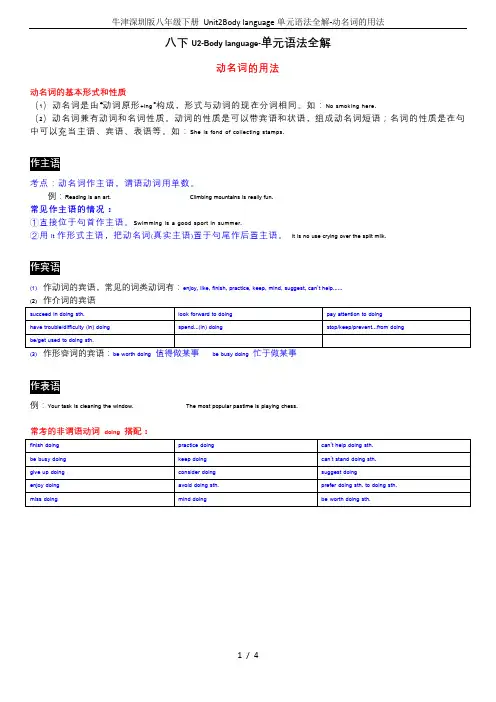
八下U2-Body language-单元语法全解动名词的用法动名词的基本形式和性质(1)动名词是由“动词原形+ing”构成,形式与动词的现在分词相同。
如:No smoking here.(2)动名词兼有动词和名词性质。
动词的性质是可以带宾语和状语,组成动名词短语;名词的性质是在句中可以充当主语、宾语、表语等。
如:She is fond of collecting stamps.考点:动名词作主语,谓语动词用单数。
例:Reading is an art. Climbing mountains is really fun.常见作主语的情况:①直接位于句首作主语。
Swimming is a good sport in summer.②用it作形式主语,把动名词(真实主语)置于句尾作后置主语。
It is no use crying over the spilt milk.(1)作动词的宾语,常见的词类动词有:enjoy, like, finish, practice, keep, mind, suggest, can’t help......作表语例:Your task is cleaning the window. The most popular pastime is playing chess.动名词专项习题一:单项选择( ) 1. --- Dear, do you mind __________? I really feel cold. --- Of course not.A. to stop to close the windowB. stopping to close the windowC. to stop closing the windowD. stopping closing the window ( ) 2. Reading stories and magazines __________Linda’s favorite hobby.A. areB. isC. wereD. being( ) 3. I’m sleepy. I prefer _________ at home to _________out to play basketball.A. sleeping; goingB. sleeping; goC. sleep; goingD. sleep; go( ) 4. _________ is bad for our health. You should stop_________.A. Smoke; smokingB. Smoking; smokingC. Smoke; to smokeD. Smoking; to smoke ( ) 5. You should avoid ___________ the same mistake again and again.A. makeB. to makeC. makingD. to making ( ) 6. --- Remember ___________ the door before ___________. --- OK, I will.A. to lock; leaveB. locking; leavingC. locking; leaveD. to lock; leaving ( ) 7. --- How about ___________ running tomorrow? --- I don’t feel like ___________.A. going; runB. go; runningC. going; runningD. go; run( ) 8. Watching movies of different countries always __________ me excited.A. makingB. makeC. makesD. will make ( ) 9. --- I suggest __________ climbing this Saturday. --- Why not __________ on Sunday?It’s sunny.A. going; goingB. go; goC. to go; goingD. going; go ( ) 10. --- Making too much eye contact is impolite. --- __________ eye contact is not polite, __________.A. Not to make; tooB. Not to making; eitherC. Not making; eitherD. Not making; too( ) 11.As my mother is looking forward to____from me,please remember____the letter on your way to company. A. hearing; posting B. hear; to post C. hearing; to post D. hear; posting ( ) 12. __________ an astronaut is difficult, but it is very exciting __________ into space.A. Becoming; travellingB. Becoming; to travelC. To become; travelD. Become; to travel ( ) 13. One learns a language by making mistakes and ______ them.A. correctsB. correctC. to correctD. correcting ( ) 14. Everyone is looking forward to ___ a good time after the exam. So they are busy preparing for the exam. A. to have B. have C. having D. to having ( ) 15. Maggie is fond of ______ pop songs from the Internet because it’s convenient.A. downloadB. to downloadC. to downloadingD. downloading ( ) 16. --Did you talk back to your mother when you were a kid?--Yes. But now I realize I was wrong. I really regret ______ that silly thing to my mom.A. doB. to doC. doingD. did( ) 17. --What kind of movies do you like better, science fiction movies or comedies? --I prefer _____ comedies. A. watches B. watching C. watched D. watch( ) 18. --Make sure you turn off the lights and the computer, Mike?--Come on, mom. You don’t need to keep ______ me of it.A. remindB. to remindC. remindedD. reminding二.语法选择When my husband and I had just moved to China, we went to dinner at a Peking Duck Restaurant. Both of us __1__ this restaurant because of its delicious food.Waiters who were friendly to us said hello __2__ a smile. Traditional pictures were put up on the wall. __3__ beautiful restaurant! I felt happy and chose a quiet corner to sit.My husband __4__ a jacket and I had a coat and we hung them on the back of our chairs when we sat down to eat. We were quite __5__ when the waitress took a cloth sack(布套) and pulled it over the backs of our chairs and __6__ the jacket and the coat completely.As we ate in more restaurants, we saw that many restaurants did this, __7__. And then we realized why they did this. Firstly, Chinese food __8__many soups, sauces, teas and so on. These might __9__ stain the clothing if the food was thrown by the waiter. Besides, many Chinese restaurants allowed people __10__, so the sack also helped keep the smell of the cigarettes __11__ from the coats and jackets.__12__ good thing is that the cloth sack can also cover a bag. When I lived in New York, I had a terrible experience of __13__ my handbag stolen when I was eating at a restaurant. __14__ handbag was right on the back of my chair. __15__I’m really happy that bag will be safely protected here in China as I enjoy the meals. ( )1. A. likes B. like C. liked D. liking( )2. A. in B. by C. with D. use( )3. A. What B. How C. How a D. What a( )4. A. put on B. wearing C. had D. dressed as( )5. A. surprisingly B. surprising C. surprised D. surprise( )6. A. cover B. covered C. covering D. was covered( )7. A. too B. either C. also D. as well as( )8. A. including B. includes C. is including D. included( )9. A. easy B. easier C. easily D. most easily( )10. A. smoking B. to smoke C. smoke D. to smoking( )11. A. up B. away C. on D. out( )12. A. Other B. The other C. Another D. Others( )13. A. have B. having C. to have D. being had( )14. A. Her B. His C. The D. Its( )15. A. But B. So C. If D. Because拓展:used to do/be, be/get used to doing 和be used to do的区别②这把刀是用来切面包的。
牛津深圳版八年级下册Unit 2 Body language 词汇与句型讲解
广州牛津版八年级下册Unit 2词汇与句型讲解1. Where does the story take place? 故事发生在何地?take place 发生。
一般指非偶然事件的发生,即这种事件的发生有其原因或事先的安排。
除“发生”外,还常翻译为“进行;举行;开展”等。
如:The meeting will take place later this afternoon. 会议将于今天下午晚些时候举行。
The Olympic Games of 2008 took place in Beijing. 2008年奥运会在北京举行。
辨析:happen发生。
常用于偶然或突发性事件。
如:What happened to you? 你出了什么事?The accident happened near the school. 事故发生在学校附近。
注意:take place和happen都不用于被动语态。
2. communication n.交流;交际communicate v.交流,沟通communicate with sb. 表示“与某人交流/沟通/联络”communicate to sb. 表示“向某人报告/通知/传达”如:Communication skills can be improved through practice. 交流技巧可以通过练习提高。
We communicate with each other by e-mails. 我们用电子邮件彼此交流。
She communicated the news to her mother. 她把这条消息告诉了她妈妈。
3. accept v. 接受(建议、邀请等)可接名词或代词作宾语。
He accepted a present from his friend. 他接受了朋友的礼物。
区别:accept表示主动而且高兴地接受, receive表示收到,但不一定接受。
2022年牛津深圳版英语八下Unit 2《Body language》word重点内容整理
1:part-time job 兼职工作2:travel agency 旅行社3:be at work在工作4:look up抬头看;查阅5:glance at扫一眼6:stare at盯着看7:walk over to走到… 8:prefer…to宁愿…而不愿9:body language肢体语言10:get a chance to do sth. 得到时机做某事11:make a good impression on留下好的印象12:hold up抬头;耽误13:decide to do sth. 决定做某事14:smile at sb. 对某人微笑15:at once=right away 立刻,马上16:remind sb about/of sth提醒某人某事17. Think it over. 考虑18:agree with sb同意某人的意见19:work as+职业:做什么职业20:one another互相〔三者以上〕21:during the summer holidays22:instead of代替,而不是23:look down往下看,蔑视24. be angery with sb.【注意区别】1)what does she look like用来询问一个人的外貌长相是怎么样的,表达外貌时,描述特征时用主系表结构,人体局部描述的谓语用have/has连句子。
如---What does Jim look like吉姆长得怎么样?----He is very thin and tall. He has short hair.拓展---what is Lucy like 露西性格怎么样?〔what’s …like 人怎么样〕----She's very friendly. 她很友好。
2)That lady told him how to send it in the fastest and cheapest way.tell sb to do sth告诉某人去做某事。
八年级英语下册Unit2BodyLanguageWriting学案牛津深圳版
八年级英语下册Unit2BodyLanguageWriting学案牛津深圳版language课题内容Unit2 Body language Writing学习目标1认读和理解单词message和短语remind sb、 about sth。
2了解便条的基本格式和写法、3 根据已设定的情境,写简单的提醒式便条、学习重点根据已设定的情境,撰写提醒式便条。
学习难点根据已设定的情境,撰写不同类型的便条。
学法指导根据要求撰写便条,并能对其他同学的文章进行批改,学习到其他同学文章中的亮点并结合实际运用到自己的文章中。
一、预习案一、What do you know about “A shortmessage”?_______________________________________________ _________________________________________________________ _______________________________2、简单归纳书信格式与便条格式的异同、_________________________________________________________ _________________________________________________________ ________________________________列出疑惑:___________二、探究案探究点一:根据大家预习内容,总结便条的格式。
------------------------------------------------------------------------------------------------------------------------------------------------------------------------------------------------------------------------------------------------探究点二:学习撰写便条:1、阅读下面文章然后完成下表。
深圳牛津八年级下unit2-知识点归纳和练习
n. 手势
southern adj. 南方的
n. (书面或口头的 )信息,
消息
be
adj. 对某人、某事厌倦的 厌倦
boring adj. 无聊的, 令人厌倦的
adj . 兼职的
adj. 衣着入时的,穿着考究
的
n. 女士
n. 叹气,叹息
n.询问某人的情况怎么了
发生 坐起来,坐直 给 ….留印象 提醒某人某事
happen
三、句型
1. What body language are the boy and the girl showing? show: 显示 , 展示 show –showed –showed / shown
【拓展】 ① (v) 给 ….看,出示 . show sb sth = show sth to sb 给某人看某物 e.g.: Please show me your photo. = Please show your photo to me. 请给我看一看 你的照片。 ② (n) 演出,节目,展览会。 e.g.: The show starts at 7:30 p.m. 演出在晚上 7:30 开始。
What ’s the matter with … ? = What ’s wrong with ….?
n. 表情,神色
express v. 表达
n . 外貌,外表
appear v. 出现 disappear v. 消失
prep. 向,朝,对着
同义词: to
v. 使保持(在某位置)
adv. 以后,后来
八年级下册
Unit 2 Body language
词性及词义
词汇拓展
n. 语言