
2015年12月大学英语六级考试真题第三套(卷三)
2015年12月大学英语六级考试真题(三)Part I Writing(30 minutes) Directions:For this part, you are allowed 30 minutes to write a short essay based on the picture below. You should focus on the harm caused by misleading information online. You are required to write at least 150 words but no more than 200 words.I just feel unfortunate to live in a world withso much misleading information!注意:此部分试题请在答题卡1上作答。
Part ⅡListening Comprehension (30 minutes) Section ADirections:In this section, you will hear 8 short conversations and 2 long conversations. At the end of each conversation, one or more questions will be asked about what was said. Both the conversation and the questions will be spoken only once. After each question there will be a pause. During the pause, you must read the four choices marked A), B),C)and D), and decide which is the best answer. Then mark the corresponding letter on Answer Sheet 1 with a single line through the centre.注意:此部分试题请在答题卡1上作答。
1.A) She has completely recovered. C) She is still in a critical condition.B)She went into shock after an operation. D) She is getting much better.2. A) Ordering a breakfast. C) Buying a train ticket.B)Booking a hotel room. D) Fixing a compartment.3. A) Most borrowers never returned the books to her.B)The man is the only one who brought her book back.C)She never expected anyone to return the books to her.D)Most of the books she lent out came back without jackets.4. A) She left her work early to get some bargains last Saturday.B)She attended the supermarket’s grand opening ceremony.C)She drove a full hour before finding a parking space.D)She failed to get into the supermarket last Saturday.5. A) He is bothered by the pain in his neck. C) He cannot afford to have a coffee break.B)He cannot do his report without a computer. D) He feels sorry to have missed the report.6. A) Only top art students can show their works in the gallery.B)The gallery space is big enough for the man’s paintings.C)The woman would like to help with the exhibition layout.D) The man is uncertain how his art works will be received.7. A) The woman needs a temporary replacement for her assistant.B)The man works in the same department as the woman does.C)The woman will have to stay in hospital for a few days.D)The man is capable of dealing with difficult people.8. A) It was better than the previous one. C) It exaggerated the city’s economic problems.B)It distorted the mayor’s speech.D) It reflected the opinions of most economists. Questions 9 to 12 are based on the conversation you have just heard.9. A) To inform him of a problem they face. C) To discuss the content of a project report.B)To request him to purchase control desks. D) To ask him to fix the dictating machine.10. A) They quote the best price in the market. C) They cannot deliver the steel sheets on time.B)They manufacture and sell office furniture. D) They cannot produce the steel sheets needed.11. A) By marking down the unit price. C) By allowing more time for delivery.B)By accepting the penalty clauses. D) By promising better after-sales service.12. A) Give the customer a ten percent discount.B)Claim compensation from the steel suppliers.C)Ask the Buying Department to change suppliers.D)Cancel the contract with the customer.Questions 13 to 15 are based on the conversation you have just heard.13. A) Stockbroker. B) Physicist. C) Mathematician. D) Economist.14. A) Improve computer programming. C) Predict global population growth.B) Explain certain natural phenomena. D) Promote national financial health.15. A) Their different educational backgrounds. C) Chaos theory and its applications.B) Changing attitudes toward nature. D) The current global economic crisis.Section BDirections:In this section, you will hear 3 short passages. At the end of each passage, you will hear some questions. Both the passage and the questions will be spoken only once. After you hear a question, you must choose the best answer from the four choices marked A), B),C) and D). Then mark the corresponding letter on Answer Sheet 1 with a single line through the centre. 注意:此部分试题请在答题卡1上作答。
Passage OneQuestions 16 to 18 are based on the passage you have just heard.16. A) They lay great emphasis on hard work. C) They require high academic degrees.B) They name 150 star engineers each year. D) They have people with a very high IQ.17. A) Long years of job training. C) Distinctive academic qualifications.B) High emotional intelligence. D) Devotion to the advance of science.18. A) Good interpersonal relationships. C) Sophisticated equipment.B) Rich working experience. D) High motivation.Passage TwoQuestions 19 to 21 are based on the passage you have just heard.19. A) A diary. C) A history textbook.B) A fairy tale. D) A biography.20. A) He was a sports fan. C) He disliked school.B) He loved adventures. D) He liked hair-raising stories.21. A) Encourage people to undertake adventures. C) Raise people’s environmental awareness.B) Publicize his colorful and unique life stories. D) Attract people to America’s national parks.Passage ThreeQuestions 22 to 25 are based on the passage you have just heard.22.A) The first infected victim. C) The doctor who first identified it.B) A coastal village in Africa. D) A river running through the Congo.23. A) They exhibit similar symptoms. C) They have almost the same mortality rateB) They can be treated with the same drug. D) They have both disappeared for good.24. A) By inhaling air polluted with the virus. C) By drinking water from the Congo River.B) By contacting contaminated body fluids. D) By eating food grown in Sudan and Zaire.25. A) More strains will evolve from the Ebola virus.B)Scientists will eventually find cures for Ebola.C)Another Ebola epidemic may erupt sooner or later.D)Once infected, one will become immune to Ebola.Section CDirections:In this section, you will hear a passage three time. When the passage is read for the first time, you should listen carefully for its general idea. When the passage is read for the second time, you are required to fill in the blanks with the exact words you have just heard. Finally, when the passage is read for the third time, you should check what you have written.注意:此部分试题请在答题卡1上作答。
2015年12月大学英语六级考试真题(卷三)

2015年12月大学英语六级考试真题(三)2015年12月大学英语六级考试真题(三)Part I Writing (30minutes)Directions :For this part,you are allowed 30minutes to write a short essay based on the picture below.You should focus on the harm caused by misleading information online.You are required to write at least 150words but no more than 200words.注意:此部分试题请在答题卡1上作答。
Part ⅡListening Comprehension (30minutes)Section A Directions :In this section,you will hear 8short conversations and 2long conversations.At the end of each conversation,one or more questions will be asked about what was said.Both the conversation and the questions will be spoken only once.After each question there will be a pause.During the pause,you must read the four choices marked A),B),C)and D),and decide which is the best answer.Then mark the corresponding letter on Answer Sheet 1with a single line through the centre.注意:此部分试题请在答题卡1上作答。
2015年12月大学英语六级真题试卷(三)(题后含答案及解析)

2015年12月大学英语六级真题试卷(三)(题后含答案及解析)题型有:1. Writing 2. Listening Comprehension 3. 4. Reading Comprehension 5. TranslationPart I Writing1.For this part, you are allowed 30 minutes to write a short essay based on the picture below. You should focus on the harm caused by misleading information online. You are required to write at least 150 words but no more than 200 words.正确答案:Identifying Misleading Information Online As is revealed in the picture, a man is sitting in front of the computer searching information from the Internet, while a woman is standing by the door, holding a cup of coffee. The most striking feature is the caption under the picture, which reads “I just feel unfortunate to live in a world with so much misleading information!”Simple as it is, what the picture conveys to us is thought-provoking. By no means can we deny that Internet is playing an increasingly important role in our information society and we couldn’t be off it in every way. For instance, we need deal with all kinds of data and information everyday by computer and Internet. Nevertheless, with a large amount of information coming up, the severity of misleading information arises. Sadly, if we lack the ability to distinguish the true information from the misleading one, we will finally fall prey to it, because the misleading information may get people into bad habits, and even make them commit crimes. Numerous network fraud is a living example. From what have been discussed above, it is necessary that some effective measures be taken to prevent ourselves from being misled by junk information. And in my opinion, learning to identify the authenticity of information is the most practical measure.Part II Listening ComprehensionSection A听力原文:W: I was shocked to hear of your wife’s illness. Is she going to be all right?M: At first, the doctors weren’t sure, but she’s really improved. She’ll be home next week. Q: What do we learn about the man’s wife from the conversation?2.A.She has completely recovered.B.She went into shock after an operation.C.She is still in a critical condition.D.She is getting much better.正确答案:D解析:对话中,女士说她对听说男士的妻子生病感到十分震惊,并询问是不是好转了;男士说最初连大夫都没把握,但现在他的妻子已经好多了,下周就会出院。
2015年12月大学英语六级考试试题及答案(3)
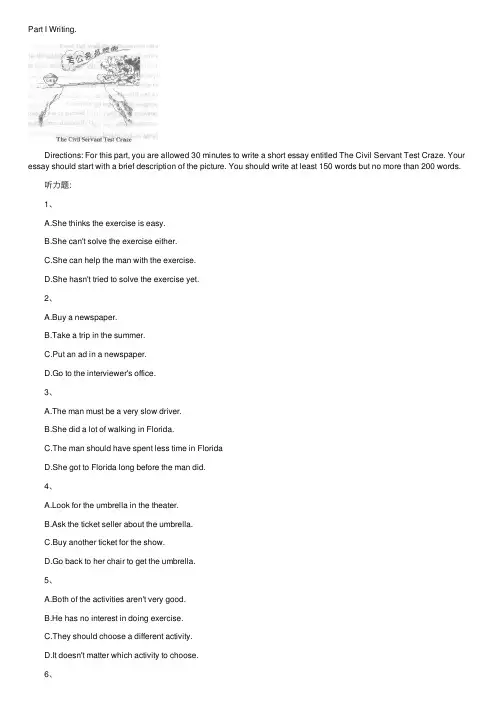
Part I Writing. Directions: For this part, you are allowed 30 minutes to write a short essay entitled The Civil Servant Test Craze. Your essay should start with a brief description of the picture. You should write at least 150 words but no more than 200 words. 听⼒题: 1、 A.She thinks the exercise is easy. B.She can't solve the exercise either. C.She can help the man with the exercise. D.She hasn't tried to solve the exercise yet. 2、 A.Buy a newspaper. B.Take a trip in the summer. C.Put an ad in a newspaper. D.Go to the interviewer's office. 3、 A.The man must be a very slow driver. B.She did a lot of walking in Florida. C.The man should have spent less time in Florida D.She got to Florida long before the man did. 4、 A.Look for the umbrella in the theater. B.Ask the ticket seller about the umbrella. C.Buy another ticket for the show. D.Go back to her chair to get the umbrella. 5、 A.Both of the activities aren't very good. B.He has no interest in doing exercise. C.They should choose a different activity. D.It doesn't matter which activity to choose. 6、 A.Wash fewer clothes at a time. e a different washing machine. C.Try to repair the washing machine first, D.Wash his clothes by hand. 7、 A.She is going to drop the class too. B.She doesn't know how to swim. C.It took her a long time to learn to swim. D.She teaches swimming, 8、 A.He'll give the woman a few prescriptions right away. B.He'll be away from the office for one or two days. C.The woman doesn't need anything for her cough. D.The woman should continue taking the medicine. Conversation One. 听材料,回答下列问题: 9、 A.Her apartment is too far from the campus. B.Her apartment needs a lot of repair work. C.She's having trouble with the owner of the apartment D.Her roommate won't share expenses. 10、 A.Because the girls didn't pay their rent on time. B.Because she couldn't find anyone to repair the dishwasher. C.Because she had to buy a new dishwasher. D.Because paula had some repairs done without her permission. 11、 A.Because he has some knowledge of the law, B.Because he once had the same problem. C.Because he is a friend of the owner. D.Because he can bring a lawsuit against the owner. Conversation Two. 听材料,回答下列各题: 12、 A.There aren't enough cabinets B.There is too much noise. C.Office supplies are taking up space. D.Some teaching assistants don't have desks. 13、 A.To chat with him socially. B.To get help with the course. C.To hand in their assignments. D.To practise giving interviews, 14、 A.They'd have to get permission. B.Jack wouldn't like it, C.She thinks it might work. D.Other assistants should be consulted 15、 A.Give Jack a different office, plain to the department head. C.Move the supplies to the storage room. D.Try to get a room to use for meetings. Passage One. 听材料,回答下列各题: 16、 A.Because of its shape. B.Because of its skin. C.Because of its size. D.Because of its behavior. 17、 A.How sea animals manage to exist, B.How large sea animals can be. C.How frightening the squid is, D.How little is known about the sea. 18、 A.Why it is difficult to use aerial photographs in research. B.Why oceanic research is so limited. C.How oceanic research has helped land research, D.How fossil remains are obtained from deep sea. Passage Two. 听材料,回答下列各题: 19、 A.New varieties of corn have been developed. B.The crops need less fertilizer. C.Farmers can now monitor crop growth. D.Crop yields are much greater. 20、 A.It's being drained from Nebraska to Texas. B.It's being pumped out. C.It's becoming contaminated with oil. D.It's becoming much warmer. 21、 A.It can be seen from an airplane. B.It's most likely polluted. C.It's usually a bright green color. D.The supply of it may be exhausted soon. Passage Three. 听材料,回答下列各题: 22、 A.To review what students know about volcanic activity. B.To demonstrate the use of a new measurement device. C.To explain the answer to an examination question. D.To provide background for the next reading assignment. 23、 A.They occur at regular intervals. B.They can withstand great heat. C.They travel through the Earth's interior. D.They can record the Earth's internal temperature. 24、 A.When the Earth was formed. B.The composition of the Earth's interior. C.Why molten rock is hot. D.How often a volcano is likely to erupt. 25、 A.How deep they are. B.Where earthquakes form. C.How hot they are. D.What purpose they serve. 听材料,回答下列各题: Directions: In this section, you will hear a passage three times. When the passage is read for the first time, you should listen carefully for its general idea. When the passage is read for the second time, you are required to fill in the blanks with the exact words you have just heard. Finally, when the passage is read for the third time, you should check what you have written. Teenagers will be told to "stand up for their elders" on public transport-or risk losing their right to free travel. London Mayor Boris Johnson will 26_________ plans today to make youngsters sign a " 27_________ pledge" to promise to behave in a 28 _________manner when travelling in the capital. The three-point pledge states that they will give up their seats to the elderly, 29_________ and disabled; refrain from using 30_________ or threatening language; and be courteous and polite to fellow passengers and staff. Those who refuse, or are caught behaving in a rude manner, will have their free travel passes 31_________ The plan--a key part of Mr. Johnson's re-election bid--will initially affect the 400,000 11-to-15-year-olds in London who qualify for free travel cards, but Conservative sources believe the idea could be used across the country. A Conservative insider said, "The initiative 32_________ the push to create a Big Society. It is about changing culture and 33 _________around behavior to improve the atmosphere on buses and trains for everyone. " Speaking before today's launch, Mr. Johnson said he 34_________ tackle the anti-social behavior of a "minority of youngsters" on public transport. "when I was a boy, I was taught to stand up for those less able to," he said. "Youngsters enjoy the privilege of free travel, which is paid for by Londoners, but they have to understand that with that privilege comes responsibility. " Anyone who abuses this privilege will have it taken away, and will have to earn that right back. Teenagers who are found 35_________ violating the new behavior code will lose their travel passes. They will have to carry out unpaid community work to have them restored.回答36-45题: Women with low literacy suffer disproportionately more than men, encountering more 36_________ in finding a well-paying job and being twice as likely to end up in the group of lowest wage earners, a study released on Wednesday said. Analysis by the Institute for Women's Policy Research (IWPR. found women at all levels of 37_________ tend to earn less than men, but it's at the lowest literacy levels that the wage gap between genders is most striking. Women with low literacy are twice as 38_________ as men at the same skill level to be among the lowest earners, bringing in $300 a week or less, the report said. "Because women start off so low in terms of wages, having higher literacy and more skills really 39_________ a big difference," said Kevin Miller, a 40_________ research associate at IWPR and co-author of the study. Women need to go 41_________ in their training and education level to earn the same as men, Miller said. The 42_________ was based on 2009 National Assessment of Adult Literacy surveys, the most recent data43_________ , and focused on reading skills, not writing and numeric literacy. That data was 44_________ from a nationally representative sample of 19,714 people aged 16 and older, living in households or prisons. Data showed about one-third of American adults have low literacy levels, and more than 36 percent of men and 33 percent of women fall into that 45_________ , the institute said. A. patternp > p b d s f i d = " 2 2 6 " > 0 0 B . s e n i o r / p > p b d s f i d = " 2 2 7 " > 0 0 C . l o n g e r / p > p b d s f i d = " 22 8 " > 0 0 D . d i f f i c u l t i e s / p > p b d s f i d = " 2 2 9 " > 0 0 E . c a t e g o r y / p > p b d s f i d = " 23 0 " > 0 0 F . c o l l e c te d / p > p b d sf i d = " 2 3 1 " > 0 0 G . p o s i t i o n s / p > p b d s f i d = " 2 3 2 " > 0 0 H . a v a i l a b l e / p > p b d s f i d = " 23 3 " > 0 0 I . c o n d u c t e d / p > p b d s f i d = " 2 34 " > 0 0 J . i n d e p e n d e n t / p > p b d s f i d = " 2 35 " > 0 0 K . l i t e ra c y / p > pb d s f i d = " 2 3 6 " > 0 0 L . a n a l y s i s / p > p b d s f i d = " 2 3 7 " > 0 0 M . l i k e l y / p > p b d s f i d = " 2 3 8 " >0 0 N . f u r t h e r / p > p b d s f i d = " 2 3 9 " > 0 0 O . m a k e s / p > p b d s f i d = " 2 4 0 " > 0 0 S e c t i o n B / p > p b d s f i d = " 2 4 1 " > 0 0 D i r e c t i o n s : I n t h i s s e c t i o n , y o u a r e g o i n g t o r e a d a p a s s a g e w i t h t e n s t a t e m e n t s a t t a c h e d t o i t . E a c h s t a t e m e n t c o n t a i n s i n f o r m a t i o n g i v e n i n o n e o f t h e p a r a g r a p h s . I d e n t i f y t h e p a r a g r a p h f r o m w h i c h t h e i n f o r m a t i o n i s d e r i v e d . / p > p b d s f i d = " 2 4 2 " > 0 0 Y o u m a y c h o o s e a p a r a g r a p h m o r e t h a n o n c e . E a c h p a r a g r a p h i s m a r k e d w i t h a l e t t e r . A n s w e r t h e q u e s t i o n s b y m a r k i n g t h e c o r r e s p o n d i n g l e t t e r o n A n s w e r S h e e t 2 . / p >。
2015年12月大学英语六级考试真题第3套

2015年12月大学英语六级考试真题(第3套)Part I Writing(30 minutes)Directions: For this part, you are allowed 30 minutes to write a short essay based on the picturebelow.You should focus on the harm caused by misleading information online.You arerequired to write at least 150 words but no more than 200 words.Part ⅡListening Comprehension (30 minutes)Section ADirections: In this section, you will hear 8 short conversations and 2 long conversations.At the endof each conversation, one or more questions will be asked about what was said.Both theconversation and the questions will be spoken only once.After each question there will bea pause.During the pause, you must read the four choices marked A), B), C.and D),and decide which is the best answer.Then mark the corresponding letter on AnswerSheet I with a single line through the centre.1.A.She has completely recovered.B.She went into shock after an operation.C.She is still in a critical condition.D.She is getting much better.2.A.Ordering a breakfast.B.Booking a hotel room.C.Buying a train ticket.D.Fixing a compartment.3.A.Most borrowers never returned the books to her.B.The man is the only one who brought her book back.C.She never expected anyone to return the books to her.D.Most of the books she lent out came back without jackets.4.A.She left her work early to get some bargains last Saturday.B.She attended the supermarket's grand opening ceremony.C.She drove a full hour before finding a parking space.D.She failed to get into the supermarket last Saturday.5.A.He is bothered by the pain in his neck.B.He cannot do his report without a computer.C.He cannot afford to have a coffee break.D.He feels sorry to have missed the report.6.A.Only top art students can show their works in the gallery.B.The gallery space is big enough for the man's paintings.C.The woman would like to help with the exhibition layout.D.The man is uncertain how his art works will be received.7.A.The woman needs a temporary replacement for her assistant.B.The man works in the same department as the woman does.C.The woman will have to stay in hospital for a few days.D.The man is capable of dealing with difficult people.8.A.It was better than the previous one.B.It distorted the mayor's speech.C.It exaggerated the city's economic problems.D.It reflected the opinions of most economists.Questions 9 to 12 are based on the conversation you have just heard.9.A.To inform him of a problem they face.B.To request him to purchase control desks.C.To discuss the content of a project report.D.To ask him to flX the dictating machine.10.A.They quote the best price in the market.B.They manufacture and sell office furniture.C.They cannot deliver the steel sheets on time.D.They cannot produce the steel sheets needed.11.A.By marking down the trait price.B.By accepting the penalty clauses.C.By allowing more time for delivery.D.By promising better after-sales service.12.A.Give the customer a ten percent discount.B.Claim compensation from the steel suppliers.C.Ask the Buying Department to change suppliers.D.Cancel the contract with the customer.Questions 13 to 15 are based on the conversation you have just heard.13.A.Stockbroker.B.Physicist.C.Mathematician.D.Economist.14.A.Improve computer programming.B.Explain certain natural phenomena.C.Predict global population growth.D.Promote national financial health.15.A.Their different educational backgrounds.B.Changing attitudes toward nature.C.Chaos theory and its applications.D.The current global economic crisis.Section BDirections : In this section, you will hear 3 short passages.At the end of each passage, you will hearsome questions.Both the passage and the questions will be spoken only once.After youhear a question, you must choose the best answer from the four choices marked A), B),C.and D ).Then mark the corresponding letter on Answer Sheet 1 with a single linethrough the centre.Passage OneQuestions 16 to 18 are based on the passage you have just heard.16.A.They lay great emphasis on hard work.B.They name 150 star engineers each year.C.They require high academic degrees.D.They have people with a very high IQ.17.A.Long years of job training.B.High emotional intelligence.C.Distinctive academic qualifications.D.Devotion to the advance of science.18.A.Good interpersonal relationships.B.Rich working experience.C.Sophisticated equipment.D.High motivation.Passage TwoQuestions 19 to 21 are based on the passage you have just heard.19A. A diary.B.A fairy tale.C.A history textbook.D.A biography.20.A.He was a sports fan.B.He loved adventures.C.He disliked school.D.He liked hair-raising stories.21.A.Encourage people to undertake adventures.B.Publicize his colorful and unique life stories.C.Raise people's environmental awareness.D.Attract people to America's national parks.Passage ThreeQuestions 22 to 25 are based on the passage you have just heard.22.A.The first infected victim.B.A coastal village in Africa.C.The doctor who lust identified it.D.A river running through the Congo.23.A.They exhibit similar symptoms.B.They can be treated with the same drug.C.They have almost the same mortality rate.D.They have both disappeared for good.24.A.By inhaling air polluted with the virus.B.By contacting contaminated body fluids.C.By drinking water from the Congo River.D.By eating food grown in Sudan and Zalre.25.A.More strains will evolve from the Ebola virus.B.Scientists will eventually fred cures for Ebola.C.Another Ebola epidemic may erupt sooner or later.D.Once infected, one will become immune to Ebola.Section CDirections: In this section, you will hear a passage three times. When the passage is read for the first time, you should listen carefully for its general idea. When the passage is read for the second time, you are required to fill in the blanks with the exact words you have just heard. Finally, when the passage is read for the third time, you should check what you have written.The ideal companion machine would not only look, feel, and sound friendly but would also be programmed to behave in an agreeable manner. Those 26 that make interaction with other people enjoyable would be simulated as closely as possible, and the machine would 27 charming, stimulating, and easy going. Its informal conversational style would make interaction comfortable, and yet the machine would remain slightly 28 and therefore interesting. In its first encounter it might be somewhat hesitant and unassuming, but as it came to know the user it wouldprogress to a more 29 and intimate style. The machine would not be a passive 30 but would add its own suggestions, information, and opinions; it would sometimes 31 developing or changing the topic and would have a personality of its own.The machine would convey presence: We have all seen how a computer's use of personal names often 32 people and leads them to treat the machine as if it were almost human. Such features are easily written into the software. By introducing 33 forcefulness and humor, the machine could be presented as a vivid and unique character.Friendships are not made in a day, and the computer would be more acceptable as a friend if it 34 the gradual changes that occur when one person is getting to know another. At an 35 time it might also express the kind of affection that stimulates attachment and intimacy.Reading Comprehension (40 minutes)Section ADirections: In this section, there is a passage with ten blanks. You are required to select one word for each blank from a list of choices given in a word bank following the passage. Read the passage through carefully before making your choices. Each choice in the bank is identified by a letter .Please mark the corresponding letter for each item on Answer Sheet 2 with a single line through the centre. You may not use any of the words in the bank more than once.Questions 36 to 45 are based on the following passage.As it is, sleep is so undervalued that getting by on fewer hours has become a badge of honor.Plus, we live in a culture that 36 to the late-nighter, from 24-hour grocery stores to online shopping sites that never close. It's no surprise, then, that more than half of American adults don't get the 7 to 9 hours of shut-eye every night as 37 by sleep experts.Whether or not we can catch up on sleep--on the weekend, say--is a hotly 38 topic among sleep researchers. The latest evidence suggests that while it isn't 39 , it might help. When Liu, theUCLA sleep researcher and professor of medicine, brought 40 sleep-restricted people into the lab for a weekend of sleep during which they logged about 10 hours per night, they showed 41 in the ability of insulin (胰岛素) to process blood sugar. That suggests that catch-up sleep may undo somebut not all of the damage that sleep 42 causes, which is encouraging, given how many adults don't get the hours they need each night. Still, Liu isn't 43 to endorse the habit of sleeping less and making up for it later.Sleeping pills, while helpful for some, are not 44 an effective remedy either."A sleeping pill will 45 one area of the brain, but there's never going to be a perfect sleeping pill, because you couldn't really replicate (复制) the different chemicals moving in and out of different parts of the brain to go through the different stages of sleep," says Dr.Nancy Collop, director of the Emory University Sleep Center.A.alternativelyB.catersC.chronicallyD.debatedE.deprivationF.idealG.improvementsH.necessarilyI.negotiatedJ.pierceK.presumptionL.readyM.recommendedN.surpassesO.targetSection BDirections: In this section, you are going to read a passage with ten statements attached to it.Eachstatement contains information given in one of the paragraphs. Identify the paragraph from which the information is derived.You may choose a paragraph more than once. Each paragraph is marked with a letter. Answer the questions by marking the corresponding letter on Answer Sheet 2.Climate change may be real, but it's still not easy being greenHow do we convince our inner caveman to be greener? We ask some outstanding social scientists.[A] The road to climate hell is paved with our good intentions. Politicians may tackle polluters while scientists do battle with carbon emissions. But the most pervasive problem is less obvious: our own behaviour. We get distracted before we can turn down the heating. We break our promise not to fly after hearing about a neighbour's trip to India.Ultimately, we can't be bothered to change our attitude. Fortunately for the planet, social science and behavioural economics may be able to do that for us.[B] Despite mournful polar beats and charts showing carbon emissions soaring, most people find it hard to believe that global warming will affect them personally. Recent polls by the Pew Research Centre in Washington, DC, found that 75-80 per cent of participants regarded climate change as an important issue. But respondents ranked it last on a list of priorities.[C] This inconsistency largely stems from a feeling of power lessness ."When we can't actually remove the source of our fear, we tend to adapt psychologically by adopting a range of defence mechanisms," says Tom Crompton, change strategist for the environmental organisation World Wide Fund for Nature.[ D] Part of the fault lies with our inner caveman. Evolution has programmed humans to pay most attention to issues that will have an immediate impact. "We worry most about now because if we don't survive for the next minute, we're not going to be around in ten years' time," says Professor Elke Weber of the Centre for Research on Environmental Decisions at Columbia University in New York. If the Thames were lapping around Big Ben, Londoners would face up to the problem of emissions pretty quickly .But in practice, our brain discounts the risks--and benefits—associated with issues that lie some way ahead.[E] Matthew Rush worth, of the Department of Experimental Psychology at the University of Oxford, sees this in his lab every day. "One of the ways in which all agents seem to makedecisions is that they assign a lower weighting to outcomes that are going to be further away in the future," he says."This is a very sensible way for an animal to make decisions in the wild and would havebeen very helpful for humans for thousands of years."[F] Not any longer. By the time we wake up to the threat posed by climate change, it could well be too late. And ff we're not going to make rational decisions about the future, others may have to help us to do so.[G] Few political libraries are without a copy of Nudge: Improving Decisions About Health, Wealthand Happiness, by Richard Thaler and Cass Sunstein. They argue that governments should persuade us into making better decisions--such as saving more in our pension plans--by changing the default options. Professor Weber believes that environmental policy can make use of similartactics. If, for example, building codes included green construction guidelines, most developers would be too lazy to challenge them.[H] Defaults are certainly part of the solution. But social scientists are most concerned about crafting messages that exploit our group mentality (,~, ~ )."We need to understand what motivates people, what it is that allows them to make change," says Professor Neil Adger, of the Tyndall Centre for Climate Change Research in Norwich. "It is actually about what their peers think of them, what their social norms are, what is seen as desirable in society." In other words, our inner caveman is continually looking over his shoulder to see what the rest of the tribe are up to.[ I ] The passive attitude we have to climate change as individuals can be altered by counting us in--and measuring us against--our peer group." Social norms are primitive and elemental," says Dr.Robert Cialdini, author of Influence: The Psychology of Persuasion." Birds flock together, fish school together, cattle herd together...just perceiving norms is enough to cause people to adjust their behaviour in the direction of the crowd."[J] These norms can take us beyond good intentions. Cialdini conducted a study in San Diego in which coat hangers bearing messages about saving energy were hung on people's doors. Some of the messages mentioned the environment, some financial savings, others social responsibility. Butit was the ones that mentioned the actions of neighbours that drove down power use.[K] Other studies show that simply providing the facility for people to compare their energy use with the local average is enough to cause them to modify their behaviour. The Conservatives plan to adopt this strategy by making utility companies print the average local electricity and gas usage onpeople's bills.[L] Social science can also teach politicians how to avoid our collective capacity for serf-destructive behaviour. Environmental campaigns that tell us how many people drive SUVs unwittingly (不经意的) imply that this behaviour is widespread and thus permissible.Cialdini recommends some careful framing of the message. "Instead of normalising the undesirable behaviour, the message needs to marginalise it, for example, by stating that if even one person buys yet another SUV, it reduces our ability to be energy-independent."[M] Tapping into how we already see ourselves is crucial. The most successful environmental strategy will marry the green message to our own sense of identity. Take your average trade unionmember, chances are they will be politically motivated and be used to collective action—much like Erica Gregory.A retired member of the Public and Commercial Services Union, she is setting up one of 1,i00 action groups with the support of Climate Solidarity, a two-year environmental campaign aimed at trade unionists.[N] Erica is proof that a great-grandmother can help to lead the revolution if you get the psychology right--in this case, by matching her enthusiasm for the environment with a fondness for organizing groups."I think it's a terrific idea," she says of the campaign."The union backing it makes members think there must be something in it." She is expecting up to 20 people at the first meeting she has called, at her local pub in the Cornish village of Polperro.[O] Nick Perks, project director for Climate Solidarity, believes this sort of activity is where the future of environmental action lies. "Using existing civil society structures or networks is a more effective way of creating change.., and obviously trade unions are one of the biggest civil society networks in the UK," he says. The " Love Food, Hate Waste" campaign entered into acollaboration last year with another such network--the Women's Institute. Londoner Rachel Taylorjoined the campaign with the aim of making new friends. A year on, the meetings have made lasting changes to what she throws away in her kitchen. "It's always more of an incentive if you're doing it with other people," she says. "It motivates you more if you know that you've got to provide feedback to a group."[P]The power of such simple psychology in fighting climate change is attracting attention across the political establishment. In the US, the House of Representatives Science Committee has approveda bill allocating $10 million a year to studying energy-related behaviour. In the UK, new studies are in development and social scientists are regularly spotted in British government offices. Withthe help of psychologists, there is fresh hope that we might go green after all.46.When people find they are powerless to change a situation, they tend to live with it.47.To be effective, environmental messages should be carefully framed.48.It is the government's responsibility to persuade people into making environment-friendly decisions.49.Politicians are beginning to realise the importance of enlisting psychologists' help in fighting climate change.50.To find effective solutions to climate change, it is necessary to understand what motivates people to make change.51.In their evolution, humans have learned to pay attention to the most urgent issues instead of long-term concerns.52.One study shows that our neighbours' actions are influential in changing our behaviour.53.Despite clear signs of global warming, it is not easy for most people to believe climate change will affect their own lives.54.We should take our future into consideration in making decisions concerning climate change before it is too late.55.Existing social networks can be more effective in creating change in people's behaviour.Section CDirections: There are 2 passages in this section. Each passage is followed by some questions or unfinished statements. For each of them there are four choices marked A), B), C. andD ).Y ou should decide on the best choice and mark the corresponding letter on Answer Sheet2 with a single line through the centre.Passage OneQuestions 56 to 60 are based on the following passage.More than a decade ago, cognitive scientists John Bransford and Daniel Schwartz, both then atVanderbilt University, found that what distinguished young adults from children was not the ability to retain facts or apply prior knowledge to a new situation but a quality they called "preparation for future learning." The researchers asked fifth graders and college students to create a recovery plan to protect bald eagles from extinction. Shockingly, the two groups came up with plans of similar quality(although the college students had better spelling skills ). From the standpoint of a traditional educator, this outcome indicated that schooling had failed to help students think about ecosystems and extinction, major scientific ideas.The researchers decided to go deeper, however. They asked both groups to generate questions about important issues needed to create recovery plans. On this task, they found large differences. College students focused on critical issues of interdependence between eagles and their habitats (栖息地).Fifth graders tended to focus on features of individual eagles ( "How big are they?" and "What do they eat?" ).The college students had cultivated the ability to ask questions, the cornerstone of critical thinking. They had learned how to learn.Museums and other institutions of informal learning may be better suited to teach this skill than elementary and secondary schools. At the Exploratorium in San Francisco, we recently studied how learning to ask good questions can affect the quality of people's scientific inquiry. We found that whenwe taught participants to ask "What if?" and "How can?" questions that nobody present would know the answer to and that would spark exploration, they engaged in better inquiry at the next exhibit--asking more questions, performing more experiments and making better interpretations of their results. Specifically, their questions became more comprehensive at the new exhibit. Rather than merely asking about something they wanted to try, they tended to include both cause and effect in their question. Asking juicy questions appears to be a transferable skill for deepening collaborative inquiry into the science content found in exhibits.This type of learning is not confined to museums or institutional settings. Informal learning environments tolerate failure better than schools. Perhaps many teachers have too little time to allow students to form and pursue their own questions and too much ground to cover in the curriculum .But people must acquire this skill somewhere .Our society depends on them being able to make critical decisions about their own medical treatment, say, or what we must do about global energy needs and demands. For that, we have a robust informal learning system that gives no grades, takes all comers, and is available even on holidays and weekends.56.What is traditional educators' interpretation of the research outcome mentioned in the first paragraph ?A.Students are not able to apply prior knowledge to new problems.B.College students are no better than fifth graders in memorizing facts.cation has not paid enough attention to major environmental issues.cation has failed to lead students to think about major scientific ideas.57.In what way are college students different from children?A.They have learned to think critically.B.They are concerned about social issues.C.They are curious about specific features.D.They have learned to work independently.58.What is the benefit of asking questions with no ready answers?A.It arouses students' interest in things around them.B.It cultivates students' ability to make scientific inquiries.C.It trains students' ability to design scientific experiments.D.It helps students realize not every question has an answer.59.What is said to be the advantage of informal learning?A.It allows for failures.B.It is entertaining.C.It charges no tuition.D.It meets practical needs.60.What does the author seem to encourage educators to do at the end of the passage?A.Train students to think about global issues.B.Design more interactive classroom activities.C.Make full use of informal learning resources.D.Include collaborative inquiry in the curriculum.Passage TwoQuestions 61 to 65 are based on the following passage."There's an old saying in the space world: amateurs talk about technology, professionals talk about insurance." In an interview last year with The Economist, George White sides, chief executive of space-tourism fu'm Virgin Galactic, was placing his company in the latter category. But insurance will be cold comfort following the failure on October 31st of VSS Enterprise, resulting in the death of one pilot and the severe injury to another.On top of the tragic loss of life, the accident in California will cast a long shadow over the future of space tourism, even before it has properly begun.The notion of space tourism took hold in 2001 with a $ 20 million flight aboard a Russian spacecraft by Dennis Tito, a millionaire engineer with an adventurous streak .Just haft a dozen holiday-makers have reached orbit since then, for similarly astronomical price tags. But more recently, companies have begun to plan more affordable "suborbital" flights--briefer ventures just to the edge of space's vast darkness. Virgin Galactic had, prior to this week's accident, seemed closest to starting regular flights. The company has already taken deposits from around 800 would-be space tourists ,including Stephen Hawking.After being dogged by technical delays for years, Sir Richard Branson, Virgin Galactic's founder, had recently suggested that a Space Ship Two craft would carry its first paying customers as soon as February 2015. That now seems an impossible timeline. In July, a sister craft of the crashed paceplane was reported to be about half-finished. The other half will have to walt as authorities ofmerica's Federal Aviation Administration (FAA.and National Transportation Safety Board work out: hat went wrong.In the meantime, the entire space tourism industry will be on tenterhooks (坐立不安).The 2004Commercial Space Launch Amendments Act, intended to encourage private space vehicles and ervices, prohibits the transportation secretary (and thereby the FAA.from regulating the design or operation of private spacecraft, unless they have resulted in a serious or fatal injury to crew or. assengers.T at means that the FAA could suspend Virgin Galactic's licence to fly. It could also insiston checking private manned spacecraft as thoroughly as it does commercial aircraft. While that may: make suborbital travel safer, it would add significant cost and complexity to an emerging industry that has until now operated largely as the playground of billionaires and dreamy engineers.How Virgin Galactic, regulators and the public respond to this most recent tragedy will determine whether and how soon private space travel can transcend that playground. There is no doubt that space flight entails risks, and to pioneer a new mode of travel is to face those risks, and to reduce them. with the benefit of hard-won experience.61.What is said about the failure of VSS Enterprise?A.It may lead to the bankruptcy of Virgin Galactic.B.It has a strong negative impact on space tourism.C.It may discourage rich people from space travel.D.It has aroused public attention to safety issues.62.What do we learn about the space-tourism firm Virgin Galactic?A.It has just built a craft for commercial flights.B.It has sent half a dozen passengers into space.C.It was about ready to start regular business.D.It is the first to launch "suborbital" flights.63.What is the purpose of the 2004 Commercial Space Launch Amendments Act?A.To ensure space travel safety.B.To limit the FAA's functions.C.To legalize private space explorations.D.To promote the space tourism industry.64.What might the FAA do after the recent accident in California?A.Impose more rigid safety standards.B.Stop certifying new space-tourist agencies.C.Amend its 2004 Commercial Space Launch Amendments Act.D.Suspend Virgin Galactic's licence to take passengers into space.65.What does the author think of private space travel?A.It is worth promoting despite the risks involved.B.It should not be confined to the rich only.C.It should be strictly regulated.。
2015年12月英语四级考试真题(第三套带详解).docx

2015年12月大学英语四级考试真题(第3套)Part Ⅰ Writing ( 30 minutes)Directions:For this part,you are allowed 30 minutes to write an essay commenting on the saying”Never go out there to see what happens, go out there to make things happen.” You can citexamples to illust rate the importance of being participants rather than mere onlookers inlife.You should write at least 120 words but no more than 180 words。
Part Ⅱ Listening Comprehension ( 30 minutes)听力音频地址:/attached/media/20160426/20160426161254_0664.mp3Sheet 1 with a single line through the centre。
1 A. Children should be taught to be more careful。
B。
Children shouldn’t drink so much orange juice.C。
There is no need for the man to make such a fuss。
D. Timmy should learn to do things in the right way。
2. A. Fitness training.B. The new job offer。
C。
Computer programming。
D。
Directorship of the club。
2015年12月英语四级真题及答案第三套
2015年12月英语四级真题及答案第三套2015年12月英语四级真题及答案第三套Part Ⅰ Writing ( 30 minutes)Directions: For this part, you are allowed 30 minutes to write an essay commenting on the saying"Never go out there to see what happens, go out there to make things happen." You can citexamples to illustrate the importance of being participants rather than mere onlookers inlife.You should write at least 120 words but no more than 180 words.Part Ⅱ Listening Compre hension ( 30 minutes)Section ADirections : In this section, you will hear 8 short conversations and 2 long conversations.At the end ofeach conversation, one or more questions will be asked about what was said.Both theconversation and the questions will be spoken only once.After each question there will bea pause.During the pause, you must read the four choices marked A, B, Cand D,and decide which is the best answer. Then mark the corresponding letter on Answer Sheet 1 with a single line through the centre.1.A.Children should be taught to be more careful.B.Children shouldn't drink so much orange juice.C.There is no need for the man to make such a fuss.D.Timmy should learn to do things in the right way.2.A.Fitness training.B.The new job offer.puter programming.D.Directorship of the club.3.A.He needs to buy a new sweater.B.He has got to save on fuel bills.C.The fuel price has skyrocketed.D.The heating system doesn't work.mitting theft.B.Taking pictures.C.Window shopping.D.Posing for the camera.5.A.She is taking some medicine.B.She has not seen a doctor yet.C.She does not trust the man's advice.D.She has almost recovered from the cough.6.A.Pamela's report is not finished as scheduled.B.Pamela has a habit of doing things in a hurry.C.Pamela is not good at writing research papers.D.Pamela's mistakes could have been avoided.7.A.In the left-luggage office.B.At the hotel reception.C.In a hotel room.D.At an airport.8.A.She was an excellent student at college.B.She works in the entertainment business.C.She is fond of telling stories in her speech.D.She is good at conveying her message.Questions 9 to 11 are based on the conversation you have just heard.9.A.Arranging the woman's appointment with Mr.Romero.B.Fixing the time for the designer's latest fashion show.C.Talking about an important gathering on Tuesday.D.Preparing for the filming on Monday morning.10.A.Her travel to Japan.B.The awards ceremony.C.The proper hairstyle for her new role.D.When to start the make-up session.11.A.He is Mr.Romero's agent.B.He is an entertainment journalist.C.He is the woman's assistant.D.He is a famous movie star.Questions 12 to 15 are based on the conversation you have just heard.12.A.Make an appointment for an interview.B.Send in an application letter.C.Fill in an application form.D.Make a brief self-introduction on the phone.13.A.Someone having a college degree in advertising.B.Someone experienced in business management.C.Someone ready to take on more responsibilities.D.Someone willing to work beyond regular hours.14.A.Travel opportunities.B.Handsome pay.C.Prospects for promotion.D.Flexible working hours.15.A.It depends on the working hours.B.It is about 500 pounds a week.C.It will be set by the Human Resources.D.It is to be negotiated.Section BDirections..In this section, you will hear 3 short passages.At the end of each passage, you will hearsome questions.Both the passage and the questions will be spoken only once.After youhear a question, you must choose the best answer from the four choices marked A., B,Cand D..Then mark the correspondingletter on Answer Sheet 1 with a single linethrough the center.Passage OneQuestions 16 to 19 are based on the passage you have just heard.16.A.To give customers a wider range of choices.B.To make shoppers see as many items as possible.C.To supply as many varieties of goods as it can.D.To save space for more profitable products.17.A.On the top shelves.B.On the bottom shelves.C.On easily accessible shelves.D.On clearly marked shelves.18.A.Many of them buy things on impulse.B.A few of them are fathers with babies.C.A majority of them are young couples.D.Over 60% of them make shopping lists.19.A.Sales assistants promoting high margin goods.B.Sales assistants following customers around.C.Customers competing for good bargains.D.Customers losing all sense of time.Passage TwoQuestions 20 to 22 are based on the passage you have just heard.20.A.Teaching mathematics at a school.B.Doing research in an institute.C.Studying for a college degree.D.Working in a hi-tech company21.A.He studied the designs of various clocks.B.He did experiments on different materials.C.He bought an alarm clock with a pig face.D.He asked different people for their opinions.22.A.Its automatic mechanism.B.Its manufacturing process.C.Its way of waking people up.D.Its funny-looking pig face.Passage ThreeQuestions 23 to 25 are based on the passage you have just heard.23.A.It is often caused by a change of circumstances.B.It actually doesn't require any special treatment.C.It usually appears all of a sudden.D.It generally lasts for several years.24.A.They cannot mix well with others.B.They irrationally annoy their friends.C.They depend heavily on family members.D.They blame others for ignoring their needs.25.A.They lack consistent support from peers.B.They doubt their own popularity.C.They were born psychologically weak.D.They focus too much on themselves.Section CDirections: In this section, you will hear a passage three times.When the passage is read for the firsttime, you should listen carefully for its general idea.When the passage is read for thesecond time, you are required to fill in the blanks with the exact words you have justheard.Finally, when the passage is read for the third time, you should check what youhave written.There was a time when any personal information that was gathered about us was typed on a pieceof paper and26 in a file cabinet.It could remain there for years and, often27, neverreachthe outside world.Things have done a complete about-face since then.28 the change has been the astonishingly29 development in recent years of the computer.T oday, any data that is 30 about us in oneplace or another--and for one reason or another--can be stored in a computer bank.It can then beeasily passed to other computer banks.They are owned by individuals and by private businesses andcorporations, lending 31 , direct mailing and telemarketing firms, credit bureaus, credit cardcompanies, and32 at the local, state, and federal level.A growing number of Americans are seeing the accumulation and distribution of computerized dataas a frightening33 of their privacy.Surveys show that the numberof worried Americans has beensteadily growing over the years as the computer becomes increasingly 34, easier to operate, andless costly to purchase and maintain.In 1970, a national survey showed that 37 percent of the people35felt their privacy was being invaded.Seven years later, 47 percent expressed the same worry.Arecent survey by a credit bureau revealed that the number of alarmed citizens had shot up to 76percent.Part Ⅲ Reading Comprehension(40 minutes)Section ADirections: In this section, there is a passage with ten blanks.You are required to select one word foreach blank from a list of choices given, in a word bank following the passage.Read thepassage through carefully before making your choices. Each.choice in the bank isidentified by a letter.Please mark the corresponding letter for each item on Answer Sheet2 with a single line through the center.You may not use any of the words in the bankmore than once.Questions 36 to 45 are based on the following passage.Children do not think the way adults do.For most of the first year of life, if something is out ofsight, it's out of mind.If you cover a baby's36toy with a piece of cloth, the baby thinks the toyhas disappeared and stops looking for it.A 4-year-old may 37 that a sister has more fruit juicewhen it is only the shapes of the glasses that differ, not the38 of juice.Yet children are smart in their own way.Like good little scientists, children are always testingtheir child-sized39 about how things work.When your child throws her spoon on the floor for thesixth time as you try to feed her, and you say, "That's enough! I will not pick up your spoon again!"the child will 40 test your claim.Are you serious? Are you angry? What will happen if she throwsthe spoon again? She is not doing this to drive you41; rather, she is learning that her desires andyours can differ, and that sometimes those42 are important and sometimes they are not.How and why does children's thinking change? In the 1920s, Swiss psychologist Jean Piagetproposed that children's cognitive (认知的) abilities unfold 43, like theblooming of a flower,almost independent of what else is44in their lives.Although many of his specific conclusions havebeen45 or modified over the years, his ideas inspired thousands of studies by investigators all overthe world.A.advocateB.amountC.confirmedD.crazyE. definiteF. differencesG. favoriteH. happeningI. ImmediatelyJ. NaturallyK. ObtainingL. PrimarilyM. ProtestN. RejectedO. theoriesSection BDirections: In this section, you are going to read a passage with, ten statements attached to it.Eachstatement contains information given in one of the paragraphs.Identify the paragraphfrom which the information is derived.You may choose a paragraph more than once.Each paragraph is marked with a letter. Answer the questions by marking thecorresponding letter on Answer Sheet 2.The Perfect EssayA.Looking back on too many years of education, I can identify one truly impossible teacher.Shecared about me, and my intellectual life, even when I didn't.Her expectations were high--impossibly so.She was an English teacher.She was also my mother.B.When good students turn in an essay, they dream of their instructor returning itto them in exactlythe same condition, save for a single word added in the margin of the finalpage : "Flawless." Thisdream came true for me one afternoon in the ninth grade.Of course, I had heard that genius couldshow itself at an early age, so I was only slightly taken aback that I had achieved perfection at thetender age of 14.Obviously, I did what any professional writerwould do; I hurried off to spread thegood news.I didn't get very far.The first person I told was my mother.C.My mother, who is just shy of five feet tall, is normally incredibly soft-spoken, but on the rareoccasion when she got angry, she was terrifying.I am not sure if she was more upset by my hubris(得意忘形) or by the fact that my English teacher had let my ego get so out of hand.In any event,my mother and her red pen showed me how deeply flawed a flawless essay could be.At the time,I am sure she thought she was teaching me about mechanics, transitions (过渡), structure, styleand voice.But whatI learned, and what stuck with me through my time teaching writing atHarvard, wasa deeper lesson about the nature of creative criticism.D.First off, it hurts.Genuine criticism, the type that leaves a lasting mark on you as a writer, alsoleaves an existential imprint (印记) on you as a person.I have heard people say that a writershould never take criticism personally.I say that we should never listen to these people.E. Criticism, at its best, is deeply personal, and gets to the heart of why we write the way we do.Theintimate nature of genuine criticism implies something about who is able to give it, namely,someone who knows you well enough to show you how your mental life is getting in the way ofgood writing.Conveniently, they are also the people who care enough to see you through thispainful realization.For me it took the form of my first, and I hope only, encounter with writer'sblock--I was not able to produce anything for three years.F. Franz Kafka once said: "Writing is utter solitude (独处), the descent into the cold abyss (深渊) ofoneself." My mother's criticism had shown me that Kafka is right about the cold abyss,and whenyou make the introspective (内省的) descent that writing requires you are not always pleased bywhat you find.But, in the years that followed, her sustained tutoring suggested that Kafka might bewrong about thesolitude.I was lucky enough to find a critic and teacher who was willing to makethe journey of writing with me."It is a thing of no great difficulty," according to Plutarch, "toraise objections against another man's speech, it is a very easy matter; but to produce a better in itsplace is a work extremely troublesome." I am sure I wrote essays in the later years of high schoolwithout my mother's guidance, but I can't recall them.What I remember, however, is how shetook up the "extremely troublesome" work of ongoing criticism.G. There are two ways to interpret Plutarch when he suggests that a critic should be able to produce "abetter in its place." In a straightforward sense, he could mean that a critic must be more talentedthan the artist she critiques (评论).My mother was well covered on this count.But perhapsPlutarch is suggesting something slightly different, something a bit closer to Marcus Cicero's claimthat one should "criticize by creation, not by finding fault." Genuine criticism creates a preciousopening for an author to become better on his own terms--a process that is often extremely painful,but also almost always meaningful.H. My mother said she would help me with my writing, but first I had to help myself.For eachassignment, I was to write the best essay I could.Real criticism is not meant to find obviousmistakes, so if she found any--the type I could have found on my own--I had to start from scratch.From scratch.Once the essay was "flawless," she would take an evening to walk methrough myerrors.That was when true criticism, the type that changed me as a person, began.I. She criticized me when I included little-known references and professional jargon (行话).She hadno patience for brilliant but irrelevant figures of speech."Writers can't bluff (虚张声势) their waythrough ignorance." That was news to me--I would need to freed another way to structure my dailyexistence.J. She trimmed back my flowery language, drew lines through my exclamation marks and argued forthe value of restraint in expression."John," she almost whispered.I leaned in to hear her:"I can'thear you when you shout at me." So I stopped shouting and bluffing, and slowly my writingimproved.K. Somewhere along the way I set aside my hopes of writing that flawless essay.But perhaps I missedsomething important in my mother's lessons about creativity and perfection.Perhaps the point ofwriting the flawless essay was not to give up, but to never willingly finish.Whitman repeatedlyreworked "Song of Myself' between 1855 and 1891.Repeatedly.We do our absolute best with apiece of writing, and come as close as we can to the ideal.And, for the time being, we settle.Incritique, however, we are forced to depart, to give up the perfection we thought we had achievedfor the chance of being even a little bit better.This is the lesson I took from my mother: Ifperfection were possible, it would not be motivating.46.The author was advised against the improper use of figures of speech.47.The author's mother taught him a valuable lesson by pointing out lots of flaws in his seeminglyperfect essay.48.A writer should polish his writing repeatedly so as to get closer to perfection.49.Writers may experience periods of time in their life when they just can't produce anything.50.The author was not much surprised when his school teacher marked his essay as "flawless".51.Criticizing someone's speech is said to be easier than coming up with a better one.52.The author looks upon his mother as his most demanding and caring instructor.53.The criticism the author received from his mother changed him as a person.54.The author gradually improved his writing by avoiding fancy language.55.Constructive criticism gives an author a good start to improve his writing. Section CDirections: There are 2 passages in this section.Each passage is followed by some questions orunfinished statements.For each of them there are four choices marked A, B, C.andD .You should decide on the best choice and mark the corresponding letter on AnswerSheet 2 with a single line through the center.Passage OneQuestions 56 to 60 are based on the following passage.Could you reproduce Silicon Valley elsewhere, or is there something unique about it?It wouldn't be surprising if it were hard to reproduce in other countries, because you couldn'treproduce it in most of the US either.What does it take to make a Silicon Valley?It's the right people.If you could get the right ten thousand people to move from Silicon Valley toBuffalo, Buffalo would become Silicon Valley.You only need two kinds of people to create a technologyhub (中心) : rich people and nerds (痴迷科研的人).Observation bears this out.Within the US, towns have become star,up hubs if and only if theyhave both rich people and nerds.Few startups happen in Miami, for example, because although it's fullof rich people, it has few nerds.It's not the kind of place nerds like.Whereas Pittsburgh has the opposite problem: plenty of nerds, but no rich people.The top USComputer Science departments are said to be MIT, Stanford, Berkeley, and Carnegie-Mellon.MITyielded Route 128.Stanford and Berkeley yielded Silicon Valley.But what did Carnegie-Mellon yield inPittsburgh? And what happened in Ithaca, home of Cornell University, which is also high on the list?I grew up in Pittsburgh and went to college at Cornell, so I can answer for both.The weather isterrible, particularly in winter, and there's no interesting old city to make up for it, as there is inBoston.Rich people don't want to live in Pittsburgh or Ithaca.So while there're plenty of hackers (电脑迷) who could start startups, there's no one to invest in themDo you really need the rich people? Wouldn't it work to have the government invest in the nerds?No, it would not.Startup investors are a distinct type of rich people.They tend to have a lot ofexperience themselves in the technology business.This helps them pick the right startups, and meansthey can supply advice and connections as well as money.And the fact that they have a personal stakein the outcome makes them really pay attention.56.What do we learn about Silicon Valley from the passage?A.Its success is hard to copy anywhere else.B.It is the biggest technology hub in the US.C.Its fame in high technology is incomparable.D.It leads the world in information technology.57.What makes Miami unfit to produce a Silicon Valley?ck of incentive for investment.ck of the right kind of talents.ck of government support.ck of famous universities.58.In what way is Carnegie-Mellon different from Stanford, Berkeley and MIT?A.Its location is not as attractive to rich people.B.Its science departments are not nearly as good.C.It does not produce computer hackers and nerds.D.It does not pay much attention to business startups.59.What does the author imply about Boston?A.It has pleasant weather all year round.B.It produces wealth as well as high-tech.C.It is not likely to attract lots of investors and nerds.D.It is an old city with many sites of historical interest.60.What does the author say about startup investors?A.They are especially wise in making investments.B.They have good connections in the government.C.They can do more than providing money.D.They are rich enough to invest in nerds.Passage TwoQuestions 61 to 65 are based on the following passage.It's nice to have people of like mind around.Agreeable people boost your confidence and allow youto relax and feel comfortable.Unfortunately, that comfort can hinder the very learning that can expandyour company and your career.It's nice to have people agree, but you need conflictingperspectives to dig out the truth.Ifeveryone around you has similar views, your work will suffer from confirmation bias (偏颇).Take a look at your own network.Do your contacts share your point of view on most subjects? Ifyes, it's time to shake things up.As a leader, it can be challenging to create an environment in whichpeople will freely disagree and argue, but as the saying goes: From confrontation comes brilliance.It's not easy for most people to actively seek conflict.Many spend their lives trying to avoidarguments.There's no need to go out and find people you hate, but you need to do some self-assessment to determine where you have become stale in your thinking.You may need to start byencouraging your current network to help you identify your blind spots.Passionate, energetic debate does not require anger and hard feelings to be effective.But it doesrequire moral strength. Once you have worthy opponents, set some ground rules so everyoneunderstands responsibilities and boundaries.The objective of this debating game is not to win but to getto the truth that will allow you to move faster, farther, and better.Fierce debating can hurt feelings, particularly when strong personalities are involved.Make sureyou check in with your opponents so that they are not carrying the emotion of the battles beyond thebattlefield.Break the tension with smiles and humor to reinforce the idea that this is friendly discourseand that all are working toward a common goal.Reward all those involved in the debate sufficiently when the goals are reached.Let your sparringpartners (拳击陪练) know how much you appreciate their contribution. The more they feelappreciated, the more they'll be willing to get into the ring next time.61.What happens when you have like-minded people around you all the while?A.It will help your company expand more rapidly.B.It will create a harmonious working atmosphere.C.It may prevent your business and career from advancing.D.It may make you feel uncertain about your own decisions.62.What does the author suggest leaders do?A.Avoid arguments with business partners.B.Encourage people to disagree and argue.C.Build a wide and strong business network.D.Seek advice from their worthy competitors.63.What is the purpose of holding a debate?A.To find out the truth about an issue.B.To build up people's moral strength.C.To remove misunderstandings.D.To look for worthy opponents.64.What advice does the author give to people engaged in a fierce debate?A.They listen carefully to their opponents' views.B.They show due respect for each other's beliefs.C.They present their views clearly and explicitly.D.They take care not to hurt each other's feelings.65.How should we treat our rivals after a successful debate?A.Try to make peace with them.B.Try to make up the differences.C.Invite them to the ring next time.D.Acknowledge their contribution.Part Ⅳ Translation( 30 minutes )Directions: For this part, you are allowed 30 minutes to translate a passage from Chinese intoEnglish.You should writeyour answer on Answer Sheet 2.今年在长沙举行了一年一度的外国人汉语演讲比赛.这项比赛证明是促进中国和世界其他地区文化交流的好方法.它为世界各地的年轻人提供了更好地了解中国的机会.来自87个国家共计126位选手聚集在湖南省省会参加了从7月6日到8月5日进行的半决赛和决赛.比赛并不是唯一的活动.选手们还有机会参观了中国其他地区的著名景点和历史名胜.2015年12月大学英语四级考试真题答案与详解(第3套)Part ⅠWriting这是一篇四级考试中常见的议论文.话题围绕“Never go out there to see what happens,g o out there tomake things happen.”这句话展开,要求考生进行评论,同时在题目要求中也明确给出了作文主题the importanceof being participants rather than mere onlookers in life.考生应该明确这一主题,并围绕其展开论述.一、点明主题:不做看客,要做实践者(being participants instead of onlookers in life)二、分析原因三、提出问题和建议主题词汇put…into practice将……付诸实践carry out执行;实现gain获得accumulate积累gradually逐渐地make a progress取得进步theory理论action行动would rather…than比起……更情愿……stand by袖手旁观句式拓展1.For some people, watching what happens to others is goodenough to learn a lesson, while for others, only practicingby themselves can finally make them get the real skills in 对一些人而言,看发生在别人身上的事情足以让他们吸取教训,而对于其他人而言,他们只有亲身实践才能最终得到生活中的真正技能.2.No matter how many authentic theories you've got before,nothing will happen until you put them into practice.无论你曾经接受了多少权威的理论,若不付诸实践,一切都无济于事.Part ⅡListening ComprehensionM: I don't know what to do with Timmy.This morning I found orange juice spilled all over the kitchenfloor.W: Don't be so hard on him.He's only four.Q: What does the woman mean?C.四个选项中出现了children,careful,juice和Timmy等词,故推测本题考查的内容与孩子的行为相关.对话中,男士抱怨说他都不知道该拿蒂米怎么办了,今天早上,他发现桔子汁在厨房洒了一地,而女士则说,别对蒂米太严厉了,他才四岁.由此可见,女士认为男士不用小题大做,故答案为C..2.W: Excuse me, sir.I would like to know about the fitness training program in your club.M: I'll have you speak with the director in charge of new accounts.Q: What is the woman interested in?A.四个选项均为名词短语,且出现了fitness,job,computer和club等词,故推测本题考查的内容与健身或者工作相关.对话中,女士向男士询问俱乐部健身锻炼的事情,男士则说他会带着女士去找专门负责新会员的经理.由此可知,女士是对俱乐部健身锻炼感兴趣,故答案为A..3.W: It's really cold in this apartment.Can we turn up the heata little bit? M: Sorry.I've run out of money and can hardly pay the fuel bill.Maybe you'd better put on a sweater.Q: what does the man mean?B.四个选项中出现了sweater,save,fuel bills和heating等词,故推测本题考查的内容与寒冷天气以及取暖相关.对话中,女士说她觉得很冷,问能不能把暖气开大一点,而男士则表示抱歉,说自己没钱了,都快付不起燃料费账单了,建议女士穿上毛衣.由此可知,男士想要节省燃料费,故答案为B.4.M: I'm sorry, Miss.But you have to come with me to the security office.The video cameras in our shophave recorded everything you did.W: No, no.I...I didn't do anything.I'll call the police if you dare insult me. Q: What does the man think the woman was doing?A.四个选项均为动名词短语,且出现了theft,pictures,shopping和camera 等词,故推测本题考查的内容与商店里发生的事情相关.对话中,男士要将女士带到保安室去,并说商店里的摄像头已经把女士所做的事都录下来了,而女士则表示自己什么都没有做,如果男士敢侮辱她的话,她就报警.由此可知,男士认为女士偷了商店里的东西,故答案为A.5.M: I think you ought to see a doctor right away about that cough.W: Well, I'll wait a few more days.I'm sure I'll get over it soon.Q: What do we learn about the woman?B.选项均以she开头,且出现了medicine,doctor和cough等词,故推测本题考查的内容与女士的健康状况相关.男士说女士应该马上去看医生,而女士则说再等几天,她相信自己的咳嗽很快就会好的.由此可知,直到本对话发生时,女士都还没有去看医生,故答案为B..6.M: I've heard that Pamela made quite a few mistakes in her lab report.W: Well, she wouldn't have if she hadn't been in such a hunt to get it done. Q: What does the woman imply?D.四个选项均提到了Pamela,且出现了report,hurry,writing 和mistakes 等词,故推测本题考查的内容与帕米拉的报告相关.对话中,男士说他听说帕米拉的实验报告出了很多错,而女士则说,如果她不是那么急着做完的话,就不会出这么多的错.由此可知,帕米拉实验报告中的错误本来是可以避免的,故答案为D..7.M: We'd better check out before 12 o'clock, Marry.And now there are only 30 minutes left.W: Let's hurry up.You go pay the bill and I'll call the reception to have our luggage taken downstairs.Q : Where did this conversation most probably take place?C.四个选项均是表示地点的介词短语,故推测本题考查的内容与对话发生的地点相关.对话中,男士说他们最好能在中午l2点之前退房,现在只剩半小时了,女士建议加快速度,并让男士去付账,她自己给前台打电话,叫人把行李送到楼下.由此可知,对话发生的时候,两人还没有开始办理退房手续,还在宾馆的房间里,故答案为C..8.W: Have you ever heard this speaker before?M: Yeah.She's excellent.She gets her point across and it's entertaining at the same time.Q: what does the man say about the speaker?D.四个选项均以she开头,且出现了college,works,speech 和message等词,可以推测本题考查的内容与女士的情况相关.对话中,女士问男士以前是否听过这个演讲者的讲座,男士说他听过,并认为这位演讲的女士很棒,她不仅将自己的观点表达得很清楚,而且讲得很有趣.由此可知,这位女演讲者擅长传达自己想要传达的信息,故答案为D..Conversation OneM: (8) What should I do about Mr.Romero? Remember? He said it was important and couldn't wait.I thinkhe may want you for that new movie he's directing.W: That's absolutely correct.(9) Now, we have to fit him in somewhere.Uh...what does Monday morninglook like?M: That doesn't look so good.You have a make-up session。
2015年12月英语六级真题卷第三套(含答案)
Part I WritingDirection:For this part, you are allowed 30 minutes to write a short essay based on the picture below. You should focus on the harm caused by misleading information online. You are required to write at least 150 words but no more than 200 words.It seems to be a law in the technology industry that leading companies eventually lose their position, often quickly and brutally. Mobile phone champion Nokia, one of Europe's biggest technology success stories, was no _____(37), losing its market share in just a few years.PartⅢ Reading ComprehensionIn 2007, Nokia accounted for more than 40% of mobile phone sales _____(38). But consumers' preferences were already _____(39)toward touch-screen smartphone. With the introduction of Apple's iPhone in the middle of that year, Nokia's market share _____(40)rapidly and revenue plunged. By the end of 2013, Nokia had sold its phone business to Microsoft.What sealed Nokia's fate was a series of decisions made by Stephen Elop in his position as CEO, which he _____(41)in October 2010. Each day that Elop spent in chargeof Nokia, the company's market value declined by $23 million, making him, by the numbers, one of the worst CEOs in history.But Elop was not the only person at _____(42). Nokia's board resisted change, making it impossible for the company to adapt to rapid shifts in the industry. Most _____(43), Jorma Ollila, who had led Nokia's transition from an industrial company to a technology giant, was too fascinated by the company's _____(44)success to recognize the change that was needed to sustain its competitiveness.The company also embarked on a _____(45)cost-cutting program, which included the elimination of thousands of jobs. This contributed to the _____(46)of the company's once-spirited culture, which had motivated employees to take risks and make miracles. Good leaders left the company, taking Nokia's sense of vision and direction with them. Not surprisingly, much of Nokia's most valuable design and programming talent left as well.A.assumedB.biasC.desperateD.deteriorationE.exceptionF.faultG.incidentallyH.notablyI.previous J.relayed K.shifting L.shrankM.subtle N.transmitting O.worldwideSection BFirst-Generation College-Goers: Unprepared and BehindKids who are the first in their families to brave the world of higher education come on campus with little academic know-how and are much more likely than their peers to drop out before graduation.A) When Nijay Williams entered college last fall as a fires-generation student and Jamaican immigrant, he was academically unprepared for the rigors of higher education. Like many first-generation student, he enrolled in a medium-sized state university many of his high school peers were also attending, received a Pell Grant, and board and the closeness of the school to his family, he chose to live at home and worded between 30 and 40 hours a week while taking a full class schedule.B) What Nijay didn't realize about his school—Tennessee State University—was its frighteningly low graduation rate: a mere 29 percent for its first-generation students. At the end of his first year, Nijay lost his Pell Grant of over $5,000 after narrowly missing the 2.0 GPA cut-off, making it impossible for him to continue paying for school.C) Nijay represents a large and growing group of Americans: first-generation college students who enter school unprepared or behind. To make matters worse, these schools are ill-equipped to graduate these students—young adults who face specific challenges and obstacles. They typically carry financial burdens that outweigh those of their peers, are more likely to work while attending school, and often require significant academic remediation(补习).D) Matt Rubinoff directs I'm First, a nonprofit organization launched last October to reach out to this specific population of students. He hopes to distribute this information and help prospective college-goers find the best post-secondary fit. And while Rubinoff believes there are a good number of four-year schools that truly care about these students and set aside significant resources and programs for them, he says that number isn't high enough.E) "It's not only the selective and elite institutions that provide those opportunities for a small subset of this population," Rubinoff said, adding that a majority of first-generation under graduates tend toward options such as online programs, two-year colleges, and commuter stand schools. "Unfortunately, there tends to be a lack of information and support to help students think bigger and broader."F) Despite this problem, many students are still drawn to these institutions —and two-year schools in particular. As a former high school teacher, I saw students choose familiar, cheaper options year after year. Instead of skipping out on higher education altogether, they chose community colleges or state schools with low bars for admittance.G) "They underestimate themselves when selecting a university," said Dave Jarrat, a marketing executive for Inside Track, a for-profit organization that specializes in coaching low-income students and supporting colleges in order to help students thrive. "The reality of it is that a lot of low-income kids could be going to elite universities on a full ride scholarship and don't even realize it."H) "Many students are coming from a situation where no one around them has the experience of successfully completing higher education, so they are coming in questioning themselves and their college worthiness," Jarrat continued. That helps explain why, as I'm First's Rubinoff indicated, the schools to which these students end up resorting can end up being some of the poorest matches for them. The University of Tennessee and Tennessee State are worth comparing. Tennessee State's overall graduation rate is a tiny 39 percent, but at least it has a smaller gap between the outcomes for first-generation students and those of their peers.I) Still, the University of Tennessee deserves credit for being transparent. Many large institutions keep this kind of data secret—or at least make it incredibly difficult to find. The University of North Carolina at Chapel Hill, for instance, admits only that the graduation rate for its first-generation pupils is "much lower" than the percentage of all students who graduate within four years (81 percent).J) It is actually quite difficult to find reliable statisties on the issue for many schools. Higher education institutions are, under federal law, required to report graduation rates, but these reports typically only include Pell recipient numbers—not necessarily rates specific to first-generation students. Other initiatives fail to break down the data, too. Imagine how intimidating it can be for prospective students unfamiliar with the complexities of higher education to navigate this kind of information and then identify which schools are the best fit.K) It was this lack of information that prompted the launch of I'm First in 2013, originally as an arm of its umbrella organization, the Center For Student Opportunity. "If we can help to direct students to more of these types of campuses and help students to understand them to be realistic and accessible places, have them apply to these schools at greater frequency and ultimately get in and enroll, we are going to raise the success rate,"Rubinoff said, citing a variety of colleges ranging from large state institutions to smaller private schools.L) Chelsea Jones, who now directs student programming at I'm First, was a first-generation college student at Howard. Like other student new to the intimidating higher-education world, she often struggled on her path to college. "There wasn't really a college-bound culture at my high school," she said. "I want to go to college but I didn't really know the process." Jones became involved with a college-access program through Princeton University in high school. Now sheattributes much of her understanding of college to that:" But once I got to campus, it was a completely different ball game that no one really prepared me for."M) She was fortunate, though. Howard, a well-regarded historically black college, had an array of resources for its first-generation students, including matching kids with counselors, connecting first-generation students to one another, and TRIO, a national program that supported 200 students on Howard's campus. Still, Jones represents a small percentage of first-generation students who are able to gain entry into more elite universities, which are often known for robust financial aid packages and remarkably high graduation rates for first-generation students. (Harvard, for example, boasts a six-year graduation rate for underrepresented minority groups of 98 percent.)N) Christian Vazquez, a first-generation Tale graduate, is another exception, his success story setting him far apart from students such as Nijay. "There is a lot of support at Yale, to an extent, after a while, there is too much support." he said, half-joking about the countless resources available at the school. Students are placed in small groups with counselors (trained seniors on campus); they have access to cultural and ethnic affinity(联系)groups, tutoring centers and also have a summer orientation specifically for first-generation students (the latter being one of the most common programs for students).O) "Our support structure was more like:' You are going to get through Yale; you are going to do well.'" he said, hinting at mentors(导师),staff, and professors who all provided significant support for students who lacked confidence about "belonging" at such a top institution.46. Many first-generation college-goers have doubts about their abilities to geta college degree.47. First-generation college students tend to have much heavier financial burdens than their peers.48. The graduation rate of first-generation students at Nijay's university was incredibly low.49. Some top institutions like Yale seem to provide first-generation students with more support than they actually need.50. On entering college, Nijay Williams had no idea how challenging college education was.51. Many universities simply refuse to release their exact graduation rates for first-generation students.52. According to a marketing executive, many students from low-income families dot's know they could have a chance of going to an elite university.53. Some elite university attach great importance to building up thefirst-generation students' self-confidence.54. I'm First distributes information to help first-generation college-goers find schools that are most suitable for them.55. Elite universities tend to graduate first-generation students at a higher rate.Section CSaying they can no longer ignore the rising prices of health care, some of the most influential medical groups in the nation are recommending that doctors weigh the costs, not just the effectiveness of treatment, as they make decisions about patient care.The shift, little noticed outside the medical establishment but already controversial inside it, suggests that doctors are starting to redefine their roles, from being concerned exclusively about individual patients to exerting influence on how healthcare dollars are spent.In practical terms, the new guidelines being developed could result in doctors choosing one drug over another for cost reasons or even deciding that a particular treatment-at the end of life, for example-is too expensive. In the extreme, some critics have said that making treatment decisions based on cost is a form of rationing.Traditionally, guidelines have heavily influenced the practice of medicine, and the latest ones are expected to make doctors more conscious of the economic consequences of their decisions, even though there's no obligation to follow them. Medical society guidelines are also used by insurance companies to help determine reimbursement(报销)policies.Some doctors see a potential conflict in trying to be both providers of patient care and financial overseers."There should be forces in society who should be concerned about the budget, but they shouldn't be functioning simultaneously as doctors," said Dr. Martin Samuels at a Boston hospital. He said doctors risked losing the trust of patients if they told patients, "I'm not going to do what I think is best for you because I think it's bad for the healthcare budget in Massachusetts."Doctors can face some grim trade-offs. Studies have shown, for example, that two drugs are about equally effective in treating macular degeneration, an eye disease. But one costs $50 a dose and the other close to $2,000. Medicare could save hundreds of millions of dollars a year if everyone used the cheaper drug. Avastin, instead of the costlier one, Lucentis.But the Food and Drug Administration has not approved Avastin for use in the eye, and using it rather than the alternative, Lucentis, might carry an additional, although slight, safety risk. Should doctors consider Medicare's budget in deciding what to use?"I think ethically(在道德层面上)we are just worried about the patient in front of us and not trying to save money for the insurance industry or society as a whole," said Dr. Donald Jensen.Still, some analysts say that there's a role for doctors to play in cost analysis because not many others are doing so. "In some ways," said Dr. Daniel Sulmasy, "it represents a failure of wider society to take up the issue."57. What do some most influential medical groups recommend doctors do?A.Reflect on the responsibilities they are supposed to take.B.Pay more attention to the effectiveness of their treatments.C.Take costs into account when making treatment decisions.D.Readjust their practice in view of the cuts in health care.58. What were doctors mainly concerned about in the past?A.Specific medicines to be used.B.Professional advancement.C.Effects of medical treatment.D.Patients' trust.59. What may the new guidelines being developed lead to?A.The redefining of doctors' roles.B.Conflicts between doctors and patients.C.Overuse of less effective medicines.D.The prolonging of patients' suffering.60. What risk do doctors see in their dual role as patient care providers and financial overseers?A.They may be involved in a conflict of interest.B.They may be forced to divide their attention.C.They may have to use less effective drugs.D.They may lose the respect of patients.61. What do some experts say about doctors' involvement in medical cost analysis?A.It may add to doctors' already heavy workloads.B.It will help to save money for society as a whole.C.It results from society's failure to tackle the problem.D.It raises doctors' awareness of their social responsibilities.Passage TwoQuestions 61 to 65 are based on the following passage.Economic inequality is the "defining challenge of our time," President Barack Obama declared in a speech last month to the Center for American Progress. Inequality is dangerous, he argued, not merely because it doesn't look good to have a large gap between the rich and the poor, but because inequality itself destroy upward mobility, making it harder for the poor to escape from poverty. "Increased inequality and decreasing mobility pose a fundamental threat to the American Dream," he said.Obama is only the most prominent public figure to declare inequality Public Enemy NO.1 and the greatest threat to reducing poverty in American. A number of prominent economists have also argued that it's harder for the poor to climb the economic ladder today because the rungs(横档)in that ladder have grown father apart.For all the new attention devoted to the I percent, a new datast from the Equality of Opportunity Projector at Harvard and Berkeley suggests that, if we care about upward mobility overall, we're vastly exaggerating the dangers of the rich-poor gap. Inequality itself is not a particularly strong predictor of economic mobility, as sociologist Scott Winship noted in a recent article based on his analysis of this data.So what factors, at the community level, do predict if poor children will move up the economic ladder as adults? What explains, for instance, why the Salt Lake City metro area is one of the least likely?Harvard economist Raj Chetty has pointed to economic and racial segregation, community density, the size of a community's middle class, the quality of schools, community religiosity, and family structure, which he calls the "single strongest correlate of upward mobility." Chetty finds that communities like Salt Lake City, with high levels of two-parent families and religiosity, are much more likely to see poor children get ahead than communities like Atlanta, with high levels of racial and economic segregation.Chetty has not yet issued a comprehensive analysis of the relative predictive power of each of these factors. Based on my analyses of the data, of the factors that Chetty has highlighted, the following three seem to be most predictive of upward mobility in a given community:1.per-capita(年均)income growth2.Prevalence of single mothers (where correlation is strong, but negative)3.per-capita local government spendingIn other words, communities with high levels of per-capita income growth, high percentages of two-parent families, and high local government spending——which may stand for good schools——are the most likely to help poor children relive Horatio Alger's rags-to-riches story.62. How does Obama view economic inequality?A.It is the biggest obstacle to social mobility.B.It is the greatest threat to social stability.C.It is the No.1 enemy of income growth.D.It is the most malicious social evil of our time.63. What do we learn about the inequality gap from Scott Winship's data analysis?A.It is fast widening across most parts of America.B.It is not a reliable indicator of economic mobility.C.It is not correctly interpreted.D.It is overwhelmingly ignored.64. Compared with Atlanta, metropolitan Salt Lake City is said to_____.A.have placed religious beliefs above party politicsB.have bridged the gap between the rich and the poorC.offer poor children more chances to climb the social ladderD.suffer from higher levels of racial and economic segregation65. What is strongly correlated with social mobility according to economist Raj Chetty?A.Family structure.B.Racial equalityC.School education.munity density.66. What does the author seem to suggest?A.It is important to increase the size of the middle class.B.It is highly important to expand the metropolitan areas.C.It is most imperative to focus our efforts on the elimination of income inequality.D.It is better to start from the community to help poor children move up the social ladder.翻译部分在帮助国际社会于2030年前消除极端贫困过程中,中国正扮演着越来越重要的角色。
2015年12月六级第3套答案解析
2015年12月大学英语六级考试真题(三)答案与详解PartⅠWriting结构框图:一、第1段描述图画内容并介绍图中人物观点。
二、第2段分析网络误导性信息的危害——网络误导性信息会使人养成坏习惯,甚至犯罪;网络误导性信息会造成个人和政府的信任危机,并举例说明。
三、第3段提出建议一采取措施来防止我们被垃圾信息误导,并提出个人见解。
The Harm Caused by Misleading Information OnlineAs is revealed in the picture,a man is sitting in front of a computer searching information from the Internet, while a woman is standing by the door,holding a cup of coffee.The most striking feature is the caption under the picture,which reads“I just feel unfortunate to live in a world with so much misleading information!”With a large amount of information coming up,the severity of misleading information arises.Unfortunately, if we lack the ability to distinguish the true information from the misleading one,we will finally fall prey to it, because the misleading information may get people into bad habits,even make them commit crimes.Numerous network fraud is a living example.In addition,there may be a trust crisis between individuals and the government, if we cannot correct the misleading news as soon as possible.For instance,the nuclear leakage in Japan in2011 has caused great panic in Eastern China,where thousands of people went out to rob salt after the rumor that salt has an effect of anti-radiation,which brought about turbulence in the domestic market.From what have been discussed above,it is therefore,necessary that some effective measures be taken to prevent ourselves from being misled by junk information.And in my opinion,learning to identify the authenticity of information online is the most practical measure.PartⅡListening Comprehension1.听力原文:W:I was shocked to hear of your wife’s illness.Is she going to be all right?M:At first,the doctors weren’t sure,but she’s really improved.She’ll be home next week.Q:What do we learn about the man’s wife from the conversation?【精析】D)。
2015年12月三级真题
College English Test Band Three2015年12月Part I Listening Comprehension (30 marks, 30 minutes)Section ADirections: In this section, you will hear 10 short conversations. At the end of each conversation,a question will be asked about what was said. Both the conversation and the questionwill be spoken only once. After each question, there will be a pause. During the pause,you must read the four choices marked A), B) C) and D), and decide which is the bestanswer. Then mark the corresponding letter on the Answer Sheet with a single linethrough the center.1. A) A housewife C) A librarianB) A post woman D) A saleswoman2. A) He was nervous when he had the interview.B) He will go to an important interview.C) He is well prepared for tomorrow’s interview.D) He is asking the woman for help.3. A) She is very pretty. C) She is excited now.B) She is very clever. D) She is unhappy now.4. A)The woman doesn’t like them. C) The man has eaten them all.B) The woman gave them to the man. D) The man failed to find them.5. A) The woman’s hairdresser. C) The color of the woman’s new car.B) The woman’s new hair style. D) The repair job she did for her old car.6. A)To drive a car C) To go by trainB) To take a taxi D)To take the underground7. A) 5 C) 25B) 20 D) 508. A)Because she promised to help the man.B) Because she came a long way to meet the man.C) Because she suggested a short-cut for the man.D) Because she took the man to where he wanted to go.9. A) She forgot the time. C) She lost the information.B) She missed the train. D) She waited at a wrong place.10. A) Because he doesn’t have time. C) Because he thinks it will be fightening.B) Because he was some other plans. D) Because he doesn’t like the female character. Section BDirections: In this section, you will hear 3 short passages. At the end of each passage, you will hear some questions. The passage will be read twice and the questions will be spokenonly once. After each question, there will be a pause. During the pause, you must readthe four choices marked A), B) C) and D), and decide which is the best answer. Thenmark the corresponding letter on the Answer Sheet with a single line through thecenter.Questions 11-13 are based on the passage you have just heard.11. A)The title of a book for English learners.B) The title of a speech for English learners.C) The name of a group teaching English.D) The name of a school for English learners.12. A) Because he wants to make public speaking easier for learners.B) Because he wants to make his presentation better organized.C) Because public speaking is new to all non-native speakers.D) Because the division into parts is easier for learner to remember.13. A) It is the outline of a presentation.B) It is the content of a presentation.C) It is the general organization of a presentation.D) It is the collection of slides shown to the audience.Questions 14-16 are based on the passage you have just heard.14. A) Because hunting was usually done in the evening.B) Because the hunters were sometimes attacked by the animals.C) Because women had to go out to hunt every day.D) Because hunters were sometimes killed by other hunters.15. A) In China B) In Europe C) In India D) In the Middle East16. A) Because they didn’t have to grow crops for food.B) Because they didn’t have to stay at home and look after the crops.C) Because they didn’t have to tame animals and kill them for food.D)Because they didn’t have to spend all their time looking for food.Questions 17-20 are based on the passage you have just heard.17. A) They were helped out by the police.B) They called the police and were let out.C) They opened the car door and walked out.D) They were let out through the car window.18. A) In February B) In May C) In August D) In November19. A) She went to the hairdressers. C) She went to the shopping mall.B) She went to meet her friends. D) She went to the police station.20. A) He broke the car window with a hammer.B) He watched and recorded the whole event.C) He scolded the mother for her carelessness.D) He called police to the scene of the incident.Section CDirections: In this section, you will hear a passage three times. When the passage is read for the first time, you should listen carefully for its general idea. When the passage is read forthe second time, you are required to fill in the blanks numbered from 21-27 with theexact words you have just heard or write down the main points in your own words.Finally, when the passage is read for the third time, you should check what you havewritten.注意:此部分试题请在答题卡2上作答。
2015年12月英语六级考试答案(卷三完整版)
2015年12⽉英语六级考试答案(卷三完整版)考试采取“多题多卷”模式,试题顺序不统⼀,请依据试题进⾏核对。
参考范⽂: Graphically revealed in this cartoon is that two youngsters are having a conversation. However, the most striking feature of it is that the man on the left is saying without hesitation that he loves reading and his favorite book is Facebook. Apparently, the purpose of this cartoon unfolds a conspicuous fact that social networking websites exert adverse impacts on our reading.Several factors can be responsible for this phenomenon. For one thing, with our science and economy enhanced remarkably, people in growing numbers tend to share their moments of life on social networks, and therefore, it is difficult for us to concentrate on what we want to read. For another, there are various kinds of information on the internet, and as a result, they may be easily distracted by other information so much that they may ignore what they are really interested in. To sum up, social network websites may pose a potential and probable threat to our reading. We are supposed to spend more time on reading paper books instead of staying on the social networking websites. Only in this way can we gradually terminate the negative influence of social networking websites. 短对话答案 1. B. The dressing makes themixed salad very inviting. 2. B. He is opening a newconsulting firm. 3. B. The man may find thesupplies in the cabinet. 4. D. He has to use amagnifying glass to see clearly. 5. C. Redecorating heroffice. 6. A. Shortage of containerships. 7. A. Acolleague. 8. C. Hold the banquet at a differentplace. 长对话答案 ConversationOne 9. D. He often goes backhome late for dinner. 10. B. To discuss an urgentproblem. 11. C. There is a sharpincrease in India's balance of payment deficit. ConversationTwo 12. D. They have unrealisticexpectations about the other half. 13. A. He is lucky to beable to do what he loves. 14. B. It is allglamour. 15. A.Amazed. 短⽂答案 Passage One 16. B. Follow closely the fast development oftechnology. 17. B. What type of personnel the team should becomposed of. 18. D. A team manager should develop a certainset skills. Passage Two 19. A. It is a program allowing people to shareinformation on the Web. 20. B. He met with an entrepreneur named JimClark. 21. B. They had confidence in his newideas. Passage Three 22. A. Word-of-mouthadvertising. 23. D. To build up theirreputation. 24. D. By using the servicesof large advertising agencies. 25. C. Pre-test alternative ads or commercialsin certain regions. 短⽂听写答案 26. eternal 27. diminishing 28. absolute 29. succeed 30. on a vast scale 31. As regards 32. used up 33. disposing 34. modification 35. magnitude 36. E. exception 37. O. worldwide 38. N. transmitting 39. L. shrank 40. A. assumed 41. F. fault 42. H. notably 43. I. previous 44. C. desperate 45. D. deterioration First-Generation College-Goers: Unprepared and Behind 46. Many first-generation college-goers have doubts about their abilities to get a college degree. 答案:【H】 解析:H段第⼆⾏so they are coming in questioning themselves...对应此题的have doubts about their abilities 47. First-generation college students tend to have much heavier financial burdens than their peers. 答案:【C】 解析:C段最后⼀句话“carry financial burdens that outweigh those of their peers...完全对应此题 48. The graduation rate of first-generation students at Nijay’s university was incredibly low. 答案:【B】 解析:此题中的Nijay、graduation rate、low均在B段中体现,并且此题的incredibly对应B段的frighteningly 49. Some top institutions like Yale seem to provide first-generation students with more support than they actually need. 答案:【N】 解析:N段以Yale举例,且此题的more support对应N段的a lot of support和后⾯的much support,所以答案确定为N段。