
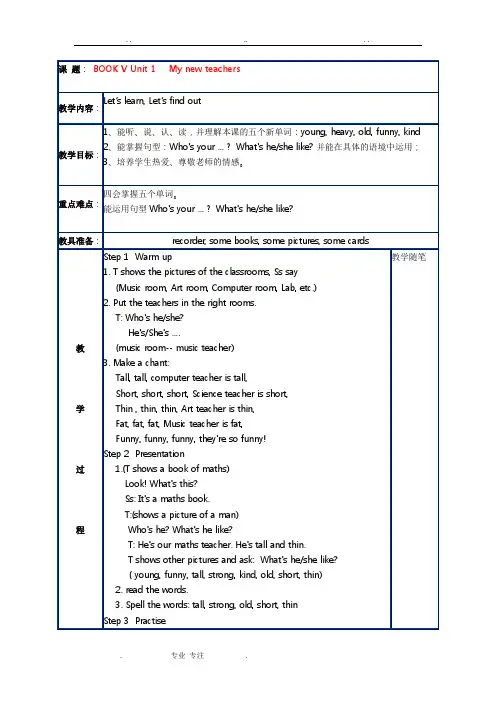
2014五年级英语上册全册教案
Unit 1 what’s he like?第一课时教学目标与要求1、能听、说、认、读,并理解本课的五个新单词:young, heavy, old , funny, kind;2、能掌握句型:Who’s your…? What’s he /she like? 并能在具体的语境中运用;3、培养学生热爱、尊敬老师的情感。
教学重点Let’s learn部分的单词:old,short thin,tall,strong, young, funny, kind 等。
要求学生能听懂句型,并结合这些句子表达的情境,学会恰当地替换句中的单词。
逐步学会听、说、读、写单词:old,short,thin,tall,strong。
教学难点如何利用所提供的对话和情景,以旧引新,让学生进入学习状态。
Let’s start部分在学生用书当中首次出现,教师应正确理解此部分的辅垫作用,可根据实际教学需要进行使用,并帮助学生熟悉教材内容的变化。
教学准备1、准备教学过程中所需要的图片、声音、课件,以及本课时的八张单词卡;2、准备一些教师的照片或图片;3、准备录音机及录音带。
教学方法小组合作法、情景教学法教学过程设计1、Warm-up(热身)(l)播放Let’s start下面歌谣的录音,让学生听歌谣猜单元话题,激发学生对新学期第一单元英语学习的兴趣。
还可以使用四年级上册第三单元学过的句型:“I have a new friend. He’s tall. He’s strong, too.”并结合相关人物的图片,引导学生复习 strong, tall, short,thin等词,为本课时听、说、读、写这些单词做好准备。
(2)日常口语练习,内容可参考如下:T:Hello, everyone! Welcome back to school! Nice to see you!Ss: Nice to meet you!(3)问学生几个问题,引出本课重点内容。
具体会话可参考如下:T:Hi,everyone!Nice to see you again.What grade are you in now?Ss:We’re in Grade 5.T:Do you like your new English books(new classroom, new teacher)?Ss:Yes!T: What are we going to talk about in Unit 1?Guess!What’s the topic of Unit 1?2、 Presentation(新课呈现)(l)出示Let’s start部分图片,介绍说: Rabbit has many new teachers in her school. Do you have new teachers? 引导学生根据情景图的提示描述新教师。
然后说:“今天我们将学习怎样描述新教师。
Sarah将为大家介绍几位新教师,大家在先看一看有哪些是新教师?(2)出示Let’s learn部分的图片,向学生介绍说: They are Sarah’s teachers. Describe these teachers.引导学生结合预习部分回答出 strong, tall, short,thin等旧词,然后结合图卡向学生呈现新词:youny,kind old,funny。
可利用简笔画、单词卡片或实物图片等—一教授新词,使学生正确理解、认读。
(3)可播放单词的声音,让学生在听过一遍后跟读单词,逐步掌握正确的读音。
(4)根据以下信息请学生判断会话中描述的教师是 Let’s learn配图中的哪一位: Mr Hu is the art teacher. What’s he like?He’s short and thin.完成前面铺垫的学习任务,让学生猜出哪位是Sarah的新教师。
再引导学生利用 Let’s learn部分所提供的替换句型,描述Sarah的其他两位新教师,练习巩固所学新词。
(5)试着写单词。
范写四会单词,让学生跟写或在单词卡片背面仿写,达到听、说、读、写四会掌握新词的目的。
3、Let’s play (趣味操练)(1)Let’s find out (找一找)指导学生用所学新词和句型描述Let’s find out部分几位教师的体貌特征,然后找出正确的图片。
完成这项活动后,教师引导学生充分利用八张新词卡片继续进行结对或小组活动,如: My new Chinese teacher is tall and strong. Who is he? 让其他学生选出正确的图片。
(2)Let’s sing (唱一唱)放歌曲“My new teacher”的录音,学生跟唱,进一步在音乐节奏中感知新词。
4、Consolidation and extension(巩固与扩展)(l)让学生做本单元 A Let’s learn部分的活动手册配套练习。
(2)让学生模仿Let’s find out部分的录音,读给朋友或家长听。
展示不同教师的图片,让学生猜出是教哪个科目的教师,然后用所学新词描述这些教师的外貌特征。
(3)让学生参照 Let’s find out部分设计一些谜语让大家清一猜。
可以参考以下语言: She is tall. She’s beautiful. She’s very young. We all like her. Who’s she?(4)让学生把新学的歌曲唱给家长或朋友听。
板书设计Unit 1 what’s he like?old,short thin,tall,strong, oung, funny, kind教学反思Unit 1 what’s he like?第二课时教学目标与要求1、能听懂、会说并在实际情景中运用以下对话:Do you have new teachers?Yes, we have a new English/math/art/science/English/computer/music/P.E. teacher.Who’s your English/math/art/science/English/computer/music/P.E. teacher?Mr. Zhao/Mr Ma/Miss Liu…What’s he/she like?He’s/She’s thin and short. And he’s/she’s very kind.2、了解歌谣的含义,并能吟唱歌谣的内容;3、能将所学的句子运用在游戏当中,并能在实际情景中进行运用。
教学重点本课时的重点掌握句型是: Who’s your math teacher? Mr Zhao.What’s he like?He’s thin and short. He’s very kind要求学生能在相似的情景中完成替换练习,能灵活运用这些句子进行交际。
教学难点Let’s try这一形式在学生用书中第一次出现,但难度不大。
学生即使不能够听懂句子的含义,只要明白关键词语的意思也能找到正确答案。
教师要帮助学生听录音熟悉新词和新句型,感知连读、失去爆破和弱读等语音现象。
初步培养学生的听力技能。
教学准备1、教师准备教学过程中所需要的图片、声音、课件,人物图片最好是能够直接粘贴在黑板上;2、准备一些教师的照片或图片;3、教师准备录音机及录音带。
教学方法情景教学法教学过程设计1、Warm-up(热身)(1)教师放歌曲“My New Teacher”,让学生感知并复习歌曲中语言。
(2)结合画有人物不同相貌特征的教学图片进行关键词的替换,引导学生复习上一课时所学的新词,为本课时学习句型做好准备。
口语练习内容可参考如下:A: Good morning/afternoon. Look! Our math teacher is very young. He’stall and thin.B: This is our music teacher. She’s young. She’s very funny.A: Who’s your art teacher?B: Mr Hu.A: What’s he like?B: He’s short and thin!2、Let’s try and talk (操练)Let’s try反复播放Let’s try部分录音,指导学生根据声音选出图中相应的人物。
在学生根据录音内容圈出所描述教师之后,可让学生看一看他们熟悉老师的图片,用英语说出他们是谁,用句型:“Who’s he/ she? What’s he / she like? ”提问学生。
此后再转入Let’s talk部分对话的详细学习。
教师最好能放一句,停一句,并重复录音中的话语,帮助学生掌握正确的语音、语调。
Let’s talk(1)教师播放Let’s learn A中的四句话(声音见媒体素材的A learn sentences.wav)。
教师说:“这位胡老师又瘦又矮,我们找一找图中的哪位老师又瘦又矮呢?”出示Let’s talk部分的人物图片,让学生快速找出Mr Zhao。
然后教师分别说出教师姓氏: Mr Ma/ Miss Liu….这时先不要求学生描述这些教师,可把该项任务放到对话教学之后。
(2)听录音,跟读Let’s talk部分的对话。
引导学生指现图中的人物Mr Zhao是English teacher, 而录音中的人物说的是math teacher。
(3)教师再次出示人物图片,让学生分别对人物进行描述,可利用句型:“Who’s this man / woman? What’s he/she like?”进行操练,先由教师示范,再结对或分小组进行。
Good to know此部分为选学内容,要求学生了解中西方国家在人名称呼习惯上的不同。
汉语中习惯把姓放首位,名字放在后面。
英语国家的人却习惯把名放在首位,家族的姓氏放在后面,而且有的在两者之间还有中间名(middle name)。
这些不同需要让学生了解。
3、Consolidation and extension(巩固与扩展)(l)让学生做A部分Let’s talk的活动手册配套练习。
(2)让学生默记Let’s talk部分的录音,将内容说给家长或朋友听。
(3)让学生利用新学的文化背景知识,试着与同学进行交流,可分别扮演不同国家的人物。
再用英语写一写自己扮演的名字。
4、小结板书设计Unit 1 what’s he like?Who’s your math teacher?Mr Zhao.What’s he like?He’s thin and short. He’s very kind.教学反思Unit 1 what’s he like?第三课时教学目标与要求1、能听懂、会说本课时单词及词组:principal, university student, strict, smart, active;2、能听懂、会说句型:Who’s …? He’s from…. What’s he like? 并能在情景中进行运用;3、能听懂Let’s chant.的歌谣,并按照节奏来念;4、能运用上节课的词汇进行Pairwork巩固练习;5、能在教师的指导下完成Read and write。
2014新版pep小学英语五年级(上册)(全册)教案
5. Read after the tape.
6. Let's chant.
a. Listen to the tape.
b. chant after the tape.
c. chant together.
Step 3 Consolidation
Step 4 Homework
3、能听懂Let's chant的歌谣,并按照节奏来念。
4、能运用上节课的词汇进行pair work巩固练习。
5、能在教师的指导下完成Read and write.
重点难点:
principal, university student, strict, smart, active
教具准备
1、学生制作的写有形容词和职业名称的卡片。
2. read the words.
3. Spell the words: tall, strong, old, short, thin
Step 3 Practise
1. Make a chant:
My grandma is old, my mother is young,
My father is tall, My little brother is short,
Tall, tall, computer teacher is tall,
Short, short, short, Science teacher is short,
Thin , thin, thin, Art teacher is thin,
Fat, fat, fat, Music teacher is fat,
T: Who's your science teacher?
2014-2015 小学英语 PEP 五年级 上册 教案(最新版)
总结今天所学的内容和德育渗透:树立正确的审美观,避免以貌取人。评出胜利小组。
1,Listen and imitate Let’s talk & learn
2, Copy new words for four times and sentences for two times.
能够在情景中运用句型Is he/she yong/…? What’s he/she like?He/She is kind/…询问并回答某人的性格或外貌特征
能够在语境中理解单词know和句子Do you know Mr Young?的意思,并能正确发音。
能够理解对话大意,按照正确的意群及语音、语调朗读对话,并进行角色扮演
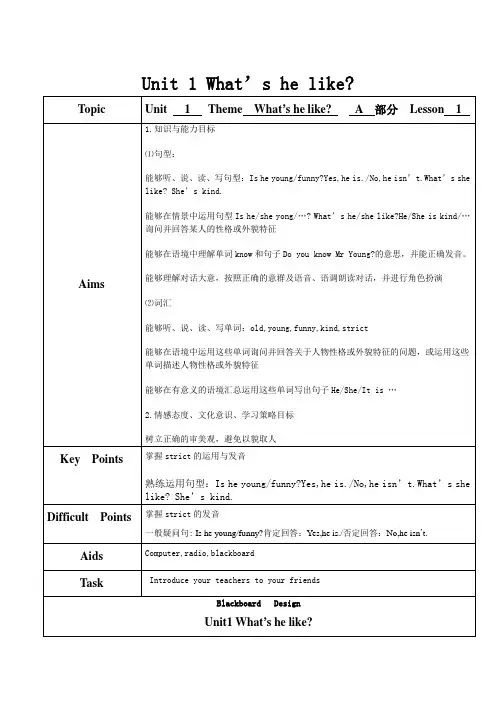
Unit 1 What’s he like?
Topic
Unit1ThemeWhat’s he like?A部分Lesson1
Aims
1.知识与能力目标
⑴句型:
能够听、说、读、写句型:Is he young/funny?Yes,he is./No,he isn’t.What’s she like? She’s kind.
2,读一读,辨一辨。教师一次呈现两张含有字母y的单词卡片,请学生以小组比赛形式。
1,教师呈现几幅图片并给出与本课所学有关的单词,让学生进行对话。
2,完成书本listen,write and say。听录音根据图片将正确的单词写在横线上。补全句子后,可以自行选择自己最喜欢的一句抄写在横线上,并注意知道学生在单线上抄写英语句子的规范格式。
3, Groups Division
2014新版人教版PEP小学英语五年级上册教案

2014新版人教版PEP小学英语五年级上册教案Unit 1 What’s he like?课时:第一课时12345678课时:第四课时910课时:第五课时1112131415Unit2 My week科目及表示人物特征的形容词。
2、知识目标(1)理解A、B部分Read and write 中的会话,并根据提示填充句子或回答问题。
(2)听、说、读、写A、B部分Let’s learn 和Read and write 中的四会单词和句子。
(3)理解Let’s start、Let’s find out、Let’s sing、Let’s chant 和Pair work 等部分的内容。
(4)了解Pronunciation部分的字母组合在单词中的发音,并能熟练读出例词。
(5)了解Task time 、Story time、Good to know等部分的内容。
3、情感、策略、文化等有关目标:(1)情感态度:根据小学高年级阶段学生的特点,引导他们在英语学习过程中更大限度发挥自主学习能力,积极主动地进行英语学习,更好地激发他们英语学习的兴趣。
(2)学习策略:学习过程中注意培养学生合作学习的态度和方法,有效利用学生用书中设计的Pair work 、Group work、Talk and draw 以及Task time部分,培养学生合作学习的意识。
(3)文化目标:了解中西方国家在称呼人名上的不同习惯。
单元教学课时安排: ?stProcedures:1 Lesson:A Let's learn Ask and answer2nd Lesson:A Let's try Let's talk Main sence17181920212223242526272829303132333435Unit 3 What would you like?教学目标1. 掌握A、B部分“Let’s learn”,“Let’s talk”中的词汇和句子。
2014五上英语教案
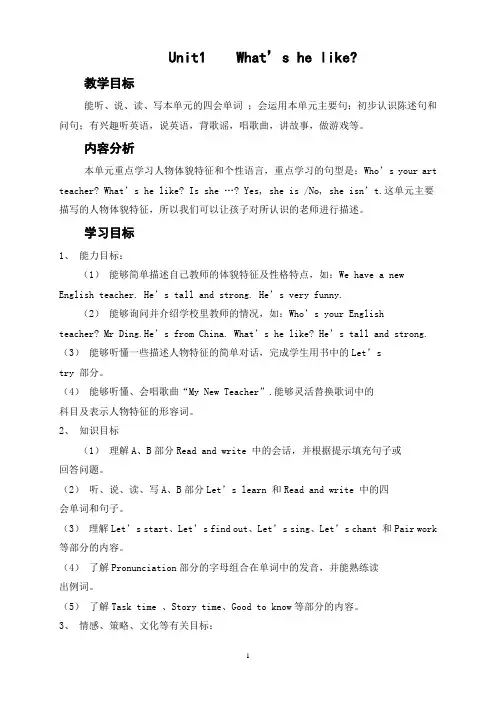
Unit1 What’s he like?教学目标能听、说、读、写本单元的四会单词;会运用本单元主要句;初步认识陈述句和问句;有兴趣听英语,说英语,背歌谣,唱歌曲,讲故事,做游戏等。
内容分析本单元重点学习人物体貌特征和个性语言,重点学习的句型是:Who’s your art teacher? What’s he like? Is she …? Yes, she is /No, she isn’t.这单元主要描写的人物体貌特征,所以我们可以让孩子对所认识的老师进行描述。
学习目标1、能力目标:(1)能够简单描述自己教师的体貌特征及性格特点,如:We have a new English teacher. He’s tall and strong. He’s very funny.(2)能够询问并介绍学校里教师的情况,如:Who’s your Englishteacher? Mr Ding.He’s from China. What’s he like? He’s tall and strong. (3)能够听懂一些描述人物特征的简单对话,完成学生用书中的Let’stry 部分。
(4)能够听懂、会唱歌曲“My New Teacher”.能够灵活替换歌词中的科目及表示人物特征的形容词。
2、知识目标(1)理解A、B部分Read and write 中的会话,并根据提示填充句子或回答问题。
(2)听、说、读、写A、B部分Let’s learn 和Read and write 中的四会单词和句子。
(3)理解Let’s start、Let’s find out、Let’s sing、Let’s chant 和Pair work 等部分的内容。
(4)了解Pronunciation部分的字母组合在单词中的发音,并能熟练读出例词。
(5)了解Task time 、Story time、Good to know等部分的内容。
2014五年级英语上册全册教案
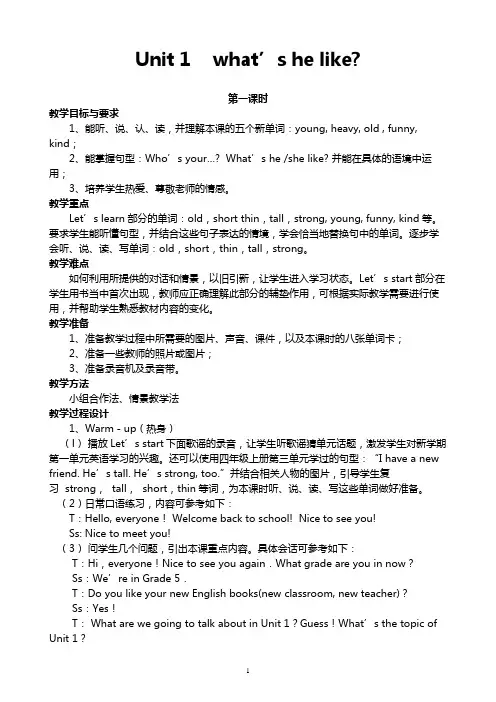
Unit 1 what’s he like?第一课时教学目标与要求1、能听、说、认、读,并理解本课的五个新单词:young, heavy, old , funny, kind;2、能掌握句型:Who’s your…? What’s he /she like? 并能在具体的语境中运用;3、培养学生热爱、尊敬老师的情感。
教学重点Let’s learn部分的单词:old,short thin,tall,strong, young, funny, kind 等。
要求学生能听懂句型,并结合这些句子表达的情境,学会恰当地替换句中的单词。
逐步学会听、说、读、写单词:old,short,thin,tall,strong。
教学难点如何利用所提供的对话和情景,以旧引新,让学生进入学习状态。
Let’s start部分在学生用书当中首次出现,教师应正确理解此部分的辅垫作用,可根据实际教学需要进行使用,并帮助学生熟悉教材内容的变化。
教学准备1、准备教学过程中所需要的图片、声音、课件,以及本课时的八张单词卡;2、准备一些教师的照片或图片;3、准备录音机及录音带。
教学方法小组合作法、情景教学法教学过程设计1、Warm-up(热身)(l)播放Let’s start下面歌谣的录音,让学生听歌谣猜单元话题,激发学生对新学期第一单元英语学习的兴趣。
还可以使用四年级上册第三单元学过的句型:“I have a new friend. He’s tall. He’s strong, too.”并结合相关人物的图片,引导学生复习 strong, tall, short,thin等词,为本课时听、说、读、写这些单词做好准备。
(2)日常口语练习,内容可参考如下:T:Hello, everyone! Welcome back to school! Nice to see you!Ss: Nice to meet you!(3)问学生几个问题,引出本课重点内容。
2014年新版译林版五年级英语上册全册教案

2014年新版译林版五年级英语上册全册教案璇?棰?Unit1 Goldilocks and three bears 鏁?瀛?鐩?鏍?1. learn the vocabulary: Goldilocks, forest, soup, just right, hard, soft, afraid, bears, in front of. 2. Learn the sentences: There is/are 鈥? 3. Train Ss enjoy the fun of this story. 閲嶇偣闅剧偣1. learn the vocabulary: Goldilocks, forest, soup, just right, hard, soft, afraid, bears, in front of. 2. Learn the sentences: There is/are 鈥??鏁欏笀娲诲姩瀛︾敓娲诲姩Step1 Warming-up T: Boys and girls, welcome back to school. Nice to see you again! S: Nice to see you, too. Thank you T: What鈥檚this? S: It鈥檚a box. T: Where is it? S: It鈥檚on the desk. T: There is a box on the desk. T: What are these? S: They鈥檙e pencils T: Where re they? S: They鈥檙e in the pencil case. T: There are some pencils in the pencil case. Step2 Presentation T: Look at the picture, who are they? They鈥檙e goldilocks and three bears. Learn the words: goldilocks, bears T: What are they doing? Let鈥檚watch the cartoon. Watch the cartoon Ask some questions and show the forms: Answer the questions and fill the forms Name-Goldilocks-in the forest, in ahouse-hungry and thirsty-some soup-on the table-too hot, too cold, justright-tired-three beds-too hard, too soft, just right-afraid-three bears in front of her Show the words: forest, soup, just right, afraid, hard, soft, in front of her and teach them Learn the new words T: What happened at the end? Please guess! S: 鈥? Step3 Practice Read the new words. Read the new words. Listen to the tape and notice the pronunciations and intonations Listen to the tape and notice Read after the tape. Read after the tape. Try to read the text. Try to read the text. Read the text together. Read the text together. Choose one kind of reading and act it. Choose and act it. Act the story. Act the story. Step4 Consolidation Describe the classroom: There is/are 鈥?on/in/ 鈥? Describe the classroom Step5 Homework 1. Copy the new words andsentences. 2. Read, recite and act this story.鏉?涔?璁?璁?Unit1 Goldilocks and three bears in the forest hungry and thirsty some soup hot-cold just in a house tired three beds hard-soft right afraid three bears in front of her There is 鈥? on the table There are 鈥? in the room 璇?鍓?鍑?澶?cards, pictures, tape, recorder 璇?鍚?灏?缁?璇?棰?Unit1 Goldilocks and three bears 鏁?瀛?鐩?鏍?1. learn the vocabulary: beside, between. 2. Learn the grammar of sentences: There is/are 鈥? 3.Train Ss can use the sentences: There is/are 鈥?correctly 4. Review the words about feelings 鏁閲嶇偣闅剧偣1. learn the vocabulary: beside, between. 2. Learn the grammar of sentences: There is/are 鈥? 3.Train Ss can use the sentences: Thereis/are 鈥?correctly ?鏁欏笀娲诲姩瀛︾敓娲诲姩Step1 Warming-up T: At first, let鈥檚read the story together. Read the story. T: Read this story in roles. Read this story in roles. T: Act this dialogue, please. Act this dialogue. Talk about the learning tip. Learn the tip. Step2 Presentation T: What鈥檚this? S: It鈥檚a bag. T: Where is it? You may say 鈥淚t 鈥檚between the desks.鈥?(Teach: between) Learn the vocabulary. T: What are these? S: They鈥檙e apples. T: Where are they? You may say 鈥淭hey鈥檙e beside the bag. Teach: beside Learn the vocabulary Read the new words. Read the new words. Look at these pictures. Look at these pictures. Talk about these pictures and repeat this story Talk about these pictures and repeat this story Check the answers.(b, c, f, d, a, e) Check the answers. Look and talk about the pictures. Look and talk about them. Try to say them: There鈥檚a house in the forest. There鈥檚some soup in the table. There are three beds in the room. There are three bears in front of me. Try to say them. Check and write these sentences. Check and write. Look at the picture. Look at the picture. Say the rules about it. Say the rules about it. Draw the picture. Draw the picture. Talk about one鈥檚picture. Talk about one鈥檚picture. Read and act the story again. Read and act the story again. Look at the words andsentences. Look at the words and sentences. Try to say them. Try to say them. Check and write these sentences. Check and write them. Review the old words about feelings. Review the old words. Step3 Consolidation Describe my bedroom: Thereis/are 鈥?on/in/ 鈥? Describe the bedroom Step4 Homework 1. Copy the new sentences. 2. Describe my bedroom by oneself..鏉?涔?璁?璁?Unit1 Goldilocks and three bears There is 鈥? beside between There are 鈥? 璇?鍓?鍑?澶?cards, pictures, tape, recorder 璇?鍚?灏?缁?璇?棰?Unit1 Goldilocks and three bears 鏁?瀛?鐩?鏍?1. Learn the word: tool, doctor, says, put on, cannot, find, their, really. 2. Learn the sentences: There aren鈥檛any 鈥? Here are 鈥? XX can 鈥? 3. Learn the phonetic of the letter 鈥渃鈥? 4. Enjoy this cartoon story. 閲嶇偣闅剧偣1. Learn the words: tool, doctor, say, put on, cannot, find, their, really. 2. Learn the sentences: There aren鈥檛any 鈥? Here are 鈥? XX can 鈥? 3. Learn the phonetic of the letter 鈥渃鈥?规硶?鏁欏笀娲诲姩瀛︾敓娲诲姩Step1 Warming-up T: Let鈥檚describe our classrooms or our schoolbags, OK? Describe classrooms or schoolbags. Read and recite the new words. Read and recite the new words. Write some sentences about places. Write some sentences. Step2 Presentation T: Look at the picture, please. Look at the picture. Listen to the tape. Listen to the tape. Teach the new words: tool, doctor, says, put on Learn the new words. Find the same letter 鈥渃鈥? Find the same letter 鈥渃鈥? Read the phonetic /k/. Read the phonetic /k/. Read the short text. Read the short text. Act the short text. Act the short text. Find the other words. Find the other words. Do some exercises. Do some exercises. T: Look at the picture, who are they? S: They鈥檙e Bobby and Tina. T: What are they saying? Let鈥檚watch the cartoon, please. Watch the cartoon. Ask and answer, then fill in the forms. Ask, answer and fillBobby-hungry-some cakes-in the kitchen, in the fridge Teach the new words: cannot, find, their, really Learn the new words. Teach the new sentences: There aren鈥檛any 鈥? Here are 鈥? Learn the new sentences. T: Read the new words and sentences, please. Read the new words and sentences. Listen to the tape and read after it, then notice the pronunciations and intonations. Listen and read, then notice the pronunciations and intonations. Read it together. Read it together. Act the dialogue. Act the dialogue. Step3 Consolidation Make some sentences: There isn鈥檛/aren鈥檛鈥? Here is/are 鈥? Make some sentences. Step4 Homework 1. Copy the new sentences. 2. Read, recite and act this cartoon story.鏉?涔?璁?璁?Unit1 Goldilocks and three bears There isn鈥檛鈥? aren鈥檛鈥? C -/k/ cannot=can鈥檛really find their Here is 鈥? are 鈥? 璇?鍓?鍑?澶?cards, pictures, tape, recorder 璇?鍚?灏?缁?璇?棰?Unit1 Goldilocks and three bears 鏁?瀛?鐩?鏍?1. Review the vocabulary and patterns of this unit. 2. Learn the different drinks culture in western countries and China. 3. Learn how to describe the places correctly. 4. Appraise the harvest about this unit. 閲嶇偣闅剧偣1. Review the vocabulary and patterns of this unit. 2. Learn the different drinks culture in western countries and China. 3. Learn how to describe the places correctly.?鏁欏笀娲诲姩瀛︾敓娲诲姩Step1 Warming-up Greetings and free talk. Greetings and free talk. Read, recite and act this cartoon story. Read, recite and act Do some exercises about the phonetic /k/ Do some exercises. Enjoy and act the cartoon story. Enjoy and act. Step2 Presentation T: What鈥檚this? S: Coffee. T: What鈥檚that? S: Tea. Guess: Who is it for? Guess. Ask and answer: Ask and answer. Coffee is popular in western countries. Tea is popular in China. Teach the new words: popular, western countries, culture, China Learn the new words. Read the sentences. Read the sentences. Say the different drinks culture. Say the different drinks culture. Look at the picture. Look at the picture. T: Talk about the picture in groups, please. Talk about the picture in groups. Check and write the sentences: Check and write. I鈥檓in the living room.There is a table. There are some books on the table. There are some toy cars under the table. There is a chair beside the table. There are three umbrellas in front of the window. Oh, there is a bear on the chair. Look at the pictures. Look at the pictures. T: Talk about the pictures in groups, please. Talk about the pictures in groups. Check and write the sentences: Check and write. There are some apples on the table. There is some orange juice in the glass. There is a bird in the tree. There are some sweets in the box. Review this unit. Review this unit. Appraise the harvest of this unit. Appraise the harvest. Step3 Consolidation Total the stars. Total the stars. Teach: There be鈥?(灏辫繎鍘熷垯) Learn: There be 鈥?(灏辫繎鍘熷垯) Step4 Homework 1. Copy the new sentences. 2. Read, recite and act this cartoon story.鏉?涔?璁?璁?Unit1 Goldilocks and three bears Coffee is popular in western countries. Tea is popular in China.There is 鈥? 灏辫繎There are 鈥? 鍘熷垯璇?鍓?鍑?澶?cards, pictures, tape, recorder 璇?鍚?灏?缁?璇?棰?Unit2 A new student 鏁?瀛?鐩?鏍?1. Learn the vocabulary: classroom, table tennis room, computer room, music room, on the first/second/third floor, show her around 2. Learn the patterns: How many are there 鈥? Is/Are there any鈥? Yes, there is/are.閲嶇偣闅剧偣Learn the vocabulary: classroom, table tennis room, computer room, music room, on the first/second/third floor, show her around and patterns: How many are there 鈥? Is/Are there any鈥? Yes, there 鈥?硶?鏁欏笀娲诲姩瀛︾敓娲诲姩Step1 Warming-up Greetings and free talk. Greetings and free talk. T: What鈥檚in our classroom? S: There is/are 鈥? Recite some vocabulary. Recite some vocabulary. Check the answers. Check the answers. Step2 Presentation T: Look, who are they? S: Yang Ling and Miss Li. T: This is Nancy Black. She鈥檚Yang Ling鈥檚friend. She鈥檚a new student. Learn: Nancy Black, a new student T: Can you show her around? S:Yes! Teach: show her around Learn: show her around T: What happened? Let鈥檚watch the cartoon, please. Watch the cartoon. Ask and answer the questions, thenfill the forms. Ask, answer the questions and fill the forms. classrooms-24-our classroom-on the second floor two computer rooms, a library-on the third floor a music room, a table tennis room-on the first floor Listen to the tape and notice the pronunciations and intonations. Listen and notice. Try to read the dialogue. Try to read Read the story together. Read the story together. Choose one kind of reading and read in groups. Choose one kind of reading and read in groups. Read this story in roles. Read this story in roles. Act the dialogue. Act the dialogue. Step3 Consolidation Read the new words and sentences. Read the new words and sentences. T: Is there a blackboard in our classroom? S: Yes. T: Are there any pencils in your pencil case? S: Yes Teach: Is/Are there 鈥? Learn: Is/Are there 鈥? Describe something: Is there 鈥? Yes, there is. Are there any 鈥? Yes, there are. Describe something. Step4 Homework 1. Copy the new vocabulary. 2. Read, recite and act this story.鏉?涔?璁?璁?Unit2 A new student How many 鈥? There are 鈥? Is there 鈥? Yes, there is. Are there any 鈥? Yes, there are our classroom on the second floor a library and two computer rooms on the third floor a music room, a table tennis room on the first floor 璇?鍓?鍑?澶?cards, pictures, tape, recorder 璇?鍚?灏?缁?璇?棰?Unit2 A new student 鏁?瀛?鐩?鏍?1. Learn the vocabulary: Art room, library, playground. 2. Learn the patterns: How many are there 鈥? Is/Are there any鈥? Yes, there is/are. 3. Train Ss can use the ordinal numbers and 鈥淚s/Are there 鈥? 鏁欏閲嶇偣闅剧偣1. Learn the patterns: How many are there 鈥? Is/Are there any 鈥? Yes, there is/are. 2. Train Ss can use the ordinal numbers and 鈥淚s/Are there 鈥? ?鏁欏笀娲诲姩瀛︾敓娲诲姩Step1 Warming-up Greetings and free talk. Greetings and free talk. Read this story. Read this story. Recite some vocabulary. Recite some vocabulary. Act this story in roles. Act this story in roles. Step2 Presentation T: Look, what鈥檚this? You maysay 鈥淎rt room鈥?鈥? Guess. 鈥? Teach: art room, playground, library Learn the new words Look at the pictures. Look at the pictures. Read the words. Read the words. Ask and answer: Where鈥檚the 鈥? It鈥檚on the 鈥?floor. Ask and answer. Check and write the sentences. Check and write. There is/are 鈥?in our school. It鈥檚/They鈥檙e on the 鈥?floor. Teach the new words: one-first,two-second, three-third Learn the new words Ask and answer: Is/Are there 鈥?Yes/No, 鈥? Ask and answer. Look at the sentences. Look at the sentences. Teach words: isn鈥檛=is not, aren鈥檛=are not, It鈥檚=It is, They鈥檙e=They are Learn the new words. Ask and answer: How many 鈥?are there? There is/are 鈥?in our school. Ask and answer. Read the sentences. Read the sentences. Complete the grammar of 鈥渢here鈥? Complete the grammar. Look at the picture. Look at the picture. Talk about the picture, then ask and answer: How many 鈥?are there?Is/Are there 鈥? It鈥檚/They鈥檙e on the 鈥?floor. Talk about the picture, then ask and answer. Check the answers. Check the answers. Step3 Consolidation Make some dialogues: This is our school. There is/are 鈥?in our school. It鈥檚/They鈥檙e on the 鈥?floor. Make some dialogues. Teach: Is/Are there 鈥? Yes/No, there is/isn 鈥檛/are/aren鈥檛. Learn the sentences 鈥渢here鈥?Step4 Homework 1. Copy the new vocabulary. 2. Describe our school to parents and friends.。
2014最新人教版小学五年级英语上册全册教案
Unit one What’s he like?Lesson 1一.教学内容Main scene Part A (let’s try let’s talk)二.教学目标1.能正确听,说,朗读“Who is ...?-- He/She is...What’s he/she like? -- He/She is... Is he/she…?--Yes,he/she is. No, he/she isn’t.”2.能正确听,说,认读表示人物外貌与性格特征的形容词old ,young,funny,kind,strict,polite,hard-working,clever.3.能听懂,会说,会表演Let’s talk 的内容并在真实场景中运用。
三.教学重难点重点:学生能够表演Main scene 和let’s talk的交际内容,能够根据实际情况用英语讨论他人外貌与性格特征。
难点:用英语准确询问并回答人物特征,如:“Who is …? He/She is…What’s he/she like? He/She is …Is he/she…?Yes,he/she is. No, he/she isn’t.”四.课前准备教师自制的单词卡、录音机、录音带五.教学过程Step1. Warming-up1.Let’s look and say the names.(教师出示本单元通过多媒体播放一些卡通图片,分别展示年老,年轻,滑稽,有礼貌,工作努力,聪明,严格等外貌与性格特征,让学生认读,说一说这是谁,怎么样。
)2.Let’s listen and sing”Who’s your teacher?”Step2. Presentation1.学习Main scene(1)出示Main scene中的部分教学挂图,让学生观察。
(2)看图回答问题。
Dialogue1: Who can you see in the picture?(Wu Yifan,Amy,Oliver and a teacher.)Dialogue2: What are they talking about?(The teacher introduces classmates to each other.)Dialogue2:Who is a new student?(Oliver)(3)听录音,模仿朗读,理解对话内容。
2014PEP小学英语五年级上册全册教案表格式
Step5 Homework
1,Greetings
2,Free talk:Who’s your Chinese teacher?Is he/she strict?Is he/she funny?Who is funny in your class?
1,教师呈现一张图片:一个动作滑稽可爱的小娃娃。教师引导学生说little baby,并采用自然拼读法进行操练。
⑵词汇
能够听、说、读、写单词:old,young,funny,kind,strict
能够在语境中运用这些单词询问并回答关于人物性格或外貌特征的问题,或运用这些单词描述人物性格或外貌特征
能够在有意义的语境汇总运用这些单词写出句子He/She/It is…
2.情感态度、文化意识、学习策略目标
树立正确的审美观,避免以貌取人
8,listen and imitate
9, We know Mr Young is a musicteacher? Who is Zhang Peng’s science teacher? Miss Green.Is she…?引出kind。
10,Mr Li is a maths teacher.Is he…?引出strict
A:She likes Chinese and music.
B:She is kind,but sometimes she is strict.
请学生总结:字母-y的发音规则,即-y在单词词尾发/i/
完成活动手册相应部分
复习旧知
运用现在新教材倡导的自然拼读法
字母-y的发音规则,即-y在单词词尾发/i/
拓展旧单词,增加印象
增强音形义间的联系
最后落实到写。强调书写三大规则
2014-2015 小学英语 PEP 五年级 上册 教案
歌曲热身,活跃课堂气氛,为新知识铺垫
引入小组竞赛机制激发学习兴趣
Let’s try为Let’s talk做铺垫
Old new对比
通过各种方式操练单词
让学生听音模仿,掌握正确的意群及语音、语调
通过现实生活中的例子操练加强印象
11,Talk about your teachers and Ask and answer
12,反义词大比拼:课件一次呈现两个单词,如果两个单词是反义词,学生就大声读出,反之,不读.将学生分为两组,一组读一个单词.
13,拼单词:呈现一些打乱顺序的单词,学生比赛最快拼出单词.
14,教师举现实生活中的例子进行句型操练.
2,读一读,辨一辨。教师一次呈现两张含有字母y的单词卡片,请学生以小组比赛形式。
1,教师呈现几幅图片并给出与本课所学有关的单词,让学生进行对话。
2,完成书本listen,write and say。听录音根据图片将正确的单词写在横线上。补全句子后,可以自行选择自己最喜欢的一句抄写在横线上,并注意知道学生在单线上抄写英语句子的规范格式。
树立正确的审美观,避免以貌取人
Key Points
掌握hard-working的书写,shy的发音
熟练运用句型:What’s Wu Yifan like? He’s hard-working.
Difficult Points
掌握hard-working的书写,shy的发音
熟练运用句型:What’s Wu Yifan like? He’s hard-working.
Step3
Production
Step4 Summary
2014新人教版五年级上册英语全册教案
Unit 5 There is a big bed.第四课时教学目标及要求1、能够听、说、读、写单词:in,on,under,behind,near;2、能够听、说、认读单词:over,in front of和句子Where’s the…? It’s…并能在情景中正确运用。
教学重点1、能听、说、读、写单词:in, on, under, behind, near;2、能够听说认读单词:over, in front of和句子“Where is …? It’s ….”,并能在一定情景中正确运用。
教学难点熟练掌握七个方位介词的用法,特别是“in front of”。
教学准备1、教师准备教学过程中所需要的图片、声音和课件;2、教师准备录音机及录音带。
教学方法小组合作法比较辨别法,听录音跟读教学法教学过程设计1、Warm—up(热身)(1)唱一唱①教师播放歌曲“I am a boy and you are a girl.”两遍,学生小声跟唱。
②教师领读歌词后,学生大声跟唱,并鼓励学生加些动作。
2、Presentation(新课呈现)(1)学一学①教师出示图中“in”的图,问学生:“Where is the ball?”,领读“in”。
②教师请学生用“in”说一说他们的铅笔在哪里。
学生可以把铅笔放在任意一样东西的里面说,如:It’s in the pencil-box. It’s in the desk. It’s in my hand.等等。
③用同样的方法学习“on”和“under”,强调字母O和U在单词中的发音。
④教师分别给出“behind, near, over, in front of”四个单词及其图片。
教师边读边把图放到相应的单词旁,让学生理解其意,也加深印象。
⑤教师提问学生:“Where is the pencil?”,学生这回可以把铅笔放在任意一地,回答道:“My pencil is on the chair. It’s in front of the pencil-case”等等。