
五年级上册英语教案Unit 6 My efriend(第1课时)译林版(三起)
Unit 6 My e-friend教学内容:Story time第一课时教学目标:1. 能听懂、会读、会说单词:e-friend,send,to,email,live,study,China,UK,…years old,wait.2. 能听懂、会读、会说日常用语:Does he/she…?Yes,he/she does. No,he/she doesn’t. Wait a minute.3. 能正确的理解并朗读课文,在教师的引导和帮助下尝试复述课文内容。
4. 能初步运用本课所学的词汇和句型对自己的朋友或者网友进行综合全面的介绍。
教学重点:能正确理解并朗读课文,在教师的帮助下尝试复述课文。
教学难点:能初步运用本课所学的词汇和句型对自己的朋友或者网友进行综合全面的介绍。
教学准备:PPT教学设计:Step 1 : Greeting1. Greeting. Good morning,boys and girls. Nice to see you. I’m your new teacher today. Let’s know each other first. Can you ask me any questions?2. I like reading. I can learn a lot from the books. And I like surfing the Internet.3. What can we do on the Internet? Send emails.Teach “Send emails” Who do I send the email to?Step 2 : PresentationI can send the email to my e-friend. Today we’ll learn Unit 6 My e-friend.1. Look at the picture. Who are they?Ss: They’re Liu Tao and Wang Bing..T: Who has an e-friend?Wang Bing has an e-friend. Why?2.Watch and answerT: Liu Tao wants to k now Wang Bing’s e-friend. Do you want to know him ?学生边问边出示问题并板书a.Who is Wang Bing’s e-friend ?b.How old is he ?c.What subjects does he like?d.What does he like doing?学生自己回答并板书: He's Peter. He's 11 years old. He likes Maths and PE. He likes playing football and swimming . Teach: UK,…years old,live,3.Read and findT: About Peter,do you have anyother questions about him?(让学生根据图片,试着提出问题)T:Group one(分组读出问题) (Where does he live? How old is he? What subjects does he like? What does he do after school? What does he like doing ?见书上60页)T: Please read your books and find the answers.(让学生Teach: study He studies Chinese after school.3..Listen and repeat. (朗读的过程中注意提醒学生模仿一般疑问句和特殊疑问句的语调)4.Try to say:Think and say P60: Now ,can you say something about Peter? Let’s think and say. Peter is … e-friend.He lives in …He’s … years old.He .. speak Chinese.He … Chinese lessons at school.He studies Chinese …He likes …He likes playing …5.Let’s PK. You can choose one to do.(A)Peter is … e-friend. He lives in …He’s … years old.He … speak Chinese.He … Maths and PE.He … Chinese lessons at school.He studies Chinese …He likes playing …(B)UK 11 speak Chinese and English like playing football,swimming like Maths and PE study Chinese PeterStep 3 : Consolidation1. Try to describe.T: I have an e-friend. She’s … She lives in the US. She is 29 years old. She studies Chinese at weekends. She likes Art and Music. She likes reading and swimming. We have the same hobby. What is it?Do you have any e-friends?OK. Please introduce your e-friend..But some of don’t have e-friends. Don’t worry. Let’s join the E-friend Club and make some e-friends there.First,read the passages as quickly as you can. (profiles)Then,choose one to be your e-friend and get some information about him.Finally,report like this.家庭是幼儿语言活动的重要环境,为了与家长配合做好幼儿阅读训练工作,孩子一入园就召开家长会,给家长提出早期抓好幼儿阅读的要求。
我把幼儿在园里的阅读活动及阅读情况及时传递给家长,要求孩子回家向家长朗诵儿歌,表演故事。
我和家长共同配合,一道训练,幼儿的阅读能力提高很快。
I want to make e-friends with… Because …Step4 SummaryE-friends should help each other. E-friends should learn from each other. E-friends should share with each other. What is an e-friend? (看动画)Step 5Homework1.Read the story time and try to retell.读熟Stoty time并试着复述。
2..Know more national flags and share with your classmates. 认识更多国旗并和同学们一起分享。
3.结合本课所学语言知识,描述下你的好朋友,可以从姓名、年龄、兴趣和喜爱的学科等方面介绍。
不少于5句话。
带上他/她的照片,下节课交流教学反思:这一课的主要内容是学习用句型“Do you/they have an e-friend? Do you/they like swimming? Does he/she have Chinese lessons? Does he/she likesinging?”“What subjects do you/they like? What subjects does he7she like?”“Yes,I/they do. Yes,he/she does. No,l/they don't,he/she doesn't.”“I/they like….He/she likes…”谈论朋友的情况,这些知识在我们的日常生活中非常常见。
因此在学习时,让学生通过谈论朋友的爱好来进行学习会让学生更容易地掌握所学知识。
本课的新课呈现环节以及谈话内容就充分地让学生在熟悉新句型的情况下谈论自己朋友的情况,这种方式很适合小学生的心理,让他们在浓厚的兴趣中对本课的知识学以致用。
本课在呈现课文分三部分,第一部,观察图片,找出谁有网友.第二陪,自己提问题,看动画回答并板书.第三部,读课文回答问题.通过这三部,教学课文.小学生活泼好动,注意力集中时间有限,因此教师利用PK游戏练习,让学生在愉快的氛围中巩固知识.最后,带领学生进入万分网友俱乐部,让学生学以致用,学生很有兴趣.教学中,正确优美的示范,能激发学生的朗读兴趣。
教师必须不断学习,不断练习,以自身优美、纯正的语音、语调感染、熏陶学生,给学生美的享受,从而引起学生的朗读欲望。
在教师示范的时候要让学生静听并注意观察口形。
但由于小学生年龄小,理解能力相对较低,让学生真正用心听录音就显得比较困难,这就需要教师在日常教学中从小处、细处入手,培养学生的倾听能力。
单靠“死”记还不行,还得“活”用,姑且称之为“先死后活”吧。
让学生把一周看到或听到的新鲜事记下来,摒弃那些假话套话空话,写出自己的真情实感,篇幅可长可短,并要求运用积累的成语、名言警句等,定期检查点评,选择优秀篇目在班里朗读或展出。
这样,即巩固了所学的材料,又锻炼了学生的写作能力,同时还培养了学生的观察能力、思维能力等等,达到“一石多鸟”的效果。
与当今“教师”一称最接近的“老师”概念,最早也要追溯至宋元时期。
金代元好问《示侄孙伯安》诗云:“伯安入小学,颖悟非凡貌,属句有夙性,说字惊老师。
”于是看,宋元时期小学教师被称为“老师”有案可稽。
清代称主考官也为“老师”,而一般学堂里的先生则称为“教师”或“教习”。
可见,“教师”一说是比较晚的事了。
如今体会,“教师”的含义比之“老师”一说,具有资历和学识程度上较低一些的差别。
(译林版)五上 Unit 6 My e-friend(story)优秀教案
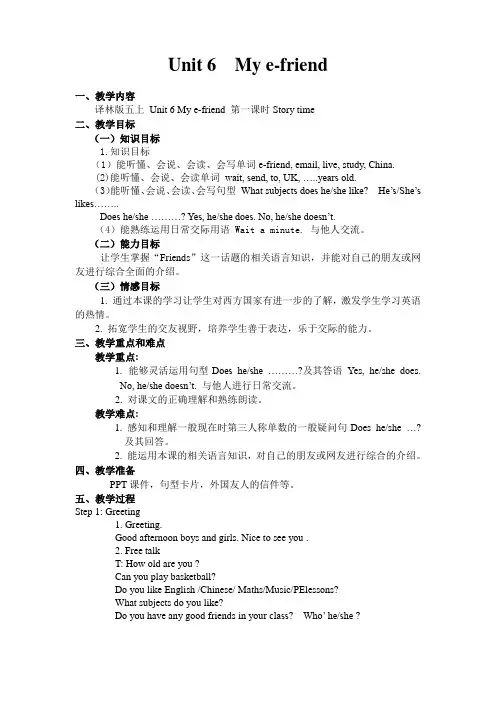
Unit 6 My e-friend一、教学内容译林版五上Unit 6 My e-friend 第一课时Story time二、教学目标(一)知识目标1.知识目标(1)能听懂、会说、会读、会写单词e-friend, email, live, study, China.(2)能听懂、会说、会读单词wait, send, to, UK, …..years old.(3)能听懂、会说、会读、会写句型What s ubjects does he/she like? He’s/She’s likes……..Does he/she ………? Yes, he/she does. No, he/she doesn’t.(4)能熟练运用日常交际用语 Wait a minute. 与他人交流。
(二)能力目标让学生掌握“Friends”这一话题的相关语言知识,并能对自己的朋友或网友进行综合全面的介绍。
(三)情感目标1. 通过本课的学习让学生对西方国家有进一步的了解,激发学生学习英语的热情。
2. 拓宽学生的交友视野,培养学生善于表达,乐于交际的能力。
三、教学重点和难点教学重点:1.能够灵活运用句型Does he/she ………?及其答语Yes, he/she does.No, he/she doesn’t. 与他人进行日常交流。
2. 对课文的正确理解和熟练朗读。
教学难点:1. 感知和理解一般现在时第三人称单数的一般疑问句Does he/she …?及其回答。
2. 能运用本课的相关语言知识,对自己的朋友或网友进行综合的介绍。
四、教学准备PPT课件,句型卡片,外国友人的信件等。
五、教学过程Step 1: Greeting1. Greeting.Good afternoon boys and girls. Nice to see you .2. Free talkT: How old are you ?Can you play basketball?Do you like English /Chinese/ Maths/Music/PElessons?What subjects do you like?Do you have any good friends in you r class? Who’ he/she ?Do you have an e-friend?(通过谈话导入课题,板书e-friend,)T: Wait a minute. Before we have this lesson, let’s play a game first. (板书Waita minute 并教授)3. Playing a game。
译林版(三起)五年级上册英语教学设计:Unit6Mye-friend
译林版(三起)五年级上册英语教学设计:Unit 6 My efriend一、教学目标1. 知识与技能:(1)能正确听、说、读、写单词:different, Russian, same, interesting, subject。
(2)能正确听、说、读句子:He is from He lives in He speaks He is in His favourite subject is(3)能理解并在适当的情境中熟练运用句型:He is from Helives in He speaks He is in His favourite subject is 描述人物。
2. 过程与方法:通过图片、情景创设等形式,培养学生的观察能力、思维能力和表达能力。
3. 情感态度与价值观:培养学生对英语学科的兴趣,增强合作意识,提高跨文化交际意识。
二、教学内容1. 词汇:different, Russian, same, interesting, subject。
2. 句型:He is from He lives in He speaks He is in His favourite subject is3. 语法:描述人物的国家、居住地、语言、年级和最喜欢的学科。
三、教学重点与难点1. 重点:词汇different, Russian, same, interesting,subject的正确运用;句型He is from He lives in He speaks Heis in His favourite subject is 的理解和运用。
2. 难点:正确运用词汇和句型描述人物的国家、居住地、语言、年级和最喜欢的学科。
四、教具与学具准备1. 教具:多媒体设备、PPT、单词卡片、图片等。
2. 学具:课本、练习本、笔等。
五、教学过程1. 导入(1)播放英文歌曲,营造英语学习氛围。
(2)展示与本节课相关的图片,引导学生预测本节课内容。
五年级上册英语教案-Unit 6 My e-friend(第一课时) 译林版(三起)
五年级上册英语教案-Unit 6 My e-friend(第一课时)译林版(三起)本教案是五年级上册英语教材中Unit 6的教案,针对译林版(三起)教材设计。
教学目标1.能够用英语熟练地描述自己的电子朋友2.能够用英语简单描述自己电子朋友的外形特征和性格特点3.能够通过听和说理解并掌握本课的语言知识点教学重点1.掌握本节课所涉及的词汇和表达方式2.通过听力和口语训练,能够运用所学知识描述和交流教学准备教师:教材Unit 6、录音机、图片、电子词典学生:课本、笔、作业本教学过程Step 1:Warming-up通过学生之间的交流,引出主题“e-friend”。
Example:T: Hello, class! How are you doing today?Ss: Fine.T: Great. Today we are going to talk about e-friends. Do you know what it means?S1: Yes, e-friend is a friend we meet on the internet.S2: I have an e-friend who lives in America.S3: My e-friend likes the same things as I do.…T: That’s right. So let’s talk about our e-friends today.Step 2:Presentation1.显示图片,简单介绍自己的电子朋友,询问学生是否了解和拥有电子朋友。
Example:T: Here is my e-friend. This is a picture of her. She is a girl, and she lives in Canada. Her name is Emily. Do you have an e-friend like Emily?Ss: Yes.T: Great. Can you describe your e-friend?2.引导学生了解自己电子朋友的外形特征和性格特点,展示相关图片,让学生学会描述和表达。
译林版(三起)五年级上册英语说课稿:Unit6 My e-friend(第1课时)

译林版(三起)五年级上册英语说课稿:Unit6 My e-friend(第1课时)一、教学背景该说课稿针对的是译林版(三起)五年级上册英语课程,教学内容为Unit6 My e-friend(第1课时)。
该单元主要围绕着介绍虚拟宠物的相关知识,培养学生的口语交际能力,帮助学生掌握有关虚拟宠物的基本英语表达。
二、教学目标1.知识目标•能够熟练掌握虚拟宠物的基本英语表达方式。
•能够通过口语表达与他人交流有关虚拟宠物的信息。
2.能力目标•能够逐步提升学生的口语表达能力,自信开口表达。
•培养学生的独立思考能力,让他们能够自主地进行口语交流。
3.情感目标•培养学生对虚拟宠物的兴趣,激发他们对英语学习的兴趣和热爱。
三、教学重难点1.教学重点•虚拟宠物的基本英语表达方式。
•同龄人之间的口语交流能力的提升。
2.教学难点•原汁原味的口语表达,让学生更有自信地表达自己的想法和看法。
四、教学内容和步骤1. 教学内容•学习虚拟宠物的基本知识及英语表达方式。
•模拟情境,让学生进行口语交流。
2. 教学步骤Step1. Warming up (1) Greet the students. (2) Review the previous lesson. (3) Lead in Unit 6 My E-friendStep2. Presentation (1) Show pictures and videos of virtual pets to students, and help them understand what virtual pets are. (2) Introduce the basic knowledge about virtual pets, such as how to feed them, how to play with them, etc. (3) Teach students some useful English expressions about virtual pets, such as。
Unit6 My e-friend (Period 1)(教案)译林版(三起)英语五年级上册

Unit6 My e-friend (Period 1)教案Teaching AimsBy the end of the lesson, students should be able to:•Understand the concept of e-friend•Learn and practice new vocabulary related to e-friends•Use third person singular present tense to talk about e-friends •Develop their speaking and listening skills through communication with their classmatesTeaching TasksTask 1: Warm-up (5 min)•Greet students and introduce the topic of the day•Ask some warm-up questions to activate students’ prior knowledge about friends, such as: What is a friend? How do you make friends? Have you ever made friends online? What are they like?Task 2: Presentation (15 min)•Introduce the concept of e-friend and its definition•Show some pictures of e-friends and ask students to describe them •Teach new vocabulary related to e-friends, such as: chat room, online game, social media, avatar, screen name•Use real-life examples and situations to help students understand the meaning and usage of these wordsTask 3: Practice (20 min)•Divide students into pairs or groups•Ask them to create a dialogue using the new vocabulary they have just learned, for example: : Hi, my name is Amy. What’s your screen name? : Hi Amy, my screen name is MaxPower. Nice to meet you. ..•Encourage students to use the third person singular present tense to talk about their e-friends, for example: likes playing online games with her e-friend. often chats with his e-friend in the chat room.•Monitor students’ progress and provide feedback and assistance as neededTask 4: Production (20 min)•Ask students to share their dialogues with the class and give feedback to each other in terms of content, accuracy and fluency•Encourage students to ask questions and discuss their opinions about the concept of e-friends•Summarize the main points of the lesson and encourage students to practice using their new vocabulary and grammar structures in theirdaily lifeTeaching Materials•Pictures of e-friends and their related words•Dialogues and scenarios•Whiteboard and markers•Students’ feedb ack and self-evaluation formsTeaching Procedures1.Warm-up Greet students and introduce the topic of the day Ask some warm-up questions to activate students’ prior knowledge about friends2.Presentation Introduce the concept of e-friend and its definition Show some pictures of e-friends and ask students to describe them Teach new vocabulary related to e-friends through real-life examples and situations3.Practice Divide students into pairs or groups Ask them to createa dialogue using the new vocabulary they have just learned Encourage students to use the third person singular present tense to talk about their e-friends Monitor students’ progress and provide feedback and assistance as needed4.Production Ask students to share their dialogues with the class and give feedback to each other Encourage students to ask questions and discuss their opinions about the concept of e-friends Summarize the main points of the lesson and encourage students to practice using their new vocabulary and grammar structures in their daily lifeTeaching ReflectionsThis lesson focuses on introducing the concept of e-friend and teaching related vocabulary and grammar structures. It encourages students to use their imagination and creativity to create dialogues, and also promotes communication and cooperation among classmates. However, to make it more engaging and interactive, teachers can consider using multimedia tools such as videos, online games and social media platforms to provide more practical and authentic learning experiences for students.。
五年级上册英语教学设计-Unit 6 My e-friend(第一课时) 译林版(三起)

五年级上册英语教学设计-Unit 6 My e-friend(第一课时)译林版(三起)教学目标1.学生能够听、说、读、写本课时的重点单词和短语:e-friend, email, send, receive。
2.学生能够理解本课时的主要句型,并能用自己的语言表达出来:“What’s your e-friend’s name?” “His/Her name is ____.” “What’s your e-friend like?” “He/She is ____.”3.学生能够用英语描述自己喜欢的电子玩具,并能够运用重点单词和短语来进行交流。
教学重点1.学生能够听、说、读、写本课时的重点单词和短语:e-friend, email, send, receive。
2.学生能够理解本课时的主要句型,并能用自己的语言表达出来:“What’s your e-friend’s name?” “His/Her name is ____.” “What’s your e-friend like?” “He/She is ____.”教学难点1.学生能够用英语描述自己喜欢的电子玩具,并能够运用重点单词和短语来进行交流。
2.学生能够理解复数名词的用法。
教学准备1.课时PPT。
2.电子玩具图片。
3.单词卡片。
教学过程Step 1: Warming up1.Greet the students and ask them if they have ever had an e-friend before.2.Introduce the concept of e-friends and explain that they are friends that you make online.3.Ask the students if they have any e-friends and if they would like to share their experiences with the class.Step 2: Presentation1.Go through the key vocabulary for the lesson: e-friend, email, send, receive.2.Give examples of each word in context, and have the students repeat after you.3.Ask the students to spell each word and write it on the board.Step 3: Practice1.Introduce the main sentence structures for the lesson:–“What’s your e-friend’s name?”–“His/Her name is ____.”–“What’s your e-friend like?”–“He/She is ____.”2.Have the students practice saying these sentences with a partner.3.Have a few students share the names and characteristics of their e-friends with the class.Step 4: Production1.Ask the students to think about their favorite electronic toy or gadget.2.Have them write down the name of the toy and a few words to describe it.3.Go around the classroom and ask each student to share what their favorite toy is and why they like it.4.Encourage the students to ask each other follow-up questions using the key vocabulary from the lesson.Step 5: Review1.Go through the key vocabulary again and have the students repeat after you.2.Ask a few students to demonstrate the sentence structures from the lesson.教学反思本课时的重点在于让学生了解电子朋友的概念以及电子邮件服务,同时,学生们还需要学会如何运用所学的单词和短语来描述自己喜欢的一件电子玩具。
五年级上册英语教案-Unit 6 My e-friend 第一课时Story time. 译林版三起
五年级上册英语教案-Unit 6 My e-friend 第一课时Story time 教学目标1.学生能够理解和口头表达有关宠物和友谊的单词和短语。
2.学生能够听懂并理解有关宠物和友谊的短文。
3.学生掌握一些新的短语和句型,如“My e-friend is a cat.”和“Do you have a pet?”。
4.学生能够阅读课文,并回答相关问题。
教学重点1.掌握有关宠物和友谊的单词和短语。
2.听懂并理解有关宠物和友谊的短文。
教学难点1.让学生练习口头表达和听力理解有关宠物和友谊的话题。
2.帮助学生理解新的短语和句子。
教学准备1.录音机或者电脑用于播放听力材料。
2.ppt用于呈现教学内容。
教学过程Step 1 Revision回顾前一课的单词和短语,如cat,dog,fish,hamster,bird,pet,Mypet is a cat/dog/…。
Step 2 Presentation1.展示一些宠物的图片,然后问学生们:“Do you have a pet?”。
2.引入新短语“My e-friend”,并且告诉学生们它的意思就是“我的电子朋友”。
3.然后告诉学生们这次故事的主人公是一只名叫Kitty的猫,它是一个电子猫,不是真的猫。
Kitty是电脑上的一个软件,能陪伴小孩学习英语。
4.介绍电子猫的外形并展示图片,这样做可以帮助学生们理解电子猫和真实宠物的区别。
5.接着播放“Story time”部分的录音,让学生们听故事,并提示学生们仔细听故事,注意特殊单词和短语。
同时,把主要单词和短语写在ppt上,方便学生记忆。
Step 3 Post-reading1.展示一个关于电子猫的简短小说,让学生们阅读,然后迅速检查学生理解情况。
2.请学生们围绕自己的宠物或者梦想中的宠物写一篇短文,然后互相分享。
教学反思此次课程是针对五年级上册Unit 6中的My e-friend第一课时Story time而设计的。
译林英语五年级上册Unit6 My e-friend第一课时教学设计
Unit6 My e-friend 第一课时教学设计【教学内容】Story time【教学目标】(一)知识目标1. 通过整体阅读理清思路,培养学生综合语言运用能力。
2. 在故事中学习,通过查阅单词表、查字典、猜测词义等方式听懂、会说、会读单词:send, e-friend,email, to, live, study, …years old, UK和China。
3. 初步感知句型Does he/she…?及其回答Yes, he/she does./No, he/she doesn’t的语调和用法。
(二)能力目标1. 能正确理解并朗读课文内容,能在教师的引导下尝试表演课文。
2. 通过自主学习和小组合作,能运用所学词汇和句型对自己的朋友或者网友进行综合全面的介绍。
(三)情感目标能够在阅读过程中体验到交朋友的乐趣,尝试通过英特网交朋友。
【教学重点】1. 在品读细节的过程中,掌握新单词。
2. 初步感知句型Does he/she…?及其回答Yes, he/she does./No, he/she doesn’t,并能运用句型复述课文。
【教学难点】能运用所学词汇和句型对自己的朋友或者网友进行综合全面的介绍。
【教学准备】PPT课件、单词卡片,朋友的照片等。
【课前先学】1. 查阅单词表和字典,写出以下单词的中文意思,并跟着磁带读一读:Australia ________ Canada ________ Cnina________ UK________wait a minute ________ e-friend ________ send ________ email ________【教学过程】。
译林版(三起)五年级上册英语教学设计:Unit 6 My e-friend第一课时
译林版(三起)五年级上册英语教学设计:Unit 6 My e-friend第一课时一、教学目标知识与技能1.了解并能正确拼读、理解与使用下列单词:e-friend,email,message,reply,camera,photo,video。
2.能使用Naikuo e-friend软件登录并发送信息。
3.能使用英语简单交流个人信息及对电子邮件的看法。
情感与价值观1.培养学生运用科技与信息进行交流与合作的兴趣和意识。
2.培养学生尊重智能设备,学会科学、安全、健康地使用它们的价值观。
二、教学重难点教学重点1.单词:e-friend,email,message,reply,camera,photo,video。
2.微信、QQ、Naikuo等软件的操作方法。
教学难点1.用英语简单地介绍自己、询问他人信息,以及发邮件的操作方法。
三、教学过程A 热身介绍电子邮件作为一种方便快捷的交流方式。
B 自主学习1.向学生展示e-friend登录过程,让他们跟随老师的步骤操作,并在练习中加深理解。
2.课前准备:–让学生在e-friend上注册一个账号,并登录到自己的主页。
–引导学生寻找对方的个人主页,发送信息并查看回复。
3.学生自主完成下列任务–学习下面的单词并完成3W1H表。
–观看电子邮件的使用视频。
单词中文意思e-friend电子朋友email电子邮件message消息reply回复、回答camera照相机photo照片video视频subject主题sender发件人receiver收件人attachment附件inbox收件箱draft草稿sent messages已发送的邮件junk emails垃圾邮件C 合作探究1.将学生分为小组,互相分享邮件地址和发送信息的方法,在进行对话交流,让学生体验真实场景。
2.学生需就自己的信息回答其它组的问题,如姓名、年龄、家庭等情况。
D. 拓展学习1.观看一段关于网络安全的视频,了解电子邮件安全使用注意事项,注意保护个人信息和知识产权。
译林版(三起)五年级上册英语教案:Unit6 My e-friend(第1课时)
译林版(三起)五年级上册英语教案:Unit6 My e-friend(第1课时)一、教学目标1.学习并掌握单词 mom, dad, sister, brother, friend。
2.进一步学习并掌握现在进行时的句子结构及用法。
3.能够运用所学知识描述自己的家庭成员和朋友。
4.培养学生合作学习的能力。
二、教学重点1.mom, dad, sister, brother, friend的学习和掌握。
2.现在进行时的学习和掌握。
3.能够描述自己的家庭成员和朋友。
三、教学难点1.运用现在进行时的句式描述自己的家庭成员和朋友。
2.加深学生对现在进行时的理解。
四、教学准备1.多媒体教学课件。
2.单词卡片。
3.学生练习册。
五、教学流程1. Class opening1.Greet students and take roll.2.Sing a song or play a game to warm up the class.2. Vocabulary1.Show pictures and teach new words: mom, dad, sister, brother, friend.2.Repeat words with the students.e the words in sentences to check comprehension.4.Practice pronunciation with students.3. Grammar1.Introduce the present continuous tense and its structure.e real-life examples to illustrate the form of present continuous tense.3.Contrast present tense with present continuous tense to help students understand the difference.4.Present exercises to students that give them a chance to practice using the present continuous.4. Listeninge a listening activity to reinforce present continuous tense understanding.2.Play a recording and have students identify verbs in present continuous tense.5. Speaking1.Have students complete an exercise where they practice using present continuous tense to describe what they or others around them are doing.2.Ask students to work with a partner or small group to describe what one another is doing.6. Writing1.Hand out worksheets that prompt students to practice writing in present continuous tense.2.Have students write about their e-friends, describing what they are doing in their e-world.7. Closing1.Review what was covered in class and ask students if they have any questions.2.Provide homework to reinforce the lesson, hand out student books and exit the class.六、教学后记通过这一堂课,学生们学习了新的单词,掌握了现在进行时的用法,并能够描述自己的家庭成员和朋友。