
外研社新标准英语七年级上册Module6Unit1教案-(精)
【教学背景】大多数孩子喜欢动物,都期待家长带自己去动物园看一看。
本模块以动物为话题,有利于激发学生的学习兴趣。
设立本模块的目的不仅仅是为了语言学习, 还希望学生能够通过本模块的学习增强爱护动物、保护自然环境的意识。
【教学课题】外研社新标准英语七年级英语上册
Module 6 A trip to the zoo
Unit 1 Does it eat meat?
【教材分析】
语言点的要求 :
语音:能流畅正确的读熟描述动物生活习性的句子;
词汇:会正确的拼写和读出动物单词以及描述性词汇;能运用所学单词描述动物的生活习性。
语法:1. 掌握动物种类的两种表达方式;
2. 掌握并熟练运用一般现在时的第三人称单数肯定句、否定句、一般疑问句及其回答; 会区分 do does
功能:能听懂关于狮子、熊猫、老虎熊等动物的问答,并且能够描述这几种动物。
话题:围绕狮子、熊猫、老虎,熊等动物的生活习性作为话题,能用相关语言表达【学情分析】
课程基础:本模块以动物为话题,通过介绍动物的生活习性来学习一般现在时态,同时培养学生爱护动物保护动物的情感。
关于动物保护,在八年级下册和九年级教材中也有涉及,所以它是贯穿初中英语的一个重要话题。
生活经验:对于大多数中学生来说,动物是他们所喜欢的。
也是日常生活中常见和熟知的东西,所以本单元的动物话题,既有重要的知识价值,同时也是学生感兴趣的话题。
【学习目标】
1. 掌握本单元的动物单词和其他相关单词;
2.能听懂有关介绍动物熊、老虎、狮子、熊猫的对话,并能在听的过程中找出关于这些动物的细节信息。
3. 能用相关语言描述狮子、熊猫、老虎,熊等动物的生活习性
【教学方法】 :多媒体教学;情境教学
【教学过程】
【课前预习】
Write as many animal words as you can (尽可能多的写出你所认识的动物单词
【课内探究】
活动一:热身(课堂导入
1 Play the video of animal world ,say the animals
2 Animals are man’ s friends---Do you love animals?
活动二:问答接龙(动物词汇练习
A : My favourite animal is the_____because it’ s ------.What about you, B? What’ s your favourite animal?
B : My favourite animal is the_____because it’ s ------.What about you,C? What’ s your favourite animal?
C: ……
. 活动三:听力训练
1. Lingling and Tony are talking to the guide at Beijing Zoo. Listen to the first part and fill in the blanks
____ ___ Beijing Zoo. The zoo has many _____ ___ of animals, _____ ____ bears,_____,giraffes and _______.They ____ ______ different ______ and they eat different_______. Here are the lions.
2 . Listen to the second partand tell True (T or False (F ?
( 1. Lions eat meat.
( 2.Bears eat meat and plants.
( 3.The elephant eats meat.
( 4. Pandas eat plants and plants.
( 5. Lions are cute
3 Complete the table
Animals food
Lions
bears
elephants
pandas
4 Group work: Practice in pairs
A:Do lions eat meat? B:Yes ,they do.
A:Do bears eat bamboo?B:No, they don’t .They eat meat and plants
5. Listen to the third part and answer two questions
1 What’s Lingling’s fvourite animal?
2 What’s the name of the panda?
活动四 :阅读练习
1.Listen and read,Underline Do and does sentences(,录音机跟读,把含有 do does 的句子标出来
2. Read in roles (分角色朗读
3. Do Activity 4
• There are other / many animals from different country/countriesin Beijing Zoo, such /whichas bears ,giraffes and pandas.The lions are funny/dangerousbecause they eat meat.The bears eat meat ,too,but also plants/leaves.Elephants are
different/cute. They ’re tall/whiteand eat plants /meat.Pandas are black and white and eat bamboo/otheranimals.The panda’s /guide’s name is Lingling.
活动五:动物描述 Group work :Who is the best guide?
Homework :Make a poster(海报 of your favourite animal and introduce(介绍 it.
【课后延伸】
I. 用所给单词的适当形式填空。
1. . My friend John _______(come from England
2. The elephant_____________(like water
3. The monkey_____________(live in the jungle and eats fruit.
4. Beijing Zoo_____________( have many animals.
5. He often______________( play with the dog.
6. ___________ the wolf __________( live in the desert?
II. 根据句意及首字母提示补全单词。
1. W_________ to Beijing Zoo.
2. The kangaroo comes from A__________.
3. Does the panda eat b____________? Yes, it does.
4. G______________ have got very long necks.(脖子
5. There is a zoo in our city. Many people v____________ it every day.
6. The monkey is my favourite a_______________.
7. The wolf l____________ in the European forest.
8. T___________ are 7,000 animals in the zoo.
【教学反思】
本节课词汇量大,对学生来说是个难点。
虽然提前学习了单词,但是单词的消化吸收需要一段时间,学生从知识的输入到输出需要一段过程,这个时间的长短影响了
教学进程,容易导致前松后紧。
在课堂授课时老师应当特别注意时间的调控。
另外课堂容量比较大,需要大量的课前准备工作,以保证课堂学习效率和任务的按时完成。
外研版英语七年级上册精品教案Module 6Unit 1

Module 6 A trip to the zooUnit 1 Does it eat meat?课型:Listening and speaking课时:45 minutes课前预测In this U nit, they’ll learn many names of animals, because most of them are interested in animals, it’s not too difficult to reach the aims.教学方法:Interactive approach, Listening and speaking.1.板书设计:Key words and sentences about general questions in PPT.2.Ask and answer some questions freely to check the key sentences they have learnt before.step2.Introduction1.Show a picture to have an introduction to learn some new words.1.Show the picture in Part 1, go through the words in the box. Tell them how to tell the information about the pictures.There is/are...in Picture ...Is/Are there...in Picture...? Yes, there is/are. No, there isn’t/aren’t.2.Listen and check the words you hear.check answers.step4.Listen and answer.1.Listen to the tape in Part3 without opening their books, answer the following questions:a. What animals are there in Beijing Zoo?b. Does the elephant eat meat?c. What’s Lingling’s favourite anima l?2.Listen and read Part3 after the tape, then read it together.3.Read freely with the help of their teacher.4.Work in pairs to act out the dialogue in class, encouragement should be given. step5.VideoEnjoy the video in Part 3.step6.Careful reading.1.Read the dialogue carefully to complete the table in Part 3.2.Check answersand have a quick answer about it.Stetp7.Underline the correct words.Finish part 4 on their own, check answers in class or each other. At last, read it together.nguage points.Observe and find some difficulties, Show more language points ,work together to solve them.Step9.Listen and repeat.1.Listen to the tape in Part 5-6, repeat it loud in class.2.Sum up the rules of third person singular.Step10.Work in pairs.Ask and answer questions about animals to finish Parts 7--8. Creation should be encouraged.Step 11.ExercisesDo some exercises in class to consolidate what they have learnt in this lesson. Encouragement should be given.Step 12. Homework1.The abbreviation of dialogues in Part 3.2.Read Part 3 smoothly.3.Additional exercises.。
外研版七上英语《Module 6Unit 1 does it eat meat?》教学设计
外研版七上英语《Module 6Unit 1 does it eat meat?》教学设计一. 教材分析《Module 6 Unit 1 Does it eat meat?》是人教版初中英语七年级上册的一个单元,本节课主要讨论动物的特点。
教材包括一个引入部分、三个对话和一个任务部分。
引入部分通过图片和问题引导学生思考动物的饮食习性;对话部分展示了动物的特点,如猫、熊猫和鸟;任务部分要求学生运用所学知识完成相关任务。
二. 学情分析七年级的学生已经掌握了基本的英语语法和词汇,具备一定的听、说、读、写能力。
但对于动物的特点和饮食习性的了解可能不够全面,因此需要在教学中进行补充。
此外,学生可能对某些动物的特点感兴趣,可以利用这一点激发学生的学习兴趣。
三. 教学目标1.知识目标:学生能够掌握表示动物特点的词汇和短语,如furry, eatmeat, omnivore等;能够运用一般现在时描述动物的特点和饮食习性。
2.能力目标:学生能够在图片和情景的帮助下,用英语进行简单的交流和描述。
3.情感目标:培养学生热爱动物,关注生态环境的意识。
四. 教学重难点1.重点:学生能够掌握表示动物特点的词汇和短语,能够用英语描述动物的特点和饮食习性。
2.难点:一般现在时的运用,以及如何准确表达动物的饮食习性。
五. 教学方法1.任务型教学法:通过完成各种任务,让学生在实践中学习和运用英语。
2.情境教学法:通过图片、动画和实物等创设情境,激发学生的学习兴趣。
3.交际法:引导学生运用英语进行交流,提高学生的口语表达能力。
六. 教学准备1.教学课件:制作课件,包括图片、动画、视频等素材。
2.教学道具:准备与动物相关的实物道具,如熊猫玩偶等。
3.作业布置:提前布置预习任务,让学生了解自己喜欢的动物的特点。
七. 教学过程1.导入(5分钟)利用课件展示各种动物的图片,引导学生谈论自己喜欢的动物。
同时,提问学生:“What animals do you like? Why?”,激发学生的学习兴趣。
外研版七年级英语上册教案 Module6 Unit1 (1)
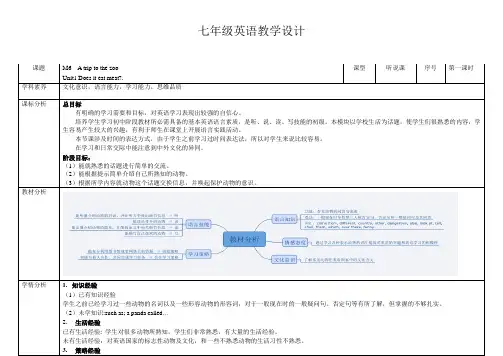
七年级英语教学设计
课型听说课序号第一课时课题M6 A trip to the zoo
Unit1 Does it eat meat?.
学科素养文化意识,语言能力,学习能力,思维品质
课标分析总目标
有明确的学习需要和目标,对英语学习表现出较强的自信心。
培养学生学习初中阶段教材所必需具备的基本英语语言素质,是听、说、读、写技能的初级。
本模块以学校生活为话题,使学生们很熟悉的内容,学生容易产生较大的兴趣,有利于师生在课堂上开展语言实践活动。
本节课涉及时间的表达方式,由于学生之前学习过时间表达法,所以对学生来说比较容易。
在学习和日常交际中能注意到中外文化的异同。
阶段目标:
(1)能就熟悉的话题进行简单的交流。
(2)能根据提示简单介绍自己所熟知的动物。
(3)根据所学内容就动物这个话题交换信息,并唤起保护动物的意识。
教材分析
panda kangaroo
bear
wolf
the USA Australia Asia -Yes.../N o…
the Arctic bamboo Europe grass Australia meat
America meat
_______ the polar bear ______ to swim?
Make a poster about your favorite 3. Find an idiom about your favorite。
外研英语初一上Module6Unit1教学案例
Module 6 A trip to the zooUnit 1 Does it eat meat?一、教学课题外研社新标准英语七年级上册Module 6 A trip to the zoo Unit 1 Does it eat meat?以动物为话题, 让学生了解各种动物的生活方式以及呼吁学生热爱动物,尤其要保护濒危动物。
(一)教学目标:A、知识目标通过unit1 的学习,要求所有学生都掌握动物单词,行为动词的一般现在时主语为第三人称单数的一般疑问句及肯定与否定回答。
B、能力目标1. 所有学生都能听懂有关介绍动物的对话,并能在听的过程中找出细节信息。
2. 百分之八十的学生能够进行语言输出,能对有关动物的话题进行问答。
C、情感目标1.通过学习让学生领悟到大自然不仅有人类的存在,而且还要使生养我们的地球平衡发展,保护和珍惜野生动物,使我们的家园更美丽和谐。
2.培养学生的合作精神,使他们能够相互帮助,共同完成学习任务,尽情享受学习的乐趣。
(二)教学重难点1.教学重点:重点句型—Does the panda eat bamboo ?—Yes, it does.—Does the tiger come from Europe ?—No, it doesn’t. It comes from Asia.2.教学难点:理解并掌握行为动词的一般现在时主语为第三人称单数的陈述句,一般疑问句及肯定与否定回答。
二、教材分析本模块以“动物”为话题,介绍了世界各地的动物及其栖息地、习性等。
通过听“北京动物园之行”以及阅读“世界各地的动物介绍”,使学生们开阔了眼界,增长了见识,同时唤起他们热爱动物、保护动物的意识。
本节课是本模块的第一单元,通过对动物的介绍开展听说读写的活动,为下一单元的阅读和写作做了良好的铺垫。
教学之前用百度在网上搜索相关教学材料,找了很多教案作参考,了解到教学的重点和难点,确定课堂教学形式和方法。
然后根据课堂教学需要,利用百度搜索在中小学教程网找到课文的录音学习参考。
外研版七年级上册Module6Unit1教学设计教案
Module 6 An invitation to the cinema李子昌Unit 1 Would you like to go to the cinema?Teaching goals教学目标知识目标:功能句式邀请和建议1. Would you like to …2. Let’s …词汇1.重点词汇cinema , would, film, match, star, team, evening, Friday, Monday, Saturday, Sunday, Thursday, Tuesday, Wednesday, with, great, idea, let, let’s, when, invite, ask,2.认读词汇invitation, stadium3.掌握并能区别语音: /s/, /z/语法用在时间前的介词—in, on重点句子1. Would you like to go to the cinema?2. Let’s go in the evening.技能目标1. 能听懂有关邀请别人做事的对话。
2. 向别人发出邀请,对邀请做出反应,提出建议。
学习策略:1.互换信息、学会合作探究、2. 从听、说过渡到写,由口头输出的流畅性过渡到笔头输出的精确性情感目标在用英语交流中,要礼貌,尊重对方。
教法与学法:在本单元的教学过程中,我运用了“任务型”教学方法,这是一种以学生为主体,活动为重点的教学方法。
本单元的主要句型贴近现实生活,邀请某人去看电影、足球比赛等,学生兴趣高,易于接受。
可以通过自由交谈,来引出新单词,引出句型Would you like to goto the cinema ?我主要采取了从Pair work分角色阅读的形式来练习对话(到教室前面表演对话),以讨论的形式来纠正听力答案。
学生以分角色阅读,到教室前面表演对话,调查探究学习,小组合作学习的方法,激发了学生的热情,提高了学习的兴趣,使学生真正成为课本的主体,提高了课堂效率。
外研版七年级上册英语《Module 6Unit 1 does it eat meat?》教学设计
外研版七年级上册英语《Module 6Unit 1 does it eat meat?》教学设计一. 教材分析《Module 6 Unit 1 Does it eat meat?》是人教版初中英语七年级上册的一篇课文。
本节课主要讨论动物的饮食习性,通过引入不同动物的饮食习性,让学生掌握一般现在时的一般疑问句和回答。
教材内容丰富,插图生动有趣,有利于激发学生的学习兴趣。
二. 学情分析七年级的学生已经掌握了部分英语基础知识,具备一定的听、说、读、写能力。
但部分学生在口语表达方面仍有困难,对本节课的内容可能存在一定的陌生感。
因此,在教学过程中,教师需要关注学生的个体差异,尽量让每个学生都能参与到课堂活动中来。
三. 教学目标1.知识目标:学生能够听懂、会说、会读、会写关于动物饮食习性的词汇和短语,如“monkey”, “eat”, “meat”, “fruit”, “bird”, “eat”, “seed”等。
2.能力目标:学生能够运用一般现在时的一般疑问句和回答进行日常交流。
3.情感目标:培养学生关爱动物、保护生态环境的意识。
四. 教学重难点1.重点:学生能够听懂、会说、会读、会写关于动物饮食习性的词汇和短语。
2.难点:学生能够运用一般现在时的一般疑问句和回答进行日常交流。
五. 教学方法1.任务型教学法:通过小组合作、角色扮演等任务型活动,让学生在实践中学习、运用英语。
2.情境教学法:创设生动、有趣的情境,激发学生的学习兴趣。
3.游戏教学法:运用游戏,让学生在轻松愉快的氛围中学习英语。
六. 教学准备1.教材:《Module 6 Unit 1 Does it eat meat?》2.多媒体教学设备:用于展示图片、视频等教学资源。
3.教学卡片:用于单词和短语的学习。
4.任务单:用于小组合作和讨论。
七. 教学过程1.导入(5分钟)教师通过向学生展示不同动物的图片,引导学生谈论动物,为新课的学习营造轻松愉快的学习氛围。
Module6Unit1第一课时教学设计外研版英语七年级上册
(2)自读:有感情地朗读课文。
分角色朗读对话。
学生能较为流畅地表达自己的想法。
学生能准确、大声跟读课文。
Step4.Grammar points
1.Read the following sentences and find out the grammar rules.
fly-flies /z/;carry-carries /z/
study-studies /z/; worry-worries
(3)以“s, x, ch, sh”结尾的,在词尾加“es”,发音为/iz/如:
teach-teaches /iz/; watch-watches /iz/
(4)以“o”结尾的动词,加“es”,读/z/如:
学情
分析
学生对很多动物所熟知,学生们非常熟悉,有大量的生活经验。学生之前已经学习过一些动物的名词以及一些形容动物的形容词,对于一般现在时的一般疑问句。否定句等有所了解,但掌握的不够扎实。
对英语国家的标志性动物及文化,和一些不熟悉动物的生活习性不熟悉。
学习
目标
通过本课时学习,学生能够:
1.借助图片和语境理解单词的含义;
---Yes, _____________
③老虎吃肉,不吃蔬菜。
A tiger ___________ , but it _______________________.
④---熊猫来自日本吗?----不,不是。
---Does the panda ________________________?
----No, ____________
基于标准的“教学评一体化”设计
课题
M6U1A trip to the zoo Unit1 Does it eat meat?
外研版七年级英语上册教案:Module6Unit1Doesiteatmeat
3.了解并运用动物及食物类词汇进行简单对话;
4.运用本课所学句型和词汇,讨论动物的食物喜好;
5.阅读理解:理解并回答课文中的问题。
教学内容与教材紧密关联,旨在帮助学生掌握一般现在时的疑问句结构,扩充动物及食物类词汇,提高英语口语表达能力。
(二)新课讲授(用时10分钟)
1.理论介绍:首先,我们要了解一般现在时疑问句的基本结构。它用于询问动物或事物的习惯性动作或状态。这是日常交流中非常常用的句型。
2.案例分析:接下来,我们来看一个具体的案例。课文中的对话展示了如何用一般现在时疑问句询问动物的食物喜好,以及如何回答。
3.重点难点解析:在讲授过程中,我会特别强调一般现在时疑问句的构成和动物及食物类词汇这两个重点。对于难点部分,我会通过例句和对比来帮助大家理解。
(三)实践活动(用时10分钟)
1.分组讨论:学生们将分成若干小组,每组讨论一个与动物食物喜好相关的实际问题。
2.实验操作:为了加深理解,我们将进行一个简单的角色扮演活动。学生们模拟动物,用所学句型和词汇介绍自己的食物喜好。
3.成果展示:每个小组将向全班展示他们的讨论成果和角色扮演活动。
(四)学生小组讨论(用时10分钟)
举例:教师可以设置填空题,让学生完成疑问句的构成,如:“_ eat plants?”(正确答案:Does it)
(2)词汇的运用:学生在实际对话中可能难以灵活运用所学词汇。教师应设计多种活动,帮助学生将词汇应用于实际场景。
举例:进行角色扮演,让学生模拟动物介绍自己的食物喜好,如:“I'm a koala. I eat leaves.”
外研社新标准英语七年级上册Module6Unit1教案-(精)(汇编)
【教学背景】大多数孩子喜欢动物,都期待家长带自己去动物园看一看。
本模块以动物为话题,有利于激发学生的学习兴趣。
设立本模块的目的不仅仅是为了语言学习, 还希望学生能够通过本模块的学习增强爱护动物、保护自然环境的意识。
【教学课题】外研社新标准英语七年级英语上册Module 6 A trip to the zooUnit 1 Does it eat meat?【教材分析】语言点的要求 :语音:能流畅正确的读熟描述动物生活习性的句子;词汇:会正确的拼写和读出动物单词以及描述性词汇;能运用所学单词描述动物的生活习性。
语法:1. 掌握动物种类的两种表达方式;2. 掌握并熟练运用一般现在时的第三人称单数肯定句、否定句、一般疑问句及其回答; 会区分 do does功能:能听懂关于狮子、熊猫、老虎熊等动物的问答,并且能够描述这几种动物。
话题:围绕狮子、熊猫、老虎,熊等动物的生活习性作为话题,能用相关语言表达【学情分析】课程基础:本模块以动物为话题,通过介绍动物的生活习性来学习一般现在时态,同时培养学生爱护动物保护动物的情感。
关于动物保护,在八年级下册和九年级教材中也有涉及,所以它是贯穿初中英语的一个重要话题。
生活经验:对于大多数中学生来说,动物是他们所喜欢的。
也是日常生活中常见和熟知的东西,所以本单元的动物话题,既有重要的知识价值,同时也是学生感兴趣的话题。
【学习目标】1. 掌握本单元的动物单词和其他相关单词;2.能听懂有关介绍动物熊、老虎、狮子、熊猫的对话,并能在听的过程中找出关于这些动物的细节信息。
3. 能用相关语言描述狮子、熊猫、老虎,熊等动物的生活习性【教学方法】 :多媒体教学;情境教学【教学过程】【课前预习】Write as many animal words as you can (尽可能多的写出你所认识的动物单词【课内探究】活动一:热身(课堂导入1 Play the video of animal world ,say the animals2 Animals are man’ s friends---Do you love animals?活动二:问答接龙(动物词汇练习A : My favourite animal is the_____because it’ s ------.What about you, B? What’ s your favourite animal?B : My favourite animal is the_____because it’ s ------.What about you,C? What’ s your favourite animal?C: ……. 活动三:听力训练1. Lingling and Tony are talking to the guide at Beijing Zoo. Listen to the first part and fill in the blanks____ ___ Beijing Zoo. The zoo has many _____ ___ of animals, _____ ____ bears,_____,giraffes and _______.They ____ ______ different ______ and they eat different_______. Here are the lions.2 . Listen to the second partand tell True (T or False (F ?( 1. Lions eat meat.( 2.Bears eat meat and plants.( 3.The elephant eats meat.( 4. Pandas eat plants and plants.( 5. Lions are cute3 Complete the tableAnimals foodLionsbearselephantspandas4 Group work: Practice in pairsA:Do lions eat meat? B:Yes ,they do.A:Do bears eat bamboo?B:No, they don’t .They eat meat and plants5. Listen to the third part and answer two questions1 What’s Lingling’s fvourite animal?2 What’s the name of the panda?活动四 :阅读练习1.Listen and read,Underline Do and does sentences(,录音机跟读,把含有 do does 的句子标出来2. Read in roles (分角色朗读3. Do Activity 4• There are other / many animals from different country/countriesin Beijing Zoo, such /whichas bears ,giraffes and pandas.The lions are funny/dangerousbecause they eat meat.The bears eat meat ,too,but also plants/leaves.Elephants aredifferent/cute. They ’re tall/whiteand eat plants /meat.Pandas are black and white and eat bamboo/otheranimals.The panda’s /guide’s name is Lingling.活动五:动物描述 Group work :Who is the best guide?Homework :Make a poster(海报 of your favourite animal and introduce(介绍 it.【课后延伸】I. 用所给单词的适当形式填空。
2022年外研版七年级上册Module 6 Unit 1精品教案
Module 6 Unit 1 Does it eat meat?一、教学目标(一〕知识与能力1.知识目标:trip, zoo, tiger, elephant, lion, giraffe, monkey, panda, guide, visit, animal, zebra, Australia, Europe, Asia, bamboo.2.能力目标:培养学生从材料中获取有效信息的能力. 掌握制作海报的方法.3.情感目标:通过学习让学生领悟到大自然不仅有人类的存在, 而且还要使生养我们的这个地球平衡开展, 保护和珍惜野生动物, 使我们的家园更美丽和谐.〔二〕态度与情感:增强学生对濒临灭绝的动物的保护之情二、教学重难点1、重点句型:一般现在时〔主语第三人称单数〕的一般疑问句以及肯定和否认形式.重点话题:Talk about one’s favourite animal.2、难点1 有关动物的名词及它们在句中的正确运用.2掌握一般现在时〔主语第三人称单数〕的一般疑问句以及肯定和否认形式.3能用恰当地道的英语问答有关动物的问题以及介绍自己的最喜爱的动物.三、教学过程Step11.Teach the new wordsbear elephant giraffe lion monkey panda tiger zebra zoo2.Ask the students to talk about the picture in activity1.I can see________.There are some______.Step21.Ask the Ss to watch the video and then finish the table.2.Show the information of animals’name,looks and characters .1)What is your favourite animal?2)Which animal do you like best?3)What does it look like?4)What is it like?Step31.Play the tape and ask the Ss to follow the tape.2.Ask the Ss to circle the important words and phrases.welcome to , many kinds of, such as, go and see, over other3. Discuss and circle the important words and phrases.Step41.Ask the Ss to write a short composition1)My favourite animals is______.2)It is________.3)It is________.4)It likes eating______.5)It lives in_________.2. Write a short compositionStep5教学反思精心设计了多组探究式学习活动, 调动全体学生有效参与, 活用英语, 学以致用, 真正在参与各种活动中展示才华, 体验成功的快乐.2. What animal do you like best?3. What does it look like?4. What is it like?5.Why do you like it?活学活用—Today is fine. What about________ a picnic?—That's a good idea. Let's go.A.have B. to haveC.having D.HasC2.What’s your name?英语中,当想知道对方叫什么名字时,可用句型"What’s your name? "进行询问,其答语一般用"My name is + 姓名.".—What’s your name?—My name’s Gao Jing.3.I’m twelve years old...years old, 表示“...岁〞. 有时候years old 可以省略, 只用数字来表达年龄即可. 如:Her dog is three. 对该句型提问可用:How old ...? 它是英语中一个较重要的句型,主要用来询问某人的年龄,其答语通常用"主语+ am / is / are + 年龄.--How old are you?--I am thirteen (years old).活学活用--How old are you?--I am .A.ten B. Susan C.nice D.Class4A4.Nice to meet you用于第一次见面时说的话, 一般的场合都可以. 比较正式.--Nice to meet you--Nice to meet you, too.语法一、人称代词1.用来代替上文提到的人或物的代词称为人称代词. 人称代词又分为主格和宾格两种. 如下表:2.主格代词在句中作主语, 常置于句首;宾格代词在句中作宾语, 常放在动词或介词后面.活学活用用适当的人称代词填空1.Hi, ________ am Wang Nana.2.This girl is my friend. ________ is 10 years old.3.That boy is from England. ________ is Jack.4.—Are ________ from Class One, Lucy?—Yes, ________ am.5.This is our teacher, Mr Zhang. ________ is 36 years old.1. I2. She3. He4. you; I5. He二、be动词的一般现在时1.be动词的含义及用法am/is/are是动词be的一般现在时形式, 根本意思为“是〞, 用来说明年龄、身份、状态等.2.一般现在时的根本用法:(1)肯定句式:主语+am/is/are +其他.例如:I am a student.我是一名学生.He's a doctor.他是一位医生.It's a desk.它是一张桌子.They are my friends. 他们是我的朋友.(2)否认句式:________+________+________+其他.(注意:is, are可与not缩写为isn't, aren't, 但am 不可与not缩写) 主语;am/is/are; not(3)一般疑问句句式:________+________+其他?Am/Is/Are; 主语;肯定答复:________, 主语+be(am/is/are).Yes;否认答复:No, 主语+be(am/is/are)+not.例如:—Is this a map? 这是一张地图吗?—Yes, it is.是的, 它是.—Are they from Xinjiang? 他们来自新疆吗?—No, they aren't.不, 他们不是.【温馨提示】肯定答复中的be动词不能与前面的代词缩写;否认答复中的not可以与前面的be动词缩写, 但am不能与not缩写.[口诀] 我(I)用am, 你(you)用are, is 连接他(he)、她(she)、它(it). 单数词用is, 复数词全用are.活学活用用be动词的适当形式填空1.I ________ from Jinan, the capital of Shandong.2.________ you a teacher?3.My friend ________ in Class 1.4.Lucy and Lily ________ twins.5.This ________ an interesting story. I like it very much.1. am2. Are3. is4. are5. is稳固训练单项选择:( C )1. -Nice to meet you. - .A. Good morningB. You are welcomeC. Nice to meet you, tooD. Goodbye( C )2.He from Beijing, I from Shanghai.A.is isB. am amC. is amD. is comes( B )3.A panda ____________ from China.A.amB. isC. are(A) 4. It’s nice ______________my old friends here.A. to meetB.meetC. meetsPART3 课后稳固一、完形填空:〔10分〕My name is Nancy. I’m twelve __1__old. I’m __2__England. I’m a middle school student. I’m in Class__3__. I like green and blue. This__4__my new friend. Her__5__ is Wendy. She is thirteen. She is from__6__too. We are friends, __7__we are in different〔不同的〕classes. Wendy is in Class Four. She__8__red and yellow. Wendy likes __9__too, but I can’t swim. On sundays, we often __10__together.( B ) 1.A. year B. years C. /( A ) 2.A. from B. in C. on( A ) 3.A. four B. Three C. Two( A ) 4.A.is B. are C. am( A ) 5.A. name B. names C. name’s( C ) 6.A. English B. America C. England( C ) 7.A. and B. so C. but( A ) 8.A. likes B. like C. is( C ) 9.A. basketball B. football C. swimming( A ) 10.A. play B. playing C. plays二、判断正误:正确的写A, 错误的写B.〔10分〕My name is Felix Black. I am from America. I’m twelve years old. And I am a student in No.2 Middle School in Suzhou. Mrs Zhao is our Chinese teacher. My friend is also a student here. Her name is Maria Smith. She is from England. She is thirteen years old. Maria and I are new students in No. 2 Middle School. We like our Chinese class.( B )1.Felix is thirteen years old.( A )2.Mr Zhao is Felix’s Chinese teacher.( A )3.Maria is from England.( A )4.Felix and Maria are in the same〔同样的〕school.( B )5.They don’t like their Chinese class.三、书面表达:〔10 分〕根据以下信息用英语写一篇介绍自己及好朋友的短文,可自由发挥.I My friendName Panpan TongtongAge 12 13City Wuhan QingdaoClass 3 6。