
PEP六年级英语下册重点句子与单词汇总
六年级下册重点单词及句子
unit 1
younger更年轻的older更年长的
taller更高的shorter更矮的
bigger更大的smaller更小的
thinner更瘦的heavier更重的
longer更长的stronger更强壮的
--i’m 1.65 metres.
--i am 1.65 metres.--你有多高?
--我身高1.65米。
--i’m 48 kilograms.
--i am 48 kilograms.--你有多重?
--我体重48公斤。
--size 7.--你穿多大号的鞋?
--七号。
your feet are bigger than mine.
my shoes are size 37.你的脚比我的大。
我穿37号的鞋。
that’s the tallest dinosaur in this hall.那是厅里最高的恐龙。
it’s taller than both of us together.它比我两加起来还高。
last night昨晚the day before yesterday
last monday上周一前天
--很好,谢谢。
--我和你奶奶待在家里。
我们喝了下午茶,还看了电视。
--did you do anything else?
--是的,我打扫房间,还洗了衣服。
--没有,我感冒了。
整个周末都待在家里睡觉。
unit 3
(ride)rode a horse骑马(hurt)hurt my foot伤到脚
(ride)rode a bike骑自行车(eat)ate fresh food吃新鲜食物
--i fell off my bike and hurt my foot.--怎么了?
--我从自行车上摔下来然后伤到脚了。
--are you all right?
我现在没事了。
我(和我家人)去三亚。
--did you fo to turpan?
是的,去了。
我们坐飞机去的。
it looks like a mule.它看起来像骡子。
sounds great!听起来不错!
unit 4
ago以前play badminton打羽毛球
…years ago…年以前last year去年
...months ago…月以前last month上个月
--easy, i looked it up on the internet.--你怎么知道的?--很容易,我上网查阅的。
六年级上册重点单词及句子
unit 1
museum博物馆left左
bookstore书店straight笔直地
hospital医院turn left转左
--it’s near the door.
--it’s next to the bookstore.--博物馆的商店在哪儿?
--在大门附近。
--turn left at the bookstore.
--by bus.--我们怎么到哪儿?
--到书店左转。
--乘公共汽车。
the bookstore is on the left.
the bookstore is on the right.书店在左边。
书店在右边。
unit 2
by taxi乘计程车stop停下
by train乘火车新|课 |标|第 |一| 网
--通常我走路来。
don’t go at the red light!别闯红灯!
go at a green light.绿灯行。
unit 3
this evening今天晚上tonight今晚
--i’m going to have an art lesson.
--我要上美术课。
--我们要到人民公园去画画。
--我们打算去电影院。
--下周三。
unit 4
singing(sing)唱歌
reading(read) stories看故事
playing(play) football踢足球
doing(do)kung fu打功夫
goes(go) hiking去远足
--he likes reading stories.--彼特有什么爱好?
--他喜欢读故事。
--does he live in sydney?
--yes, he does.--他喜欢猜字谜和远足吗?--是的,他喜欢。
unit 5
postman邮递员pilot飞行员
--he’s a businessman.--他是做什么的?
--他是商人。
--他在海上工作。
--他骑自行车上班。
--她是工人。
--她在工厂工作。
--她步行上班。
--她步行上班。
unit 6
afraid害怕more更多的
sad难过的deep深的
happy高兴的take a deep breath做深呼吸
--your father is ill.--怎么了?
--你爸爸病了。
don’t be sad.别伤心。
they’re afraid of him. 新课标第一网它们害怕它。
【口袋书】人教版PEP六年级下册英语 基础知识汇总

人教版PEP六年级下册基础知识汇总Unit 1 How tall are you?重点单词:[四会]older(old的比较级)更年长的younger (young 的比较级)更年轻的taller(tall的比较级)更高的shorter(short的比较级)更矮的;更短的longer (long 的比较级)更长的thinner (thin 的比较级)更瘦的heavier (heavy 的比较级)更重的bigger (big 的比较级)更大的smaller(small的比较级)更小的stronger (strong 的比较级)更强壮的[三会]kilogram 千克dinosaur 恐龙hall 大厅than 比metre 米countryside 乡村lower (low 的比较级)更低地shadow 阴影;影子smarter(smart的比较级)更聪明的become 开始变得;变成重点短语:what size 多大尺寸how tall 多高how heavy 多重go hiking 去远足both of 两者都over there 在那边go on a trip 去旅行have a look 看一看think of 想起longer and longer越来越长go down 下降lower and lower 越来越低catch the ball 接球agree with 同意…have a try试一试重点句型:1.A + be动词+ 形容词比较级+ than + B.You're older than me. 你比我年纪大。
2. -- How tall/heavy/old… + be 动词+ 主语?-- 主语+ be 动词+ 数字+ 长度单位/重量单位/ year(s)old .-- How tall are you? 你有多高?-- I'm 1. 65 metres. 我身高1. 65米。
新人教版小学英语六年级下册各单元重点考点总结

新人教版小学英语六年级下册各单元重点考点总结本文档总结了新人教版小学英语六年级下册各单元的重点考点。
Unit 1: Where's your pen pal from?- 掌握国家和地区的名称,并能正确运用问句和答句进行询问。
- 掌握复数形式并能恰当使用。
- 能够用简单的单词描述他人的国籍。
Unit 2: At the zoo- 掌握动物名称的表达,并能恰当运用这些单词进行对话。
- 能够表示一些人对某种动物喜好或不喜好的态度。
- 运用形容词和副词的正确形式进行描述。
Unit 3: This is my sister- 掌握表示家庭成员关系的词汇,并能在合适的情境下熟练使用。
- 能够用简单的句子表达自己和他人的家庭成员状况。
- 掌握疑问句和肯定/否定回答的语法结构。
Unit 4:What do you usually do on weekend?- 掌握表示日常活动和娱乐爱好的名词和动词,并能在合适的情境下熟练使用。
- 能够描述周末的计划,并能够用适当的时态表达过去、现在和未来的时间。
- 学会以礼貌的方式询问和回答他人的问题。
Unit 5: What's the matter?- 能够描述自己的身体不适,并能运用一些常用的疾病词汇。
- 掌握表示询问、建议和回答的用语,并能在合适的情境下使用。
- 学会表示关心和病愈等祝福的表达方式。
Unit 6: It's raining- 学会用简单的句子描述天气情况,并能表达对不同天气的态度。
- 掌握天气形容词的表达方式。
- 能够描述不同季节的气温、天气和风景。
总之,在学习小学英语六年级下册的过程中,应注重关注以上重点考点,并在实际中多进行运用练习,以此提高英语水平。
人教pep版六年级下册英语全册重要知识点总结

人教pep版六年级下册第一单元单元重要知识点总结四会单词:tall—taller更高的short—shorter 更矮的strong—stronger更强壮的small—smaller (体型)更小的old—older 年龄更大的young—younger 更年轻的big—bigger更大的heavy—heavier 更重的long—longer 更长的thin—thinner 更瘦的四会句型:How tall are you? 你有多高?I’m 164 cm tall. 我164 厘米高。
You’re shorter than me. 你比我矮。
You’re 4 cm taller than me.你比我高4厘米。
How heavy are you? 你有多重?I’m 48 kg. 我48千克。
应该掌握的知识点:1.表示两者之间有所比较时,句子中的形容词要用比较级形式。
形容词变为比较级的变化规则:(1)一般情况下,在形容词的词尾直接加er。
如: tall—taller short—shorter.(2)以字母e结尾的形容词,在词尾直接加r,如:nice—nicer late—later(3)以重读闭音节结尾,且结尾只有一个辅音字母的词,先双写这个辅音字母,再加er.如:big—bigger thin—thinner fat—fatter(4)以辅音字母加y结尾的双音节形容词,先变y为i , 再加er。
如:easy—easierheavy—heavier funny—funnier.形容词比较级的变化口诀:原级变为比较级,通常er加上去。
若是结尾辅元辅,辅音双写要牢记。
辅音加y结尾时,把y变i 是必须。
原级若以e结尾,直接加r不后悔。
2.部分形容词比较级的不规则变化:good—better well—better bad—worsebadly—worse many—more much—more little—less far—farther3.同义句:How tall are you?=What’s your height?How heavy are you?=What’s your weight?4.以How开头的问句(仅限小学阶段):How are you? 问身体状况。
小学英语六年级下册句子及词语

【导语】假如⽣活是⼀条河流,愿你是⼀叶执著向前的⼩⾈;假如⽣活是⼀叶⼩⾈,愿你是个风⾬⽆阻的⽔⼿。
以下是®⽆忧考⽹为⼤家整理的《⼩学英语六年级下册句⼦及词语》供您查阅。
Unit1 How tall are you?⼀、重点单词:tall—taller更⾼的、short—shorter 更矮的、 strong—strong更强壮的、old—older年龄更⼤的、young—younger 更年轻的、big—bigger更⼤的heavy—heavier 更重的、 long—longer 更长的、 thin—thinne更瘦的、small—smaller 更⼩的、low—lower更低的、smart—smarter更聪明的dinosaur恐龙、 hall⼤厅、meter ⽶、than⽐、 both 两个都、 kilogram千克,公⽄、 countryside乡村、shadow阴影,影⼦、 become开始变得,变成⼆、重点句式:1、That's the tallest dinosaur in this hall.那是这个厅⾥的恐龙。
2、You're older than me. 你⽐我⼤。
3、How tall are you ?你有多⾼? I'm 1.65 metres.我⾝⾼1.65⽶。
4、What size are your shoes ?你穿多⼤号的鞋?5、My shoes are size 37. 我穿37号的鞋。
6 、Your feet are bigger than mine .你的脚⽐我的⼤。
7、How heavy are you ?你有多重? I'm 48 kilograms .我体重48公⽄。
8、It's taller than both of us together .它⽐我们俩加在⼀起还⾼。
三、知识点:1、形容词变为⽐较级的变化规则:(1)⼀般情况下,在形容词的词尾直接加er。
新人教pep版六年级英语下册unit1复习总结
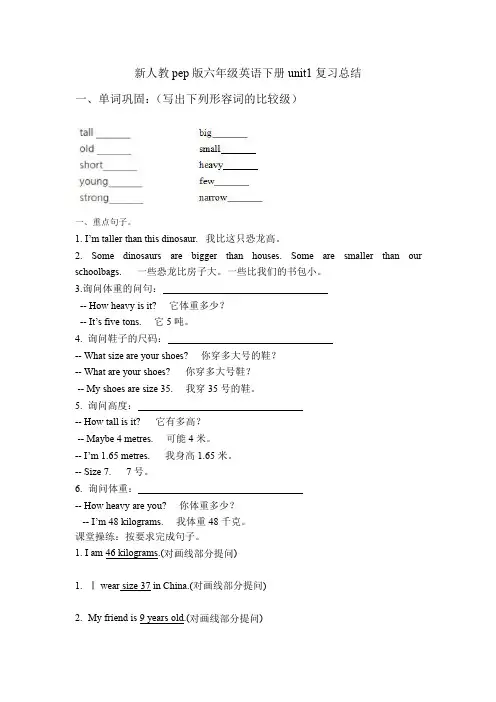
新人教pep版六年级英语下册unit1复习总结一、单词巩固:(写出下列形容词的比较级)一、重点句子。
1.I’m taller than this dinosaur.我比这只恐龙高。
2.Some dinosaurs are bigger than houses.Some are smaller than our schoolbags.一些恐龙比房子大。
一些比我们的书包小。
3.询问体重的问句:--How heavy is it?它体重多少?--It’s five tons.它5吨。
4.询问鞋子的尺码:--What size are your shoes?你穿多大号的鞋?--What are your shoes?你穿多大号鞋?--My shoes are size35.我穿35号的鞋。
5.询问高度:--How tall is it?它有多高?--Maybe4metres.可能4米。
--I’m1.65metres.我身高1.65米。
--Size7.7号。
6.询问体重:--How heavy are you?你体重多少?--I’m48kilograms.我体重48千克。
课堂操练:按要求完成句子。
1.I am46kilograms.(对画线部分提问)1.Ⅰwear size37in China.(对画线部分提问)2.My friend is9years old.(对画线部分提问)3.Peter is shorter than Sam.(对画线部分提问)5.I am stronger than my brother.(改为一般疑问句)三、语法专项:形容词比较级的规则变化:单音节词和少数双音节词:(1)一般在词尾加“er”。
例如:tall—taller,young younger,old一older,small smaller。
(2)以字母“e”结尾的词,加“r”。
例如:fine—finer,nice-nicer,late-later。
六年级下册英语重点单词归纳
六年级下册英语重点单词归纳Unit 1: Food单元一:食物1. fruit (水果) - Apples, oranges, bananas, and grapes are examples of fruits.2. vegetable (蔬菜) - Carrots, broccoli, and spinach are examples of vegetables.3. rice (米饭) - Rice is a staple food in many countries.4. bread (面包) - Bread is made from flour, water, and yeast.5. meat (肉类) - Chicken, beef, and pork are examples of meat.6. fish (鱼) - Salmon, tuna, and cod are examples of fish.7. milk (牛奶) - Milk is a common beverage that comes from cows.8. cheese (奶酪) - Cheese is made from milk and is often used as a topping or ingredient in dishes.9. yogurt (酸奶) - Yogurt is a fermented dairy product that is often consumed for its health benefits.10. egg (鸡蛋) - Eggs are commonly used in cooking and baking.11. cake (蛋糕) - Cake is a sweet dessert made from flour, sugar, and eggs.12. ice cream (冰激凌) - Ice cream is a frozen dessert that comes in many flavors.Unit 2: Nature单元二:自然1. tree (树) - Trees are tall plants with a trunk and branches.2. flower (花朵) - Flowers are the reproductive organs of plants and come in many different colors and shapes.3. grass (草地) - Grass is a type of plant that is commonly found in lawns and meadows.4. river (河流) - A river is a large natural stream of water that flows into a lake, ocean, or another river.5. mountain (山) - Mountains are large landforms that rise above the surrounding land.6. lake (湖泊) - A lake is a large body of water surrounded by land.7. ocean (海洋) - An ocean is a large body of saltwater that covers most ofthe Earth's surface.8. rain (雨水) - Rain is water that falls from the sky in the form of droplets.9. sun (太阳) - The sun is the star at the center of our solar system that provides heat and light.10. moon (月亮) - The moon is Earth's only natural satellite and can be seenin the night sky.11. star (星星) - Stars are celestial bodies that emit light and are visible from Earth at night.12. cloud (云) - A cloud is a visible mass of water droplets or ice crystals suspended in the atmosphere.Unit 3: School Life单元三:学校生活1. teacher (老师) - A teacher is a person who instructs students in a classroom setting.2. student (学生) - A student is a person who is enrolled in a school or educational institution.3. classroom (教室) - A classroom is a room where teaching and learning activities take place.4. desk (课桌) - A desk is a piece of furniture designed for studying or working.5. chair (椅子) - A chair is a seat with a backrest and four legs.6. book (书) - A book is a written or printed work consisting of pages bound together.7. pen (钢笔) - A pen is a writing instrument that uses ink to produce writing.8. pencil (铅笔) - A pencil is a writing instrument with a thin, cylindrical graphite core encased in wood.9. eraser (橡皮擦) - An eraser is a tool used to remove pencil or ink markings.10. ruler (尺子) - A ruler is a straightedge instrument used for measuring or drawing straight lines.11. blackboard (黑板) - A blackboard is a large, dark surface that can be written on with chalk.12. test (测验) - A test is an assessment of knowledge or skills.Unit 4: Hobbies单元四:爱好1. hobby (爱好) - A hobby is an activity that someone enjoys doing in their free time for pleasure or relaxation.2. music (音乐) - Music is a form of art that uses sound and rhythm to express emotions or ideas.3. dance (跳舞) - Dance is a form of rhythmic movement performed to music.4. art (艺术) - Art refers to visual creations such as paintings, sculptures, and drawings.5. painting (画画) - Painting is the act of applying color or pigment to a surface to create a visual representation.6. photography (摄影) - Photography is the art or practice of taking and processing photographs.7. sports (运动) - Sports are physical activities that require skill and are often played competitively.8. soccer (足球) - Soccer, also known as football, is a team sport played witha round ball.9. basketball (篮球) - Basketball is a team sport played on a rectangularcourt with two hoops and a ball.10. swimming (游泳) - Swimming is the act of moving through water by usingone's arms and legs.11. reading (阅读) - Reading is the process of interpreting written words and deriving meaning from them.12. writing (写作) - Writing is the act of putting words on paper or a digital device to convey thoughts or ideas.Unit 5: Travel单元五:旅行1. travel (旅行) - Travel refers to the act of going from one place to another, often for leisure or business purposes.2. vacation (假期) - A vacation is a period of time when someone takes a break from work or school to relax or travel.3. hotel (酒店) - A hotel is an establishment that provides accommodation, meals, and other services for travelers.4. airport (机场) - An airport is a location where airplanes take off, land, and offer services to passengers.5. ticket (车票/机票) - A ticket is a document that allows someone to travelon a particular mode of transportation, such as a train or plane.6. passport (护照) - A passport is an official government document thatverifies a person's identity and citizenship and allows them to travel internationally.7. suitcase (行李箱) - A suitcase is a portable box-shaped bag used for carrying clothes and belongings while traveling.8. camera (相机) - A camera is a device used to capture and store images or videos.9. map (地图) - A map is a visual representation of an area, showing its physical features and boundaries.10. guidebook (旅行指南) - A guidebook is a book that provides information and advice for travelers.11. tourist (游客) - A tourist is a person who visits a place for pleasure or cultural exploration.12. sightseeing (观光游览) - Sightseeing refers to the activity of visiting and observing tourist attractions in a particular area.Unit 6: Daily Routine单元六:日常作息1. wake up (醒来) - To wake up means to stop sleeping and become conscious.2. get dressed (穿衣服) - To get dressed means to put on clothes.3. brush teeth (刷牙) - To brush teeth means to clean the teeth with a toothbrush and toothpaste.4. have breakfast (吃早餐) - To have breakfast means to eat a meal in the morning.5. go to school (去上学) - To go to school means to attend classes at an educational institution.6. have lunch (吃午餐) - To have lunch means to eat a midday meal.7. do homework (做作业) - To do homework means to complete assignments or tasks given by teachers.8. play (玩耍) - To play means to engage in activities for enjoyment or recreation.9. watch TV (看电视) - To watch TV means to view programs or shows on a television.10. have dinner (吃晚餐) - To have dinner means to eat an evening meal.11. take a shower (洗澡) - To take a shower means to cleanse the body with water.12. go to bed (上床睡觉) - To go to bed means to lie down and sleep.Unit 7: Technology单元七:科技1. smartphone (智能手机) - A smartphone is a mobile phone with advanced features, such as internet connectivity and a touchscreen interface.2. computer (电脑) - A computer is an electronic device that processes data and performs tasks according to instructions given by the user.3. internet (互联网) - The internet is a global network of interconnected computers and devices, allowing for the sharing of information and communication.4. email (电子邮件) - Email is a method of sending and receiving messages electronically between computers over the internet.5. social media (社交媒体) - Social media refers to online platforms that enable users to create and share content, as well as connect with others.6. app (应用程序) - An app is a software application designed to perform specific tasks or functions on a mobile device or computer.7. tablet (平板电脑) - A tablet is a portable electronic device with a touchscreen interface, similar to a smartphone but with a larger screen.8. laptop (笔记本电脑) - A laptop is a portable computer that can be used on the go, with its own built-in screen and keyboard.9. camera (摄像头) - A camera is a device used to capture images or videos, either as a separate device or integrated into another piece of technology. 10. printer (打印机) - A printer is a device that produces hard copies of text or images on paper.11. scanner (扫描仪) - A scanner is a device that captures images of physical documents or photos and converts them into digital format.12. headphones (耳机) - Headphones are a pair of small speakers worn over the ears, often used for listening to music or other audio.Unit 8: Health and Fitness单元八:健康与健身1. exercise (锻炼) - Exercise refers to physical activity that is planned, structured, and repetitive, with the goal of improving health and fitness.2. gym (健身房) - A gym is a facility equipped with exercise equipment and spaces for various types of physical activity.3. yoga (瑜伽) - Yoga is a mind-body practice that combines physical postures, breathing exercises, and meditation or relaxation.4. meditation (冥想) - Meditation is a practice of focusing the mind, often through relaxation and breathing techniques, to achieve a state of calm and mental clarity.5. diet (饮食) - Diet refers to the food and drink consumed by an individual, which can impact their health and body weight.6. nutrition (营养) - Nutrition is the study of food and how it affects the body, including the process of吸收 and using nutrients for energy and growth.7. vitamins (维生素) - Vitamins are organic compounds that are essential for normal bodily functions and are obtained through diet.8. minerals (矿物质) - Minerals are inorganic substances that are necessaryfor various bodily functions, such as bone formation and fluid balance.9. water (水) - Water is a vital substance for human health, involved in numerous bodily functions and essential for hydration.10. sleep (睡眠) - Sleep is a natural, recurring state of mind and body, characterized by altered consciousness and reduced activity, vital for physical and mental restoration.11. stress (压力) - Stress is a physiological or psychological response to external pressures or demands, which can impact physical and mental health.12. wellness (健康) - Wellness is a state of being in good health, encompassing physical, mental, and social well-being.Unit 9: Work and Career单元九:工作与职业1. job (工作) - A job is a regular paid position of work, typically performed in exchange for wages or a salary.2. career (职业) - A career is a person's journey through various jobs or positions within a particular field or industry.3. company (公司) - A company is a business entity that employs individuals and provides goods or services in exchange for payment.4. office (办公室) - An office is a room or set of rooms where people work, often sitting at desks and using computers.5. boss (老板) - A boss is a person who has authority over employees and is responsible for overseeing their work.6. employee (员工) - An employee is a person who works for an employer in exchange for wages or a salary.7. team (团队) - A team is a group of individuals working together towards a common goal or objective.8. meeting (会议) - A meeting is a gathering of people to discuss ideas, issues, or plans, typically in a professional or formal setting.9. project (项目) - A project is a temporary and collaborative endeavor undertaken to create a unique product, service, or result.10. deadline (截止日期) - A deadline is a date or time by which something must be completed or submitted.11. salary (薪水) - A salary is a fixed amount of money or compensation paid to an employee by an employer in return for work performed.。
(完整版)PEP小学英语六年级下册词汇句子汇总
六年级下册词汇句子汇总Unit 1How tall are you ?young 年轻的–younger更年轻的old 年长的–older更年长的tall 高的–taller更高的short –shorter更矮的;更短的long 长的–longer 更长的thin 瘦的–thinner更瘦的heavy 重的–heavier更重的big 大的–bigger更大的small 小的 -smaller更小strong 强壮的 - stronger更强壮的dinosaur 恐龙hall 大厅meter 米lower 更低的smarter 更聪颖的than 比both 两个都kilogram 千克countryside 乡村shadow 影子become 开始变得1. That ’ s the tallest dinosaur in the hall.那是这个大厅里最高的恐龙。
2. It ’ s taller than both of us together.他比我俩加起来还高。
3. — How tall are you ?你有多高?-- — I ’ m 1.65 meters.我身高米。
4. —What size are your shoes, Mike?迈克,你穿多大号的鞋?- — -My shoes are size 37.我穿37号的鞋。
— Your feet are bigger than mine .你的脚比我的大。
-5. — How heavy are you ?你体重多少?-— -I ’m 48 kilograms.我体重48公斤。
Unit 2Last weekendclean my room –cleaned my room打扫房间wash my clothes - washed my clothes洗衣服stay at home - stayed at home待在家watch TV - watched TV看电视read a book - read a book看书see a film–saw a film看电影have a cold –had a cold感冒sleep–slept睡觉last weekend上周末last night 昨晚last Monday 上个星期一yesterday昨天the day before yesterday 前天drank喝show 演出magazine 杂志better 更好的faster 更快的hotel 酒店fixed 维修broken 破坏的lamp 台灯loud 喧闹的enjoy 喜爱stay 暂住1. — -How was your weekend ?你周末过的怎么样?-—--It was good, thank you .很好。
人教版六年级pep三年级起点英语单词及重点句子
Unit 1 How do you go to school?一、重点短语:by plane 坐飞机 by ship 坐轮船 on foot步行 by bike 骑自行车by bus 坐公共汽车 by train 坐火车 trafficlights 交通灯 traffic rules交通规则go to school 去上学 get to 到达 get on上车 get off下车Stop at a red light. 红灯停 Wait at a yellow light. 黄灯等Go at a green light. 绿灯行二、重点句型:1.How do you go to school?你怎么去上学?ually I go to school on foot.Sometimes I go by bus.通常我步行去上学。
有时候骑自行车去。
3.How can I get to Zhongshan Park ?我怎么到达中山公园?4.You can go by the No. 15 bus. 你可以坐15路公共汽车去。
三、重点语法:1、There are many ways to go somewhere.到一个地方去有许多方法。
这里的ways一定要用复数。
因为there are是There be句型的复数形式。
2、on foot 步行。
乘坐其他交通工具大都可以用介词by…,但是步行只能用介词on 。
3、go to school的前面绝对不能加the,这里是固定搭配。
4、USA 和US 都是美国的意思。
另外America也是美国的意思。
5、go to the park 前面一定要加the. 如果要去的地方有具体的名字,就不能再加the ,如果要去的地方没有具体名字,都要在前面加the. (go to school除外。
)6、How do you go to…?你怎样到达某个地方?如果要问的是第三人称单数,则要用:How does he/she…go to …?7、反义词:get on(上车)—get off(下车) near(近的)—far(远的) fast(快的)—slow(慢的)because(因为)—why(为什么) same(相同的)—different(不同的)8、近义词:see you—goodby esure—certainly—of course9、频度副词:always 总是,一直 usually 通常 often经常 sometimes 有时候 never 从来不Unit 2 Where is the science museum?一、重点短语:library 图书馆 post office 邮局 hospital医院 cinema 电影院bookstore书店 science museum科学博物馆 turnleft向左转turn right 向右转 go straight 直行 north北 south南east东west西next to靠近、与……。
PEP人教版六年级下册英语重点知识总结 unit2
Unit 2 What’s the matter, Mike?一、单词与短语1.have a fever 发烧2.have a sore throat喉咙疼3.have a cold感冒4.have a toothache 牙疼5. have a headache 头疼6.matter事情,麻烦7.sore 疼的8.hurt疼痛9.nose 鼻子10.tired疲劳的,累的11.excited兴奋的12.angry生气的13.happy高兴的14.bored无聊的,烦人的15.sad 忧伤的,悲伤的16.sick 不舒服17. take some medicine 吃点药18.have the flu患流感二、句型1. What’s the matter? 你怎么啦?2. How do you feel? 你感觉如何?How dose Amy feel? Amy感觉如何?3. My leg hurts. 我腿疼。
I have a toothache. 我牙疼。
4. Do you have a sore throat? 你喉咙疼吗?5. Don’t worry! 别担心!6. You will feel better soon! 你很快会好起来的!7. You look happy. 你看起来很开心。
8. I feel very sad. 我感觉很伤心。
三、对话Doctor: How do you feel? 你感觉如何?Amy: I feel sick. 我不舒服。
Doctor: What’s the matter? 你怎么啦?Amy: I have a fever. 我发烧了。
Doctor: let me see. 让我看看。
Do you have a sore throat? 你喉咙疼吗?Amy: Yes. My throat is sore. 是的。
我的喉咙很疼。
Doctor: Don’t worry! Take some medicine. You will feel better soon! 别担心,吃点药就好了!Amy: Thank you very much!非常感谢!Doctor: You are welcome! 不客气!练习题一、翻译下列短语(10分)感冒发高烧头痛have a sore throat牙痛二、选词填空(20分)1 、What’s the (matter, wrong) with you?2、I (have, feel ) a fever.3、My throat is (sore, ill).4、What’s wrong (for, with) you?5、You’d better go to (see, look) a doctor.三、选答句(20分)1. Does Lisa feel angry? ( )2. Do Chen Jie go swimming with her parents? ( ) 3. What is the matter with you, John? ( )4. How do you go to Beijing? ( )5. What do you do when you hurt your leg? ( )四、补全对话。
PEP小学英语六年级下册单词、句型、练习汇总
PEP小学英语六年级下册单词、句型、练习汇总英语学习对于我们来说总是困难中的困难,其实英语也需要多积累。
小编在这里整理了相关知识,快来看看吧!PEP小学英语六年级下册单词、句型、练习汇总【单词】Unit 1tall—taller更高的 short—shorter 更矮的 strong—stronger 更强壮的old—older 年龄更大的young—younger 更年轻的big—bigger 更大的 heavy—heavier 更重的 long—longer 更长的 thin—thinner 更瘦的 small—smaller (体型)更小的Unit 2have a fever 发烧 have a sore throat喉咙疼 have a cold感冒have a toothache 牙疼 have a headache 头疼 matter事情,麻烦sore 疼的 hurt疼痛 nose 鼻子tired疲劳的,累的excited兴奋的angry生气的happy高兴的bored无聊的,烦人的sad 忧伤的,悲伤的Unit 3watch—watched 看wash—washed 洗clean—cleaned打扫play—played玩 visit—visited 看望 do—did last weekend 上一个周末 go—went去 go to a park—went to a park去公园go swimming—went swimming去游泳go fishing—went fishing去钓鱼 read—read 读go hiking—went hiking 去远足Unit 4learn Chinese—learned Chinese学汉语sing and dance—sang and danced 唱歌和跳舞eat good food—ate good food吃好吃的食物 take pictures—took pictures 照相 climb—climbed 爬 have—had buy presents—bought presents买礼物row a boat—rowed a boat 划船see elephant—saw elephant 看大象 go skiing—went skiing 去滑雪 go ice-skating—went ice-skating 去滑冰 how怎么,如何 get—got 到达 last 上一个的,仅余的,留在最后的【句子】1. How tall are you? ------ I’m 164 cm tall.你有多高? 我164厘米高.You’re shorter than me. You’re 4 cm taller than me.你比我矮. 你比我高4厘米.2. How heavy are you? ------ I’m 48 kg. I’m thinner than you, and shorte你有多重? 我48千克.我比你要更瘦,更矮.3. What’s the matter? ------ My throat is sore. My nose hurts.怎么了? 我的喉咙痛.我的鼻子不舒服.4. How are you, Liu Yun? You look so happy.你怎么了,刘云? 你看起来很高兴.How are you, Sarah? You look sad today.你怎么了,萨拉?你今天看起来很伤心.5. What did you do last weekend? ------ I played football.你上周末在做什么? 我在踢足球.6. Did you read books? ------ Yes, I did. ------ No, I didn’t.你看过书了吗? 是的,我是. 不,我没有.7. Where did you go on your holiday? ------ I went to Xinjiang.你假期去了哪? 我去了新疆.8. How did you go there? ------ I went by train.你怎样去的? 我乘火车去的.六年级pep英语下册期末总复习测试题Unit 11、短语:更高的更更矮的更强壮的年龄更大的更年轻的更重的更瘦的更长的更大的更小的更滑稽的2、连词成句(1)are to How tall you ?(2)shorter are you me 4cm than .(3)bigger stranger and you than am I3、根据汉语完成下列句子(1)你比你的弟弟高 ? You are ______ ______your brother.(2)那只猴子你最喜欢? ______monkey do you like ________(3)黄色的猴子大概40cm 高。