
新概念英语第一册第49-50课
★ either adv. My husband likes steak . I like steak, too . =I also like steak . Do you like steak too ? My husband doesn't like chicken I don't like chicken, either .
egg: The boy is at the butcher's . He wants to buy some meat .
I have to go to the butcher‟s. doctor – doctor‟s
在英文表示“某一商店”的商店中,往往可 以把shop省略,如课文中的the butcher‟s (shop)和the greengrocer‟s (shop),类似 的例子还有the hairdresser‟s (shop),the stationer‟s (shop),the doctor‟s (office), my mother‟s (house)等。
butcher n.屠夫;刽子手(残忍的或滥杀无辜
的人)
He is a real butcher!他是嗜杀成性的人。
★ meat 肉(食用)
Do you want any meat?
★
beef
★
lamb
★
steak
★
mince
beef
n.(UC)
the meat from oxen [‟ɔksən] or cows
tell the truth 说真话 tell a lie说谎 tell the time “报时“ tell a story讲故事 tell about a person / a game / a success tell sb. sth./ tell sth. to sb. tell sb. to do sth. tell : 辨别,说出区别 tell A from B tell the differences between A and B
▲talk意为“讲、谈论,谈话”是不及物动词,
常和to with about 连用如: They are talking about the film. 他们正谈论这 部电影。 The teacher is talking with Mike. 老师正和迈 克谈话。 I want to talk to you. talk to/ with sb. about sth. have a talk with 意为“与......交谈” give a talk做报告 (talk n.报告) have a talk听报告 talk show 脱口秀
★ tell v. 过去式 told I told you something about my husband just now .
Tell me another. 我不相信你。 You are telling me. 我早就知道这事了!
tell v.告诉,说
to tell you the truth ……说老实话
husband
wife
girlfriend fiancée bride wife housewife spouse配偶, 夫或妻 复数 spouses spouse’s date of birth /配 偶出生日期 spouse’s place of birth /配 偶出生地
ox和bull的区别 ox指被阉割过的公牛 bull指未被阉割过的
Do you want any beef ? There isn‟t any beef on the plate.
steak n. (UC) a piece of steak
steak
---How do you like your steak? 你想怎样吃你的牛排? --- Steak rare/medium/well-done. 生些/五分熟/全熟。 Waiter, this steak is too rare. 服务生,这牛排太生了。 How will you like your steak? Rare! 您要怎么做的牛排?嫩些的! I want my steak medium rare, please. 我要半生的牛排,麻烦你。 Would you like the steak well done or rare? 你喜欢牛排煎得透一点,还是略生一点?
▲say是“讲,说”的意思,强调说话内容。一般作及物动词, 常用于直接引述所说的话或间接叙述所说的话。例如: Say it in Chinese please. 请用汉语说。 He says: ″It„s great.″他说:“好极了。” He says that he saw the man yesterday. 他说他昨天 看见这个人了。 My English teacher always says that I’m a good student. say+ 说话内容 2. say to sb. 3. It is said that... 意为“据说”。如: It is said that he could stay under the water for a long time. 据说他能呆在水里很长时间。
truth n.实情,事实
true adj. 真实的 truly adv. 1. 真正地2. 忠实地, 真诚地
come true 梦想成真 come into reality true lie 真实的谎言
The truth is … 真相是/事实是… The truth is you are gay!!! find out the truth 找到真相
mince
n. (UC)
I want a pound of mince. Because I want to make some dumplings .
chickenຫໍສະໝຸດ n.★ chicken n.鸡,鸡肉
hen [hen] 母鸡
chick [tʃik]小鸡
cock [kɔk] 公鸡
翻译:
1. 房子后面有一些鸡。 2. ---你想吃些什么? --- 我想吃些鸡肉。
练习二:选用 say speak talk tell的适当 形式填空。
1. He ____ he is busy. 2.”What language do you __﹖” ″I ______ Chinese.″ 3. The teacher is ____ loudly to the students. 4. She is ____ with her classmates. 5. Please ___ me the news.
▲tell意为“告诉,对…说”.告诉的内容 可以和to 连用 作及物动词,如: I can‟t tell the bad news to you. =I can‟t tell you the bad news. My mother tells me to buy some fruit.
chat 聊天
chat room 聊天室 chitchat闲谈,聊天 have a chitchat 闲聊 video chat 视频聊天 have a chat with sb./chat with sb. 和某人聊 天 AV=adult video
练习一:
1. Did he _____ it in English? A. tell B. speak C. say D. talk 2. The teacher _____ us to finish the homework in time. A. tells B. speaks C. says D. talks 3.What would you like to ______ us about your hometown. A. speak B. talk C. say D. tell
1.
1.▲
speak作及物动词,意为“说”“讲”,其宾语常是 某种语言。如:speak French说法语; 2.表示说到什么人或事,须用介词about/ of /on引出的短 语。如:They all spoke on folk music. 3.speak也作不及物动词,主要表示说话的本能和方式, 发言等。例如: The baby is learning to speak. speak+ 语言 speak to sb. speak about/ of/ on sth. speak of 意为“提到、说起” speak to [with] sb (about sth)
lamb n.
(uc)
the meat from lambs
e.g.: Do you want beef or lamb ? Beef , please . Lamb , please .
a lovely lamb
a wolf in sheep‘s clothing 披着羊皮的狼, 口蜜腹 剑的人
To tell you the truth , I don't want to tell you this . To tell you the truth, we can‟t lower the price again. 实话说,这个牛排不是很好。 I have been loving you for a long time! To be frank, =frankly, …
I like lamb, too. 我也喜欢小羊肉。 Can I come, too? 我也来,行吗? I, too, have been to Shanghai. 我也到 过上海。
新概念第一册49课
一般现在时
肯定结构
1.主语 + be +其它. 如:It is cold today.
2.主语 + 动词原形+其它 如:I want an apple.
3.主语 + 动词+s/es(第三人称单数作主语时) 如: She likes apples.
否定结构
1.主语 + be + not+其它. 2.主语 + don’t + 动词原形 3.主语 + doesn’t+ 动词原形
4. She lives in a small town near New York. (改为一般疑问句)
Does she live in a small town near New York?
三、选择题。
(C)1.-- _____Ann like beer?
--Yes, ______. A. Does, he do. B. is, she is. C. Dose, she does.
~ the time in English 用英语报时 ~ a lie撒谎 ~ the truth说实话 2)truth n.实情 true adj.真实的
3)either“也” 用于否定的情况,位于句末
too “也”用于肯定的情况,位于句末
• I don’t like chicken__e_it_h_er_ ! • He likes smoking and I like it_t_o_o_.
A. likes, doesn’t B. don’t like, do C. likes, didn’t
(A) 5. Lucy doesn’t want____ any bread. She feels like _____some
新概念英语第一册第49-50课
butcher
❖ ---Do you eat meat every day? ❖ 你每天都吃肉吗? ❖ --- _____________.
Key words
u.n.
beef
meat--肉类统称
lamb mutton
butcher
steak mince
I have to go to the butcher’s.
doctor – doctor’s
在英文表示“某一商店”的商店中,往往可 以把shop省略,如课文中的the butcher’s (shop)和the greengrocer’s (shop),类似 的例子还有the hairdresser’s (shop),the stationer’s (shop),the doctor’s (office), my mother’s (house)等。
❖ --- Does she like bananas? --- Yes, she do. She like bananas, but she doesn’t want any.
Orange, sweet orange
❖--- Do you like oranges? ❖--- Yes, I do.
I don't like chicken either!
Detailed study about the passage
❖At the butcher’s在肉店
❖ 方位副词at与in的区别是,at和in在…里;但 at表示的地方较小,而in表示的地方很大, 例:
❖ at the school ❖ at home ❖ in China ❖ in Asia ❖ in Changzhou
新概念一 L49-50
To tell you the truth, Mrs. Bird, I don’t like chicken either!
1)tell v. 告诉 tell sb sth 告诉某人某事 tell sb to do sth. 告诉某人做某事
~ the time in English 用英语报时 ~ a lie 撒谎 ~ the truth 说实话 2)truth n.实情 true adj.真实的
疑问句
借助助动词提问do/does Do / Does + 主语+动词~
你每天说英语吗? Do you speak English every day? (主语为 I, you及复数时, 助动词用do)
他每天说英语吗 ? Does he speak English every day?
(主语为第三人称单数时,助动词用do)
在英文表示“某一商店”的商店中, 往往可以把shop省略
eg . at the hairdresser’s (shop) 理发店
lamb [læ m] n. 羊羔[C];羔羊肉[U]
e.g: 你想要些羔羊肉吗?
Would you like some lamb?
农场里有几只羔羊?
How many lambs are there on the farm?
选择疑问句( …or…)
你想要一个苹果还是一个香蕉呢? Do you want an apple or a banana ? An apple please! /A banana,please!
Truth or dare! 真心话大冒险(a game)
To be or not to be, that’s a question. 生存还是毁灭?这是个问题。
新概念英语第一册课后练习题及答案:49-50
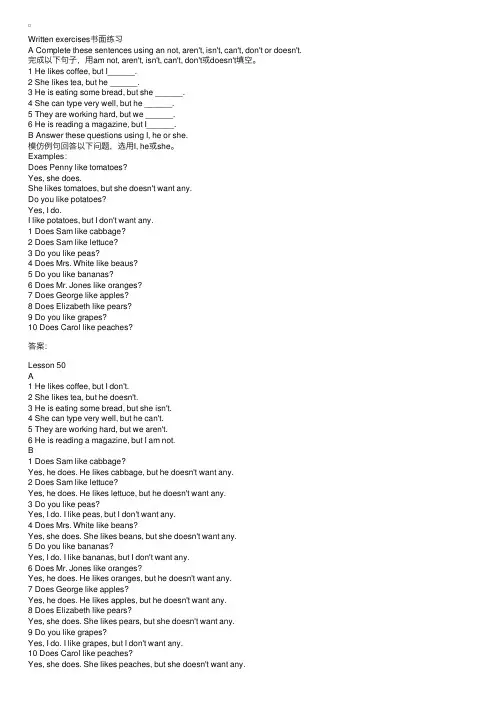
Written exercises书⾯练习A Complete these sentences using an not, aren't, isn't, can't, don't or doesn't.完成以下句⼦,⽤am not, aren't, isn't, can't, don't或doesn't填空。
1 He likes coffee, but I______.2 She likes tea, but he ______.3 He is eating some bread, but she ______.4 She can type very well, but he ______.5 They are working hard, but we ______.6 He is reading a magazine, but I______.B Answer these questions using I, he or she.模仿例句回答以下问题,选⽤I, he或she。
Examples:Does Penny like tomatoes?Yes, she does.She likes tomatoes, but she doesn't want any.Do you like potatoes?Yes, I do.I like potatoes, but I don't want any.1 Does Sam like cabbage?2 Does Sam like lettuce?3 Do you like peas?4 Does Mrs. White like beaus?5 Do you like bananas?6 Does Mr. Jones like oranges?7 Does George like apples?8 Does Elizabeth like pears?9 Do you like grapes?10 Does Carol like peaches?答案:Lesson 50A1 He likes coffee, but I don't.2 She likes tea, but he doesn't.3 He is eating some bread, but she isn't.4 She can type very well, but he can't.5 They are working hard, but we aren't.6 He is reading a magazine, but I am not.B1 Does Sam like cabbage?Yes, he does. He likes cabbage, but he doesn't want any.2 Does Sam like lettuce?Yes, he does. He likes lettuce, but he doesn't want any.3 Do you like peas?Yes, I do. I like peas, but I don't want any.4 Does Mrs. White like beans?Yes, she does. She likes beans, but she doesn't want any.5 Do you like bananas?Yes, I do. I like bananas, but I don't want any.6 Does Mr. Jones like oranges?Yes, he does. He likes oranges, but he doesn't want any.7 Does George like apples?Yes, he does. He likes apples, but he doesn't want any.8 Does Elizabeth like pears?Yes, she does. She likes pears, but she doesn't want any.9 Do you like grapes?Yes, I do. I like grapes, but I don't want any.10 Does Carol like peaches?Yes, she does. She likes peaches, but she doesn't want any.。
Lesson4950(讲义)新概念英语一册
Lesson 49 At the butcher's 在肉店[词汇](11)(1)butcher [ˈbʊtʃə(r)]n. 屠夫v. (为了吃肉)屠杀、屠宰动物eg. butcher’s= butcher’s shop(2)meat [miːt]n. 肉 [u]同音异义词:meet v. 遇见,会见新概念一册L:5 Nice to meet you!(3)beef [biːf]n. 牛肉 [u]eg. have a beef with sb. 和某人起争执,和某人发生矛盾(4)lamb [læm]n. 羔羊肉 [u]mutton [ˈmʌtn] n. 羊肉eg. 新概念三册L:16 Mary and a little lamb(5)chicken [ˈtʃɪkɪn] n. 小鸡[c] 鸡肉[u] duck [dʌk] n. 鸭肉(6)mince [mɪns]n. 肉馅[u]eg. mincer n. 绞肉机pork n. 猪肉bacon n. 咸肉,熏肉,腊肉(培根)(7)steak [steɪk]n. 牛排 [u]★steak house 牛排餐馆,牛排屋eg. How do you like your steak?★ rare 三分熟,稀少的,稀有的(rare animal/plant)★ medium [ˈmiːdiəm] 半生/半熟的(medium形容处于中性的物质,而middle是说明空间的中部)★ medium well 七分熟★ well done 全熟的牛排(8)husband [ˈhʌzbənd] n. 丈夫eg. husband and wife 夫妇They are a couple. 他们是一对(夫妻)。
(9)tell [tel]vt. 告诉,讲述(把一件事情传达给别人,及物动词,后可接双宾语)eg. tell the truth 说实话tell a lie 撒谎tell a story 讲故事tell sb.(not) to do sth. 告知某人(不要)做某事(Mum told me not to ride a bike quickly.)★ say vt.说话,强调说话的内容eg. What does he say? 他说了什么?(新概念一册L:101 A card from Jimmy)‘I can ask him the way,’she said to herself.(新概念一册L:73 The way to king street)(say to oneself 自言自语,心里暗想)★ speak vi.强调说话、发言的动作vt.讲某种语言eg. May I speak to Uncle Wang?我可以和王叔叔通话吗?(打时)Do you speak English? 你说英语吗?★ talk vi. 交谈(强调双方)eg. talk show 脱口秀★ chat 聊天eg. chat room 聊天室have a chat with sb./chat with sb. 和某人聊天video chat 视频聊天voice chat 语音聊天★ gossip [ˈɡɒsɪp] 聊天(说三道四,贬),嘎三胡(10)truth [truːθ] n. 实情 [u]eg. to tell you the truth 说老实话★true adj. 真实的eg. true lie 真实的谎言e true 梦想成真,实现(11)either [ˈaɪðə(r)]a dv. 也(用于否定句)either一般用于否定句,位于句末,前面通常有逗号。
新概念英语第一册自学笔记
4 She can type very well, but he can't.
5 They are working hard, but we aren't.
6 He is reading a magazine, but I am not.
B
1 Where does she come from?
Does she come fromEngland?
No, she doesn't come fromEngland. She comes from the U. S.
What nationality is she?
She's American.
B
1 Yes, he does.
He likes cabbage, but he doesn't want any.
2 Yes, he does.
He likes lettuce, but he doesn't want any.
3 Yes, I do.
I like peas, but I don't want any.
Does he come fromFrance?
No, he doesn't come fromFrance. He comes fromGermany.
What nationality is he?
He's German.
4 Where does he come from?
Does he come fromItaly?
词汇学习 Word study
新概念英语一册第49-50课练习
新概念一册第49-50课练习一根据汉语提示填空1.Do you want any ____________(肉)today?2.He doesn’t like beef or____________(羔羊肉).3.My husband doesn’t like____________(西红柿)4.I like____________(卷心菜) with meat.5.Can you eat some____________(牛排)?6.Tom wants some____________(莴苣).7.Which do you want,beans or____________(豌豆)?8.There are some dried ____________(葡萄) in the ice cream.9.Mrs. Bird gets a pound of____________(肉馅).10.Does Mrs. Bird want a ____________(小鸡)?二、用所给动词的适当形式填空1.____________Sam____________(like)cabbages?2.Mrs. white____________not____________(want) beans.3.____________the butcher____________(tell) Mrs. Bird the truth?4.Sally often____________(sit) near the tree.5.The family____________(walk) over the bridge now.6.____________the children____________(jump) off the branch?7.____________the aeroplane always____________(fly) under the bridge?8.I____________(see) my grandfather tomorrow.9.Li Ming and his friend like____________(play basketball.10.Be careful!____________not____________(drop) it.11.Is that tin of tobacco for ________ (I)?12.What are you going ________ (do) with that vase?13.________ not ________ (put) it here.14.Look, the boys ________ (jump) off the tree.15.We are doing ______ (we) homework.16.Penny ________ (put) the bag on the chair now17.The boss ________ (want) Bob to come to his office.18.You mustn’t ________ (show) that picture to her.19.Do you want ________ (some) wine?20.Must he __________(go) to school by bike?三、阅读理解There is a reading-room in our school. It is big and bright. On the walls there are some maps and pictures. There is a clock on the front wall. There are many desks and chairs in the room. There are all kinds of books on the shelves.Many students often go there and read books after class. The students and teachers in our school clean the reading-room every day.( ) 1、The reading-room is ______.A. bigB. brightC. small but niceD. big and bright( ) 2、There is a nice clock ______.A. on the wall.B. on the front wallC. on the back wallD. in front wall ( ) 3、There are ______ on the shelves.A. some maps and pictures.B. many desks and chairs.C. all kinds of books.D. some books( ) 4、Every day ______ clean the reading-room.A.the studentsB. the teacherC. the teachers and studentsD. the students and teachers in our school ( ) 5、Many students often go there and ______ after class.A. read booksB. do some homeworkC. have their lessonsD. clean the reading-room四、写作______________________________________________________________________________ ______________________________________________________________________________ ______________________________________________________________________________ ______________________________________________________________________________ ______________________________________________________________________________ ______________________________________________________________________________ ______________________________________________________________________________ ______________________________________________________________________________ ______________________________________________________________________________。
新概念第一册第49、50课
1. Did he _____ it in English? A. tell B. speak C. say D. talk 2. The teacher _____ us to finish the homework in time. A. tells B. speaks C. says D. talks 3. What would you like to ______ us about your hometown. A. speak B. talk C. say D. tell
BUTCHER: Do you want any meat today, Mrs. Bird? MRS.BIRD: Yes, please.
BUTCHER: Do you want beef or lamb? MRS.BIRD: Beef, please. BUTCHER: This lamb's very good. MRS.BIRD: I like lamb, but my husband doesn't. BUTCHER: What about some steak? This is a nice piece. MRS.BIRD: Give me that piece, please. MRS.BIRD: And a pound of mince, too.
New Words and Expressions
mince chicken tell truth either
/mins/ n.肉馅 /'ʧikən/ n.鸡 /tel/ v.告诉 /tru:θ/ n.实情 /'aiðə/ adv.也
★ butcher n.卖肉的 a person who sells meat
新概念英语第一册Lesson49-50Atthebutcher's课件
Language Point
语句讲授、课文讲授
如果是疑问的语气 , 怎么表达? — Do you like coffee? — Yes, I do. / Yes, I like coffee. e.g. — Does she like coffee?
— Yes, she does. / Yes, she likes coffee. — Does he want a new schoolbag? — No, he doesn't.
B. do D. doesn't
查看答案解析
答案:do 解析: 考查疑问句回答 第一因为是Yes,所以是肯定回答,排除don't和doesn't;其次I是第一人称单数,后面要跟do; 译文:“你想要些土豆吗?” “是的 , 我想要。”
下一题
— Does Sam like cabbage? — Yes, he ______ .
Language Point
语句讲授、课文讲授
如果是否定的语气 , 怎么表达? 实义动词来做谓语动词 , 应根据主语来加助动词 , 然后在 后面踉上动词原形。 e.g. I like green. → I don't like green.
He likes green. → He doesn't like green. I want a cup of tea. → I don't want a cup of tea. She wants a cup of tea. → She doesn't want a cup of tea.
把do变成does。 e.g. He / She / It does.
否定语气:doesn't + 实义动词原形。 e.g. doesn't like / want
新概念英语第1册课程讲义Lesson49-50
Lesson 49 单词讲解1. butcher: 卖肉的at the butcher’s:在肉店at the doctor’s:在诊所at the hairdresser’s:在理发店at the bak er’s:在面包店……2. meat: 肉,不可数名词3. beef: 牛肉4. lamb : 羔羊肉mutton: 羊肉5. steak: 牛排a piece of steak6. mince: 肉馅7. chicken: 鸡肉8. pork: 猪肉a pound of …9. husband : 丈夫10. tell: 告诉tell sb. sth. 告诉某人某件事11. truth: 实情、事实true: adj. 真实的12. either: 也,too: 也,陈述句,疑问句我也不知道。
I don’t know either.你也喜欢英语吗?Do you love English, too?Lesson 49 课文讲解1. Do you want any meat…?Are you…?Do you…?Are you+ 非动词?Do you + 动词?Are you…?Do you…?_____________ busy?_____________ a teacher?_____________ at home?_____________ sleep well?_____________ make thebed?_____________ havebreakfast?Are you…?Do you…?I s she\he\it…?Does she\he\ it…?_____________ tall?_____________ a boss?_____________ in Beijing?_____________ swim well?_____________ wash your hands?_____________ walk to school?先看词性: 再看人称:Are you…?Do you…?Is she\he\it…?Does she\ he\ it…?她是你的女朋友吗?Is she your girlfriend?你经常睡得很晚吗?Do you go to bed late?他在北京学习吗?Does he study in Beijing?先看词性: 动词or 非动词再看人称: 三单or 非三单三单: 第三人称单数she\ he\ itLucy,2. Yes, please.No, thank you.3. But my husband doesn’t.isn’t,aren’t,don’t & doesn’t?isn’t+非动词, aren’t+非动词, don’t+动词, doesn’t+动词先看词性: 动词or 非动词,再看人称: 三单or 非三单练习:他个子不高。