
人教版七年级英语下册第三单元Section A 第2课时
小结训练
A 1. The early bus _____ him to school. A. takes
C. needs
B. brings
D. take
2. I always go to work _____. C
Language points
1.by的用法 by+交通工具名词单数,意为“(搭) 乘……”,不加冠词,类似短语有: on foot。 如:He goes to school by bike. =He rides a bike to school. 他骑自行车去学校。
2.take的用法:
take作动词,意为“需要,花费,占用”, 固定句型It takes sb some time to do sth, 意为“做某事需要花费某人多长时间”。
2c
Listen again. Check your answers in 2b
20 minutes
A: How does Tom get to school? B: He walks to school. A: How long does it take?
B: It takes him twenty minutes.
84 105 99 200 72 61
Can you read these numbers? Have a try.
90
ninety
60
sixty
88
eighty eight
116
one hundred and sixteen
225
two hundred and twenty five
203
two hundred and three
2d
Student A is Jane and Student B is e the information in 2b to make conversations.
A:How do you get to school? B:I… A:How long does it take… A:How far is it from…to… B:It takes… B:It’s about…
How do you get to school?
I get to school by subway.
How long does it take ? It takes about 15 munites.
How do you get to school?
How far is it from your home to school? I get to school by bike. it’s about three kilometers away.
Yes.I ride it to school every day.How do you get to school?
10 kilometers 20 minutes
15 minutes
Grammer Focus
How do you get to school? I ride my bike. How does she get to school? She usually takes the bus. How long does it take to get It takes about to school? 15 minutes. How far is it from your home It’s only about two to school? kilometers. No, she doesn’t. She Does Jane walk to school? goes by bike. No, they don’t. Do they take the bus to They walk. school?
2a
Listen and repeat
sixty-one ______ 61 seventy-two ________ 72
eighty-four ______ 84
ninety-nine _______ 99 one hundred and five _______ 105 two hundred _______ 200
992
nine hundred and nighty two
2b
Listen and complete the chart
How Tom walks
How long (minutes)
20 minutes
How far (kilometers)
2 kilometers
Jane takes one hour 60 the bus and 30 minutes kilometers
a. Yes, they do. b. No, he doesn’t. c. He rides his bike. d. It’s five kilometers. e. About 15 minutes.
3b
Use these words to make questions.
Then ask and answer them with your
A. ride B. take a bus
C. by bus D. by a bus
完成当堂测评作业
在学习上做一眼勤手勤脑勤, 就可以成为有学问的人。 ——吴晗
Unit 3
How do you get to school?
R 七年级下册
Section A 第2课时(2a-3c)
A:How do you get to school? B:I ride my bike to school.
A:How does she get to school?
B:She takes the bus to school.
to school? ___________________________
3. school/your/ from/it/is/how far/ home/to ___________________________ How far is it from your home to school? 4. you/to/walk/do/school Do you walk to school? ___________________________ 5. ride/their bikes/do/school/your friends/to Do your friends ride their ________________________ ________________________ bikes to school?
partner.
1. school/you/get to/do/how ___________________________ How do you get to school?
2. to/school/get to/does/how long/take/it How long does it take to get ___________________________
3a
Matchwers. Then practice them.
1. 2. 3. 4. 5.
How does Mike get to school? ___ c e How long does it take to get home? ___ How far is it from here? ___ d a Do your friends go to school by bus? ___ Does your dad drive to work? ____ b
2e
Read the conversation and fill in the blanks.
Who
How
How long
How far 10 kilometers
Lisa take the bus 20 minutes Jane ride the bike 15 minutes
Hey,Jane.Is this your new baike?
人教版英语七年级下册Unit3SectionB2a2c教学设计

3.培养学生的团队协作能力,让他们在合作中学会倾听、表达和尊重。
4.激发学生的学习兴趣,培养他们自主学习的意识和能力,为今后的英语学习奠定坚实基础。
四、教学内容与过程
(一)导入新课,500字
1.教师通过多媒体展示一组学生的日常作息图片,如:早晨起床、刷牙、吃早餐、上学等,引导学生观察并思考以下问题:
3.运用问题引导法,引导学生关注文章细节,提高阅读技巧。
4.创设情境,让学生在实际语境中运用所学知识,提高语言表达能力。
(三)情感态度与价值观
在本章节的学习中,学生将形成以下情感态度与价值观:
1.培养学生良好的生活习惯,认识到合理安排时间的重要性。
2.增强学生的自信心,鼓励他们大胆表达自己的观点。
3.培养学生的团队精神,让他们学会尊重、关心和帮助他人。
- Make sentences using the given words.
- Ask and answer questions about daily routines.
2.学生独立完成练习题,教师针对学生的完成情况进行点评,解答学生的疑问。
3.教师挑选部分学生的练习成果进行展示,鼓励学生互相学习和借鉴。
4.引导学生树立正确的价值观,关注个人成长,努力提高自己。
二、学情分析
本章节的教学对象为七年级下册的学生,他们在英语学习方面具备以下特点:
1.经过前一阶段的学习,学生已经掌握了一般现在时态的基本用法,能够运用该时态进行简单的句子表达。
2.学生对日常生活中的作息、活动有一定的认知,能够通过已学的词汇描述一些简单的日常行为。
3.能够通过阅读文本,获取、整理、归纳文章中的关键信息,提高阅读理解能力。
Unit3第2课Section A 2e-Grammar focus 3c教学课件七年级下册人教版)
You,too.
Presentation 2e Read again and finish the chart.
Name
How?
How long? (minutes) How far? (kilometers)
No, he doesn’t.
Use these words to make questions, then ask and answer with Practice 3b your partner.
school
get to
how
you
do
How do you go to school?
Use these words to make questions, then ask and answer with Practice 3b your partner.
-YI etsa.kIer/irdide eitato/tshceh+o交ol通ev工er具y。day. How do you get to school?
-How does he/she go/get to ...?
-HeI/Suhsueatlalyketsa/kreidtehse ab/uths.e+交通工具。
school
to
Do your friends ride their bikes to school?
Part four
Production
.......
Production 3c Ask your classmates questions and write their names in the chart. The first student to fill in all the blanks wins!
七年级英语下人教版 Unit3Section A 第二课时教学设计
Section A 第二课时教学设计
教学内容
SectionA 中的 3A、3b、4。
教学目标
知识与能力
1.Revise the knowledge of the last class.
2.Learn the following words: Africa South Africa bingo.
3.Do some exercises to practice the target language.
过程与方法
在上一节课的学习中学生们已有了相当的基础,因此能轻松完成本课的学习任务,通过测试引入教学,利用多种练习方式从听、说、读、写四个方面入手进行教学活动。
情感态度价值观
明确动物种类及产地,有探索欲望。
教学重、难点及教学突破
重点
1.The vocabulary
2.The revision
难点
Use the language freely.
教学突破
借助于多媒体及单词卡片来进行练习。
教学准备
教师准备
recorder. slides. Exercises
学生准备
课前预习本课内容。
教学步骤
(第1课时)
本课小结
本节课学习了与动物相关的几个国家,通过游戏巩固了所学,学生兴趣很高。
结合本节课所学的内容,学生课下搜集其它与动物有关的国家。
教学探讨与反思
1.游戏激趣可以推广。
2.要经常反复检查学生的知识掌握情况,以便巩固、提高。
板书设计
Unit 3 Why do you like koalas?
animals countries.。
Unit3SectionA2a2e课件人教版七年级英语下册
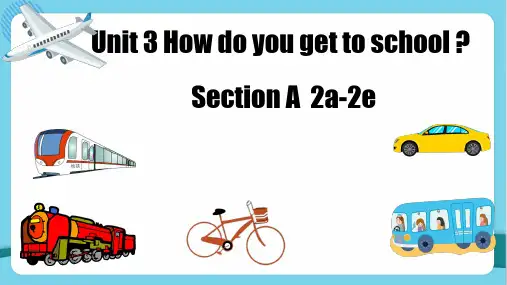
Tapescripts 2c Listen again. Check your answers in 2b.
Conversation 1 Mary: How do you get home from school, Tom? Tom: I walk. Mary: How long does it take? Tom: It takes about 20 minutes. Mary: Wow! That’s quick! How far is it from the school to your home? Tom: Only about two kilometers.
Revision
(动词)交通方式
--How do you get to school? --I usually ...to school.
ride a bike take the subway
take a ship
TAXI
take a train
walk
take a bus take a plane/taxi take / drive a car
A: How long does it take…? B: It takes…
A: How far is it from…to…? B: It’s about…
Post-listening
2d
Student A is Jane and Student B is Tom. Use the information in 2b to make conversations.
Let’s listen 2b
How
Tom
walk
Jane take the bus
How long (minutes)
2021人教版英语七年级下册unit3sectionA2a---2d教学课件 (2)
【拓展】表示“乘坐某种交通工具”还可以 用“on / in + 限定词 + 表示交通工具的名词”。 如:She often goes to school on the school bus. 她经常乘校车去上学。
He sometimes goes to school in his father’s car. 他有时坐爸爸的汽车去上学。
2) “ride / take + 限定词 + 表示交通工具的 名词” 在句中作谓语。如:
She rides the bus to school every day. 她每天乘公共汽车去上学。 We can take a train to their hometown. 我们可以坐火车去他们的家乡。
-I ________ to school.
take the bus
take the subway
take the car
ride the bike
-How do you get to Hongkong? -I ______to Hongkong.
take the train
take the plane
Read the conversation and fill in the blanks.
How
Lisa takes the bus Jane rides the bike
How long (minutes)
20 minutes 15 minutes
How far (kilometers)
10 kilometers
Lisa: Hey, Jane. Is this your new bike? Jane: Yes. I ride it to school every day. How
人教版七年级英语下册Unit 3第2课时Section A(2a-3c)教案

第2课时Section A(2a-3c)【学习目标】【课堂导学】Step 1情景导入Teacher:How do you get to school?Student 1:I take the bus to school.Teacher:How does he get to school?Student 2:He takes the bus to school.Teacher:How long does it take?Student2:It takes twenty minutes.Teacher:How far is it?Student2:It’s ten kilometers.环节说明:通过师生互动复习上节课的内容,在问答中提醒学生注意一般现在时态单数第三人称的使用。
Step 2 完成教材2a~2d的任务1.提取卡片,熟练地说出数字。
(5分钟)2.听录音跟读数字并完成2a,然后熟读这些数字。
(3分钟)3.听录音,完成2b,并核对答案。
(4分钟)4.一人扮演Jane,一人扮演Tom,根据2b中的信息来练习对话,并邀请几组表演。
(5分钟)5.小结训练。
(2分钟)(1)选用how long、how far 填空。
① __How__long__ does it take you to get home?②— __How__far__ is it from the bank to school?—One kilometer.(2)用所给单词的正确形式填空。
It takes him two hours __to__do__ (do) his work.环节说明:通过听、说学习训练让学生了解要掌握的语言目标,学生的口语表达能力在这一环节得到提升。
Step 3 完成教材2e的任务1.学生自读对话。
(2分钟)2.大声朗读2e对话,读熟后与同伴结对练习,分角色表演对话。
(3分钟)3.邀请三组来表演对话。
(3分钟)4.小结训练。
人民教育出版社七年级英语下Unit3 A第二课时
Unit 3 How do you get to school?Section A (2e) 阅读课Period 2一、Teaching and Learning Goals and Evaluation :(一)、目标:目标1:Talk about how to get to places.(背会各种交通工具的英文表达并能够自由谈论出行方式。
)目标2:能正确读出和记忆使用下列常用表达(Useful expressions):get to school, take the subway\bus\train, ride a\my bike, walk to school (get to school on foot), by bike\bus\train\subway, every day.目标3:能灵活使用下列句型询问出行方式与同伴或老师进行交流。
A: How do you get to school?B: I usually take the bus.A: How far is it from your home to school?B: It’s only 10 kilometers.A: How long does it take you to get to school?B: It takes about 15 minutes by bike.目标4:通过细读梳理文章脉络,能形成思维导图,引导学生提高听力和阅读技巧。
并且利用多媒体感受语言,学生能通过听和看图来描述人物的出行方式。
目标5:通过对文章的学习,学生能创设合适的情景用对话的形式谈论交通方式,了解因地域文化差别所造成的出行方式的差异,并教育学生注意交通安全,加深对交通知识的了解。
(二)评价任务及标准1.能准确为句子排序,句子每3分。
满分15分。
2.听录音正确流畅回答下列问题。
一个问题5分,满分20分。
3.根据粗读文章能选出大意和正确填写表格。
人教新目标七年级英语下册unit 3(第二课时)课件
2d Role-play the conversation. (Two)
Lisa: Hey, Jane. Is this your new ________? Jane: Yes. _____________ every day. How do you get to school? Lisa: I usually __________. Jane: _______ is it from your home to school? Lisa: I’m not sure … about 10 kilometers? ________ takes about 20 minutes. __________ does it take you to get to school? Jane: About 15 minutes ____ bike. It’s good exercise. Lisa: Yeah. Well, _____________ at school. Jane: You, too.
Lisa: Hey, Jane. Is this your new bike? Jane: Yes. I ride it to school every day. How do you get to school? Lisa: I usually take the bus. Jane: How far is it from your home to school? Lisa: I’m not sure … about 10 kilometers? The bus ride takes about 20 minutes. How long does it take you to get to school? Jane: About 15 minutes by bike. It’s good exercise. Lisa: Yeah. Well, have a good day at school. Jane: You, too.
有课后反思的七年级人教版英语下册第三单元教案
Unit 3 How do you get to school?第一课时Section A (1a-2d)一、教学目标:1. 语言知识目标:语言知识目标:1) 能掌握以下单词:能掌握以下单词:train, bus, subway, ride, bike, sixty, seventy, eighty, ninety, hundred, far, minute, kilometer, new, every, every day 2) 能掌握以下句型:能掌握以下句型:① —How do you get to school? —I ride my bike. ② —How does Mary get to school? —She takes the subway. 2. Talk about how to get to places (谈论出行方式) take the bus /subway /train /taxi , ride a bike /walk . 3. how 引导的特殊疑问句,表示乘坐何种交通工具的方式。
how far, how long 引导的特殊疑问句。
导的特殊疑问句。
4. 复习基数词及时间的表示方法。
复习基数词及时间的表示方法。
2. 情感态度价值观目标:让学生感受到他们学习英语是为了在现实生活中进行交流,而不单纯是为了英语课和应付考试而学习,了解东西方国家出行方式的不同,了解东西方国家出行方式的不同,以及不同的交通以及不同的交通规则,教育学生注意交通安全, 加深对交通知识的了解。
倡导自觉遵守交通法规及礼貌,构建和谐的人际关系。
了解交通的发展,培养创新精神。
二、教学重难点1. 教学重点:教学重点:1) how /how far /how long 引导的特殊疑问句. 2) 乘坐交通工具的表示方法. 3) It takes / sb some time to do sth . 2. 教学难点:教学难点:—How do you get to school? —I take the …/ride …/ walk… —How does Mary get to school? —She takes the subway. —How long does it take? —It takes forty minutes. —How far is it from … to … —It's It's…… kilometers. 三、教学过程Ⅰ. Warming-up and Lead in 学生和老师进行简单的问候学生和老师进行简单的问候Ss : Good morning , teacher. T: Good morning , class T: Look at the picture. What can you see? Do you like your school? I usually get to school by bike, but sometimes on foot . How do you get to school? Ss 按实际情况作答按实际情况作答S1: I ride my bike. S2: I go by bus. S3: ………T: V ery good. You’re clever. Let’s learn Unit 4 Section A. 之后板书:之后板书:“Unit 4 How do you get to school?”Ⅱ. Presentation 1. T: If you are here, but your school is in Shanghai. How do you get to school? Ss: I take the bus /plane/ boat / ship / car / taxi I ride a bike / motorbike T: Do you know any other way? 2. Teacher shows pictures on the big screen .归纳出行方式和常用短语. Ask some questions about how you get to…? (让学生积极主动的思考想象总结,多媒体增加趣味性,加强直观性,效果事半功倍) 3. Show a picture about Part 1, on the screen. Point at girls or boys in the picture. Ask students to answer and write in the blanks. S1 : How does he / she go to school? S2 : He / She … …Ⅲ. 1a T: Look at the picture on your book. Match the words with the picture. (学生们完成1a 的学习任务,然后校对答案) Ⅳ. Listening 1. Make sure the Ss know what to do. Give them an example orally if possible. 2. Read the names in the box. 3. Play the tape and check the answers. Ⅴ. Pair work Ask two students to read the dialogue in the speech bubbles to the class. Then ask students students to to to work work work in in in pairs. pairs. pairs. Ask Ask Ask and and and answer answer answer how how how students students students get get get to to to school school school in in in the the picture. Finally ask some pairs of students to present their conversations to the class. Ⅵ. Listening 1. 1. Revise Revise Revise the the the numbers, numbers, numbers, first, first, first, zero~nine, zero~nine, zero~nine, next, next, next, ten~nineteen, ten~nineteen, ten~nineteen, then, then, then, twenty, twenty, thirty, forty forty……finally, twenty-one, twenty-two… Teach the new word "hundred". 2. Play the tape for the students to finish 2a. Then play again and check the answers Ⅶ. Presentation Section A (1a-2d) 1. —How do you get to school? —I ride my bike? —How does Mary get to school? —She takes the subway. 2. 表达“几十” 个位数字+ty twenty, thirty, 一定要用连字符 twenty-five, sixty-nine 表达“几十几” 一定要用连字符hundred one hundred, two hundred 3. ① How does Jane get to school? ② How far is it from home to school? ③ How long does it take to get to school from her home? 课后反思:引入环节可以先让学生以小组活动为主要练习方式,引入环节可以先让学生以小组活动为主要练习方式,让学生讨论他们让学生讨论他们所知道的交通工具,所知道的交通工具,并把它们画出来,并把它们画出来,并把它们画出来,由小组长汇总,由小组长汇总,由小组长汇总,并填表向全班同学展示讨并填表向全班同学展示讨论结果,论结果,全班评选出哪一组知道的交通工具多,全班评选出哪一组知道的交通工具多,全班评选出哪一组知道的交通工具多,并看谁画得棒。
人教版英语七年级下册Unit3SectionA1a2e说课稿
在教学过程中,我预见到可能出现的问题或挑战,如部分学生对一般现在时的理解和运用存在困难,口语表达能力较弱等。针对这些问题,我将采取以下应对措施:1.对于一般现在时的理解和运用困难,我将通过更多的示例和练习,让学生进行实际操作,提高他们的理解能力;2.对于口语表达能力较弱的学生,我将组织更多的口语练习活动,如小组讨论、角色扮演等,提高他们的口语表达能力。课后,我将通过学生的作业、课堂表现和自我评价等方式,评估教学效果。根据评估结果,我将进行教学反思,针对存在的问题和改进措施,调整教学方法和策略,以提高教学效果。
(二)学习障碍
在学习本节课之前,学生需要掌握一定的基础知识,如基本的日常活动和喜好表达,一般现在时的基本结构等。可能存在的学习障碍主要有:对一般现在时的理解和运用,特别是动词的三单形式的变化;在口语交流中,可能会出现词汇量不足,表达不准确的情况;对于部分学生,可能会存在害羞、不敢开口的问题。
(三)学习动机
2.教学难点:本节课的难点是一般现在时的运用。学生需要能够在适当的情境中,正确运用一般现在时进行交流。对于部分学生来说,掌握动词的三单形式可能会有一定难度。
二、学情分析导
(一)学生特点
本节课面向的是七年级的学生,他们正处于青少年时期,好奇心强,好动,善于模仿,同时也具有一定的独立思考能力。他们的认知水平正处于从具体形象思维向抽象逻辑思维过渡的阶段,对于新鲜事物充满好奇,善于接受新知识。在学习兴趣方面,大部分学生对英语学习保持积极态度,尤其是对于口语交流和有趣的活动。在学习习惯方面,学生已经逐渐养成了一定的学习习惯,如按时完成作业,积极参与课堂活动等。
(二)媒体资源
为了辅助教学,我将使用多媒体课件、实物教具和在线学习平台等资源。多媒体课件能够直观地展示日常生活场景,帮助学生更好地理解和运用所学知识;实物教具能够让学生直观地观察和模仿,提高他们的学习兴趣;在线学习平台能够提供丰富的学习资源和互动机会,让学生在课后进行自主学习和交流。