
人教版新目标七年级下Unit10 I’d like some noodles单元复习课件
• 9. green tea 绿茶 10. orange juice 橘汁 • 11. around the world 世界各地 • 12. birthday cake 生日蛋糕 • 13. the number of… 的数量 • 14. make a wish 许个愿望 • 15. blow out 吹灭 • 16. in one go 一口气 • 17. come true 实现 • 18. cut up 切碎
• 1. I ’d like some noodles. 我想要面条。 • 【自主领悟】(1)would like意为“愿意; 喜欢”, 表示意愿,
后接名词作宾语, 相当于want, 但语气较委婉。would是情
态动词, 没有人称和数的变化, 常简写为“‘d”。 • (2)noodle为名词, “面条”, 常用复数形式。例如: • Noodles are very popular in our city. • 面条在我们城市很受欢迎。
(3)would like sb. to do sth. 想让某人做某事。例如:
Her parents would like her to learn music. 她的父母想让她学音乐。
(4)Would you like. . . ? 句型的答语:
肯定回答常用Yes, please. /OK. /All right. ; 否定回答常用No, thanks. 在回答Would you like to do sth. ? 时, 肯定回答常用 Yes/Sure, I’d like/love to; 否定回答常用I’d like/love to, but. . . 。
我想要鸡肉土豆卷心菜面。 【自主领悟】句中名词chicken/potato/cabbage均作noodles的
定语, 其中potato, cabbage是可数名词, 由此可见可数名词作定
语一般用单数形式。
【温馨提示】 可数名词作定语一般用单数, 但man/woman除外, man/woman 要与后面的名词在数上保持一致, 如a man/ woman teacher; two men/women teachers。
②—Would you like some coffee?
A. Yes, I would
C. No, I wouldn’t
③Little Jimmy has A. noodle
D. No, I don’t
for breakfast. B. a noodle
C. some noodles
D. some noodle
2. I’m not sure yet. 我还不确定。
【自主领悟】句中yet为副词, 意为“还; 仍然”, 表示“某事 尚未发生或完成”, 多用于否定句或疑问句。例如:
He can’t leave hospital yet. 他现在还不能出院。
【归纳拓展】yet的同义词still的用法 still表示“某事尚在进行中”, 常用于肯定句中, 也可用在疑问 句或否定句中, 在否定句中须放在否定词not之前。例如: The door is still closed. 门仍然关着。
【活学活用】
①These (woman) runners would like some ________
(tomato) noodles.
②There are some
答案: ①women; tomato
(apple)
(tree)over there.
②apple trees
4. May I take your order? 可以点餐了吗?
【自主领悟】本句话是服务员询问顾客是否点菜的常用语 , order作名词, 意为“点菜”, take your order相当于have your
order。
【归纳拓展】order的不同词性 order还可以用作动词, 意为“命令; 点菜”。例如: She orders one mapo tofu with rice. 她点了一份麻婆豆腐外带米饭。
Is Tom still in No. 4 Middle School?
汤姆还在第四中学吗?
【活学活用】
①我现在还不能离开这儿。 I leave here .
②汤姆仍然站在那里。
Tom there. ②still stands
答案: ①can’t; yet
3. I’d like chicken, potato and cabbage noodles.
【活学活用】 ①—What would you like for dinner? —I like hamburgers. But now I’d like A. eating — . B. Yes, please B. to eat C. to drink some bread. D. drinking
【归纳拓展】would like的不同用法 (1)would like sth. 想要某物。例如:
I would like beef noodles. 我想要牛肉面。
(2)would like to do sth. 想做某事。例如: My friends would like to visit you. 我朋友想去拜访你。
【活学活用】
①May I have your order? (同义替换) A. take B. eat C. look D. buy
②我们点份土豆沙拉吧。
Let’s 答案: order one potato salad.
unit10 I’d like some noodles
单元复习课件
短语归纳
• • • • • • • •
1. would like 想要 2. take one’s order 点菜 3. beef soup 牛肉汤 4. one bowl of… 一碗…… 5. what size 什么尺寸 6. mapo tofu with rice带米饭的麻婆豆腐 7. what kind 什么种类 8. small / medium / large bowl 小/ 中/大碗
人教版七年级下册英语Unit10 I'd like some noodles教材听力原文及译文
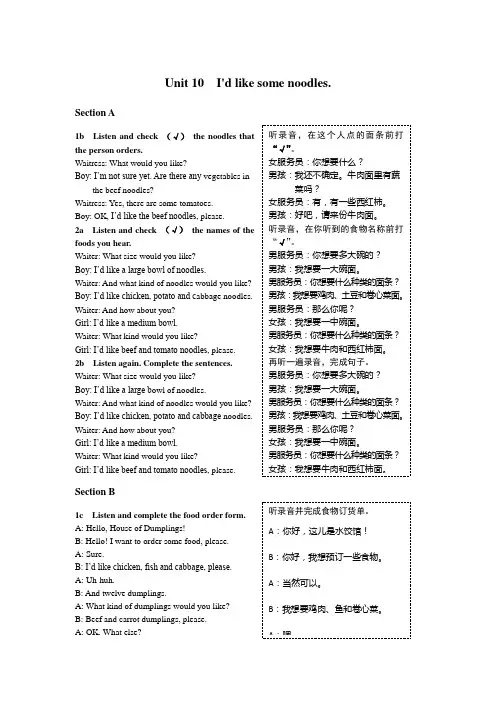
Unit 10 I'd like some noodles. Section A1b Listen and check (√)the noodles that the person orders.Waitress: What would you like?Boy: I’m not sure yet. Are there any vegetables in the beef noodles?Waitress: Yes, there are some tomatoes.Boy: OK, I’d like the beef noodles, please.2a Listen and check (√)the names of the foods you hear.Waiter: What size would you like?Boy: I’d like a large bowl of noodles.Waiter: And what kind of noodles would you like? Boy: I’d like chicken, potato and c abbage noodles. Waiter: And how about you?Girl: I’d like a medium bowl.Waiter: What kind would you like?Girl: I’d like beef and tomato noodles, please.2b Listen again. Complete the sentences. Waiter: What size would you like?Boy: I’d like a large b owl of noodles.Waiter: And what kind of noodles would you like? Boy: I’d like chicken, potato and cabbage noodles. Waiter: And how about you?Girl: I’d like a medium bowl.Waiter: What kind would you like?Girl: I’d like beef and tomato noodles, please. Section B1c Listen and complete the food order form. A: Hello, House of Dumplings!B: Hello! I want to order some food, please.A: Sure.B: I’d like chicken, fish and cabbage, please.A: Uh-huh.B: And twelve dumplings.A: What kind of dumplings would you like?B: Beef and carrot dumplings, please.A: OK. What else? 听录音,在这个人点的面条前打“√”。
人教版新目标七年级英语下册Unit10教案

—1—人教版新目标七年级英语下册Unit10教案Unit 10I’d like some noodles.Period 1 Ⅰ.Teaching Aims and Demands Knowledge Objects Key vocabulary. Ta rget language. 2. Ability Object Train 2. Ability Object Train students’students’students’ listening and speaking skills. listening and speaking skills.3. Moral Object Noodles are popular with people. They are trad itional Chinese food. Ⅱ. Teaching Key Points Key vocabulary, espe cially the names of food. Countable and uncountable nouns. Ⅲ. Teac hing Difficulties Train hing Difficulties Train students’students’students’ listening and speaking skills. listening and speaking skills. Ⅳ. Teac hing Methods Listening and speaking methods. Scene teaching methods Ⅴ. T eaching Aids A tape recorder . Ⅵ. Teaching Procedures Step Ⅰ. Warming-up and lead-in Oral speech.→ I like I like…I’…I’…I’d like some noodles. Step d like some noodles. Step Ⅱ. New words learning Step Ⅲ. Presentation (1a) 1. Write the letter after the name of the food. 2. Have students match the words with the foods on their 初一全科目课件教案习题汇总语文数学英语历史地理own. 3. Go over the answers. StepⅣ. Listening (1b) Listen and put a check before the noodles the m an ordered. StepⅤ. Pairwork(1c) Ask students to practice similar conversation s in pairs. Students take turns to be the customer and the noodles ma ker . StepⅥ. Summary and homework Remember the words and practice the target language.Period 2Ⅰ.Teaching Aims and Demands 1. Knowledge Objects Target language Ability Object Train Ability Object Train students’students’students’ listening and speaking skills. Train stude listening and speaking skills. Train stude nts’nts’ communicative competence. Moral Object Noodles are popular communicative competence. Moral Object Noodles are popular with people. They are traditional Chinese food. Ⅱ. Teaching Key Poi nts T h e t a r g e t l a n g u a g e u s e d f o r a s k f o r a n d g i v e p e r s o n a l information. Order food. Ⅲ. Teaching Difficulties Train Train students’students’students’ listening and speaking skills. Train listening and speaking skills. Train listening and speaking skills. Train students’students’students’ commu commu nicative competence. Ⅳ. Teaching Methods Listening and speaking methods. Scene teaching methods Ⅴ. T eaching Aids A tape recorder Ⅵ. Teaching Procedures Step Ⅰ. Warming-up and revision Oral speech and free talk. StepⅡ. Listening (2a 2b) 1. . Listening (2a 2b) 1. YY o u ’r e t o listen and check the names of the foods you hear on the tape. 2. Play the recording twice. Then che ck the answers. 3. P lay th e s ame record ing ag ain. Lis t en carefully and fill in the blanks. StepⅢ. Pairwork (2c,2d) 1. Work with a partner. One is a customer and t he other is a waiter. 2. Invite several pairs of students to act out the ir conversations in front of the class. 3.Have some students role-p lay the conversations in pairs,then explain it to the class. StepⅣ. Grammar Focus G u i d et h e s t u d e n t s t o m a k e s o m e s e n t e n c e s w i t h I ’d , H e ’d and and They’d.They’d.They’d. Step StepⅤ. Conversation practice (3a ,3b) 1. You are to match each question wi th an answer. 2. Get students to do the task in pairs. 3. Put students i nto pairs. One is working in a noodles h o u s e. T h e o t h e r i s t h e c u s t o m e r. G e t t h e p a i r s t o s t a r t t h e activity . Ste pⅥ. Summary and homework 1. S u m m a r yt h e t a r g e t l a n g u a g e w e ’v e l e a r n e d i n t h i s class. 2. Reread the conversa tion in 3a. try to recite it. 3. Write down the conversation in 3c.Period 3Ⅰ. T . Teaching Aims and Demands Knowledge Objects Key vocabulary eaching Aims and Demands Knowledge Objects Key vocabulary . T . Tar ar get language. 2. Ability Object Train get language. 2. Ability Object Train students’students’ listening and speaking skill s. Train s. Train students’students’students’ communicative competence. 3. Moral Object Every communicative competence. 3. Moral Object Every one should choose foods which are good for h is health. Ⅱ. T eachi ng Key Points Learn how to ask for and give personal information an d write down the information. Ⅲ. Teaching Difficulties Learn howto ask for and give personal information and write down the i nformation. Ⅳ. Teaching Methods Practicing methods. Scene teach ing methods Ⅴ. T eaching A ids A tape recorder Ⅵ. Teaching Procedures StepⅠ.Warming-up and lead-in Oral speech. Describe one .Warming-up and lead-in Oral speech. Describe one’’s preferenc es. StepⅡ. New words learning. Porridge onion fish pancake Step Ⅲ. Presentation (1a 1b) 1. Match the words with the pictures. Write the letter of the food on the blank line before its name.2. Circle the things you like in the picture. And make an “×”“×” nex nex t to the things you t to the things you don’t don’t don’t like. Step like. StepⅣ. Listening (1c,1d) 1. Listen carefully and circle in activity 1a th e words that you hear on the tape. 2. Play the same recording again. W Write down the rite down the rite down the customer’s customer’s customer’s address, telephone number and what he or address, telephone number and what he or ders. 3.Check the answers. StepⅤ. Pairwork (2a) 1. Put students into pairs. Ask questions abo ut what they door eat on their birthdays. 2. Invite more advanced students t o demonstrate how to do the activity o demonstrate how to do the activity. Step . StepⅥ.Summary and homework Remember the key words and target la nguage.Period 4Ⅰ. T . Teaching Aims and Demands Knowledge Objects Learn to read and eaching Aims and Demands Knowledge Objects Learn to read and write an ad for House of Dumplings. 2. Ability Object Train student s’s’ reading and writing skills. Train reading and writing skills. Train reading and writing skills. Train students’students’students’ integrating skills. 3. Moral integrating skills. 3. Moral Object Keep healthy. Ⅱ. Teaching Key Points Learn how to order fo od. Learn to write an ad for House of Dumplings. Ⅲ. T . Teaching Diffic eaching Diffic ulties Learn how to order food. Learn to write an ad for House of D umplings. Ⅳ. Teaching Methods reading and writing methods. Practi cing methods Ⅴ. T eaching A ids A tape recorder Ⅵ. Teaching Procedure s Step I. Warming-up and revision Oral speech and dictation. Step II.R eading and answering(2b,2c) Do 2b:Ask students to read the article and complete the c h a r t ,t h e n c h e c k t h e a n s w e r s.E x p l a i n t h e k e y p o i n t s t o the class. D o 2c :H a v e s t u d e n t s r e a d t h e a r t i c l e a g a i n a n d a n s w e r t h e questions,then check the answers. Step III. Reading (3a) Fill in the blank lines, usi ng words from the box. Get students to complete the paragraph on t heir own. Step IV . Writing (3b,3c) 1. W r i t e y o u r o w n a d. P l e a s e u s e t h e a d i n a c t i v i t y 3a a s a model. 2. Us e the sample version in activity 1c to demonstrate how to order a meal. 3.Have some students to read their ads to the class. Step V . P airwork Let students work in pairs to order meal. Students p ractice both roles. Step VI. Summary and homework Order food.Period 5Ⅰ. T . Teaching Aims and Demands Knowledge Objects Reaching Aims and Demands Knowledge Objects R e v i e w t h e n a me s o f f o o d s a n d d r i n k s , t h e t a rg e t l a n g u a g e used to order food, ask for and give personal information and design an ad.2. Ability Object Train 2. Ability Object Train students’students’students’ communicative competence.3. Moral communicative competence. 3. Moral Object Noodles, a kind of fast food, helps save a lot of time. And it ’s ’s delicious and rich in nutrient, thank the inventor. Ask your family delicious and rich in nutrient, thank the inventor. Ask your family members or classmates what they’d they’d like to eat. In this way, you like to eat. In this way, you will understand each other better. Ⅱ. Teaching Key Points Review all the key words and order food. Review to ask for and give person al information. Ⅲ. Teaching Difficulties Order food, design an ad fo r House of Dumplings. Ⅳ. Teaching Methods Practicing methods. Ⅴ. T eaching A ids Ⅵ. Teaching Procedures Step Ⅰ.W arming-up Step Ⅱ. Review the key vocabulary Give students several minutes to me morize the key vocabulary . Large, medium, noodles, beef, mutton, chic ken, cabbage, potatoes, tomatoes, dumplings, soup, green tea, orang e juice. StepⅢ. Self Checks1, 2 ,3 D oS e l f C h e c k 1. A s k s t u d e n t st o c h e c k a l l t h e w o r d s t h e y know. Write five new word s in their V ocab-builder. Do Self Check2. Ask students to complete th—7—e task,then h a v e s o me s t u d en ts r e a d th e 3 co n v e r s at io n s t o t h e c l as s i n pairs. D o S e l f C h e c k 3. A s k s t u d e n t s t o w r i t e a c o n v e r s a t i o n w i t h the help of the clues in pairs,t hen have some pairs read their conversations to the class. StepⅣ. Review the target language Make a conversation use the target la nguage. What kind of noodles would you like?→I’d I’d like beef noodles. What size bowl of noodles would you like? like beef noodles. What size bowl of noodles would you like?→I’d I’d like a small/medium/large bowl of noodles. like a small/medium/large bowl of noodles. like a small/medium/large bowl of noodles. What’s What’s What’s your address? your address? →My address is My address is ….….…. Get several pairs of students to act out their conv Get several pairs of students to act out their conv ersations. StepⅤ.Summary and homework Summary the language .Summary and homework Summary the language we’ve we’ve we’ve learned learned in this unit. Finish 3c as your homework.。
2013年春人教新目标版七年级英语下册Unit10 I’d like some noodles .Self check

4. 他想要一个牛肉的中碗的面条。 medium He’d like a ________ bowl of noodles with beef ______ _______. 5. 让我们列一份菜单吧! make a Let’s ______ ____ menu ______! 6. My father would like beef dumplings. (改为同义句) wants with My father ________ dumplings ________ beef.
10.The noodles with orange juice ________ A only $1.5. A. is B. are C. for D. with 11.What size bowl of dumplings would C you like, small, medium, ______ large? A. and B. with C. or D. but C 12. He usually _______ breakfast at home. A. eat B. have C. has D. eats
3. Write a conversation with the help of the clues.
In a restaurant:
Waiter: Ask for the order
Customer: Ask about what is the food
Customer: Thank the waiter
A 16.Where do you have lunch ______ Sunday? A.on B.in C.at D.for
17. -- Would you like a cup of tea? B -- ________. A. I’d love
七年级英语下册Unit10I’dlikesomenoodles整体分析教案新人教新目标
Unit 10 I’d like some noodles.单元整体分析◆重点词句梳理◆教材内容解本单元的中心话题是“就餐”。
Section A部分有三个方面的内容:一是有关食品的词汇mutton, beef, noodles, chicken, cabbage, potato, tomato, carrot等;二是食品名词中的可数名词与不可数名词的用法;三是订餐或叫外卖等的用语。
Section B部分重点是关于订餐的主题内容和语言表达。
通过打电话订餐的情境,让学生感悟订餐时所用句型结构。
阅读篇章通过对全世界各种各样的生日食品的介绍,了解世界各地的饮食文化,生日文化等事情,使学生们具有初步的世界文化观念。
◆功能话题应用What kind of noodles would you like?I’d like beef and tomato noodles, please.What size would you like?I’d like a small/ medium/ large bowl.Would you like any drinks?One large green tea.◆语法结构点击1. would like的用法2. some与any的用法3. 可数名词与不可数名词的用法背景知识链接◆The history of pizza比萨饼是意大利人发明的吗?Italian pizza is very famous. Many people think that pizza comes from Italy, but it is wrong. The first pizza didn’t appear (出现) in Italy.Long long ago, the early Greeks first made large, round and flat (扁平的) bread. When they made the bread, they put many things over the bread, such as tomatoes, potatoes, meat and other things. Their bread tasted (尝起来) very good.Later, the idea of flat bread found its way to Italy. In the 18th century, Italian people called the flat bread “pizza”. They sold it on the streets and at the markets. Pizza was very cheap. Many people liked it.Now pizza is very popular around the world. It tastes better and better.Section A新课备课素材◆素材一新课导入设计导入一图片导入: show some pictures about food, meat and vegetables; Then ask and answer: What's your favorite food/drink/vegetables? Lead to the new words and sentences with the pictures; then lead to the new lesson.导入二Pandora's box: The teacher prepare a box and write these words :food, meat, vegetables and drink on some pieces of paper. Then put them into the box. Ss extract a card and say the导入三Brainstorming: Write down the words as many as possible about food, meat and vegetables; And then lead to the new lesson.◆素材二新课活动案例活动 1 : Which restaurant is the most special?If you have a special restaurant, please make a menu yourself.Then show your menu to other Ss.活动 2:Who is the fastest?(详见PPT)活动 3 Role-play(分角色表演,学生分组模拟餐馆场景编演对话。
人教新目标七年级英语(下)Unit10 I'd like some noodles检测试题有答案

绝密★启用前Unit 10 I’d like some noodles同步检测试题一、重点短语:1. 世界各地__________________2. 与…不同__________________3. 许愿__________________4. 把…放进…__________________5. 切碎__________________6. 相同 __________________7. 短缺,缺少__________________ 8. 别着急__________________9. 带上,穿上__________________ 10. 同一次,一次性__________________11. 一碗……__________________ 12. 梦想实现__________________13. 随便吃(喝)…. __________________ 14. 多大(尺寸)__________________15. 想要……. __________________ 16. 给某人带来好运 __________________二、重点知识:1. would like“想要”,相当于want, 用法亦同want,但比want委婉。
1)want/would like sth. 想要某物eg: 我想要些面条。
________________________.2)want/would like to do sth. 想要做某事eg: 我想要弹钢琴。
___________________.3)want/would like sb. to do sth. 想要某人做某事eg: 我想要他帮助我。
___________4)would you like sth. 你想要某物吗?(委婉地询问对方的要求时的用语)肯定回答:Yes, please.否定回答:No, thanks.5) Would you like to do sth?你想要/愿意做某事吗?(向对方有礼貌地提出建议或邀请)肯定回答:Yes, I’d like/love to. 是的,我愿意。
七年级英语下册 Unit 10 I’d like some noodles单元教案 (新版)人教新目标版
元
教
学
目
标
1.知识目标:
学习、掌握本单元所出现的生词及短语,学习运用目标语言来订餐。
2.能力目标:
通过本单元的学生能够询运用所学词汇和句型模仿情景进行订餐对话练习。
3.教学方法 :通过学生的讨论、合作和探究的学习方法式。
4.情感态度价值观:通过对本单元的学习,帮助学 生养成不挑食、不偏食、均衡饮食的好习惯。
教学重点:
1.Would like to do sth.的含义及用法。
2.There be结构的用法
教学难点:1.可数名 词与不可数名词的用法。
2.And和or用法的辨析。
课时安排
Perio d 1SectionA1 a1c Period 2Section A2a-2d
Period 3 SectionA Grammar Focus-3cPeriod 4Section B1a1d
Period 5Section B2a3c
Period 6单元知识点归纳
Unit 10 I’d like som e noodles
单元
主题
Unit 10 I’d like som e noodles
教
材பைடு நூலகம்
分
析
本单元的核心话题是order food,通过本单元的学习学生能运 用所学词汇和句型模仿情景进行订餐对话练习,并尝试着自己写出食品宣传广 告。本单元有承上启下的作用由于前面已学过有关食物的词所以现在学起来 很感兴趣。本单元主要围绕面条的种类来学习如何订餐,让学生在创设的情境中模拟练习,极大地调动了学习的兴趣和激情。
新人教版七年级下册英语Unit10_I'd_like_some_noodles_SectionA(1a-2c)
mutton
mutton and potato noodles
potatoes
what kind of noodles would you like? I’d like…noodles.
Special 1
beef and tomato noodles.
Special 2
mutton and potato noodles.
Give a report like this:
Tom would like mutton and cabbage noodles. He’d like a medium bowl of noodles…
would like 的一般疑问句及回答:
Would +主语+like ……? 肯定:Yes, please./( Yes, I’d like to.) 否定: No, thanks./( I’d like to, but ……)
Special 1
beef and tomato noodles.
Special 2
mutton and potato noodles.
Special 3
chicken and cabbage noodles.
Take notes:
would like=want,但 would like比 want语更委婉. would like sth想要某物 would like to do sth想要做某事 would like sb to do sth 想要某人做某事 如: (1)我想要一个苹果。 I would like an apple. (2)他想要回家。 He would like to go home. (3)Mary想要我和他一起去。 Mary would like me to go there with her.
人教版新目标七年级下Unit10 I’d like some noodles单元复习课件
【活学活用】 ①—What would you like for dinner? —I like hamburgers. But now I’d like A. eating — . B. Yes, please B. to eat C. to drink some bread. D. drinking
• 9. green tea 绿茶 10. orange juice 橘汁 • 11. around the world 世界各地 • 12. birthday cake 生日蛋糕 • 13. the number of… 的数量 • 14. make a wish 许个愿望 • 15. blow out 吹灭 • 16. in one go 一口气 • 17. come true 实现 • 18. cut up 切碎
我想要鸡肉土豆卷心菜面。 【自主领悟】句中名词chicken/potato/cabbage均作noodles的
定语, 其中potato, cabbage是可数名词, 由此可见可数名词作定
语一般用单数形式。
【温馨提示】 可数名词作定语一般用单数, 但man/woman除外, man/woman 要与后面的名词在数上保持一致, 如a man/ woman teacher; two men/women teachers。
32。
(2)age为可数名词, 意为“年龄”。常用短语: at the age of 在„„岁时; the age of„„的年龄。
【归纳拓展】would like的不同用法 (1)would like sth. 想要某物。例如:
I would like beef noodles. 我想要牛肉面。
(2)would like to do sth. 想做某事。例如: My friends would like to visit you. 我朋友想去拜访你。
人教版新目标英语七年级下册:Unit 10 《I’d like some noodles》测试题附答案
七年级英语下Unit10 I’d like some noodles.测试题附参考答案一.单项选择(10分)( ) 1. ---Would you like something to eat?---_______. I’m not hungry.A. Yes, I’d like toB. Yes, I’d love toC. No, thanks( ) 2. ---_______? ---I’d like a cup of tea.A. Would you like some teaB. Can you help meC. Do you like tea( ) 3. ---Do you want a big watermelon(西瓜) or a _______ one?---A big one, please.A. thinB. smallC. heavy( ) 4. He is too hungry and he wants two _______.A. bowl of noodlesB. bowls of noodlesC. bowls of noodle( ) 5. ---What _______ coat would you like? ---A medium one.A. sizeB. kindC. color( ) 6. ---Let’s do something at the party. What about _______?---No, I’d like _______.A. to sing; to danceB. to sing; dancingC. singing; to dance( ) 7. ---Would you like green tea _______ juice?---I don’t like green tea _______ juice.A. and; andB. or; orC. and; or( ) 8. Look! Some chicken _______ on the plate(盘子). And some eggs _______ in the bowl.A. is; isB. are; areC. is; are( ) 9. I often eat some _______ and _______ on Sunday evenings.A. tomatoes; fishB. tomato; fishC. tomatoes; fishes( ) 10. ---What size pizza _______ Lily like?---She _____ like a large pizza.A. does; isB. is; wouldC. would; would( )11.---What size pizza would you like, small or medium ? ---__________.A.Small,pleaseB.Medium, pleaseC.Sorry, I don’t knowD.Both A and B( )12.---Can I help you ?---I’d like to drink ______.A.some orangesB.orangesC.some arangeD.orange juices( )13.He’d like me_________ him_________ English.A.help, learnB.help, learningC.to help, learnD.to help learning( )14.I can’t go with you because I have _________ to do.A. many homeworkB. much homeworkC. a lot homeworkD. a lot of homeworks( )15.______ you like______ to eat?A. Are, somethingB. Are, anythingC. Would, somethingD. Would, anything二.完形填空(10分)I like eating rice, noodles, strawberries, ice cream, hamburgers and so on. But my favorite __16__ is dumplings. Every Sunday, my mother __17__ many dumplings for me. If she has __18__ time, I’ll go to the supermarket to __19__ some. Dumplings look __20__ white boats(船). They are very delicious.__21__ my birthday every year, I usually help my mother make a lot of dumplings. Do you know the __22__? Because I often ask some friends to __23__ them with me. There are different kinds of __24__ and meat in them. My friends __25__ like to eat them very much.( ) 16. A. food B. dessert C. fruit( ) 17. A. do B. does C. makes( ) 18. A. some B. no C. any( ) 19. A. want B. order C. buy( ) 20. A. for B. at C. like( ) 21. A. In B. On C. About( ) 22. A. kind B. size C. reason( ) 23. A. eat B. drink C. like( ) 24. A. noodles B. dumplings C. vegetables( ) 25. A. all B. every C. both三.阅读理解(20分)AOur school is on Heping Street. It’s next to the People’s Hospital. There is a big garden across from our school. The pay phone is between our school and the post office. There are three buildings(楼房) in ou r school, the students’ building, the teachers’ building and the library. The teachers in our school are very good. Our school is very beautiful. If you come to our school from the airport, take a taxi and go down Long Street. When you see a bridge, go across the bridge and turn right. Just go down Heping Street. Our school is on the right.根据短文内容判断句子正(T)误(F)。
人教版七年级英语下册【词汇秒记】Unit10_I’d_like_some_noodles.
Unit 10 I’d like some noodles.➢描述与食物有关的词汇1.noodle n.(常用复数形式)面条2. beef n.牛肉3.special n.特色菜;特价品adj.特别的;特殊的4.meat n.(可食用的)肉5.dumpling n.饺子6.fish n.鱼;鱼肉7.pancake n.烙饼;薄饼8.cake n.蛋糕9. candy n.糖果10.potato n.土豆;马铃薯→ potatoes pl➢描述与点餐有关的词汇11.would modal v.(表示意愿)愿意12.yet adv.(常用于否定句或疑问句)还;仍然rge sdj.大号的;大的14.order n.&v.点菜;命令15.size n.大小;尺码16.bowl n.碗➢描述与人的生日有关的词汇17.candle n.蜡烛18.age n.年龄19.blow v.吹20.luck n.幸运→ lucky adj.幸运的→-luckily adv.幸运地➢其他万能词汇21.world n.世界22.answer n.答案v.回答23.if conj.如果24.will v.将要;会25.popular adj.受欢迎的;普遍的26.idea n.想法;主意27. different adj.不同的→ difference n.不同→ differently adv.不同地1.would like (表示意愿)愿意;喜欢2.two bowls of beef soup 两碗牛肉汤3.take one’s order 点菜4.beef noodles with carrot 有胡萝卜的牛肉面5.around the world 世界各地6.make a wish 许愿7.blow out 吹灭8.the number of…… ……的数量9.in one go 一口气e true 实现11.get popular 受欢迎;流行12.cut up 切碎13.bring good luck to 给……带来好运14.a symbol of….……的象征1.—What kind of noodles would you like? 你想要哪种面条?—I would like beef noodles, please. 我想要牛肉面。