
初一英语 Starter Module 4
• 2.__________________
Tuesday ______________________
______________________ ______________________
• 3.__________________
____________________________ ____________________________
7.____________________
Sunday _______________________
_______________________ _______________________
Happy Tuesday
10
d不发音
• a year 一年 a month 一个月
a week 一周 a day 一天 an hour 一小时 a minute 一分钟 a second 一秒钟
[deɪt]
What’s the date today?
It’s September 23 rd.
Students: It’s Monday. Miss Zhou: Yes, it’s_M__o_n_d_a_y_ . _W__ri_te_ it
__in___ _y_o_u_r_book. Students: M—O—N—D—A—Y, Monday. Miss Zhou: What day is it tomorrow? Students: __T_u_e_sd_a_y_. Miss Zhou: Yes, tomorrow is Tuesday.
My favourite day is …
[feivərət] (最喜爱的)
What day is your favourite day? ---It’s …
7.Work in pairs. Ask and answer.
• A: What day is it today? • B: It’s …. • A: What day is it tomorrow? • B: It’s …. • A: My favourite day is …. • What day is your favourite day? • B: It’s ….
• Tomorrow is T_h__u_rs_d_a_y__.
1. Listen and answer
1. What day is today? It’s Monday.
2. What day is tomorrow? Tuesday.
1.Listen and repeat.
• Miss Zhou: Good morning, class.
today
tomorrow yesterday
the day after tomorrow(后天)
yesterday
the day after today tomorrow tomorrow
5. Listen and write
• 1____________________
Monday ______________________
• Students: Tuesday.
• Miss Zhou: Yes, tomorrow is Tuesday.
Read it and finish the dialogue.
Miss Zhou: Good morning, class. __W_h_a_t_ _d_a_y___ is it today?
Challenge time
What’s missing?
Thursday Friday
Saturday Tuesday
Sunday Monday
Wednesday Friday
Saturday Tuesday
Monday Thursday
Monday Wednesday
Saturday Tuesday Sunday Friday
1.__S__u_n_d_a_y___ is the first (第一) day of a week. 2.__S_a_t_u_r_d__a_y_ is the last (最后)day of a week. 3.Tuesday comes after (在…之后)M__o_n_d_a_y_. 4.Wednesday comes before (在…之前) _T_h_u__rs_d__a_y_.
• 2. Today is Tuesday.
• Tomorrow isW_e_d_n__e_s_d_a_y____. • 3. Thursday, Friday,S_a_t_u_r_d_a_y__. • 4. __S_u_n_d_a_y__, Monday, Tuesday.
• 5. It’s Wednesday today.
Monday Sunday
Thursday Tuesday Wednesday
Saturday
2. Listen and repeat
What day is it ?
It’s ….
Sun.
6 13 20 27
Mon. Tue. Wed. Thu. Fri. 1234
7 8 9 10 11 14 15 16 17 18 21 22 23 24 25 28 29 30
5.There are __s_e_v_e_n______ days in a week.
a month
a year年
1 year=12 months
Sat. 5 12 19 26
4.Work in pairs. Ask and answer.
Sun.
6 13 20 27
Mon.
7 14 21 28
Tue. 1 8 15 22 29
Wed. Thu. Fri.
2
3
4
9
10 11
16 17 18
23 24 25
30
Sat. 5 12 19 26
Today is … What day is tomorrow?
a week(一周)
a day(一天) √ √√ √ √ √ √
1 week = 7 days
What day is it today? 今天是星期几?
Today is Monday . = It is Monday today.
What day is it tomorrow? Tomorrow is Tuesday . = It is Tuesday tomorrow.
Starter Module 4
Unit 1
How many days are there in a week?
There are 7 days in a week.
What are they?
They are …
Sunday 1st Day
days
Saturday 7th Day
on
HAPPY MONDAY
It’s….
3. Read and match and then listen and check.
1.Today is Wednesday.
What day is it tomorrow?
2.Today is Friday.
a) Suomorrow? b) Tuesday 3.Today is Monday.
Wednesday ______________________
______________________ ______________________
• 4.__________________
Thursday ______________________
______________________ ______________________
5.________________________
Friday ___________________________
___________________________ ___________________________
6.________________________
Saturday ____________________________
•
What day is it today?
• Students: It’s Monday.
• Miss Zhou: Yes, it’s Monday. Write it in your book.
• Students: M-O-N-D-A-Y, Monday. • Miss Zhou:What day is it tomorrow?
What day is it tomorrow? c) Thursday 4.Today is Saturday.
What day is it tomorrow? d) Saturday
6. Write. And then listen and check.
• 1. What _d__a_y__ is it today?
Starter+Module4+Unit1+课件+2023-2024学年外研版英语七年级上册

• Homework
• 根据音标拼读星期一到星期日; • 默写一周七天; • 一张分层作业卷。
Lead in
Let’s listen to an English song: Days of the week.
Which words do you hear in this song?
Which words do you hear in this song?
Monday, Tuesday, Wednesday, Thursday, Friday, Saturday Sunday,
Pair work!
telephone
door [dɔː]
window [ˈwɪndəʊ]
A:--What’s this in English? B:--___________________. A:--How do you spell “...”? B: ____________________. B:--What colour is the...? A:--It’s … B: -- What colour are the ...? A: -- They are ... Oh, it’s time to go now.Bye. B:--________________.
Miss Zhou: Gs it today?
Students: It’s Monday. Miss Zhou: Yes, it’s Monday.
Write it in your book. Students: M-O-N-D-A-Y, Monday. Miss Zhou: What day is it tomorrow? Students: Tuesday.
['wenzdei] ['θɜ:zdei]
外研英语七年级上册单元卷Starter Module 4 My everyday life(测能力)

Starter Module 4 My everyday life(测能力)——2023-2024学年外研版英语七年级上册单元闯关双测卷满分:100分一、单选题(共15小题;每小题1分,满分15分)1.I enjoy having _____ breakfast with my family at home. It makes me feel relaxed.A.aB.theC./2.—How often are you late for school?—_____. I'm always the first to get to school.A.AlwaysB.SometimesC.OftenD.Never3.Yunnan Museum is such an interesting place that many kids have fun _____ it.A.visitingB.to visitC.readingD.to read4.Do you have a computer lesson ______ the afternoon, Kate?A.forB.atC.onD.in5.Tom always has a lot of time ______ football at weekends. And he has a good time ______ it.A.to play; to playB.to play; playingC. playing; playingD. playing; to play6.Nelson ______ exercises because he has too much work every day.uallyB.alwaysC.oftenD.seldom7.—I am going to my friend's birthday party tomorrow.—_____.A.Good luckB.GoodbyeC.Have a good timeD.That's OK8.—Would you like to go to Shanghai Disneyland with me in July?—_____A. Yes, I'd like to.B. It doesn't matter.C. Have a good time!D. You're welcome.9.There is going to be an English movie in our school _____ the evening of June 20.A. atB. inC. forD. on10.—How often do you go to the cinema?—______. I only watch movies at home.A.AlwaysuallyC.SometimesD.Never11.—The photo makes me think of ______ trip to Hangzhou last year.—Yeah, we had ______ great time there.A.a; /B.an; theC.the; theD.the; a12.People go to work ______ 8:30 am ______ 5:30 pm at weekdays.A.at; andB.on; andC.from; atD.from; to13.—There is ___________ milk at home. Please buy some on yourway home.—All right.A. muchB. fewC. littleD. a little14.—You'd better take some _____ outside the classroom after finishing your maths _____.—Good idea. I really need to have a rest.A.exercise; exerciseB.exercise; exercisesC.exercises; exerciseD.exercises; exercises15.Look! great fun the children have in the park!A.What; playingB.How; to playC.What a; playingD.How a; play二、完形填空(共10小题;每小题1.5分,满分15分)Dear Mona,Thanks for your e-mail of May 31st. These days I'm in Beijing,in the US, too?fifth day of the fifth lunar(农历的) month. It's a festival to remember a great Chinese poet(诗人)Qu Yuan. Now it's 8:30 a. m., and I'm ininteresting things in the park. I can see many boats on the lake. OnThey are having the boat races. The boats are running very fast andyoung woman is taking a walk with her mother. Under a big tree,this e-mail to you, I'm eating zongzi with Meimei. Zongzi is a kind of traditional Chinese food for the Dragon Boat Festival. I can send someWhat are you doing now, Mona? Please e-mail and tell me.Yours,Judy1.A. / B. a C. an D. the2.A. are celebrated B. were celebrated C. is celebrated D. was celebrated3.A. with B. for C. in D. to4.A. What are they doing B. Why are they doingC. What they are doingD. Why they are doing5.A. little B. few C. much D. many6.A. watched B. are watching C. will watch D. have watched7.A. he B. she C. his D. her8.A. easy B. easily C. happy D. happily9.A. If B. When C. Unless D. Because10.A. to have B. to fall C. have D. fall三、阅读理解(共10小题;每小题2分,满分20分)ASarah is a hairdresser (理发师).Her husband Jack is a musician. They have a son and a daughter. They're Peter and Mary.Sarah usually gets up at 7:00 a.m. She takes a shower and then makes breakfast. At 8:00 a.m., she has breakfast. At 8:30 a.m., she goes to work.Sarah gets to her workplace at 9:00 a.m. She's never late. She loves her job because she meets new people every day and she gets big tips(小费).But she needs to stand all day. She doesn't like that. At 6:30 p.m., Sarah leaves work.When Sarah gets home, she plays chess with Peter and Mary. Jack makes dinner. She and her family usually have dinner at 7:30 p.m. After dinner, she washes clothes.On the weekend, Sarah's day is very different because she doesn't work. She likes going shopping with her friends. Sometimes she takes a walk with her parents.1. Jack isn't _____.A. a hairdresserB. Sarah's husbandC. Mary's father2.What time does Sarah have breakfast?A. At 7:00 a.m. B .At 7:30 a.m. C. At 8:00 a.m.3.What does the underlined word "that" refer to?A. Getting tips.B. Standing all day.C. Meeting new people.4. Who makes dinner?A. Jack.B. Peter.C. Sarah.5.What does Sarah do after dinner?A. She plays chess.B. She takes a walk.C. She washes clothes.BIn the United States, every year, Thanksgiving Day is on the fourth Thursday of November. Canada also has the Thanksgiving Day. But because Canada is in the north of the United States, so it is colder and the harvest comes earlier in the year. In Canada, people have Thanksgiving Day on the second Monday of October.The harvest brings a lot of food to people. On Thanksgiving Day people in Canada and America like to have a big meal with their friends and family just like Chinese people do at Mid-Autumn Festival. Many Canadians and Americans put flowers,vegetables and fruits around their homes.At a Thanksgiving Day dinner, many Canadians and Americans will eat turkey, potatoes, and pumpkin pies. These are food like the food of many years ago. They are saying “Thank you” for the harvest that comesevery year.6.Which country has the Thanksgiving Day like the United States?A. Japan.B. China.C. Canada.D. Korea.7.In the United States, Thanksgiving Day is on the fourth Thursday of_______.A.JanuaryB.MayC.NovemberD.December8.Canada has Thanksgiving earlier in the year because______.A.they like flowersB.the harvest comes earlierC.they have a big mealD.they want to be different9.The harvest brings _______to people.A. flowersB. turkeysC. foodD. pumpkins10.What do people usually say on Thanksgiving Day for the harvest?A.Good morning.B.I’m hungry.C.Hello.D.Thank you.四、任务型阅读(共5小题;每小题2分,满分10分)Paul and John are my friends, but they are different. Paul is a runner. Every morning he goes swimming for one hour. Then he practices running. He likes fish, beef and eggs. Paul says he can't be fat, or he can't run fast. John is a sumo wrestler(相扑手). Heweighs(重) over 100 kg, because he eats a lot and sleeps for a long time. John only has lunch and dinner every day, but he eats much. And he usually sleeps from the evening to the next noon. He only practices in the afternoon. The training is very hard. These habits help him keep fat and be a good sumo wrestler.1题完成句子; 2、3题简略回答问题; 4题找出并写下全文的主题句; 5题将文中画线句子译成汉语。
外研版英语七年级上册模块各单元教案 Starter Module 4

外研版英语七年级上册模块各单元教案Starter Module 4 My everyday life.Unit 1 What day is it today?Ⅰ. Analysis of the text:In this text students will learn how to ask and answer “What day is it today?”, “What’s the weather like today?” , “What’s your favourite sports?”.Ⅱ. Arrangement of teaching in this moduleThree periods for this module, one period for one unit.Ⅲ. Teaching focus:1. Students will comprehend and produce the sentence structures.2. Students will learn about activities and the weather .and some sentences about them.3. Students will successfully request information about activities and the weather .and can talk about their activities the like.4. Key vocabulary and phrases:day, today, Monday, Tuesday, Wednesday, Thursday, Friday, Saturday, Sunday, yesterday, birthday, favourite, spring, summer, autumn, winter, warm, hot, cool, cold, weather, like, basketball, football, swimming, table tennis, sport, let, us, let’s=le t us, play, after, school, idea5. Key structures:1) What’s your favourite sport?2) Do you like watching television?3) Can you speak English?4) What’s the weather like in summer?6. Be skilled in oral expression of asking and answering everyday life.Ⅳ. Teaching aims:1. Listening: To understand the listening parts in the text about activities and the2. Speaking: To master the sentence structures and practice.3. Reading: To know something about activities and the weather.4. Writing: Write a composition about “ My favourite sport”Ⅴ. Teaching Procedures:Step 1 Lead in:Step 1 Lead in:1. Review English expression of colours.2. Show some pictures by PPT, ask and answer “What colour is it?”.3. Ask and answer. What day is it today?4. Learn new words: Sunday, Monday, Tuesday, Wednesday, Thursday, Thursday, Friday, SaturdayStep 2 Vocabulary study:1. Show some pictures by PPT.2. Ask and answer: What day is it today?3. Learn the new words.4. Read the new words.Step 3 Listen and read.1. Play the recording and ask the students to listen.2. Ask the students to read the conversation silently.3. Play the recording and ask the students to listen and read the conversation.4. Read the conversation together.5. Act it out.Step 4 Work in pairs.Monday—Good morning, class. What day is it today?—It’s Monday.—Yes, it’s Monday. Write it in your book.—M-O-N-D-A-Y, Monday.—What day is it tomorrow?—Yes, tomorrow is Tuesday.Step 5 Listen and repeat.1. Ask the students to look through the table in Activity2.2. Play the recording and ask the students to listen.3. Listen and repeat.4. Now point, ask and answer.What day is it? It’s …5. Work in pairs.Step 6 Read and match.1. Ask the students to look through the sentences in Activity 3.2. Match the sentences.1 Today is Wednesday. What day is it tomorrow? a) Sunday.2 Today is Friday. What day is it tomorrow? b) Tuesday.3 Today is Monday. What day is it tomorrow? c) Thursday.4 Today is Saturday. What day is it tomorrow? d) Saturday.5. Call back the answer from the whole class and check the answer. Keys: 1. c 2. d 3. b 4. aStep 7 Work in pairs.1. Ask and answer like this.—Today is … What day is it tomorrow?—It’s …Step 8 Listen and write.1. Play the recording of Activity 5.2. Listen and write.1. ________________ 5 .________________2. ________________ 6. ________________3 .________________ 7. ________________4. ________________3. Call back the answer from the whole class and check the answer.Step 9 Write.1. Ask the students to read the words in Activity 6.2. Complete the table in Activity 6.1 What ____________ is it today?2 Today is Tuesday. Tomorrow is ___________.3 Thursday, Friday, ____________4 ___________, Monday, Tuesday.5 It’s Wednesday today. Tomorrow is ________3. Call back the answer from the whole class and check the answer.Keys: 1. day 2. Wednesday 3. Saturday 4. Sunday 5. Thursday Step 10 Work in pairs.1. Ask and answer like this.A: What day is it today?B: It’s …A: What day is it tomorrow?B: It’s …A: My favourite day is… What day is your favourite day?B: It’s …2. Work in pairs.Unit 2 What’s the weather like?Step 1 Lead in:1. Review the text of Unit 1.2. Show some pictures, ask the students to look at the pictures, then talk something about the pictures.3. Introduce the new words.Step 2 Vocabulary study:1. Show some pictures by PPT.2. Ask and answer:What’s the weather like today?3. Learn the new words.4. Read the new words.Step 3 Listen and repeat.1. Ask the students to read the words in Activity 1 silently.2. Play the recording and ask the students to listen and read the words.① spring ② summer ③autumn ④ winter⑤ warm ⑥ hot ⑦ cool ⑧ coldStep 4 Listen and match.1. Ask the students to look at the pictures in Activity2.2. Read the words in Activity 2 silently.1. It’s cool in autumn.2. It’s hot in summer.3. It’s cold in winter4. It’s warm in spring.3. Look through the words in Activity1.① spring ② summer ③autumn ④ winter⑤ warm ⑥ hot ⑦ cool ⑧ cold4. Play the recording and ask the students to listen and read the words.5. Call back the answer from the whole class and check the answer.Step 5 Listen and point.1. Ask the students to look at the pictures in Activity 3.2. Ask and answer like this:1) —What’s the weather like in spring?—It’s warm.2) —What’s the weather like in winter?—It’s cold.3) —What’s the weather like in autumn?—It’s cool.4)—Wha t’s the weather like in summer?—It’s hot.3. Listen again and say.4. Work in pairs.Step 6 Write.1. Ask the students to read the words in Activity 6.2. Fill in the blanks in Activity 5.1.—What’s the ____________ like in London in autumn?—It’s cool.2.—What’s the weather _____________ in New York in __________?—It’s cold.3.—_____________________ in Hong Kong in summer?—It’s hot.4.—_____________________ in Beijing in spring?—__________________3. Call back the answer from the whole class and check the answer. Keys: 1. weather 2. like, winter 3. What’s the weather like4. What’s the weather like, It’s warm4. Now listen and check.Step 7 Work in pairs.1. Show a map of China. Talk about the weather.2. Ask and answer like this.—What’s the weather like in Harbin in winter?—It’s cold.3. Work in pairs.Unit 3 What’s your favourite sport?Step 1 Lead in:1. Review the text of Unit 1 and2.2. Show some pictures, ask the students to look at the pictures, then talk something about the pictures.3. Introduce the new words.1. basketball2. football3. swimming4. table tennisStep 2 Vocabulary study:1. Show some pictures by PPT.2. Ask and answer:What’s your favourite sport?3. Learn the new words.4. Read the new words.Step 3 Listen and number.1. Ask the students to look at the pictures in Activity2.2. Read the words in Activity 1.3. Play the recording and ask the students to listen and number.4. Call back the answer from the whole class and check the answer.Keys: b d a cStep 4 Listen and read.1. Ask the students to look at the pictures in Activity 3.2. Talk something about the pictures.3. Play the recording and ask the students to listen.4. Ask the students to read the conversation silently.5. Play the recording and ask the students to listen and read the conversation.6. Read the conversation together.Tony : What’s your favourite sport, Daming?Daming: Football!Tony: It’s my favourite sport too!Daming: Let’s play football after school.Tony: OK. Good idea!Betty: What’s your favourite sport, Lingling?Lingling: Swimming.Betty: I like swimming too.Lingling: Let’s go swimming on Wednesday.Betty: OK.7. Act it out.Step 5 Read and number.1. Ask the students to read the sentences in Activity 4.2. Read and number.a) What’s your favourite sport? □b) Let’s play basketball after school.□c) OK. Good idea!□d) Basketball! □e) I like basketball, too. □Keys: a1 b4 c5 d2 e33. Call back the answer from the whole class and check the answer.4. Listen again and check.Step 6 Write.1. Read the words in Activity 5.basketball football swimming table tennis2. Complete the table.3. Call back the answer from the whole class and check the answer.Keys: go swimming play basketball play football play table tennisStep 7 Work in pairs.1. Ask and answer like this.—What’s your favourite sport?—…—Let’s … this afternoon.—OK...2. Work in pairs.Step 8 Listen and write.1. Play the recording and ask the students to listen.2. Fill in the blank.A: What’s ___________________ sport?B: I like ______________.A: Let’s ____________.B:. OK.____________.3. Now listen again and check.Keys: your favourite swimming go swimming Let’s go。
Starter+Module+4++Unsport+课件+2023-2024学年外研版英语七年级上册
A.a
B.an
C.the
D./
Байду номын сангаас
2 Good idea! 好主意! 【自主探究】 “Good idea!”常用于对别人提出的建议表示赞同, 相 当 于 “That's a good idea.” 。 如 : —Why not see a film this weekend? 这周末为什么不去看电影呢?—Good idea.好主意。
us play
after school idea
(宾格)我们 pron. 参加(体育运动或球赛); 玩耍 v. 在……后 prep. 学校 n. 想法,主意 n.
课堂导学
知识探究
1 Let's play football after school.放学后我们去踢足球吧。 【自主探究1】 “Let's +动词原形”是提建议的常见句型,意为 “ 让 我 们 ……” , let's 是 let us 的 缩 写 形 式 。 其 肯 定 回 答 一 般 用 “OK./All right./Good idea./That sounds great./Great.”,否定回答常 用“Sorry, I ...”。 【自主探究2】 “play +球类名词”表示 “进行某项球类运动”, 中 间 不 加 冠 词 。 如 : play football/basketball/volleyball/pingpong/tennis。
this passage? _T__h_r_e_e_(_fr_i_e_n_d_s_a_r_e_m__e_n_t_io_n_e_d__i_n_t_h_is__p_a_s_sa_g_e_)_._____________________
学习新单词—看音标学单词
外研版 七年级上册Starter Module 4 知识点总结
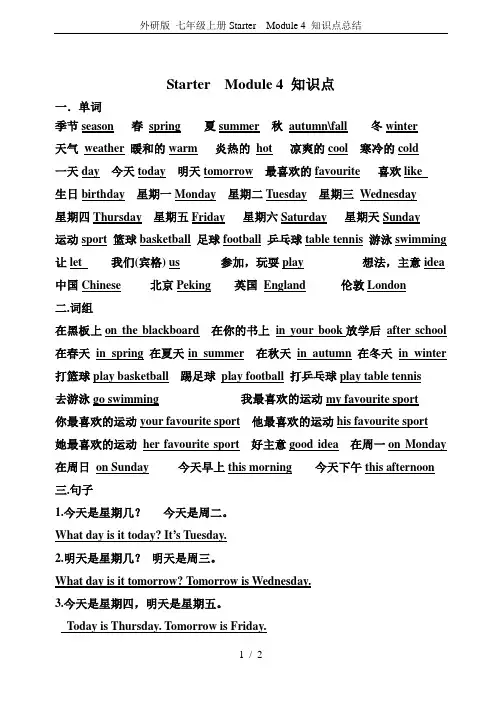
Starter Module 4 知识点一.单词季节season 春spring 夏summer 秋autumn\fall 冬winter天气weather 暖和的warm 炎热的hot 凉爽的cool 寒冷的cold一天day 今天today 明天tomorrow 最喜欢的favourite 喜欢like生日birthday 星期一Monday 星期二Tuesday 星期三Wednesday星期四Thursday 星期五Friday 星期六Saturday 星期天Sunday运动sport 篮球basketball 足球football 乒乓球table tennis 游泳swimming 让let 我们(宾格) us 参加,玩耍play 想法,主意idea 中国Chinese 北京Peking 英国England 伦敦London二.词组在黑板上on the blackboard 在你的书上in your book放学后after school 在春天in spring 在夏天in summer 在秋天in autumn 在冬天in winter 打篮球play basketball 踢足球play football 打乒乓球play table tennis去游泳go swimming 我最喜欢的运动my favourite sport你最喜欢的运动your favourite sport 他最喜欢的运动his favourite sport她最喜欢的运动her favourite sport 好主意good idea 在周一on Monday 在周日on Sunday 今天早上this morning 今天下午this afternoon三.句子1.今天是星期几?今天是周二。
What day is it today? It’s Tuesday.2.明天是星期几?明天是周三。
What day is it tomorrow? Tomorrow is Wednesday.3.今天是星期四,明天是星期五。
七年级英语上册 starter4个模块重点句型归纳总结 外研版

月考复习资料(Module1~~~Module4)I Greetings (基本问候语)1.Hello/ Hi 你好 2. Good morning/ afternoon/ evening 早上/下午/晚上好3.———How do you do?你好!(第一次见面时)———How do you do?你好!4.———How are you?(你好吗?)———I’m fine./ I’m OK/ I’m very well./ Just so—so(一般般). And you? ———I’m fine, too(也). Thank you.5.———Nice to meet you!(见到你很高兴!)———Nice to meet you,too!(见到你我也很高兴!)II 重点句型1.What’syourname, please? (请问你叫什么名字?)什么是你的名字请2.My name is ……/ I’m …(我的名字是。
/我是。
)我的名字是我是3.This is ……(这位是。
)这位/个是4.———What’s this in English?(这用英语怎么说/ 这是什么?)什么是这个用英语———It’s a book.(它是一本书)它是一本书5.———What are these?(这些是什么?)什么是这些———They are books./ These are books.(他们是书/ 这些是书)他们是书这些是书6.———How many desks are there?(有多少X桌子?)多少桌子有---------There areten desks.(有十X桌子)/ There is (only) one desk./(仅仅只有一X桌子)有十(X)桌子有仅仅一(X)桌子There is no desk. (没有桌子)有不桌子What colour is the tree?(这棵树是什么颜色的?)什么颜色是这(棵)树-------I t’s green.(它是绿色的)它是绿色------- What colour are the flowers?(这些花是什么颜色的?)什么颜色是这(些)花------- They’re blue.(他们是蓝色的)它们是蓝色8.------ How do you spell “blue”?(怎样拼写“blue”)怎样你拼写蓝色Where’s my/the coat?(我的/这件外套在哪儿?)哪儿是我的/这(件)外套------ It’s on the bed.(它在这X床上)它是在。
外研版-英语-七上-英语:Starter Module4 全模块教案
课题:(Starter )Module 4 Activities and the weather教学目标(整个模块):Aims of the ModuleListening: To understand the listening parts in the text about activities and the weather . Speaking: To master the sentence structures and practice.Reading: To know something about activities and the weather .Writing:Write a composition about “ My favourite sport”学习目标:1.Students will comprehend and produce the sentence structures (As follows)2. Students will learn about a ctivities and the weather .and some sentences about them.3.Students will successfully request information about activities and the weather .and can talk about their activities the like.学习问题1.在这个模块学了哪些单词?2.在这个模块学了哪些短语?3.我掌握了哪些句型?4.Can的用法5.怎么表达自己喜欢某项活动?6. 我还知道哪些活动(书上没有的)?学习重点:Focuses of the Module1.句型1).What’s your favourite sport?2).Do you like watching television?3) Can you speak English?及回答4).What’s the weather like in summer?及回答2. can 的用法3动名词表示某项活动4play 后面冠词的用法总结动词+ing的规则5.词汇学习难点:Difficulties of the Module1.What’s the weather like in summer?句型2.can 的用法3.动名词表示某项活动4.play 后面冠词的用法总结5.动词+ing的规则Unit 1 I like reading一、词汇:and, dance, read, run, sing, swim, walk二、短语:1. do sports 2.play computer games3. play football4.watch television2.三、句型:1).What’s yo ur favourite sport?2).Do you like watching television? Yes/No.3) I like reading四、教学过程:(Teaching procedures):Step 1: Warm-up: Review the sentence st ructure “What’s your favourite sport?”and then lead-in this lesson.Step 2: Look at the pictures on screen and read words after the teacher, In this step, students should know some verbs about actions and some phrases about the word “play”. (可以通过(What is she/ he doing? 来引导学生对动名词的形式的认识,为like+ doing 做准备)。
外研版英语七年级上册_Starter_Module_4知识讲解
Now listen again and check.
What’s the weather like
in Harbin in winter?
Urumqi (cold)
Lhasa (cold)
It’s cold.
Harbin (cold)
• (B ) 3. ____________ now?
•
A. What’s the weather B. How is the
weather
• C. What’s the weather it eather like
• 二、根据汉语完成句子,每空一词。
• 1、今天的天气怎么样?
It’s hot(热) in summer.
What’s the weather like in autumn? (秋天天气怎么样?)
= How’s the weather in autumn?
It’s cool(凉快) in autumn.
What’s the weather like in winter? (冬天天气怎么样?)
• 一、单项选择题:
• (A )1.It’s ______in winter in Beijing.
•
A cold B warm C. hot D. cool
• (B ) 2. What’s the weather ____in Shanghai?
•
A./ B. like C . likes D . be like
4.—What’s the weather like in summer? —It’s hot.
Listen again and say.
starterModule4Unit1教案-外研版七年级英语上册
《starterModule4Unit1教案-外研版七年级英语上册》核心素养目标:培养学生英语语言能力,通过本节课的学习,使学生能够熟练运用所学问候语、自我介绍等基本句型进行口头交流,提高他们的英语听说能力;培养跨文化交际意识,让学生了解并尊重不同文化背景下的问候方式,提升他们的国际视野;发展学生的思维品质,通过课堂互动活动,激发学生的思维活跃度,提高其问题解决能力和创新意识;培育良好情感态度,鼓励学生积极参与英语学习,增强自信心,培养合作精神。教学内容与核心素养紧密结合,旨在全面提升学生的英语学科素养。
(二)新课讲授(用时10分钟)
1.理论介绍:首先,我们要了解基本英语问候语的概念。问候语是日常交流中的基本礼节,如hello, good morning等。它们在建立良好人际关系中起着重要作用。
2.案例分析:接下来,我们来看一个具体的案例。这个案例展示了如何在不同的时间段和场合使用恰当的问候语。
3.重点难点解析:在讲授过程中,我会特别强调基本问候语和自我介绍这两个重点。对于难点部分,如发音准确性、问候语的适用场合,我会通过举例和对比来帮助大家理解。
starterModule4Unit1教案-外研版七年级英语上册
一、教学内容
《starterModule4Unit1教案-外研版七年级英语上册》主要包括以下内容:教材的第四章第一节,重点词汇包括:hello, good morning, good afternoon, good evening, bye bye等基本问候语;介绍自己的简单句型,如:My name is...,I'm from...;以及常用的课堂用语,如:How are you? Fine, thank you.等。本节课将通过情景对话、角色扮演等形式,让学生掌握基本的英语问候和自我介绍,培养他们在实际生活中运用英语进行简单交流的能力。同时,课程还将结合课文内容,让学生了解不同国家的问候方式,增强他们的跨文化交际意识。
Starter Module 4
Starter Module 4 My everyday life.Unit 1 What day is it today ?Period 1【学习目标】1. 知识与技能掌握下列单词和英语音素(四会):day , today , Monday , Tuesday , Wednesday , Thursday , Friday , Saturday , Sunday , [ ], [ ] ,[ s ], [ z].熟练使用下列句型(四会):------- What day is it today ------ It’s Monday..Today is Monday, and tomorrow is Tuesday.过程与方法通过本节课任务驱动、小组合作学习,培养提高学生的合作探究能力,培养学生学习兴趣和创新意识,提高学生解决实际问题的能力。
情感、态度与价值观掌握学习英语的方法,提高学习英语的兴趣,学会与人合作、交流。
【重点难点】重点单词和音素:day , today , Monday , Tuesday , Wednesday , Thursday , Friday , Saturday , Sunday , [ ], [ ] ,[ s ], [ z].重点句子:------- What day is it today ------ It’s Monday..Today is Monday, and tomorrow is Tuesday.难点: 1. 学生开口用英语表达。
2. “七天“的读写。
【学法指导】课前熟读单词和句子完成自主检测,或与小组成员合作完成。
对未能解答的做上标记,完成后交小组长检查登记打等级。
课堂上,随老师的引导,完成听说读训练,同时纠正自主检测的内容。
师生总结让学生知道本节课要学习掌握的内容,然后完成检测反馈练习,反复巩固已学内容,上交练习或当堂检查。
跟老师或mp3 /mp4读音素和拼读音标词。