
2019中考英语语法专题复习—情态动词专题
中考专题《情态动词》学习目标:掌握中考情态动词三种用法及辨析预习导学:尝试用情态动词造句知识梳理一、情态动词的定义:情态动词表示说话人对某一动作或状态的态度。
二、情态动词的特点:1)有一定词义;2)不受主语人称和数的变化影响;3)与主要动词的原形(或称不带to的不定式)一起构成谓语(除ought to作固定词组看待)。
批注:情态动词无人称和数的变化, 情态动词后面跟的动词需用原形,否定式构成是在情态动词后面加"not"。
个别情态动词有现在式和过去式两种形式, 过去式用来表达更加客气, 委婉的语气, 时态性不强, 可用于过去,现在或将来。
情态动词属非及物动词,故没有被动语态。
He could be here soon. 他很快就来。
We can't carry the heavy box. 我们搬不动那箱子。
I'm sorry I can't help you. 对不起,我帮不上你。
基本助动词与情态助动词最主要的区别之一是,基本助动词本身没有词义,而情态助动词则有自己的词义,能表示说话人对有关动作或状态的看法,或表示主观设想:What have you been doing since? (构成完成进行体,本身无词义)I am afraid I must be going. (一定要)You may have read some account of the matter. (或许已经)除此之外,情态助动词还有如下词法和句法特征:1)除ought和used以外,其他情态动词后面只能接不带to的不定式。
如果我们把ought to和used to看做是固定词组的话,那么,所有情态动词无一例外地只能接不带to的不定式:We used to grow beautiful roses.I asked if he would come and repair my television set.2)情态助动词在限定动词词组总是位居第一:They need not have been punished so severely.3)情态助动词用于第三人称单数现在时的时候,没有词形变化,即其词尾无-s形式:She dare not say what she thinks.4)情态动词没有非限定形式,即没有不定式和分词形式,也没有相应的动名词:Still, she needn't have run away.5)情态助动词的“时”的形式并不是时间区别的主要标志。
在不少场合,情态助动词的现在时和过去时形式都可以表示现在、过去或将来时间:Would you mind very much if I ask you to do something?She told him he ought not to have done it.6)情态助动词之间是相互排斥的,即在一个限定动词词组中只能出现一个情态助动词,但有时却可以与have和be基本助动词连用:You should have washed the wound.Well, you shouldn't be reading a novel.三、情态动词有四类:①只做情态动词:must,can(could),may(might),ought to②可做情态动词又可做实义动词:need,dare③可做情态动词又可做助动词:shall(should),will(would)④具有情态动词特征:have(had,has) to,used to⑤情态动词表猜测四.情态动词的基本用法1. can (could)1)表示能力,could主要指过去时间。
Two eyes can see more than one. 两只眼比一只眼看得清。
Could the girl read before she went to school? 这女孩上学前能识字吗?2)表示可能(理论上或是逻辑判断上)。
The temperature can fall to –60℃, that is 60℃ below freezing.气温可降至—60℃,也就是零下60℃。
He can´t (couldn´t) have enough money for a new car. 他不可能有足够的钱买新车。
You mustn´t smoke while you´re walking around in the wood. You could start a fire .在林子里走时勿吸烟,那样可能会引起火灾。
3)表示允许。
Can I have a look at your new pen? 我可以看一看你的新钢笔吗?He asked whether he could take the book out of the reading—room.他问他可不可以把书带出阅览室。
4)表惊异、怀疑、不相信等态度。
主要用于否定句、疑问句或感叹句中。
Where can (could) they have gone to? 他们会去哪儿了呢?He can´t (couldn´t) be over sixty. 他不可能超过六十岁。
How can you be so careless? 你怎么这么粗心?5)比较委婉客气地提出问题或陈述看法。
Can (Could) you lend me a hand? 帮我一把好吗?I´m afraid we couldn´t give you an answer today. 恐怕我们今天不能给你答复。
2. may (might)1)表允许,might可以指过去时间,也可指现在时间,语气更委婉。
You may take whatever you like. 你喜欢什么就拿什么。
He told me that I might smoke in the room. 他告诉我可以在房间里抽烟。
May (Might) I ask for a photo of your baby? 我可以要一张你宝宝的照片吗?在回答以may引起的问句时,多避免用这个词,而用其它方式,如Y es, please. / Certainly. / Please don´t ./ You´d better not. / No, you mustn´t.等,以免显得太严峻或不客气。
2)表可能(事实上)。
可以指过去时间,也可以指现在时间,但语气更加不肯定。
He may be at home. 他可能在家。
She may not know about it. 她可能不知道这件事。
He was afraid they might not agree with him. 他担心他们可能不同意他的意见。
They might be having a meeting, but I´m not sure. 他们有可能在开会,不过我不肯定。
【例题精讲】——I hear you’ve got a set of Australi an coins. _____I have a look?—— Yes, certainly.A. DoB. MayC. ShallD. Should【解析】本题考察情态动词,―我可以看一看吗?‖,表示允许。
【答案】B【点拨】如果选项里有can也可以用。
3. must1)表示义务。
意为“必须”(主观意志)。
We must do everything step by step. 我们一切都必须循序渐进地做。
You mustn´t talk to her like that. 你不可能那样对她说话。
--Must we hand in our exercise—books now? 我们现在就要交练习本吗?--No, you needn´t. / No, you don´t have to. 不必。
(这种情况下,一般不用mustn´t)2)表示揣测。
意为“想必、准是、一定”等,只用于肯定句。
He must be ill. He looks so pale. 他准是病了。
他的脸色苍白。
She´s wearing a diamond necklace. She must have a lot of money.她戴着钻石项链,一定很有钱。
【例题精讲】---May I go to the cinema, Mum?--- Certainly. But you________ be back by 11 o'clock.A. canB. mayC. mustD. need【解析】本题考察情态动词,根据句意―你必须在11点前回来‖可知,用must。
【答案】C【点拨】根据语境判断4. shall1)表征询意见,用于第一、第三人称疑问句。
Shall I get you some tea? 我给你点茶好吗?Shall the boy wait outside? 让那男孩在外面等吗?What shall we do this evening? 我们今晚做什么?2)表说话人的意愿,有“命令、允诺、警告、决心”等意思,用于第二、第三人称陈述句。
You shall do as I say. 按我说的做。
(命令)You shall have my answer tomorrow. 你明天可以得到我的答复。
(允诺)He shall be sorry for it one day, I tell you. 有一天他会后悔的,我告诉你。
(警告)Nothing shall stop us from carrying out the plan. 什么也不能阻止我们执行这项计划(决心)【例题精讲】He seldom listens to others. He_____ answer for what he has done.A. shallB. willC. canD. would【解析】本题考察情态动词,根据句意―他应该为他做的事情负责‖可知,用shall。
【答案】A【点拨】此处shall表示警告。
5. will1)表意愿,用于各种人称陈述句。
I will do anything for you. 我愿为你做任何事。
None is so blind as those who won´t see. 不愿看的人眼最瞎。
If you will read the book, I´ll lend it to you. 如果你愿意读这本书,我会把它借给你。
中考英语专题练习动词(含解析)
2019中考英语专题练习-动词(含解析)一、单选题1.I had to walk to school because the bus broke down on the way this morning.A.threw awayB.stopped workingC.ran slowly2.If you ____ someone or something from several people or things that are available (有用的), you decide which person or thing you want to have.A.punishB.pushC.choose3.—Jimmy, your toys should be in right order.—OK, I'll ________ them _________ right now.A.put, downB.put, awayC.put, upD.put, on4.—Did you see Tom at the party?—No, he by the time I got there.A.leftB.was leavingC.had leftD.has left5.一Have you mended your bike,Bob?一Yes,I______it twenty minutes ago.A.have mendedB.mendC.had mendedD.mended6.--you go to Xi'an with me tomorrow?-- I'd love to. But I have a lot of work to do.A.MustB.NeedC.CanD.Do7.There a sports meeting tomorrow.A.is going to haveB.hadC.is going to beD.has8.—What is a left-luggage office?—It's a place where bags _be left for a short time, especially at a station.A.willB.mustC.canD.should9.The manager is used to _____________the computer to check e-mails every morning.A.turn onB.turning onC.turn offD.turning off10.The library _____ about five years ago.A.was buildedB.was builtC.buildsD.has been built11.—Already five people in the taxi, but the driver managed to take me as well.—Terrible, and it be an uncomfortable journey.A.canB.shouldC.mustD.need12.I often Linda the old woman with housework last year.A.see; helpsB.saw; helpsC.saw; helpedD.saw; help13.—Can you your little brother ?I'm busy now.—All right,mun.I'll do it right now.A.wearB.put onC.dressD.in14.一What time do morning classes start in your school?一At 8:30 a.m.A.beginB.stopC.rest15.Kangkang usually _____ his homework at 7:00 p. m, but yesterday he started _____ it at 8:00 p. m.A.do; doingB.does; doC.does; doingD.do; do16.The small boys decided ______ to each other.A.not talkB.not talkingC.not to talkD.not to talking二、填空题17.I'd like ________ (join) the English Corner.18.Do you think their dream can ________ (come) true?19.She'd like ________ (buy) some milk.20.Can you help me with ________ (dance)?21.They had great fun ________ (spend) their holidays on the beach (海滩).22.The ten boys ________(be) going to play basketball after school.23.The mother turtle l________ her new-born eggs in the sand then went back to the sea.24.A dog ________(lie) under the tree. Don’t wake him up!st night, I f________ closing the door. What a bad memory I have!26.It's time for you ________(have) supper.27.Would you mind ________(close) the window, please? It's so cold.28.________in the morning? (when / he / always / get up)三、语法填空29.I want ________ ( know ) something about your parents.30.Cars________(run) faster than bikes.31.My mother ________________(work) in the hospital for twenty years.32.Trust me! I ________ (keep) it between you and me. Talk now.33.Have you made any plans ________ (visit) the teacher next week?34.用括号内所给动词的适当形式填空。
最新版-英语情态动词专项复习
we can see his name on it .
7
4. need (需要) 既可做实义动词也可做情态动词 1)实义动词 need to do sth 需要做某事
Eg: I need to buy a big house . --- Do you need to buy a big house ? --- Yes , I do . No, I don’t . He needs to borrow a map . --- Does he need to borrow a map ?
Yes ,you may. No, you mustn’t. No, you can’t.
Yes, you must. No, you needn’t. No you don’t have to
Yes, you must. No, you needn’t
1.Must I take the keyboard to the office now ?
2) 情态动词 need do sth 需要做某事 Eg: I need buy a big house .
8
5. have to
不得不
Eg: It’s eleven o’clock . I have to go now .
He has to finish the work first .
请注意: I don’t have to go now .
--No, you __C___.Tomorrow is Saturday .You
may get up later.
A mustn’t
中考英语专题系动词、助动词情态动词复习
语法互动(十)┃系动词、助动词和情态动词
(2)could也可表示现在,用于婉转地提出请求、建议等,回 答时用can。 —Could you show me the way to the hospital? 你能告诉我去医院的路吗? —Of course I can.当然可以。 (3)can与be able to的区别 can只能用于一般现在时和一般过去时,而be able to可用于 任何时态。 He was able to flee to Europe before the war broke out. 战争 爆发前他成功地逃到了欧洲。
精品PPT
语法互动(十)┃系动词、助动词和情态动词
6.will和would的用法 will用于第二人称的疑问句时,表示征求意见或提建议。 would 为 will 的过去式,可用于多种人称,表示意愿。 Will you have a little soup? 你要不要喝点汤?
精品PPT
语法互动(十)┃系动词、助动词和情态动词
7.归纳:情态动词表推测的用法 (1)肯定句中一般用must(一定),may(可能),might/could(也 许,或许),其中must表推测的语气最强,其余依次减弱。 The book must be hers. Her name is on it. 这本书一定是她的,她的名字在上面。 He must be running.他一定在跑步。 They may know the way to the library. 他们可能知道去图书馆的路。
精品PPT
语法互动(十)┃系动词、助动词和情态动词
2.—He ________ be in the classroom, I think.
—No, he ________ be in the classroom. I saw him go
完整word版初中英语语法专题 情态动词
初中英语语法专题情态动词一、【情态动词】又叫情态助动词。
它们具有以下特点:⑴它们必须与其他动词连用,即:情态动词+动词原形表示说话人对所述动作的看法,如需要、可能、意愿或怀疑等。
⑵绝大多数情态动词没有人称和数的变化,即第三人称单数不加-s(以be和have 开头的情态动词短语除外)。
⑶在意义上,情态动词具有“多义性”。
例:can既可表示能力,又可表示可能、允许等意义。
有can (could), may (might), must, have to, shall (should, will (would), dare (dared), need (needed), ought to等。
情态动词无人称和数的变化;不能单独使用,必须与其后的动词原形构成谓语。
^^can 表示能力,意为“能会”表示推测,意为“可能”,常用于否定句和疑问句中表示请求,允许,意为“可以”.^^could 是can 的过去式,意为“能、会”,表示过去的能力在疑问句中表示委婉请求 .^^may 表示请求、许可,意为“可以”表示推测,常用于肯定句中,意为“可能、也许”. ^^might 是may的过去式,表推测,常用于肯定句中,意为“可能、也许” .^^must 表示主观看法,意为“必须、应该”表有把握的推测,用语肯定句 .^^need \表示需要、必须,主要用于否定句和疑问句中 .^^dare 表示敢于,主要用于否定句和疑问句中.^^should 意为“应该”,表示要求和命令表示劝告、建议.^^had better 意为“最好”,表示建议.^^used to意为“过去常常,表示过去的动作、行为.部分情态动词的基本用法:考点一情态动词知识清单1. can的基本用法:⑴表示体力或智力上的能力,即“能够,会”,可与be able to转换。
例:He can speak English. = He is able to speak English.—Can you play basketball?— No, I can't.如果表示将来具备的能力,要用will be able to。
(河南专用)2019年中考英语复习专题八情态动词(讲解部分)素材(pdf)
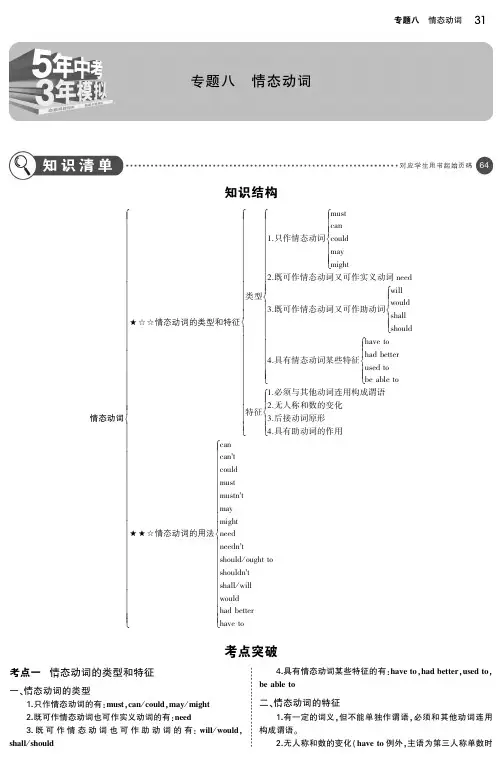
We must stay here. 我们必须待在这里㊂ He can speak Japanese. 他会说日语㊂ Can we go home now,please? No,you can������t. 我们现在可以回家了吗? 不,不可以㊂
3. 后接动词原形㊂ 如:
He has to walk home. 他不得不步行回家㊂
3. 既 可 作 情 态 动 词 也 可 作 助 动 词 的 有: will / would,
������������������������������������
二㊁情态动词的特征
1. 有一定的词义,但不能单独作谓语, 必须和其他动词连用 2. 无人称和数的变化( have to 例外,主语为第三人称单数时 构成谓语㊂
情态动词
4. 具有助动词的作用,可用来构成否定句㊁ 疑问句及用于简 明答语㊂ 如:
He may come tomorrow. 他 明 天可能会来㊂ He asked if he might retell again. 他 问 他 是 否 可 以 再 复 述一次㊂ Might I ask you a question? 我 可以问你一个问题吗? She might go swimming. She likes swimming. 她有可能去游 泳了,她喜欢游泳㊂ 留在这儿吗? Need I stay here? 我 有 必 要 You needn������t come to school so early. 你不必这么早来学校㊂ 们应该吃健康的食品㊂ We should eat healthy food. 我 Who should we ask? 我 们 应 该请教谁? You shouldn������t tell lies. 你不应 该撒谎㊂ Shall I open the window? 要 我开窗吗? You shall not talk loudly at the cinema. 你们不许在电影院内 大声喧哗㊂
2019中考英语情态动词的知识点复习
2019中考英语情态动词的知识点复习2019中考英语情态动词的知识点复习英语的情态动词本身有一定的词义,表示语气的单词,下面店铺为大家带来了2019中考英语情态动词的知识点复习,欢迎阅读!情态动词表推测的用法小结(一)情态动词表推测的三种句式1.在肯定句中一般用must (一定),may(可能),might / could(也许,或许)。
(1)He must/may/might know the answer to this question?他一定/可能/也许知道这个问题的答案。
(2)It is cold in the room. They must have turned off the heating.屋里很冷,他们肯定把暖气关了。
2.否定句中用can’t / couldn’t(不可能), may not/might not(可能不)。
(1)It can’t/couldn’t be the headmaster. He has gone to America.这不可能是校长,他去美国了。
(2)He may not/might not know the scientist. 他也许不认识那位科学家。
3.疑问句中用can/could (能……?)。
(1)Could he have finished the task? 他可能把任务完成了吗?(2)Can he be at home now? 他现在能在家吗?注:以上三种句式中情态动词的语气按程度都是依次递减的。
Might, could并非may, can的过去式,而表示语气较为委婉或可能性较小。
(二)情态动词表推测的三种时态1.对将来情况的推测,用“情态动词 + 动词原形”。
(1)She must / may / might / could arrive before 5. 5:00前她一定/可能/也许到。
(2)She must/may/might/could walk miles and miles among the hills without meeting anyone.她一定/可能/也许会在山里一连走好几英里而遇不到一个人。
【2019年备考】中考英语语法专题复习—情态动词专题
中考专题《情态动词》学习目标:掌握中考情态动词三种用法及辨析预习导学:尝试用情态动词造句知识梳理一、情态动词的定义:情态动词表示说话人对某一动作或状态的态度。
二、情态动词的特点:1)有一定词义;2)不受主语人称和数的变化影响;3)与主要动词的原形(或称不带to的不定式)一起构成谓语(除ought to作固定词组看待)。
批注:情态动词无人称和数的变化, 情态动词后面跟的动词需用原形,否定式构成是在情态动词后面加"not"。
个别情态动词有现在式和过去式两种形式, 过去式用来表达更加客气, 委婉的语气, 时态性不强, 可用于过去,现在或将来。
情态动词属非及物动词,故没有被动语态。
He could be here soon. 他很快就来。
We can't carry the heavy box. 我们搬不动那箱子。
I'm sorry I can't help you. 对不起,我帮不上你。
基本助动词与情态助动词最主要的区别之一是,基本助动词本身没有词义,而情态助动词则有自己的词义,能表示说话人对有关动作或状态的看法,或表示主观设想:What have you been doing since? (构成完成进行体,本身无词义)I am afraid I must be going. (一定要)You may have read some account of the matter. (或许已经)除此之外,情态助动词还有如下词法和句法特征:1)除ought和used以外,其他情态动词后面只能接不带to的不定式。
如果我们把ought to和used to看做是固定词组的话,那么,所有情态动词无一例外地只能接不带to的不定式:We used to grow beautiful roses.I asked if he would come and repair my television set.2)情态助动词在限定动词词组总是位居第一:They need not have been punished so severely.3)情态助动词用于第三人称单数现在时的时候,没有词形变化,即其词尾无-s形式:She dare not say what she thinks.4)情态动词没有非限定形式,即没有不定式和分词形式,也没有相应的动名词:Still, she needn't have run away.5)情态助动词的“时”的形式并不是时间区别的主要标志。
初中英语中考总复习 第1编 语法专项突破 第8讲 情态动词
考点一
考点二
考点三
4.—Mum,
I go fishing with my friends now?
—Sure, but you
make your bed first.
A.can; need
B.may; have to
C.must; need D.need; must
答案:B
解析:征询别人意见时用委婉语气, 句首应为may, could等词。
考点一
考点二
考点三
(3)否定形式的不同: must的否定形式是mustn’t, 表示“禁 止, 不应该”; have to的否定形式是not have to, 表示“不必”, 相当于needn’t。如:
The boy had to stay at home alone because his parents both
stay at home until my
parents come back.
A.canபைடு நூலகம்
B.may
C.must
D.could
解析:句意: 我不能和你一起去。我必须待在家里直到我父
母回来。must“必须”。故选C项。
答案:C
考点一
考点二
考点三
活学活用
考点一
考点二
考点三
考点一
考点二
考点三
3.—Who’s drawing under the tree?
考点三
情态 用法
动词
含义 例句
用于第二人称疑问句中, will/ 表示征求意见或提建议 would will 用于各种人称, 表示
意愿
愿意
Will/Would you please take out the trash?
中考英语语法专项练习题——情态动词和系动词(含答案)
中考英语语法专项练习题——情态动词和系动词1. It’s a rule that students ________ bring mobile phones to our school.A. mustn’t B, wouldn’t C. needn’t D. couldn’t2. —Must I clean my bedroom this afternoon, Mom?— No, you_______. You can do it tomorrow, dear.A. needn’tB. mustn’tC. can’tD. won’t3. —Is the woman Miss Zhao?—It _______ be her. She has gone to Qingdao for a meeting.A. can’tB. needn’tC. mustD. may4.—You ______ smoke at the oil station, it’s too dangerous.—I’m sorry, I won’t.A. couldn’tB. needn’tC. wouldn’tD. mustn’t5. The dictionary _______belong to Sam. You can see his name on it.A. canB. mustC. needD. would6. You ________ worry about her too much. She will get well soon.A. can’tB. mustn’tC. needn’tD. shouldn’t7. Sometimes the smooth surface of the lake really ________ like a mirror.A. soundsB. looksC. smellsD. tastes8. The dish smells delicious, but it ______ a little salty.A. looksB. tastesC. feelsD. sounds9. —______ I have a word with you, Mr. Green? It won’t take long.—Okay.A. ShouldB. MayC. NeedD. Must10. You ______ be very tired with the long drive. Let’s stop to have a rest.A. mustB. canC. shallD. need11. —I’ve got a toothache, mom.—Oh, you _____ eat too much candy.A. shouldn’tB. needn’tC. shouldD. need12. The man _______ be a doctor in this hospital, but I’m not sure.A. mustB. wouldC. can D might13. “Dad, my bike is broken. I use yours?”“Sure! It’s in the backyard.”A. MustB. ShouldC. May14. — The summer vacation is coming. Have you made a plan for it?—Not yet. I ______ go to Guilin.A. mayB. canC. should15. We ______ pay to get into the concert, because it’s free.A. mustn’tB. can’tC. don’t need toD. might not16. That ________be an alien—there’s no such thing!A. mightB. mustC. can’t17. He _________ like coffee. I see him drink a cup at times.A. mustB. mayC. can’tD. mustn’t18. —Look at the dark clouds, and the wind is blowing strongly.—It ______that a big storm is coming.A. soundsB. seemsC. feelsD. smells19.—Joe, don’t eat too much ice-cream.—OK, mom. But it ________ really good.A. feelsB. looksC. tastesD. sounds20. The fruit salad ______ delicious, I’d like to have more.A. tastesB. touchesC. soundsD. feels21.—Listen!Is that Linda playing the piano in the room?—No.It ______ be Linda, she has gone to London.A.may notB.needn’tC.can’tD.mustn’t22. Every one of us _______ always breathe the same breath and share the same future as the people.A.mightB. shouldC. could23. —I can’t find my phone anywhere.—You have lost it while shopping.A. mayB. canC. shouldD. would24. —Mum, may I go to see a film with my cousin?— You _______ go if you have finished your homework.A. mustB. needC. shouldD. can25. Zhao Liying, who played in Legend of Chu Qiao, says: “As an actress, you _____ behard-working.”A. canB. mayC. must26. —Whose cap is this? Is it Cindy’s?—It _________ be hers. Don’t you remember she even didn’t come to the party?A. can’tB. mightC. may notD. must27. Buses stop when the traffic lights turn red.A. canB. mayC. must28.—Some people don’t show their talents at the very beginning.—I agree. Even Einstein ________ read until he was seven.A. can’tB. mustn’tC. couldn’tD. needn’t29. The designer has tried every possible way to make the robot light, so you _______ worry about its weight.A. mustB. mayC. can’tD. needn’t30. According to the notice, guests at this hotel ______ use the sports center at no extra cost.A. canB. shouldC. mustD. need31. — Mum, it’s too hot. _______ I swim in the lake?— No, you _______. That’s too dangerous!A. Should; can’tB. Need; mustn’tC. Must; needn’tD. Could; mustn’t32. Ants are pretty small. You might think that they _______ be rather weak. But what you might not know is that ants are actually very strong for their size.A. needB. can’tC. must33. As middle school students, we ______ follow the public rules wherever we go.A. wouldB. shouldC. mightD. could34. —Is that Tom over there?—It ______ be him. He is on the plane to Chengdu now.A. can’tB. might notC. must35. —Where is Monica? I can’t find her anywhere.—She _______ be in the library. She loves reading books when she is free.A. mustB. needC. can’t36. —Look, Linda. The flowers in our classroom came out in one night.—I can’t believe it. They are beautiful and colorful. They ________ great.A. soundB. smellC. taste37. We should keep quiet in the library. We_____speak loudly.A. mustB. mustn’tC. canD. needn’t38. —Mum, may I play computer games this evening?—No way, you _________ finish your homework.A. canB. mustC. mayD. will39. You ______ walk on the wet hill path because you ______ fall and hurt yourself.A must; might not B. mustn’t; mightC. needn’t; needD. must; must40. We don’t allow taking magazines out, but you ________ copy the article you need on the machine over there.A. canB. mustC. shouldD. would41. —Lily, ______ you finish the letter in ten minutes?—Yes, I can.A. mustB. shouldC. needD. can42.Jerry didn’t pay me back, but he promised that he ______ this Sunday.A. mustB. couldC.wouldD. should43. —Is that red schoolbag Mary’s?— It ______ be hers. She hates that color.A.mayB. mustC. can’tD. might44. —______ I take the magazine out of the reading room?—I’m sorry you _______.A. Could; couldn’tB. Must; couldn’tC. Will; can’tD. May; can’t45.—Who is singing in the next room?—It _______ be Lisa, but I’m not sure.A. mustB. mayC. need46.—the beautiful lady with glasses over there looks like our English teacher.—It ______ be her. She has gone abroad.A. can’tB. may notC. Mustn’tD. needn’t47. — _______ I keep the book for a week?—Sorry, I’m afraid you ________.A. Need; couldn’tB. Need; can’tC. May; couldn’tD. May; can’t48. —Must I finish this work at once?—No, you ______.A. can’tB. won’tC. needn’t49.—Mom, may I go to the party with my friends tonight?—Yes, you . But you be back by 10:00 pm.A. can; mayB. must; have toC. may; must50. Size and type do not matter – you ______ do almost anything if you never give up.A. shouldB. mustC. needD. can51. —Kangkang, I saw your English teacher in the office just now.—It _______ be him. He ________ to Shanghai on business.A. must; has goneB. must; has beenC. can’t; has beenD. can’t; has gone52.—Will Sam go to the cinema with us tonight?—I’m not sure.He ______ not be free.A.mayB.shouldC.can53.—Will you stay here for dinner with us?—Sorry, I ________. My mother is waiting for me at home.A. mustn’tB. can’tC. needn’tD. couldn’t54. The girl in the music room ________ be Celia. She has gone to the dining hall.A. can’tB. mustC. may55. David, ________ you please sweep the floor and take out the trash?A. couldB. mayC. mightD. must56. The magazine ______ Lucy’s. We can see her name on the coverA. mustn’t beB. can’t beC. must beD. needn’t be57. Dirty air and water are harmful. They ______ kill plants, and even people.A. canB. can’tC. shouldD. shouldn’t58. — Listen! Is Sarah singing in the neighbor room?—No. It ______ be Sarah. She has gone to Italy.A. needn’tB. may notC. can’tD. won’t59. —The driver_______ be hurt badly in the accident.—That’s true. Let’s send him to the hospital as soon as possible.A. needB. can’tC. mustD. may not60.—May I join the art club, Dad?—If you have interest, you ________.A. shouldB. canC. have toD. must61. —A little bird entered through the open window to join us for dinner last night.—Wow, the unexpected guest _________ welcomed.A. will beB. must beC. won’t beD. mustn’t be62. —May I take the magazine out of the reading room?—No, you________. Please read it here.A. mustn’tB. wouldn’tC. needn’t63.—Is that boy Scott?—No, it ________ be Scott. Scott is much taller.A. canB. can’tC. mustn’t64. —Whose volleyball is this?—It _________ be Linda’s. She loves volleyballA must B. can’t C. needn’t65.— This task is really beyond me.— Well,if you _______ sol ve it, you won’t get paid.A. can’tB. needn’tC. mustn’tD. shouldn’t66. With this new lock, you ________ search for keys in your bag any more. Isn’t it cool?A. needn’tB. can’tC. mustn’tD. shouldn’t67. Size and type do not matter – you ______ do almost anything if you never give up.A. shouldB. mustC. needD. can68.--Have you seen the movie Titanic, Wang Wei?--Yes. The music in it .A. looks greatB. sounds great C feels great69.—Yuan Longping, a famous Chinese scientist, is now doing research on sea rice.—If farmers start planting rice in salty water, China’s food supply will surely rise.A. canB. can’tC. mustD. mustn’t70.You________ write the report again because spelling mistakes are not allowed at all.A. mayB. canC. mustD. could71.—Is that Mr. Zhou?—It ______ be him. He has gone to Beijing.A. mayB. canC. can’t72.—Are you going to the cinema tonight?—I don’t know. I _____ go or I _____ stay at home.A. will; willB. must; mustC. should; shouldD. might; might73 — ________ I finish my work now?— No, you _________. You can do it later.A. May; needn’tB. Must; don’t have toC. Can, couldn’t74. —Must I finish reading the book today, Mr. Brown?—No, you __________. You can finish it in two days.A. needn'tB. mustn'tC. can'tD. couldn't75.—It’s too hot. _______ I swim in the lake?—No, you _______. That’s too dangerous!A. Should; can’tB. Need; mustn’tC. Must; needn’tD. Could; can’t76..—Can we walk across the road now?—No, we _______. We have to wait until the light turns green.A. couldn'tB. needn'tC. shouldn'tD. mustn't77. –I went to Mount Mudang with my five friends in one small car last weekend.—Oh, my God! I think it ______ be an uncomfortable trip.A. mustB. can’tC. mayD. shouldn’t 78— Mom,________ I play computer games this evening?— Sure, but you ______ finish your homework firstA. can; mustB. can; mustn’tC. may; couldD. may; can’t79.—Mum, I’ve signed for a big box by Future Express (快递). What’s in it?—I’m not sure. It _______ be a present from your brother.A. mightB. mustC. shouldD. will80.Did you see the sign “No swimming”? You swim in the river.A. needn’tB. mustn’tC. don’t have to81. —Mr. Wang, must I come back to clean the classroom again?—No, you ____. I have asked Kate to do it.A. mustn’tB. needn’tC. shouldn’t82.—Didn’t you see the zebra crossing? You __________ slow down, son!—Sorry, sir. Am I going to fail the test?A. can’tB. canC. mustn’tD. must83. — If I want to be an astronaut, how will I get to be one?— You ____ do well in school and tame your fears,A.mayB. canC. mustD. could84. Since you have drunk so much wine, you ____drive your car.A.needn’t B.wouldn’t C.mustn’t85.-Must I do the project on my own?-No, you____.You can work with your classmates.A.needn’tB.can’tC.shouldn’tD.mustn’t86.—______ I have a talk with you now?—Sorry, I’m quite busy.A. WillB. MustC. MayD. Need87. —Look! The man welcoming us at the school gate be our headmaster.—No, it be him. He is having a meeting in the office now.A. must; can’tB. must; mustn’tC. can’t; mustn’tD. mustn’t; can88.I ______ go now, or I’ll miss my train.A.canB. mightC. mustD. Could89. —Must I hand in the survey on the use of bicycle-sharing right now?—No, you _______.A. needn’tB. can’tC. shouldn’t90.—Must I stay with him all day, Mum?—No, you .A.needn’tB.can’tC.don’t needD.mustn’t91.The blue coat be Tony’s. He never wears blue clothes.A. canB. mustC. can’tD. mustn’t92.—__________ I swim here?—I’m sorry. Children __________ swim alone here. It’s very dangerous.A. Must; can’tB. May; mustC. Can; mustn’tD. Can’t; can93.—Look!The woman at the school gate ______ be our headmaster.—No,it ______ be her.She is holding a meeting in the office now.A.must;can’tB.must;mustn’tC.can;needn’tD.may;mustn’t94.—Look at the man standing at the school gate. Is he your math teacher Mr. Brown?—No, it be him, He has gone to Chengdu on business.A. needn’tB. can’tC. may notD. mustn’t95.—Must I go out to have dinner with you, Mum?—No, you_________,my dear. You're free to make your own decision.A. shouldn'tB. mustn'tC. needn'tD. can’t96. This book ______ be Lucy’s. Look! Her name is on it.A. canB. mayC. mustD. might97.—May I watch TV, Dad?—When your homework is finished, you _______.A. shouldB. canC. mustD. need98.— How amazing this robot is!— Wow, it has video cameras in its eyes, so it ____ “see” and interact with people.A. mayB. canC. mustD. should99. Could you please speak a little louder? I ______ hear you very well.A. can’tB. mustn’tC. shouldn’tD. needn’t100.—Wow. another gift! What’s in the box?—I'm not sure. It_______be a pair of sports shoes.A. mustB. mayC. will101. Jack be at home because I saw him in the library just now.A.can’tB.mayC.mustD.mustn’t102.— Why ______ we close that chemical factory?— Because it has caused lots of pollution. We need better environment.A. mustB. canC. may103.— What do you think of the fish soup?— Well, it ______ a bit salty.A. looksB. smellsC. tastes104. Mr. Green ______ be at home now. He went abroad on vacation last Friday.A. needn’tB. mustn’tC. can’t105.—Must I come here before 6:30 tomorrow?—No, you_______. There will be plenty of time.A. mustn’tB. can’tC. couldn’tD. needn’t106.The cake _____ delicious. I’d like to have another one.A.tastesB. looksC. soundsD. feels107.You ____ stop when the traffic lights turn red.A.can’tB. mayC. mustD. needn’t108. — Lucy is walking the dog in the park.— She be. Listen! She is singing loudly in her room.A. can'tB. mustn'tC. needn'tD. won't109.. —Must I do how now?—No, you ________.A. mustn’tB. needn’tC. shouldn’t110.—Is the man over there Adam?—It ____be him. He has gone to Hong Kong on vacation.A. MustB. can'tC. mustn't112. You look so weak! I think you____go to see a doctor at once.A. mightB.shouldC.could113.She be slow, but at least she doesn’t make stupid mistakes.A. needn’tB. mayC. can’tD. shall114.To keep children away from danger during the coming summer holiday, parents ________give them some safety tips.A. shouldB. mayC. couldD. might115. —I saw John in the park this morning.—It __________ be him. He has gone to Hong Kong.A. can’tB. canC. mustn’tD. must116.Look, little Jim is swimming so fast. I __________ believe my eyes.A. shouldn’tB. can’tC. mustn’tD. needn’t117. —Can we play soccer here?—No, you __________ play it near the road. That’s too dangerous!A. canB. mayC. won’tD. mustn’t118. Parents put the things like knives and medicine away in the house to keep children safe.A. mayB. mightC. canD. should119.—Must I stay here with you, Mum?—No, you_____ .You may go home now, but you _____go to the net-bar.A. must; needB. need; mustC. needn't; mustn’tD. mustn’t; needn’t120.—Must we hand in our homework today, Miss Chen?—____. You may hand it in tomorrow morning.A. Yes, you mustB. Yes, you needC. No, you needn’tD. No, you mustn’t121. The cheese cake ______ so good that I can't wait to eat it.A. tastesB. feelsC. soundsD. smells122.—Must you go?—Yes. I’m afraid I really_____ .A.mayB. shouldC. mustD. can解析及答案1. It’s a rule that students ________ bring mobile phones to our school.A. mustn’t B, wouldn’t C. needn’t D. couldn’t【答案】A【解析】考查情态动词的用法。
【中考英语一轮复习语法一点通】语法专题八 情态动词(学生版)
语法专题八、情态动词(常考)考点精讲情态动词表示讲话人的态度、请求、许可、愿望、可能等。
本身具有一定的意义,但不能独立作谓语,没有人称和数的变化,且后面必须跟动词原形。
常考的情态动词有:can/could(能够,可以),may/might(可能,可以),must(必须,一定),should(应该),need(必要),have to(不得不)等。
Need用作情态动词时常用于否定句和疑问句,need还可作实意动词,常用结构need to do sth.考点1.情态动词+动原➢He can play the violin. 他会拉小提琴。
➢It might snow tomorrow. 明天可能下雪。
➢We should respect everyone. 我们应该尊重每一个人。
考点2.常考的一般疑问句的回答—Can you swim?—Yes, I can. /No, I can’t.—May I smoke here?—Yes, you may/can. /Sure. / Certainly. / Of course. /No, you mustn't / can’t.—Must we finish the work at once?—Yes,you must. /No,you needn't. / No,you don't have to.(must引导的一般疑问句的否定回答是常考点)考点3.must必须(强调主观看法)mustn’t表示禁止,不允许➢You must study harder this term. 你们这学期必须更加努力学习。
(说话者的个人看法)➢You mustn’t swim in the river. 你们千万不能去河里游泳。
(这条河禁止游泳)考点4.情态动词表推测表推测:由强到弱肯定:must 准是,一定can 可能could(可能)may (或许) might(大概)否定:can’t 不可能may/ might not 或许不能can 和could 表示推测,can 表示推测时,往往用于否定句和疑问句。