
1人教版英语七年级上册Unit 6 Section A 2a-2d
birthday dinner ? They decide to prepare hamburgers, sapples for John’s birthday
1人教版英语七年级上册Unit 6 Section A 2a-2d 1人教版英语七年级上册Unit 6 Section A 2a-2d
1人教版英语七年级上册Unit 6 Section A 2a-2d
Talk about your favorite fruit with your partner.
1人教版英语七年级上册Unit 6 Section A 2a-2d
Ice-cream ×
√ √
milk √ × √
1人教版英语七年级上册Unit 6 Section A 2a-2d
1. John’s birthday dinner is next week. 约翰的生日 晚宴在下周。 表示“某人的生日”要使用名词所有格;next week 表示“下周”,英语中含有next的时间短语,其前 面是不加介词的,如:
dinner.
1人教版英语七年级上册Unit 6 Section A 2a-2d
1人教版英语七年级上册Unit 6 Section A 2a-2d
对比一下:
What do we eat on birthday?
We eat long noodles , eggs and meat on birthday .
2c Practice the conversations above. Give answers that are true for you.
Do you like…? Yes, I do. / No, I don’t.
Do you like hamburgers?
No, I don’t.
1人教版英语七年级上册Unit 6 Section A 2a-2d
1.To help students focus on the new vocabulary and foods 2.To practice students’ listening skills To role-play the conversation in 2d
I like apples. I like pears. I like oranges. I like bananas. I don’t like ice cream. I don’t like hamburgers. I like tomatoes. I like salad.
and it’s his birthday. Jack: Yes, you’re right.
What about the fruit? Tom: I think John likes strawberries and apples. Bill: OK. Let’s have strawberries and apples then.
1人教版英语七年级上册Unit 6 Section A 2a-2d
1人教版英语七年级上册Unit 6 Section A 2a-2d
你需要帮助吗?我们来讨论一下吧!
Li Rui Sun Hua YOU
salad √
√ ×
tomatoes √ √ √
apples √ √ √
提示: 1.Next week is … 2.Let’s think about … 3. How about …? 4. I don’t like … 5. Li Rui likes .. 6. Let’s have …
1人教版英语七年级上册Unit 6 Section A 2a-2d
2b Listen again and fill in the blanks.
tomatoes
ice-cream ice-cream
1人教版英语七年级上册Unit 6 Section A 2a-2d
tomatoes
1人教版英语七年级上册Unit 6 Section A 2a-2d
1人教版英语七年级上册Unit 6 Section A 2a-2d
1人教版英语七年级上册Unit 6 Section A 2a-2d
2d Role-play the conversation.
Jack: Hey, John’s birth day dinner is next week. Let’s think about the food.
hamburgers pears tomatoes strawberries oranges ice-cream salad bananas
1人教版英语七年级上册Unit 6 Section A 2a-2d
2b Listen again and fill in the blanks.
1人教版英语七年级上册Unit 6 Section A 2a-2d
Tom: Sure. How about burgers, vegetable salad, and some fruit?
Bill: Sounds good. John likes hamburgers.
Jack: Oh, I don’t like salad. Bill: But John likes salad,
1人教版英语七年级上册Unit 6 Section A 2a-2d
1人教版英语七年级上册Unit 6 Section A 2a-2d
探究一下:
1.Does Jack like salad ?
No, he doesn’t .
2. Are they going to have salad ? Why ? Yes. Because John likes salad and it’s John’s birthday
CouGntraabmle mar
Focus
Uncountable
hamnobuunrsgers,
nouns
tomatoes, ice cream
French fries, oranges,
chicken
broccoli
bananas, salad
Guessing game
I like …
2a Listen and circle the food you hear.
Unit 6 Section A(2a-2d)七年级上册英语课件(人教版)
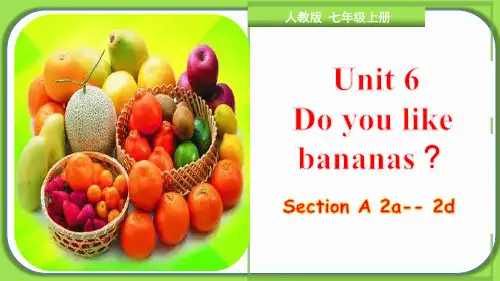
burger/ˈbɜː(r)ɡə/汉堡包
Their friend, John’s birthday is coming.They want to think about思考,考虑 the food.
Jack, Tom and Bill
Listen to 2d and answer the questions. 1. When什么时候 is John’s birthday dinner?
hamburgers tomatoes French fries oranges bananas tea strawberries bread apples carrots pears broccoli meat water milk eggs ice cream salad chicken vegetables
6
orange
9
salad
Game: What’s missing?
Can you remember them all?
Game: What’s missing?
Game: What’s missing?
Do you like apples? Do you like salad?
Yes, I do. I like apples.
2a Listen and circle the
food you hear. hamburgers pears tomatoes strawberries
人教版初中英语七年级上册Unit 6 Section A (1a-2d)-课件

A: Do you like salad? B: No, I don’t.
A: Do you like oranges? B: Yes, I.
2b Listen again. Fill in the blanks.
2c (Imagine you are having lunch with your friend.) Practice the conversations in 2b. Give answers
that are true for you.
2d Answer the questions below and then role-play the conversation.
Do you like bananas? 1 Yes, I do.
3
Do you like oranges? Yes, I do.
Practice
1c Practice the conversations above with your
partner. Then make you own conversations.
A: I like _h_a_m__b_u_r_g_e_rs__. Do you like _h_a_m_b_u_r_g_e_r_s____? B: Yes, I do. A: Do you like_t_o_m_a_t_o_e_s ? B: No, I don’t like___to_m__a_t_o_e_s___. A: Let’s have _ic_e_-_cr_e_a_m_. B: Oh, no. A: No? B: I don’t like _ic_e_-_cr_e_a_m___.
人教版七年级英语上册Unit6 sectionA课件
ice cream
Do you like bananas ?
Yes,I do./No, I don’t.
hamburgers
pears
broccoli
French fries
oranges
ice cream
salad
bananas
2b Listen again and fill in the blanks
broccoli
Western-style food
French fries
salad
ice cream
hamburgers
Match
1. hamburgers d 2. tomatoes g 3. broccoli a 4. French fries h e 5. orange 6. ice cream f c 7. salad 8. bananas b 9. strawberries i 10.pears j
broccoli broccoli ice cream cream ice ice cream ice cream
broccoli broccoli
Make a list of food ,fruit and drinks.
Food
hamburgers dumplings noodles rice meat fish cakes porridge French fries eggs broccoli salad tomatoes ice cream
His brother doesn’t have lunch at home.
2 .He likes ice cream very much.一般疑问
Does
he like ice cream very much?
七年级人教版英语上册Unit6Doyoulikebananas?全单元教案

Unit 6Do you like bananas?Period 1(Section A 1a-1c)Teaching aims1. Learn words and be able to say, read and write them:orange(s), banana(s), strawberry, strawberries, pear(s), apple(s),tomato(es), carrot(s), vegetable(s), hamburger(s), egg(s), ice-cream(s),salad(s), bread, chicken2. Be able to talk about likes and dislikes by using:I/We/They like oranges. He/She likes oranges.I /We/They don’t likebananas. He/She doesn’t like hamburgers.Do you like salad? Yes, I do./No, I don’t.Does he/she like tomatoes? Yes, he/she does. / No, he/she doesn’t.3.Understand the difference between countable nouns and uncountable nouns.Teaching key and difficult points:1.Learn these words and be able to say, read and write them:2.Be able to talk about likes and dislikes by using:I/We/They like oranges. He/She likes oranges.I /We/They don’t likebananas. He/She doesn’t like hamburgers.Do you like salad? Yes, I do./No, I don’t.Does he/she like tomatoes? Yes, he/she does. / No, he/she doesn’t. Moral objects(1)To call students ’ attention to otherserests and’ei n ablet themto care more about classmates.(2)To improve Sts ’communicating skills and enable them to keeptheir health.教学设计备注Step 1. Warm-up and revision(1)Daily greeting to the students(2)Revision: What ’s this/that in English ? What coloris it?T:What ’s this in English? (show a picture of andorange)T:What color is it?Step 2. Presentation –New words.(1)Go on asking: What ’s this/that in English ? Whatcolor is it?T:What ’s this in English? (show a picture of anapple and if the student don’t know it, show thephonetic symbol of the word.)T: Spell it, please.S: A-P-P-L-E.T: What color is it?S: It ’s red.(Present the other three words as above: pear,strawberry, banana )T:We can call all of these things fruit . (Teach the newword “fruit ”.)Show pictures and ask the Ss “What arethese/those? ”and ask the SS to spell the pluralforms of these words: oranges, apples, pears,strawberries, bananas.(2)Repeat step (1) to present: carrot, carrots,tomato, tomatoes and vegetable, vegetables.(3)Present some more words by showing pictures. Get theSs to make an effort to pro nounce and spell the new words.Bread, hamburger ,hamburgers, milk, ice-cream,ice-creams, salad, chicken ,an egg, eggsWe can call all of these things food:食物3.Memory Challenge: Who has the best eyes?(1)Show the pictures, and say the plural forms of the nouns andsome uncountable noun.(2)Summarize. 可数名词有复数形式 , 不可数名词一般没有复数形式Step 3Presentation Target language 11. Show the pictures and say:I like tomatoes, but I don’ t like bread.2.Let students say:I like, but I don’t like ....3. Show the pictures and say:She likes bread, but she doesn’t like milk.He likes chicken, but he doesn’t like eggs.4.Let students say: He/She likes , but he/she doesn’tlike ....According Ss’answers and say:5. Sing a chant:Bananas, bananas, I like bananas! Salad, salad, I like salad!Strawberries, strawberries,I don ’t like strawberries!Pears, pears, he likes pears!Milk , milk, he likes milk!Tomatoes, tomatoes,He doesn ’t like tomatoes! Step 4 Work 1a .1. Read the words.2.T: Look at the pictures and fill in the chart .Fruit Food Vegetable3.Match the words with the things in the picture.4.Check the answers .Step 5 Present the new language 1 .1. T: Oh, we have lots of delicious fruits . I like apples best.Do you like apples ?S1 :Yes , I do. I like apples.S2: No, I don't . I like salad.T: Do you like salad ? S3: Yes , I do. I like salad./ No, I don't . I don’tlike salad.Step 6 Pairwork .1. T: Work in pairs .Ask and answer with your partners .(Before class the students have draw some pictures of the food )2. Get the Ss to ask and answer in pairs, using the sentences:’t.A: Do you like ?B: Yes, I do./ No, I don 3. When you ask andanswer, please fill in the chart. Name Like DislikeStep 7 Present the new language 2 .1.Show pictures and ask and answer questionsDoes she/he like ?Yes, she/he does. She/He likes/ No, she/he doesn ’t. She/He doesn ’tlike .Step 8 Pairwork .1. T: Work in pairs .Ask and answer with your partners .2.Get the Ss to ask and answer in pairs, using the sentences:Does she/he like ?Yes, she/he does. She/He likes/ No, she/he doesn ’t. She/He doesn ’tlike .3.According Ss’answers and ask “Do they like ? Yes, they do./ No, they don’t.”Step 9 Work on 1b.1.T: 1b. List en and number the conversations.2.Listen.3.Check the answers.4.Read after the tape.Step 10 work on 1c.1.First, practice the conversations in 1b.Then, make a survey and fill in the chart below.2. Report: I like milk and tomatoes, but I don’t like ice-cream. Mary likes oranges, but she doesn’liket milk orice-cream. Tom likes tomatoes and strawberries, but hedoesn ’ t like bread.Step 11 . HomeworkWrite down the report.Blackboard design:New Words Unit 6 Do you like bananas?Do you like?Yes , I do. I likeNo ,I don ’t. I don ’tlikeDoes she/he like ?Yes, she/he does. She/He likes/No, she/he doesn ’t. She/He doesn ’tlike.Period 2(Section A 2a-2d)Teaching aims:1. Words & expressionsBirthday, dinner, week, think about, food, sure, how/whatabout ? Burger, vegetable, fruit, apple, then2. Target languageI like strawberries, they’re delicious. Let’s have them.--Yes, I like them ,too./ No, I don’tlike them.I like salad, it ’s delicious. Do you like it?-- Yes, I do./No, I don’t but I likeice cream.Let ’ s have Let ’s think about the food.Ability goalsEnable students to talk about likes and dislikes.Learning ability goalsHelp students learn how to talk about likes and dislikes.2. Listening and speaking skills.Moral object:Learn to keep healthy.Teaching important / difficult pointsHow to talk about likes and dislikes with the target language.教学设计备注Step1 Warm up and revision.1.Everyday greeting.2.Review.Show the pictures and say the singularforms and the plural forms of the countable nouns.3.Show some pictures of the uncountable nouns.4.Summarize.(1).当可数名词复数再次出现时,用“They( 主语)或 them(宾语)”替代。
七上英语书6单元课文
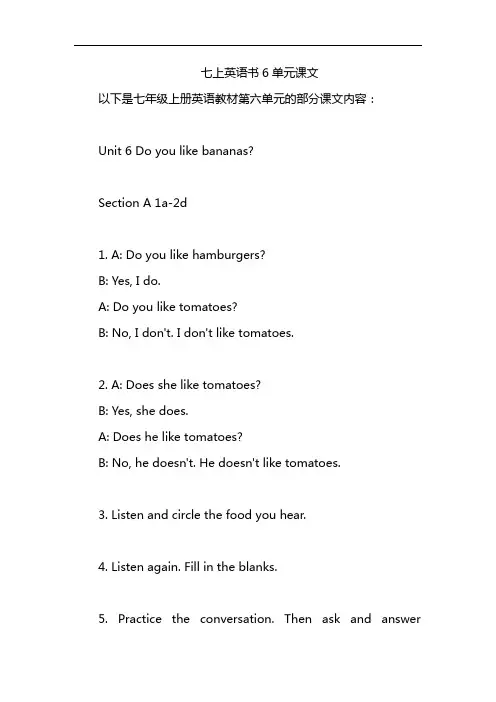
七上英语书6单元课文以下是七年级上册英语教材第六单元的部分课文内容:Unit 6 Do you like bananas?Section A 1a-2d1. A: Do you like hamburgers?B: Yes, I do.A: Do you like tomatoes?B: No, I don't. I don't like tomatoes.2. A: Does she like tomatoes?B: Yes, she does.A: Does he like tomatoes?B: No, he doesn't. He doesn't like tomatoes.3. Listen and circle the food you hear.4. Listen again. Fill in the blanks.5. Practice the conversation. Then ask and answerquestions about the other food in 1a.6. A: Do you like oranges?B: Yes, I do.A: Do you like strawberries?B: No, I don't. I don't like strawberries.7. Listen and number the conversations [1-3].8. Practice the conversations above. Then make your own conversations.9. A: Does your mother like salad?B: No, she doesn't. She likes bananas.A: Does your father like bananas?B: No, he doesn't. He likes strawberries.10. Listen and circle the food you hear.11. Listen again. Fill in the blanks.12. Ask and answer questions about what the people inthe picture like and don't like.13. A: Does Tom like hamburgers?B: Yes, he does.A: Does Tom like tomatoes?B: No, he doesn't. He doesn't like tomatoes.14. A: Does your sister like ice-cream?B: Yes, she does. She likes ice-cream, but she doesn't like hamburgers.15. A: Does your brother like salad?B: No, he doesn't. He likes carrots, but he doesn't like salad.。
人教版英语七年级上册Unit 1 Section A 2a-2d
Tips
1.My name’s……=I’m…….我叫…… (这是一个自我介绍的句型,英美等国家的人在 询问对方姓名之前,习惯上先说出自己的姓名,表 示自己愿意和对方认识,并且很有礼貌。 (name’s= name is , I’m= I am )
• 基本技能
• 1.了解形容词性物主代词 your, his, her ,my 等的简单用法。 • 2. 了解 what’s , I’m , name’s ,she’s, he’s 等的缩写形式
一、 Revision(复习)
What’s this in English?
It’s …aaanajkapeceyknet Spell oitr,apnlegasee.
It’ a…
LOGO
It’ a…
Introduce myself 自我介绍
Attention:
name’s = name is
I’m = I am
My name’s Gina. =I’m Gina.
可以缩写为: 可缩写为:
MMyy nammeei’ss =I I ’amm
YLLaiinuuCCgLhhDXoLeeneinngawhggneugia. LLYiiauunLgDXoeniLaghiwnugeai.
Explanation
一、问候他人。
➢ Hello!/Hi!你好! Hello, Jack. 你好杰克。 ➢Good morning/afternoon! 早上/下午好! ➢ Nice to meet you! 很高兴认识你! ➢ Nice to meet you, too!认识 你也很高兴!
1人教版英语七年级上册Unit 1 Section A 2a-2d优质课件
(2) Did she go with anyone? Yes, she did. She went with her family.
(3)What did she see? How did she like it? She saw Huangguoshu Waterfall. It was wonderful.
vacation?
B: I went to New York City.
A: Oh, really? Did you go with
anyone?
B: Yes, I went with my mother.
1人教版英语七年级上册Unit 1 Section A 2a-2d优质课件
1人教版英语七年级上册Unit 1 Section A 2a-2d优质课件
(4) What did Rick do on vacation? He just stayed at home most of the time to read and relax.
1人教版英语七年级上册Unit 1 Section A 2a-2d优质课件
1人教版英语七年级上册Unit 1 Section A 2a-2d优质课件
1人教版英语七年级上册Unit 1 Section A 2a-2d优质课件
1人教版英语七年级上册Unit 1 Section A 2a-2d优质课件
A: Did you do anything fun on your vacation?
B: Yes, I did. I went to Sanya.
A: How did you like it? = What did you think of it?
人教版英语初一年级七年级上册 Unit 6 Section A 2a-2d 【教学课件PPT】
Jack: Oh, I don’t like salad. Bill: But John likes salad, and it’s his birthday.
Jack: Yes, you’re right. What about the fruit? Tom: I think John likes strawberries and
4. Let’s have strawberries and apples then. “Let’s have…”译为“让我们吃……” 1) 在英语中“have”+表示一日三餐名词,意为“ 用餐”。
have breakfast/lunch/supper 吃早饭/午饭/晚饭 have dinner 吃晚饭
2)have+表示食品、饮料等名词, 意为“吃;喝” (=eat, drink)。如: have (some) bread 吃面包 have eggs (for breakfast) (早餐)吃鸡蛋 have (a cup of )tea 喝(一杯)茶
Exercises
I. 根据图片提示完成句子。
3. How about...?意为“……怎么样?” 相当于What about...?,用来询问情况或征求意见。 如:How about/What about eating salad?
吃沙拉怎么样? My father is a teacher. What about yours? 我父亲是位老师,你父亲呢?
next year 明年
last year 去年
2. Let’s think about the food. 让我们来想想(吃什么)食物吧。
“think about”表示“思考;考虑”, “think” 为不及物动词,常与介词 about连用 。例如: Let me think about your house.
新人教版英语七年级上册 Unit 6 第二课时 Section A 2a-2e
询问时间(what time与when)
➢ 对时间的提问一般用when和what time。 ◆具体用法 1.when是疑问副词,意为“什么时候,何时”,用于对日期(某年、某月、某日)提问。 eg:When are you going to leave Shanghai?你们打算何时离开上海?
When were you born?你何时出生的? 2.当询问某年某月某日的上午、下午、晚上等某个具体时刻钟点时,用what time。当 泛指“做某事的时间”时,when和what time一般可互换。
3.when还表示“当……的时候”,而what time无此意思。 eg:I was reading a book when my mother got home.
妈妈到家时我在读书。 4.what time用来对某个时间提问,希望知道的时间比
when更具体。 eg:—What time do you get up in the morning? 你早上几点起床? —About six.大约6点。 What time does the shop open?这个商店几点开门?
• 1)询问做某事的具体时间(钟点)时,可用___w___h_a_t__t_i_m或e
_____w_h__e_n__提问。
• 2)询问事件(月份、星期、日期)等非钟点时间时只能用_______。
• 3w)h询en问钟表所表示的具体时间(钟点)时,只能用__w__h__a_t__t_i_m。e
填空:
1) --___W__h_a_t__ti_m__e__ do you eat breakfast?
2c Read again and complete Tom’s school day routine.
1人教版英语七年级上册Unit 6 Section A 2a-2dPPT下载
1人教版英语七年级上册Unit 6 Section A 2a-2dPPT下载
1人教版英语七年级上册Unit 6 Section A 2a-2dPPT下载
你需要帮助吗?我们来讨论一下吧!
Li Rui Sun Hua YOU
salad √
√ ×
tomatoes √ √ √
apples √ √ √
提示: 1.Next week is … 2.Let’s think about … 3. How about …? 4. I don’t like … 5. Li Rui likes .. 6. Let’s have …
right 15.Yes,you are _______(正确的).
1人教版英语七年级上册Unit 6 Section A 2a-2dPPT下载
1人教版英语七年级上册Unit 6 Section A 2a-2dPPT下载
四、单项选择。
16.I like _B___. A.tomato and salad
hamburgers pears tomatoes strawberries oranges ice-cream salad bananas
2b Listen again and fill in the blanks.
1人教版英语七年级上册Unit 6 Section A 2a-2dPPT下载
2b Listen again and fill in the blanks.
. 3.So what do they decide to prepare for John’s
birthday dinner ? They decide to prepare hamburgers, salad ,