
新外研版高一英语必修1:Unit2 Exploring English Period 2 Using language (构词法)
She is wearing a black dress.她穿着一条黑色的裙子。
The girl in black is very beautiful.那个穿黑衣服的女孩很漂亮。
4)形容词转化为动词
Tom is a brave man.汤姆是一个勇敢的人。
He always braves the difficulties in life.他一直勇敢地面对生活中的困难。
More examples in the reading passage:
abbreviating:IT, US
changing the part of speech:When we…see…snow, we can say…“it’s snowing”.
adding a prefix or suffix:paint–painting, hard–hardly, soft–softly, harm–harmless / harmful, shame–shameless / shameful, visible–invisible
课题
Unit2 Exploring English
Using language(1)
学科
英语
班级
Class
授课教师
教学目标
1带领学生复习英语中常见的构词法,使学生能够根据构词规律推断词义、进行单词重构;
2引导学生初步了解并说明英式英语和美式英语在拼写方式、词汇使用方面的差异,开阔国际视野;
重点
认识四种不同的构词法
1)动词转化为名词
Let’s talk about it.咱们谈谈这件事吧。
I think we’d better finish the talk now.我想我们现在最好结束谈话。
2)名词转化为动词
She gave me a glass of water.她给了我一杯水。
You should water the flowers twice a week.你应该每周给这些花浇两次水。
b.…sculpt a sculpture…
c . When we…see rain…, we can say“it’s raining”…
d . WHO
1. abbreviating
2. changing the part of speech
3. adding a prefix or suffix
4)其他合成词
every + one = everyone
through + out = throughout
2.派生法:在词根上加前缀或后缀,构成新词。前缀和后缀有一定的含义或功能,有助于推测新词的词义。
一些常见的前缀、后缀及其含义或功能如下。
3.转化法:把一种词性转化为另一种词性,词形不变。转化后的词义可以通过原词义推断得出。
4缩写:用单词或短语的部分内容指代整体。
1)首字母缩写
ASAP–as soon as possible
WTO–World Trade Organization
2)单词截短
advertisement–ad
laboratory–lab
Step3 Consolidation
教师带领学生进一步了解英语构词法的内容及例子,在真实语境中巩固对英语构词法的理解。
4 .combining two or more words
第二步:请学生在课文中找出涉及本活动中构词法的更多例子,进一步体会其表意功能,学会根据构词规律推断词义。
Now look for more examples of each type in the reading passage.
参考答案
1–d 2–c 3–b 4–a
Look at the sentences and expressions from the reading passage. Match the words in bold to the types of word formation.
a . Neither is there pine nor apple in pineapple.
难点
介绍美式英语和英式英语在拼写方式和词汇使用方面的差异,帮助学生了解这两种英语的特点
教学方法
Teach grammar in real situations.
Learn grammar through practice.
教
学
内
容
与
过
程
Step1 Review: word formation
第一步:请学生朗读学生用书中的四个例子,关注粗体部分。学生以小组为单位,讨论活动中呈现的构词法,完成粗体部分的单词与相应构词法的匹配。
combining two or more words:hamburger, eggplant, seasick, airsick, carsick, homesick, homework, housework
Step2 Presenting
构词法讲解
1.合成法:把两个或两个以上的独立且语义不同的单词合成一个新词,构词方式较灵活。合成词的词义通常可以由组成它的单词的词义推测出来。
第一步:学生独立阅读活动中的语篇,整体理解语篇大意。
第二步:学生以小组为单位,运用构词法的表意功能,根据上下文,用括号中的信息完成填空。
第三步:请个别学生朗读完整语篇,全班核对答案。
Complete the passage with the help of word formation.
When you open a dictionary, you often come across a lot of unfamiliar words. You might think this is a bit scary. But many of them are formed using other simpler words. This is called word formation.
1)合成名词
r
hair + cut = haircut
2)合成动词
baby + sit = babysit
over + look = overlook
3)合成形容词
heart + felt = heartfelt
kind + hearted = kind-hearted
高一英语(外研版)必修一 Unit 2 Exploring English
Before listening
Check answers:
Do you know other similar examples?
பைடு நூலகம்
Eg. APP
Summary
3. Useful expressions to ask for the meaning:
I beg your pardon?
What does...mean?
What’s that for?
When you say...you mean..., right?
eful expressions to explain the meaning:
1. Can we avoid coming across unfamiliar English expressions? No. Language changes with time. Don’t worry if you don’t understand. It’s natural. Use your knowledge and ability! 2. Can we use internet slangs on any occasion? Use language in an appropriate way. (P19 Learning to learn)
必修一 Unit 2 Exploring English (3)
高一年级 英语
Unfamiliar English Expressions listening and speaking
高中英语unit2exploringenglish教学知识细解码外研外研高一第一册英语

[翻译] 他没有告诉我他解决这个问题有多难。 He didn't tell me what trouble he had working out the problem.
[知识拓展] in trouble out of trouble get into trouble get sb.into/out of trouble take the trouble to do sth. have trouble with sth.
[例1] His behavior in school is beginning to improve.他在学 校的表现开始改善。
[例2] It is necessary to reward children for their good behavior. 对孩子们的良好行为给予奖励是有必要的。
知识要点3 behavio(u)r n.行为,举止;表现方式 (教材原句P15) If harmless actions are the opposite of harmful actions,why are shameless and shameful behaviors the same? 如果harmless actions(无害的行为)是harmful actions(有害的行为) 的反义词,为什么 shameless behaviors(无耻的行为)和shameful behaviors(可耻的行为)是同义词呢?
[翻译] 汤姆因为在课堂上的恶劣行为被惩罚了。 Tom was punished for his bad behavior in class.
[知识拓展] behave v. behave well/badly behave oneself
表现;表现得体,有礼貌 举止得当/不得当 守规矩,行为检点
新外研社高中英语必修一Unit2ExploringEnglish--UsingLanguage教案
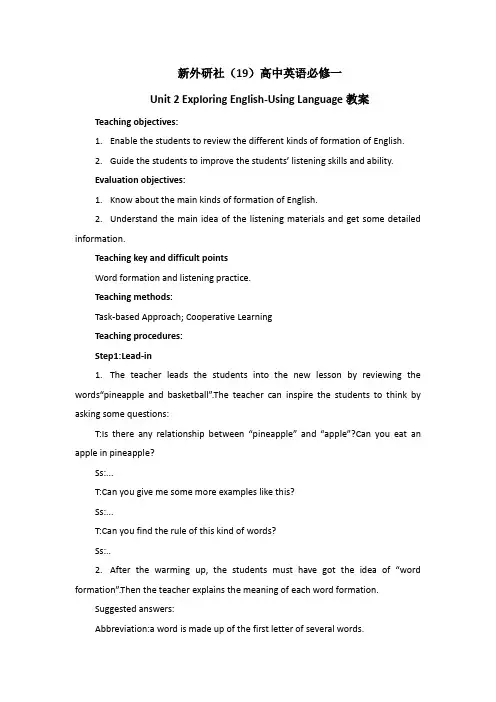
新外研社(19)高中英语必修一Unit 2 Exploring English-Using Language教案Teaching objectives:1.Enable the students to review the different kinds of formation of English.2.Guide the students to improve the students’ listening skills and ability.Evaluation objectives:1.Know about the main kinds of formation of English.2.Understand the main idea of the listening materials and get some detailed information.Teaching key and difficult pointsWord formation and listening practice.Teaching methods:Task-based Approach; Cooperative LearningTeaching procedures:Step1:Lead-in1.The teacher leads the students into the new lesson by reviewing the words“pineapple and basketball”.The teacher can inspire the students to think by asking some questions:T:Is there any relationship between “pineapple” and “apple”?Can you eat an apple in pineapple?Ss:...T:Can you give me some more examples like this?Ss:...T:Can you find the rule of this kind of words?Ss:..2.After the warming up, the students must have got the idea of “word formation”.Then the teacher explains the meaning of each word formation.Suggested answers:Abbreviation:a word is made up of the first letter of several words.例如:very important person--VIP重要的人;大人物Conversion: to create a new word without any change in spelling(1)动词转名词:例如:①Let’s go out for a walk.我们到外面去散散步吧②He is a man of strong build.他是一个体格健壮的男人。
新外研社高中必修一Unit2ExploringEnglishUnderstandingideas教案
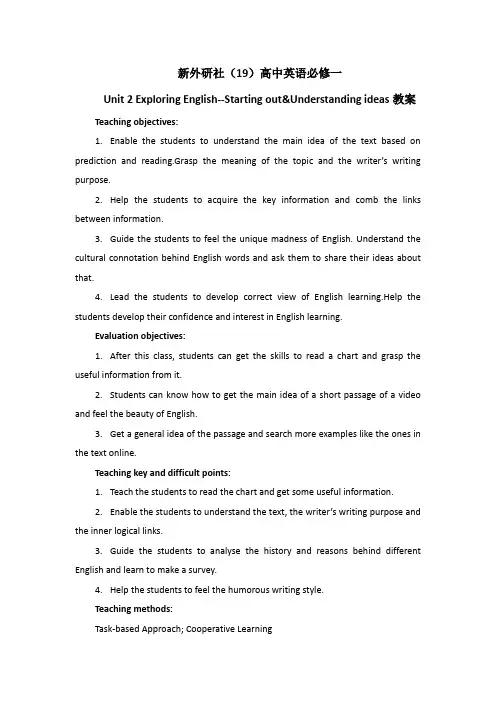
新外研社(19)高中英语必修一Unit 2 Exploring English--Starting out&Understanding ideas教案Teaching objectives:1.Enable the students to understand the main idea of the text based on prediction and reading.Grasp the meaning of the topic and the writer’s writing purpose.2.Help the students to acquire the key information and comb the links between information.3.Guide the students to feel the unique madness of English. Understand the cultural connotation behind English words and ask them to share their ideas about that.4.Lead the students to develop correct view of English learning.Help the students develop their confidence and interest in English learning.Evaluation objectives:1.After this class, students can get the skills to read a chart and grasp the useful information from it.2.Students can know how to get the main idea of a short passage of a video and feel the beauty of English.3.Get a general idea of the passage and search more examples like the ones in the text online.Teaching key and difficult points:1.Teach the students to read the chart and get some useful information.2.Enable the students to understand the text, the writer’s writing purpose and the inner logical links.3.Guide the students to analyse the history and reasons behind different English and learn to make a survey.4.Help the students to feel the humorous writing style.Teaching methods:Task-based Approach; Cooperative LearningTeaching procedures:Preparation:Read the following passage and try to understand the main idea and some new words.At the end of the 16th century,about five to seven million people spoke English.Nearly all of them lived in ter in the next century,people from England made voyages①to conquer②other parts of the world and because of that,English began to be spoken in many other countries.Today,more people speak English as their first,second or a foreign language than ever before.At first the English spoken in England between about AD 450 and 1150 was very different from the English spoken today.It was based more on③German than the English we speak at present.Then gradually④between about AD 800 and 1150,English became less like German because those who ruled England spoke first Danish and later French.These new settlers enriched⑤the English language and especially⑥ its vocabulary⑦.So by the 1600s Shakespeare was able to make use of a wider vocabulary than ever before.In 1620 some British settlers moved to ter in the 18th century some British people were taken to Australia too.English began to be spoken in both countries.English now is also spoken as a foreign or second language in South Asia.For example,India has a very large number of fluent⑧ English speakers because Britain ruled India from 1765 to 1947.During that time English became the language for government and education.English is also spoken in Singapore and Malaysia and countries in Africa such as South Africa.Today the number of people learning English in China is increasing rapidly.In fact,China may have the largest number of English learners.Will Chinese English develop its own identity⑨?Only time will tell.①voyage n.航行;航海②conquer vt.征服;占领③be based on以……为基础④gradually adv.逐渐地;逐步地⑤enrich v.使富裕;充实⑥especially adv.尤其;特别⑦vocabulary n.词汇;词汇量⑧fluent adj.流利的;流畅的⑨identity n.特征;身份Step1:Lead-inThe teacher asks the students some questions about English in order to lead them into the topic of this unit.For example:(1)How long have you learnt English?(2)What do you think of the popularity about English?(3)Which countries have English as their first language?Can you list them?The answer is various.Step2:Look at the charts on Page 13 and answer the questions1.Ask the students to look at Chart 1 and answer the question “Which language has the largest number of native speakers?”2.Ask the students to look at Chart 2 and answer the question” Which language has the largest number of learners?”3.Ask the students to think about the question “What can you learn from Chart 3?”Suggested answers:1.Chinese.2.English.3.In 1993/2003/2014,there are 50 million/200 million/300 million Chinese learning English.From the statistics we can know the number of English learners in China is increasing rapidly.Step3:Watch the video and answer the questionsThe teacher plays the video and asks the students to answer some questions after watching the video.Word bank in the video:native speaker说母语的人invasion侵略invader侵略者tribe部落original最初的 a third 1/3ahead of在……之前It has been estimated that... 据估计……1.Which countries mentioned in the video have English as their first language?2.Where do a third of English words come from?What examples are given in the video?Suggested answers:1.The UK,Ireland,the USA,New Zealand and Australia.2.More than a third of English words come from French.For example,“fruit,travel,crocodile and invasion”.Step4:Watch the video once again and try to fill in the blanksSuggested answers:Celtic,north,west,three tribes,Germany,Vikings,French,1066,Germany,many other placesStep5: Further thinkingThis time the teacher leads the students to think further to improve their thinking ability.The teacher can ask some questions to help the students to think and share.After thinking about these questions, the teacher can ask the students to share their opinions.Some possible questions:1.Why do more and more Chinese learn English?2.Why has English,instead of other languages,become the global language nowadays?Suggested answers:The answers are various.Step6: PresentationShow the students some examples of misusing English in our daily life.Ask the students to reflect on our problems in learning English.Step7:Fast readingAsk the students to read the text quickly and do Activity1 on Page 14 to get a general idea of the text.Suggested answer:wordsAsk the students to do Activity 3 on Page 16Suggested answer:3Step8:Careful readingActivity1:Ask the students to do Activity4 on Page16.Activity2:The word “pineapple” developed from the Spanish word “pina”,which means pine cone.When it came to England,“apple” was added to show it is a kind of fruit.The origin of “hamburger” was a hard beef steak called “Hamburg steak”,eaten without ter,people reinvented it and called it “hamburger”.Eggplants used to be smaller and yellow or white.They looked a bit like eggs,which led to the name “eggplant”.Question 1.How did pineapples,hamburgers and eggplants get their names?Question 2.Does the information above give you a better understanding of thepassage?Give your reasons.1.The name of “pineapple” developed from the Spanish word “pina”,with “apple” added to show it’s a kind of fruit;the name of hamburger came from the idea of “Hamburg steak”,and later people reinvented it and called it “hamburger”;eggplants got the name because they used to look like eggs.2.Students’ own answers.Activity3:In order to support his idea,the author uses many examples that show the 1madness of English.no egg in eggplantno ham in 2 neither pine nor apple in 3sculpt a sculpturepaint a(n)4BUT take a photoseasick→sick at sea5→sickin the air6→sickin a carBUT 7→/sick at home“Hard”is theopposite of “soft”.“Hardly”and“softly”are not a(n) 8pair.“Harmless” is theopposite of “harmful”.Shameful and shameless 9 are the same.burn up→burndownfill in a form→10 aformStars areout.→They are visible.Lights areout.→They are11.I wind up mywatch.→It starts.I wind up thepassage.→It12.Suggested answers:1.unique2.hamburger3.pineapple4.painting5.airsick6.carsick7.homesick8.opposing9.behaviors10.fill out11.invisible12.ends 13.reflectsStep9:Self-evaluationAfter learning together,the teacher asks the students to have a self-evaluation.1.Have you got the tips to interpret charts?2.What do you think of the development of English in the future?3.Have you got the main idea of the passage on Pages 14-15?Suggested answers:The answers are various.Step10:SummaryFirst,the teacher leads the students to recall what they have learnt from the charts on Page 13.Then,lead the students to figure out the main idea of the text on Pages 14-15.Step11:Language Points:长难句突破:分析、理解文章中的长难句。
Unit2 Exploring English -高中英语外研版课件(必修第一册)

toilet water A light perfume that does not have a very strong smell
While Reading
Guess what the English expressions mean?
When we entered the classroom after a long holiday, everything was at sixes and sevens.
When we entered the classroom after a long holiday, everything was in a mess.
Which of the statement is true in the passage? a. “The first floor” in America may be called “the ground floor” in other countries. b. When we say someone is “wicked”, we only want to show the person is bad. c. If you want to go to “the first floor” in Britain when you enter a building, you should go upstairs. d. In China, we use “Not bad!” to show something is good.
Britain
very good/fantastic
高中英语新教材外研版必修第一册学案+作业:Unit 2 Exploring English Period Ⅲ

Period ⅢDeveloping ideas课前自学导引英语中的不幸事件上周,我们的论坛问你有没有关于使用英语的有趣或奇怪的故事。
我们没有想到会有这么多的帖子!这里有一些我们最喜欢的(帖子)提醒我们,我们在教室里学习的英语与外部世界的英语是相当不同的!人们说英国人总是谨慎对待他们的饮食。
不是真的!我去了曼彻斯特的一所暑期学校,我的英语老师叫玛吉。
一天,另一位老师带我们去上课。
他告诉我们那天玛吉不能去教书,因为她喉咙里有只青蛙(实指咽喉痛而说话困难)。
可怜的玛吉,但是她为什么要吃这么大的青蛙呢?135条评论当我第一次去纽约的时候,我去市区的一个购物中心去买一些冬天穿的靴子。
在入口的问询处,我问一位女士鞋子柜台在哪里。
她说在the first floor(一层)。
所以我去了the first floor(一层),但是没有找到任何鞋子。
我决定离开。
当我在找出口的时候,我看到鞋子实际上是在楼下的the ground floor(负一层)卖的,而不是在the first floor(一层)。
她为什么要给我错误的信息呢?128条评论我有一个英国笔友,今年夏天我终于在伦敦见到了他。
他告诉我他的祖父真的很wicked(缺德)。
但是当我见到他的祖父时,我很喜欢他。
我觉得很奇怪。
我的朋友为什么用贬义词来形容这么好的人?63条评论英国人一定有很高的标准。
我参加了英国一所大学和中国一所大学的学生交流活动。
我花了几天时间准备并且写我的第一篇英语论文。
我知道我做得很好,我期待着得到一个好的评语。
当我拿回试卷时,我发现我的老师写的评论“不错!”不错?可是我的论文里没有任何错误。
85条评论课堂合作探究①Let me remind you once again so that you won't forget.我再说一遍,省得你忘了。
②Please remind him to start early.请提醒他早点动身。
新外研版高中英语必修一Unit2ExploringEnglish知识点总结
新外研版高中英语必修一Unit2ExploringEnglish知识点总结Unit2. Exploring English重点知识点:SectionA.1、Pine n.松树2、pineapple n.菠萝3、five- year-old五岁的※“数词+名词+形容词”构成复合形容词,其中的名词用单数形式。
4、ham n.火腿5、eggplant n.茄子6、sculpt v.雕刻,雕塑7、sculpture n.雕像,雕刻品,雕塑品8、seasick adi.晕船的9、airsick adj.晕机的10、carsick adj.晕车的11、homesick adj.想家的12、speaking of谈到,说起(在句中作独立成分)13、opposing adj.(观点、意见等)相反的,相对立的14、behavior n. 举止,行为15、look out of从…向外望去16、confusing adi.令人困感的※confused adj.感到困惑的17、capitalized adj.大写的18、unique adj.独一无二的,独特的※(be) unique to对…来说是独一无二的19、burn up 烧毁,烧尽20、burn down烧毁21、alarm n.警报器;闹钟22、go off(警报器等)突然发出巨响23、reflect v显示,反映24、creativity n.创造性,创造力25、visible adj.看得见的,可见的26、wind up给(机械)上发条;使(活动、会议等)结束原文长难句分析:1、Have you ever asked yourself why people often have trouble learning English?--- why引导宾语从句,作ask的宾语※have trouble(in) doing sth.做某事有困难2、Neither is there pine nor apple in pineapple.---“Neither/Nor+助动词/连系动词be/情态动词+另一主语表示上述否定情况也适用于该主语。
新外研版高一英语必修1:Unit2 Exploring English Period 4 Developing ideas
了解网站论坛讨论这一新媒体语篇的文体特点;初步掌握故事的内容特点、文体特点和写作手法。
难点
鼓励学生关注并积累生活中和媒体上所使用的英语,体会地道、多样化的英语表达,提升自己的语言能力和文化意识。
教学方法
Task-based Approach.
Group Work.
教
学
内
容
与
过
程
Step1 Leading-in
Read the passage and find the words or expressions that caused themisunderstandings.
Step2 Fast-reading
请学生带着任务快速阅读课文,从四则网站论坛讨论中找出引起误解的英语表达。
参考答案:
had a frog in her throat; the first floor; wicked; not bad
4 The girl didn’t know that“toad-in-the-hole”is actually the name of a dish.
Task2:师引导学生根据故事的脉络和主要内容要素,进行知识和思维能力的迁移,写出这则有关语言误解的小故事。
Write a paragraph to tell the story. Use the expressions in the box to help you.
A. (British English) the floor of a building above the one at ground level;
(American English) the floor of a building at ground level
《2020新版》外研版高中英语必修第一册 Unit2 Exploring English 单词表
2020新版外研版高中英语必修第一册Unit2 Exploring English 单词表Words and expression注:词汇表中,未加符号的单词为必修单词;加□的为选择性必修单词;加*的为未做要求的单词。
UNIT 2title/'tartl/n.题目,标题14□ ham/haem/n.火腿14 *eggplant /'egpla:nt/n.茄子14 *pine/pain/n.松树14 *pineapple/'pamnæp(ə)l/n.菠萝14□ sculpt/skAlpt/v.雕刻,雕塑14□ sculpture/'skAlptfa/n.雕像,雕刻品,雕塑作品14 *seasick/'si:;sik/adj.晕船的14 *airsick/'ea,sik/adj.晕机的14 *carsick/'ka:,sik/adj.晕车的14 *homesick /'houm,stk/ adj.想家的14□ opposing /o'pouzty/adj.(观点、意见等)相反的,相对立的15 behavior/br'hervja/n.举止,行为15□ confusing /kən'fju:zin/adj.令人困惑的15 *capitalized /'kæepitlaizd/ adj.大写的15 unique /ju:'ni:k/ adj.独一无二的,独特的15 burn up 烧毁,烧尽15 burn down 烧毁15 alarm/ə'la:m/n.警报器;闹钟15 reflect/ri'flekt/v.显示,反映15 creativity/,krier'tiviti/n.创造性,创造力15□ visible/'vizib(ə)l/ adj.看得见的,可见的15 wind up 给(机械)上发条;使(活动、会议等)结束15creative/kri'ertrv/ adj. 创造(性)的16 type/taip/n.类型,种类17 come across偶然发现17 unfamiliar /,Anfa'milia/ adj. 不熟悉的,不了解的17 contact/'kontæekt/v.联系,联络17 organization /,o:gənar'zeif(ə)n/ n.组织,团体,机构17 likely/'laukli/ adj.可能的,可能发生的17 subway/'sAbwei/n.地铁18 *highway/'harwei/n.公路18 *motorway/'mautawel/n.高速公路18 gas/gæes/n.汽油18 petrol/'petral/n.汽油18 apartment/o'pa:tment/n.一套住房,公寓套房18 flat/flæet/n.一套住房,公寓套房18 *elevator/'elrverto/n.电梯,升降机18 context/'kontekst/n.上下文,语境18 addition/ə'dif(ə)n/n.增加物,添加物19 *forum/'forrom/n.(因特网上的)论坛,讨论区20 resource/ri'zois/n.资料,(教学)资源20 misadventure/,mised'ventfa/n.事故,灾难20 remind/ri'maind/v.提醒,使······想起20 rather/'ra:ða/adv.相当,颇20 comment/'koment/n. 评论20□ frog/frog/n.蛙,青蛙21 *throat/0rout/n.喉咙,咽喉21 have a frog in one's throat(尤因喉咙痛)说话困难21 downtown/,daun'taun/adj.在城镇中心区的,在闹市区的21 boot/buit/n.靴子21 entrance/'entrans/n. 大门(口),入口(处)21 section/'sekf(ə)n/n.区域21exit/'egzit/n. 出口21 actually/'aektfueli/ adv.事实上,实际上21 downstairs/,daun'steəz/ adv. 在楼下21 *wicked/'wikid/ adj.缺德的,邪恶的;很棒的,极好的21 odd/od/adj.奇特的,古怪的21 negative/'negetrv/adj.消极的,负面的21 error/'era/n.错误,谬误21 intend/in'tend/v.计划,打算22 informal/mn'fo:m(ə)l/adj.(书写或言谈)非正式的22 recognise/'rekagnaiz/v.认识,辨认出24 base/beis/v.以···.··为基础24 aware/a'wea/adj.意识到的,明白的24 be aware of 意识到,察觉到24。
新外研版高中英语必修一Unit2ExploringEnglish知识点总结
新外研版高中英语必修一Unit2ExploringEnglish知识点总结单词:1. likely adj.可能的,可能发生的;adv.很可能the most likely cause of the problem造成这个问题最有可能的的原因Rain is likely in our city today.今天我市可能下雨。
We are likely to be very busy tomorrow.明天我们可能很忙。
It will likely rain tomorrow.明天很有可能要下雨。
句型It is likely that... 意思是“可能......”,be动词也可用seem等系动词替换。
The car is likely to break down soon.=It’s likely that the car will break down soon.这车很可能马上要抛锚。
It is very likely that he will not agree.很可能他不会同意。
She may get the job, but it isn’t likely.她或许能得到那份工作,但是可能性不大。
It is/seems very likely that it will rain tomorrow.明天很有可能要下雨。
易混辨析possible,probable,likely1)表示“可能”的形容词possible的可能性最小,指客观上有可能;probable可能性最大,表示“很可能,十有八九”;likely更接近probable,表示外表迹象表明有可能。
如:It’s possible but not likely/ probable that he’ll come here next month.他下月有可能来这里,但是不很肯定。
It’s probable, not only possible.这事多半如此,不只是可能。