
人教版五年级英语下册全册知识点总结
Unit 1一、重点词汇eat breakfast吃早餐 have...class 上······课play sports 进行体育运动 exercise 活动,运动do morning exercises做早操 eat dinner吃晚饭clean my room 打扫我的房间 go for a walk 散步go shopping 去购物 take学习,上(课)dancing 舞蹈 take a dancing class 上舞蹈课a.m.上午 p.m.下午usually 通常地二、其他日常活动get up起床 eat lunch吃午饭go to bed 上床睡觉 wash my face洗脸wash my clothes 洗我的衣服 watch TV看电视play ping-pong打乒乓球 play the pipa弹琵琶go swimming 去游泳 go running去跑步do homework 做作业 do kungfu练武术play football踢足球 play basketball打篮球三、语音cl→ [cl] :clean clock class cleverpl→[pl] :plate eggplant please play注意:cl 和pl 放在词尾与e 结合变为cle 和ple 时发音不同。
四、频度副词always总是,一直(100%)usually通常(80%)often 经常(60%) sometimes有时(30%)五、疑问词why 为什么 when 什么时候六、重点句型1.询问别人什么时候做某事的句型及回答。
句型结构:问:When do you+动词短语原形+其他?(你/你们什么时候做某事?)答:I/we(+频度副词)+动词短语原形+at+具体时间. (我/我们通常在几点做某事。
)例:When do you go to bed?(你什么时候上床睡觉?)I go to bed at 9:00 p.m. (我晚上九点上床睡觉。
)注意:当主语是第三人称单数(he,she,it,单个人名或单数名词)时,助动词do要变成does。
句型结构是:When does+主语(第三人称单数)+动词短语原形+其他?2.询问别人周末做什么的句型及回答。
句型结构:问:What do you do on the weekend?(你周末做什么?)答:I(+频度副词)+动词(短语)+其他。
例:What do you do on the weekend?(你周末做什么?)I usually read books. (我通常看书。
)注意:当主语是第三人称单数(he,she,it,单个人名或单数名词)时,助动词do要变成does。
句型结构是:What does+主语(第三人称单数)+do+on the weekend?Unit 2一、重点词汇spring 春天 summer 夏天autumn秋天 winter 冬天season季节 picnic 野餐go on a picnic 去野餐 pick摘pick apples摘苹果 snowman雪人make a snowman 堆雪人 go swimming去游泳which 哪一个 best最because 因为 vacation 假期二、其他1.形容天气的形容词:hot 炎热的warm 暖和的rainy多雨的windy 多风的foggy有雾的 cold 寒冷的cool凉爽的sunny晴朗的cloudy 多云的snowy下雪的2.由go构成的活动短语:go swimming去游泳 go shopping去购物go boating去划船 go skating去滑冰go hiking去远足 go fishing去钓鱼三、语音br →[br]: brown library brother umbrellagr→ [gr] : green grapes grandpa grow四、重点句型1.询问别人天气怎么样的句型及回答。
句型结构:问:What’s the weather like+时间+地点?(······天气怎么样?)答:It’s+表示天气的形容词.例:What’s the weather like in winter in Beijing?(北京冬天的天气怎么样)It’s cold and windy(有风而且寒冷。
)2.询问别人最喜欢的季节句型及回答。
句型结构:问:Which season do you like best? (你最喜欢的季节是哪一个?)答:I like+季节+best. 或直接说季节名称。
同义句还有:What’s your favourite season?3.询问别人喜欢某个季节的原因的句型及回答。
句型结构:问:Why do you like+季节名称?或直接用“Why”来提问。
答:一般要用“because”引导的句子来说明理由,可以从天气相关的活动等方面来说。
例:(1)Why do you like spring?(你为什么喜欢春天?)Because I can go on a picnic.(因为我能去野餐。
)(2)Why do you like summer?(你为什么喜欢夏天?)Because I can go swimming.(因为我能去游泳。
)(3)Why do you like autumn?(你为什么喜欢秋天?)Because I can pick apples.(因为我能摘苹果。
)(4)Why do you like winter?(你为什么喜欢冬天?)Because I can make a snowman.(因为我能堆雪人。
)Unit 3一、重点词汇January一月 February二月March三月 April四月May五月 June六月July七月 August 八月September 九月 October十月November 十一月 December十二月注意:1.月份的首字母一定要大写。
2.May没有缩写形式,September的缩写形式是“Sept”,其他月份单词的缩写形式都是由单词的前三个字母加“·”构成。
3.月份的缩写形式不用在句子中,只能单独使用。
4.表示“在几月”时,要在月份单词前面加介词in。
二、常用节假日名称New Year’s Day元旦(1.1)Tree Planting Day 植树节(3.12)Easter 复活节(每年春分月圆之后第一个星期日)April Fool’s Day愚人节(4.1) May Day 劳动节(5.1)Mother’s Day母亲节(五月第二个周日)Children’s Day 儿童节(6.1)Father’s Day父亲节(六月第三个周日)Teacher’s Day教师节(9.10)National Day国庆节(10.1)Mid-Autumn Day 中秋节(农历八月十五)Thanksgiving Day 感恩节(11月第4个周四) Christmas圣诞节(12.25)summer vacation暑假(July and August ) winter vacation寒假三、语音ch→ [ts]: China chicken lunch teachersh→[s]: sheep fish shirt shorts四、活动名称sports meet 运动会 Easter party 复活节聚会school trip 学校旅行 Chinese test 语文测试singing contest歌咏比赛 birthday party生日聚会五、介词in 、on、at的用法。
1.in +上午/下午/晚上/月份/季节/年份。
如:in the morning, in April, in winter, in 20152.on+具体的某一天。
如:on Monday, on April 3rd, on Friday morning3.at +具体的时间点或与其他词构成固定搭配。
如:at 6:00 , at noon六、重点句型1.问答某个活动或节日在几月份的句型及回答。
句型结构:问:When is+ the +活动或节日名称?(注意:节日开头字母要大写)答:It’s in+月份.例:(1)When is the trip this year ? (今年的旅行在什么时候?)It’s in October. (在十月)(2)When is Christmas?(圣诞节在什么时候?)It’s in December.(在十二月。
)2.询问别人将要做什么的句型及回答。
句型结构:问:What will you do+其他?答:I will...=I’ll...例:What will you do for your mum on Mother’s Day?(母亲节你将为你妈妈做什么?)I’ll give her some flowers.(我将送给她一些花。
)3.表达“我们将要···”的句型。
We’ll/We will +动词原形. 这是一个一般将来时的句子,表示将来某个时间要发生的动作或事情。
例:We’ll have a school trip.(我们将有一次学校旅行。
)We’ll have a singing contest.(我们将有一次歌咏比赛。
)We’ll take a dancing class.(我们将要上一节舞蹈课。
)Unit 4一、重点词汇first(1st) 第一 second (2nd)第二third (3rd)第三fourth (4th)第四fifth(5th) 第五sixth(6th) 第六seventh(7th)第七 eighth(8th)第八ninth(9th)第九tenth(10th) 第十eleventh(11th)第十一twelfth(12th)第十二thirteenth(13th) 第十三 fourteenth(14th) 第十四fifteenth(15th)第十五 sixteenth(16th)第十六seventeenth(17th) 第十七eighteenth(18th) 第十八nineteenth(19th) 第十九twentieth(20th) 第二十twentieth-first(21th) 第二十一 twentieth-second(22nd) 第二十二twentieth-third(23rd) 第二十三thirtieth(30th) 第三十二、用序数词表示具体的日期在英语中,“几月几日”可以先说“月”,再说“日”,其中“日”要用序数词。
人教版小学五年级英语下册重点知识归纳
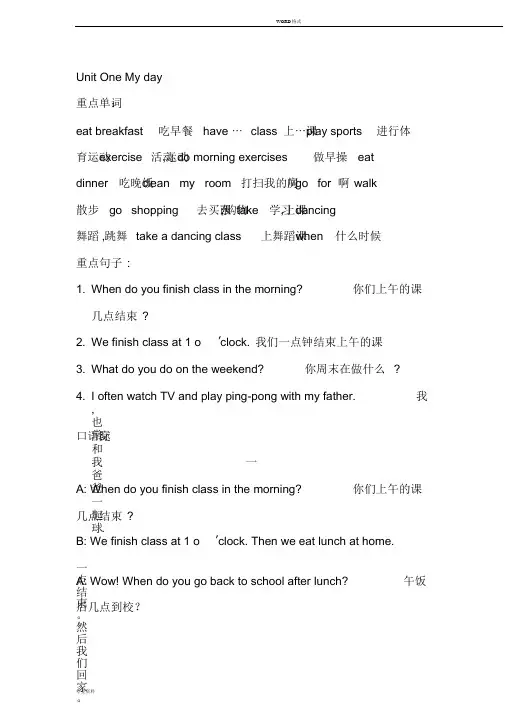
Unit One My day 重点单词: eat breakfast吃早餐 have ⋯ class 上⋯课p lay sports 进行体育运动e xercise 活动,运动d o morning exercises做早操 eatdinner 吃晚饭c lean my room 打扫我的房间go for 啊 walk 散步 go shopping去买东西,购物t ake 学习,上课d ancing舞蹈 ,跳舞 take a dancing class 上舞蹈课w hen 什么时候重点句子 :1. When do you finish class in the morning? 你们上午的课几点结束 ?2. We finish class at 1 o’clock. 我们一点钟结束上午的课.3. What do you do on the weekend?你周末在做什么 ?4. I often watch TV and play ping-pong with my father. 我 ,也常和我爸爸一起球.口语交际: 一 A: When do you finish class in the morning? 你们上午的课 几点结束 ? B: We finish class at 1 o ’clock. Then we eat lunch at home. 一点结束。
然后我们回A: Wow! When do you go back to school after lunch? 午饭后几点到校?B: At 2:30. Classes start at 3 o ’clock. 两点半到校,三点上课。
A: When do you usually eat dinner in Spain? 在西班牙你们通常几点吃晚饭?B: Usually at 9:30 or 10 o ’clock. 通常在九点半或十点。
人教版小学五年级英语下册知识点汇总(完整版)
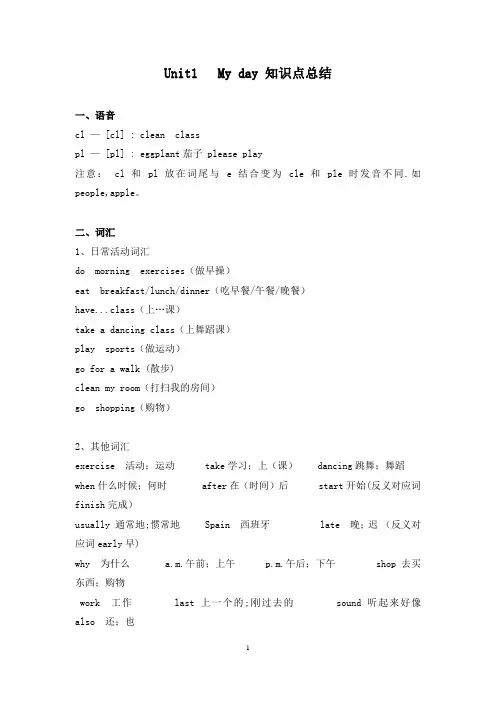
Unit1 My day 知识点总结一、语音cl — [cl] : clean classpl — [pl] : eggplant茄子 please play注意:cl 和 pl 放在词尾与 e 结合变为cle 和 ple 时发音不同.如people,apple。
二、词汇1、日常活动词汇do morning exercises(做早操)eat breakfast/lunch/dinner(吃早餐/午餐/晚餐)have...class(上…课)take a dancing class(上舞蹈课)play sports(做运动)go for a walk (散步)clean my room(打扫我的房间)go shopping(购物)2、其他词汇exercise 活动;运动 take学习;上(课)dancing跳舞;舞蹈when什么时候;何时 after在(时间)后 start开始(反义对应词finish完成)usually 通常地;惯常地 Spain 西班牙 late 晚;迟(反义对应词early早)why 为什么 a.m.午前;上午 p.m.午后;下午 shop去买东西;购物work 工作 last上一个的;刚过去的 sound听起来好像also 还;也busy 忙的need 需要play 戏剧剧本 letter 信Live 居住island 岛always 总是;一直 cave 山洞;洞穴go swimming 去游泳win 获胜。
三、句型以及语法知识点1、询问别人什么时候做某事某种活动的when特殊疑问句型,使用时间短语回答。
When do you do morning exercises? 你何时做早操?I do morning exercises at 7:00.我七点钟做早操。
When do you finish class in the morning? 你们上午的课到什么时候结束?We finish class at 1 o’clock.我们一点钟结束上午的课。
最新人教版五年级下册英语知识点(非常有用)
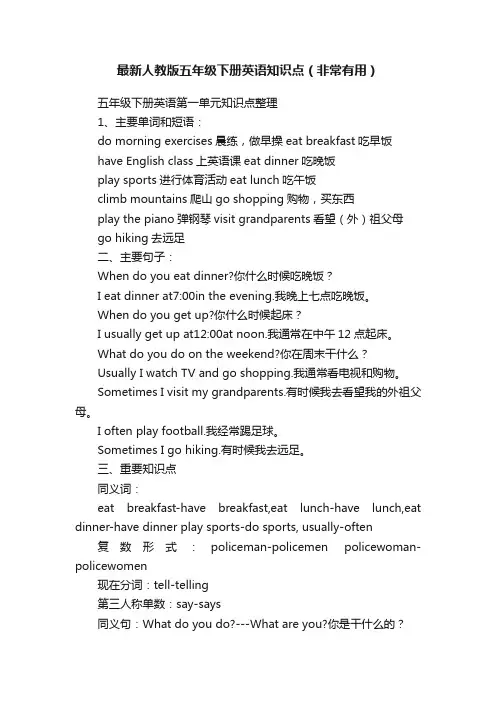
最新人教版五年级下册英语知识点(非常有用)五年级下册英语第一单元知识点整理1、主要单词和短语:do morning exercises晨练,做早操eat breakfast吃早饭have English class上英语课eat dinner吃晚饭play sports进行体育活动eat lunch吃午饭climb mountains爬山go shopping购物,买东西play the piano弹钢琴visit grandparents看望(外)祖父母go hiking去远足二、主要句子:When do you eat dinner?你什么时候吃晚饭?I eat dinner at7:00in the evening.我晚上七点吃晚饭。
When do you get up?你什么时候起床?I usually get up at12:00at noon.我通常在中午12点起床。
What do you do on the weekend?你在周末干什么?Usually I watch TV and go shopping.我通常看电视和购物。
Sometimes I visit my grandparents.有时候我去看望我的外祖父母。
I often play football.我经常踢足球。
Sometimes I go hiking.有时候我去远足。
三、重要知识点同义词:eat breakfast-have breakfast,eat lunch-have lunch,eat dinner-have dinner play sports-do sports, usually-often 复数形式:policeman-policemen policewoman-policewomen现在分词:tell-telling第三人称单数:say-says同义句:What do you do?---What are you?你是干什么的?表示频度的副词:always总是,一直;usually通常,常常;often经常;sometimes有时候以复数形式出现的词组:visit grandparents,plant trees介词后跟表示时间的词语时,表示在某年、某月、某个季节,某个时候(在上午,在下午,在晚上)用in;表示在某一天,在星期几用on,在具体的几点几分用at.too和either的用法区别:too和either都是“也”的意思,但too用于肯定句,either用于否定句。
人教版小学五年级下册英语知识点整理
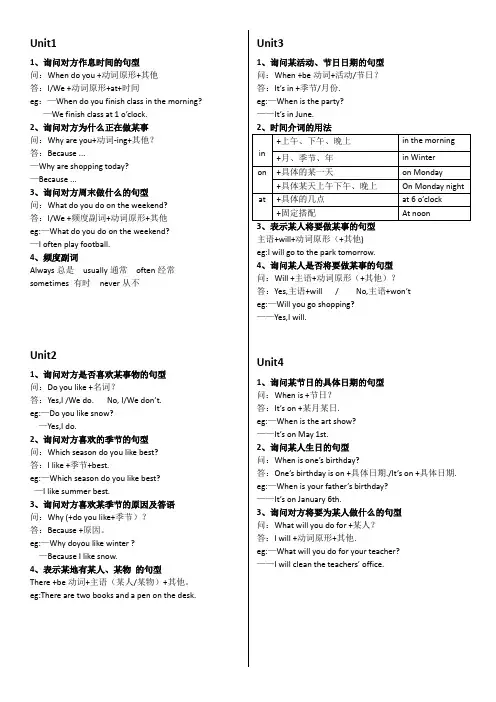
Unit11、询问对方作息时间的句型问:When do you +动词原形+其他答:I/We +动词原形+at+时间eg:—When do you finish class in the morning?—We finish class at 1 o’clock.2、询问对方为什么正在做某事问:Why are you+动词-ing+其他?答:Because ...—Why are shopping today?—Because ...3、询问对方周末做什么的句型问:What do you do on the weekend?答:I/We +频度副词+动词原形+其他eg:—What do you do on the weekend?—I often play football.4、频度副词Always总是usually通常often经常sometimes 有时never从不Unit21、询问对方是否喜欢某事物的句型问:Do you like +名词?答:Yes,I /We do. No, I/We don’t. eg:—Do you like snow?—Yes,I do.2、询问对方喜欢的季节的句型问:Which season do you like best?答:I like +季节+best.eg:—Which season do you like best?—I like summer best.3、询问对方喜欢某季节的原因及答语问:Why (+do you like+季节)?答:Because +原因。
eg:—Why doyou like winter ?—Because I like snow.4、表示某地有某人、某物的句型There +be动词+主语(某人/某物)+其他。
eg:There are two books and a pen on the desk.Unit31、询问某活动、节日日期的句型问:When +be动词+活动/节日?答:It’s in +季节/月份.eg:—When is the party?——It’s in June.主语+will+动词原形(+其他)eg:I will go to the park tomorrow.4、询问某人是否将要做某事的句型问:Will +主语+动词原形(+其他)?答:Yes,主语+will / No,主语+won’t eg:—Will you go shopping?——Yes,I will.Unit41、询问某节日的具体日期的句型问:When is +节日?答:It’s on +某月某日.eg:—When is the art show?——It’s on May 1st.2、询问某人生日的句型问:When is one’s birthday?答:One’s birthday is on +具体日期./It’s on +具体日期. eg:—When is your father’s birthday?——It’s on January 6th.3、询问对方将要为某人做什么的句型问:What will you do for +某人?答:I will +动词原形+其他.eg:—What will you do for your teacher?——I will clean the teachers’ office.1、描述物品归属的句型物品+ be动词(is/are)+(mine/his/hers/yours/ours/theirs) eg:The book is yours.2、确认物品归属地句型问:be动词+this/that/these/those(+其他)+某人的?答:Yes,it is. Yes,they are./ No,it,is’t. No,they aren’t. eg:—Is that crayou his?——Yes,it is.3、询问物品归属的句型问:单数Whose+is it/this/that?复数Whose+are they/these/those?答:It’s/They’re+名词性物主代词/ 名词所有格eg:—Whose bag is this?——It’s mine.4、现在进行时的一般疑问句问:Be动词+主语+动词-ing(+其他)?答:Yes,主语+be动词/ No,主语+be动词+not. eg:—Is she listening to music?——Yes,she is.5、描述某人正在做某事主语+be动词(am/is/are)+动词-ing(+其他).eg:I’m doing my homework now.6、询问某人能否做某事问:Can+主语+动词原形+其他?答:Yes,主语+can. /No,主语+can’t.eg:—Can I play football?——Yes,you can.Unit61、询问多个人或动物正在做什么的句型问:What are +主语(复数)+doing?答:主语(复数)+are+动词-ing+其他.eg:—What are the boys doing?——They are jumping2、询问单个人或动物正在做什么的句型问:What is +主语(单数)+doing?答:主语(单数)+is+动词-ing+其他.eg:—What is Tom doing?——He is playing football.。
人教版五年级英语下册 知识点总结

Unit 1 This Is My Day对话一:A: When do you get up ? 你什么时候起床啊?B: I usually get up at 6:30.When do you eat breakfast?A: At 6:20. What about you? / And you? 你呢?B: I usually eat breakfast at 7:00.对话二:A: Excuse me .Can I ask you some questions ? 打扰了,我能问你几个问题吗?B: Sure.A: What do you do ? 你是做什么的?B: I am a policeman .A: When do you go to work ? 你什么时候去上班?B: I usually go to work at 9:00 in the evening.A: When do you go home ?B: I go home at 5:00 in the morning .A: Thank you for telling me about your day.谢谢你告诉我你的一天。
B: You’re welcome.对话三:A: What do you do on the weekend ? 你周末干什么呀?B: Usually I watch TV and go shopping. Sometimes I visit my grandparents.What about you ? 我通常看电视和购物。
有时候去拜访我的祖父母。
你呢?A: I often play football . Sometimes I go hiking .B: That’s fun .好玩句型:1、询问某人的生活,学习规律——when do you +动词(短语)——I(usually)+动词(短语)+at + 时间.2、Excuse me . 用在打扰别人时的一种客气说法,意为:打扰了。
人教版小学五年级英语下册知识点归纳
人教版小学五年级英语下册知识点归纳五年级英语下册是小学阶段的最后一学期,学生们将进一步学习英语的语法、词汇和日常交际用语。
本文将对五年级英语下册的知识点进行归纳,以帮助学生更好地复习和掌握这些知识。
一、语法知识点1. 一般现在时:表示经常性的动作或习惯性的行为,结构为主语+动词原形。
例如:"She often goes to the park on weekends."2. 一般过去时:表示过去发生的动作或状态,结构为主语+动词过去式。
例如:"Yesterday, I played soccer with my friends."3. 现在进行时:表示现阶段正在进行的动作,结构为主语+be动词(am/is/are)+动词-ing形式。
例如:"They are watching a movie in the cinema."4. 一般将来时:表示将来要发生的动作或事件,结构为主语+will+动词原形。
例如:"I will visit my grandparents next week."5. 动词的-ing形式:表示正在进行的动作,或者作为主语、定语、表语、宾语补足语等。
例如:"I enjoy swimming in the summer."6. 动词的过去式:表示过去发生的动作或状态。
例如:"He ate an apple for breakfast."二、词汇知识点1. 数字:学习1-100的基本数字,以及基本的数学运算符号。
例如:"5 + 3 = 8."2. 季节和月份:学习四季和每个月份的英文表达,以及与之相关的天气和活动。
例如:"In winter, it often snows. We can go skiing."3. 食物:学习常见食物的英文表达,以及与之相关的问答句型。
【口袋书】人教版PEP五年级下册英语 基础知识汇总
人教版PEP五年级下册基础知识汇总Unit 1 My day.重点单词:[四会]dancing 跳舞;舞蹈exercise 活动;运动take 学习;上(课)[三会]after 在(时间)后start 开始usually 通常地;惯常地Spain 西班牙late 晚;迟a.m.午前;上午p.m.午后;下午why 为什么shop 去买东西;购物work 工作last 上一个的;刚过去的sound 听起来好像also 还;也busy 忙的need 需要play 戏剧;剧本letter 信live 居住island 岛always 总是;一直cave 山洞;洞穴win 获胜重点短语:eat breakfast 吃早饭have … class 上…课play sports 进行体育运动do morning exercises 做早操eat dinner 吃晚饭clean my room 打扫我的房间go for a walk 散步go shopping 去买东西;购物take a dancing class 上舞蹈课go swimming 去游泳start class 开始上课last night 昨天晚上after lunch 午饭以后a lot of fun 许多乐趣live on an island 住在一座岛上be good at sports 擅长体育运动字母组合cl 发/kl/ 音:clean 打扫clock 钟class 课;班级clever 聪明的clock 钟字母组合pl 发/pl/ 音:plate 盘子;碟子eggplant 茄子please 请play 玩耍;戏剧重点句型:1.询问别人什么时候做某事的问句及回答:-- When do/does + 主语+ 动词(短语)原形(+ 其他)?-- 主语(+ 频度副词)+ 动词(短语)原形/ 第三人稀单数形式+ at + 具体时间/ At + 具体时间.-- When do you get up? 你什么时候起床?-- I get up at 5 o'clock. 我5点起床。
人教版PEP小学英语五年级下册知识点汇总(最新)
人教版PEP小学英语五年级下册知识点汇总(最新)Unit One: This Is My DayBasic Vocabulary:Activities: get up。
do morning exercises。
have English class。
play sports。
play the piano。
climb mountains。
go shopping。
go hiking。
visit grandparents。
eat breakfast。
eat dinner.Basic XXX Structures:1.Asking about daily routines:When do you。
(你什么时候。
)XXX I。
(我通常在。
(点钟)。
(做什么事)。
有时。
)XXX: When do you go to school。
(你每天几点去上学?)I usually go to school at 7:00.Sometimes I go to school at7:10.2.Asking about XXX:What do you do on the weekend。
(你周末做什么?)XXX I。
(我通常/经常。
有时。
)XXX: What do you do on the weekend?I often play XXX I go shopping with my mom.3.Introducing one's own habits:Every weekend。
I go hiking。
(我每个周末远足。
)Every day。
I do my homework at 8:00 in the evening。
(我每天晚上8点做作业。
)4.Asking XXX:What do you do。
(你是干什么的?)Time:morning。
afternoon。
evening。
noon。
at night。
6:00.on Sunday。
人教版新起点英语五年级下册全册单元知识点
Unit 1 Keep Healthy(保持健康)一、单元词汇too much 太多candy 糖果go to bed 去睡;就寝early 早exercise 锻炼tired 困倦的;疲倦的drink 喝;饮before 在......之前dirty 肮脏的always 总是stomachache 胃疼headache 头疼toothache 牙痛a lot of 大量;许多sleepy 困的;欲睡的subject 学科mark 分数advice 建议more 更多的二、单元句型1. A: What s wrong? 怎么了?B: I ve got a stomachache. 我肚子疼。
2. A: I often have stomachaches. What should I do?我经常肚子疼。
我应该怎么办?B: You should drink some water. 你应该喝些水。
3. Here you are. 给你。
4. A: Do you eat a lot of candy? 你吃了很多糖吗?B: Yes, I eat some after every class. 是的,我每节课后都吃很多。
5. You shouldn t eat too much candy. 你不该吃太多糖。
6. A: Do you wash your hands before eating? 你饭前洗手了吗?B: Not always. 不总洗。
7. You shouldn t eat with dirty hands. 你不该用脏手吃饭。
8. You should always wash your hands before eating.你应该坚持饭前洗手。
9. I always feel tired and sleepy. 我总觉得很累很困。
10. I have some advice for you. 我给你一些建议。
人教精通版五年级英语下册全册知识点总结
人教精通版五年级英语下册全册知识点总结知识点总结Unit 1 Welcome to our school!【词汇】library 图书馆borrow (向某人、从某人)借borrow books 借书meeting room 会议室have a meeting 开会welcome 欢迎meet 相遇;开会our 我们的science lab 科学实验室science lesson 科学课language lab 语言实验室English lesson 英语课we 我们have 有all 所有;全部like 喜欢very much 非常;很art club 美术(艺术)俱乐部paint a picture (用颜料)绘画music club 音乐俱乐部play the piano 弹钢琴many 许多music 音乐way 路;道路please 请also 也;同样【句型】1. We\\\\\\\\\'ll show you around our school. 我们会带你参观我们学校。
2. Look! This is our library. 看!这是我们的图书馆。
3. —Do you often come to the library?你经常去图书馆吗?—Yes. We often borrow books from the library.是的。
我们经常从图书馆借书。
4. This way, please. This is our meeting room.这边请。
这是我们的会议室。
5. Welcome to our school. 欢迎来到我们学校。
6. —How many science lessons do you have in a week?你们一周有多少实验课?—We have two. 两节。
7. —Do you like English? —Yes. We all like it.你喜欢英语吗?喜欢。