
牛津译林版九年级英语上册 Unit3 Teenage problems教学课件:welcome
go to bed early and don't watch too much TV
try to be friendly to others and chat with them after class
plan your time carefully and try to finish your homework quickly
Homework
What should (not) you do when you have some problis Millie’s problem? • 2 What should she do then?
• manage your time better • 作及物动词,意为“控制;对付;照管”。 • The girl is good at managing her money. 这个女孩善于理财
3 这个书架不够大,不能放下那么多书。 big enough to The bookshelf isn’t _____ _____ ______ put so many books on it. ______ so _____ small _____ that it The bookshelf is _____ can’t put so many books on it.
• (5 )I don’t have any close friends to talk to. 我没有亲密的朋友好交谈。 • close 此处的意思是“亲密的”;还可表示 距离,意为“靠近的;接近的”,常与to 连用。
• 练一练:翻译下列句子 • 这个车站离我们家最近。 is ____ the ______ closest one • This station _____ _______ our home. to • 他是我的一位密友。 • He is a _______ friend of _________. close mine
• (2)get low marks in exams • 得高分 get high marks
• (3). The TV is always on at my home. • 我家电视总是开着。
• 1 我回来的时候,电视机还开着。 • The TV was ______ when I still ______ on ______ came back. • 2 当我到达电影时,这部电影已开始10分钟 了。 been _______ on for 10 • The film had ________ minutes when I got ______ the cinema. to
be old enough to go to school
• 足够高可以够到树上的苹果
be tall enough to reach the apple on the tree
translation
• 1我没有足够时间做作业。 have enough time _____ to do • I don’t _____ _____ _____ ______ homework. • 2我没有足够的钱买这种手机。 enough money to buy • I don’t have _____ _____ ______ ______ this type of mobile phone. cheap _____ enough for • The mobile phone isn’t _____ _____ me to buy.
Free talk
1. Do you have any problems in your daily life? 2. What are the problems?
She doesn't have enough sleep. She feel tired in class .
He doesn’t have enough time to do his Homework.
Unit 3 Teenage problems
Period one
课前预习: 翻译下列词组
• • • • • • • • 变胖________________________ 吃的更少___________________ 更多锻炼_________________ 有个问题____________________ 使某人发疯__________________ 考低分______________________ 感到孤独____________________ 没时间陪我__________________
noise almost .The TV is always on at her home. The ____ Drives her mad.
He doesn’t have close friends . Sometimes, he feels Lonely .
Herparents work all day, they don't have time for her .
ask parents to turn down or turn off the TV ask parents to come home early
study harder and ask for teacher's help
Language points
• • • • • • 1)get enough sleep enough+ noun. e.g. 足够的水 enough water 足够的食物 adj.+ enough enough food e.g. 足够大可以上学
These are teenage problems
• don't get enough sleep • don't get enough time to do homework • have no close friends • quarrel with others • It's noisy at home • Their parents work all day and don't have time for them • have low marks in the exams • not very tall/beautiful/clever/strong
He gets low marks in exams .
I don’t get enough I don’t have enough It’s very noisy at sleep. Time to do my home . I feel tired in Homework. The TV is always on. class.
• Translation: • 这件衬衫很脏,但他设法把它弄干净了。 managed The shirt was very dirty, but he______ to ______ _______ clean it.. • 你应该学会如何控制好你的时间。You how to manage should learn ______ ______ ______ your time.
Comic strip
• 1. What problem does Eddie have? What is Hobo’s advice? • 2. Why does Hobo tell Eddie not to eat too much?
Fill in the blanks
• Eddie has got a problem .He is getting fat . Hobo tells him not to eat too much because it is unhealthy. He also tells Eddie to try more exercise.If Eddie does so, he will finish the food for Eddie.
I don’t have close friends. Sometimes, I feel lonely.
.
My parents work all day. They don’t have time for me.
Sometimes I get low marks in exam. I feel sad.
牛津译林版英语九上Unit 3《Teenage problems》(Grammar)教学设计

牛津译林版英语九上Unit 3《Teenage problems》(Grammar)教学设计一. 教材分析《牛津译林版英语九上Unit 3 Teenage problems》主要讨论青少年时期可能遇到的各种问题,如学习压力、与父母沟通、健康饮食等。
本单元通过不同的话题帮助学生了解青少年阶段可能面临的挑战,并学会用英语表达这些问题。
单元中包含了大量的词汇和表达方式,以及一些复杂的语法结构,如现在分词作状语等。
二. 学情分析九年级的学生已经具备了一定的英语基础,能够理解和运用一些基本的英语表达方式和语法结构。
然而,对于一些复杂的语法结构和词汇,他们可能还需要进一步的引导和帮助。
此外,由于青少年阶段本身就是充满挑战和变化的,学生应该能将自己的人生经验和所学内容联系起来,提高他们的学习兴趣和参与度。
三. 教学目标1.学生能够掌握本单元中的重点词汇和表达方式,如“pressure”,“communicate”, “healthy eating”等。
2.学生能够正确运用现在分词作状语等语法结构。
3.学生能够用英语讨论青少年时期可能遇到的问题,并给出相应的建议。
四. 教学重难点1.重点:本单元的重点词汇和表达方式,以及现在分词作状语的语法结构。
2.难点:如何正确运用现在分词作状语,以及如何在讨论中运用所学词汇和表达方式。
五. 教学方法1.任务型教学法:通过不同的任务和活动,让学生在实际的语言环境中学习和运用英语。
2.合作学习:鼓励学生之间的合作和交流,提高他们的语言表达能力和团队合作能力。
3.引导式教学法:教师引导学生通过观察、思考和讨论,发现和理解语言规律。
六. 教学准备1.教材:牛津译林版英语九上Unit 3 Teenage problems。
2.多媒体教学设备:用于展示PPT和视频材料。
3.教学素材:与本单元主题相关的图片、视频等。
七. 教学过程1.导入(5分钟)通过提问方式引导学生谈论他们所知道的青少年时期的问题,激发学生的兴趣和参与度。
牛津译林版九上《Unit 3 Teenage problems》word教案
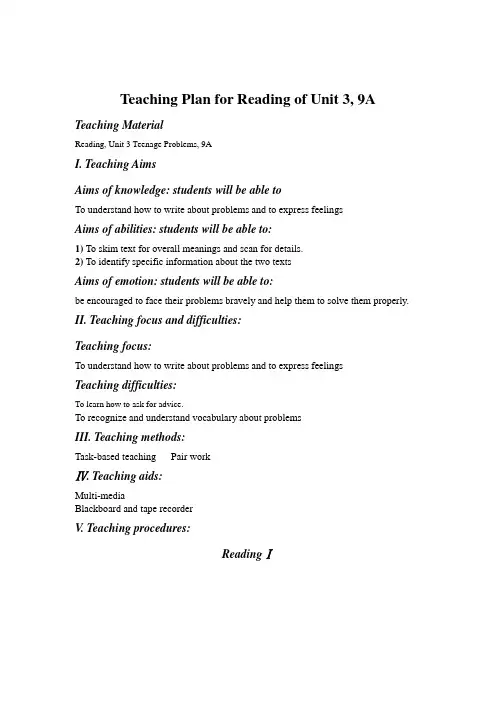
Teaching Plan for Reading of Unit 3, 9A Teaching MaterialReading, Unit 3 Teenage Problems, 9AI. Teaching AimsAims of knowledge: students will be able toTo understand how to write about problems and to express feelingsAims of abilities: students will be able to:1) To skim text for overall meanings and scan for details.2) To identify specific information about the two textsAims of emotion: students will be able to:be encouraged to face their problems bravely and help them to solve them properly. II. Teaching focus and difficulties:Teaching focus:To understand how to write about problems and to express feelingsTeaching difficulties:To learn how to ask for advice.To recognize and understand vocabulary about problemsIII. Teaching methods:Task-based teaching Pair workⅣ. Teaching aids:Multi-mediaBlackboard and tape recorderV. Teaching procedures:ReadingⅠVII. Homework1.Read the text for some times.2.Learn the new words and phrases by heart.3.Finish exercises on P46-47.VIII. Blackboard designUnit 3 Teenage problemsWhat should I do?youth workerⅨ. A summary after teaching:_____________________________________________________________________ _____________________________________________________________________ _____________________________________________________________________ _________________________________________ReadingⅡVII. Blackboard designUnit 3 Teenage problemsWhat should I do?role playⅧ. A summary after teaching:_____________________________________________________________________ _____________________________________________________________________ _____________________________________________________________________ _________________________________________Additional exercises一、根据中英文提示填写单词。
牛津译林版九年级上册Unit 3《Teenage problems》(Study skills)教学
牛津译林版九年级上册Unit 3《Teenage problems》(Study skills)教学设计一. 教材分析牛津译林版九年级上册Unit 3《Teenage problems》(Study skills)围绕着青少年的学习方法展开,旨在让学生通过阅读、听力、口语和写作等环节,了解并掌握各种学习方法,以及如何有效地解决学习中遇到的问题。
本节课的主要内容包括:不同学生有不同的学习风格和策略,如何选择适合自己的学习方法,以及如何养成良好的学习习惯等。
二. 学情分析九年级的学生已经具备了一定的英语基础,能够进行简单的听、说、读、写操作。
但部分学生在面对较复杂的文章时,可能会存在阅读困难,理解能力有限。
此外,学生对学习方法和策略的认识相对较弱,需要老师在教学中进行引导和启发。
三. 教学目标1.知识目标:让学生掌握与学习方法相关的词汇和表达,如effective,strategy, improve等。
2.能力目标:培养学生通过阅读、听力、口语和写作等多种方式,理解和运用本节课所学内容。
3.情感目标:引导学生认识到学习方法的重要性,激发学生探索适合自己的学习方法,养成良好的学习习惯。
四. 教学重难点1.重点:让学生理解和运用本节课所学词汇和表达。
2.难点:引导学生如何选择适合自己的学习方法,以及如何养成良好的学习习惯。
五. 教学方法1.任务型教学法:通过设定各种任务,让学生在实践中学习和运用英语。
2.合作学习法:鼓励学生分组讨论,培养学生的团队协作能力。
3.情感教学法:关注学生的情感需求,激发学生的学习兴趣。
六. 教学准备1.教材:牛津译林版九年级上册Unit 3《Teenage problems》(Studyskills)2.多媒体设备:电脑、投影仪、音响等3.教学素材:相关学习方法的文章、视频等4.课件:制作与本节课相关的内容,包括词汇、图片、视频等七. 教学过程1.导入(5分钟)利用课件展示一些关于学习方法的名言,如“活到老,学到老”、“适合自己的才是最好的”等,引导学生思考如何选择适合自己的学习方法。
牛津译林版九年级上册Unit 3《Teenage problems》(Reading 2)教学设计
牛津译林版九年级上册Unit 3《Teenage problems》(reading 2)教学设计一. 教材分析《牛津译林版九年级上册Unit 3 Teenage problems(reading 2)》讲述了关于青少年面临的问题,通过阅读文章让学生了解并学会应对这些问题。
文章内容丰富,涉及到青少年在生活、学习、心理等方面的困扰。
本节课的主要目的是让学生通过阅读,了解青少年问题,并提高他们的阅读理解能力。
二. 学情分析九年级的学生已经具备一定的英语基础,能够进行简单的阅读和交流。
但他们在阅读理解方面,尤其是通过文章了解和分析问题方面还存在一定的困难。
因此,在教学过程中,需要关注学生的个体差异,引导他们更好地理解文章内容,提高阅读理解能力。
三. 教学目标1.让学生掌握文章主要内容,了解青少年面临的问题及解决方法。
2.提高学生的阅读理解能力,能够通过阅读获取有用信息。
3.培养学生的批判性思维,学会从不同角度分析问题。
4.提升学生的英语听说能力,能够用英语讨论青少年问题。
四. 教学重难点1.重点:掌握文章主要内容,提高阅读理解能力。
2.难点:分析文章中的观点,运用批判性思维讨论青少年问题。
五. 教学方法1.任务型教学法:通过完成各种任务,让学生在实践中学习英语。
2.交际型教学法:鼓励学生积极参与讨论,提高口头表达能力。
3.情境教学法:创设情境,让学生在真实环境中感受和运用英语。
六. 教学准备1.教材:《牛津译林版九年级上册》2.多媒体设备:电脑、投影仪、音响等3.教学素材:相关青少年问题的图片、视频等4.教学卡片:单词、短语等七. 教学过程1.导入(5分钟)利用图片和视频展示青少年面临的问题,引导学生思考并讨论这些问题。
同时,引入本节课的主题:Teenage problems。
2.呈现(10分钟)老师快速阅读文章,引导学生关注文章标题、作者、关键词等。
然后,让学生自主阅读文章,理解文章大意。
3.操练(15分钟)学生分小组,讨论文章中的观点,并从不同角度分析问题。
Unit3 Teenage problems教案(译林牛津版九上)

Unit 3 Teenage problems总课题: 9A Unit 3 Teenage problems 总课时: 10 第9 课时课题: Main task 课型: 新授教学目标: 知识目标:To answer a quiz about causes of stressTo make a writing plan for a letterTo write a letter about stress problems能力目标:To develop the ability of writing and the ability of dealing withproblems情感目标: To be a happy , lively teenagers after learning this lesson教学重点:1.To make a writing plan for a letter and write a letter about stress problems2.The ability of dealing with problems教学难点: To make a writing plan for a letter and write a letter about stress problems 课前预习: Prepare the quiz and find out more problems and solutionsTeaching procedures:Step1. presentationShow some pictures of stress on page 57. Arous e student’s interest by asking them to think about stress situations and how they deal with them.The teacher asks: can you find out why people feel stressed from these pictures? Then we can callWhat are your problems? How can you deal with them? Write the answers down on the blackboard. prepare for the following writing.Step2 practiceMr. Wu has set a quiz for the Class 1, Grade 9 students about good and bad ways to deal with problems.Tell students that they will take part in the quiz in Part A on page 57. Read out one question at a time, as well as all the answer choices. Students should work on their own and keep their answers secret. Tell students they are not allowed to discuss their answers with their classmates.Once you have gone through all the questions, ask students to swap their book with another student.Read out the best answer to each of the questions. Each student must mark the book he/she has been to given. Talk about why one way of dealing with problems might be better than another. Ask students if they have other ideas about how to deal with stressful situations.This discussion and the sentences on page 57 are useful for the later parts of the main task section.Stept 3 presentationThe teacher says:We have learned many causes of stress till now. Millie’s teacher wants her to write to her pen-friend about the causes of their stress and how to deal with the problems. You know in our writing we usually have three parts . Do you know what they are?(Ask students to complete Part B on their own. It is important for each student to be able to plantheir work independently. If students find it difficult to think of ideas, tell them to discuss their writing plans with a classmate.)OutlineStept 4.practice1. Here is the beginning of Millie’s letter, please finish it as quickly as you can. Ask a student to read Millie’s letter in Part C aloud. Ask students whether they have any questions about meaning or vocabulary. Students have only to fill in two blanks based on the information in Millie’s notes. Tell students to complete Part C on their own.Please use Millie’s writing plan to help you.2.For Part D, tell less able students to copy the beginning of the Millie’s letter in Part C and develop a longer letter. Tell more able students to plan their own letter. Tell them that they canuse Millie’s letter as a guide for their piece of writing. However, encourage more able students to use some alternative constructions, rather than simply copying Millie’s letter word for word.Some useful words and phrases students can use include:I am always busy and don’t have enough time to……Sometimes, it is difficult to achieve a balance between ……I worry a lot about……Somet imes, it is very noisy so……I worry a lot about……My biggest problem is ……A lot of students worry about ……It is common for students to ……The best advice a friend gave me was……Form of connecting words and phrasesStep 5. After finishing the letter, swap the letters between you and your deskmate .Check the mistakes for your partner. and give him/her grades. We will present some students’ letters in class.Revising and editingSample:Dear Daniel:How are you? I am in Grade 9 now and I am always busy. I usually can not find enough time to do the things I want to do. In fact, many students of my age feel stressed. Some of them are not sure how to deal with this problem.One major cause of stress is homework. We have too mu ch homework. Very often, we don’t know when to work and when to play. Do you have the same problem?One way to solve this problem is to plan your time carefully. Make a list of all the homework you have to do. Then work out how much time you need to finish it.This will give you an idea of how much free time you have.Another major cause of stress is too much noise at home.My grandmother often turns up the TV loudly.I don’t know how to finish my work quietly. Then I let my parents know the problem.They have a talk with my grandma. When I am doing my homework, she doesn’t watch TV any more.The most important cause of stress is too many exams and tests. I always worry about them. I think you also have the same problem: One way to solve this problem is to talk to your teachers.They would like to help you. So I am telling you my problems.If you need help , I am happy to give you some advice .Your friendEmmaPS:The Grading Standard is as following.第一档:10——9分上下连贯,意思完整,语言通顺,表达清楚,很少有语法错误和拼写错误。
牛津译林版九年级上册Unit3《Teenageproblems》(reading1)说课稿
牛津译林版九年级上册Unit 3《Teenage problems》(Reading 1)说课稿一. 教材分析《牛津译林版九年级上册Unit 3 Teenage problems(Reading 1)》是一篇关于青少年问题的阅读文章。
文章主要讲述了一个青少年在成长过程中遇到的各种问题,如学习压力、与父母沟通、朋友之间的关系等。
通过这篇文章,学生可以了解到青少年成长过程中可能遇到的问题,并学会如何面对和解决这些问题。
二. 学情分析九年级的学生正处于青春期,他们面临着与文章中相似的问题。
因此,他们对这篇文章的主题会有共鸣,学习兴趣会比较浓厚。
然而,由于他们的英语水平不同,有的学生可能对文章中的一些词汇和语法结构理解起来有一定的困难。
三. 说教学目标1.知识目标:学生能理解文章的主要内容,掌握文章中的一些重要词汇和短语,如“pressure”、“communicate”、“relationship”等。
2.能力目标:学生能用英语简单描述青少年面临的问题,并学会如何解决这些问题。
3.情感目标:学生能认识到青少年时期的重要性,学会珍惜时光,积极面对生活中的困难。
四. 说教学重难点1.重点:学生能理解文章的主要内容,掌握文章中的一些重要词汇和短语。
2.难点:学生能用英语描述青少年面临的问题,并学会如何解决这些问题。
五. 说教学方法与手段1.教学方法:采用任务型教学法,让学生在完成任务的过程中,提高英语听说读写的能力。
2.教学手段:利用多媒体课件、图片、卡片等辅助教学,激发学生的学习兴趣。
六. 说教学过程1.Pre-reading:教师通过提问引导学生思考青少年时期可能遇到的问题,激发学生的学习兴趣。
2.While-reading:学生速读文章,回答相关问题;教师引导学生详细阅读文章,讨论文章中的细节。
3.Post-reading:学生分组讨论,用英语描述青少年面临的问题及解决方法;教师学生进行汇报,给予评价。
牛津译林版9AUnit3《teenageproblems》优秀教学案例(共5课时)
2.通过口语表达和小组讨论,培养学生的交际能力,提高学生在实际情境中运用英语进行沟通的能力。
3.通过案例分析和问题解决,培养学生的批判性思维和解决问题的能力。
4.通过写作和分享,培养学生的自我表达和反思能力,提高学生用英语进行写作的能力。
(三)情感态度与价值观
1.引导学生关注自身成长过程中所遇到的问题,培养学生对青少年问题的认识和关注。
五、案例亮点
1.生活化情境的创设:本案例通过引入真实的生活情境,如学习压力、父母关系等,使学生能够更好地理解和应用所学知识。这种情境创设不仅能够激发学生的兴趣,还能够提高学生的实际应用能力,使英语学习更具有现实意义。
2.学生主动探究的学习方式:本案例引导学生提出问题、寻找答案,激发学生的思考和探究欲望。通过问题导向的方式,学生能够主动参与到学习中,培养独立思考和解决问题的能力。
4.选取小组讨论的结果进行分享和讨论,丰富学生的学习经验和视野。
(四)总结归纳
1.通过提问和讨论,引导学生对所学知识进行总结和归纳,巩固学习成果。
2.利用思维导图或概念图,将所学知识点进行整合和展示,帮助学生形成知识体系。
3.强调本节课的重要内容和知识点,提醒学生注意和复习。
4.引导学生进行自我评价和反思,让学生认识到自己的学习成果和不足之处。
3.小组合作的教学策略:本案例通过设计小组讨论和合作任务,让学生在小组内进行交流和合作,共同解决问题。这种教学策略不仅能够培养学生的团队合作意识和沟通能力,还能够促进学生之间的相互学习和共同进步。
牛津译林版九年级上册Unit3《Teenageproblems》(Task)说课稿
牛津译林版九年级上册Unit 3《Teenage problems》(Task)说课稿一. 教材分析《Teenage problems》是牛津译林版九年级上册Unit 3的一篇课文,主题是关于青少年问题的。
通过描述青少年在成长过程中所面临的各种问题,如学习压力、与父母关系、朋友关系等,让学生了解并关注这一年龄段所特有的困惑和挑战。
本节课的主要目标是让学生能够理解课文内容,掌握相关的语言知识,提高阅读理解能力。
二. 学情分析九年级的学生已经具备了一定的英语基础,能够听、说、读、写一些简单的英语句子。
但他们在阅读理解方面还存在一定的困难,特别是对于一些长篇的文章。
因此,在教学过程中,我们需要关注学生的阅读理解能力,引导他们通过关键词、句子来理解文章的大意。
三. 说教学目标1.知识目标:让学生掌握课文中的关键词汇和句型,提高阅读理解能力。
2.能力目标:培养学生通过关键词、句子来理解文章大意的技巧。
3.情感目标:让学生认识到青少年时期所面临的问题,引导他们正确面对和处理这些问题。
四. 说教学重难点1.重点:课文的理解和相关的语言知识的掌握。
2.难点:对于一些长篇的文章,学生如何通过关键词、句子来理解文章的大意。
五. 说教学方法与手段1.教学方法:采用任务型教学法,让学生在完成任务的过程中,提高阅读理解能力。
2.教学手段:利用多媒体课件,为学生提供丰富的视觉、听觉材料,激发学生的学习兴趣。
六. 说教学过程1.导入:通过提问方式,引导学生谈论青少年时期所面临的问题,激发学生的学习兴趣。
2.阅读理解:学生自主阅读课文,回答相关问题,教师给予指导。
3.单词学习:学生通过课文,学习并掌握相关的词汇。
4.句型练习:学生模仿课文中的句型,进行口语练习。
5.小组讨论:学生分组讨论,分享自己面临的青少年问题,并尝试寻找解决办法。
6.总结:教师引导学生总结课文内容,加深对文章主题的理解。
7.作业布置:让学生写一篇关于自己青少年问题的文章,培养写作能力。
牛津译林版9AUnit3《teenageproblems》教学设计(共5课时)
2.短片观看后,引导学生分享自己的感受和认识,为新课学习奠定情感基础。
3.提问:“What kind of teenage problems do you think are the most common?”让学生预测本节课将讨论的青少年问题,激发学生的好奇心。
牛津译林版9AUnit3《teenageproblems》教学设计(共5课时)
一、教学目标
(一)知识与技能
1.学生能够理解并掌握本章节关于青少年问题的核心词汇和短语,如:conflict, communicate, independence, rebellion, stress, depression等,并能熟练运用这些词汇进行讨论和表达。
2.语法讲解:结合课文,讲解一般现在时、一般过去时等时态的用法,并举例说明。
3.词汇学习:通过例句、同义词、反义词等形式,帮助学生深入理解重点词汇和短语。
4.阅读策略:指导学生运用扫读、精读等策略,提高阅读理解能力。
5.课堂讲解:针对课文中的难点和重点,进行详细讲解,确保学生理解到位。
(三)学生小组讨论
4.个性化教学:针对不同学生的学习特点,实施差异化教学,提高教学效果。
5.教学评价:采用多元化的评价方式,如自我评价、同伴评价、教师评价等,全面评估学生的学习过程和成果。
6.家校合作:与家长保持沟通,了解学生在家的表现,共同关注学生的成长,形成教育合力。
四、教学内容与过程
(一)导入新课
在导入新课环节,教师将通过以下方式激发学生的学习兴趣和探究欲望:
4.教师展示与本节课相关的词汇和短语,如:conflict, communicate, independence等,让学生尝试猜测它们的意思,为新课学习做好词汇准备。
牛津译林版九年级英语上册Unit3《Teenageproblems.》Lesson2说课稿
牛津译林版九年级英语上册 Unit 3 《Teenage problems.》Lesson 2说课稿一. 教材分析《牛津译林版九年级英语上册 Unit 3 》Lesson 2 是本单元的第二课,主要围绕着青少年的问题进行讨论。
本课的主要内容是通过一个关于青少年问题的对话,让学生掌握与青少年问题相关的词汇和表达方式,同时提高他们的听说能力和合作能力。
通过本课的学习,学生可以更好地了解青少年阶段可能会遇到的问题,并学会如何用英语进行表达和讨论。
二. 学情分析九年级的学生已经具备了一定的英语基础,能够理解和运用一些基本的英语词汇和句型。
但是,他们在口语表达和听力理解方面还存在一些困难。
此外,对于一些青少年问题,他们可能还没有深入的思考和了解。
因此,在教学过程中,需要注重培养学生的口语表达能力和听力理解能力,同时引导学生思考和讨论青少年问题。
三. 说教学目标1.知识目标:学生能够掌握与青少年问题相关的词汇和表达方式,如“identity crisis”、“pressure from parents” 等。
2.能力目标:学生能够通过听力和口语活动,提高他们的听说能力。
3.情感目标:学生能够了解青少年阶段可能会遇到的问题,并学会如何面对和解决这些问题。
四. 说教学重难点1.重点:学生能够掌握与青少年问题相关的词汇和表达方式。
2.难点:学生能够正确运用这些词汇和表达方式进行口语表达和听力理解。
五. 说教学方法与手段1.交际式教学法:通过模拟真实场景,让学生在实际语境中进行英语交际,提高他们的口语表达能力和听力理解能力。
2.任务型教学法:通过完成各种任务,引导学生主动参与学习过程,激发他们的学习兴趣和积极性。
3.多媒体教学手段:利用多媒体课件和音频材料,为学生提供丰富的学习资源和真实的语言环境。
六. 说教学过程1.导入:通过展示一些青少年问题的图片,引导学生思考和讨论青少年阶段可能会遇到的问题。
2.听力理解:让学生听一个关于青少年问题的对话,并回答相关问题,以提高他们的听力理解能力。