
仁爱版八年级英语上册 Unit 3 Topic 1 知识汇总
仁爱版八年级英语上册Unit 3 Topic 1 知识汇总Unit 3 Topic 1 单词hobby /ˈhɒbi/n. 业余爱好,嗜好recite /rɪˈsaɪt/v. 背诵,朗诵poem /ˈpəʊɪm/n. 诗,韵文maybe /'meɪbi/adv. 可能,或许,也许be interested in 感兴趣的fond /fɒnd/adj. 喜爱的,爱好的be /biː/fond of 喜欢pet /pet/n. 宠物;宠儿;宝贝collect /kə'lekt/v. 收集,搜集plant /plɑːnt/v. 种植,播种;n.植物collection /kəˈlekʃ(ə)n/n. 收藏品,收集物doll /dɒl/n. 玩偶,玩具娃娃coin /kɔɪn/n. 硬币hate /heɪt/v. 厌恶,讨厌,仇恨pop /pɒp/(=popular)adj. (口语)(音乐、艺术等)大众的,通俗的scrapbook 剪贴簿friendship /'frendʃɪp/n 友谊,友好,友情funny /'fʌni/adj. 滑稽的,好笑的stupid 愚蠢的;笨的ugly /ˈʌɡli/v. 丑陋的,难看的background /ˈbækɡraʊnd/n. 背景paper /'peɪpə/n. 纸,纸张scissors/'sɪzəz/n.剪刀glue /ɡluː/n. 胶,胶水v(用胶水)粘合,粘贴cut /kʌt/v. 剪,切,割n.伤口,开口stick /stɪk/v. 粘贴,粘住lazy /'leɪzi/adj. 懒惰的title /ˈtɪʃuːˌˈtɪsjuː/n. 题目,标题passage /ˈpæsɪdʒ/n. 章节,段落introduction /ɪntrəˈdʌkʃ(ə)n/n. 介绍,引进everyday /ˈevrɪbɒdi/adj. 日常的,每日的snake /sneɪk/n. 蛇provide /prə'vaɪd/v. 提供,给予owner /'əʊnə/n. 主人,主物comfort /ˈkʌmfət/n. 安慰,舒服v.安慰,抚慰pig /pɪg/n. 猪,贪婪的人bath /bɑːθ/n. 洗澡;浴室;污秽的pond /pɒnd/n. 池塘dirty /'dɜːti/adj. 肮脏的,污秽的unfriendly /'ʌn'frendli/adj. 不友好的有敌意的Unit 3 Topic 1 知识梳理Topic1 What’s your hobby? 【重点短语】1.in one’s free/spare time 在某人空闲时间2.go fishing 钓鱼3.do some outdoor activities 做一些户外活动4.why not +v.=why don’t you + v.5.enjoy/like/love doing sth. 喜欢做某事be interested in doing 对做某事感兴趣be fond of doing sth. 喜欢做某事prefer doing sth. 更喜欢做某事6.stamp collection 邮票收集7.learn…from…从……中学习ed to do sth. 过去常常做某事be/get used to (doing0 sth. 习惯于做某事9.get started 着手,开始10.start/begin with…以……开始11.cut out 剪下12.stick…to…把……粘贴到……上13.share sth. with sb. 与某人分享某物14.finish school 毕业15.provide sb. with sth.= provide sth. for sb.为某人提供某物16.take/have a bath 洗澡17.whether…or not…是否18.recite poems 背诗【重点句型】1.What do you often do in your free time?你空闲时间经常做什么?2.--Why not go out and do some outdoor activities? --Sound good! Maybe I need a change.--为什么不出去做一些户外活动呢?--听起来不错,也许我需要改变。
3.--What hobbies did you use to have?--I used to collect baseball cards.--你过去有什么爱好?--我过去常常收集棒球卡。
4.I am interested in playing basketball.我对打篮球感兴趣。
5.I am fond of acting.我喜欢表演。
6.I used to enjoy pop music, but now I don’t like it.我过去常常喜欢流行音乐,但是我现在不喜欢它。
7.I didn’t use to go shopping, but now I like it.我过去不喜欢购物,但我现在喜欢它。
【重点语法】used to do用法/情态动词must/whether用法1.I used to listen to rock music but now I collect telephone cards and paintings. (Page 53)我过去常听摇滚乐,可现在我集电话卡和画。
used to do sth. 这一结构表示过去的习惯(过去经常反复发生的动作)或状态(暗含的意思是现在已不复存在),只有一种形式,即过去式,用于所有人称。
used to的否定形式为:used not to do或didn’t use to do。
疑问句为Used you to... ? 或Did you use to...?如:1)I used to go to school on foot.我过去步行上学。
(暗含的意思是:我现在不再步行上学了。
)2)Mary used to sleep late.玛莉过去总是很晚才睡觉。
(暗含的意思是:玛莉现在睡觉不再那么晚了。
)3)I used to walk along the road after supper.我过去常常在晚饭后沿着这条马路散步。
4)He used not to like Peking opera, but now he’s very fond of it.他过去不喜欢京剧,但现在非常喜欢。
现在大多数人在口语中或不太正式的书面语中对否定句和疑问句常使用与do 连用的形式。
例如:1)I didn’t use to like skating, but now I like it very much.我过去不喜欢滑冰,但现在很喜欢。
2)Did you use to go there?你以往常去哪儿?3)There used to be a theater here, didn’t there?以前这里有一座剧院,是不是?be used to doing sth.与used to do sth.的区别:be used to doing sth “习惯于……,适应于……”如:1)He is used to working hard. 他习惯于努力地工作。
2)He used to bring me roses when he came to see me. 过去他来看我时,常带玫瑰花。
3)I’m used to doing jogging in the morning now. 我习惯于早上慢跑。
be used to do sth.“某物被用来做某事”。
如:1)Wood is used to make paper. 木材被用来生产纸张。
2)Computers can be used to do a lot of work now. 如今电脑可用来做许多事。
2. Collecting stamps must be great fun! (Page 53)集邮肯定很有趣!must在这里是情态动词,作用是用来表示推测,可以翻译为“想必”。
如: 1)Your brother must be in the school. I saw him just now.你的哥哥想必在学校。
我刚才看见他了。
2)Your friend must have left for Nanjing yesterday.你的朋友想必昨天已经离开去南京了。
3) She thought that her present must be in the box.她以为礼物一定是在盒子里。
4) You must be thirsty after a long walk.走了很长的路,你一定渴了。
5) It must be ten o’clock now.现在肯定有10点钟了。
情态动词must的三种否定形式:must表示“必须”时,其否定回答为don’t have to,意思为“不需要”。
如: 1)Must I pay back the money right now? No, you don’t have to.我必须现在偿还这笔钱吗?不,你不需要现在还。
2)You must listen to the teacher carefully in class.你必须在课堂上认真听讲。
must表示“推测”时,其否定形式为can’t,意思为“不可能”。
如:1)I’ve seen what she is talking about, so she can’t be telling lies.我目睹了她所说的事情,因此,她不可能在说谎。
2)Yesterday I received a letter from him, so he can’t be here.昨天我收到了他的信,所以说他不可能在这儿。
而must not的意思为“绝对不可,不许,禁止”。
如:1)You must not smoke in the hospital.你绝对不可以在医院里吸烟。
2)You must not cross the road when the traffic lights are red.交通灯是红色时,你千万不能过马路。
3.He doesn’t mind whether they’re good or not. ( Page 59)他并不介意它们是否是好的。
此句为以whether引导的宾语从句。
Unit3 topic1-3重要知识点讲解2021-2022学年仁爱版八年级英语上册
Unit 3 Our hobbies重要知识点讲解Topic 1一、used toI used to collect baseball cards.我过去常常收集棒球卡片。
[点拨]"used to+do"意为“过去常常做某事”二、询问对方的爱好的句型-What's your hobby?你的爱好是什么?-I like listening to music.我喜欢听音乐。
[点拨]"What's your hobby?"用于询问对方的爱好。
回答形式:I like/love V-ing.Topic 2一、感叹句-What sweet music!多么优美的音乐!-What a pity!好可惜![点拨]"感叹句"指表达欢喜、悲伤、惊讶等感情的句子。
一般以疑问词what或how起始,而以惊叹号终结。
How与What引导的区别在于,How用于感叹形容词,而What则感叹名词。
感叹句通常有以下形式:1.What a(an)+形容词+名词+S+V…!What lovely flowers they are!好美的花朵啊!2.How+形容词(或副词)+S+V…!How beautifully you sing!你唱得真美妙!3.How+形容词+ a[an]+名词+S+V… !How kind a man he is! 他这个人真好!上述结构中的主谓可以省略。
如:How lucky (I am) !我是多么地幸运啊!Topic 3一、过去进行时I was taking a shower at this time yesterday.昨天这个时候我正在洗澡。
[点拨]"Be(was、were)+doing"是过去进行时的表达式。
过去进行时表示在过去某一时刻或某一段时间内进行或发生的动作。
常与表示过去的时间状语连用,如:last night, last Saturday等;或者与when, while, as引导的过去时间状语连用。
仁爱版英语八年级上册Unit 3 Topic 1 重难点知识归纳总结

仁爱版英语八年级上册Unit 3 Our HobbiesTopic 1 What’s your hobby?【重点单词】1.hobby ['hɒbɪ] n.业余爱好,嗜好2.recite [rɪ'saɪt] v.背诵,朗诵3.poem [pəʊɪm] n.诗;韵文4.maybe [ˈmeɪbi] adv.可能,或许,也许5.fond [fɒnd] adj.喜爱的,爱好的6.pet [pet] n.宠物;宠儿,宝贝7.collect [kə'lekt] v.收集,搜集8.plant [plɑ:nt] v.种植,播种n.植物9.collection [kəˈlekʃn] n.收藏品,收集物10.doll [dɒl] n.玩偶,玩具娃娃11.coin [kɔɪn] n.硬币12.hate [heɪt] v.厌恶,讨厌;仇恨13.pop [pɒp] (=popular [ˈpɒpjələ(r)]) adj.(音乐、艺术等)大众的,通俗的14.scrapbook [skræpbʊk] n.剪贴簿15.friendship [ˈfrendʃɪp] n.友谊,友好,友情16.funny ['fʌnɪ] adj.滑稽的,好笑的17.stupid [ˈstjuːpɪd] adj.愚蠢的,笨的18.ugly ['ʌɡlɪ] adj.丑陋的;难看的19.background [ˈbækgraʊnd] n.背景20.paper [ˈpeɪpə(r)] n.纸,纸张21.scissors [sɪzəz] n.(pl.)剪刀22.glue [ɡlu:] n.胶水,胶v.(用胶水)粘合,粘贴23.cut [kʌt] v.剪,切,割n.伤口;开口24.stick [stɪk] v.粘住,粘贴zy ['leɪzɪ] adj.懒惰的26.title [taɪtl] n.标题,题目27.passage [pæsɪdʒ] n.章节,段落28.introduction [ˌɪntrəˈdʌkʃn] n.介绍;引进29.everyday [evrideɪ] adj.日常的,每日的30.snake [sneɪk] n.蛇31.provide [prə'vaɪd] v.提供,给予32.owner [ˈəʊnə(r)] n.主人,物主fort [kʌmfət] n.安慰;舒服v.安慰,抚慰34.pig [pig] n.猪;贪婪的人35.bath [bɑ:θ] n.洗澡;浴室;澡盆36.pond [pɒnd] n.池塘37.dirty ['dɜ:tɪ] adj.肮脏的;污秽的38.unfriendly [ʌn'frendlɪ ] adj.不友好的,有敌意的【重点短语】1.in one’s free time 在某人的空闲时间2.do some outdoor activities 做一些户外活动3.be interested in 对……感兴趣4.be fond of 喜欢5.go to the movie 看电影6.walk a pet dog 遛遛宠物狗7.listen to music 听音乐8.collect stamps 集邮9.go traveling 去旅行10.go swimming 去游泳11.look at 看着12.keep pet 养宠物13.go shopping 去购物14.cut out 切掉15.the history of... ……的历史16.take a bath 洗澡17.provide sb with sth 提供某人某物【重点句型】1.—What’s your hobby? 你的爱好是什么?—I love/enjoy/like/prefer/am interested in/am fond of... 我喜欢……2.Why not go out and do some outdoor activities? 为什么不出去做些户外活动呢?3.What beautiful stamps! 多么漂亮的邮票啊!4.We can learn a lot about history and people from stamps. 通过这些邮票我们可以学到许多关于历史和人文的知识。
【知识点】仁爱版英语8年级上册Unit3 Topic1

【知识点】8年级上册Unit3 Topic1一、重点短语和表达in one’s free time在某人的空闲时间be interested in... 对...感兴趣be fond of...喜欢...walk a pet dog遛狗collect stamps集邮go traveling去旅游used to过去常常get started开始二、课文解读1. What do you often do in your free time? 你在空闲时间常做什么?★in one’s free time “在某人的空闲时间”,句中的in your free time可以换成由when引导的时间状语从句:e.g. What do you often do when you have time?=What do you often do when you are free? 当你空闲时经常干什么?2. Why not go out and do some outdoor activities? 为什么不做一些户外运动?★why not “为什么不…”,相当于why don’t you,后接动词原形。
★do outdoor activities 做户外运动do indoor activities 做室内运动3. Maybe I need a change. 或许我需要改变一下。
★maybe和may be都表示“也许,或许”的意思,区别如下:①maybe是副词,只能作句子中的状语。
e.g. Maybe he is a student. 或许他是个学生。
e.g. ---Is he 6 years old? 他6岁了吗?---Maybe. 也许吧。
②may be则是两个词,应该分开来看。
may是情态动词,本身不能算作谓语动词,即不能作句子的谓语,使用时必须后接谓语动词;而be则是系动词,可以作谓语。
e.g. He may be a student. 或许他是个学生。
Unit 3 Topic 1知识梳理仁爱版英语八年级上册
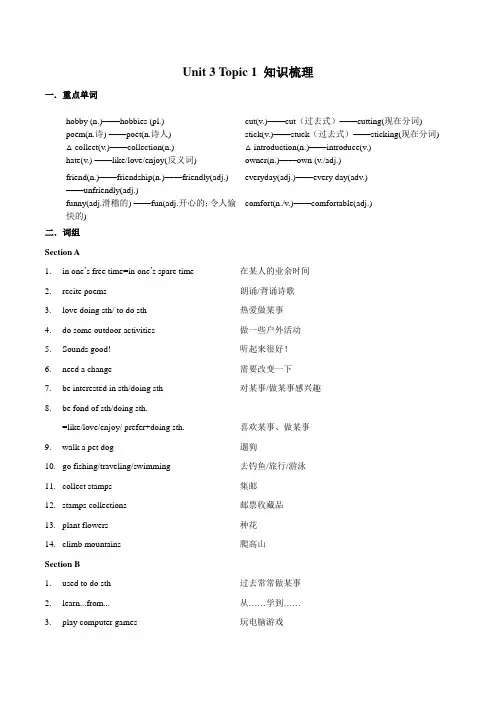
Unit 3 Topic 1 知识梳理一.重点单词二.词组Section A1. in one ’s free time=in one ’s spare time在某人的业余时间 2. recite poems朗诵/背诵诗歌 3. love doing sth/ to do sth热爱做某事 4. do some outdoor activities做一些户外活动 5. Sounds good!听起来很好! 6. need a change需要改变一下 7. be interested in sth/doing sth对某事/做某事感兴趣 8. be fond of sth/doing sth.=like/love/enjoy/ prefer+doing sth.喜欢某事、做某事 9. walk a pet dog遛狗 10. go fishing/traveling/swimming去钓鱼/旅行/游泳 11. collect stamps集邮 12. stamps collections邮票收藏品 13. plant flowers种花 14. climb mountains爬高山 Section B1. used to do sth过去常常做某事 2. learn...from...从……学到…… 3. play computer games 玩电脑游戏 hobby (n.)——hobbies (pl.)cut(v.)——cut (过去式)——cutting(现在分词) poem(n.诗) ——poet(n.诗人)stick(v.)——stuck (过去式)——sticking(现在分词) △collect(v.)——collection(n.)△introduction(n.)——introduce(v.) hate(v.) ——like/love/enjoy(反义词)owner(n.)——own (v./adj.) friend(n.)——friendship(n.)——friendly(adj.)——unfriendly(adj.)everyday(adj.)——every day(adv.) funny(adj.滑稽的) ——fun(adj.开心的;令人愉快的)comfort(n./v.)——comfortable(adj.)Section C1.more than=over 超过……以上2.△keep pictures 保存图片3.△other things they want to remember 其他他们想要记住的东西4.△funny collections 好笑的收藏,滑稽的收藏5.the world’s most stupid ideas 世界上最愚蠢的想法6.the world’s most ugly dogs 世界上最丑陋的狗7.△get started 开始8.start with 以……开始9.cut out 剪出10.need sth. to do sth. 需要某物做某事11.stick sth. to... 把某物粘贴在……上12.It’s fun to do sth. 做某事有乐趣13.△make a scrapbook 制作一本剪贴本14.share sth. with sb. 与某人分享某物Section D1.everyday pets 日常宠物2.provide sb. with sth. 提供某人某物3.=provide sth. for sb. 为某人提供某物4.△keep him in the house 把他养在房子里5.keep pets 养宠物6.take a bath=have a bath 洗澡7.in the pond 在池塘中8.whether...or not 是否……9.take sb. out for a walk 带某人出去散步10.be special to sb. 对某人很特别三.重点句子1. And I also enjoy reading stories and listening to music.我也很享受读故事和听音乐2. Why not go out and do some outdoor activities?为什么不出去做一些户外活动呢?3. Maybe I need a change.可能我需要一个改变。
精编仁爱英语八年级上册Unit3 Topic1知识点和练习(有答案)
精编仁爱英语八年级上册Unit3 Topic1知识点和练习(有答案)G8 Unit 3: Our HobbiesTopic 1: What's Your Hobby?1.What do you usually do in your free time?In one's free time。
one can XXX.2.I love reciting XXX.One can express their hobbies using verbs such as enjoy。
like。
love。
be fond of。
or be interested in。
followed by a noun。
pronoun。
or gerund.3.Why not try some outdoor activities?One XXX。
indoor activities XXX.4.Maybe I need a change.Maybe is an adverb that means "perhaps" or "possibly." May be is a verb phrase that means "might be" or "could be."5.XXX.To walk a pet dog means to take it for a walk on a leash.6.It's great fun.XXX。
One can have fun doing something that they enjoy。
XXX.XXX: What are your hobbies?Wen Wei: Well。
what's your hobby?XXX: I love dancing and I'm also a movie fan。
精编仁爱英语八年级上册Unit3 Topic1知识点和练习(有答案)
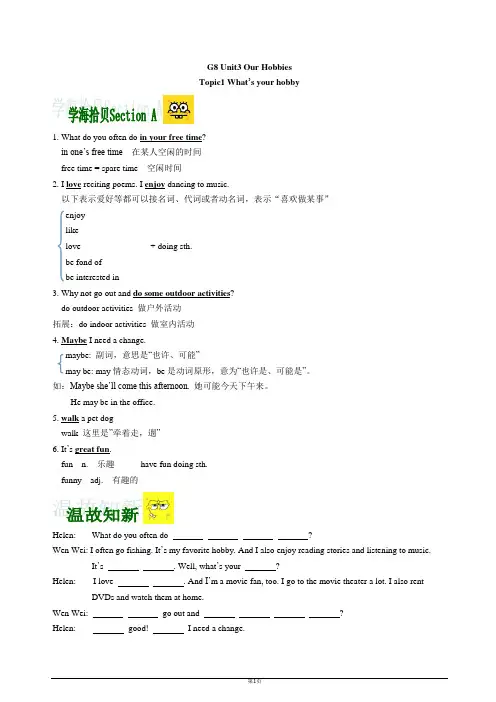
G8 Unit3 Our HobbiesTopic1 What’s your hobby1. What do you often do in your free time?in one’s free time 在某人空闲的时间free time = spare time 空闲时间2. I love reciting poems. I enjoy dancing to music.以下表示爱好等都可以接名词、代词或者动名词,表示“喜欢做某事”enjoylikelove + doing sth.be fond ofbe interested in3. Why not go out and do some outdoor activities?do outdoor activities 做户外活动拓展:do indoor activities 做室内活动4. Maybe I need a change.maybe: 副词,意思是“也许、可能”may be: may情态动词,be是动词原形,意为“也许是、可能是”。
如:Maybe she’ll come this afternoon. 她可能今天下午来。
He may be in the office.5. walk a pet dogwalk 这里是”牵着走,遛”6. It’s great fun.fun n. 乐趣have fun doing sth.funny adj. 有趣的Helen: What do you often do ?Wen Wei: I often go fishing. It’s my favorite hobby. And I also enjoy reading stories and listening to music.It’s . Well, what’s your ?Helen: I love . And I’m a movie fan, too. I go to the movie theater a lot. I also rent DVDs and watch them at home.Wen Wei: go out and ?Helen: good! I need a change.I.单项选择1. , I read books at home or travel around the country.A. In my spare timeB. On my spare timeC. At my free timeD. For my free time2. --- Hello, Sam! What’s your hobby?--- .A. I am a doctorB. I love listening to musicC. I like it very muchD. It’s interesting.3. --- What’s your hobby?--- My hobby is toys.A. collectB. collectingC. collectsD. playing.4. --- Where is Maria?--- I am not sure, she is in the school library.A. may beB. maybeC. mayD. might5. Mike enjoys stamps, not coins.A collecting B. to collect C. collected D. collects6. --- Why not fly kites with me tomorrow?--- I’m sure we’ll have a good time.A. Sounds good.B. Sounds boring.C. Sorry. I’m busy.D. Because I have no time7. What else are you of collecting?A. likeB. lovesC. fondD. enjoyed8. --- Where is my English book?--- it’s in your bag or it in your desk.A. Maybe; may beB. Maybe; maybeC. May be; maybeD. May be; may beII. 根据句意及首字母提示补全单词。
仁爱英语 八年级 Unit 2 -Unit 3 Topic 1 短语知识点
Unit 2 Topic 11.look well/ pale看起来健康/苍白的get well 变健康feel terrible 感觉糟糕的2.have a toothache/ cold/ fever/cough/ backache/ stomachachehave the fluhave sore eyes/ have a sore throat 3.go to see a doctor/ dentist去看医生/牙医4.take/ have a (good) rest 好好休息5.at night/ in the night 在夜晚in the evening 在傍晚6.drink coffee/ tea 喝咖啡/茶7.plenty of boiled water 大量开水8.lift heavy things 抬重物9.have a good sleep 好好睡觉sleep well10.should/ shouldn’t 应该/不应该had better/ had better not最好/最好不要11.have a terrible/ bad cold患重感冒12.day and night 日日夜夜13.feel like doing sth. 想要做某事want/ would like to do sth.14.lie down 躺下15.drink tea with honey喝带有蜂蜜的茶16.too much candy/ eat too much太多的糖果/吃太多too many apples 太多的苹果much too tired/ fast 太累/快17.brush teeth 刷牙18.on the Internet 在因特网上on TV/ on the phone19.take good care of 好好照顾look after… well20.worry about 担心be worried about21.nothing serious 没什么严重的22.check me/ it over 为我/它检查23.take the pills 吃药24.two pills each time 一次两片three times a day 一天三次25.Thank you for your help.谢谢帮助我。
最新仁爱版英语八年级上册Unit3 Topic1知识点 完整版
Unit3 Topic1SectionA语法:过去常常做某事used to do sth(各种句式变化)区分①used to do sth过去常常做某事②be/get used to doing sth.习惯做某事③be used to do sth.=be used for doing sth.被用来做某事例如:①I used to hate climbing hills,but now I love it.②We are used to getting up early.③Wood is used to make paper.1.在某人的空闲时间in one’s free time=in one’s spare time2.去钓鱼go fishing 去旅游go traveling3.你的爱好是什么?What’s your hobby?喜欢做某事(6个)like/love/enjoy/prefer/be fond of/be interested in doing sth.4.听音乐listen to music5.做某事是有趣的be fun to do sth.6.为什么不做某事?Why don’t you +V原=Why not +V原7.做一些户外活动do some outdoor activities8.听起来sound为系动词,后跟形容词构成系表结构。
9.需要一个改变need a change10.随着音乐跳舞dance to music11.遛狗walk a pet dog12.集邮collect stamps13.种花plant flowers 浇花water flowers14.爬山climb mountainsUnit3 Topic1 SectionB1.集邮collect stamps 邮票集stamp collection2.想要做某事would like to do sth.=want to do sth.=feel like doing sth.3.感叹句what+名词①What beautiful stamps!②What fine weather!③What a nice girl!4.许多a lot of=lots of后跟可数名词复数或不可数名词5.三种推测①肯定推测must be(必定是)②可能性推测may be(可能是)③否定推测can't be(不可能是)6.向…学习learn…from学习做某事learn to do sth.7.你过去常常有什么爱好?What hobbies did you use to have?I used to collect baseball cards.过去常常做某事used to do sth.I used to go fishing.(否定句)I didn’t use to go fishing.(一般疑问句)Did you use to go fishing?Yes,I did/No,I didn,t.8.康康来了。
初中英语 仁爱版八年级上Unit3 Topic 1重点短语句子
仁爱版八年级上重点短语句子Unit3 Topic1重点短语Some ……others /other +复数名词,一部分…另一部分Eg .Some are carrying water .Other students are sweeping the floorAnother +可数名词单数/数词+复数名词,又一/再一One…the other 一个…另一个…One is black.The other is redIn one ’s free/spare time 在某人空闲的时间Why not=why don ’t you 为什么不... (to do)Do outdoor /indoor activities 做室外/室内活动Here is your change 找你的零钱Enjoy/be fond of /be interested in/ love/ like/ prefer doing 喜欢做某事dance to music 随着音乐跳舞Walk a pet dog 遛狗May be 可能是; can be可以是;must be 应该是Learn...from... 从...学习...;learn from...从中学习…Get started 着手开始Start/begin with... 以...开始Cut out 剪下Stick...to... 把...粘贴在...Share sth to sb. 与...分享...Used to do 过去常常做某事;get/be used to doing 习惯于做某事Be used to do sth 被用来做某事It is fun to do/doing 做是很有趣的Keep warm 保暖Provide sb. with sth=provide sth. for sb. 为某人提供某物。
Whether...or not... 是否...(固定词组) Take sb. out for a walk 带某人出去散步Be special to 对...特别There used to be 某地过去曾有某物Decide to do 决定做某事In one ’s life 在某人的生命里Just...like 就像...一样Keep one ’s mind on doing 专心的做某事重点句子/交际用语1.W hat do you often do in your free time?你在业余时间经常做什么?2.It's great fun.这很有趣。
仁爱版八年级上册英语知识点汇总(完整版)
仁爱版八年级上册英语知识点汇总(完整版)Unit 1 Topic 1: English Phrases for 8th Grade1."Be going to do" means to have plans to do something.2."See sb do sth" means to XXX doing something from start to finish。
while "See sb doing sth" means to witness someone in the act of doing something.3."XXX.4."Play against" means to XXX.5."Be against" means to oppose something。
while "Be for" means to support it.6."Practice + doing" means to practice doing something.7."Prefer + doing" means to like doing something more than something else.8."Prefer + doing/n。
to doing/n." means to like doing something more than another thing.9."Prefer to do" means to choose to do something over something else.10."Quite a lot/bit" means often.11."Which" means "what kind of," while "prefer" means "like better."12."XXX," "XXX," "Take part in + activity/XXX," and "Be in + activity/XXX" all mean to participate in something.13."Know about" means to be aware of or understand something.14.In a time clause。