
牛津译林版7BUnit 1 Welcome to the unit公开课课件
1. The most famous clock in the world is
Big Ben called _________.
the UK It is in ________,the capital of__________. London
2. Red Square is in ________. Russia
the Eiffel Tower (埃菲尔铁塔)
France
Countries
Red Square (红场)
Russia
Countries
the CN Tower (加拿大国家电视塔)
Canada
Japan ___________
the USA ___________
France ___________
6.The capital of Canada is _______________. Ottawa
A: Which country is this photo from, …? B: Oh, it’s from……This is…… A: I see. Where is it? B: It’s in /near…… A: Is ……the capital of ……? B: Yes, it is. / No, it isn’t.
He is from ___________. the USA
Which country are they in?
He is from ________. Japan
Which country are they in?
He comes from ________. Russia
Which country are they in?
Canada ___________
the UK ___________
Russia ___________
Countries
Russia ___________
France ___________
the USA ___________
the UK ___________
Canada ___________
Japanese women are good at the 6. Many _________ art of making tea.
America 7. Washington DC is the capital of ________.
The capital of China is ________. Beijing
Capitals
The capital of France is ________. Paris
Capitals
The capital of Russia is ________. Moscow
Capitals
The capital of Canada is ________. Ottawa
Unit 1 Dream homes
Comic & Welcome
Free talk:
• Did you have fun during the winter holiday?
• How did you spend your holiday?
• Where did you go ?
• Did you go to some
___________
___________
Paris Capitals Washington D.C. Tokyo Moscow Ottawa London
___________
___________
___________
___________
___________
___________
Capitals
Japan ___________
Which country are they in?
He is from __________. the UK .
Which country are they in?
He is from ________. China
Which country are they in?
the football team of France
They are from ________. France
London ___________
Tokyo
Moscow Ottawa ___________ Washington D.C.
Paris ___________
___________
1.The capital of the USA is _______________. Washington DC
2.The capital of the UK is ________________. London 3.The capital of France is ________________. Paris 4.The capital of Japan is _________________. Tokyo 5.The capital of Russia is _________________. Moscow
Capitals
The capital of the UK is ________. London
Capitals
DC The capital of the USA is Washington ___________.
Capitals
The capital of Japan is ________. Tokyo
3. The president (总统) of the USA lives in
_______ห้องสมุดไป่ตู้_______. the White House It’s in _______________. Washington DC France 4. Do you like Paris, the capital of ________?
places of interest(名胜)?
Do you know any countries?
Countries
Big Ben (大本钟)
the UK
Countries
the White House (白宫)
the USA
Countries
Mount Fuji (富士山)
Japan
Countries
最新牛津译林英语7B Unit1 Welcome to the unit公开课课件

Retell the story
Eddie’s dream home
Eddie doesn’t want to live in a ______. palace to live next to a However, he would like _________
_________. ___ in Fifth restaurant He ____ likes the biggest one
It’s in Toronto, Canada.
the Big Ben 大本钟
It’s in London, the UK.
the Red Square 红场
It’s in Moscow, Russia.
the CN Tower 加拿大国家电视塔
It’s in Toronto, Canada.
B: It’s…
A: Is… the capital of…?
B: Yes, it is./no, it isn’t. the capital of…is....
知识探究1 learn about的用法
学习关于……的知识,了解…… 。 learn about意为_____________________________ 介词 ,后接名词作宾语。 about是_______ 例:I’d like to learn to something about your study. 我想了解你的学习情况。
Presentation
Countries and capitals
Mount Fuji 富士山
It’s in a town near Tokyo, Japan.
the White House 白宫
It’s in Washington D.C, the USA.
译林牛津版7BU7AbilitiesWelcometotheunit教学课件共18张PPT
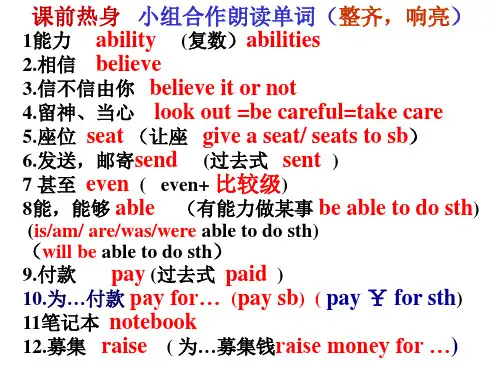
2.“清扫,打扫干净”clean up ,宾语放
中间/后面,但当宾语是“放
。
例:你必须把它打扫一下。
You must __c_le_a__n_ __i_t__ __u_p_._.
你们昨天花了多少时间清理花园? __H__o_w_ __lo_n__g_ ___d_id__ it _t_a_k__e_ you __to____ __c_l_e_a_n_ ___u_p___ the garden?
例:我们一定要小心火。
We _m__u_s_t__b_e__ _c_a_r_e_fu__l __w_i_th__ __fi_r_e_..
★“小心(不)做某事”be__ca_r_e_f_u_l_(__n_o_t_)__to__d_o__st_h_. 例:我们必须小心玩水。
We _m_u__st_b__e _c_a_r_e_fu__l _t_o_ _p_l_a_y_ w__i_th_ _w_a_t_e_r..
2.His hobby is
collecting/ to collect
(collect)
stamps.
3.We will play (plant) more trees in the park
in a year. 4.People have different abilities (ability). 5.She had an unhappy(happy) childhood (童年) .
9.他经常告诉小学生在做水上运动时要小心。
He often tells younger students to be careful when theyplay water sport。s
10.如果他通过测试我们都将很高兴。
Welcome to the unit 课件(共14张PPT,内嵌音频) 英语牛津译林版

A.What
B. How often C. Why
D. When
1. 背诵Welcome to the unit和对应单词表(包括补充的知识点) 2. 用所学句型写一篇短文,介绍自己的爱好,不少于五句话。 3. 收集一些关于爱好的名言或故事并与同学分享。
reading
playing basketball
playing the piano
gardening
What other hobbies do you know?
What do the Class 1, Grade 7 students like to do? Complete their answers with the words in the box.
What about you? Amy: I like swimming. Millie: How often do you go swimming? Amy: I go swimming every week. It helps me keep fit.
Work in pairs and talk about your hobbies. Use the conversation below as a model.
Millie Simon Sandy Daniel Kitty Amy
Reading
Playing football
Playing the piano
Science
dancing swimming
新课讲授
Pre-listening What hobbies can you see in these pict jog, paint, paper-cutting, fit.
高中-英语-牛津译林版-英语Module 1 Unit 1(Welcome to the unit)
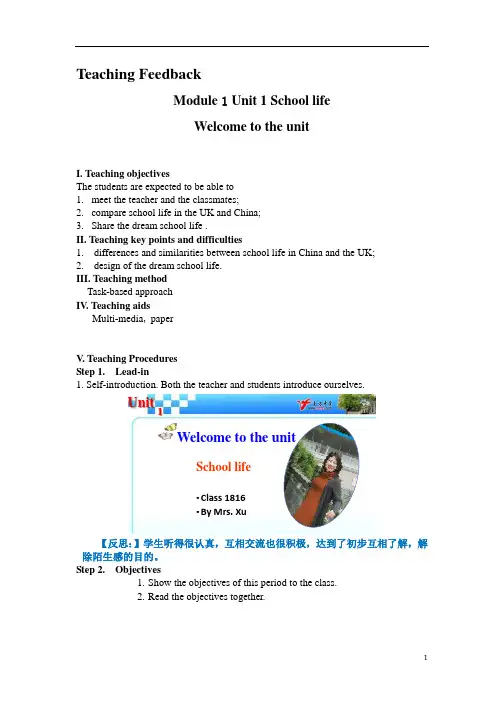
Teaching FeedbackModule 1 Unit 1 School lifeWelcome to the unitI. Teaching objectivesThe students are expected to be able to 1. meet the teacher and the classmates;2. compare school life in the UK and China;3. Share the dream school life .II. Teaching key points and difficulties1. differences and similarities between school life in China and the UK;2. design of the dream school life. III. Teaching method Task-based approach IV . Teaching aidsMulti-media , paperV . Teaching Procedures Step 1. Lead-in1. Self-introduction. Both the teacher and students introduce ourselves.Welcome to the unitUnit1School life•Class 1816•By Mrs. Xu【反思:】学生听得很认真,互相交流也很积极,达到了初步互相了解,解除陌生感的目的。
Step 2. Objectives1. Show the objectives of this period to the class.2. Read the objectives together.【反思:】目标清楚,而且这个时候已经完成了第一个目标,每个学生都知道这节课接下来要干什么。
译林版模块七Unit1Welcome to the unitppt课件

with the same letter, we look at the second
letter to decide the alphabetical order. If the
first and the second letters are the same, we
The words in a paper dictionary are arranged
in alphabetical order from ‘A’ to ‘Z’. We need
to look at the first letter of the word and use it
to search in the dictionary. If two words start
degree. ● They are developing very quickly. ● The radiation from some of the electrical or
electronic devices, such as mobile phones, may be harmful to people’s health. ● When people buy new electrical or electronic devices, they throw away the old ones. This may generate a large amount of waste, which is harmful to the environment.
mobile phone.
12
Development of audio (音响) devices
gramophone (留声机) CD player
牛津译林版7B Unit6 Welcome to the unit课件(共22张PPT)

He likes being outside, near the beautiful lakes and hills.
• Listen to the radio again then read it twice!
Task Two:
A: What outdoor activity would you like to try? B: I want to…
cycling
Daniel and Amy are talking about outdoor activities. Listen to the conversation and answer the questions.
1.What outdoor activity would
Amy like to try? She wants to go riding. 2.What does Daniel like about camping?
3.You complain too much.你抱怨得太多了。 too much 太多 用来修饰动词或不可数名词 too many 太多 用来修饰可数名词复数 much too 太,非常 用来修饰形容词或副词 too much (1)他说得太多了。He talks____ ____. too much (2)我有太多工作要做。I have___ ____work to do (3)天太热了。我想去游泳。 much____hot.I too It's____ want to go swimming. (4)你不能吃太多的桔子。 too many You can't eat____ _____oranges.
It makes you very cool. It can give you an exciting feeling. You can sit on the back of the horse.
牛津7B Unit1 Welcome to the unit课件(共25张PPT)
Simon’s cousin, Annie, is asking Simon questions about the places in Part A. Listen and answer the questions. 1. What country are they talking about? They’re talking about Japan. 2. What’s in the photo?
3. There is a big tree ______ my house. A. in B. in the front of C. in front of D. on
4. The driver wanted his car ______ near the roadside but
was asked by the police not to.
我想和你一起去看电影。
2) would you like…?用来委婉地征求对方的意见
或劝诱多方做某事,肯定回答Yes, please.或Yes, I’d love to.否定回答No, thanks.或Sorry, I can’t.
例:—Would you like to go swimming with me? —Sorry, I can’t. I have to look after my sister. 想要某人做某事 。 3) would like sb to do sth.意为_______________ 例:I would like you to meet my parents.
牛津译林版高中英语Module 10 Unit 1 Welcome to the unit教学课件
Picture 3 1. What has happened to the village? --- It has become a city. With the development of society, many villages have changed a lot over the years. Tall building have been built and motorways and bridges have been constructed. The living conditions of local people have been greatly improved. Small villages have been developed into towns or cities.
I do not think giving food and money to poor people will solve all their problems. Food aid is merely a short-term solution to a long –term problem. Giving food and money will probably solve the immediate problem of hunger and food shortages, yet food has been eaten and the money has been used up. There are many causes of poverty. In order to solve the problem, we need to identify what causes poverty and then try to combat it.
牛津译林版9A unit1 Welcome to the unit (共33张PPT)
• all day long
Complete the sentences.
1.Suzy keeps her things in good order so she
is well __o_rg_a_n_i_z_e_d___(有条理的). 2.They usuallys_ห้องสมุดไป่ตู้_a_re_____(分享)their joy with
Hobo shows Eddie an interesting article about pe_r_s_o1n_al_it_y__. Eddie would like to have a ll_o_o2k__. The article sa_y_s3__ that if people are gg_en_e_r4o_u_s_, it will mm_a_k5e__ them feel good to share things with others. Then Eddie says he is generous. And Hobo begins to ee_a_t 6__ Eddie’s breakfast. After a ww_h_il7e__, Eddie finds Hobo has ea_t_e8n___ up his breakfast. But Hobo thinks that it would make Eddie feel gg_o_o9d__. In fact, Eddie is an_g_r1y0__.
Neither my parents nor I think I can make a good accountant.
neither … nor … “既不……也不……”,具有否定 含义。 e.g.水既不太热也不太冷。
牛津译林版英语ModuleUnitWelcometotheunit优秀课件
牛津译林版英语 Module 1 Unit 1(Welcome to the unit)(共25张PPT)
What about school lives in other countries? Do you know?
牛津译林版英语 Module 1 Unit 1(Welcome to the unit)(共25张PPT)
Fill in the blanks according to what we discussed just now.
牛津译林版英语MoMdoudluelUeni1tWUenlictome1t(o tWheelucnoimet优t秀o pthpet课u件nit)(共25张PPT)
牛津译林版英语MoMdoudluelUeni1tWUenlictome1t(o tWheelucnoimet优t秀o pthpet课u件nit)(共25张PPT)
牛津译林版英语MoMdoudluelUeni1tWUenlictome1t(o tWheelucnoimet优t秀o pthpet课u件nit)(共25张PPT)
Make
a
summary.
Differences
In UK
campus& Huge campus; building Low buildings
In the UK
In China
small class sizes Large numbers of students
In the UK, there is usually a large classroom with a few students in it, who sit face to face in two lines. The students are encouraged to participate in various classroom activities. In China, we always have a full classroom with students sitting in several lines facing the blackboard and in most cases, students are not so eager to answer the teachers’ questions, especially high middle school students. 牛津译林版英语MoMdoudluelUeni1tWUenlictome1t(otWheelucnoimet优t秀o pthpet课u件nit)(共25张PPT)